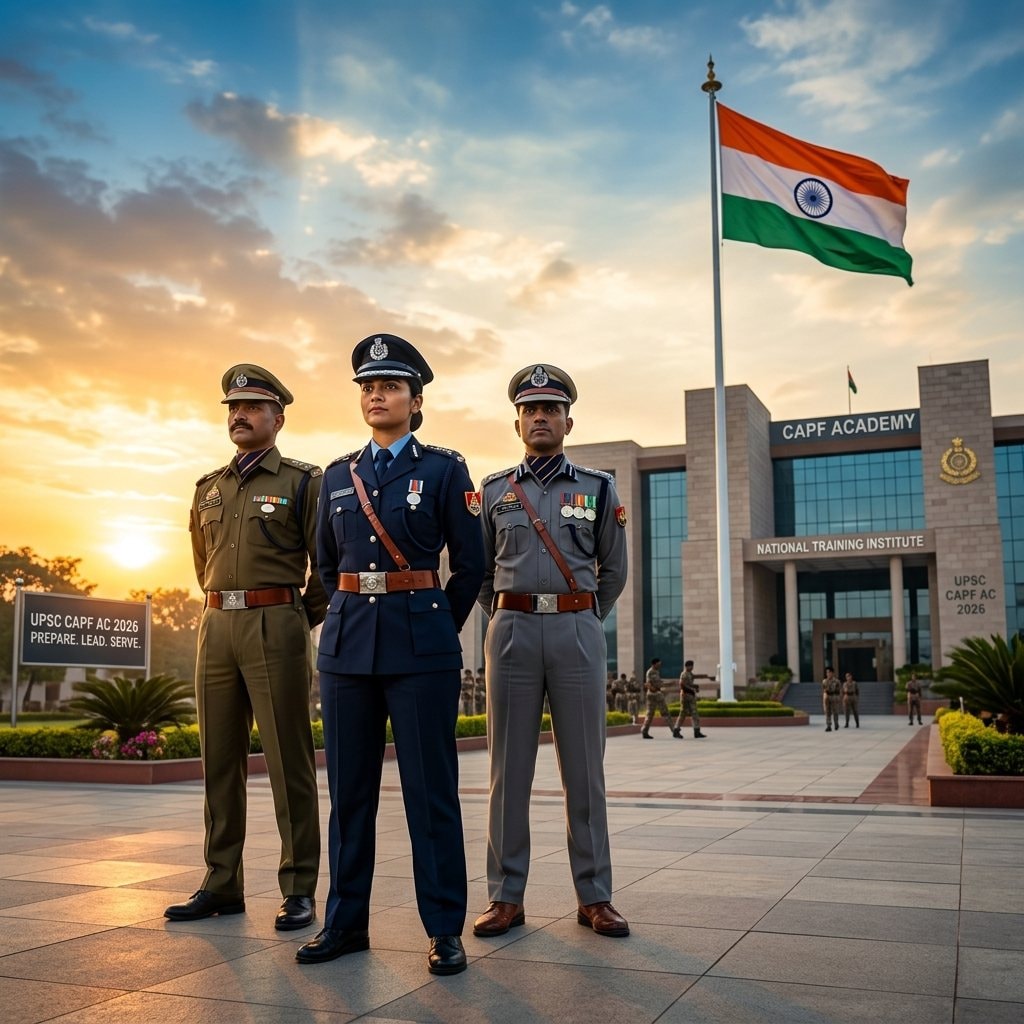
Introduction: Your Gateway to Leadership in Central Armed Police Forces
The UPSC Central Armed Police Forces Assistant Commandant (CAPF AC) 2026 examination is one of the most prestigious opportunities to join India's elite paramilitary forces as a gazetted officer. With approximately 300-400 vacancies across five major forces � CRPF, BSF, CISF, ITBP, and SSB � this exam offers a unique blend of leadership, adventure, and service to the nation.
Quick Navigation: Important Dates | Eligibility | Exam Pattern | Syllabus | Physical Standards | Preparation Strategy | Salary | FAQs
Unlike SSC CPO which recruits Sub-Inspectors, UPSC CAPF AC directly recruits you as an Assistant Commandant (Group A Gazetted Officer) � equivalent to Deputy Superintendent of Police in state police. This is a leadership position from day one with excellent career growth prospects.
Why Choose UPSC CAPF AC?
- Direct Gazetted Officer Entry: Start as Assistant Commandant (Group A)
- Attractive Salary: ?56,100 - ?1,77,500 (Level 10, 7th Pay Commission)
- Fast Career Growth: Promotion to Commandant, DIG, IG levels
- Job Security: Permanent central government position
- Adventure & Action: Field postings, operations, VIP security
- Respect & Authority: Gazetted officer status from day one
- Additional Benefits: DA, HRA, Risk Allowance, Medical, Pension
- Pan-India Posting: Opportunity to serve across India
UPSC CAPF AC 2026 at a Glance
| Parameter | Details |
|---|---|
| Conducting Body | Union Public Service Commission (UPSC) |
| Exam Name | Central Armed Police Forces (Assistant Commandants) Examination |
| Frequency | Once a year |
| Expected Vacancies | 300-400 (varies yearly) |
| Forces Covered | CRPF, BSF, CISF, ITBP, SSB |
| Post | Assistant Commandant (Group A Gazetted) |
| Age Limit | 20-25 years (relaxation for reserved categories) |
| Educational Qualification | Bachelor's Degree (any stream) |
| Selection Process | Written Exam ? Physical Test ? Interview |
| Official Website | upsc.gov.in |
UPSC CAPF AC 2026 Important Dates
Official Notification: UPSC releases the CAPF AC notification in August every year.
| Event | Expected Date | Status |
|---|---|---|
| Official Notification Release | August 7, 2026 | Awaited |
| Online Application Start | August 7, 2026 | Awaited |
| Last Date to Apply | September 3, 2026 (6:00 PM) | Awaited |
| Last Date for Fee Payment | September 3, 2026 (6:00 PM) | Awaited |
| Application Withdrawal Window | September 10-16, 2026 | Awaited |
| Admit Card Release (Paper I) | November 20, 2026 | Awaited |
| Paper I (Written Exam) | December 13, 2026 (Sunday) | Awaited |
| Paper I Result | January 15, 2027 | Awaited |
| Admit Card Release (Paper II) | February 10, 2027 | Awaited |
| Paper II (Written Exam) | March 7, 2027 | Awaited |
| Written Exam Result | April 20, 2027 | Awaited |
| Physical Efficiency Test (PET) | May-July 2027 | Awaited |
| Medical Examination | June-August 2027 | Awaited |
| Interview/Personality Test | August-October 2027 | Awaited |
| Final Result Declaration | December 2027 | Awaited |
Important Notes:
- Dates are tentative based on previous year patterns
- Official dates will be announced on UPSC Official Website
- Set reminders for application deadlines
- Keep all documents ready before applying
Stay Updated:
- UPSC Official Website - Primary source
- UPSC Twitter - Quick updates
- Subscribe to our notifications - Get instant alerts
Eligibility Criteria
Educational Qualification
Minimum Requirement:
- Bachelor's Degree from a recognized university (any stream)
- Final year students can also apply (degree must be completed before interview)
- Percentage/CGPA: No minimum marks required
- Distance/Open University: Degrees from UGC-recognized universities accepted
Special Cases:
- Professional degrees (MBBS, Engineering, CA, etc.) are valid
- Candidates with equivalent qualifications from foreign universities (approved by AIU) can apply
- Those who have appeared for final year exams but results are awaited can apply
Age Limit (As on August 1, 2026)
| Category | Minimum Age | Maximum Age | Age Relaxation |
|---|---|---|---|
| General/EWS | 20 years | 25 years | - |
| OBC | 20 years | 28 years | 3 years |
| SC/ST | 20 years | 30 years | 5 years |
| Ex-Servicemen | 20 years | 28 years | 3 years (after deduction of military service) |
| Defence Personnel (Disabled) | 20 years | 28 years | 3 years |
Age Calculation:
- If you are born on August 2, 2001, you are eligible (25 years on August 1, 2026)
- If you are born on August 1, 2001, you are eligible (exactly 25 years)
- If you are born on July 31, 2001, you are NOT eligible (25 years + 1 day)
Nationality Requirements
Candidates must be:
- A citizen of India, OR
- A subject of Nepal, OR
- A subject of Bhutan, OR
- A Tibetan refugee (came to India before January 1, 1962), OR
- A person of Indian origin migrated from Pakistan, Burma, Sri Lanka, East African countries with intention to permanently settle in India
Note: Candidates in categories (2), (3), (4), and (5) must have a certificate of eligibility issued by the Government of India.
Number of Attempts
No limit on the number of attempts. You can apply as many times as you want until you reach the maximum age limit.
Physical Standards
For Male Candidates:
- Height: Minimum 165 cm (157.5 cm for ST candidates, 160 cm for NE states)
- Chest: 80 cm (unexpanded), 85 cm (expanded) - 5 cm expansion required
- Weight: Proportionate to height and age
For Female Candidates:
- Height: Minimum 157 cm (150 cm for ST candidates, 152 cm for NE states)
- Weight: Proportionate to height and age
Vision Standards:
- Distant Vision: 6/6 in one eye, 6/9 in other (without correction)
- Near Vision: 0.6 in one eye, 0.8 in other (Jaeger's Type)
- Colour Vision: Must be able to distinguish primary colours
- Binocular Vision: Required
Note: Candidates wearing spectacles are NOT eligible. Refractive surgery (LASIK) is also NOT acceptable.
Exam Pattern
UPSC CAPF AC exam is conducted in 3 stages: Written Exam (Paper I & II), Physical Efficiency Test (PET) & Medical Examination, and Interview/Personality Test.
Stage 1: Written Examination
Paper I: General Ability and Intelligence
Exam Mode: Offline (OMR-based)
Duration: 2 hours
Total Marks: 250 marks
Negative Marking: Yes (1/3rd penalty for wrong answers)
Qualifying Nature: Yes (marks counted for final merit)
Subject-wise Distribution:
| Section | Topics | Marks |
|---|---|---|
| General Mental Ability | Logical reasoning, analogies, series, coding-decoding | 50 |
| General Studies | Current affairs, history, geography, polity, economy | 100 |
| General Science | Physics, chemistry, biology (Class X level) | 50 |
| Quantitative Aptitude | Arithmetic, algebra, geometry (Class X level) | 50 |
| Total | 250 |
Important Points:
- Questions asked in English and Hindi (bilingual)
- Each question carries 2.5 marks
- 0.83 marks deducted for wrong answer (1/3rd penalty)
- No marks deducted for unattempted questions
- Minimum qualifying marks: 33% (82.5 marks out of 250)
Paper II: General Studies, Essay and Comprehension
Exam Mode: Offline (Descriptive - Pen & Paper)
Duration: 3 hours
Total Marks: 200 marks
Qualifying Nature: Yes (marks counted for final merit)
Language: English or Hindi (candidate's choice)
Paper Structure:
| Component | Marks | Word Limit |
|---|---|---|
| Essay Writing | 60 marks | 600-700 words |
| Comprehension | 60 marks | 2-3 passages |
| Precis Writing | 40 marks | 1/3rd of original |
| Communication Skills | 40 marks | Letter/Report writing |
| Total | 200 marks | - |
Topics for Essay:
- National and international importance
- Social, economic, and political issues
- Science and technology
- Environmental issues
- Internal security and defence
Evaluation Criteria:
- Content quality and relevance
- Logical presentation and coherence
- Grammar and vocabulary
- Sentence structure
- Adherence to word limit
Important Points:
- Must score minimum 33 marks out of 200 to qualify
- Marks counted for final merit (unlike UPSC CSE Tier-III)
- Can write in English or Hindi (your choice)
- Handwriting and presentation matter
Stage 2: Physical Efficiency Test (PET) & Medical Examination
Qualifying Nature: Yes (only qualifying, no marks)
Conducted for: Candidates who qualify Written Exam
Physical Efficiency Test (PET)
For Male Candidates:
| Event | Standard |
|---|---|
| 100 meters race | 16 seconds |
| 800 meters race | 3 minutes 45 seconds |
| Long Jump | 3.65 meters (3 chances) |
| High Jump | 1.20 meters (3 chances) |
For Female Candidates:
| Event | Standard |
|---|---|
| 100 meters race | 18 seconds |
| 800 meters race | 4 minutes 45 seconds |
| Long Jump | 2.70 meters (3 chances) |
| High Jump | 0.90 meters (3 chances) |
Important Notes:
- All events are compulsory
- Must qualify in all four events
- Failure in any one event = disqualification
- No second chance in same recruitment cycle
- Conducted at designated centers across India
Medical Examination
Comprehensive medical test including:
- General physical examination
- Vision test (without spectacles)
- Hearing test
- Blood pressure and heart examination
- X-ray (chest)
- Blood and urine tests
- Dental examination
- Psychological assessment
Disqualifying Conditions:
- Poor eyesight (below prescribed standards)
- Colour blindness
- Flat feet
- Knock knees
- Varicose veins
- Hydrocele
- Piles
- Any chronic disease
Stage 3: Interview/Personality Test
Mode: Face-to-face interview with UPSC Board
Duration: 30-45 minutes (varies)
Marks: 150 marks
Board Members: 4-5 members including Chairman
Nature: Personality assessment, leadership qualities
What is Evaluated:
- Mental alertness and critical thinking
- Leadership qualities and decision-making
- Communication skills and confidence
- Knowledge of current affairs
- Awareness about CAPF and internal security
- Physical fitness and bearing
- Motivation for joining paramilitary forces
Interview Process:
- Entry: Candidate enters the room, greets the board
- Introduction: Brief self-introduction
- Educational Background: Questions on your degree/subjects
- Current Affairs: National and international events
- CAPF Knowledge: About forces, operations, challenges
- Situation-based Questions: Ethical dilemmas, problem-solving
- Hobbies & Interests: Discussion on personal interests
- Conclusion: Candidate thanks the board and exits
Final Merit Calculation:
Final Score = Paper I (250) + Paper II (200) + Interview (150)
Total = 600 marks
Important: PET and Medical are only qualifying. Only Written Exam + Interview marks determine your final rank.
Complete Syllabus
Paper I: General Ability and Intelligence (250 Marks)
1. General Mental Ability (50 Marks)
Verbal Reasoning:
- Analogies (Word, Letter, Number)
- Classification
- Series Completion
- Coding-Decoding
- Blood Relations
- Direction Sense Test
- Ranking and Arrangement
- Syllogism
- Statement and Conclusions
Non-Verbal Reasoning:
- Figure Classification
- Figure Series
- Figure Analogy
- Paper Folding and Cutting
- Mirror Images
- Embedded Figures
- Counting of Figures
Analytical Reasoning:
- Seating Arrangement
- Puzzle Test
- Data Sufficiency
- Critical Reasoning
2. General Studies (100 Marks)
Current Affairs (Last 6 Months):
- National and International Events
- Government Schemes and Policies
- Important Days and Dates
- Awards and Honors
- Sports Events
- Science and Technology News
- Economic Developments
- Internal Security Issues
Indian History:
- Ancient India (Indus Valley, Vedic Period, Mauryas, Guptas)
- Medieval India (Delhi Sultanate, Mughals)
- Modern India (British Rule, Freedom Struggle)
- Post-Independence India
Indian Geography:
- Physical Geography (Mountains, Rivers, Climate)
- Economic Geography (Agriculture, Industries, Resources)
- Indian States and Capitals
- Important Places and Landmarks
Indian Polity:
- Indian Constitution (Features, Amendments)
- Fundamental Rights and Duties
- Directive Principles of State Policy
- Union and State Government
- Parliament and Judiciary
- Local Government
- Constitutional Bodies
Indian Economy:
- Basic Economic Concepts
- Five Year Plans
- Budget and Taxation
- Banking System
- Inflation and GDP
- Economic Reforms
- Government Schemes
World Geography:
- Continents and Oceans
- Climate and Vegetation
- Natural Resources
- Important Countries and Capitals
3. General Science (50 Marks)
Physics:
- Motion, Force, and Energy
- Light and Sound
- Electricity and Magnetism
- Heat and Temperature
- Modern Physics basics
Chemistry:
- Elements and Compounds
- Acids, Bases, and Salts
- Metals and Non-metals
- Chemical Reactions
- Everyday Chemistry
Biology:
- Cell Structure
- Human Body Systems
- Diseases and Immunity
- Nutrition and Health
- Genetics basics
- Environmental Science
4. Quantitative Aptitude (50 Marks)
Arithmetic:
- Number System
- HCF and LCM
- Percentage
- Ratio and Proportion
- Average
- Simple and Compound Interest
- Profit and Loss
- Discount
- Time and Work
- Time, Speed and Distance
Algebra:
- Linear Equations
- Quadratic Equations
- Algebraic Identities
Geometry:
- Lines and Angles
- Triangles
- Circles
- Quadrilaterals
- Mensuration (Area and Volume)
Data Interpretation:
- Tables
- Bar Graphs
- Line Graphs
- Pie Charts
Paper II: General Studies, Essay and Comprehension (200 Marks)
1. Essay Writing (60 Marks)
Common Essay Topics:
- National Security and Defence
- Internal Security Challenges
- Terrorism and Naxalism
- Border Management
- Role of Paramilitary Forces
- Women in Police Forces
- Technology in Policing
- Police Reforms
- Human Rights and Police
- Disaster Management
- Cyber Security
- Drug Trafficking
- Social Issues (Corruption, Poverty, Education)
- Environmental Issues
- Science and Technology
Essay Structure:
- Introduction (100-150 words)
- Body (400-450 words with 3-4 paragraphs)
- Conclusion (100-150 words)
- Total: 600-700 words
2. Comprehension (60 Marks)
Types of Passages:
- Social and economic issues
- Science and technology
- Environment and ecology
- National security
- International relations
- Historical events
- Literary passages
Question Types:
- Main idea and theme
- Inference questions
- Vocabulary in context
- Author's tone and purpose
- Fact vs Opinion
- Critical analysis
3. Precis Writing (40 Marks)
What is Precis:
- Summary of a passage in 1/3rd of original length
- Must retain main ideas
- Written in your own words
- No personal opinions
Evaluation Criteria:
- Accuracy of content
- Brevity and clarity
- Grammar and vocabulary
- Coherence
4. Communication Skills (40 Marks)
Letter Writing:
- Official letters
- Application letters
- Complaint letters
- Request letters
Report Writing:
- Incident reports
- Investigation reports
- Event reports
- Analytical reports
Evaluation Criteria:
- Format and structure
- Content relevance
- Language proficiency
- Clarity of expression
Preparation Strategy
6-Month Preparation Plan
Month 1-2: Foundation Building
Daily Schedule (8-9 hours):
- Morning (6:00 AM - 9:00 AM): General Studies (History, Geography, Polity)
- Mid-Morning (9:30 AM - 12:30 PM): Quantitative Aptitude + Reasoning
- Afternoon (2:00 PM - 4:00 PM): Current Affairs (Newspaper + Magazine)
- Evening (5:00 PM - 8:00 PM): General Science + Revision
- Night (9:00 PM - 10:00 PM): Essay reading + English practice
Weekly Tasks:
- Complete 2-3 NCERT books
- Solve 200 MCQs (Paper I topics)
- Read newspaper daily
- Write 1 essay per week
- Practice 1 comprehension passage daily
Books to Complete:
- NCERT History (Class 6-12)
- NCERT Geography (Class 6-12)
- NCERT Polity (Class 11-12)
- NCERT Science (Class 6-10)
Month 3-4: Advanced Preparation
Daily Schedule (9-10 hours):
- Morning (6:00 AM - 9:00 AM): Paper I practice (100 MCQs)
- Mid-Morning (9:30 AM - 12:30 PM): Paper II practice (Essay + Comprehension)
- Afternoon (2:00 PM - 4:00 PM): Current Affairs compilation
- Evening (4:30 PM - 7:30 PM): Standard books reading
- Night (8:00 PM - 10:00 PM): Revision + Mock tests
Weekly Tasks:
- Solve 3 previous year papers
- Write 3 essays
- Practice 5 comprehension passages
- Solve 500 MCQs
- Update current affairs notes
Books to Complete:
- Indian Polity by M. Laxmikanth
- Indian Economy by Ramesh Singh
- Certificate Physical and Human Geography (G.C. Leong)
- Spectrum Modern India
- Lucent's General Science
Month 5: Intensive Practice
Daily Schedule (10-11 hours):
- Morning (9:00 AM - 12:00 PM): Full-length Paper I mock test
- Afternoon (2:00 PM - 5:00 PM): Mock test analysis + weak area practice
- Evening (5:30 PM - 8:30 PM): Paper II practice (Essay + Precis + Letter)
- Night (9:00 PM - 11:00 PM): Current affairs + Revision
Weekly Tasks:
- Attempt 5 full-length Paper I tests
- Write 5 essays
- Practice 10 comprehension passages
- Solve 10 previous year papers
- Revise all subjects once
Month 6: Final Revision & Mock Tests
Daily Schedule (11-12 hours):
- Morning (9:00 AM - 12:00 PM): Full-length mock test (Paper I)
- Afternoon (2:00 PM - 5:00 PM): Paper II practice
- Evening (5:30 PM - 8:30 PM): Quick revision (all subjects)
- Night (9:00 PM - 11:00 PM): Current affairs + Formula revision
Weekly Tasks:
- Attempt 7 full-length tests
- Write 7 essays
- Revise entire syllabus twice
- Update current affairs (last 6 months)
- Practice OMR filling
Last 15 Days Before Exam:
- Reduce study hours (7-8 hours)
- Focus on revision only (no new topics)
- Solve previous year papers
- Revise current affairs thoroughly
- Practice OMR filling speed
- Stay healthy and confident
Subject-wise Preparation Tips
General Studies
Current Affairs:
- Read The Hindu or Indian Express daily
- Make monthly current affairs notes
- Focus on: Government schemes, International relations, Awards, Sports
- Use apps: Jagran Josh, Affairs Cloud, GK Today
History:
- Start with NCERT (Class 6-12)
- Focus on: Freedom struggle, Important movements, Leaders
- Make timeline charts
- Revise regularly
Geography:
- Use maps extensively
- Focus on: Indian geography, World geography basics
- Learn important rivers, mountains, states
- Practice map-based questions
Polity:
- Read Laxmikanth thoroughly
- Focus on: Constitution, Fundamental Rights, DPSP, Parliament, Judiciary
- Make notes of important articles
- Revise amendments
Economy:
- Read NCERT Class 9-12
- Focus on: Budget, Banking, Economic terms, Government schemes
- Read Economic Survey (relevant chapters)
- Follow business news
Quantitative Aptitude & Reasoning
Strategy:
- Learn all formulas and shortcuts
- Practice mental calculations
- Solve 50+ questions daily
- Focus on accuracy first, then speed
- Learn Vedic Math tricks
- Practice previous year papers
Important Topics:
- Percentage, Ratio, Average (high weightage)
- Time and Work, Time-Speed-Distance
- Profit and Loss, Simple Interest
- Data Interpretation
- Syllogism, Coding-Decoding
- Blood Relations, Seating Arrangement
Essay Writing
Preparation Strategy:
- Read 2-3 quality essays daily
- Write 2-3 essays per week
- Focus on: National security, Internal security, Social issues
- Use facts, data, and examples
- Practice within time limit (45 minutes)
- Get feedback from mentors
Essay Structure:
- Introduction: Hook + Context + Thesis
- Body: 3-4 paragraphs with arguments, examples, data
- Conclusion: Summary + Way forward + Impactful statement
Comprehension & Precis
Preparation Strategy:
- Read English newspapers daily
- Practice 2-3 passages daily
- Focus on: Main idea, Inference, Vocabulary
- Time yourself (7-8 minutes per passage)
- Practice precis writing (1/3rd rule)
- Improve vocabulary (learn 20 words daily)
Physical Fitness Preparation
Start 6 Months Before Exam:
Daily Routine:
- Morning (5:30 AM - 7:00 AM):
- Warm-up: 10 minutes
- 100m sprint practice: 10 repetitions
- 800m run: 3 rounds
- Long jump practice: 20 attempts
- High jump practice: 20 attempts
- Cool down: 10 minutes
Weekly Schedule:
- Monday: Speed training (100m focus)
- Tuesday: Endurance training (800m focus)
- Wednesday: Jump training (Long + High)
- Thursday: Speed + Endurance
- Friday: Jump training
- Saturday: Full practice (all events)
- Sunday: Rest + Light jogging
Diet:
- High protein diet (eggs, chicken, fish, dal)
- Complex carbs (brown rice, oats, whole wheat)
- Fruits and vegetables
- Adequate water (3-4 liters daily)
- Avoid junk food and cold drinks
Important Tips:
- Start slow, gradually increase intensity
- Wear proper running shoes
- Practice on track (not road)
- Get proper rest (7-8 hours sleep)
- Avoid injuries (warm-up is must)
Salary Structure
Assistant Commandant Salary (7th Pay Commission)
| Component | Amount |
|---|---|
| Pay Level | Level 10 |
| Basic Pay | ?56,100 - ?1,77,500 |
| DA (Dearness Allowance) | 50% of Basic (?28,050) |
| HRA (House Rent Allowance) | 24-27% of Basic (?13,464 - ?15,147) |
| Transport Allowance | ?3,600 - ?7,200 |
| Risk Allowance | ?4,200 |
| Kit Maintenance Allowance | ?1,000 |
| Washing Allowance | ?500 |
| Total In-Hand (Approx) | ?1,05,000 - ?1,15,000/month |
Additional Benefits
Accommodation:
- Free government accommodation (Type III/IV quarters)
- Or HRA if accommodation not provided
Medical Facilities:
- Free medical treatment for self and family
- CGHS coverage
- Cashless treatment at empanelled hospitals
Leave:
- 30 days Earned Leave (EL) per year
- 8 days Casual Leave (CL) per year
- 20 days Half Pay Leave (HPL) per year
- Maternity/Paternity leave as per rules
Other Benefits:
- LTC (Leave Travel Concession) - twice in 4 years
- Children Education Allowance - ?2,250/child/month (max 2 children)
- Hostel Subsidy - ?6,750/child/month
- New Pension Scheme (NPS) with government contribution
- Group Insurance Scheme
- Canteen facilities
- Sports and recreation facilities
Career Progression
| Rank | Pay Level | Years of Service | Salary Range |
|---|---|---|---|
| Assistant Commandant | Level 10 | 0-5 years | ?56,100 - ?1,77,500 |
| Deputy Commandant | Level 11 | 5-10 years | ?67,700 - ?2,08,700 |
| Commandant | Level 12 | 10-15 years | ?78,800 - ?2,09,200 |
| Deputy Inspector General (DIG) | Level 13 | 15-20 years | ?1,18,500 - ?2,14,100 |
| Inspector General (IG) | Level 14 | 20-25 years | ?1,44,200 - ?2,18,200 |
| Additional Director General (ADG) | Level 15 | 25-30 years | ?1,82,200 - ?2,24,100 |
| Director General (DG) | Level 16 | 30+ years | ?2,25,000 (Fixed) |
Note: Promotions are based on seniority-cum-merit and departmental exams.
Frequently Asked Questions
Q1: Can I apply for UPSC CAPF AC if I wear spectacles?
A: No, candidates wearing spectacles are NOT eligible. Vision must be 6/6 and 6/9 without correction. LASIK surgery is also not acceptable.
Q2: What is the difference between SSC CPO and UPSC CAPF AC?
A: SSC CPO recruits Sub-Inspectors (Group B), while UPSC CAPF AC recruits Assistant Commandants (Group A Gazetted Officers). CAPF AC is a higher position with better salary and faster career growth.
Q3: Can female candidates apply for UPSC CAPF AC?
A: Yes, female candidates can apply for all five forces (CRPF, BSF, CISF, ITBP, SSB). Physical standards are different for women.
Q4: Is there any interview coaching required?
A: While not mandatory, interview coaching can help. Focus on current affairs, CAPF knowledge, and personality development.
Q5: What happens if I fail in PET?
A: If you fail in any one event of PET, you will be disqualified. You can apply again in the next year's exam.
Q6: Can I choose my preferred force?
A: Yes, you can indicate your preference during application. Final allotment is based on your rank and availability of vacancies.
Q7: What is the training period for Assistant Commandant?
A: Training is for 1 year at respective force training academies (e.g., CRPF Academy, Gurugram for CRPF).
Q8: Is there any bond after training?
A: Yes, there is usually a bond of 3-5 years. If you resign before completing the bond period, you may have to pay penalty.
Q9: Can I prepare for UPSC CSE and CAPF AC simultaneously?
A: Yes, both exams have overlapping syllabus (especially Paper I). Many candidates prepare for both together.
Q10: What is the success rate of UPSC CAPF AC?
A: Approximately 0.5-1% (1 out of 100-200 candidates). With proper preparation, your chances improve significantly.
Best Books for UPSC CAPF AC 2026
For Paper I
General Studies:
- NCERT Books (Class 6-12) - History, Geography, Polity, Science
- Indian Polity by M. Laxmikanth
- Indian Economy by Ramesh Singh
- Certificate Physical and Human Geography by G.C. Leong
- Spectrum Modern India by Rajiv Ahir
- Lucent's General Science
Current Affairs:
- The Hindu/Indian Express (Daily newspaper)
- Pratiyogita Darpan (Monthly magazine)
- Manorama Yearbook 2026
- Chronicle IAS Academy Current Affairs
Quantitative Aptitude & Reasoning:
- Quantitative Aptitude by R.S. Aggarwal
- A Modern Approach to Verbal & Non-Verbal Reasoning by R.S. Aggarwal
- Fast Track Objective Arithmetic by Rajesh Verma
For Paper II
Essay & Comprehension:
- Essays for Civil Services Examination by Pulkit Khare
- Descriptive English by S.P. Bakshi
- Word Power Made Easy by Norman Lewis
- High School English Grammar by Wren & Martin
Previous Year Papers:
- UPSC CAPF AC Previous 10 Years Solved Papers
- Arihant CAPF AC Guide
Important Resources & Links
Official Websites:
- UPSC Official Website - Notifications and results
- CRPF Official - Force information
- BSF Official - Force information
- CISF Official - Force information
- ITBP Official - Force information
- SSB Official - Force information
Useful Apps:
- UPSC Official App
- GK Today
- Jagran Josh
- Affairs Cloud
- Unacademy
- BYJU's Exam Prep
YouTube Channels:
- Study IQ Education
- Unacademy UPSC
- Adda247
- Gradeup
Conclusion
UPSC CAPF AC 2026 is an excellent opportunity to serve the nation as a gazetted officer in India's elite paramilitary forces. With proper preparation, dedication, and physical fitness, you can crack this exam and build a prestigious career.
Key Takeaways:
- Start preparation 6 months before exam
- Focus equally on Paper I and Paper II
- Maintain physical fitness from day one
- Read newspaper daily for current affairs
- Practice essay writing regularly
- Solve previous year papers
- Stay motivated and consistent
Apply on time, prepare thoroughly, and become an Assistant Commandant!
Stay Updated
Last Updated: January 30, 2026
Lead from the front, serve the nation with pride!