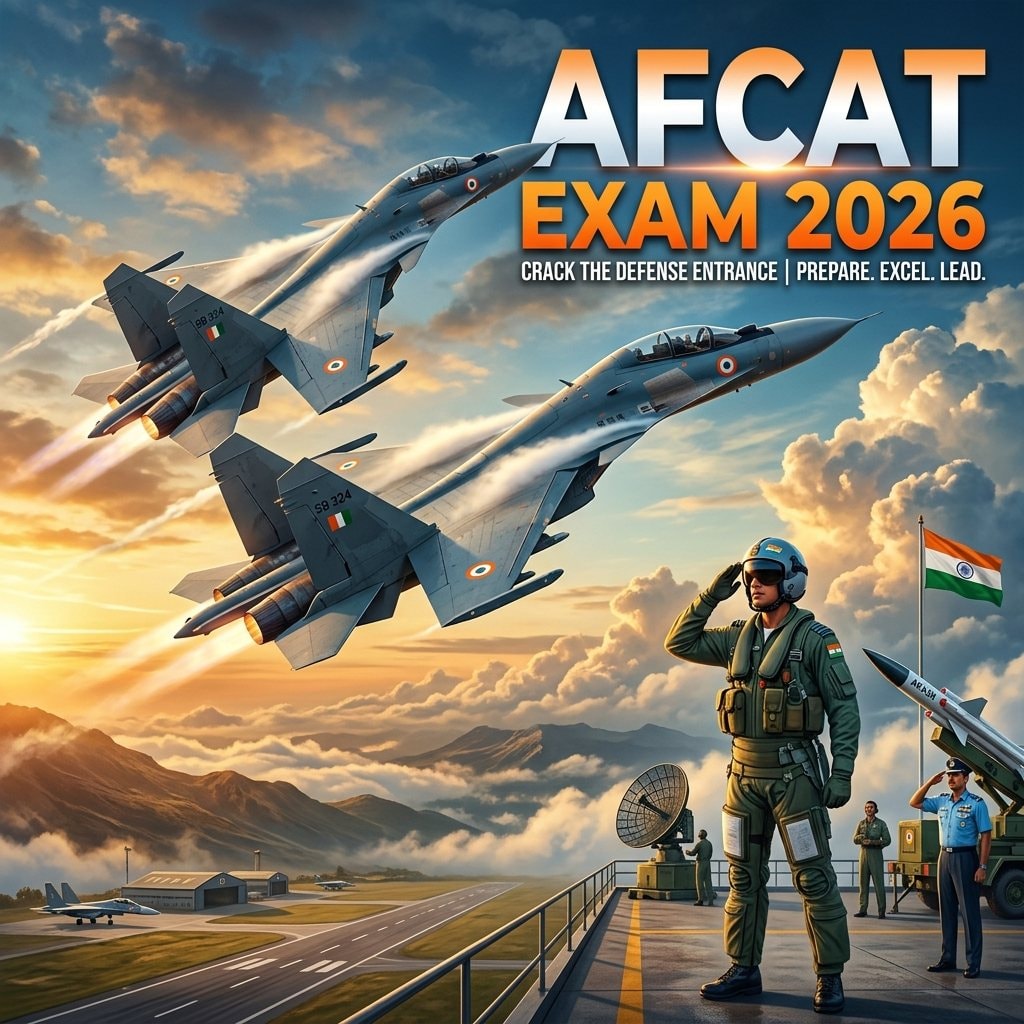
Introduction: Fly High with Indian Air Force
The Air Force Common Admission Test (AFCAT) 2026 is conducted by Indian Air Force for recruitment of officers in Flying, Technical, and Ground Duty branches. With approximately 300-400 vacancies twice a year, AFCAT offers an opportunity to serve the nation and fly high.
Why AFCAT?
- Serve the Nation: Join Indian Air Force
- Attractive Salary: ?56,100 - ?1,77,500/month
- Flying Opportunity: Become a pilot
- Job Security: Permanent commission
- Prestige: Respected position
AFCAT 2026 at a Glance
| Parameter | Details |
|---|---|
| Conducting Body | Indian Air Force |
| Frequency | Twice a year |
| Vacancies | 300-400 per cycle |
| Age Limit | 20-24 years (Flying), 20-26 years (Technical/Ground Duty) |
| Qualification | Bachelor's Degree (60% marks) |
| Selection | AFCAT ? EKT ? AFSB ? Medical |
| Website | careerairforce.nic.in |
Important Dates
AFCAT 1/2026
| Event | Date |
|---|---|
| Notification | December 1, 2025 |
| Application | December 1-30, 2025 |
| Exam | February 22, 2026 |
| Result | March 15, 2026 |
| AFSB | April-June 2026 |
AFCAT 2/2026
| Event | Date |
|---|---|
| Notification | June 1, 2026 |
| Application | June 1-30, 2026 |
| Exam | August 23, 2026 |
| Result | September 15, 2026 |
| AFSB | October-December 2026 |
Eligibility
For Flying Branch
- Age: 20-24 years
- Qualification: B.E./B.Tech (any branch) OR B.Sc. (Physics, Maths) with 60% marks
- Height: 162.5 cm minimum
- Vision: 6/6 in each eye
For Technical Branch
- Age: 20-26 years
- Qualification: B.E./B.Tech (specific branches) with 60% marks
- Height: 157.5 cm minimum
For Ground Duty
- Age: 20-26 years
- Qualification: Bachelor's Degree (any stream) with 60% marks
- Height: 157.5 cm minimum
Exam Pattern
AFCAT Written Test
| Section | Questions | Marks | Time |
|---|---|---|---|
| General Awareness | 20 | 20 | - |
| Verbal Ability | 20 | 20 | - |
| Numerical Ability | 15 | 15 | - |
| Reasoning & Military Aptitude | 25 | 25 | - |
| Total | 100 | 100 | 120 min |
EKT (Engineering Knowledge Test)
- For Technical Branch only
- 50 questions, 150 marks
- 45 minutes duration
Complete Syllabus
1. General Awareness (20 Questions - 20 Marks)
Current Affairs (8-10 questions)
- National & International Events
- Government Schemes & Policies
- Awards & Honors
- Sports News & Events
- Books & Authors
- Important Days & Dates
- Science & Technology News
- Defence News & Updates
History (3-4 questions)
- Ancient India (Indus Valley, Vedic Period)
- Medieval India (Mughal Empire, Delhi Sultanate)
- Modern India (Freedom Struggle, British Rule)
- World History (World Wars, Major Events)
Geography (2-3 questions)
- Indian Geography (Rivers, Mountains, Climate)
- World Geography (Continents, Oceans)
- Physical Geography
- Economic Geography
Polity (2-3 questions)
- Indian Constitution
- Fundamental Rights & Duties
- Parliament & Judiciary
- President, PM, Governor
Economy (2-3 questions)
- Indian Economy Basics
- Budget & Economic Survey
- Banking & Finance
- Economic Terms
Science (2-3 questions)
- Physics (Laws, Inventions)
- Chemistry (Elements, Reactions)
- Biology (Human Body, Diseases)
- Environmental Science
Defence (2-3 questions)
- Indian Armed Forces
- Defence Organizations
- Military Operations
- Defence Equipment
- Chiefs of Armed Forces
2. Verbal Ability in English (20 Questions - 20 Marks)
Reading Comprehension (5-6 questions)
- Passage-based questions
- Main idea identification
- Inference questions
- Vocabulary in context
Grammar (6-8 questions)
- Error Spotting
- Sentence Improvement
- Fill in the Blanks
- Active-Passive Voice
- Direct-Indirect Speech
- Tenses
- Subject-Verb Agreement
Vocabulary (6-8 questions)
- Synonyms & Antonyms
- One Word Substitution
- Idioms & Phrases
- Spelling Errors
- Word Meanings
3. Numerical Ability (15 Questions - 15 Marks)
Arithmetic (8-10 questions)
- Percentage
- Profit & Loss
- Simple & Compound Interest
- Time & Work
- Time, Speed & Distance
- Average
- Ratio & Proportion
- Partnership
- Mixture & Alligation
Algebra (2-3 questions)
- Linear Equations
- Quadratic Equations
- Polynomials
- Inequalities
Geometry (2-3 questions)
- Lines & Angles
- Triangles
- Circles
- Quadrilaterals
Mensuration (1-2 questions)
- Area & Perimeter
- Volume & Surface Area
- 2D & 3D Figures
Data Interpretation (1-2 questions)
- Tables
- Bar Graphs
- Pie Charts
4. Reasoning & Military Aptitude Test (25 Questions - 25 Marks)
Verbal Reasoning (8-10 questions)
- Analogy
- Classification
- Series Completion
- Coding-Decoding
- Blood Relations
- Direction Sense
- Logical Venn Diagrams
Non-Verbal Reasoning (8-10 questions)
- Figure Series
- Figure Analogy
- Figure Classification
- Mirror Images
- Water Images
- Paper Folding & Cutting
- Embedded Figures
Military Aptitude (7-8 questions)
- Spatial Ability
- Situational Reasoning
- Leadership Qualities
- Decision Making
- Problem Solving
- Military Scenarios
EKT (Engineering Knowledge Test) - For Technical Branch Only
Mechanical Engineering:
- Thermodynamics
- Fluid Mechanics
- Manufacturing
- Machine Design
- Strength of Materials
Electronics & Communication:
- Electronic Devices
- Digital Electronics
- Communication Systems
- Network Theory
- Control Systems
Electrical Engineering:
- Circuit Theory
- Electrical Machines
- Power Systems
- Control Systems
- Measurements
Computer Science:
- Programming
- Data Structures
- Algorithms
- Database Management
- Operating Systems
Detailed Preparation Strategy
6-Month Comprehensive Plan
Month 1-2: Foundation Building
Week 1-2: General Awareness Foundation
- Study NCERT books (Class 6-12) for History, Geography, Polity
- Read newspapers daily (The Hindu/Indian Express)
- Make notes of current affairs
- Study defence-related topics
- Learn about Indian Air Force history
Week 3-4: Numerical Ability Foundation
- Study basic arithmetic concepts
- Practice 30 questions daily
- Learn shortcut methods
- Master percentage, ratio, profit-loss
- Practice mental calculation
Week 5-6: Verbal Ability Foundation
- Read English newspapers daily
- Learn 20 new words daily
- Practice grammar rules
- Read comprehension passages
- Improve vocabulary
Week 7-8: Reasoning Foundation
- Study verbal reasoning concepts
- Practice non-verbal reasoning
- Learn military aptitude topics
- Solve 30 questions daily
- Master pattern recognition
Month 3-4: Advanced Practice
Week 9-12: Subject-wise Deep Dive
- General Awareness: Focus on defence, current affairs
- Numerical: Practice complex problems
- English: Master grammar, comprehension
- Reasoning: Solve advanced puzzles
Week 13-16: Mock Tests & Analysis
- Take 2 mock tests per week
- Analyze mistakes thoroughly
- Revise weak areas
- Practice time management
- Maintain error log
Month 5: Intensive Practice
Week 17-20: Full-Length Mock Tests
- Take 3 mock tests per week
- Simulate exam environment
- Improve speed and accuracy
- Revise all topics
- Focus on military aptitude
Month 6: Final Revision
Week 21-24: Complete Revision
- Revise all formulas and concepts
- Take final mock tests
- Update current affairs
- Practice previous year papers
- Boost confidence
Subject-Wise Preparation Tips
General Awareness
Current Affairs Strategy:
- Read newspapers daily (The Hindu)
- Follow PIB (Press Information Bureau)
- Watch news channels
- Make monthly current affairs notes
- Focus on last 6 months events
Defence Awareness:
- Study about Indian Air Force
- Learn about aircraft types
- Know defence organizations
- Study military operations
- Follow defence news
Static GK:
- Read NCERT books thoroughly
- Make short notes
- Use mnemonics for dates
- Practice MCQs daily
- Revise weekly
Verbal Ability in English
Reading Comprehension:
- Read passages daily
- Identify main idea quickly
- Practice inference questions
- Improve reading speed
- Time yourself: 5 minutes per passage
Grammar Mastery:
- Learn tenses thoroughly
- Master voice & narration
- Practice error detection
- Study subject-verb agreement
- Solve 20 questions daily
Vocabulary Building:
- Learn 20 words daily
- Use flashcards
- Read quality English content
- Practice synonyms/antonyms
- Use words in sentences
Numerical Ability
Speed Building:
- Learn Vedic Mathematics
- Practice mental calculation
- Master multiplication tables (up to 30)
- Learn squares (up to 50)
- Learn cubes (up to 30)
Topic-wise Strategy:
- Percentage: Master basics first
- Profit-Loss: Learn formulas
- Time-Work: Practice variations
- Speed-Distance: Solve different types
- Average: Quick calculation methods
Common Mistakes to Avoid:
- Not reading questions carefully
- Calculation errors
- Time mismanagement
- Attempting all questions
- Not using shortcuts
Reasoning & Military Aptitude
Verbal Reasoning:
- Practice analogy daily
- Master coding-decoding
- Learn blood relations tricks
- Practice direction sense
- Solve series questions
Non-Verbal Reasoning:
- Practice figure series
- Master mirror images
- Learn paper folding
- Practice embedded figures
- Improve spatial ability
Military Aptitude:
- Understand military scenarios
- Practice situational questions
- Develop leadership thinking
- Learn decision-making
- Study defence operations
Time Management Strategy
During Exam (120 minutes for 100 questions)
Recommended Approach:
- First 30 minutes: Attempt easy questions from all sections
- Next 60 minutes: Attempt moderate difficulty questions
- Last 30 minutes: Attempt difficult questions + revision
Section-wise Time Allocation:
- General Awareness: 25 minutes (20 questions)
- Verbal Ability: 30 minutes (20 questions)
- Numerical Ability: 30 minutes (15 questions)
- Reasoning: 35 minutes (25 questions)
Smart Strategy:
- Start with your strongest section
- Don't spend more than 1.5 minutes per question
- Skip very difficult questions
- Mark questions for review
- Use last 10 minutes for guessing
Mock Test Strategy
Before Mock Test:
- Take test in exam-like environment
- Keep all materials ready
- Set timer properly
- Avoid distractions
- Stay focused
During Mock Test:
- Follow time allocation strictly
- Mark difficult questions
- Don't panic if stuck
- Maintain accuracy
- Stay calm
After Mock Test:
- Analyze mistakes immediately
- Identify weak areas
- Revise concepts
- Maintain error log
- Track improvement
Mock Test Schedule:
- Month 3-4: 2 mocks per week
- Month 5: 3 mocks per week
- Month 6: 4 mocks per week
- Total: Minimum 40-50 mocks
Salary & Benefits
| Rank | Pay Level | Salary |
|---|---|---|
| Flying Officer | Level 10 | ?56,100 - ?1,77,500 |
| Flight Lieutenant | Level 10B | ?61,300 - ?1,93,900 |
| Squadron Leader | Level 11 | ?69,400 - ?2,07,200 |
Additional Benefits:
- Flying Allowance, DA, HRA
- Medical, Accommodation
- Canteen, Leave Travel
Best Books & Study Material
General Awareness
- Pathfinder for AFCAT by Arihant - Complete coverage
- Lucent's General Knowledge - Static GK
- Manorama Yearbook 2026 - Current Affairs
- Pratiyogita Darpan - Monthly magazine
- NCERT Books (Class 6-12) - History, Geography, Polity, Science
Verbal Ability in English
- Objective General English by S.P. Bakshi
- Word Power Made Easy by Norman Lewis
- High School English Grammar by Wren & Martin
- English for Competitive Exams by Neetu Singh
Numerical Ability
- Quantitative Aptitude by R.S. Aggarwal
- Fast Track Objective Arithmetic by Rajesh Verma
- Magical Book on Quicker Maths by M. Tyra
Reasoning & Military Aptitude
- A Modern Approach to Verbal & Non-Verbal Reasoning by R.S. Aggarwal
- Analytical Reasoning by M.K. Pandey
- AFCAT Reasoning by Arihant
EKT (Engineering Knowledge Test)
- Engineering Knowledge Test by Arihant
- Branch-specific Engineering Books
- GATE Previous Year Papers
Previous Year Papers & Mock Tests
- AFCAT Previous Year Solved Papers by Arihant
- AFCAT Practice Sets by Disha Publications
- AFCAT Mock Tests by Adda247
Online Resources
Best YouTube Channels
- SSBCrack Academy - AFCAT preparation
- Study IQ Education - General awareness
- Adda247 - Complete preparation
- Unacademy - Live classes
- Defence Direct Education - Defence exams
Best Mobile Apps
- AFCAT Exam Prep by Gradeup
- SSBCrack App - AFCAT & SSB
- Adda247 App - Mock tests
- Testbook App - Practice questions
- Current Affairs by Jagran Josh
Best Websites
- careerairforce.nic.in - Official website
- ssbcrack.com - AFCAT & SSB preparation
- affairscloud.com - Current affairs
- defencedirecteducation.com - Defence exams
- oliveboard.in - Mock tests
AFSB (Air Force Selection Board) Preparation
AFSB Process (5 Days)
Day 1: Screening Test
- Intelligence Test (50 questions, 30 minutes)
- PPDT (Picture Perception & Description Test)
Day 2-4: Psychological Tests
- TAT (Thematic Apperception Test)
- WAT (Word Association Test)
- SRT (Situation Reaction Test)
- SD (Self Description)
Day 2-4: Group Testing
- GD (Group Discussion)
- GPE (Group Planning Exercise)
- PGT (Progressive Group Task)
- HGT (Half Group Task)
- Individual Obstacles
- Command Task
- FGT (Final Group Task)
Day 5: Interview & Conference
- Personal Interview (30-45 minutes)
- Conference with all assessors
AFSB Preparation Tips
For Screening Test:
- Practice verbal & non-verbal reasoning
- Improve speed and accuracy
- Take mock screening tests
- Time management is crucial
For PPDT:
- Practice story writing
- Focus on positive themes
- Include action, mood, outcome
- Practice narration skills
For Psychological Tests:
- Be honest and natural
- Show positive attitude
- Demonstrate leadership qualities
- Practice TAT, WAT, SRT daily
For Group Testing:
- Be a team player
- Show initiative
- Communicate effectively
- Stay calm under pressure
- Help team members
For Interview:
- Know yourself well
- Be confident and honest
- Prepare on current affairs
- Know about Indian Air Force
- Practice mock interviews
What Assessors Look For
OLQs (Officer Like Qualities):
- Effective Intelligence
- Reasoning Ability
- Organizing Ability
- Power of Expression
- Social Adjustment
- Cooperation
- Sense of Responsibility
- Initiative
- Self Confidence
- Speed of Decision
- Ability to Influence the Group
- Liveliness
- Determination
- Courage
- Stamina
Medical Standards
Physical Standards
For Flying Branch:
- Height: 162.5 cm minimum
- Weight: Proportionate to height
- Leg Length: Minimum 99 cm, Maximum 120 cm
- Thigh Length: Maximum 64 cm
- Sitting Height: 81.5 cm to 96 cm
For Technical & Ground Duty:
- Height: 157.5 cm minimum (Male), 152 cm (Female)
- Weight: Proportionate to height
Vision Standards
For Flying Branch:
- Distant Vision: 6/6 in each eye (without correction)
- Near Vision: N-5 in each eye
- Color Vision: CP-I (No color blindness)
- No refractive surgery allowed
For Technical & Ground Duty:
- Distant Vision: 6/60 correctable to 6/6
- Near Vision: N-9 correctable to N-6
- Color Vision: CP-II or CP-III acceptable
Medical Examination
Tests Conducted:
- General Physical Examination
- Eye Test (Vision, Color Vision)
- ENT Examination
- Dental Examination
- X-Ray (Chest, Spine)
- Blood Tests
- Urine Tests
- ECG
- Ultrasound (if required)
Common Disqualifications:
- Poor eyesight
- Color blindness (for Flying)
- Flat feet
- Knock knees
- Dental issues
- Hearing problems
Salary & Benefits (Detailed)
Pay Structure
| Rank | Pay Level | Basic Pay (?) | Total Salary (?) |
|---|---|---|---|
| Flying Officer | Level 10 | 56,100 - 1,77,500 | 80,000 - 1,00,000 |
| Flight Lieutenant | Level 10B | 61,300 - 1,93,900 | 90,000 - 1,20,000 |
| Squadron Leader | Level 11 | 69,400 - 2,07,200 | 1,20,000 - 1,50,000 |
| Wing Commander | Level 12A | 1,21,200 - 2,12,400 | 1,80,000 - 2,20,000 |
| Group Captain | Level 13 | 1,30,600 - 2,15,900 | 2,00,000 - 2,50,000 |
| Air Commodore | Level 13A | 1,39,600 - 2,17,600 | 2,20,000 - 2,80,000 |
| Air Vice Marshal | Level 14 | 1,44,200 - 2,18,200 | 2,50,000 - 3,00,000 |
| Air Marshal | Level 15 | 1,82,200 - 2,24,100 | 3,00,000 - 3,50,000 |
| Air Chief Marshal | Level 17 | 2,25,000 (Fixed) | 4,00,000+ |
Allowances
Flying Allowance:
- Flying Officers: ?25,000/month
- Flight Lieutenants: ?30,000/month
- Squadron Leaders: ?35,000/month
Other Allowances:
- Dearness Allowance (DA): 50% of Basic Pay
- House Rent Allowance (HRA): 24%/16%/8% based on city
- Transport Allowance: ?3,600 + ?7,200/month
- Kit Maintenance Allowance: ?10,000/year
- Special Compensatory Allowance: ?6,000/month
Additional Benefits
Financial Benefits:
- Annual Increment
- Performance Bonus
- Leave Encashment
- Gratuity
- Pension (after 20 years)
Non-Financial Benefits:
- Free Medical for self & family
- Subsidized Accommodation
- Canteen Facilities (CSD)
- Leave Travel Concession
- Children Education Allowance
- Club Membership
- Sports Facilities
Career Progression
Promotion Timeline:
- Flying Officer ? Flight Lieutenant: 2 years
- Flight Lieutenant ? Squadron Leader: 6 years
- Squadron Leader ? Wing Commander: 13 years
- Wing Commander ? Group Captain: 20 years
- Group Captain ? Air Commodore: 26 years
Important Tips for Success
Do's
- Start early - Begin preparation 6 months before exam
- Read newspapers daily - Stay updated with current affairs
- Practice mock tests - Take minimum 50 mocks
- Focus on defence news - Important for General Awareness
- Improve English - Read quality content daily
- Stay fit - Physical fitness is important
- Be confident - Believe in yourself
- Time management - Practice with timer
- Revise regularly - Don't forget what you learned
- Stay positive - Maintain positive attitude
Don'ts
- Don't procrastinate - Start today
- Don't ignore weak areas - Work on them
- Don't skip mock tests - They are crucial
- Don't neglect physical fitness - Important for AFSB
- Don't be overconfident - Prepare thoroughly
- Don't ignore AFSB preparation - Equally important
- Don't give up - Keep trying
- Don't compare with others - Focus on yourself
- Don't panic during exam - Stay calm
- Don't leave questions - No negative marking for unattempted
Last Week Strategy
7 Days Before Exam:
- Stop learning new topics
- Revise formulas and concepts
- Take 1 mock test daily
- Revise current affairs notes
- Keep documents ready
3 Days Before Exam:
- Light revision only
- Solve previous year papers
- Relax and stay calm
- Check exam center location
- Prepare exam kit
1 Day Before Exam:
- Don't study new topics
- Light revision of important points
- Sleep well (8 hours)
- Keep all documents ready
- Stay positive and confident
Exam Day:
- Wake up early
- Have light breakfast
- Reach center 1 hour early
- Stay calm and confident
- Read instructions carefully
- Attempt easy questions first
Frequently Asked Questions (FAQs)
About Exam
Q1: What is the age limit for AFCAT?
A: Flying Branch: 20-24 years, Technical & Ground Duty: 20-26 years. Age relaxation of 5 years for defence personnel.
Q2: Can girls apply for AFCAT?
A: Yes, girls can apply for all branches except Fighter Pilot stream in Flying Branch.
Q3: Is there negative marking in AFCAT?
A: Yes, 1/3 mark (0.33) is deducted for each wrong answer.
Q4: How many times can I attempt AFCAT?
A: There is no restriction on number of attempts within the age limit.
Q5: What is the selection process?
A: AFCAT Written Test ? EKT (for Technical) ? AFSB Interview ? Medical Examination.
Q6: Is AFSB interview mandatory?
A: Yes, AFSB is mandatory. It's a 5-day selection process.
Q7: What is EKT?
A: Engineering Knowledge Test for Technical Branch candidates only.
Q8: Can I apply for multiple branches?
A: Yes, you can apply for multiple branches if you meet eligibility criteria.
About Preparation
Q9: How much time is required to prepare for AFCAT?
A: Ideally 4-6 months of dedicated preparation is sufficient.
Q10: Which section is most important?
A: All sections are equally important. Focus on General Awareness and Reasoning.
Q11: Are coaching classes necessary?
A: Not mandatory. With good study material and self-discipline, you can prepare at home.
Q12: How many mock tests should I take?
A: Minimum 40-50 full-length mock tests before the exam.
Q13: How to improve General Awareness?
A: Read newspapers daily, follow defence news, study NCERT books, and practice MCQs.
Q14: How to prepare for AFSB?
A: Practice psychological tests, improve communication skills, stay fit, and develop OLQs.
Q15: What is the passing marks in AFCAT?
A: There is no fixed passing marks. It varies based on difficulty level and number of candidates.
About Job
Q16: What is the salary of Flying Officer?
A: Starting salary is approximately ?80,000-1,00,000 per month including all allowances.
Q17: What is the job profile?
A: Flying Branch: Pilot duties, Technical: Maintenance & Engineering, Ground Duty: Administration & Logistics.
Q18: Is there any bond after joining?
A: Yes, minimum 10 years for Flying Branch, 10 years for Technical, and 10 years for Ground Duty (Permanent Commission).
Q19: What are the working hours?
A: Varies based on branch and posting. Generally office hours with operational duties.
Q20: Is transfer possible?
A: Yes, transfers happen based on organizational requirements across India.
Q21: What are the promotion prospects?
A: Good promotion prospects. Flying Officer to Flight Lieutenant in 2 years.
Q22: What is the retirement age?
A: 54 years for Flying Branch, 54 years for Technical, 54 years for Ground Duty.
Q23: Can I leave Air Force before bond period?
A: Yes, but you need to pay bond amount which can be significant.
Q24: What is the difference between PC and SSC?
A: PC (Permanent Commission) is till retirement, SSC (Short Service Commission) is for 10-14 years.
Q25: Can I apply for both AFCAT and NDA?
A: Yes, if you meet age and qualification criteria for both.
Success Stories
Testimonial 1: Flight Lieutenant Rajesh Kumar
"I cleared AFCAT in my first attempt with 6 months of preparation. The key was consistent practice and staying updated with current affairs. I took 60+ mock tests before the exam. AFSB was challenging but my confidence helped me clear it."
Preparation Time: 6 months
Mock Tests Taken: 65
AFCAT Score: 185/300
Branch: Flying Branch
Testimonial 2: Flying Officer Priya Sharma
"As a girl, I was initially hesitant about joining Air Force. But AFCAT gave me the opportunity to serve the nation. I focused on General Awareness and English. AFSB was a great learning experience. My advice: Be yourself and stay confident."
Preparation Time: 5 months
Mock Tests Taken: 50
AFCAT Score: 178/300
Branch: Ground Duty (Administration)
Testimonial 3: Squadron Leader Amit Singh
"I cleared AFCAT in my third attempt. Don't give up if you fail. Learn from mistakes and keep improving. Physical fitness is equally important. I practiced running and exercises daily. AFSB tests your overall personality, not just academics."
Preparation Time: 8 months
Mock Tests Taken: 80
AFCAT Score: 192/300
Branch: Technical Branch
Conclusion
The Air Force Common Admission Test (AFCAT) 2026 is your gateway to join the prestigious Indian Air Force and serve the nation with pride. With approximately 300-400 vacancies twice a year, attractive salary package starting from ?80,000-1,00,000 per month, excellent career growth prospects, and the honor of wearing the Air Force uniform, AFCAT is one of the most prestigious career opportunities.
Key Takeaways:
- Start Early: Begin preparation at least 4-6 months before the exam
- Stay Updated: Read newspapers daily for current affairs and defence news
- Practice Regularly: Solve 50+ questions daily across all sections
- Mock Tests: Take minimum 40-50 full-length mock tests
- AFSB Preparation: Equally important as written exam
- Physical Fitness: Maintain good health and fitness
- Stay Confident: Believe in yourself and your abilities
Final Words:
Success in AFCAT requires dedication, consistent effort, smart preparation strategy, and the right attitude. The journey from AFCAT to becoming an Air Force Officer is challenging but extremely rewarding. Don't get discouraged by initial failures. Learn from mistakes, work on weak areas, and keep improving.
Remember, the Indian Air Force is not just looking for academically brilliant candidates, but for individuals with leadership qualities, integrity, courage, and the passion to serve the nation. Develop these qualities along with your academic preparation.
The sky is not the limit when you're aiming for the stars. Start your preparation today and make your dream of flying high with the Indian Air Force a reality!
All the best for AFCAT 2026! Touch the sky with glory!
Disclaimer: All information provided is based on previous year patterns and expected dates for 2026. Please refer to the official Indian Air Force website for confirmed notifications and updates.
Official Website: careerairforce.nic.in
Last Updated: February 6, 2026
Share this guide with your friends preparing for AFCAT 2026!
Jai Hind!