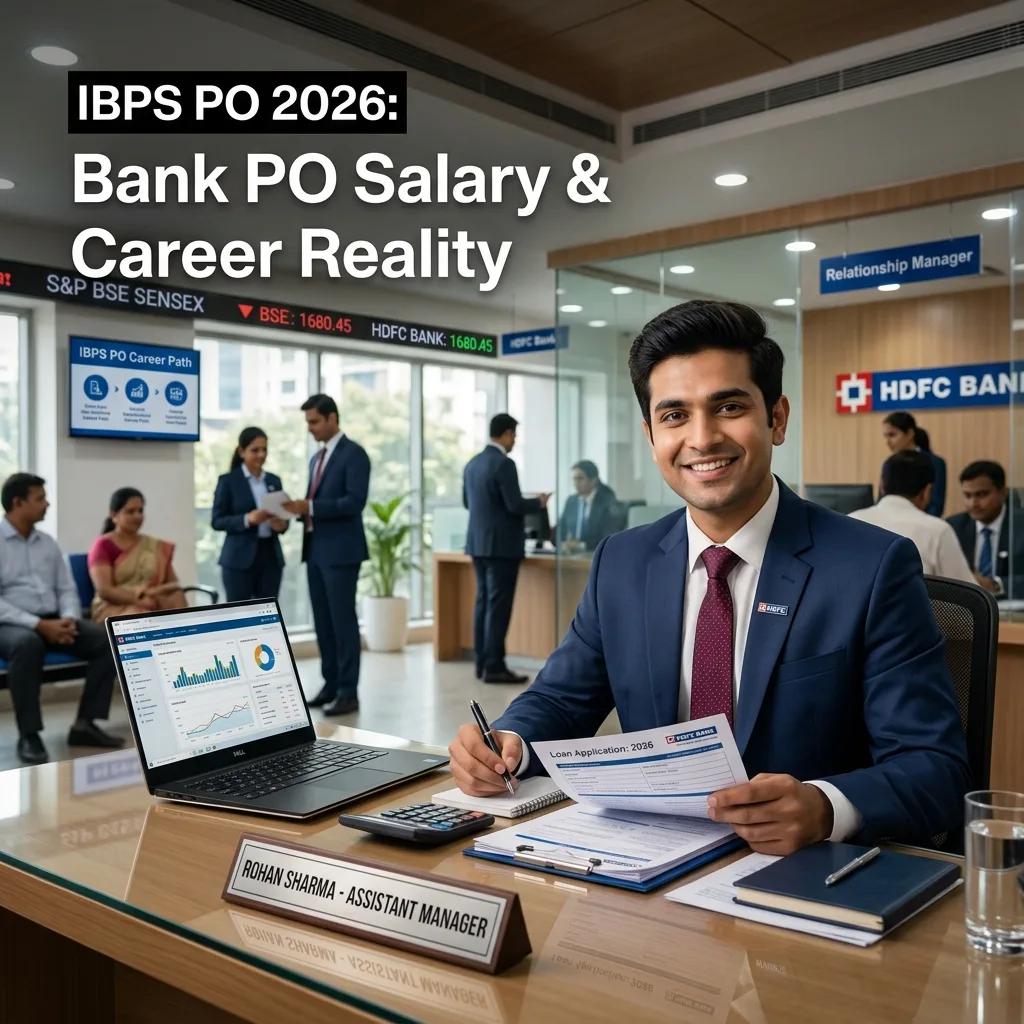
Introduction: Why IBPS PO 2026 Deserves a Fresh Look
Most blogs about IBPS PO tell you the same things: exam pattern, syllabus, cutoffs. But what about the reality of a Bank PO career AFTER selection?
In July 2026, the 12th Bipartite Settlement has fundamentally changed the bank officer salary landscape. An IBPS PO now starts at Rs.48,480 basic pay — with gross salary reaching Rs.88,000-92,000 per month. This makes the Bank PO one of the highest-paying entry-level positions available to any graduate in India.
But salary is only part of the story. This guide covers what actually happens after you clear the exam — the posting, the work, the transfers, the promotions, and the honest challenges that no coaching institute will tell you.
Quick Reference (IBPS PO CRP-XVI 2026):
- Vacancies: 6,715 posts across 12 Public Sector Banks
- Application Last Date: July 21, 2026
- Prelims: August 22-23, 2026
- Mains: September 2026
- Official Website: ibps.in
- Starting Basic Pay: Rs.48,480 (after 12th Bipartite Settlement)
- Gross Monthly Salary: Rs.88,000-92,000
- Net In-Hand: Rs.74,000-76,500
Part 1: IBPS PO 2026 Notification — Key Details
Participating Banks (12 Public Sector Banks):
| Bank | Full Name | Expected Vacancies |
|---|---|---|
| Bank of Baroda | BOB | 600-800 |
| Bank of India | BOI | 500-700 |
| Bank of Maharashtra | BOM | 300-400 |
| Canara Bank | Canara | 700-900 |
| Central Bank of India | CBI | 400-500 |
| Indian Bank | Indian Bank | 400-500 |
| Indian Overseas Bank | IOB | 300-400 |
| Punjab and Sind Bank | PSB | 200-300 |
| Punjab National Bank | PNB | 700-800 |
| UCO Bank | UCO | 300-400 |
| Union Bank of India | UBI | 800-1,000 |
| Uco Bank | UCO | 200-300 |
| Total | — | 6,715 |
Note: SBI PO is a separate exam (not IBPS). RBI Grade B is another separate exam.
Important Dates:
| Event | Date |
|---|---|
| Notification Released | July 1, 2026 |
| Application Last Date | July 21, 2026 |
| Prelims Exam | August 22-23, 2026 |
| Prelims Result | September 2026 |
| Mains Exam | September 2026 |
| Interview | October-November 2026 |
| Final Result | December 2026-January 2027 |
| Joining | February-March 2027 |
Part 2: The 12th Bipartite Settlement — Complete Salary Revolution
The 12th Bipartite Settlement, signed in 2025 between Indian Banks Association (IBA) and bank employee unions, revised bank officer salaries significantly. Here is what changed:
New Pay Structure (JMGS-I — Junior Management Grade Scale I):
New Pay Scale: Rs.48,480 – 2,000/7 – 62,480 – 2,340/2 – 67,160 – 2,680/7 – 85,920
This means:
- Starting basic: Rs.48,480
- After 7 annual increments (7 years): Rs.62,480
- After 9 years: Rs.67,160
- After 16 years (in same scale): Rs.85,920
Previous (11th Bipartite) vs New (12th Bipartite) Salary:
| Component | 11th Bipartite (Old) | 12th Bipartite (New) | Change |
|---|---|---|---|
| Starting Basic Pay | Rs.36,000 | Rs.48,480 | +34.7% |
| Gross Salary | Rs.62,000-68,000 | Rs.88,000-92,000 | +41% |
| In-Hand Salary | Rs.52,000-58,000 | Rs.74,000-76,500 | +35% |
This is the biggest salary hike for bank officers in 15 years. Fresh IBPS PO joiners in 2027 will start at Rs.74,000-76,500 net in-hand — more than most private sector MNCs offer freshers.
Part 3: Complete Salary Breakdown — Every Component Explained
Monthly Salary Components (JMGS-I, Metro City):
| Component | Amount | Basis |
|---|---|---|
| Basic Pay | Rs.48,480 | Fixed starting |
| Dearness Allowance (DA) | Rs.19,000-21,000 | Revised quarterly (~40-43% of Basic) |
| Special Allowance | Rs.12,847 | 26.5% of Basic (12th Bipartite) |
| HRA — Metro (8%) | Rs.3,878 | 8% of Basic (Metro cities) |
| HRA — Urban (7%) | Rs.3,394 | 7% of Basic (Urban towns) |
| HRA — Rural (6%) | Rs.2,909 | 6% of Basic (Semi-urban/Rural) |
| Transport Allowance | Rs.2,500-3,500 | Fixed |
| Other Allowances | Rs.1,500-3,000 | Newspaper, entertainment, medical |
Gross Salary — City-wise:
| City Type | Examples | Gross Salary | Net In-Hand |
|---|---|---|---|
| Metro | Mumbai, Delhi, Chennai, Bengaluru, Kolkata, Hyderabad | Rs.90,000-92,000 | Rs.76,000-78,000 |
| Urban (Major) | Jaipur, Lucknow, Patna, Bhopal, Chandigarh | Rs.86,000-88,000 | Rs.72,000-74,000 |
| Semi-urban | District headquarters | Rs.82,000-85,000 | Rs.68,000-72,000 |
| Rural | Villages and semi-rural branches | Rs.78,000-82,000 | Rs.64,000-68,000 |
Deductions:
| Deduction | Amount |
|---|---|
| NPS (10% of Basic + DA) | Rs.6,750-7,000 |
| Income Tax (approx.) | Rs.2,000-5,000 (depends on exemptions) |
| Professional Tax | Rs.200-250 |
| Staff Union Membership | Rs.100-200 |
Additional Non-Monetary Benefits:
| Benefit | Value/Amount |
|---|---|
| Medical Reimbursement | Self + Dependents — Rs.1.5-2 lakh/year |
| LTC (Leave Travel Concession) | Subsidized travel — home + anywhere in India |
| Subsidized Housing Loan | Interest rate 2-3% below market rate |
| Subsidized Car Loan | Special rate for staff |
| Concessional Education Loan | For children |
| Festival Advance | Rs.15,000-20,000 interest-free advance twice/year |
| Petrol Allowance | Rs.1,500-3,000/month (for officers with field duty) |
The Real Annual Package:
| Component | Annual Value |
|---|---|
| Net Cash In-Hand | Rs.8,64,000-9,18,000 |
| Medical Reimbursement | Rs.1,50,000 |
| NPS (Employer Contribution 14%) | Rs.1,00,000 |
| Housing/Car Loan Interest Saving | Rs.80,000-1,50,000 |
| LTC Value | Rs.40,000-60,000 |
| Festival Advances (free) | Rs.30,000-40,000 |
| Total Effective CTC | Rs.12-14 lakh/year |
Part 4: IBPS PO Life — The Reality Nobody Tells You
The Probation Period (2 Years):
You join as "Probationary Officer" — same designation across all 12 banks. The probation period is 2 years. During probation:
- You are an "Officer Trainee" technically — but designated Assistant Manager
- Training rotations across all bank departments: Branch Banking, Advances, FOREX, Treasury, HR, Operations
- Performance appraisal every 6 months
- Confirmation after 2 years — subject to satisfactory performance
- If performance is poor: Probation extended by 6-12 months (rare, but possible)
What most candidates don't know: Bank PO is NOT a desk job in the traditional sense. From Day 1, you are expected to:
- Meet business targets (new accounts, loans, insurance, fixed deposits)
- Handle customer complaints — some involving significant money
- Manage branch operations in the SHO's (branch manager's) absence
- Represent the bank at external meetings, fairs, government offices
A Typical Day as Bank PO (Urban Branch):
9:30 AM: Reach branch. Morning review with Branch Manager — yesterday's business figures, today's targets, pending cases.
10:00 AM: Branch opens. Counter rush begins. Monitor staff — ensure all counters operational. Handle customer escalations that staff cannot resolve.
11:00 AM: Process loan applications — review documents, run CIBIL score checks, verify income proofs. Prepare credit appraisal note for Branch Manager's approval.
12:30 PM: Branch Manager asks you to visit a high-value NRI customer's office — they want to open an NRE fixed deposit of Rs.50 lakh. You go, explain products, complete KYC.
2:00 PM: Lunch — usually 30-45 minutes, not a relaxed hour.
2:45 PM: Evening rush — salary day (25th-28th of month) means extremely busy counters. More customer complaints, long queues.
4:00 PM: End-of-day reconciliation begins. Balance RTGS/NEFT transactions, verify cash position with cashier, review day's transactions for any discrepancies.
5:30 PM (official closing): Actual work continues until 7:00-8:00 PM on busy days (month-end, audit days, special campaigns).
Honest assessment: Bank PO is NOT a 9:30-5:30 job in reality. Extended hours are common, especially during:
- Month-end (last 3 days)
- Quarter-end (March 31, June 30, September 30, December 31)
- Audit weeks (concurrent audit visits)
- Business campaigns (insurance month, loan melas)
Rural Branch Posting — The Honest Picture:
Many IBPS PO joiners get their first posting in a semi-urban or rural branch. This is very common — banks have more rural branches than urban. Here is the reality:
Challenges of Rural Posting:
- Branch may be in a small town with limited facilities
- Customer base is farmers, small traders, self-help groups — very different from urban banking
- Housing: Bank may provide quarters or rent allowance — but quality is basic
- Social life: Significant adjustment for metro-born candidates
- Connectivity: Internet, medical facilities may be limited
Advantages of Rural Posting:
- Faster learning — you handle ALL aspects of banking as there are fewer staff
- Early Branch Manager responsibility — rural branches often have just 3-5 staff, PO gets more responsibility quickly
- Lower cost of living — Rs.68,000-70,000 in-hand in rural area actually buys MORE than Rs.76,000 in Metro
- Less competition for targets — rural loan targets are more achievable with agricultural loan schemes (KCC, etc.)
- Strong community respect — bank officer is a prestigious figure in rural India
Transfer out of rural posting: After 2-3 years, transfer to urban branch is typically possible by putting in a transfer request. Banks rotate staff regularly.
Part 5: Transfer Policy — How Bank PO Postings Work
Transfer Rules Across 12 IBPS Banks:
Bank officer transfers are governed by each bank's internal policy. General pattern:
| Bank Category | Transfer Frequency | Zone |
|---|---|---|
| Public Sector Banks (IBPS PO) | Every 2-4 years | Within state / Inter-state |
| SBI PO | Every 2-3 years | All India — any state |
| RBI Grade B | Every 3-5 years | Any office in India/abroad |
Understanding the Transfer System:
Zone-based system: Most banks divide India into 5-8 zones (North, South, East, West, Central, Northeast etc.). Officers are typically posted within one zone for 5-7 years before inter-zone transfer.
Request transfers vs mandatory transfers:
- After mandatory posting period (3 years minimum), officers can request transfer to preferred location
- High-performing officers get preferred postings faster
- Officers with medical requirements get location preference on medical grounds
- Married couples who are both bank officers can request same city posting (most banks accommodate)
Family Impact of Transfers:
Spouse accommodation: Banks provide rent allowance wherever posted. No accommodation guarantee. In remote areas, bank quarters are provided.
Children's education: Frequent transfers mean school changes. Most bank officer families use private schools in cities, government schools in rural areas. Bank provides children's education allowance.
Marriage factor: Many bank officers marry after joining — choosing to stay single during frequent early-career transfers is common. After marriage, most apply for home state posting.
Reality check: Transfer is the #1 challenge of bank officer life. Anyone expecting to spend their career in one city should think carefully about whether banking is the right career choice.
Part 6: IBPS PO vs SBI PO vs RBI Grade B — Which Is Best?
The Complete 10-Year Career Comparison:
| Factor | IBPS PO | SBI PO | RBI Grade B |
|---|---|---|---|
| Entry Salary (Gross) | Rs.88,000-92,000 | Rs.88,000-92,000 | Rs.1,05,000-1,10,000 |
| Entry In-Hand | Rs.74,000-76,500 | Rs.74,000-76,500 | Rs.87,000-90,000 |
| After 5 Years | Rs.90,000-95,000 in-hand | Rs.90,000-95,000 | Rs.1,10,000-1,20,000 |
| After 10 Years | Rs.1,10,000-1,30,000 (as Scale II) | Rs.1,15,000-1,35,000 | Rs.1,50,000-1,70,000 |
| Transfer Zone | State-level mostly | All India | All India |
| Transfer Frequency | Every 2-4 years | Every 2-3 years | Every 3-5 years |
| Work Pressure | High | High | Moderate-High |
| Social Prestige | Very High | Very High | Extremely High |
| Exam Difficulty | High | Very High | Extremely High |
| Vacancies | 6,715 | 2,000-3,000 | 200-300 |
| Chances of Selection | Better (more vacancies) | Moderate | Very Low |
Recommendation by Profile:
If you are a science/commerce graduate wanting banking career: IBPS PO is your target. Balanced difficulty, large vacancies, excellent salary.
If you want only SBI (brand prestige, national footprint): Prepare for SBI PO — harder exam, but SBI brand is unmatched.
If you are an Economics/Finance/MBA graduate: Target RBI Grade B — the gold standard of Indian banking careers with the highest salary and job security.
Smart strategy: Appear for ALL three simultaneously. SBI PO, IBPS PO, and RBI Grade B all have different exam dates. Preparing for one helps in the others (common syllabus overlap).
Part 7: Bank PO Promotion Path — PO to MD in 30 Years
Promotion Ladder:
| Stage | Designation | Pay Scale | Years to Reach |
|---|---|---|---|
| Entry | Probationary Officer / Asst. Manager | JMGS-I (Rs.48,480-85,920) | 0 |
| Promotion 1 | Manager | MMGS-II (Rs.64,820-1,10,590) | 4-6 years |
| Promotion 2 | Senior Manager | MMGS-III (Rs.76,010-1,34,670) | 8-10 years |
| Promotion 3 | Chief Manager | SMGS-IV (Rs.89,890-1,57,460) | 12-15 years |
| Promotion 4 | Asst. General Manager (AGM) | SMGS-V (Rs.1,05,280-1,73,280) | 15-18 years |
| Promotion 5 | Deputy General Manager (DGM) | TEGS-VI (Rs.1,36,080-1,89,500) | 20-22 years |
| Promotion 6 | General Manager (GM) | TEGS-VII (Rs.1,48,790-2,07,390) | 24-26 years |
| Top Level | Executive Director / MD & CEO | Special Scale | 30+ years |
How Promotions Happen in Banks:
Written exam + interview (most banks):
- Internal promotion exams are held every year
- Minimum service period required before each promotion
- No mandatory exam — seniority-based promotion also exists in some banks, but it's slow
Fast-track promotion: Some banks have merit-based fast track programs. Top performers reach Manager (Scale II) in 3-4 years instead of 5-6.
Salary at Key Milestones:
| Milestone | Designation | In-Hand Salary (Metro) |
|---|---|---|
| Year 0 (Joining) | PO / Asst. Manager | Rs.74,000-76,500 |
| Year 5 | Manager (Scale II) | Rs.95,000-1,05,000 |
| Year 10 | Senior Manager (Scale III) | Rs.1,25,000-1,40,000 |
| Year 15 | Chief Manager (Scale IV) | Rs.1,55,000-1,70,000 |
| Year 20 | AGM (Scale V) | Rs.1,90,000-2,10,000 |
| Year 25 | DGM (Scale VI) | Rs.2,50,000-2,80,000 |
At the top levels — General Manager and above — bank officers also get perks like:
- Official car with driver
- Subsidized bungalow / luxurious flat
- Entertainment allowance
- Travel allowance
- Club memberships
Part 8: IBPS PO Exam Pattern 2026
Prelims (Online):
| Subject | Questions | Marks | Duration |
|---|---|---|---|
| English Language | 30 | 30 | 20 min |
| Quantitative Aptitude | 35 | 35 | 20 min |
| Reasoning Ability | 35 | 35 | 20 min |
| Total | 100 | 100 | 60 min |
Negative Marking: 0.25 marks per wrong answer. Section-wise time limit is strict.
Mains (Online):
| Subject | Questions | Marks | Duration |
|---|---|---|---|
| Reasoning and Computer Aptitude | 45 | 60 | 60 min |
| English Language | 35 | 40 | 40 min |
| Data Analysis and Interpretation | 35 | 60 | 45 min |
| General Economy and Banking | 40 | 40 | 35 min |
| Total | 155 | 200 | 3 hours |
Plus: Descriptive Paper (English Letter/Essay): 25 marks, 30 minutes.
Interview:
100 marks. Typically 15-20 minutes. Focus areas:
- Banking knowledge and current banking news
- Your motivation for banking career
- Situational questions (what would you do if a customer...)
- Your city preference and transfer willingness
Part 9: Preparation Strategy — Section-wise
English Language — Prelims (30 marks):
| Topic | Questions | Priority |
|---|---|---|
| Reading Comprehension | 8-10 | Very High |
| Cloze Test | 5 | High |
| Error Detection | 5 | High |
| Phrase Replacement | 4-5 | High |
| Para Jumble | 4-5 | Moderate |
| Fill in the Blanks | 3-4 | Moderate |
Target: 24-28 correct in English. The 20-minute time limit means you need to be fast.
Strategy: RC first (guaranteed marks), skip questions you are unsure about to save time, return at end.
Quantitative Aptitude — Prelims (35 marks):
| Topic | Questions | Priority |
|---|---|---|
| Data Interpretation (Tabular, Graph) | 10-15 | Very High |
| Number Series | 5 | Very High |
| Simplification/Approximation | 5 | High |
| Quadratic Equations | 5 | High |
| Arithmetic (SI/CI, P&L, TSD, P&W) | 5-10 | High |
Target: 25-30 correct. DI and Number Series combined are 15-20 marks — master these first.
Reasoning Ability — Prelims (35 marks):
| Topic | Questions | Priority |
|---|---|---|
| Puzzle (Linear, Circular, Floor) | 15-20 | Very High |
| Seating Arrangement | 5-10 | Very High |
| Syllogism | 3-5 | High |
| Direction Sense | 2-3 | High |
| Blood Relation | 2-3 | High |
| Coding-Decoding | 2-3 | High |
Target: 28-32 correct. Puzzles are 15-20 marks — this is where selection is decided.
General Economy and Banking (Mains — 40 marks):
| Topic | Expected Questions |
|---|---|
| Banking Current Affairs (last 6 months) | 12-15 |
| RBI Policies, Repo Rate, CRR, SLR | 5-6 |
| Financial Awareness (Budget, Economic Survey) | 5-6 |
| Banking Terminology | 4-5 |
| History of Indian Banking | 3-4 |
| Government Schemes (banking-related) | 4-5 |
Best sources: The Hindu Business Line (weekly), RBI website (Monthly Bulletin), Banking Awareness book (Arihant/Adda247).
Part 10: What IBPS PO Interview Panel Actually Wants
The bank interview is a personality assessment, not just a knowledge test. Here is what the panel evaluates:
What They Look For:
Communication clarity: Can you explain things clearly? Banking is about communicating with customers, seniors, auditors. Poor communication = poor customer service.
Banking awareness depth: Not just "what is CRR" but "what was the last CRR change and why did RBI do it?" Read one banking news story daily for 3 months before interview.
Transfer willingness: Explicitly asked in most interviews. If you say "I am not willing to go anywhere" — immediate negative. Say: "I am open to posting anywhere in the country and will serve wherever the bank needs me."
Ethical maturity: Questions like "A customer offers you a bribe for a loan approval — what do you do?" or "Your branch manager asks you to approve a loan you think is risky — what do you do?" These test your ethical judgment.
Composure under pressure: Interviewers sometimes ask very difficult or unexpected questions to see how you handle pressure. Stay calm, take a second before answering, and it is completely fine to say "I am not sure of the exact figure, but based on my understanding..."
Common Interview Questions (IBPS PO 2026):
- "Why banking when you have [engineering/science/arts] background?"
- "What do you know about IBPS PO and the bank you will join?"
- "Tell me about the latest RBI policy rate decision and why."
- "What is the difference between NBFC and Bank?"
- "A major customer threatens to take all his business to a competitor — what do you do?"
- "How does UPI work and how has it changed Indian banking?"
- "What is Digital India initiative and how does it affect banking?"
Part 11: Frequently Asked Questions
Q1. IBPS PO 2026 application last date is July 21 — have I missed it? As of publication (July 18, 2026), you have 3 days remaining. Apply IMMEDIATELY at ibps.in. Fee: Rs.175 for SC/ST/PwBD, Rs.850 for others. The application takes 20 minutes — do not delay.
Q2. Can final year graduation students apply for IBPS PO 2026? Yes — candidates who will complete graduation by the interview/joining date can apply. You must hold a graduation degree at the time of joining. If your final results are pending, attach a certificate from college stating you have appeared in final year exams.
Q3. What is the IBPS PO 2026 age limit? 20-30 years as on July 1, 2026. OBC-NCL: 20-33 years. SC/ST: 20-35 years. PwBD: 20-40 years. Ex-Servicemen: Up to 20-38 years.
Q4. Is IBPS PO salary better than SSC CGL Inspector salary? Yes — significantly. IBPS PO gross: Rs.88,000-92,000. SSC CGL Income Tax Inspector gross: Rs.55,000-65,000. However, SSC CGL provides CGHS medical (more comprehensive), NPS at 24% (10% employee + 14% govt), and government quarter (usually not available in banks). Bank PO has higher cash salary but less comprehensive social security benefits compared to Central Government jobs.
Q5. What percentage of IBPS PO candidates are from non-commerce backgrounds? A significant percentage — approximately 40-50% — of IBPS PO selected candidates have engineering, science, or arts backgrounds. Commerce graduates have a slight advantage in General Economy section, but it is not decisive. Reasoning and Aptitude sections are equal for all backgrounds.
Q6. Can an IBPS PO refuse a transfer to a rural area? Not without consequences. Banks require transfer compliance as part of the service contract. An officer who consistently refuses transfers faces:
- Poor performance rating
- Delayed promotion
- Disciplinary action in extreme cases
However, legitimate grounds (medical condition, disability, spouse's government posting) allow transfer requests which banks usually honor.
Q7. What are the best banks to join among the 12 IBPS PO banks in terms of salary and work culture? Based on general officer feedback: Bank of Baroda and Union Bank of India are considered to have better management culture and slightly more structured target-setting. Canara Bank has good transfer policies. Punjab National Bank and Bank of India have large networks meaning more posting options. Ultimately, all 12 banks have the same pay structure under IBPS — differences are in culture, management style, and specific branch posting quality.
Q8. How long does it typically take to become Branch Manager (BM) after joining as PO? The typical path: PO (0 years) → Pass Scale II internal exam after 4-5 years → Manager at a smaller branch → Pass Scale III exam after 3-4 more years → Senior Manager → Eligible for Branch Manager charge of a mid-size branch. Most PO-level officers get their first Branch Manager charge in 8-12 years of service, depending on performance and vacancies.
Conclusion: IBPS PO 2026 — The Best Graduate Career in India Right Now
With Rs.74,000-76,500 in-hand salary from Day 1, a structured promotion path to Rs.2,50,000+ salary in 25 years, medical benefits, housing loan subsidies, and one of the most prestigious designations available to a graduate — IBPS PO remains the single most rewarding banking exam in India.
The 12th Bipartite Settlement has made it even more attractive than before. A 22-year-old graduate joining as Bank PO in 2027 will earn more in their first month than most of their friends will earn in 5 years of private sector struggle.
Action Plan (If You Haven't Applied Yet):
- Apply at ibps.in BEFORE July 21, 2026 deadline — 3 days remaining
- Fee: Rs.850 (General/OBC/EWS), Rs.175 (SC/ST/PwBD)
- Start Prelims preparation: Reasoning + Quant daily 3 hours minimum
- Current Affairs: Read one banking story daily
- Mains Banking Awareness: Begin collecting notes from ibps.in and RBI website
The exam is in August. The joining is in early 2027. Your salary in March 2027 could be Rs.76,500 in-hand.
Stay updated with IBPS PO 2026 admit card, result, cut-off, interview schedule, and banking career news at Government Job Result — India's most trusted government career resource.
Disclaimer: Salary figures are based on 12th Bipartite Settlement effective 2025 and current DA rates as of July 2026. Actual in-hand salary varies by posting location and individual tax regime. IBPS PO dates and vacancies are based on official CRP PO/MT-XVI notification — always verify from ibps.in.
Part 12: Banking Terminology — Complete Glossary Every PO Must Know
Before joining as Bank PO, understanding core banking terminology is essential — both for the Mains General Economy section and for Day 1 on the job:
Monetary Policy Terms:
| Term | Full Form | Meaning |
|---|---|---|
| Repo Rate | Repurchase Rate | Rate at which RBI lends to commercial banks. Lower repo = cheaper loans for public. |
| Reverse Repo Rate | — | Rate at which RBI borrows from banks. Controls excess liquidity. |
| CRR | Cash Reserve Ratio | % of deposits banks must keep with RBI as cash — not lendable |
| SLR | Statutory Liquidity Ratio | % of deposits banks must keep in liquid assets (gold, govt securities) |
| MSF | Marginal Standing Facility | Emergency overnight borrowing for banks at rate above Repo Rate |
| Bank Rate | — | Rate at which RBI discounts bills — signals long-term monetary stance |
| OMO | Open Market Operations | RBI buying/selling govt bonds to control money supply |
Credit and Lending Terms:
| Term | Meaning |
|---|---|
| NPA | Non-Performing Asset — loan where borrower has not paid for 90+ days |
| GNPA | Gross NPA — total NPAs before provisions |
| NNPA | Net NPA — after deducting provisions made against NPAs |
| CIBIL Score | Credit score (300-900) — measures borrower's creditworthiness |
| CRAR | Capital to Risk-weighted Assets Ratio — bank's capital adequacy |
| PCR | Provision Coverage Ratio — % of NPAs covered by bank's provisions |
| Moratorium | Temporary suspension of loan repayment — allowed during COVID-19 |
| Restructuring | Modifying loan terms to help struggling borrower (changes interest, tenure) |
| DRT | Debt Recovery Tribunal — specialized court for recovering bank dues |
| SARFAESI Act | Allows banks to seize and sell mortgaged assets without court order |
Digital Banking Terms:
| Term | Meaning |
|---|---|
| UPI | Unified Payments Interface — NPCI-managed instant payment system |
| IMPS | Immediate Payment Service — 24x7 interbank transfer |
| NEFT | National Electronic Funds Transfer — settlement in batches |
| RTGS | Real Time Gross Settlement — for high-value (Rs.2 lakh+) transfers |
| NACH | National Automated Clearing House — ECS replacement for bulk payments |
| AePS | Aadhaar-enabled Payment System — banking using Aadhaar + fingerprint |
| e-RUPI | Digital voucher-based payment — cashless, contactless |
| CBDC | Central Bank Digital Currency — RBI's digital rupee (e-Rupee) |
Part 13: 12 Public Sector Banks — Culture and Work Environment Comparison
Understanding the culture of each IBPS PO bank helps you prioritize your preference:
Detailed Bank-wise Profile:
1. Bank of Baroda (BOB):
- India's international bank — 100+ overseas branches
- Strong in Gujarat, Maharashtra, Rajasthan, UP
- Known for: Digital banking (BOB World app), MSME lending
- Work culture: Structured, process-oriented
- Transfer pattern: Often inter-state — good for those wanting diverse postings
- Unique: BOB UID (Baroda Universal Institute) provides excellent officer training
2. Bank of India (BOI):
- Headquarters: Mumbai
- Strong in: Maharashtra, Karnataka, AP, Tamil Nadu
- Known for: Star Connect mobile banking, international presence
- Work culture: Moderate pressure, reasonable targets in non-metro branches
- Transfer pattern: Mix of local and outstation postings
3. Canara Bank:
- Headquarters: Bengaluru
- Strong in: Karnataka, Kerala, Tamil Nadu, Andhra Pradesh
- Known for: Agriculture lending, South India network
- Work culture: Conservative, traditional — good for stability-seekers
- Transfer pattern: Mostly within South India for South zone recruits
4. Punjab National Bank (PNB):
- India's 2nd largest public sector bank by branches
- Strong in: Punjab, Haryana, UP, Delhi NCR, Rajasthan
- Known for: Massive rural network (over 10,000 branches)
- Work culture: High branch volume — busy branches, good learning environment
- Note: PNB merged with OBC and United Bank in 2020 — still integrating systems
5. Union Bank of India:
- Headquarters: Mumbai
- Strong in: Maharashtra, UP, MP, South India
- Known for: Union Virtual Assistant (AI banking), digital innovation
- Work culture: One of the more progressive large banks post-merger
- Transfer pattern: All-India — active rotation
6. Indian Bank:
- Headquarters: Chennai
- Strong in: Tamil Nadu, Andhra Pradesh, Telangana, Puducherry
- Known for: MSME, agricultural, education loan focus
- Work culture: South India-dominant culture — conservative, stable
- Transfer pattern: Primarily within South India circles for South region recruits
7. Bank of Maharashtra (BOM):
- Headquarters: Pune
- Strong in: Maharashtra, Goa
- Known for: Fastest growing PSB in recent years, clean NPA record
- Work culture: Lean, efficient — lower staff count means more responsibility per officer
- Transfer pattern: Mostly within Maharashtra for Maharashtra recruits
8. Central Bank of India:
- Headquarters: Mumbai
- Strong in: MP, UP, Maharashtra, Bihar, Rajasthan
- Known for: Rural and semi-urban network, Jan Dhan focus
- Work culture: Moderate — large rural presence means more agricultural banking exposure
9. Indian Overseas Bank (IOB):
- Headquarters: Chennai
- Strong in: Tamil Nadu, Kerala, overseas (Singapore, Sri Lanka)
- Known for: International banking, South India focus
- Work culture: Stable, traditional
10. Punjab and Sind Bank (PSB):
- Headquarters: New Delhi
- Primarily in: Punjab, Delhi, Haryana, UP
- Smallest of 12 IBPS banks — fewer vacancies, more personal growth opportunities
- Work culture: Close-knit, less corporate pressure
11. UCO Bank:
- Headquarters: Kolkata
- Strong in: West Bengal, Assam, Odisha, Bihar, UP
- Known for: Strong East India network
- Work culture: Traditional — largely East India focused operations
Choosing Your Bank Preference in IBPS PO:
IBPS does NOT let you choose a specific bank during application. You are allocated based on your score and merit. However, during Document Verification/Joining process, you fill a bank preference form. High scorers get first choice.
General preference strategy for home state posting:
- If from South India: Prefer Canara, Indian Bank, IOB for likely South postings
- If from North India: Prefer PNB, UCO, Central Bank for North India postings
- If from West India: Prefer Bank of Baroda, Bank of Maharashtra
- If from East India: Prefer UCO, Bank of India
Part 14: Bank PO — Work-Life Balance Reality
The work-life balance question is the most searched aspect of bank officer life. Here is the honest breakdown:
Normal Days (Non-Month-End, Non-Audit):
- Office hours: 9:30 AM to 6:00-7:00 PM
- Saturdays: Work (second and fourth Saturdays are off — but first, third, fifth Saturdays are working days)
- Sundays: Off (unless very special circumstances)
- Average overtime: 1-2 hours daily
Pressure Periods (Monthly):
| Period | Pressure Level | Reason |
|---|---|---|
| 26th-31st of month | Very High | Month-end target achievement — loans, deposits, insurance |
| March 31 | Extreme | Financial year-end — entire year's targets |
| June 30, Sept 30, Dec 31 | Very High | Quarter-end targets |
| Audit week | High | Concurrent audit, statutory audit |
| CBS (Core Banking) migration/update | High | System downtime issues |
| Election duty | Moderate | Bank staff deputed for election counting duty |
Annual Leave Entitlement:
| Leave Type | Days |
|---|---|
| Casual Leave (CL) | 12 days/year |
| Sick Leave (SL) | 30 days/year |
| Privilege Leave (PL) | 30 days/year (accumulated) |
| Special Sick Leave | Extra for hospitalization |
| Maternity Leave | 6 months for women |
| Paternity Leave | 15 days |
Reality: Many bank officers don't fully utilize CL/PL due to branch workload — especially in rural and semi-urban branches where staff count is low.
Work-Life Balance by Branch Type:
| Branch Type | WLB Score | Reason |
|---|---|---|
| Metro Branch (large, 20+ staff) | 6/10 | High customer volume, targets, but work distribution better |
| Metro Branch (small, 5-8 staff) | 5/10 | Every officer handles everything — high workload |
| Urban District Branch | 7/10 | Moderate volume, reasonable targets |
| Semi-urban Town Branch | 7.5/10 | Lower customer pressure, but all-round responsibility |
| Rural Branch (3-5 staff) | 8/10 (calm) or 5/10 (during harvest/KCC season) | Very calm normally, but agricultural loan season is intense |
| Zonal/Regional Office posting | 9/10 | Administrative work, no customer pressure, 9:30-5:30 strict |
Career tip: Applying for a Regional Office / Zonal Office posting is a strategic move for officers wanting better work-life balance. These desk-based administrative roles exist at all banks and are filled by senior officers or by junior officers with specific skills (IT, HR, Credit).
Part 15: Banking Sector — Future Outlook and Job Security
Is Bank PO Still a Safe Career in the Digital Age?
A common concern among aspirants: "Will AI and automation eliminate bank jobs?"
The honest answer: Bank branch numbers and officer counts will NOT reduce significantly in the next 15-20 years. Here is why:
1. Financial Inclusion mandate: Government has mandated banking access for all 140 crore Indians. New branches are still being opened in unbanked areas. Over 5,000 new branches planned in next 3 years.
2. MSME and agricultural lending: These cannot be fully automated. A Bank PO must physically assess a small business, evaluate the borrower's character, inspect the collateral. AI cannot replace human judgment in complex credit decisions.
3. Customer service escalations: Angry customers, complex complaints, legal matters — these require human intervention. The "human in the loop" requirement will persist.
4. Regulatory compliance: RBI mandates physical presence and human oversight for many banking operations. Full automation is legally restricted.
5. Digital banking creating NEW roles: Cybersecurity officers, data analytics officers, digital lending officers — banks are creating new roles faster than they automate old ones.
What IS Changing:
| Old Role | Automated/Reduced | New Role Emerging |
|---|---|---|
| Data entry clerks | Mostly automated | Data quality analysts |
| Cash counters (many branches) | ATM + cash recyclers replacing | Universal Teller (fewer, more skilled) |
| Manual ledger maintenance | Core Banking replaced | CBS administrators |
| Physical passbook printing | Net banking replaced | Digital onboarding specialists |
| Loan application form filling | Online filing | Credit analytics |
Conclusion for aspirants: Bank PO as a designation will evolve — but it will NOT disappear. Officers who upgrade their skills (digital banking, MSME credit, FOREX operations) will thrive even more in the digital banking era.
Part 16: Bank PO Specialization Options — Build a Niche Career
Once you join as Bank PO, you can develop specialization in specific banking domains that dramatically increase career growth:
Specialization 1 — Credit (Loans and Advances):
What you do: Evaluate loan applications for businesses (MSME, corporate), farmers (KCC), home loans, vehicle loans. Prepare credit appraisal reports. Recommend approval/rejection to higher authority.
Why specialize: Credit officers get faster promotions. Banks desperately need skilled credit analysts. Well-regarded credit background = preferred for Circle Credit Officer (CCO) posting — a prestigious role.
How to develop: Volunteer for credit department in your branch. Study JAIIB (Junior Associate of Indian Institute of Banking and Finance) examination with Principles of Banking paper focusing on credit.
Specialization 2 — Treasury and FOREX:
What you do: Handle foreign exchange transactions — money changing, FOREX remittances, LC (Letter of Credit) for importers/exporters.
Why specialize: FOREX operations are complex and specialized. FOREX-qualified officers are limited. Postings in port cities, Authorized Dealer branches are prestigious. International branches in major banks (BOB, BOI, IOB) need FOREX-qualified officers.
How to develop: Request posting to Authorized Dealer (AD) branch in your city. Attempt CAIIB examination with Advanced Bank Management paper specializing in FOREX.
Specialization 3 — MSME Banking:
What you do: Business banking for Micro, Small and Medium Enterprises. Evaluate working capital loans, term loans, bank guarantees for small businesses.
Why specialize: MSME is the largest employment generator in India. Government pushes banks to increase MSME lending. Dedicated MSME officers are valued and often promoted to Area MSME Manager (AMM) — a very active, respected role.
Specialization 4 — Digital Banking and Fintech:
What you do: Manage digital banking channels — mobile app issues, internet banking onboarding, UPI disputes, digital product promotion.
Why specialize: Fastest-growing area in banking. Young POs with digital skills get IT Department/Digital Banking Department postings — which offer regular hours, no customer pressure, and excellent exposure to banking technology.
Specialization 5 — Agricultural Banking:
What you do: Kisan Credit Card (KCC) loans, government agriculture schemes, SHG (Self Help Group) linkage, rural infrastructure loans.
Why specialize: Government focus on farmers makes this department very active. Officers who excel in agriculture banking get Lead Bank Manager postings — heading an entire district's banking coordination. Prestigious and impactful role.
Part 17: Banking Examinations for In-Service Bank Officers — JAIIB and CAIIB
After joining as Bank PO, the most important professional certifications are:
JAIIB (Junior Associate of Indian Institute of Banking and Finance):
| Parameter | Detail |
|---|---|
| Conducted by | Indian Institute of Banking and Finance (IIBF) |
| Papers | 3 papers: Principles of Banking, Accounting & Finance, Legal & Regulatory Aspects |
| Passing marks | 50 each paper (100 marks each) |
| Attempts | Maximum 9 attempts (3 years) |
| Benefit | One annual increment (salary bump) upon passing all 3 papers |
| When to attempt | Within first 2-3 years of service |
JAIIB passing gives you one extra annual increment — meaning your basic pay increases faster. This compounds over a 30-year career. Approximately Rs.2,00,000 extra career-long benefit from one JAIIB pass.
CAIIB (Certified Associate of Indian Institute of Banking and Finance):
| Parameter | Detail |
|---|---|
| Papers | 4 papers: Advanced Bank Management, Bank Financial Management, Advanced Business and Financial Management, Bank HR and Operations |
| Passing marks | 50 each paper |
| Benefit | Two more annual increments upon passing all 4 papers |
| When to attempt | After passing JAIIB (typically 3-5 years after joining) |
| Career impact | Mandatory for promotion to Scale III (Senior Manager) in many banks |
Combined JAIIB + CAIIB benefit: 3 extra increments = approximately Rs.6,000 extra basic pay = Rs.8,000+ extra gross = Rs.6,500 extra in-hand EVERY MONTH for the rest of your career. Total career value: Rs.30-40 lakh extra earnings.
Key insight: Most bank officers procrastinate on JAIIB/CAIIB. Those who complete both within the first 5 years consistently earn more and get promoted faster. It is the single most impactful action a new Bank PO can take for their career.
Part 18: Bank PO — Social Status and Community Respect
The social value of being a Bank PO is a significant but underappreciated aspect of the career:
In Urban Areas:
Being a bank officer in an Indian city carries professional respect. The designation "Assistant Manager, [Bank Name]" is recognized as a solid middle-class career. It opens doors for:
- Housing society membership (banks look good on rental applications)
- Marriage prospects — bank officer is considered a stable partner
- Community standing — invited to speak at events, consulted on financial matters
In Rural and Semi-Urban Areas:
The social impact is even more significant. A Bank PO posted in a small town becomes one of the most respected professionals in the community:
- Branch Manager and officers are treated like VIPs at local events
- Farmers come to you for advice beyond just loans — crop decisions, investment
- Politicians, local officials, and businesspeople seek good relations with the local bank officer
- First point of contact for government scheme implementation
The "Government Job" Perception:
Though technically a public sector bank (not strictly "government"), IBPS PO is socially treated as a government job. This matters enormously in India's social fabric — particularly for marriage, family standing, and career credibility.
Part 19: Common Myths About Bank PO — Debunked
Myth 1: "Bank PO is easy and stress-free — just stamp papers all day"
Reality: Bank PO manages loans worth crores, handles compliance audits, meets business targets, and answers to Branch Manager daily on performance. The work is intellectually demanding and the accountability is very real.
Myth 2: "Private sector banks pay more — HDFC/ICICI is better than IBPS PO"
Reality: At entry level, HDFC Bank and ICICI Bank pay Rs.35,000-55,000 for similar positions. IBPS PO now pays Rs.74,000-76,500 in-hand — more than private banks for equivalent officer roles. Private banks offer higher salaries only at senior levels (4-7 years of experience).
Myth 3: "You can't apply for other exams after joining bank"
Reality: There is no restriction. Bank officers regularly appear for RBI Grade B, UPSC CSE, state PSC exams. Many IAS officers were previously bank POs. Your banking experience is actually an advantage in UPSC General Studies Economy sections.
Myth 4: "Rural posting means career stagnation"
Reality: Paradoxically, rural postings often accelerate early career growth. You get full branch responsibility faster, your all-round skills develop quicker, and your performance visibility is higher (a rural branch officer who performs well stands out more than one of 50 officers at a large metro branch).
Myth 5: "Bank mergers mean job losses"
Reality: The bank mergers of 2019-2020 (BoB-Vijaya-Dena, PNB-OBC-UB, Canara-Syndicate, UBI-Andhra-Corporation, Indian-Allahabad) did not result in officer layoffs. The merged entities absorbed all staff. Banking regulations prevent layoffs of confirmed employees. Your job is safe.
Part 20: IBPS PO vs Other Career Paths — Complete Comparison for Graduates
For a Fresh Graduate in 2026 — What Are the Options?
| Career Path | Starting In-Hand | Growth Potential | Job Security | Effort to Get |
|---|---|---|---|---|
| IBPS PO | Rs.74,000-76,500 | Rs.2,50,000+ in 25 years | Very High | High (competitive exam) |
| SSC CGL IT Inspector | Rs.55,000-65,000 | Rs.1,80,000+ in 30 years | Very High | Very High (toughest SSC exam) |
| UPSC IAS | Rs.78,000-85,000 | Rs.3,00,000+ (District Collector) | Extremely High | Extremely High (UPSC) |
| RBI Grade B | Rs.87,000-90,000 | Rs.3,00,000+ in 20 years | Very High | Extremely High |
| Private IT Sector (TCS/Infosys) | Rs.30,000-42,000 | Variable — Rs.1,50,000+ if very good | Low-Moderate | Moderate (placement) |
| FAANG/Product Company | Rs.1,50,000+ | Rs.5,00,000+ (top performers) | Moderate | Very High (DSA skills) |
| MBA (IIM-A/B/C) | Rs.2,00,000+ | Rs.5,00,000+ | Depends on company | Very High (CAT) |
| Teaching (KVS/NVS TGT) | Rs.45,000-55,000 | Rs.1,20,000+ | Very High | High (competitive) |
| Engineering PSU (BHEL/NTPC) | Rs.60,000-70,000 | Rs.2,00,000+ | Very High | Very High (GATE) |
The Verdict for Average Graduate:
For a graduate without IIT/IIM background or UPSC-level preparation capacity, IBPS PO offers the single best risk-adjusted career outcome in India:
- Starting salary higher than most private sector alternatives
- Job security comparable to IAS/IPS
- Career growth to Rs.2,50,000+/month at senior levels
- Work is intellectually stimulating (credit, treasury, compliance, digital banking)
- Social prestige equivalent to a government officer
Part 21: First 30 Days as a Bank PO — What to Expect
Week 1 (Induction at Training Institute):
Almost all banks send new POs to their training college for 4-8 weeks before branch posting. Training colleges:
- Bank of Baroda: Baroda Academy (various cities)
- PNB: PNB Staff College Lucknow
- SBI: SBTC (State Bank Training Centre) — not IBPS but similar
- Most banks have their own training institutes
What induction covers:
- Bank's history, mission, values
- Introduction to core banking system (CBS) — usually Finacle or BaNCS
- Basic banking products — savings account, current account, fixed deposit, recurring deposit
- KYC (Know Your Customer) process — very detailed
- Anti-Money Laundering (AML) training — mandatory by RBI
- Code of Conduct — what bank officers can and cannot do
Week 2-3 (Branch Attachment):
After classroom training, you are attached to a live branch for observation. You shadow senior officers — watching how FDs are opened, loans processed, customer complaints handled. You do not independently process transactions yet.
Week 4 (First Independent Work):
You are given specific responsibilities — initially low-risk tasks:
- Verifying account opening forms
- Processing cheque deposits
- Generating balance certificates for customers
- Handling small enquiries at the counter
Month 2-3 (Full Duty):
You are now fully operational. Given a specific counter or department. Targets begin — even informally in first 3 months.
First month salary: Your first salary reaches your bank account on the 28th-30th of the joining month (or 1st of next month). This is the moment when 3-4 years of exam preparation becomes tangible reality.
Extended FAQ
Q9. Is there any bond after joining IBPS PO? Yes — most IBPS PO banks require a Bond/Service Agreement. Typical bond: Serve for minimum 2-3 years or pay back training cost (Rs.1-2 lakh approximately). If you resign within bond period, you must repay the specified amount. After bond period, you can resign freely (with 3 months notice).
Q10. Can I prepare for UPSC CSE while working as Bank PO? Yes — and many successful IAS officers started as bank POs. The stable income funds preparation. You can take up to 12 days casual leave + Sundays + second and fourth Saturdays for study. Many use morning hours (5-8 AM) before work. Bank experience provides excellent UPSC General Studies background in economy and governance topics.
Q11. What is the pension situation for IBPS PO employees? Bank employees who joined after April 2010 are covered under NPS (New Pension System) — same as central government employees. Contribution: 10% employee + 14% employer. The 12th Bipartite Settlement also kept the Defined Benefit Pension option alive for employees who opted in — check your bank's specific option.
Q12. Are there opportunities for foreign postings in IBPS PO banks? Yes — but limited and senior-level. Banks like BOB, BOI, IOB, and PNB have international branches (London, Singapore, Dubai, New York). These postings are typically for Scale III and above officers. Some scale II officers in FOREX-specialized roles also get international exposure. Not a typical IBPS PO benefit but a long-term career possibility.
Q13. What is the difference between IBPS PO Prelims and Mains cutoff? Prelims cutoff varies by category and section (each section has minimum cutoff + overall cutoff). Typical General category Prelims cutoff: 65-75 out of 100. Mains cutoff: 65-75 out of 225 (200 marks + 25 descriptive). The final merit list combines Mains + Interview marks proportionally (80:20 weightage).
Q14. If I fail Prelims, can I appear again? Yes — IBPS PO has no attempt limit as long as you are within the age limit. Many successful bank POs attempted 3-5 times before clearing. Each attempt improves your understanding of the exam pattern and time management.
Q15. How important is the English descriptive paper in IBPS PO Mains? Very important — 25 marks in 30 minutes. You write one Essay (150 words) and one Letter (150 words). Common failing point for candidates who focus only on MCQ sections. Practice: Write one essay and one letter daily for 2 months before Mains. Word limit adherence, paragraph structure, grammar — these are evaluated.
Conclusion (Updated): IBPS PO 2026 — Your Comprehensive Career Decision
The information in this guide covers what you will NOT find in standard coaching material — the real salary calculation post-12th Bipartite Settlement, the honest assessment of rural branch life, the transfer reality, the promotion path, and the 30-year financial journey.
Summary decision framework:
Choose IBPS PO if:
- You want high starting salary (Rs.74,000-76,500) with government-equivalent job security
- You can handle transfers across states/zones every 3-4 years
- You enjoy dealing with people — customers, colleagues, community
- You want a career that offers constant variety — credit, FOREX, digital, rural
Reconsider if:
- You are completely location-bound (family emergency, medical) and cannot accept any transfer
- You prefer pure desk work with no customer interaction
- Your primary motivation is avoiding competition — banking targets create real professional pressure
For the vast majority of Indian graduates, IBPS PO 2026 is not just a job — it is a life transformation. From private sector uncertainty to government-equivalent security, from Rs.25,000 IT salary to Rs.76,500 Bank PO salary — the exam is the only barrier.
Last reminder: Application for IBPS PO CRP-XVI closes July 21, 2026. Apply NOW at ibps.in.
Stay updated with IBPS PO 2026 admit card dates, Prelims result, cut-off analysis, and complete banking career guidance at Government Job Result.
Disclaimer: Salary figures based on 12th Bipartite Settlement effective 2025. DA component is revised quarterly. All exam dates from official IBPS notification. Verify latest updates at ibps.in.