Introduction: Why 25 Lakh People Want to Drive India's Trains
The Indian Railways is the world's fourth-largest railway network — 68,000 km of track, 13,000+ trains daily, carrying 2.3 crore passengers every single day.
Behind every train that runs on time — behind every Rajdhani, every Shatabdi, every goods train carrying coal and cement — is a Loco Pilot.
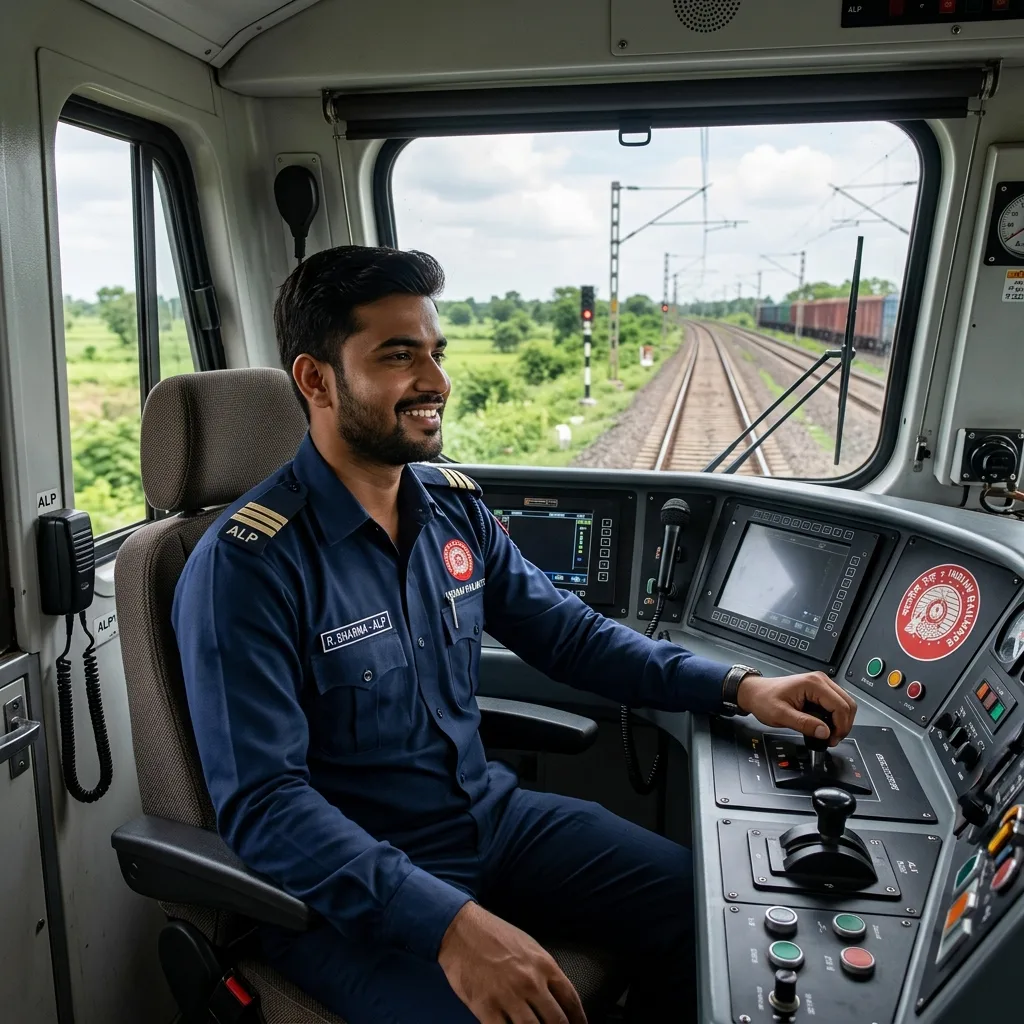
The Assistant Loco Pilot (ALP) is the entry point to this career. It is a job that combines technical skill, safety responsibility, the thrill of operating a 5,000-horsepower locomotive, and the security of a permanent Central Government position.
RRB ALP CEN 01/2025 — Key Facts Right Now:
- CBT-2 Exam Date: July 28, 2026 — 15 days away
- Admit Card Expected: July 24, 2026
- City Intimation Slip: July 18, 2026
- Total Vacancies: 18,799 posts across all RRBs
- Basic Pay: Rs.19,900 (Level 2, 7th CPC)
- In-hand Salary with Running Allowance: Rs.28,000–38,000/month
- Official Website: rrbapply.gov.in
This guide covers everything from CBT-2 strategy and CBAT psycho test tips to what it actually feels like to drive a train across India.
Part 1: RRB ALP 2025 — Complete Recruitment Overview
What Is the ALP Post?
The Assistant Loco Pilot works alongside a senior Loco Pilot in the locomotive cab. The ALP monitors traction equipment, brakes, and signals. Assists the Loco Pilot during complex operations. Takes charge of locomotive in emergencies. Performs basic maintenance and checks at stations. Gradually gains experience to independently drive trains.
After gaining sufficient service and clearing departmental exams, the ALP becomes an independent Loco Pilot — driving passenger and express trains solo.
Vacancy Breakdown (CEN 01/2025):
| Zone / RRB | Approximate Vacancies |
|---|---|
| RRB Mumbai | 2,800+ |
| RRB Secunderabad | 1,900+ |
| RRB Chennai | 1,600+ |
| RRB Prayagraj (Allahabad) | 1,400+ |
| RRB Bhopal | 1,200+ |
| RRB Patna | 1,100+ |
| RRB Kolkata | 1,000+ |
| Other RRBs | 7,800+ |
| Total | 18,799 posts |
Eligibility Criteria:
| Parameter | Requirement |
|---|---|
| Educational Qualification | 10th pass + ITI (Electrician, Electronics, Fitter, Mechanic) OR 10+2 with Physics and Maths OR Diploma in Engineering |
| Age Limit (General) | 18–28 years |
| Age Limit (OBC-NCL) | 18–31 years |
| Age Limit (SC/ST) | 18–33 years |
| Age Limit (PwBD) | 18–38 years |
| Medical | A-1 Medical Fitness (most stringent category) |
Part 2: Complete Selection Process — All 4 Stages
Stage 1: CBT-1 (Already Completed)
CBT-1 screening is done. Candidates who cleared CBT-1 are now preparing for CBT-2.
| Detail | Information |
|---|---|
| Questions | 75 questions |
| Duration | 60 minutes |
| Sections | Mathematics (20), Reasoning (25), General Science (20), Current Affairs (10) |
| Negative Marking | 1/3 mark deducted per wrong answer |
Stage 2: CBT-2 — July 28, 2026 (Most Important Stage)
CBT-2 is the merit-determining stage split into two parts:
Part A — Technical Knowledge (Merit-Based, 70% Weightage):
| Detail | Information |
|---|---|
| Questions | 100 questions |
| Duration | 90 minutes |
| Sections | Mathematics (25), Reasoning (25), Basic Science and Engineering (40), Current Affairs (10) |
| Negative Marking | 1/3 mark deducted per wrong answer |
| Weightage | 70% of final merit score |
Part B — Trade Test (Qualifying Only — 35% Minimum):
| Detail | Information |
|---|---|
| Questions | 75 questions |
| Duration | 60 minutes |
| Type | Qualifying — minimum 35% needed |
| Merit Impact | ZERO — only qualifying marks needed |
Stage 3: CBAT — Computer-Based Aptitude Test (Psycho Test)
- Minimum T-Score of 42 in EACH battery (5 batteries)
- 30% weightage to CBAT in final merit
- No negative marking
- Failing even one battery = total elimination
Stage 4: Document Verification + A-1 Medical Examination
Final gate — document check and strict railway medical at designated railway hospital.
Part 3: CBT-2 Strategy — 15-Day Plan (July 14–28)
Subject-wise Preparation Guide:
Basic Science and Engineering (40 marks — MOST IMPORTANT):
| Topic | Questions | Priority |
|---|---|---|
| Engineering Drawing and Symbols | 4–5 | Very High |
| Units and Measurements | 3–4 | Very High |
| Basic Electricity (Ohm's Law, Circuits) | 4–5 | Very High |
| Levers and Simple Machines | 3–4 | High |
| Occupational Safety and Health | 3–4 | High |
| Mass, Weight, Density, Force | 2–3 | High |
| Work, Power, Energy | 2–3 | High |
| Speed and Velocity | 2–3 | High |
| Heat and Temperature | 2–3 | Medium |
| Basic Electronics (Diodes, Transistors) | 2–3 | Medium |
| IT Literacy | 2–3 | Medium |
Mathematics (25 marks):
| Topic | Expected Questions |
|---|---|
| Percentage and Ratio | 3–4 |
| Time, Distance, Speed | 2–3 |
| Work and Time | 2–3 |
| Simple and Compound Interest | 2–3 |
| Number System, HCF, LCM | 2–3 |
| Algebra and Equations | 2–3 |
| Geometry and Mensuration | 3–4 |
Reasoning (25 marks):
| Topic | Expected Questions |
|---|---|
| Series (Number, Alphabet) | 3–4 |
| Analogies | 3–4 |
| Coding-Decoding | 2–3 |
| Blood Relations | 2 |
| Non-Verbal (Figures, Matrices) | 3–4 |
| Venn Diagrams | 2 |
15-Day Study Plan:
| Days | Focus |
|---|---|
| Day 1–3 | Basic Science and Engineering — complete revision |
| Day 4–5 | Mathematics — all formulas and 3 practice sets |
| Day 6–7 | Reasoning — 50 questions daily practice |
| Day 8 | Trade test Part B — quick 90-minute revision (35% is enough) |
| Day 9–10 | Current Affairs — last 2 months compilation |
| Day 11–12 | Full-length mock tests (100 questions in 90 min) |
| Day 13 | Weak area analysis and targeted revision |
| Day 14 | Final revision of formulas and key concepts |
| Day 15 (July 27) | Rest day — logistics preparation, light revision |
Exam Day Strategy:
- Attempt order: Reasoning first (fastest) → Mathematics → Basic Science → Current Affairs
- Time allocation: 90 min for 100 questions = 54 seconds per question
- Safe attempt target: 75–80 questions with 85%+ accuracy
- Negative marking: Skip only if less than 40% confident
- Target score (General category): 68+ out of 100 for safe merit
Part 4: Admit Card — July 24, 2026
How to Download Admit Card:
- Visit your regional RRB official website
- Click on "CEN 01/2025 ALP CBT-2 Admit Card"
- Enter Registration Number and Date of Birth
- Download and print (colour or B&W both accepted)
- Carry original photo ID (Aadhaar preferred)
All RRB Regional Websites:
| RRB | Website |
|---|---|
| Mumbai | rrbmumbai.gov.in |
| Secunderabad | rrbsecunderabad.nic.in |
| Chennai | rrbchennai.gov.in |
| Prayagraj | rrbprayagraj.nic.in |
| Bhopal | rrbbhopal.nic.in |
| Patna | rrbpatna.gov.in |
| Kolkata | rrbkolkata.gov.in |
| Ahmedabad | rrbahmedabad.gov.in |
| Chandigarh | rrbcdg.gov.in |
| Bangalore | rrbbnc.gov.in |
| Bhubaneshwar | rrbbbs.gov.in |
| Guwahati | rrbguwahati.gov.in |
| Ranchi | rrbranchi.gov.in |
What to Carry on Exam Day:
- Printed admit card
- One original photo ID (Aadhaar, PAN, Driving Licence)
- One passport-size photograph
- Arrive at exam centre 60 minutes before the reporting time
- No calculators, mobile phones, or electronic watches allowed inside
Part 5: CBAT — Complete Psycho Test Guide (Most Feared Stage)
Why Does Indian Railways Conduct CBAT?
A Loco Pilot drives a train weighing 4,000–5,000 tonnes at speeds of 100–130 km/h. A wrong decision in a fraction of a second can cause derailments, collisions, or deaths. Indian Railways uses CBAT to ensure candidates have the necessary cognitive abilities — reaction time, sustained concentration, depth perception, memory — before entrusting them with this responsibility.
CBAT is NOT a test of knowledge. It is a test of how your brain works naturally under pressure.
CBAT — 5 Test Batteries:
Battery 1: Memory Test
What it tests: Working memory — ability to hold and recall sequences of digits or symbols.
Format: A sequence of digits or symbols is shown. After a delay, recall them correctly.
How to prepare: Daily number memorisation — start with 7-digit sequences, gradually increase to 10–12 digits. Use chunking: memorise 456-789-012 as three groups instead of nine individual digits.
Battery 2: Following Directions Test
What it tests: Ability to follow complex multi-step instructions accurately and quickly.
Format: Complex verbal or visual instructions — example: "If the red light blinks 3 times, press key 4, but only if the counter shows above 60."
How to prepare: Practice multi-step direction exercises. Read complex instructions and execute them mentally before touching the keyboard.
Key tip: Read EVERY instruction completely before acting. Do not rush.
Battery 3: Depth Perception Test
What it tests: Ability to judge distances and spatial relationships accurately.
Format: Moving objects on screen — judge which is closer, or when two moving objects will collide.
Relevance: Loco Pilots must judge when to apply brakes based on distance to signals, stations, and level crossings.
Key tip: Trust your first instinct — overthinking depth perception reduces accuracy significantly.
Battery 4: Concentration Test
What it tests: Sustained attention over time — staying focused despite monotony.
Format: Identify specific patterns or signals from a continuous stream of information over 10–15 minutes.
Challenge: Fatigue sets in after 8–10 minutes — concentration naturally drops.
How to prepare: Daily 15-minute number matrix exercises. Visual cancellation tasks (cross out all "3s" in a 10x10 number grid as fast as possible).
Key tip: Do not skip breakfast on CBAT day — blood sugar directly affects concentration performance.
Battery 5: Perceptual Speed Test
What it tests: Speed and accuracy of processing visual information.
Format: Quickly identify identical or matching symbols, letters, or patterns from a set.
How to prepare: Speed reading exercises, visual discrimination tasks.
Key tip: Balance accuracy and speed — wrong answers may hurt your T-score.
CBAT Scoring — T-Score of 42 Explained:
Indian Railways uses standardised T-Scores — not raw marks — for CBAT:
| T-Score | Meaning |
|---|---|
| Below 42 | FAIL — eliminated from selection regardless of CBT-2 score |
| 42–49 | Pass — average performance |
| 50 | Exactly average (mean of population) |
| 50–59 | Above average — good CBAT contribution to merit |
| 60–70+ | Excellent — significantly boosts final merit score |
Final Merit Formula:
- CBT-2 Part A score (normalised to 70) + CBAT average T-score (normalised to 30) = Final 100-mark score
- Example: CBT-2 75/100 → 52.5/70. CBAT T-score 58 → (58/100 x 30) = 17.4/30. Final = 69.9/100
A high CBAT T-score can help a lower CBT-2 scorer beat a higher CBT-2 scorer. CBAT preparation is NOT optional.
CBAT Preparation — 10-Day Plan (After CBT-2 Result):
| Day | Activity |
|---|---|
| Day 1–2 | Memory drills: 30 min morning + 30 min evening digit memorisation |
| Day 3–4 | Following directions: complex multi-step instruction exercises |
| Day 5 | Depth perception exercises: 20 min online 3D perception tasks |
| Day 6–7 | Concentration: 15-minute sustained number/symbol cancellation tasks |
| Day 8–9 | Perceptual speed: symbol matching as fast and accurately as possible |
| Day 10 | Full mock CBAT simulation (available on coaching platforms) |
CBAT Critical Rules:
- No negative marking — attempt every question in every battery
- T-Score of 42 is mandatory in EACH battery — one failure = elimination
- Cannot reappear for CBAT in same cycle if you fail
- Practice on computer screen — CBAT is computer-based, not paper-based
Part 6: A-1 Medical Standard — Complete Guide
Vision Requirements (Most Critical):
| Test | Requirement |
|---|---|
| Distant Vision (each eye) | 6/6 WITHOUT glasses or contact lenses |
| Near Vision (each eye) | Sn 0.6 WITHOUT glasses |
| Binocular Vision | Both eyes working correctly together |
| Field of Vision | Full normal visual field in both eyes |
| Night Vision | Must pass low-light vision test |
| Colour Vision | Must pass Ishihara test — no colour blindness |
| LASIK or Refractive Surgery | STRICTLY DISQUALIFYING — no exceptions |
LASIK Warning: If you have had LASIK surgery — even if your current vision is a perfect 6/6 — you are medically ineligible for the ALP post. The surgery permanently alters the corneal structure, disqualifying you from A-1 medical category regardless of outcome. This is the most common hidden disqualification reason.
Other Medical Requirements:
| Area | Requirement |
|---|---|
| Height | Minimum 158 cm (male), 150 cm (female) |
| Blood Pressure | Normal range (90/60 to 140/90 mmHg) |
| Hearing | Whispered voice at 6 metres in each ear |
| Cardiovascular | No heart murmur or arrhythmia |
| Diabetes | Insulin-dependent: disqualifying. Diet-controlled: may be accepted |
| Colour Blindness | Any degree is disqualifying |
| Varicose Veins | Disqualifying if severe and symptomatic |
| Epilepsy / Psychosis | History is disqualifying |
A-1 vs A-2 vs A-3 Comparison:
| Standard | Required For | Vision | Key Point |
|---|---|---|---|
| A-1 | ALP, Loco Pilot | 6/6 without glasses | Most strict — no spectacles allowed |
| A-2 | Station Master, Guard | 6/9 (one eye may be 6/12) | Glasses allowed for correction |
| A-3 | Ticket Collector, Clerk | 6/12 with correction | Relaxed — more candidates qualify |
How to Prepare for A-1 Medical:
- Avoid alcohol for 72 hours before medical examination
- Get 8+ hours sleep the night before — sleep deprivation worsens vision test scores
- Avoid heavy exercise the day before — blood pressure should be resting
- Eat normally — do not fast (low blood sugar affects alertness)
- Do NOT wear contact lenses on medical day
Part 7: RRB ALP Salary — Complete Breakdown with Running Allowance
Basic Pay and Standard Allowances:
| Component | Amount |
|---|---|
| Basic Pay (Level 2) | Rs.19,900 |
| Dearness Allowance (50%) | Rs.9,950 |
| HRA — X City (27%) | Rs.5,373 |
| HRA — Y City (18%) | Rs.3,582 |
| HRA — Z City (9%) | Rs.1,791 |
| Transport Allowance | Rs.1,350–3,600 |
| Running Allowance | Rs.4,000–8,000/month |
Running Allowance — The Unique ALP Salary Booster:
Running Allowance is paid per kilometre driven — a mileage-based component unique to loco running staff:
| Category | Rate per 100 km |
|---|---|
| ALP | Rs.520 approx |
| Loco Pilot (Goods) | Rs.610 |
| Loco Pilot (Passenger) | Rs.680 |
| Loco Pilot (Mail/Express) | Rs.780 |
Example Calculation:
- ALP runs 1,000 km in a month: 1,000 / 100 x Rs.520 = Rs.5,200 Running Allowance
- ALP runs 1,400 km in a month: Rs.7,280 Running Allowance
Complete In-Hand Salary (Y-City Posting):
| Component | Amount |
|---|---|
| Basic Pay | Rs.19,900 |
| DA (50%) | Rs.9,950 |
| HRA — Y City | Rs.3,582 |
| Transport Allowance | Rs.1,350 |
| Running Allowance (1,000 km avg) | Rs.5,200 |
| Gross | Rs.39,982 |
| Less: NPS (10% of Basic + DA) | -Rs.2,985 |
| Less: Income Tax | -Rs.1,200 |
| Less: Other Deductions | -Rs.800 |
| Net In-Hand | Rs.34,997/month |
Salary Growth as Career Progresses:
| Designation | Pay Level | Basic Pay | Running Allowance | Approx In-Hand |
|---|---|---|---|---|
| ALP (Entry) | Level 2 | Rs.19,900 | Rs.4,000–7,000 | Rs.30,000–38,000 |
| ALP Senior (3 yrs) | Level 2 (increment) | Rs.21,700 | Rs.4,500–8,000 | Rs.33,000–42,000 |
| Loco Pilot (Goods) | Level 5 | Rs.29,200 | Rs.7,000–12,000 | Rs.48,000–60,000 |
| Loco Pilot (Passenger) | Level 6 | Rs.35,400 | Rs.9,000–15,000 | Rs.58,000–75,000 |
| LP (Mail/Express) | Level 6 | Rs.35,400+ | Rs.12,000–18,000 | Rs.65,000–85,000 |
| Loco Inspector | Level 7 | Rs.44,900 | Rs.0 (desk) | Rs.72,000–88,000 |
Free Railway Pass — Hidden Salary Worth Lakhs:
| Benefit | Detail |
|---|---|
| Free Railway Pass | ALP and family (spouse + 2 children + dependent parents) — free travel anywhere in India in ALL classes |
| Privilege Pass | 6 sets of Privilege Passes per year in AC classes |
| Railway Hospital | Free medical for self and entire family at all railway hospitals |
| Running Room | Free accommodation during outstation duty |
| Subsidised Canteen | Meals at Rs.40–80 per meal at Railway canteens |
| Uniform | Free uniform issued annually |
| RELGIS Insurance | Group life insurance — Rs.15–50 lakh coverage at minimal premium |
| NPS Pension | 10% employee + 14% government contribution |
Economic value of free train travel: A family of 4 travelling twice a year in 3AC saves Rs.30,000–50,000 annually. Over 30 years: Rs.9–15 lakh in travel savings alone.
Part 8: Loco Pilot Career Progression — ALP to Loco Inspector
Complete Career Ladder (30-Year Journey):
Step 1 — ALP (Year 0–3): Pay Level 2. Works alongside senior Loco Pilot in cab — monitoring instruments, assisting operations. Undergoes 12-month initial training program. Mandatory A-1 medical renewal every 3 years.
Step 2 — Senior ALP / Shunting Loco Pilot (Year 3–7): Pay Level 3 (Rs.21,700). Can drive shunting locomotives independently in railway yards. Still assists on mainline passenger and goods trains.
Step 3 — Loco Pilot (Goods) (Year 7–12): Pay Level 5 (Rs.29,200). Independently drives freight trains — coal, cement, petroleum goods. Runs 80–120 km per trip. Running Allowance increases significantly. First time your name appears on the engine as "Driver."
Step 4 — Loco Pilot (Passenger) (Year 12–18): Pay Level 6 (Rs.35,400). Drives passenger trains — local, intercity, some express trains. More predictable schedule than goods operations. Carrying human lives — highest responsibility.
Step 5 — Loco Pilot (Mail/Express) (Year 18–25): Pay Level 6 (with increments to Rs.56,900). Drives Rajdhani, Shatabdi, Mail/Express trains at 110–130 km/h. High-speed premium routes. Peak of the Loco Pilot career — the most respected designation.
Step 6 — Power Controller (Year 20+): Pay Level 7 (Rs.44,900). Desk-based management role — crew scheduling, locomotive allocation, power plans. No more field driving duty.
Step 7 — Loco Inspector / Traction Inspector (Year 22+): Pay Level 7 (Rs.44,900). Inspects and mentors ALPs and LPs. Conducts safety audits and quality checks. Posted at Division headquarters. Comes full circle — now teaching what you were once taught.
Part 9: A Day in the Life of an Assistant Loco Pilot
Typical Duty Cycle (Long-Run Goods Train):
4:00 AM — Report for Duty: Report at Crew Booking Office. Receive duty order — train number, route, departure time. Read briefing board — speed restrictions, track maintenance caution orders. Sign physical fitness declaration. Drive to locomotive shed.
4:45 AM — Pre-Departure Inspection: Inspect locomotive with senior Loco Pilot. Check brake pipe pressure, brake system, horn, headlight, tail light. Check fuel (diesel) or pantograph condition (electric). Sign Pre-Trip Inspection register. Move locomotive to departure platform.
5:30 AM — Depart with Train: Couple locomotive to goods wagons. Brake power certification from Guard. Receive authority to proceed from Station Master. Proceed on route. ALP monitors instruments (speedometer, brake pressure, temperature gauges, signal aspects).
During 400 km Journey (8–10 hours): Continuous signal observation — green (proceed), yellow (caution), double yellow (be prepared to stop), red (stop). Speed checks at permanent and temporary restrictions. Horn at every level crossing (400m advance). Monsoon vigilance — flooding, slip weather.
Arrival and Stabling: Stable locomotive at destination shed. Update Loco History Card (maintenance log). Handover to incoming crew.
Outstation Rest at Running Room: 8–16 hours mandatory rest. Subsidised meals. Rest before return journey.
What Makes the Job Exciting:
- Driving a 5,000-horsepower locomotive — raw mechanical power
- Seeing India from the unique perspective of the engine cab — forests, mountains, rivers, cities
- High responsibility — millions of tonnes of freight, hundreds of passengers
- Brotherhood of loco pilots — unique camaraderie of running staff
- Free travel throughout India — the country becomes your backyard
What Makes the Job Challenging:
- Irregular hours — duty at 2 AM starts, midnight returns, no weekends
- Away from home — outstation duty means nights away from family
- High-stakes responsibility — safety is paramount, mistakes are unacceptable
- Weather extremes — monsoon floods, extreme heat in locomotive cab
- Night duty fatigue — long-duration alertness requirement
Part 10: Posting Zones — Where Do ALPs Get Posted?
Zone-wise Posting:
| Zone | HQ | States Covered |
|---|---|---|
| Northern Railway (NR) | New Delhi | Delhi, Haryana, Punjab, HP, UK, UP (part) |
| North Central Railway (NCR) | Prayagraj | UP (central), MP (part) |
| North Eastern Railway (NER) | Gorakhpur | Eastern UP, Bihar |
| Eastern Railway (ER) | Kolkata | West Bengal, Jharkhand |
| South Eastern Railway (SER) | Kolkata | Odisha, Jharkhand, WB south |
| South Central Railway (SCR) | Secunderabad | Telangana, AP, Maharashtra |
| Southern Railway (SR) | Chennai | Tamil Nadu, Kerala, Karnataka |
| Central Railway (CR) | Mumbai | Maharashtra, MP, Goa |
| Western Railway (WR) | Mumbai | Gujarat, Maharashtra, Rajasthan |
Transfer Policy: ALP cannot choose posting city at joining. Railway allocates based on vacancy. Initial postings are typically smaller divisions. With seniority (5+ years), transfer requests to preferred divisions become possible.
Part 11: ALP vs Other Railway Posts — Comparison
| Factor | ALP (Level 2) | Station Master (Level 6) | Group D (Level 1) |
|---|---|---|---|
| Qualification | 10th + ITI or Diploma | Graduate | 10th pass |
| Starting Basic Pay | Rs.19,900 | Rs.35,400 | Rs.18,000 |
| In-Hand with Perks | Rs.30,000–38,000 | Rs.55,000–70,000 | Rs.22,000–28,000 |
| Career Ceiling | Loco Inspector (Level 7) | Area Manager | Level 3 |
| Free Travel | YES — all classes | YES — all classes | Yes — 2nd class |
| Medical Standard | A-1 (strictest) | A-2 | B-1 |
| Nature of Work | Driving trains | Station operations | Track/station support |
| Night Duty | Yes — irregular | Yes — shifts | Yes |
| Job Thrill | Very High | Moderate | Low |
Part 12: Training After Selection
Training Program Structure:
| Phase | Duration | Location |
|---|---|---|
| Foundation Training | 4 weeks | Divisional Training Centre (DTC) |
| Technical Training | 16 weeks | Zonal Training Centres |
| On-the-Job Training (OJT) | 26 weeks | Home division — cab-based practical |
| Final Test and Certification | 2 weeks | DTC — written + practical exam |
| Total | Approx. 12 months |
Technical Modules Covered:
- Traction equipment — electric loco (WAP4, WAP7, WAG9) or diesel (WDM, WDP) systems
- Brake systems — vacuum, air, and electro-pneumatic brakes
- Complete Signal Rules of Indian Railways
- General Rules (GR) — the operating rule book
- Emergency procedures — brake failure, train parting, signal failure
- SPAD (Signal Passed at Danger) prevention
- Vigilance Control Device (VCD) — automatic safety brake system
- ATP (Automatic Train Protection) — modern safety systems
Training Stipend: During training, ALP receives 75% of basic pay (Rs.14,925/month). Full salary starts from certification date.
Frequently Asked Questions
Q1. What happens if I fail CBAT? If you score below T-42 in any one battery, you are eliminated from CEN 01/2025 selection entirely. You cannot reappear in the same cycle. However, you can apply in future RRB ALP recruitment cycles while within the age limit. Many candidates fail CBAT on first attempt and clear it in subsequent cycles with targeted preparation.
Q2. Can I get posting in my home state? Not guaranteed at joining, but Railways generally tries to post near home state. You may get posted anywhere within your recruited zone. With seniority (5+ years), transfer requests near home become possible.
Q3. Is there a height requirement for ALP? Yes — minimum 158 cm for male, 150 cm for female candidates. This is a medical requirement related to the physical demands of operating a locomotive.
Q4. If I wear spectacles, can I apply for ALP? No. A-1 medical standard requires 6/6 vision in both eyes WITHOUT any glasses or correction. If your unaided vision is less than 6/6 — you are not eligible for the ALP post, regardless of how well glasses correct your vision.
Q5. How long from CBT-2 to joining? Estimated timeline: CBT-2 Result (September 2026) → CBAT (October-November 2026) → Merit List (December 2026) → Document Verification (January-February 2027) → Medical (February-March 2027) → Training Start (April-May 2027). Total: approximately 9–11 months after CBT-2.
Q6. Can women apply for RRB ALP? Yes — no gender restriction. Women are eligible and have joined as Loco Pilots in Indian Railways. The same A-1 medical standard applies. Indian Railways has been actively increasing women in locomotive operations.
Q7. ALP vs Guard — which is better for an ITI graduate? For ITI holders, ALP is clearly better: higher career ceiling (reaches Level 7 vs Guard's Level 6-7), ALP can directly become LP (Guard cannot), running allowance is comparable, and the operational driving experience is unique to ALP. Guards have a higher starting pay (Level 5) but require graduation.
Q8. What is RELGIS insurance? RELGIS (Railway Employees Liberal Guarantee Insurance Scheme) provides group life insurance to all railway employees at low premium (Rs.200–500/month). Coverage ranges from Rs.15–50 lakh depending on grade. In case of death during service (including on-duty accidents), the family receives full insured amount immediately.
Conclusion: The Journey to Driving India's Trains Starts July 28
25 lakh people applied for 18,799 posts in RRB ALP CEN 01/2025 — a competition ratio of 133:1. But statistics miss one truth: the top 10% of seriously prepared candidates are the ones who actually qualify.
For CBT-2 on July 28:
- Focus all remaining days on Basic Science and Engineering (40 marks — the decider)
- Mathematics formula revision daily
- Do not ignore Current Affairs — easy 6–8 marks
- Get admit card ready at rrbapply.gov.in from July 24
For CBAT after CBT-2 result:
- Start psycho test practice immediately
- Minimum T-42 in EACH battery — practice all five
- CBAT eliminates 20–30% of otherwise qualified candidates — do not underestimate it
At Medical Examination:
- A-1 is strict — LASIK surgery is permanently disqualifying
- 6/6 unaided vision in both eyes is mandatory — no exceptions
Part 13: Zone-wise CBT-2 Cut-off Analysis — What Score Do You Need?
Understanding historical cut-offs helps set realistic score targets:
RRB ALP CBT-1 Cut-off (2018 cycle — last completed cycle — for reference):
| Category | Cut-off (Out of 75) |
|---|---|
| General | 49–55 |
| OBC (NCL) | 44–50 |
| SC | 38–45 |
| ST | 32–40 |
| PwBD (Visual) | 28–35 |
Expected CBT-2 Part A Cut-off (2025 cycle prediction — 100 marks):
| Category | Predicted Safe Score |
|---|---|
| General | 68–75 |
| OBC (NCL) | 60–68 |
| SC | 52–60 |
| ST | 45–54 |
| EWS | 65–72 |
Zone-wise variation: RRB Mumbai, Chennai, and Secunderabad typically have higher cut-offs (more applicants, fewer vacancies per head). RRB Patna, Ranchi, and Siliguri tend to have lower cut-offs. Check your zone's specific vacancy count to estimate your zone's competition.
How Final Merit Score Is Calculated — Real Examples:
Example A — Strong CBT-2, Average CBAT:
- CBT-2 Part A: 78/100 → Normalised to 70: (78/100 x 70) = 54.6/70
- CBAT T-Score Average: 48 → (48/100 x 30) = 14.4/30
- Final Score: 54.6 + 14.4 = 69.0/100
Example B — Average CBT-2, Strong CBAT:
- CBT-2 Part A: 70/100 → Normalised: (70/100 x 70) = 49.0/70
- CBAT T-Score Average: 62 → (62/100 x 30) = 18.6/30
- Final Score: 49.0 + 18.6 = 67.6/100
Example C — Strong in both (Topper Profile):
- CBT-2 Part A: 88/100 → (88/100 x 70) = 61.6/70
- CBAT T-Score Average: 65 → (65/100 x 30) = 19.5/30
- Final Score: 61.6 + 19.5 = 81.1/100 — Top merit list rank
Key Takeaway: A T-Score of 62+ in CBAT combined with a CBT-2 score of 70+ puts you in the top 10–15% of candidates nationally. Both stages matter equally in practice.
Score to Attempt Ratio Strategy:
| CBT-2 Score Target | Attempts Needed | Accuracy Required |
|---|---|---|
| 75/100 (Top 5%) | 85+ attempts | 88%+ accuracy |
| 70/100 (Top 15%) | 80+ attempts | 87%+ accuracy |
| 65/100 (Cut-off range) | 75+ attempts | 86%+ accuracy |
| 60/100 (Below cut-off) | Any | Below safe zone |
Part 14: Basic Science and Engineering — Deep Dive (40 Marks Master Guide)
This is the most unique and most differentiating section of RRB ALP CBT-2. Most candidates prepare inadequately for it. Here is your complete master reference:
Engineering Drawing (4–5 Questions):
Engineering Drawing is a subject where most ITI graduates have an advantage. Non-ITI candidates must study basics:
Most Tested Topics:
- First angle vs Third angle projection symbols — know both symbols by heart
- Types of lines: continuous thick (visible edges), continuous thin (dimension lines), dashed (hidden edges), chain (centre lines)
- Orthographic projection — front view, top view, side view relationships
- Isometric projection — 3D representation on 2D plane
- BIS (Bureau of Indian Standards) — standard conventions in engineering drawing
- Scales: RF (Representative Fraction) = Drawing size / Actual size
- Dimensioning conventions — arrowheads, leaders, extension lines
Shortcut for Exam:
- First angle projection: Object between observer and projection plane (used in India and Europe)
- Third angle projection: Projection plane between observer and object (used in USA)
- Symbol for first angle = two circles with one truncated (cone shape left)
- Symbol for third angle = same shape but mirrored
Units and Measurements (3–4 Questions):
| System | Length | Mass | Time |
|---|---|---|---|
| CGS | centimetre (cm) | gram (g) | second (s) |
| MKS | metre (m) | kilogram (kg) | second (s) |
| SI (International) | metre (m) | kilogram (kg) | second (s) |
Key SI Units for ALP Exam:
| Quantity | SI Unit | Symbol |
|---|---|---|
| Force | Newton | N |
| Pressure | Pascal | Pa |
| Energy/Work | Joule | J |
| Power | Watt | W |
| Electric Current | Ampere | A |
| Voltage | Volt | V |
| Resistance | Ohm | Ω |
| Frequency | Hertz | Hz |
| Temperature | Kelvin | K |
| Luminous Intensity | Candela | cd |
Conversion formulas (tested often):
- 1 kWh = 3,600,000 Joules = 3.6 MJ
- 1 HP (Horsepower) = 746 Watts
- 1 bar = 10^5 Pascals = 100 kPa
- 0°C = 273 Kelvin; 100°C = 373 Kelvin
- 1 litre = 10^-3 cubic metres
Basic Electricity (4–5 Questions — Highest Scoring):
Ohm's Law and Circuits:
- Ohm's Law: V = I × R (Voltage = Current × Resistance)
- Series circuit: Total resistance R_total = R1 + R2 + R3 (resistances add up)
- Parallel circuit: 1/R_total = 1/R1 + 1/R2 + 1/R3 (reciprocals add)
- Power: P = V × I = I² × R = V²/R
Key Formulas:
| Formula | Variables |
|---|---|
| V = I × R | V=voltage(V), I=current(A), R=resistance(Ω) |
| P = V × I | P=power(W) |
| Energy = P × t | t=time in seconds, Energy in Joules |
| I = Q/t | Q=charge in Coulombs |
Kirchhoff's Laws (basics):
- KCL (Current Law): Sum of currents entering a junction = Sum of currents leaving
- KVL (Voltage Law): Sum of all voltages around a closed loop = 0
AC vs DC:
| Property | DC | AC |
|---|---|---|
| Direction | Unidirectional | Alternating (changes direction) |
| Source | Battery, solar cells | Generator, mains power |
| Frequency | Zero | 50 Hz in India |
| Transmission | Limited distance | Long distance (more efficient) |
| Used in | Electronics, vehicles | Household, industrial |
Transformers:
- Step-up: Increases voltage (fewer primary turns → more secondary turns)
- Step-down: Decreases voltage (more primary turns → fewer secondary turns)
- Turns ratio = V_primary / V_secondary = N_primary / N_secondary
Levers and Simple Machines (3–4 Questions):
Three Classes of Levers:
| Class | Fulcrum Position | Mechanical Advantage | Examples |
|---|---|---|---|
| Class 1 | Between load and effort | Can be >1, =1, or <1 | See-saw, scissors, pliers |
| Class 2 | Load between fulcrum and effort | Always >1 (MA > 1) | Wheelbarrow, nutcracker, bottle opener |
| Class 3 | Effort between fulcrum and load | Always <1 (MA < 1) | Tweezers, fishing rod, broom |
Mechanical Advantage (MA): MA = Load / Effort = Effort arm length / Load arm length
Other Simple Machines tested:
- Pulley: Single fixed — changes direction only. Single movable — MA = 2
- Inclined plane: MA = Length of slope / Height
- Wheel and axle: MA = Radius of wheel / Radius of axle
- Wedge and screw — related to inclined plane principle
Occupational Safety and Health (3–4 Questions):
Electrical Safety:
- Never work on live circuits — always isolate power first
- Earthing: Connecting equipment frame to ground — prevents electric shock
- Fuse and MCB (Miniature Circuit Breaker) — overload protection devices
- ELCB/RCCB — earth leakage protection
- Safe working voltage for human body: below 50V AC is generally considered safer
- PPE for electrical work: Rubber gloves, rubber-soled shoes, insulated tools
Fire Safety:
- Classes of fire: A (solids), B (liquids), C (gases), D (metals), E (electrical)
- Extinguisher types: Water (Class A), CO2 (Class B, E), DCP (Class A, B, C), Sand (metals)
- Never use water on electrical fire
- Fire triangle: Fuel + Oxygen + Heat — remove any one to extinguish
First Aid Basics:
- Electric shock victim: Do NOT touch with bare hands — disconnect power first
- CPR: 30 chest compressions + 2 rescue breaths (30:2 ratio)
- Burns: Cool with running water for 10 minutes — do not apply butter or oil
Mass, Weight, Work, Power, Energy (2–3 Questions each):
Core Formulas:
| Quantity | Formula | SI Unit |
|---|---|---|
| Weight | W = m × g (g = 9.8 m/s²) | Newton (N) |
| Work | W = F × d × cos θ | Joule (J) |
| Power | P = Work / Time | Watt (W) |
| Kinetic Energy | KE = ½ × m × v² | Joule (J) |
| Potential Energy | PE = m × g × h | Joule (J) |
| Pressure | P = Force / Area | Pascal (Pa) |
| Density | ρ = Mass / Volume | kg/m³ |
Newton's Laws of Motion (tested frequently):
- First law (Inertia): An object at rest stays at rest, an object in motion stays in motion unless acted upon by external force
- Second law: F = m × a (Force = mass × acceleration)
- Third law: Every action has an equal and opposite reaction
Basic Electronics (2–3 Questions):
Semiconductor Devices:
- Diode: Allows current in one direction only (forward biased). Blocks in reverse bias
- LED (Light Emitting Diode): Emits light when forward biased
- Transistor: NPN and PNP types. Acts as switch or amplifier
- Zener diode: Operates in reverse breakdown — used for voltage regulation
Number Systems:
| System | Base | Digits Used |
|---|---|---|
| Binary | 2 | 0, 1 |
| Octal | 8 | 0–7 |
| Decimal | 10 | 0–9 |
| Hexadecimal | 16 | 0–9, A–F |
Conversions (practice these):
- Binary to Decimal: (1101)₂ = 1×8 + 1×4 + 0×2 + 1×1 = 13
- Decimal to Binary: 13 = 8+4+1 = 1101₂
IT Literacy (2–3 Questions):
Computer Basics:
- RAM (Random Access Memory) — temporary, volatile storage
- ROM (Read Only Memory) — permanent, non-volatile storage
- HDD/SSD — permanent secondary storage
- 1 Byte = 8 bits; 1 KB = 1024 bytes; 1 MB = 1024 KB; 1 GB = 1024 MB
Internet and Networking:
- URL (Uniform Resource Locator) — web address
- HTTP vs HTTPS — HTTPS is encrypted (secure)
- IP Address — unique identifier for a device on network
- LAN (Local Area Network) — small area; WAN (Wide Area Network) — large area
Part 15: CBAT Practice Exercises — Sharpen Your Psycho Test Skills
Since CBAT is computer-based and not widely practised, here are sample exercises you can do on paper or screen to build the cognitive skills tested:
Exercise Set 1 — Memory Test Practice:
Exercise 1A (5 digits): Look at this number for 10 seconds: 47382 Cover it. Write it from memory. Check.
Exercise 1B (7 digits): Study for 15 seconds: 9 2 6 4 8 1 7 Cover. Recall. (Use chunking: 926 — 481 — 7)
Exercise 1C (Increasing difficulty — 10 digits): Study for 20 seconds: 5 3 8 2 9 1 6 4 7 0 Cover. Recall. (Group as: 538 — 291 — 647 — 0)
Daily practice: Start with 6-digit sequences. Add one digit every 3 days. By CBAT day, you should comfortably recall 9–11 digit sequences.
Exercise Set 2 — Following Directions (Multi-Step Instructions):
Exercise 2A: Instructions: "Write the number 5. If it is odd, multiply by 3. If the result is above 10, subtract 4. Write the final number."
Work through: 5 is odd → 5×3=15 → 15>10 → 15–4 = 11
Exercise 2B: "Start with 8. If even, divide by 2. Add the number of vowels in the word TRAIN. If total exceeds 5, write 'YES', else write 'NO'."
Work through: 8 is even → 8/2=4. TRAIN vowels: A, I = 2. 4+2=6. 6>5 → YES
Exercise 2C (Advanced): "Take the 3rd letter of RAILWAY. Convert it to its position in the alphabet. Divide by 2. If result is whole number, write it. If not, round up."
Work through: RAILWAY → 3rd letter = I. I = 9th position. 9/2 = 4.5. Not whole → Round up = 5
Daily practice: Create your own multi-step instruction exercises. The more complex the chain, the better you prepare for CBAT.
Exercise Set 3 — Concentration (Cancellation Task):
In the number grid below, find and mentally count all instances of the digit 7:
4 7 2 9 1 7 3 8 5 7
6 1 7 4 8 2 7 9 3 1
9 3 5 7 2 6 1 4 7 8
7 2 8 1 4 9 5 7 2 6
Answer: Count the 7s carefully. There are 11 sevens. Time yourself — aim for under 30 seconds with zero errors.
Daily concentration exercise: Take any newspaper. Set a timer for 5 minutes. Count a specific digit in any article. Progress to 10 minutes, then 15 minutes. Train your sustained attention.
Exercise Set 4 — Perceptual Speed:
In each row, identify which symbol EXACTLY matches the target. Respond as fast as possible:
Target: △▲ — Find the identical pair among: ▲△ | △▲ | ▲▲ | △△ Answer: △▲ (second option)
Target: K4 — Find: 4K | KA | K4 | K$ Answer: K4 (third option)
Daily practice: Visual discrimination puzzles (available free online). Aim to increase speed while maintaining zero errors. Speed comes from pattern recognition — the more you practise, the faster you identify matches automatically.
Part 16: Women in Indian Railways Loco Operations — A Rising Trend
Indian Railways has been actively recruiting and promoting women in locomotive operations — a traditionally male-dominated field. Here is the complete picture:
Women ALPs — Current Status:
- Indian Railways first recruited women as Loco Pilots in 2000
- As of 2025, approximately 6,000+ women Loco Pilots operate across all zones
- Western Railway (Mumbai) has the highest number of women loco pilots
- Many women have driven premium trains — Rajdhani, Shatabdi, Vande Bharat Express
Special Provisions for Women in Loco Operations:
| Provision | Detail |
|---|---|
| Maternity Leave | 180 days fully paid maternity leave — running duties adjusted accordingly |
| Child Care Leave (CCL) | 2 years cumulative over service career — no salary deduction |
| Night Duty | Night duties are rostered — not exempt, but Railways tries to balance shifts |
| Running Room | Women's separate Running Rooms provided at major junctions |
| Uniform | Women-specific uniform — salwar kameez or trouser with Indian Railways badge |
| Medical | Same A-1 medical standard — no relaxation in vision or physical requirements |
| Safety | Official escort/companion available for remote area running duties |
Inspirational Stories:
Surekha Yadav — India's First Woman Loco Pilot: Surekha Yadav from Maharashtra became India's first woman to drive a passenger train in 1988. In 2011, she became Asia's first woman to drive a metro train. In 2023, she drove the Vande Bharat Express — India's fastest train — making headlines globally.
Mumtaz Kazi — First Muslim Woman Loco Pilot: Mumtaz Kazi from Central Railway became the first Muslim woman to become a Loco Pilot, inspiring thousands of minority women aspirants across India.
Should Women Apply for RRB ALP?
Absolutely yes. The same eligibility, same selection process, same salary, same career growth. The only unique consideration is the operational nature of the job:
- Night duties will come
- Outstation duties will come
- Physical fitness requirement (height 150 cm minimum)
- A-1 medical is the same standard
Women who have served as Loco Pilots report that the job commands extraordinary respect — both at the workplace and in their communities. The sight of a woman at the controls of a Rajdhani Express is still powerful and inspiring.
Part 17: Important Indian Railways Rules Every ALP Must Know
During training and on-duty, ALPs must know the General Rules (GR) of Indian Railways. These are also tested indirectly in aptitude assessments:
Critical Safety Rules:
Rule for Passing a Red Signal (most serious rule): A Loco Pilot must NEVER pass a red signal without authority. If the signal does not clear within 3 minutes:
- Apply brakes — stop at signal
- Wait 3 minutes
- Proceed cautiously at 15 km/h maximum
- Prepared to stop at any obstruction
- Report to next station and obtain authority to proceed
SPAD (Signal Passed at Danger): This is the most serious disciplinary offence for a Loco Pilot. Even unintentional SPAD leads to:
- Suspension pending inquiry
- Departmental inquiry
- Possible demotion or dismissal
- Criminal prosecution in case of accident
Vigilance Control Device (VCD):
- A safety device installed in all modern locomotives
- Requires the Loco Pilot to acknowledge every 60 seconds (by pressing a button or pedal)
- If LP does not acknowledge for 60 seconds → automatic brake application
- This prevents accidents due to LP incapacitation (sleep, medical emergency)
Speed Rules (important for exam):
- Maximum speed of a goods train: 75 km/h (general freight)
- Maximum speed of passenger train: 120–130 km/h (depends on track rating)
- Rajdhani/Shatabdi: 130–160 km/h (on authorised sections)
- Vande Bharat Express: up to 180 km/h (on dedicated high-speed sections)
- Level crossing speed: 30 km/h (unmanned), 10–15 km/h (damaged gates)
- Caution order speed: As specified in the written caution order
Horn Codes (Loco Pilot must know all):
| Code | Situation |
|---|---|
| One long blast | Approaching a station, level crossing, tunnel, or obstruction |
| Two short blasts | When starting from station |
| Three short blasts | Emergency brake application |
| Four short blasts | LP needs assistance / breakdown |
| Two long blasts | Acknowledgement of signal from Guard |
| Continuous short blasts | Danger — stop immediately |
Communication Between LP and Guard:
- Guard gives brake power certificate before departure
- LP and Guard communicate via walkie-talkie on specified channel
- In case of train parting: Guard applies Brake Van brakes, LP applies Loco brakes simultaneously
Part 18: NPS Pension Calculator — What Will Your Retirement Corpus Be?
As a Central Government employee, ALP receives NPS (National Pension System) — not the old defined benefit pension. Understanding this helps plan your financial future:
How NPS Works for ALP:
| Component | Amount |
|---|---|
| Employee Contribution | 10% of (Basic Pay + DA) monthly |
| Government Contribution | 14% of (Basic Pay + DA) monthly |
| Total Monthly NPS Investment | 24% of (Basic + DA) |
For a new ALP (Basic Rs.19,900 + DA Rs.9,950 = Rs.29,850):
- Employee contributes: 10% × Rs.29,850 = Rs.2,985/month
- Government adds: 14% × Rs.29,850 = Rs.4,179/month
- Total NPS invested: Rs.7,164/month
Retirement Corpus Projection (30-Year Career):
| Starting Age | Retirement Age | Avg Monthly NPS | Assumed Return | Corpus at 60 |
|---|---|---|---|---|
| 24 years | 60 years | Rs.10,000 (increasing) | 10% CAGR | Rs.2.8–3.5 crore |
| 26 years | 60 years | Rs.10,000 (increasing) | 10% CAGR | Rs.2.2–2.8 crore |
| 28 years | 60 years | Rs.10,000 (increasing) | 10% CAGR | Rs.1.7–2.2 crore |
NPS at retirement: You must use 40% of the corpus to buy an annuity (pension). The remaining 60% is tax-free lump sum. On a Rs.3 crore corpus: Rs.1.2 crore buys annuity (monthly pension ~Rs.8,000–12,000/month), Rs.1.8 crore tax-free lump sum.
NPS Tier 1 vs Tier 2:
| Feature | Tier 1 (Mandatory) | Tier 2 (Optional) |
|---|---|---|
| Minimum Contribution | Rs.500/month | Rs.250/anytime |
| Withdrawal | Restricted until 60 | Anytime (like savings account) |
| Tax Benefit | Yes (Section 80C + 80CCD) | No additional tax benefit |
| Purpose | Retirement corpus | Additional savings |
Tax saving on NPS contribution:
- Section 80C: Up to Rs.1.5 lakh deduction (shared with other investments)
- Section 80CCD(1B): Additional Rs.50,000 deduction ONLY for NPS — total saving: Rs.2 lakh
Part 19: RRB ALP CBT-2 Previous Year Paper Analysis (2018 Cycle)
The last completed RRB ALP cycle (2018-19) provides the best reference for question patterns:
CBT-2 Part A — Topic-wise Questions Appeared (2018):
Mathematics (25 questions):
| Topic | Questions Asked |
|---|---|
| Percentage | 4 |
| Ratio and Proportion | 3 |
| Time and Work | 3 |
| Speed, Distance, Time | 3 |
| Simple Interest | 2 |
| Compound Interest | 2 |
| HCF and LCM | 2 |
| Number System | 2 |
| Mensuration (Area, Volume) | 2 |
| Algebra | 2 |
General Intelligence and Reasoning (25 questions):
| Topic | Questions Asked |
|---|---|
| Number and Alphabet Series | 5 |
| Analogies | 4 |
| Coding-Decoding | 4 |
| Non-Verbal Reasoning | 4 |
| Blood Relations | 3 |
| Venn Diagram | 2 |
| Directions | 2 |
| Puzzle | 1 |
Basic Science and Engineering (40 questions):
| Topic | Questions Asked |
|---|---|
| Basic Electricity | 6 |
| Engineering Drawing | 5 |
| Units and Measurements | 5 |
| Work, Power, Energy | 4 |
| Simple Machines (Levers, Pulleys) | 4 |
| Occupational Safety | 4 |
| Heat and Temperature | 3 |
| Basic Electronics | 3 |
| Speed, Velocity, Acceleration | 3 |
| IT Literacy | 2 |
| Environment | 1 |
General Awareness (10 questions):
| Topic | Questions Asked |
|---|---|
| Railway current affairs | 3 |
| Government schemes | 2 |
| Science and tech news | 2 |
| Sports | 1 |
| Awards and honours | 1 |
| Economy news | 1 |
Key Observations from 2018 Papers:
- Basic Electricity had highest weightage — 6 out of 40 Basic Science questions. Never skip Ohm's Law or circuit topics.
- Engineering Drawing questions were straightforward — mostly symbol identification and projection type. All candidates could score full marks with 2 hours of targeted preparation.
- Series questions in Reasoning were easiest — candidates who practised series scored 5/5 easily.
- Current Affairs was India/Railway specific — no international current affairs appeared.
- Calculation-heavy Maths questions came from TSD (Time, Speed, Distance) — practise shortcut methods.
Most Repeated Questions Across Shifts (2018):
| Question Type | Frequency |
|---|---|
| Ohm's Law — find current/resistance | Very High |
| First angle vs Third angle projection | Very High |
| Class of lever — identify from description | High |
| SI unit of power | High |
| Transformer turns ratio | High |
| AC frequency in India | High |
| Fire extinguisher type for electrical fire | High |
| Binary to Decimal conversion | Medium |
| Newton's second law application | Medium |
Part 20: RRB ALP Preparation Resources — Complete Study Material List
Books for CBT-2 Preparation:
| Subject | Book | Author/Publisher | Why Use It |
|---|---|---|---|
| Mathematics | Fast Track Objective Arithmetic | Rajesh Verma (Arihant) | Comprehensive formulas + shortcuts |
| Reasoning | A Modern Approach to Verbal and Non-Verbal Reasoning | R.S. Aggarwal | Most complete reasoning book |
| Basic Electricity | Workshop Technology | S.K. Hajra Choudhary | Excellent electrical fundamentals |
| Engineering Drawing | Engineering Drawing | N.D. Bhatt | Standard textbook — too detailed; use summaries |
| Complete RRB ALP | RRB ALP and Technician CBT-2 Guide | Arihant Publications | All-in-one CBT-2 reference |
| Current Affairs | Monthly Current Affairs | Drishti / Lucent | Monthly compilation |
| Previous Year Papers | RRB ALP Solved Papers | Made Easy / GK Publications | 2018 papers with solutions |
Online Free Resources:
| Resource | Platform | Content |
|---|---|---|
| RRB Official Website | rrbapply.gov.in | Official syllabus, admit card, result |
| Khan Academy | khanacademy.org | Mathematics — free, excellent explanations |
| NCERT Class 9–10 Science | ncert.nic.in | Physics basics — free PDF download |
| Government Schemes | pmindia.gov.in | Official scheme information |
| Indian Railways Annual Report | indianrailways.gov.in | Railway-specific current affairs |
YouTube Channels for Free Preparation:
| Channel | Best For |
|---|---|
| Wifistudy (Unacademy) | Daily live classes — Math, Reasoning, GS |
| Adda247 Railways | RRB-specific preparation with mock tests |
| Drishti IAS | Current affairs in Hindi |
| Study91 (Nitin Sir) | Mathematics shortcuts in Hindi |
| Dear Sir | Reasoning — excellent channel |
Mock Test Series:
| Platform | Tests | Price | Recommended? |
|---|---|---|---|
| Testbook | 30+ RRB ALP mocks | Rs.299–499 | Yes — closest to actual pattern |
| Adda247 | 25+ mocks | Rs.249–399 | Yes — good analysis feature |
| Oliveboard | 20+ mocks | Rs.199–349 | Yes — good UI |
| RRB Official Sample | Free samples | Free | Must attempt — official pattern |
Part 21: Life After RRB ALP — Complete 35-Year Career Financial Planning
Understanding your full financial life as an ALP helps you make better decisions from day one:
Year-by-Year Financial Milestones:
Year 1–3 (ALP, Age 22–26):
- In-hand: Rs.30,000–35,000/month
- Priority: Emergency fund (6 months expenses), repay education loans if any
- NPS: Rs.7,000–8,000/month going into retirement corpus automatically
- Action: Open PPF account (additional retirement savings), buy term insurance
Year 5–8 (Senior ALP, Age 27–32):
- In-hand: Rs.35,000–42,000/month (increments + DA revision)
- Priority: Home loan EMI (use railway housing loan facility), family planning
- Railway Housing Loan: Central Government employees get subsidised housing loans through HBA (House Building Advance) at 7.9% rate
- Action: Increase PPF contribution, start SIP in equity funds
Year 10–15 (LP Goods, Age 32–40):
- In-hand: Rs.48,000–60,000/month
- Priority: Children's education planning, life insurance review
- Railway School: Children can attend Kendriya Vidyalayas (KV) at concessional fee — significant education saving
- Action: Children's education fund, health insurance top-up
Year 20–25 (LP Passenger/Express, Age 42–47):
- In-hand: Rs.65,000–85,000/month
- Priority: Pre-retirement planning — maximise NPS corpus
- Additional NPS: Voluntary contribution to Tier 2 NPS for extra retirement savings
- Action: Review and consolidate all investments
Year 30+ (Loco Inspector, Age 50–55):
- In-hand: Rs.80,000–95,000/month
- Priority: Final 5-year push for maximum NPS corpus growth
- Gratuity: Government service gratuity — up to Rs.20 lakh tax-free at retirement
- Action: Estate planning, nominate all accounts
Retirement Benefits Summary (At Age 60):
| Component | Estimated Amount |
|---|---|
| NPS Corpus | Rs.2.5–3.5 crore |
| Lump Sum (60% of corpus) | Rs.1.5–2.1 crore (tax-free) |
| Monthly Annuity (40% corpus) | Rs.8,000–15,000/month |
| Gratuity | Up to Rs.20 lakh (tax-free) |
| Leave Encashment | Rs.5–15 lakh (up to 300 days) |
| CGHS Medical | Lifetime free medical for self + spouse |
| Railway Pass (Privilege) | Continues post-retirement (Retired Railway Pass) |
| Total Retirement Package Value | Rs.2.5–3.5 crore + monthly pension |
Comparison: A private sector ITI graduate retiring at 60 typically has PF corpus of Rs.50–80 lakh (much lower due to lower salaries and employer contribution gaps). The total retirement package for an ALP is 4–5 times higher than a comparable private sector peer.
Part 22: Frequently Asked Questions (Extended)
Q9. Can I appear for RRB ALP and SSC CGL simultaneously? Yes — and many candidates do this strategically. SSC CGL is held in July-October annually. RRB ALP CBT-2 is now on July 28. If you are appearing for both in July 2026, you need to manage preparation carefully. The Common Ground: Mathematics and Reasoning are heavily overlapping. The Difference: SSC CGL has English Language (25 marks) and General Awareness (25 marks); ALP has Basic Science and Engineering (40 marks). Dedicate 2 hours daily for Basic Science + Engineering exclusively for ALP — this cannot be borrowed from SSC CGL preparation.
Q10. Is the Running Allowance tax-free? Running Allowance for Indian Railways running staff has a specific tax treatment: 70% of Running Allowance is tax-exempt (considered reimbursement of duty-related expenses). Only 30% of Running Allowance is treated as taxable income. Example: Rs.6,000 Running Allowance → Rs.4,200 tax-exempt + Rs.1,800 taxable. This makes the effective take-home even higher than the gross calculation shows.
Q11. What is the difference between ALP CEN 01/2025 and ALP CEN 02/2024? CEN numbers identify different recruitment cycles. CEN 01/2025 is the current ongoing cycle (CBT-2 on July 28, 2026) for 18,799 posts. CEN 02/2024 was an earlier cycle for Technician Grade 1 posts — a completely different position from ALP. Some candidates confuse the two. If you applied for ALP CEN 01/2025, your current exam is July 28 CBT-2.
Q12. Can I change my exam city preference before CBT-2? Generally, RRB does not allow exam city changes after the application period closes. However, the city for CBT-2 is allocated based on your application preference and availability. Check your admit card (releasing July 24) for the actual exam city. If the city is different from your preference and you have a genuine hardship (like long distance), contact your regional RRB helpline — in exceptional cases, RRB accommodates changes.
Q13. What is the probation period for new ALP? New ALP officers serve a 2-year probation period from the date of joining. During probation: Full salary is paid, NPS contributions continue, annual increment applies, service confirmation happens after successful probation completion (including training certification). Officers who fail departmental exams during training may face extension of probation or discharge.
Q14. Can ALP opt for CGHS (Central Government Health Scheme)? Yes. Railway employees are covered under the Railway Medical system (Railway hospitals and empanelled hospitals), not CGHS directly. However, this is equivalent or superior to CGHS in terms of coverage. Retired railway employees continue to get medical coverage at railway hospitals or can opt for CGHS if posted in a CGHS-covered city.
Q15. What happens if I am posted in a city where there is no railway hospital? In areas without a dedicated railway hospital, railway employees are treated at government hospitals under a referral system. For specialist treatment, railway employees are referred to the nearest Central Railway Hospital. Major surgeries and specialist treatments are available at all divisional railway hospitals.
Q16. Is there a physical fitness test (PFT) for RRB ALP beyond the medical? No separate physical fitness test (like running, push-ups) is required for RRB ALP selection. The physical requirements are assessed entirely through the A-1 Medical Examination — vision, hearing, blood pressure, general physical examination, and relevant medical tests. There is no written or practical running, strength, or endurance test.
Part 23: RRB ALP vs Competitive Exam Alternatives — Big Picture Decision
Many aspirants preparing for RRB ALP also consider other competitive exams. Here is an honest comparison to help make the right choice:
ALP vs SSC MTS vs India Post GDS vs Group D:
| Factor | RRB ALP | SSC MTS | India Post GDS | Railway Group D |
|---|---|---|---|---|
| Education Needed | 10th + ITI/Diploma | 10th pass | 10th pass | 10th pass |
| Pay Level | Level 2 (Rs.19,900) | Level 1 (Rs.18,000) | Rs.10,000–14,500 (TRCA) | Level 1 (Rs.18,000) |
| In-Hand Salary | Rs.30,000–38,000 | Rs.22,000–28,000 | Rs.12,000–18,000 | Rs.22,000–28,000 |
| Career Growth | Loco Pilot → Inspector | Havaldar → Tax Asst | Postmaster Grade | Sr. Maintainer |
| Job Nature | Operational driving | Multi-tasking support | Postal delivery | Track/station maintenance |
| Free Travel | Yes — all classes | No | No | Yes — 2nd class |
| Medical | A-1 (strict) | Normal | Normal | Relaxed |
| Pension (NPS) | 24% combined | 24% combined | 14% Govt only | 24% combined |
| Prestige | Very High (drives trains) | Moderate | Low | Low |
| Exam Difficulty | High (CBAT added) | Moderate | Low (merit-based) | Moderate |
| Best for | Technical ITI graduates | All 10th pass | Rural area aspirants | Non-technical 10th pass |
ALP vs Private Sector Diploma Engineer:
| Factor | RRB ALP | Private Company (Diploma Engineer) |
|---|---|---|
| Starting Salary | Rs.30,000–38,000/month | Rs.15,000–25,000/month |
| Job Security | Permanent — cannot be fired | Contract/permanent — retrenchment risk |
| Increment System | Annual guaranteed increment | Performance-based — may not happen |
| Travel Benefits | Free train travel for family | None |
| Medical | Free — railway hospital | Basic ESI or company health |
| Pension | NPS — significant corpus | EPF only — lower corpus |
| Weekends | No fixed — shift-based | Generally fixed |
| Promotion | Defined seniority-based path | Uncertain — depends on company |
| Social Respect | Loco Pilot — very high | Depends on company brand |
| At Age 60 (Retirement) | Rs.2.5–3.5 crore + free medical | Rs.50–80 lakh + no medical |
Verdict: For an ITI graduate or Diploma Engineer who clears the ALP exam, the Railway ALP career is significantly superior to private sector employment at every financial and security metric over a 30-year horizon.
Conclusion: The Journey to Driving India's Trains Starts July 28
Part 24: Indian Railways — Locomotives You Will Drive
As an ALP and later Loco Pilot, you will work with different types of locomotives across your career. Understanding them makes you a better aspirant and a better pilot:
Electric Locomotives (Most Common):
| Loco Class | Type | Max Speed | Power | Trains It Pulls |
|---|---|---|---|---|
| WAP-4 | AC Passenger | 140 km/h | 5,350 HP | Rajdhani, Mail Express (older) |
| WAP-5 | AC Passenger | 160 km/h | 6,000 HP | Rajdhani, Shatabdi (premium) |
| WAP-7 | AC Passenger | 140 km/h | 6,350 HP | Most Rajdhani, SF Express |
| WAG-9 | AC Freight | 100 km/h | 6,350 HP | Heavy goods — coal, cement |
| WAG-9H (3-Phase) | AC Freight | 100 km/h | 9,000 HP | DFCC heavy haul freight |
| WAG-12B (BHEL) | AC Freight | 120 km/h | 12,000 HP | World's most powerful! DFCC |
| WAP-8 | AC Passenger | 180 km/h | 7,200 HP | Vande Bharat loco version |
Diesel Locomotives (Gradually Phasing Out):
| Loco Class | Type | Max Speed | Power | Common Routes |
|---|---|---|---|---|
| WDM-3A | Diesel Mixed | 120 km/h | 3,100 HP | Non-electrified sections |
| WDM-3D | Diesel Mixed | 120 km/h | 3,300 HP | Northern and Eastern sections |
| WDP-4B | Diesel Passenger | 160 km/h | 4,000 HP | Fast passenger trains |
| WDP-4D | Diesel Passenger | 160 km/h | 4,000 HP | Tejas, some Shatabdi |
Vande Bharat Express — The Future of Loco Pilot Career:
Vande Bharat Express (Train 18) is India's fastest train — self-propelled (no separate locomotive). The "loco pilot" for Vande Bharat sits in a driver's cab at one end of the trainset:
| Feature | Detail |
|---|---|
| Maximum Speed | 180 km/h (commercial: 130–160 km/h currently) |
| Propulsion | Distributed Electrical Multiple Unit — no separate loco |
| Current Fleet | 100+ trainsets, expanding to 400+ by 2030 |
| Driver's Requirements | Special Vande Bharat driver training certificate |
| ALP Role | Vande Bharat has one pilot (no ALP per trainset) — future ALP posts shift |
| Career Impact | Loco Pilots trained on Vande Bharat become premium — preferred for new trainset deployment |
Bullet Train (Mumbai-Ahmedabad HSRC) — Impact on Career:
India's first High Speed Rail (bullet train) is under construction:
- Target speed: 350 km/h
- Technology: E5 Shinkansen from Japan
- Expected operational: 2027–2029
- Pilot requirements: Completely different training from conventional LP
- Salary premium: SHSRC (Shinkansen) pilots expected to receive 40–60% higher compensation
- Current ALP/LP joining the Railways now will be prime candidates for bullet train training in 5–10 years
Part 25: Railway Zone Hospitals and Medical Benefits — Complete Guide
One of the most undervalued benefits of being an ALP is the Railway Medical System — one of India's best government healthcare networks:
Railway Hospital Network:
| Zone | Major Railway Hospital | Location |
|---|---|---|
| Northern Railway | Rail Hospital, New Delhi | Connaught Place, Delhi |
| Central Railway | Central Railway Hospital | Byculla, Mumbai |
| Western Railway | Railway Hospital | Churchgate, Mumbai |
| Southern Railway | Railway Hospital | Ayanavaram, Chennai |
| South Central Railway | Railway Hospital | Secunderabad |
| Eastern Railway | Railway Hospital | Garden Reach, Kolkata |
| Northeast Frontier | Railway Hospital | Maligaon, Guwahati |
| South Eastern Railway | Railway Hospital | Garden Reach, Kolkata |
What Railway Medical Covers:
| Category | Coverage |
|---|---|
| OPD (Outpatient) | Free consultation, free medicines from railway dispensary |
| IPD (Inpatient) | Free hospitalization, surgery, nursing |
| Family Coverage | Spouse, dependent children (up to 18 years or 25 if studying), dependent parents |
| Specialist Referral | Referred to empanelled private hospitals if railway hospital cannot handle |
| Empanelled Private Hospitals | Major private hospitals in each city — costs reimbursed up to fixed CGHS rates |
| Mental Health | Railway hospitals have psychiatry departments — mental health support available |
| Eye Care | Spectacles, cataract surgery covered |
| Dental | Basic dental covered — extractions, fillings |
| Emergency | Any hospital in emergency — reimbursement later |
Annual Medical Renewal for Running Staff (ALP/LP):
Unlike office-based government employees, ALPs undergo mandatory annual medical renewal:
- A-1 medical renewed every 3 years (ages 18–45)
- After age 45: Every year
- After age 55: Every 6 months
- If medical fails after joining: Transferred to non-running duty (desk job) — salary protected
This means even after joining, if your vision deteriorates below A-1 standards, you are not dismissed — you are transferred to a non-running administrative role within Railways.
Part 26: Historical Cut-offs and Rank Analysis — RRB ALP
Zone-wise Vacancy Distribution (CEN 01/2025 approximate):
| Zone | Vacancies | Competition Level |
|---|---|---|
| RRB Mumbai (CR+WR) | 2,800+ | Very High |
| RRB Secunderabad (SCR) | 1,900+ | High |
| RRB Chennai (SR) | 1,600+ | High |
| RRB Prayagraj (NCR+NER) | 1,400+ | Moderate |
| RRB Bhopal (WCR+CWR) | 1,200+ | Moderate |
| RRB Patna (ECR) | 1,100+ | Low-Moderate |
| RRB Kolkata (ER+SER) | 1,000+ | Moderate |
| RRB Ahmedabad (WR part) | 900+ | Moderate |
| RRB Chandigarh (NR) | 850+ | High |
| RRB Bangalore (SWR) | 800+ | High |
| Other RRBs | 5,250+ | Varies |
CBT-2 Score Zones (Expected 2025 cycle):
| Score Range | Position | Action Needed |
|---|---|---|
| 85–100 | Top 1–2% — Exceptional | Certain selection in preferred zone |
| 75–84 | Top 5–10% — Excellent | Very likely ITI selection |
| 68–74 | Top 15–25% — Good | Selection likely in most zones |
| 60–67 | Borderline zone | Uncertain — depends on zone cut-off |
| Below 60 | Below safe zone | CBAT T-score must compensate |
Most Common Reasons for CBT-2 Failure:
Based on 2018 cycle analysis:
| Reason | Percentage of Failed Candidates |
|---|---|
| Poor Basic Science and Engineering preparation | 45% |
| Negative marking over-attempts | 25% |
| Insufficient time management | 15% |
| Trade Part B failure (below 35%) | 10% |
| Technical issues at exam centre | 5% |
Part 27: ALP vs Air Force Pilot — A Dream Comparison
Many aspirants wonder: "Should I join Railways as ALP or pursue Air Force pilot (Agniveer Vayu or AFCAT)?" Here is an honest comparison:
RRB ALP vs Indian Air Force Fighter/Transport Pilot:
| Factor | RRB ALP | Air Force Pilot (AFCAT Commission) |
|---|---|---|
| Educational Qualification | 10th + ITI or Diploma | Graduate (Science with Maths + Physics) |
| Age Limit | 18–28 years | 20–24 years (commissioned) |
| Starting Salary | Rs.19,900 basic + Rs.5,000+ RA | Rs.56,100 basic + flying allowance |
| In-Hand Salary | Rs.30,000–38,000/month | Rs.80,000–1,00,000/month |
| Flying Type | Electric/diesel locomotive at ground level | Fighter jets / transport aircraft at altitude |
| Medical Standard | A-1 (no spectacles) | PASL — even stricter than A-1 |
| Career Duration | 30–35 years (till 60) | 14–20 years commissioned service |
| Pension | NPS — corpus-based | Defence pension — 50% of last pay |
| Social Status | Loco Pilot — very high | Air Force Officer — extremely high |
| Risk Level | Moderate (railway safety) | Very High (combat, flying risks) |
| Selection Process | CBT-1, CBT-2, CBAT, Medical | AFCAT written, EKT, AFSB (5 days), Medical |
| Posting | Near home zone generally | All-India, remote airfields |
| Family Life | Good — stable postings | Frequent moves, remote postings |
Honest verdict: Air Force pilot has higher immediate salary and extreme prestige. But ALP offers much longer service, stable family life, and NPS corpus that rivals defence pension over 30+ years. If you clear both — Air Force pilot is the dream. But RRB ALP is a genuinely excellent career for ITI graduates who do not meet Air Force's graduate requirement.
Part 28: Famous Indian Loco Pilots — Inspiring Stories
Suresh Angadi — From LP to Railway Minister:
Suresh Angadi started his career as a Loco Pilot in Karnataka. Through dedication, community work, and political involvement, he rose to become the Union Minister of State for Railways in 2019. He is the most prominent example of the respect that the Loco Pilot community commands in India. He passed away in September 2020 — remembered as a minister who never forgot his roots as a driver.
Surekha Yadav — India's Trailblazing Woman LP:
Already mentioned earlier — but her achievement deserves emphasis. In 2023, she drove the Vande Bharat Express from Mumbai to Solapur — India's fastest train driven by a woman — making international headlines. She has inspired thousands of women to apply for RRB ALP positions.
C. Suresh — The 5 Crore Km Loco Pilot:
C. Suresh from Southern Railway completed over 5 crore (50 million) kilometres of service across 38 years — the highest by any Indian Loco Pilot. He drove trains from 1983 to 2021, operating through wars, riots, floods, and the COVID-19 pandemic. He received the National Safety Award from the Railway Ministry.
Unnamed Hero — Itarsi LP Who Stopped a Potential Disaster:
In 2019, an unnamed ALP at Itarsi Junction noticed unusual track vibration and applied emergency brakes, stopping a passenger train before it could derail on a compromised track. His quick response — within 2 seconds of detecting the anomaly — prevented what could have been a catastrophic accident. He received the General Manager's Safety Award.
These stories represent what the loco pilot career truly is — not just a government job, but a position of life-and-death responsibility that rewards competence, courage, and dedication.
Part 29: ITI Trade Part B — Subject-wise Preparation
Part B of CBT-2 is qualifying (minimum 35% = 26.25 marks out of 75). It tests knowledge of your ITI trade:
Electrician / Wireman Trade (Most Common Trade):
Key Topics and Expected Questions:
| Topic | Questions | Key Points to Know |
|---|---|---|
| Electrical circuits | 8–10 | Series-parallel, Ohm's law, Kirchhoff's laws |
| Transformers | 5–6 | Step-up/step-down, turns ratio, losses |
| Motors and Generators | 6–8 | AC/DC motors, EMF, Fleming's rules |
| Wiring systems | 4–5 | Conduit, CTS, PVC wiring methods |
| Measuring instruments | 4–5 | Ammeter, voltmeter, multimeter, energy meter |
| Safety rules | 3–4 | Earthing, fusing, isolation procedures |
| Installation standards | 3–4 | BIS standards, IS codes for electrical |
| Power factor | 2–3 | PF correction, capacitors |
Strategy: Electrician trade candidates typically score 55–70/75 in Part B. Focus on motors/generators (most questions) and measurement instruments (easy scoring).
Fitter / Machinist Trade:
| Topic | Questions | Key Points |
|---|---|---|
| Lathe machine operations | 8–10 | Turning, facing, boring, threading |
| Limits and fits | 5–6 | Tolerance, allowance, clearance/interference fit |
| Measuring tools | 6–7 | Vernier caliper, micrometer, dial gauge readings |
| Thread types and cutting | 4–5 | Metric, BSW, Acme threads |
| Welding basics | 3–4 | Arc welding, TIG, MIG, gas welding |
| Workshop safety | 3–4 | PPE, machine guarding |
| Heat treatment | 2–3 | Annealing, quenching, tempering |
Strategy: Fitter trade — practice Vernier caliper and micrometer reading questions daily. These appear every year and are easy marks.
Diesel Mechanic Trade:
| Topic | Questions | Key Points |
|---|---|---|
| IC Engine working | 8–10 | 2-stroke vs 4-stroke, diesel cycle |
| Fuel system | 6–7 | Injection pump, injectors, filters |
| Cooling system | 4–5 | Radiator, thermostat, coolant types |
| Lubrication | 4–5 | SAE grades, oil pump, sump |
| Clutch and gearbox | 4–5 | Single/multi-plate clutch, synchromesh |
| Brakes | 4–5 | Drum, disc, ABS basics |
| Electrical (vehicle) | 4–5 | Battery, starter motor, alternator |
Strategy: Focus on engine timing and fuel injection — highest weightage. Diesel Mechanic candidates often find Part B easiest — most score 55+/75 easily.
Electronics / Radio Mechanic Trade:
| Topic | Questions | Key Points |
|---|---|---|
| Semiconductor devices | 8–10 | Diode, transistor, thyristor, MOSFET |
| Amplifiers | 5–6 | CE, CB, CC configurations, gain |
| Oscillators | 3–4 | Colpitts, Hartley, RC phase shift |
| Digital electronics | 6–8 | Logic gates, flip-flops, counters, ADC/DAC |
| Communication systems | 5–6 | AM/FM modulation, receiver types |
| Power supplies | 4–5 | Rectifiers, filters, regulators (7805, 7812) |
| Microcontrollers basics | 2–3 | 8051 architecture basics |
Strategy: Digital electronics (logic gates) and semiconductor devices appear most frequently. Practice truth tables for all gate combinations.
Part 30: Mental Health and Fatigue Management for Loco Pilots
Running a train is one of the most mentally demanding jobs in India. Loco Pilots face unique psychological challenges that non-running staff never encounter:
The 5 Unique Mental Challenges of Loco Pilot Life:
Challenge 1: Hyper-Vigilance Fatigue A Loco Pilot must maintain 100% attention for 8–12 hours continuously. Unlike most jobs where brief mental wandering is harmless, a momentary lapse for a Loco Pilot can be catastrophic. This sustained hyper-vigilance creates a specific type of mental exhaustion called "vigilance fatigue."
Signs: Irritability after long duty, difficulty relaxing after duty, sleep problems despite physical tiredness.
Strategies:
- Pre-duty: 8 hours minimum sleep — non-negotiable
- During duty: Use VCD acknowledgement as forced attention reset (every 60 seconds)
- Post-duty: 30-minute decompression walk before reaching home
- Long-term: Regular conversation with fellow running staff — shared experience helps
Challenge 2: Incident Trauma Every Loco Pilot encounters incidents on the track — trespassers, level crossing accidents, animals on track. Some encounters result in fatalities. These experiences can cause PTSD (Post-Traumatic Stress Disorder) in some pilots.
Indian Railways Support:
- Indian Railway Welfare Organisation (IRWO) provides counselling
- Railway hospitals have psychiatry services
- Peers and senior pilots are the primary support network
- Post-incident mandatory rest with senior LP accompaniment on return duty
Challenge 3: Social Isolation Irregular duty hours mean Loco Pilots often miss family events, children's school functions, festivals. Outstation rest means nights away from home weekly.
Coping:
- Accept the schedule from Day 1 — mental preparation is key
- Communicate openly with family — they must understand the duty nature
- Use off-season months for intense family time
- Plan family activities around predictable duty patterns (goods train schedules are more regular)
Challenge 4: The Weight of Responsibility 2.3 crore passengers travel by Indian Railways daily. When driving a passenger train, the Loco Pilot carries the weight of hundreds of lives. This responsibility, while motivating, also creates anxiety in some pilots.
Managing it:
- Thorough pre-departure inspection builds confidence — "If I checked everything, I can focus on driving"
- Follow rules exactly — rule-following eliminates decision anxiety
- Trust the system — signals, tracks, schedules are maintained by thousands of Railway employees
Challenge 5: Career Uncertainty Anxiety Annual A-1 medical renewal means the career depends on maintaining perfect vision and health. Some pilots develop health anxiety as they age.
Practical management:
- Regular annual eye check BEFORE the mandatory medical — get early warning
- Maintain healthy lifestyle from Day 1 — smoking and alcohol affect vision long-term
- Know the transfer-to-non-running option — career security even if A-1 fails
Indian Railways' Mental Health Initiatives:
| Initiative | Purpose |
|---|---|
| IRWO Counselling | Individual counselling for running staff |
| Buddy System | Pairing new ALPs with senior mentors for first 6 months |
| PTSD Protocol | Mandatory de-briefing after any track incident |
| Yoga Centers | Railway Institutes have yoga and stress management programs |
| Running Room Improvements | Modern running rooms with Wi-Fi, TV, comfortable bedding — reduce isolation |
Part 31: RRB ALP Departmental Exam — Promotion from ALP to Shunting LP
The first departmental examination an ALP faces is for promotion to Shunting Loco Pilot and eventually Loco Pilot (Goods). Understanding it early helps you prepare from Day 1:
Structure of Departmental Examination:
| Paper | Subject | Marks | Duration |
|---|---|---|---|
| Paper 1 | Rules and Regulations (General Rules, Special Instructions) | 100 | 3 hours |
| Paper 2 | Technical — Traction equipment and systems | 100 | 3 hours |
| Practical | Driving assessment by Traction Inspector | Pass/Fail | — |
Key Topics for Rules Paper:
- General Rules (GR) of Indian Railways — complete book
- Special Instructions (SI) for your specific traction type
- Accident Manual — procedures for each type of accident
- Signal Regulation Manual — all signal aspects and procedures
- Working Time Table — train scheduling understanding
- Block Working Rules — how trains are authorized on single-line sections
Key Topics for Technical Paper:
For Electric Traction (WAP/WAG series):
- Pantograph operation and troubleshooting
- Traction Motor characteristics
- Regenerative Braking system
- High-Speed Circuit Breaker (HSCB) operation
- Auxiliary systems — compressor, battery charger, lighting
- Fault diagnosis and isolation procedures
For Diesel Traction (WDM/WDP/WDG series):
- Power plant — diesel engine operation
- Cooling and lubrication systems
- Dynamic braking operation
- Multiple unit (MU) operation
- Fault codes and troubleshooting
When Can You Appear?
- Minimum 2 years service as ALP
- Must have completed all mandatory route learning certificates
- Clear annual medical renewal
- No pending disciplinary proceedings
Tip: Start studying General Rules from your very first month of joining. Most new ALPs postpone this and then struggle when departmental exam approaches.
Part 32: Route Learning — An Essential ALP Responsibility
Before an ALP can drive independently on any route, they must complete Route Learning — an Indian Railways safety requirement:
How Route Learning Works:
Step 1 — Study Route Details: Obtain the route chart — showing every station, speed limit, gradient, level crossing, tunnel, and signal location on the assigned route.
Step 2 — Footplate Learning: Travel multiple times on the route in the driver's cab alongside an experienced Loco Pilot. Observe every signal, landmark, caution board, and special feature.
Step 3 — Route Examination: Written test by Senior Traction Inspector — questions on signal locations, speed restrictions, emergency procedures for that specific route.
Step 4 — Certificate Issue: ALP receives a Route Learning Certificate for that specific section. Only then authorized to drive on that route.
How Many Routes Must Be Learned?
- Initial posting: 2–4 routes (home base to nearby major junctions)
- After 3–5 years: 6–10 routes typically
- Senior LP: May hold 15–20 route certificates covering large division network
Tip: Route learning certificates accumulate throughout career. A LP with more route certificates gets preference for mail/express train duty — meaning higher running allowance and faster promotion visibility.
Part 33: RRB ALP 2025 — Last 7 Days Checklist (July 21–27)
With CBT-2 on July 28, here is your day-by-day final preparation checklist:
July 21 (7 days to go):
- Complete Basic Science revision — work through all engineering drawing symbols
- Download your city intimation slip from regional RRB website
- Confirm exam city and plan travel/accommodation
July 22 (6 days to go):
- Mathematics full revision — formulas only, no new problems
- Prepare a 1-page formula cheat sheet for last-day reference
- Verify your ITI trade knowledge — scan Part B syllabus
July 23 (5 days to go):
- Reasoning — attempt one full 25-question practice set
- Current Affairs: Railways news of last 3 months — new trains, route electrification, safety initiatives
- Check admit card availability (expected July 24)
July 24 (4 days to go — ADMIT CARD DAY):
- Download admit card from your regional RRB website from 10 AM onwards
- Print two copies — keep one at home, carry one to exam
- Verify: Name, registration number, photo, exam date, exam city, reporting time
- If any discrepancy: contact RRB helpline immediately
July 25 (3 days to go):
- Attempt one full-length CBT-2 mock test (90 min) — simulate exam conditions
- Review weak areas identified in the mock
- Physical preparation: Adequate sleep, avoid late nights
July 26 (2 days to go):
- Only revision — no new topics
- Pack exam kit: Admit card, photo ID, 2 passport photos
- Check exam centre location on Google Maps — note travel time and route
- Set TWO alarms for exam day morning
July 27 (1 day to go — REST DAY):
- Light revision only — 30 minutes formula glance
- DO NOT attempt full mock test — mental rest is more valuable
- Eat well, sleep by 9:30 PM (especially if exam is in morning shift)
- Confirm reporting time from admit card
July 28 (EXAM DAY):
- Wake up 2.5 hours before reporting time
- Eat light breakfast — avoid heavy food
- Reach exam centre 60 minutes before reporting time
- Inside exam: Attempt Reasoning first (fastest), then Maths, then Basic Science, then Current Affairs
- Maintain calm — breathe deeply between sections
- Do not leave early — use remaining time to review marked questions
Part 34: Complete List of Benefits — ALP vs Other Government Jobs
A side-by-side view of the full benefits package makes the ALP's true compensation clear:
ALP Benefits Checklist:
Monthly Salary Benefits:
- Basic Pay: Rs.19,900 (Level 2)
- Dearness Allowance: 60% = Rs.11,940
- HRA: 9–27% of Basic depending on city
- Running Allowance: Rs.4,000–8,000/month (unique to running staff)
- Night Duty Allowance: For night shifts
- Transport Allowance: Rs.1,350–3,600 + DA
Healthcare Benefits:
- Free OPD and IPD at Railway hospitals
- Coverage for spouse + dependent children + dependent parents
- Empanelled private hospitals for specialist care
- No health insurance premium — fully Railway-funded
Travel Benefits:
- Free Railway Pass (Privilege Pass): Travel anywhere in India — all classes
- 6 sets of Privilege Passes per year (AC class)
- 4 Complementary Passes per year
- Concessional passes for parents
- Value: Rs.40,000–70,000 per year at market rates
Housing Benefits:
- Running Room free accommodation during outstation duty
- Government quarter allotment (wait-list — 3–10 years at major stations)
- HRA drawn until quarter allotted — no housing expense during waiting period
Education Benefits:
- Kendriya Vidyalaya (KV) priority admission for children
- Children Education Allowance: Rs.2,250/month per child (max 2)
Retirement Benefits:
- NPS: 10% employee + 14% government monthly contribution
- Gratuity: Up to Rs.20 lakh (tax-free)
- Leave encashment: Up to 300 days
- Retired Railway Pass: Free travel continues after retirement
- Railway hospital access: Continues for self and spouse post-retirement
- RELGIS insurance: Group life insurance during service
Total Annual Monetary Value (Including All Benefits):
- Base salary: Rs.3,60,000–4,50,000/year
- Running Allowance: Rs.48,000–96,000/year
- Free travel value: Rs.40,000–70,000/year
- Health coverage value: Rs.30,000–50,000/year (if purchased privately)
- NPS corpus building: Rs.85,000–1,00,000/year (employee + govt combined)
- Effective Total Compensation (Year 1): Rs.5,63,000–7,66,000/year
This is significantly higher than most private sector jobs available to an ITI or Diploma holder at entry level.
Part 35: Most Important Questions Answered by Senior Loco Pilots
Questions collected from senior ALPs and LPs across various Railway zones:
"Is it boring to drive trains for 30 years?" Answer from LP Ramesh Kumar (NR, 22 years experience): "No two days are identical. Routes change. Seasons change. The monsoon crossing in Western Ghats feels completely different from a summer run through Rajasthan. You see India in a way no tourist ever does — from inside the locomotive cab. The responsibility keeps you engaged — you cannot be distracted even for a moment."
"What is the best part of being a Loco Pilot?" Answer from LP Priya Sharma (CR, 9 years experience): "The freedom pass. My family has travelled every major route in India — Shimla, Kashmir, Northeast, Kerala — all by train, all in AC classes. The stories we have from those trips — my children will remember them forever."
"What is the worst day you ever had as a Loco Pilot?" Answer from LP Sunil Verma (ER, 17 years experience): "There was a fog night in December 2018. Visibility was near zero. I was running a goods train through a section with 40+ level crossings. Every crossing, I slowed to 15 km/h, sounded the horn repeatedly, then slowly accelerated. That 6-hour journey felt like 60 hours. I cannot describe the relief when I finally handed over the train at the destination. But I did it safely. That matters."
"What advice would you give to a new ALP joining today?" Answer from LP Meena Devi (SCR, 5 years experience): "Learn the General Rules before everything else. Read them like a novel — not to memorize but to understand why each rule exists. Every rule was written because of an accident. When you understand that, you follow them naturally. And never skip your pre-departure inspection — even when you are tired, even when everyone is waiting."
"How has the job changed with modern technology?" Answer from LP Anirudh Pillai (SR, 13 years experience): "The VCD was the biggest change — it keeps you alert even on night duty. Kavach (automatic train collision avoidance) is being installed now. These technologies will make our job safer but also require us to be technically sharper. The LP of 2030 will need computer literacy that the LP of 2000 never needed."
Conclusion: The Journey to Driving India's Trains Starts July 28
The engine whistle sounds. The green signal shows. India's railways need skilled, alert, and dedicated loco pilots.
Check admit card at your regional RRB website from July 24, 2026. Best of luck for CBT-2 on July 28.
Stay updated with RRB ALP admit card releases, CBAT dates, medical standards, and railway recruitment news at Government Job Result — India's most trusted government career resource.
Disclaimer: All vacancy counts, exam dates, salary figures, and medical standards are based on official RRB notifications (CEN 01/2025) and Indian Railways 7th CPC rules as of July 2026. Candidates must verify all exam dates from their official regional RRB website before travelling to examination centres.