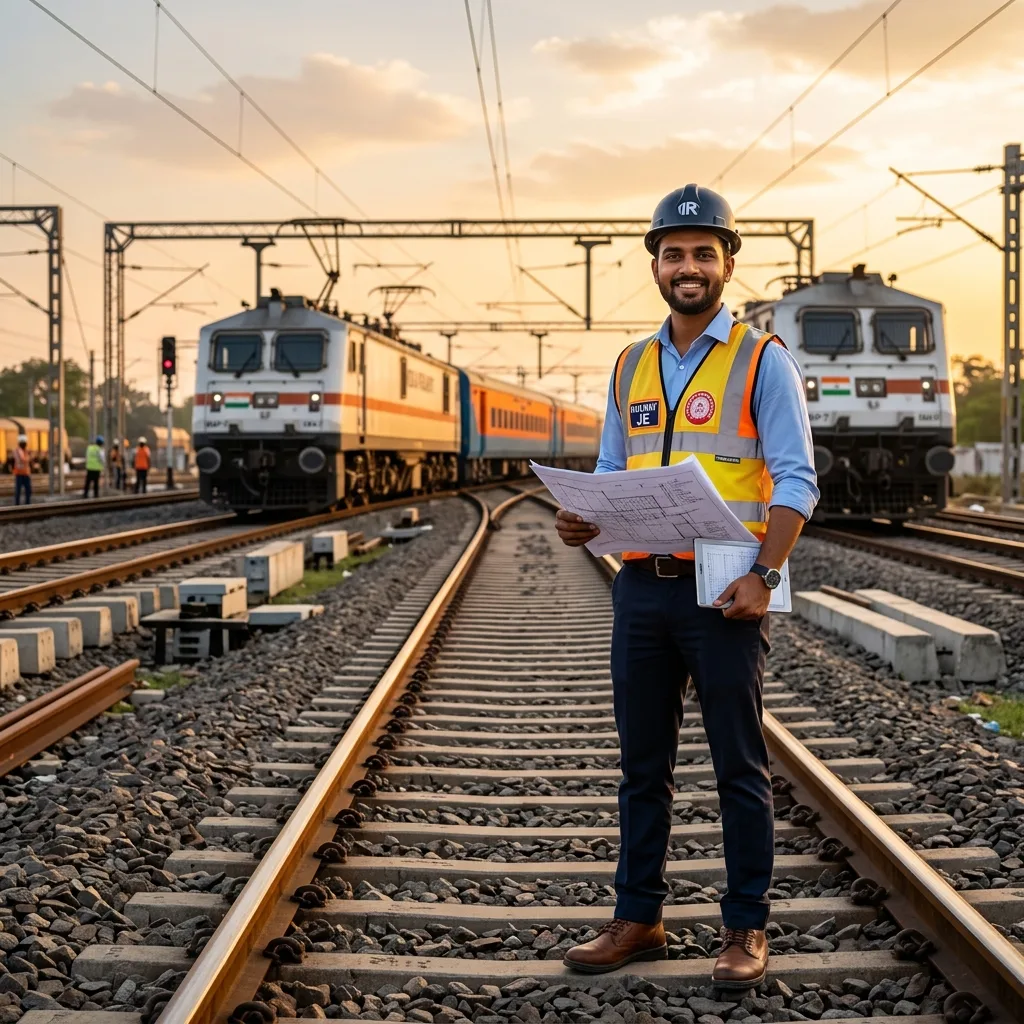
Introduction: Section Controller — Railway's Most Critical Operational Role
Out of India's 13 lakh railway employees, the Section Controller is perhaps the LEAST visible but MOST critical. They never drive a train. They never handle tickets. They never work on the platform. But without them — not a single train moves safely.
A Section Controller sits in an Indian Railways Divisional Control Room and manages the movement of EVERY train in their assigned section — sometimes 200+ trains passing through 50-100 km of track during a single 8-hour shift. They are the brain of Indian Railways' traffic management — making split-second decisions that determine whether the 12301 Howrah-Mumbai Mail runs on time, or whether the Rajdhani Express clears a signal safely before the goods train arrives from the opposite direction.
This is India's best-kept railway career secret. 119 posts. Level 6 salary. Graduate eligible. Application closes August 14, 2026.
Why Section Controller stands out:
- Level 6 pay from Day 1 — Rs.35,400 basic (same as SSC CPO Sub-Inspector) — for a GRADUATE-level railway exam
- CBAT (unique aptitude test) — tests cognitive ability, not just bookish knowledge
- No technical degree required — any graduation works
- Among railway's most prestigious operational roles — not a frontline physical job
Quick Reference:
- CEN: 03/2026
- Posts: 119
- Apply: rrbapply.gov.in
- Deadline: August 14, 2026
- Pay Level: 6 (Rs.35,400 basic)
- Age: 20-33 years (as on July 1, 2026)
Part 1: What Does a Section Controller Actually Do?
This is the question EVERY aspirant should ask before applying — and almost no blog answers properly:
The Railway Control Room:
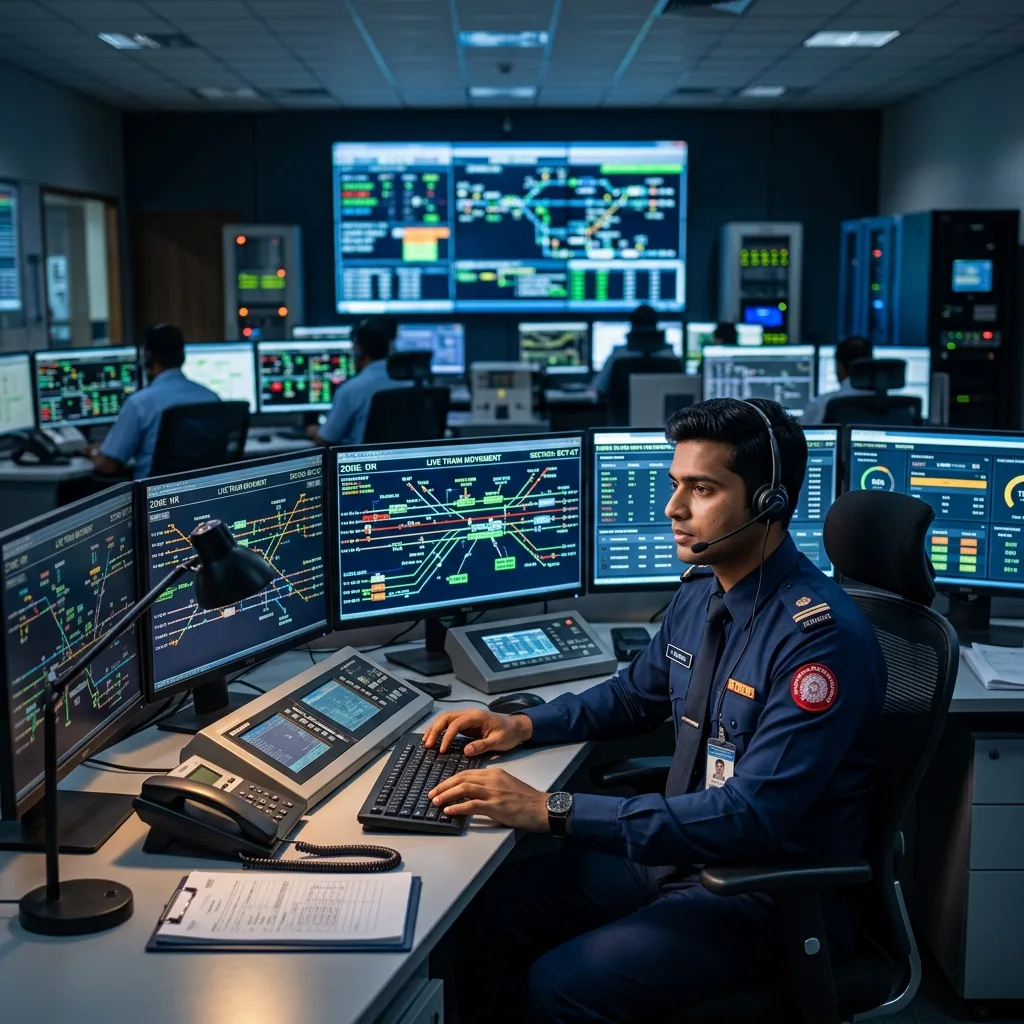
Every Railway Division in India has a Divisional Control Office (DCO) — a large, 24/7 operational facility typically at the Divisional Railway Manager (DRM) headquarters.
Inside the Control Office:
- Banks of computers and screens showing train movement across the division's track network
- Multiple telephone lines — direct lines to every station master, guard, loco pilot in the division
- Large display boards showing real-time train positions (increasingly computerized via COIS — Control Office Information System)
- Multiple controllers working different sections simultaneously
Section Controller's Role — Minute by Minute:
Managing Train Movement: The railway track network is divided into "sections" — typically 50-80 km stretches. The Section Controller is responsible for:
- Authorizing train movements into their section
- Ensuring no two trains are on the same track at the same time in the same direction (block working)
- Granting "line clear" to station masters based on train position information
- Managing crossing points — where trains from opposite directions cross each other at loop lines (sidings)
- Managing overtaking — ensuring a faster train (Rajdhani/Shatabdi) overtakes a slower goods train without delay
Communication:
- Constant phone coordination with all station masters in the section
- Coordination with loco pilots (drivers) through station masters
- Coordination with guards (brake van staff) for train starting/stopping
- Reporting to Divisional Control Office higher authorities
- Coordination with adjacent section controllers when trains cross section boundaries
Emergency Management:
- When there is a signal failure — Section Controller authorizes trains under special rules (Regulation 3.81 of General Rules — permits train movement under written authority when signals fail)
- Accident/derailment coordination — Section Controller is among first to know, immediately alerts DRM, Railways Protection Force, Medical
- Power block coordination — when overhead wire maintenance is needed, Section Controller grants "block" (stops trains) for maintenance window
The Analogy That Makes It Clear:
If Indian Railways is an airline — loco pilots are the pilots, guards are co-pilots, and Section Controllers are AIR TRAFFIC CONTROLLERS. They don't fly the plane — but they direct where every plane goes, manage the airspace, prevent collisions, and ensure everything moves safely and on schedule.
Just like ATC, Section Controller work is cognitively intense, shift-based, and carries enormous responsibility for public safety.
Part 2: Vacancy Distribution — 119 Posts Across Railway Zones
Zone-wise Section Controller Posts (CEN 03/2026):
| Railway Zone | Headquarters | Expected Posts |
|---|---|---|
| Central Railway (CR) | Mumbai CST | 10-15 |
| Northern Railway (NR) | New Delhi | 12-18 |
| Western Railway (WR) | Mumbai Churchgate | 8-12 |
| Eastern Railway (ER) | Kolkata | 8-12 |
| South Eastern Railway (SER) | Kolkata | 6-10 |
| Southern Railway (SR) | Chennai | 8-12 |
| South Central Railway (SCR) | Secunderabad | 8-12 |
| North Eastern Railway (NER) | Gorakhpur | 5-8 |
| East Central Railway (ECR) | Hajipur | 6-10 |
| North Western Railway (NWR) | Jaipur | 5-8 |
| South Western Railway (SWR) | Hubli | 4-7 |
| East Coast Railway (ECoR) | Bhubaneswar | 4-7 |
| Other zones | Various | Remaining |
Exact zone-wise distribution in official CEN 03/2026 notification on rrbapply.gov.in
Zone preference strategy: Candidates applying through a specific RRB are typically posted in that RRB's jurisdiction. RRB Patna covers ECR (East Central Railway). RRB Mumbai covers CR and WR. Choose your RRB wisely — it determines your posting zone.
Part 3: Eligibility — Strict Medical Standards
Educational Qualification:
Required: Bachelor's Degree from a recognized university (any stream — Arts, Commerce, Science, Engineering, Law)
No minimum percentage specified in CEN 03/2026 — graduation is the only educational criterion. This makes Section Controller accessible to all graduation streams.
Age Limit:
| Category | Maximum Age (as on July 1, 2026) |
|---|---|
| UR (General) | 33 years |
| OBC (NCL) | 36 years |
| SC/ST | 38 years |
| PwBD (UR) | 43 years |
| PwBD (OBC) | 46 years |
| PwBD (SC/ST) | 48 years |
| Ex-serviceman | 33 + service period (upto 3 years relaxation) |
Minimum age: 20 years.
A-2 Medical Standard — The Critical Filter:
This is where many candidates are eliminated. Section Controller requires A-2 Medical Standard — one of Indian Railways' strictest medical categories (A-1 is reserved for loco pilots).
Vision Requirements (A-2):
| Eye | Requirement |
|---|---|
| Distant vision | 6/9, 6/9 (both eyes, without glasses) |
| Near vision | Sn 0.6, Sn 0.6 (both eyes) |
| Color vision | CP-II (must correctly identify all colors — red, green, yellow railway signal colors) |
| Glasses | PERMITTED for distant vision during service with certain limits |
| LASIK/PRK surgery | NOT ELIGIBLE — refractive surgery disqualified for A-2 |
| Squint | Disqualifying |
What 6/9 without glasses means: Your natural (unaided) vision must be good enough to read a standard eye chart at 6 meters that a normal eye reads at 9 meters. This is relatively good but not as strict as A-1 (loco pilot — requires 6/6). Most people with mild spectacle numbers (-0.5 to -1.5 approximately) may still meet 6/9. Get a professional vision test to confirm.
The LASIK disqualification: This surprises many aspirants. If you had LASIK or any laser refractive surgery — you are permanently disqualified from A-2 medical standard posts including Section Controller. The reason: Railways needs to know your NATURAL vision stability without surgical correction.
Other A-2 medical requirements:
- No color blindness (complete color vision required)
- No hearing impairment
- No flat feet (Pes Planus)
- No cardiac conditions
- No diabetes (uncontrolled)
- No significant orthopaedic issues
Part 4: Selection Process — CBT + Unique CBAT
Stage 1: Computer-Based Test (CBT)
Total: 100 questions | 100 marks | 90 minutes Negative Marking: 1/3 per wrong answer
| Section | Questions | Marks |
|---|---|---|
| General Intelligence and Reasoning | 30 | 30 |
| General Awareness | 20 | 20 |
| Arithmetic | 25 | 25 |
| General Science | 25 | 25 |
| Total | 100 | 100 |
CBT difficulty level: Similar to RRB NTPC Graduate Level (non-technical popular category). Graduates who have prepared for NTPC will find this familiar.
Stage 2: Computer-Based Aptitude Test (CBAT) — THE UNIQUE STAGE
This is what makes Section Controller recruitment fundamentally different from ALL other RRB exams:
What CBAT Tests: CBAT is NOT a knowledge test. It measures cognitive and operational aptitude — the mental qualities needed to manage train movements effectively:
| Test Component | What It Measures |
|---|---|
| Memory Test | Short-term memory — remembering train numbers, platform numbers, time sequences |
| Attention and Concentration | Sustained focus over extended periods — critical during long shifts |
| Spatial Awareness | Understanding of train positions on track diagrams |
| Multi-tasking Ability | Handling multiple train movements simultaneously |
| Reaction Time | Speed of correct response to signals/alerts |
| Perceptual Speed | Quickly identifying patterns in complex information |
| Traffic Sense | Simulated train management scenarios — making correct routing decisions |
CBAT format: Computer-administered. Typically 60-90 minutes. Mix of multiple-choice and reaction-based tasks. Conducted at Railway Aptitude Test Centers.
CBAT cut-off: Qualifying nature — you must score above the cut-off in CBAT. High CBT score alone doesn't compensate for low CBAT. Both are mandatory.
Critical fact: CBAT cannot be "mugged" or prepared through standard exam books. It tests inherent cognitive aptitude refined by practice. Practicing attention tests, memory games, and multi-tasking apps helps — but natural aptitude is the primary factor.
Stage 3: Document Verification (DV)
Standard document check:
- Graduation certificate and marksheet
- DoB proof (10th certificate)
- Category certificate (OBC/SC/ST/EWS)
- Aadhaar or other ID
- Passport photo
Stage 4: Medical Examination
Detailed railway medical at Railway Hospital:
- Vision test (strict A-2 — as detailed above)
- Color vision test (Ishihara plates + lantern test)
- Hearing test
- Blood pressure, ECG (basic cardiac)
- General physical
Part 5: Salary — Complete Level 6 Breakdown
Level 6 (7th Pay Commission):
| Component | Amount |
|---|---|
| Basic Pay (Level 6 entry) | Rs.35,400 |
| Dearness Allowance (DA) | Rs.18,000-20,000 |
| HRA (8-16% of Basic) | Rs.2,800-5,600 |
| Transport Allowance | Rs.3,600-7,200 |
| Night Duty Allowance | Rs.1,500-3,000 (shift-specific) |
| Gross Salary | Rs.61,000-66,000 |
| Deductions (NPS + Tax + CGEGIS) | Rs.6,000-10,000 |
| Net In-Hand | Rs.52,000-58,000 |
Railway-Specific Benefits Beyond Salary:
| Benefit | Detail |
|---|---|
| Railway Pass | Free rail travel for self and family — ANYWHERE in India on Indian Railways. Privilege Passes: 4 passes/year first class; Season Passes for daily commute |
| Railway Quarter | Government accommodation near railway control office. Rent: Rs.300-1,500/month deducted (nominal) |
| Railway Hospital | Free medical treatment at Railway Hospitals (Central Railway Hospital, Divisional Railway Hospitals) for employee and family |
| Railway Schools | Children's Railway Schools (Central School network) at railway colonies — quality education, subsidized fees |
| NPS Pension | Government contributes 14% of Basic+DA to NPS |
| CGEGIS | Central Government Employees Group Insurance Scheme — Rs.50,000-5,00,000 life insurance |
| LTC | Leave Travel Concession — free rail travel for family vacation twice a year |
| Canteen | Railway canteen at workplace — subsidized food |
| Uniform Allowance | Formal railway uniform provided |
Railway Pass — The Hidden Million-Rupee Benefit:
Railway Pass is perhaps the most undervalued perk of railway service. 4 Privilege Passes per year = 4 free first-class return journeys anywhere in India for the employee and family.
Consider: Delhi to Goa and back first-class costs Rs.12,000-15,000. Four such trips = Rs.48,000-60,000 saved per year. Over a 30-year career = Rs.15-18 lakh in saved travel expenses. This is a real financial benefit that non-railway employees pay from their pocket.
Part 6: Life as a Section Controller — Realistic Picture
The Control Room Environment:
Physical setup: Air-conditioned control room (essential — controllers must remain alert). Multiple workstations, each with COIS (Control Office Information System) terminal, multiple phone lines, and headset. Large display boards (increasingly digital).
Shift pattern: Three shifts — Morning (6AM-2PM), Afternoon (2PM-10PM), Night (10PM-6AM). Roster rotates — you work all three shifts in sequence. Night shift is the most demanding — fewer supervisors, same train movements, highest accident risk.
Team in control room: Multiple controllers (each handling a specific section), Chief Controller (supervising all), Train Passing Clerk (maintaining train passing register), Crew Controller (managing loco pilot and guard crew logistics), Power Controller (managing electric traction for electric sections).
Cognitive Demands — Honest Assessment:
Section Controller work is NOT for everyone. Honest self-assessment before applying:
You will thrive if:
- You are naturally good at multi-tasking (doing multiple things simultaneously without confusion)
- You have good memory — remembering train numbers, times, positions without constantly writing everything
- You remain calm under pressure — a 3-train jam on a single section requires clear thinking, not panic
- You are comfortable with 24/7 shift rotation (including night shifts permanently throughout career)
- You handle responsibility well — a wrong decision can delay thousands of passengers or cause an accident
You may struggle if:
- You prefer fixed hours / cannot manage night shift health
- You get easily overwhelmed by multiple simultaneous demands
- You have anxiety about high-stakes decision-making
- You dislike telephone-intensive communication
The CBAT filters for this: The CBAT tests these exact qualities before selection. If you score well in CBAT naturally — you are likely well-suited for the role.
Career Satisfaction:
Senior Section Controllers (Chief Controllers, Divisional Controllers) report extremely high job satisfaction. The reason: Every day, you manage something REAL. When the Shatabdi Express arrives in Mumbai exactly on time despite a signal failure at Lonavala — and you authorized the movement under special rules — that punctuality is partly YOUR achievement. When you coordinate the path for an Emergency Medical Train in flood conditions — you are literally saving lives.
The intangible satisfaction of keeping India's largest railway network running is something very few careers can match.
Part 7: Section Controller vs Other Railway Posts
Comparing Key Railway Posts:
| Factor | Section Controller | RRB NTPC (CG Level) | RRB ALP | Loco Pilot |
|---|---|---|---|---|
| Pay Level | Level 6 | Level 6 | Level 2 | Level 6 |
| Basic Pay | Rs.35,400 | Rs.35,400 | Rs.19,900 | Rs.35,400 |
| Qualification | Graduation | Graduation | 10th + ITI | 10th + ITI |
| Selection | CBT + CBAT | CBT | CBT + CBAT | CBT + CBAT |
| Medical | A-2 (strict vision) | B-1 (relaxed) | A-1 (strictest) | A-1 (strictest) |
| LASIK allowed | NO | YES | NO | NO |
| Work location | Control Room (indoor) | Office (desk job) | Locomotive (field) | Locomotive (field) |
| Night shifts | YES (permanent rotation) | Minimal | YES | YES |
| Physical demands | Low (cognitive) | Low | Moderate | Moderate |
| Post count (2026) | 119 | Thousands | Thousands | Thousands |
| Competition | Lower (fewer posts, CBAT filter) | Very high | High | High |
Section Controller vs SSC CPO Sub-Inspector:
| Factor | RRB Section Controller | SSC CPO SI |
|---|---|---|
| Pay Level | Level 6 | Level 6 |
| Salary | Rs.52,000-58,000 in-hand | Rs.55,000-65,000 in-hand |
| Qualification | Graduation | Graduation |
| Nature of work | Indoor control room, cognitive | Field law enforcement |
| Physical fitness | Not intensive (cognitive job) | Physical (patrolling) |
| Night shift | Yes (rotating) | Yes (duty-based) |
| Transfer | Railway zone | Pan-India CAPF |
| Medical | A-2 (vision 6/9 strict) | Moderate (spectacles allowed) |
| CBAT | Yes (unique aptitude test) | No |
| Competition | Lower | Very high |
Part 8: CBAT Preparation — The Decisive Stage
Since CBAT cannot be prepared like a standard exam, here is a structured approach:
What Helps in CBAT:
Memory improvement:
- Daily memory exercise: Read 10 train numbers (e.g., 12301, 22691, 11061...) — close eyes — recall all
- Number sequence games — apps like Lumosity, Elevate, CogniFit
- Memorizing news headlines, phone numbers, dates — everyday memory strengthening
Attention and concentration:
- Meditation (10-15 minutes daily) — proven to improve sustained attention
- Reading long-form text (book pages, not social media) — builds reading concentration
- Avoiding phone distractions — long phone screen time REDUCES attention span
- Crossword/Sudoku — sustained concentration practice
Multi-tasking practice:
- This is genuinely hard to practice because true multi-tasking is rare. What helps:
- Monitoring two information streams simultaneously (e.g., listen to news while tracking time)
- Computer games requiring simultaneous multiple decisions (strategy games, traffic management simulations)
- Cooking multiple dishes simultaneously — genuine multi-tasking in everyday life
Reaction time improvement:
- Reflexes decline with age, poor sleep, and stress — manage all three
- Physical exercise (especially aerobics) improves reaction time
- Computer-based reaction time tests available free online — practice daily in the 2 weeks before CBAT
Traffic management simulation:
- No official CBAT simulator is publicly available
- Railway previous year CBAT format questions are available on testbook and adda247
- Some coaching institutes (like ALS Institute in Delhi) have CBAT practice material
- Concept: Practice reading a track diagram with trains marked at positions, making crossing and overtaking decisions
CBT Preparation Strategy:
General Intelligence and Reasoning (30 marks):
- Series completion (number, alphabet, image)
- Analogies
- Syllogism
- Blood relations
- Directions
- Coding-decoding
- Venn diagrams
- Matrix completion
Arithmetic (25 marks):
- Number systems, BODMAS
- Fraction and decimals
- Percentage
- Ratio and proportion
- Simple and compound interest
- Profit and loss
- Time and work
- Time, speed, distance
General Science (25 marks):
- Physics: Motion, force, energy, sound, light, electricity
- Chemistry: Atoms, molecules, acids/bases, chemical reactions
- Biology: Cells, human body systems, diseases, nutrition
- Level: Class 10 NCERT
General Awareness (20 marks):
- Railway GK: History of Indian Railways (1853 first train — Mumbai to Thane), railway zones, recent railway budget, new trains launched (Vande Bharat, Amrit Bharat)
- Current Affairs: Government schemes, sports, international events (last 6 months)
- India and World: Basic geography, polity, economy
Part 9: Railway Zones and Divisional Control Offices
Understanding where you may work helps aspirants visualize the role:
Indian Railways — 18 Zones and Key Divisional Headquarters:
| Zone | HQ | Key Divisions (Control Offices) |
|---|---|---|
| Central (CR) | Mumbai | Mumbai, Pune, Nagpur, Solapur, Bhusaval |
| Northern (NR) | New Delhi | Delhi, Ambala, Moradabad, Lucknow, Firozpur |
| Western (WR) | Mumbai | Mumbai, Vadodara, Ahmedabad, Ratlam, Rajkot, Bhavnagar |
| Eastern (ER) | Kolkata | Howrah, Sealdah, Asansol, Malda |
| South Eastern (SER) | Kolkata | Kharagpur, Chakradharpur, Adra, Ranchi |
| Southern (SR) | Chennai | Chennai, Salem, Tiruchirappalli, Madurai, Palakkad |
| South Central (SCR) | Secunderabad | Secunderabad, Vijayawada, Nanded, Guntur, Guntakal, Hyderabad |
| North Eastern (NER) | Gorakhpur | Gorakhpur, Lucknow, Varanasi |
| East Central (ECR) | Hajipur | Danapur, Dhanbad, Mughalsarai, Samastipur, Sonpur |
| North Western (NWR) | Jaipur | Jaipur, Ajmer, Bikaner, Jodhpur |
| South Western (SWR) | Hubli | Hubli, Bengaluru, Mysuru |
| East Coast (ECoR) | Bhubaneswar | Khurda Road, Sambalpur, Visakhapatnam |
| North Central (NCR) | Prayagraj | Prayagraj, Agra, Jhansi |
| South East Central (SECR) | Bilaspur | Bilaspur, Raipur, Nagpur |
| North East Frontier (NFR) | Guwahati | Guwahati, Katihar, Lumding, Rangia, Alipurduar |
| Metro Railway | Kolkata | Kolkata Metro |
| West Central (WCR) | Jabalpur | Jabalpur, Bhopal, Kota |
| South Coast (SRCR) | Visakhapatnam | New zone — verify current divisions |
Posting reality: Section Controllers are posted at DIVISIONAL Control Offices — not at small stations. This means posting in a Division HQ city — typically a significant urban center. Gorakhpur, Lucknow, Secunderabad, Chennai, Mumbai, Pune, Kolkata, Delhi — these are where Control Offices are. Urban posting is a significant lifestyle advantage.
Part 10: Frequently Asked Questions
Q1. What is the difference between Section Controller and Traffic Controller in Indian Railways? Section Controller is a specific post under the Traffic Operating department. Traffic Department in railways has: Guard → Assistant Station Master (ASM) → Station Master (SM) → Section Controller → Chief Controller → Divisional Commercial Superintendent → Divisional Railway Manager (DRM). Section Controller sits in the Control Office monitoring and authorizing train movements in their assigned section. Traffic Controller (if mentioned separately in some notifications) may refer to specific control room functions in some zones. In CEN 03/2026 — "Section Controller" is the specific post title.
Q2. Is there any physical fitness test for Section Controller? No PET (Physical Efficiency Test) — unlike police/defence jobs. The only physical requirement is passing the A-2 medical examination. This is a cognitive/desk job — physical fitness requirements are standard health fitness, not specific athletic standards. However, being physically healthy and having good sleep habits is important for performance in the control room.
Q3. Can Section Controllers be promoted to officer level (Group A/B)? Yes — promotion path: Section Controller (Level 6) → Chief Controller (Level 7) → Senior Controller → Senior Divisional Commercial Superintendent (SDCS) → Divisional Railway Manager (DRM) is a separate cadre (Group A). Promotion from Group C (Section Controller) to Group B (Junior Scale equivalent) is possible through departmental competitive examinations (LDCE — Limited Departmental Competitive Examination). Exceptional Controllers can reach senior officer roles through departmental promotion — though the typical promotion path stays within the Controllers cadre.
Q4. The Section Controller post has only 119 vacancies — is competition too high? Lower vacancy count AND unique CBAT filter make the competitive dynamics interesting. Unlike RRB NTPC (lakhs of applicants for thousands of posts), Section Controller attracts: (1) Only graduates (filtering 10th/12th level applicants), (2) Only those with acceptable A-2 vision (filtering spectacle wearers with high numbers), (3) Only those who pass CBAT (filters cognitively unsuited candidates). Effective competition is significantly lower than raw application numbers suggest. For a well-prepared graduate with good natural vision and cognitive aptitude — this is a realistic opportunity.
Q5. What happens during night shifts as Section Controller? Is it dangerous? Night shifts (10 PM-6 AM) are the most demanding for Section Controllers. Train traffic reduces after midnight but significant freight traffic continues. Goods trains — heavy, slow — clog sections at night. Section Controllers must remain fully alert during all 8 hours — there is no "quiet time" when you can sleep. Railways provides: coffee/tea facilities in control rooms, climate control, adequate lighting. However, sustained night work over years takes a health toll — known occupational challenge. Many experienced controllers report adapting within 1-2 years of joining.
Q6. What is the bond period after joining as Section Controller? Railways does not have a specific bond period for Section Controller. However: (1) Training period (typically 3-6 months) during which salary is paid — resignation during training requires repaying training costs. (2) General employment terms allow resignation with proper notice (typically 30-90 days) after training completion. There is no multi-year bond unlike some PSUs or defence services.
Conclusion: India's Trains Move Because of Section Controllers
13,452 trains run daily on Indian Railways. 24 million passengers travel every day. 3,300+ km of track. 9,000+ railway stations.
Behind every on-time departure, every safe crossing, every emergency response — a Section Controller in a Divisional Control Room made the call.
119 posts. Level 6 salary. Graduate eligible. A career that most Indians have never heard of but absolutely depend on every day.
The Section Controller opportunity is unique:
- Level 6 pay (Rs.52,000-58,000 in-hand) with a graduate degree
- Railway Pass — free first-class travel anywhere in India
- Indoor posting at Divisional HQ (urban city)
- No physical fitness test — pure cognitive aptitude
- Intellectually demanding — never a boring day managing 200+ trains
Your action plan:
- Apply at rrbapply.gov.in before August 14 — don't delay
- Vision check immediately — 6/9 both eyes unaided is mandatory. Visit an ophthalmologist for accurate measurement (not just chart reading at an optician)
- CBT preparation: NTPC Graduate level difficulty — Reasoning, Arithmetic, Science, GK
- CBAT preparation: Memory games, attention exercises, multi-tasking apps — 20 minutes daily
- Railway GK: Indian Railways zones, history (1853), Vande Bharat, railway budget highlights
Stay updated with RRB Section Controller 2026 admit card, CBT date, CBAT schedule, result, and merit list at Government Job Result — India's most trusted government career resource.
Disclaimer: Vacancy count (119), pay level, eligibility, and selection process from official RRB CEN 03/2026 notification (July 2026). A-2 medical standards per Indian Railway Medical Manual. CBAT format based on previous Section Controller and Traffic recruitment aptitude test patterns. Always verify from official RRB notification at rrbapply.gov.in.
Part 11: Indian Railways — Know Your Employer
Understanding the organization you are joining gives you an edge in interviews and genuine career pride:
Indian Railways — World's 4th Largest Railway Network:
| Statistic | Data |
|---|---|
| Route km | 68,000+ km (world's 4th largest) |
| Running tracks | 1,25,000+ km (including multiple tracks) |
| Trains daily | 13,452+ (passenger + freight) |
| Passengers daily | 2.4 crore (24 million) |
| Stations | 9,000+ |
| Employees | 12 lakh+ (one of world's largest employers) |
| Revenue (2025-26) | Rs.2.5+ lakh crore |
| Freight carried | 1.7 billion tonnes per year |
| Zones | 18 |
| Divisions | 70+ |
Railway History — Key Dates (Interview GK):
| Year | Event |
|---|---|
| 1853 | India's first train — Mumbai (Bori Bunder) to Thane, 34 km, April 16 |
| 1853 first train speed | 35 km/hour |
| 1869 | First train in Rajasthan |
| 1925 | First electric train — Mumbai (Victoria Terminus to Kurla) |
| 1986 | First computerized passenger reservation system |
| 2003 | Shatabdi Express introduced (actually 1988 — verify) |
| 2019 | Vande Bharat Express (Train 18) — India's fastest semi-high speed train |
| 2022 | Vande Bharat 2.0 (improved version) |
| 2023 | Amrit Bharat Express — sleeper trains for longer routes |
| 2024 | Namo Bharat (RAPIDX) — Regional Rapid Transit System, Delhi-Meerut |
| 2027 target | Bullet Train (Mumbai-Ahmedabad) — under construction |
Railway Ministry and Key Officials (Interview Preparation):
- Ministry: Ministry of Railways, Government of India
- Railway Board: The apex body of Indian Railways — chaired by Chairman and CEO
- Zones are headed by: General Manager (GM)
- Divisions are headed by: Divisional Railway Manager (DRM)
- DRM's Control Office: Where Section Controllers work
Recent Railway Initiatives:
Kavach (Anti-Collision System): India's indigenous automatic train protection system. Kavach enables two trains on the same track to automatically brake when collision risk is detected. Section Controllers work WITH Kavach-equipped sections — understanding basic Kavach is valuable interview knowledge.
COIS (Control Office Information System): The software system Section Controllers use. COIS provides real-time train position display on control computers — replacing handwritten train graphs. Modern Section Controllers must be computer-proficient.
Train-18 / Vande Bharat: Semi-high speed trainsets running at 160 km/hour. Section Controllers managing sections where Vande Bharat runs must ensure clear lines for these high-speed trains — more complex clearance decisions than ordinary express trains.
One Station One Product (OSOP): Local products promoted at railway stations — controlled by Commercial department, but Section Controllers ensure trains stop at designated stations as per schedule.
Part 12: How Trains Actually Move — The Technical Reality
Every Section Controller must understand the physical and technical framework within which they operate. This knowledge is tested in interviews and critical for actual work:
Block Working — The Foundation of Train Safety:
Absolute Block System (most Indian single lines):
- Track divided into "blocks" — sections between two consecutive block stations
- Only ONE train permitted in a block at one time in one direction
- Section Controller grants "line clear" to starting station ONLY after confirming the block ahead is clear
- If you allow two trains in same block simultaneously — catastrophic collision risk
Automatic Block Signaling (busy double/multi-line sections):
- Signals automatically operate based on train presence detected by track circuits
- Multiple trains can be in a territory as long as each is separated by at least one signal
- Section Controller monitors overall flow — not granting individual line clear for each train
- Used on: Delhi-Mumbai, Delhi-Howrah, Mumbai-Chennai (high-density corridors)
Tokenless Block Instruments: On single lines — block instruments (electrical) connect two consecutive block stations. Both station masters must agree to grant line clear before a train departs. Section Controller oversees this system — particularly for emergency situations.
Signal System — What Controllers Manage:
| Signal Type | Color | Meaning |
|---|---|---|
| Absolute Stop (STOP) | Red | Train MUST stop — cannot proceed |
| Caution | Yellow | Approach next signal prepared to stop |
| Clear (Proceed) | Green | Proceed at full permissible speed |
| Double Yellow | Yellow+Yellow | Proceed, next signal at caution |
| Lunar White | White | For shunting movements only |
When a signal fails — Section Controller authorizes train movement under "Signal Failure" procedures (paper authority given to station master, who communicates to loco pilot). This is high-risk — controllers must follow exact procedures.
Types of Train Operations Controlled:
Passenger Trains:
- Express/Mail/Superfast: Priority trains — must clear sections first
- Shatabdi/Rajdhani/Vande Bharat: Highest priority — clear line immediately
- Passenger/Ordinary: Lower priority — may be held in loops for express trains to cross
Freight/Goods Trains:
- Goods trains move slower but carry bulk of railway revenue
- Section Controllers manage crossing points — where goods trains wait in sidings for passenger trains to pass
- BOXN, BCN, tank wagons — different train types, different speed restrictions
Special Trains:
- Special trains (pilgrim specials, military specials, relief trains) require Section Controller coordination
- Medical vans, accident relief trains — IMMEDIATE PRIORITY — Section Controller clears all traffic
Part 13: CBAT — In-Depth Understanding and Practice
Since CBAT is the unique differentiator, it deserves comprehensive coverage:
Official CBAT Design Philosophy:
Indian Railways designs CBAT based on research into what cognitive abilities correlate with effective train traffic management. The tests are designed and administered by Railway Recruitment Boards in consultation with psychologists and operational experts.
Core cognitive abilities tested:
1. Selective Attention: Ability to focus on relevant information while ignoring distractions. In control room: 10 phone calls, 50 trains on display, radio chatter — controller must focus on what matters NOW.
Practice: Dichotic listening exercises (different audio in each ear — process both). Stroop color-word task (app available — tests interference management).
2. Divided Attention (Multi-tasking): Processing multiple information streams simultaneously. In control room: Monitor train board, answer station master call, grant line clear, note train passing time — all simultaneously.
Practice: Dual N-back game (scientifically validated working memory + attention). Traffic control simulation games (Mini Metro, Train Valley).
3. Working Memory: Holding and manipulating information in short-term memory. In control room: Remember that 12301 Howrah-Mumbai Mail entered section at 14:23, MPS 110 km/h, expected to clear Igatpuri at 14:56 — all from memory while handling three other trains.
Practice: Digit span test (forward and backward). Reading a list of 15 items, recalling in order. Memory card matching games.
4. Processing Speed: How quickly you process information and respond correctly. Slow processing in a control room = delayed response to signal failure = potential accident.
Practice: Online reaction time tests (humanbenchmark.com — reaction time, sequence memory). Regular physical exercise significantly improves processing speed.
5. Spatial Reasoning: Understanding of train positions in a geographic network. Looking at a track diagram and instantly knowing which train is where and what crossing options exist.
Practice: Railway track diagram puzzles (some available in coaching materials). Jigsaw puzzles. Map reading exercises. Chess (develops spatial reasoning).
6. Decision Making Under Pressure: Making correct routing decisions quickly when multiple trains approach a crossing point simultaneously.
Practice: Timed decision games. Chess (time pressure decisions). Traffic management simulations.
CBAT Practice Resources:
| Resource | What It Helps |
|---|---|
| Lumosity (app) | Memory, processing speed, attention |
| CogniFit (app) | Comprehensive cognitive training |
| Cambridge Brain Sciences (website) | Scientific cognitive tests |
| Mini Metro (game) | Traffic management simulation |
| Train Valley (game) | Railway routing decisions |
| Dual N-Back (app) | Working memory and attention |
| Human Benchmark (website) | Reaction time, number memory, visual memory |
Important: Start CBAT practice at LEAST 60 days before expected exam. Cognitive training shows results gradually — not overnight.
CBAT Pass Rate:
CBAT has a significant elimination rate. Based on past Section Controller and Traffic Assistant recruitments — approximately 30-40% of CBT-qualified candidates fail CBAT. This is why Section Controller competition is more manageable than raw numbers suggest.
Part 14: The Train Graph — Section Controller's Most Important Tool
Every Section Controller must master reading and plotting the Train Graph (T/Graph):
What is a Train Graph?
A graphical representation of train movements in a section:
- X-axis: Time (24-hour format)
- Y-axis: Station-to-station distance (all stations in the section listed)
- Each line on graph: One train's journey — slope indicates speed (steeper = faster)
Reading a Train Graph:
If two train lines intersect on the graph — those trains WOULD occupy the same location at the same time = COLLISION if both on the same track. Section Controller's job is to ensure no intersections on single tracks without the trains being at separate loop lines (sidings).
Modern COIS replaces manual graph: COIS (Control Office Information System) automatically plots trains in real-time. But understanding the underlying graph principles is still taught at Railway Training Institutes and tested in interviews.
Block Register:
Before computerization — Block Register was the handwritten record of every train passing each station in the section. Section Controllers maintained this manually. Even today, manual backup records are maintained alongside COIS. Understanding Block Register entries is part of Section Controller training.
Part 15: Railway Training — What Happens After You Join
After selection as Section Controller — what is the training pathway?
Initial Training:
Zonal Railway Training Institute (ZRTI): Each railway zone has a Zonal Railway Training Institute. New Section Controllers attend:
- Foundation training: Railway rules, regulations, General Rules (GR), Subsidiary Rules (SR)
- Traffic department-specific training: Block working, signal failures, emergency procedures
- Computer training: COIS operation, FOIS (Freight Operations Information System)
- Practical training: Observation duty at Control Office under supervision
Duration: Typically 3-6 months (combination of classroom and on-the-job training)
Indian Railway Institute of Transport Management (IRITM), Lucknow: India's premier railway management training institute. Senior Section Controllers and Controllers pursuing promotion attend IRITM for management courses.
On-the-Job Training Structure:
Phase 1: Observation (1-2 months at Control Office) New Section Controller observes experienced controller — watching how decisions are made, how communications flow, how emergencies are handled. Does NOT independently give instructions.
Phase 2: Assisted Working (2-3 months) New controller takes over a section shift under close supervision of senior controller. All decisions reviewed by senior before action.
Phase 3: Independent Charge After certification — takes independent charge of a section shift. Now fully responsible for train movements in assigned section.
Ongoing Training:
- Periodic refresher courses (every 3-5 years) at ZRTI
- Safety training following accidents (when new procedures are introduced)
- Technology training when new COIS versions or systems are deployed
Part 16: Emergency Procedures — The Section Controller's Critical Role
Emergencies are rare but when they happen — Section Controller is at the center of response:
Train Accident (Derailment/Collision):
Immediate actions by Section Controller:
- Receive emergency message from station master or guard
- IMMEDIATELY protect lines — send STOP messages to trains approaching the accident site from both directions
- Alert Chief Controller and Divisional Railway Manager (DRM)
- Stop all movements in affected section
- Coordinate Accident Relief Train (ART) movement — PRIORITY
- Coordinate Medical Van (MFD — Medical First on Demand) movement
- Alert Railway Protection Force (RPF), Government Railway Police (GRP)
- Keep log of all actions with times
The golden hour: In any railway emergency, the first 15-30 minutes of Section Controller response determines whether a bad situation becomes catastrophic. Stopping trains quickly, routing relief trains fast — these decisions save lives.
Signal Failure:
Most common emergency: When a signal fails — it defaults to DANGER (red) — trains cannot proceed. Section Controller must:
- Confirm signal failure with station master
- Authorize movement under "authority to proceed" (T/369 form or paper token)
- Set speed restriction (typically 15 km/hour through failed signal)
- Ensure signal maintenance team dispatched
- Monitor until signal restored
Fog Operations (Winter — North India):
During dense fog — visibility drops to near-zero. Trains must run under fog rules:
- Fog signal devices placed at signals by track maintainers
- Speed restrictions applied throughout foggy section
- Section Controller coordinates fog pilot deployment on high-priority trains
- Extra monitoring — trains move slower, crossing decisions take longer
This is when Section Controller work intensity peaks — managing 200 slow-moving trains instead of 100 normal-speed trains is MORE complex, not less.
Floods and Natural Disasters:
- Section Controller immediately diverts trains from affected sections
- Coordinates with engineering department for track inspection reports
- Issues speed restrictions or "all stop" until track declared safe
- Special trains (relief, rescue) get immediate path clearance
Part 17: Welfare and Service Conditions
Railway Welfare for Section Controllers:
Railway Colonies: Railway maintains residential colonies near divisional offices. Section Controllers are entitled to Type-II or Type-III government quarters. Railway colonies have schools, markets, hospitals, clubs — self-contained communities.
Railway Schools: Children of railway employees can attend Kendriya Vidyalaya (Central School) in railway townships. Excellent education, subsidized fees, national recognition.
Railway Clubs and Sports: Every major railway division has a railway club — cricket ground, badminton court, table tennis, library. Railway sports teams participate in inter-zonal competitions.
Shift Allowance: Controllers working night shifts receive Night Duty Allowance (NDA) — additional payment for anti-social hours. HRA is paid if quarters not allotted.
Superannuation Benefits:
- Gratuity: 1/4 month basic per year of service (max Rs.20 lakh)
- NPS: Pension on retirement (14% government contribution throughout service)
- Leave encashment: Upto 300 days of accumulated earned leave encashed at retirement
Part 18: Section Controller Exam — Previous Year Analysis
Based on historical RRB CBT patterns for Section Controller and similar Traffic posts:
CBT Most-Asked Topics (Historical Pattern):
General Intelligence and Reasoning (30 marks):
- Series completion: 6-8 questions typically (number series, letter series)
- Seating arrangement and puzzles: 4-6 questions
- Blood relations: 2-3 questions
- Analogy: 3-4 questions
- Syllogism: 2-3 questions
- Coding-decoding: 3-4 questions
- Directions: 2-3 questions
- Miscellaneous (Venn diagram, ranking): 3-5 questions
Arithmetic (25 marks):
- Number system and simplification: 4-5 questions
- Percentage and its applications: 4-5 questions
- Profit/loss, discount: 2-3 questions
- SI and CI: 2-3 questions
- Ratio and proportion: 2-3 questions
- Time and work: 2-3 questions
- Time, speed, distance: 3-4 questions (trains questions frequently appear — especially distance between trains)
- DI (simple table or chart): 3-4 questions
General Science (25 marks): Physics (10-12 questions expected):
- Motion — Newton's laws, momentum
- Heat and thermodynamics — temperature scales
- Light — reflection, refraction, lenses
- Electricity — Ohm's law, power, circuit calculations
- Sound — wavelength, frequency, decibel
- Magnetism — electromagnets, induction (railway relevance — traction motors)
Chemistry (6-8 questions):
- Acids, bases, salts — pH scale
- Carbon and its compounds
- Metals and non-metals
- Chemical reactions and equations
- Air, water, pollution
Biology (5-7 questions):
- Cell and cell organelles
- Human digestive/respiratory/circulatory system
- Diseases — bacterial, viral, nutritional deficiency
- Food chain, ecology
General Awareness (20 marks):
- Indian Railways GK: 4-5 questions (zones, history, new trains, records)
- Current affairs: 6-8 questions (government schemes, sports, awards)
- Geography: 3-4 questions
- Polity: 2-3 questions
- Economy: 2-3 questions
Surprise Topics from Past Papers:
- "Which two trains can go on same track simultaneously?" — block working concept
- Railway zone headquarters questions (4-5 times in previous papers)
- Kavach/anti-collision — appeared in recent papers
- India's busiest railway station (Howrah, Kanpur — both appear)
- Fastest train in India (Vande Bharat — 160 km/h)
- World's first railway: 1804 UK (steam locomotive) / 1825 Stockton-Darlington (passenger)
- India's longest railway platform: Hubli (Shri Siddaroodha Swamiji Station) — 1,505 meters
Part 19: Section Controller's Work-Life Balance — Honest Assessment
Since this is a 24/7 shift role, understanding work-life impact is critical before applying:
The Shift Rotation Reality:
A typical rotating roster for Section Controllers:
| Week | Days | Shift |
|---|---|---|
| Week 1 | Mon-Sat | Morning (6 AM-2 PM) |
| Week 2 | Mon-Sat | Afternoon (2 PM-10 PM) |
| Week 3 | Mon-Sat | Night (10 PM-6 AM) |
| Week 4 | — | Off/Rest |
This means: Every 4 weeks, you have worked all three shifts. Your "weekend" moves around the calendar. Festival nights (Diwali, Eid, Christmas) — you may be on night duty. New Year's midnight — you may be authorizing train movements in the control room while the world celebrates.
Circadian rhythm impact: Frequent shift changes disrupt body clock. Health research shows long-term shift workers have higher risk of:
- Sleep disorders
- Metabolic syndrome
- Cardiovascular issues
- Mental fatigue
How railway controllers manage: Most adapt within 1-2 years. Keys to healthy shift work:
- Fixed sleep schedule even on rotating shifts
- Blackout curtains and sleep masks for day sleep
- Nutritious meals (railway canteen helps — available 24/7)
- Regular exercise despite irregular hours
- Strong family support
Family life: Spouses and families of Section Controllers must understand the role before marriage/relationship commitment. Irregular hours mean missing family dinners, school events, festivals. Railway family community (in railway colonies) helps — other families in similar situations provide support.
The Positive Side of Shift Work:
- Morning shift (6AM-2PM): Done by 2 PM — entire afternoon free. Shopping, errands, appointments — all possible.
- Afternoon shift (2PM-10PM): Mornings free — personal work, gym, social time before reporting.
- Night shift (10PM-6AM): Day sleeping, evenings free for family. Many controllers find morning hours after night shift perfect for studying (JAIIB, CAIIB, departmental exam preparation).
Part 20: Smart Application Tips and Common Mistakes
Application Mistakes That Disqualify:
Choosing wrong RRB: RRB application is ZONE-specific. If you apply through RRB Patna — you will be posted in East Central Railway (ECR). If you apply through RRB Mumbai — Central or Western Railway. Choose based on your preferred zone. You CANNOT change RRB after submission.
Vision check before applying: Do NOT apply if you have had LASIK/PRK surgery — you WILL be eliminated at medical. Get a professional vision test for 6/9 unaided vision BEFORE filling the application. An ophthalmologist (eye doctor) — not just an optician — should confirm your unaided vision meets A-2 standard.
Age calculation errors: Age is calculated as on July 1, 2026 — NOT on the date of application. Some candidates miscalculate and apply when over-age.
Category certificate currency: OBC NCL certificate must be current (issued after cut-off date specified in notification). Outdated OBC certificate causes rejection at DV stage.
Experience certificate for reserved categories: If claiming EWS — income certificate must be current year (FY 2025-26 or 2026-27 depending on notification specification).
Smart Application Strategy:
Multiple RRB applications: You can apply through ONE RRB only for the same post. Choose your RRB based on posting preference (which zone you want to work in).
Photo and signature: Use a clear, recent passport photo. Background should be white/light. Signature should match your documents — any discrepancy at DV is problematic.
Fee payment: Pay immediately after form submission. Technical issues with payment are a common problem — pay on days 2-3 of the application window, not Day 1 (server load) or last day (server crash risk).
Extended FAQ (Part 2)
Q7. Is Section Controller the same as Traffic Assistant in railway? What is the difference? Section Controller and Traffic Assistant are different posts at different pay levels. Traffic Assistant (Level 2) is a junior-level traffic department post requiring 10th class qualification. Section Controller (Level 6) is a much senior role requiring graduation + CBAT. Career path: Traffic Assistant → Senior Traffic Assistant → Junior Section Controller → Section Controller → Chief Controller. Section Controller via direct recruitment (current notification) is a Level 6 entry — far above Traffic Assistant's entry level. Do not confuse the two.
Q8. What is the impact of Kavach on Section Controller's role? Kavach (Train Collision Avoidance System) automatically prevents train-to-train collisions by triggering automatic emergency braking when collision risk is detected. As Kavach is deployed across more sections: Section Controllers remain equally important — Kavach is a safety net, not a replacement for human traffic management. Section Controllers still grant line clear, manage crossings, handle emergencies, and coordinate operations. Kavach adds an additional safety layer but does NOT automate the intellectual work of traffic control.
Q9. Can a Section Controller transfer from one railway zone to another? Inter-zone transfer for Section Controllers is possible but uncommon and requires specific conditions: (1) Mutual transfer — two controllers from different zones agree to swap postings, (2) Compassionate grounds — serious medical or family emergency, (3) Spouse posting — if spouse is in government service in another zone. Routine transfer requests across zones are generally not accommodated. Within the zone — division-to-division transfers are more common and slightly easier.
Q10. What is a Chief Controller and how is promotion achieved? Chief Controller (Level 7) is the senior controller in a Divisional Control Office — supervises all Section Controllers in a shift and handles major decisions and emergencies. Promotion from Section Controller to Chief Controller follows seniority-cum-merit basis — typically 8-12 years. LDCE (Limited Departmental Competitive Examination) allows meritorious controllers to fast-track to Group B positions (equivalent of Section Officer rank). Beyond Chief Controller — Senior Divisional Commercial Superintendent, and eventually Divisional Commercial Superintendent — the senior officer level requiring departmental examination and extensive experience.
Q11. How are Section Controllers different from Station Masters? Can they switch roles? Station Master (SM) operates at a specific station — manages passenger handling, train dispatch, signal operation at that station. Section Controller operates from the Control Office — manages entire section's train movements. Both are Traffic Department employees. Inter-role movement is possible through departmental processes — some experienced SMs are promoted/transferred to control work and vice versa. However, direct inter-departmental switch is not routine — both have separate career progression paths.
Q12. What happens to Section Controller in case of an accident during their shift? Accident inquiry is taken extremely seriously in Indian Railways. If an accident occurs in a Section Controller's section during their shift — a Railway inquiry board investigates. Controller is required to provide detailed statement, all communication records, block register entries, and COIS logs for the accident period. If the inquiry finds the controller followed all prescribed procedures correctly — no adverse action. If lapse in procedure is found — departmental action possible (warning, suspension, or in severe cases, dismissal). Most controllers maintain meticulous records precisely for this reason — every decision, every communication is logged. This is also why the role carries high responsibility — and why it is compensated at Level 6.
Conclusion (Final): The Man Behind the Movement
Every morning, when you board the Rajdhani Express at New Delhi station, an announcement crackles: "Train will depart on time." What you don't hear: In the Divisional Control Office, a Section Controller just authorized the Rajdhani's movement into the next section, coordinating with station masters at Palwal, Mathura, Agra Cantonment, ensuring a goods train that was supposed to cross at Mathura loop has cleared in time. In 8 hours, he will do this for 200 trains.
119 posts. One of the most intellectually demanding roles in India's largest employer. Level 6 salary. Urban posting. Railway Pass. 24/7 significance.
The Section Controller is not a glamorous job. No one sees your face on television. Your name does not appear in newspapers unless something goes wrong. But every safe journey — every passenger who arrives at their destination, every tonne of freight that reaches its factory — carries a piece of your work.
If this resonates — apply before August 14.
Your complete checklist:
- Vision test TODAY — ophthalmologist confirmation of 6/9 unaided vision
- LASIK check — if you've had refractive surgery, you are not eligible — save your time
- Apply at rrbapply.gov.in — choose zone wisely, cannot change later
- Start CBT preparation — NTPC graduate level: Reasoning, Arithmetic, Science, GK
- CBAT preparation — Lumosity, Dual N-back, Mini Metro game, 20 minutes daily
- Railway GK — 18 zones, headquarters, Vande Bharat, Kavach, railway history 1853
- Self-assessment — are you comfortable with 24/7 shift rotation throughout career? Honest answer matters for your long-term satisfaction
Stay updated with RRB Section Controller 2026 CBT date, admit card, CBAT schedule, result, and merit list at Government Job Result — India's most trusted government career resource.
Disclaimer: All details from official RRB CEN 03/2026 notification. A-2 medical standards per Indian Railway Medical Manual. Train operation procedures per Indian Railways General Rules (GR) and Subsidiary Rules (SR). CBAT format based on previous Section Controller aptitude test patterns from multiple Railway zones. Always verify from official notification at rrbapply.gov.in.