Introduction: Bihar's Biggest Teacher Recruitment — BPSC TRE 4.0
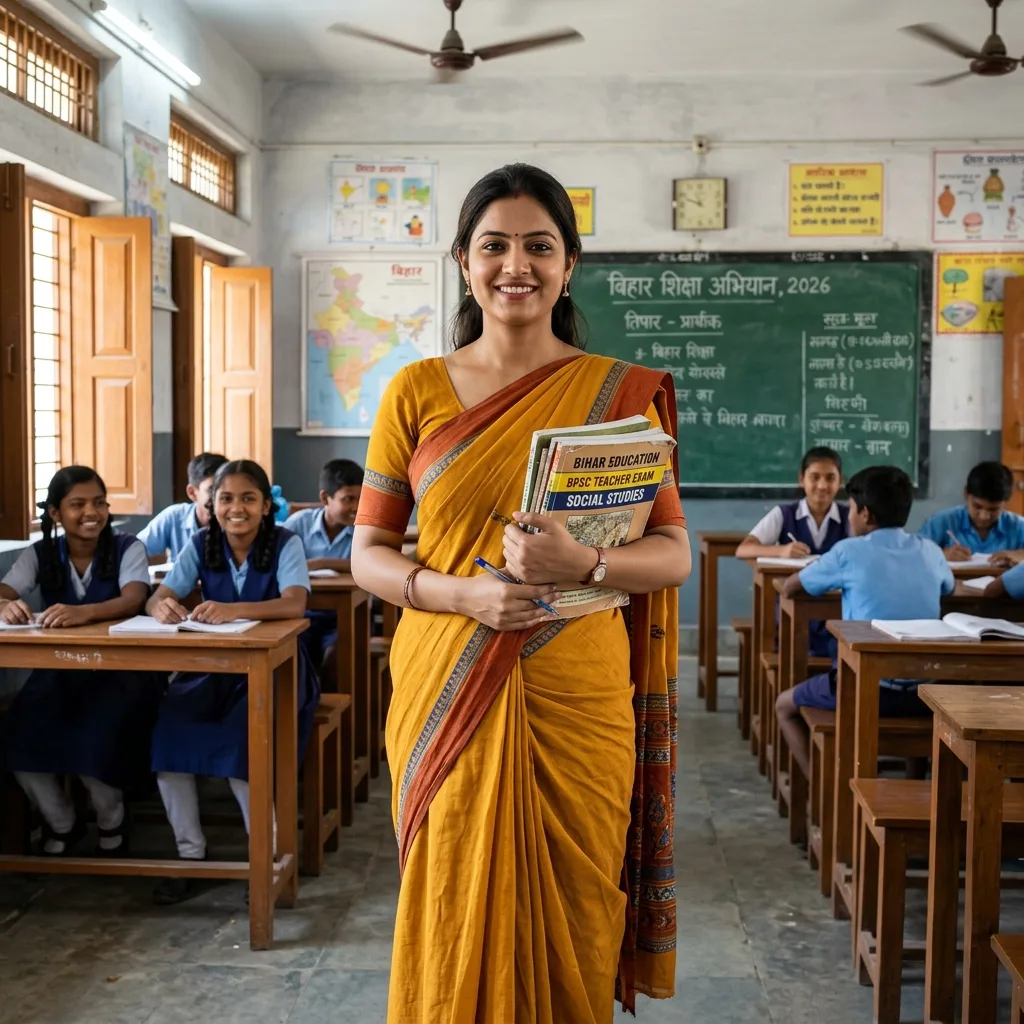
Bihar is preparing to launch its largest-ever teacher recruitment in 2026 — 46,882 vacancies across all levels of government school education. For any Bihar-domicile candidate with a teaching qualification, this is the most important opportunity of the decade.
The Bihar Public Service Commission (BPSC) is conducting this Teacher Recruitment Examination (TRE) as the fourth cycle — hence "TRE 4.0." Unlike previous state-level teacher exams (BTET, STET), the BPSC TRE is conducted directly by the same prestigious commission that conducts the Bihar Civil Services (BPSC CCE) exam for IAS-equivalent state officers. This gives BPSC Teacher appointments a higher administrative credibility and standardized selection process.
Why BPSC TRE 4.0 is a historic opportunity:
- 46,882 posts — Bihar's single largest teacher recruitment ever
- All levels covered: Primary (1-5), Middle (6-8), Secondary TGT (9-10), Senior Secondary PGT (11-12)
- Notification expected August 2026 — exam September 22-27, 2026
- Bihar domicile advantage — 95%+ of seats for Bihar residents
- Women's reservation 35% + OBC/SC/ST reservations
Quick Reference:
- Notification: Expected August 2026
- Application: Online at bpsc.bihar.gov.in (after notification)
- OTR: MUST complete before applying
- Exam Dates: September 22-27, 2026 (tentative)
- Total Vacancies: 46,882
- Website: bpsc.bihar.gov.in
Part 1: Vacancy Breakdown — 46,882 Posts Across All Levels
Level-wise Vacancy Distribution:
| Level | Classes | Estimated Posts | For Whom |
|---|---|---|---|
| Primary Teacher | Class 1-5 | 15,000-18,000 | D.El.Ed/BTC + BPSC TRE |
| Middle School Teacher | Class 6-8 | 10,000-13,000 | Graduation + B.Ed + BPSC TRE |
| Secondary Teacher (TGT) | Class 9-10 | 10,000-12,000 | Graduation (Subject) + B.Ed + CTET/STET |
| Senior Secondary Teacher (PGT) | Class 11-12 | 6,000-8,000 | Post-Graduation + B.Ed + CTET/STET |
| Total | — | ~46,882 | — |
Note: Exact vacancy distribution per level will be published in official notification. Figures above are based on available reports.
Subject-wise Openings (Middle, TGT, PGT levels):
| Subject | Available at Level | High Demand |
|---|---|---|
| Mathematics | Middle, TGT, PGT | Very High |
| Science (Physics/Chemistry/Biology) | Middle, TGT, PGT | Very High |
| Social Science / History / Geography | Middle, TGT | High |
| English | All levels | Very High |
| Hindi | All levels | High |
| Sanskrit | Middle, TGT, PGT | Moderate |
| Economics | TGT, PGT | Moderate |
| Political Science | TGT, PGT | Moderate |
| Commerce | PGT | Moderate |
Part 2: Eligibility Criteria — Complete Level-wise Breakdown
Primary Teacher (Class 1-5):
| Criterion | Requirement |
|---|---|
| Qualification | 12th pass (50% marks for General category) + D.El.Ed/BTC/D.Ed/JBT or equivalent |
| OR | Graduation + B.Ed (2 years) — also eligible |
| Bihar STET/BPSC TRE | Must have passed Bihar STET (Paper 1) OR previous BPSC TRE OR appearing in TRE 4.0 itself |
| Age | 21-40 years (General), relaxation for OBC/SC/ST/Women |
| Bihar Domicile | Preferred — verified by domicile certificate |
Middle School Teacher (Class 6-8):
| Criterion | Requirement |
|---|---|
| Qualification | Graduation in relevant subject (50% marks for General) + B.Ed (2 years) |
| Bihar STET | Bihar STET Paper 2 or equivalent TET qualification |
| Age | 21-40 years (General) |
Secondary Teacher — TGT (Class 9-10):
| Criterion | Requirement |
|---|---|
| Qualification | Graduation in teaching subject (at least 50% marks) + B.Ed (2 years) |
| For Mathematics/Science | B.Sc (Mathematics/Physics/Chemistry) + B.Ed |
| For Languages | Graduation with Language major + B.Ed |
| CTET/BSTET | CTET Paper 2 or Bihar STET (required for Secondary) |
| Age | 21-42 years (General) |
Senior Secondary Teacher — PGT (Class 11-12):
| Criterion | Requirement |
|---|---|
| Qualification | Post-Graduation in teaching subject (at least 50% marks) + B.Ed |
| For Sciences | M.Sc (relevant) + B.Ed |
| For Commerce | M.Com + B.Ed |
| For Languages | MA (Language) + B.Ed |
| Age | 21-42 years (General) |
Age Relaxation Table:
| Category | Maximum Age |
|---|---|
| General (Men) | 40 years |
| General (Women) | 42 years |
| OBC (Men) | 42 years |
| OBC (Women) | 44 years |
| SC/ST (Men) | 45 years |
| SC/ST (Women) | 47 years |
Part 3: The OTR Process — Mandatory First Step
OTR (One Time Registration) is the most confusing and most important step for BPSC TRE aspirants. Many candidates miss application deadlines because they don't complete OTR in time.
What Is OTR?
Bihar Public Service Commission requires ALL candidates to complete a one-time registration on their portal BEFORE applying for any exam. This is a permanent registration — you do it ONCE and it is valid for all future BPSC exams.
OTR Process — Step by Step:
Step 1 — Visit official portal: Go to onlinebpsc.bihar.gov.in (the online application portal)
Step 2 — Register with mobile number: Enter your mobile number (this becomes your User ID). OTP verification required.
Step 3 — Fill basic information:
- Name (as in 10th marksheet — must match exactly)
- Father's name
- Date of birth (from 10th certificate)
- Category (General/OBC/SC/ST/EWS)
- Gender
- Domicile state
Step 4 — Upload photo and signature:
- Photo: JPG format, 20-50 KB, recent passport size, white background
- Signature: JPG, 10-20 KB, on plain white paper in black ink
Step 5 — Upload documents:
- Aadhaar card (mandatory)
- Category certificate (for SC/ST/OBC/EWS)
- Domicile certificate (Bihar)
Step 6 — OTR Registration Number generated: Save this number carefully — used for all future applications.
Critical Warning: OTR must be completed BEFORE the notification comes. Do it NOW (July 2026) so you are ready the moment August notification drops.
Part 4: Bihar Teacher Salary — Complete Structure
Salary by Level (7th Pay Commission — Bihar):
| Post Level | Basic Pay | Gross Salary | In-Hand (Approx.) |
|---|---|---|---|
| Primary Teacher (Class 1-5) | Rs.25,500 | Rs.35,000-42,000 | Rs.30,000-37,000 |
| Middle School Teacher (Class 6-8) | Rs.28,900 | Rs.40,000-48,000 | Rs.35,000-43,000 |
| Secondary Teacher — TGT (Class 9-10) | Rs.31,500 | Rs.44,000-52,000 | Rs.38,000-46,000 |
| Senior Secondary — PGT (Class 11-12) | Rs.32,300 | Rs.45,000-55,000 | Rs.39,000-48,000 |
Note: Bihar teacher salaries include DA (Dearness Allowance), HRA (House Rent Allowance), TA (Transport Allowance). Figures based on 2026 DA rates.
Salary Components (Detailed — TGT Level):
| Component | Amount |
|---|---|
| Basic Pay | Rs.31,500 |
| Dearness Allowance (50%+ of Basic) | Rs.16,000-18,000 |
| HRA (8-16% of Basic, varies) | Rs.2,500-5,000 |
| Transport Allowance | Rs.1,500-3,000 |
| Gross Total | Rs.51,500-57,500 |
| Deductions (NPS + Tax) | Rs.5,000-8,000 |
| In-Hand Net | Rs.43,000-50,000 |
Additional Benefits:
| Benefit | Detail |
|---|---|
| Job Security | Permanent government appointment — cannot be terminated without cause |
| NPS (Pension) | 10% employee + 14% employer contribution toward pension fund |
| Maternity Leave | 180 days for women (central government rules applied in Bihar) |
| Annual Increments | 3% of basic pay annually — automatic |
| Medical Benefit | State Government health scheme for employees |
| School Summer Vacation | 2 months — teachers get 60+ days annual holiday |
| School Infrastructure | Teaching in government schools with improving infrastructure |
Part 5: BPSC TRE vs KVS vs NVS — Key Differences
Many aspirants confuse BPSC Teacher with KVS/NVS. They are completely different:
| Factor | BPSC TRE (Bihar) | KVS Teacher | NVS Teacher |
|---|---|---|---|
| Conducting Body | Bihar PSC | KVS (Central) | NVS (Central) |
| Posting | Bihar government schools only | Any KVS school in India | Navodaya schools — any state |
| Salary | Bihar state pay — slightly lower | Central pay — higher (PRT Rs.44,900+) | Central pay — higher + free quarters |
| Transfer | Within Bihar | Any state in India | Any state + residential campus |
| Eligibility | Bihar domicile preferred | All India, no domicile restriction | All India, no domicile restriction |
| Exam | BPSC TRE (single paper, 150 MCQ) | KVS Written Test + Interview | NVS Written Test + Interview |
| Subject GK | Includes Bihar-specific GK | No state-specific GK | No state-specific GK |
| Vacancies | 46,882 (TRE 4.0) | 3,000-5,000/year | 1,000-2,000/year |
| Competition | Very High (Bihar population) | High | Moderate |
| Job Prestige | State government — respected | Central government — very respected | Central government — very respected |
Bihar-domicile strategy: If you are from Bihar and have Bihar teaching qualifications — BPSC TRE is your primary target (46,882 seats vs KVS's 3,000). Also attempt KVS/NVS for higher salary + all-India posting.
Part 6: BPSC TRE 4.0 Exam Pattern
Written Examination Structure:
Total Marks: 150 marks Duration: 2 hours 30 minutes (150 minutes) Type: Objective Multiple Choice Questions (OMR-based) Negative Marking: 0.25 marks per wrong answer (1/4)
Paper Pattern — by Level:
Primary Teacher (Class 1-5) — 150 MCQ:
| Section | Marks | Syllabus |
|---|---|---|
| Language (Hindi/Urdu/Bangla) | 30 | Grammar, comprehension, pedagogy |
| General Studies | 40 | History, Geography, Science, Civic |
| Mathematics | 30 | Class 1-5 level mathematics + pedagogy |
| Child Development and Pedagogy | 30 | Learning theories, teaching methods |
| Bihar GK | 20 | Bihar-specific current affairs + history |
Middle School Teacher (Class 6-8) — 150 MCQ:
| Section | Marks | Syllabus |
|---|---|---|
| Language | 20 | Hindi + English grammar, comprehension |
| General Studies | 30 | Combined GS (History, Geography, Science) |
| Subject-specific | 60 | Your teaching subject (Maths/Science/Social/Language) |
| Child Development | 20 | Pedagogy, learning theories |
| Bihar GK | 20 | Bihar-specific topics |
Secondary TGT (Class 9-10) — 150 MCQ:
| Section | Marks | Syllabus |
|---|---|---|
| General Studies | 40 | History, Geography, Economy, Science |
| Subject Knowledge | 80 | Your subject — Class 9-10 level + degree level |
| Pedagogy (Teaching Methods) | 30 | Subject-specific teaching methodology |
Senior Secondary PGT (Class 11-12) — 150 MCQ:
| Section | Marks | Syllabus |
|---|---|---|
| General Studies | 30 | Advanced GS including Bihar economy |
| Subject Knowledge | 90 | PG-level subject knowledge |
| Pedagogy | 30 | Senior level teaching methodology |
Part 7: Bihar GK Capsule — Complete for BPSC TRE
Bihar GK is tested in all levels of BPSC TRE. Here is the complete capsule:
Geography of Bihar:
| Topic | Key Facts |
|---|---|
| Location | 24°20'N to 27°31'N latitude, 83°19'E to 88°17'E longitude |
| Area | 94,163 sq km — 12th largest state |
| Borders | UP (West), Nepal (North), WB (East), Jharkhand (South) |
| Districts | 38 districts |
| Divisions | 9 administrative divisions |
| Capital | Patna (on Ganga river banks) |
| Rivers | Ganga (main), Gandak, Kosi (Sorrow of Bihar), Son, Bagmati, Kamla, Punpun |
| Highest Point | Someshwar Fort area in West Champaran — 880m |
| Climate | Hot continental — hot summers, cold winters, monsoon June-September |
| Soil | Alluvial (Terai in north), Red soil (south), Black soil |
Economy of Bihar:
| Topic | Facts |
|---|---|
| GDP | 6th largest state GDP (nominal) in India |
| Agriculture | Main occupation — rice, wheat, maize, vegetables |
| Special Crops | Litchi (Muzaffarpur — world famous), Makhana (Fox nuts — Bihar produces 90% of India's makhana) |
| Minerals | Coal, limestone (limited) — mostly plain agricultural state |
| Industry | Sugar mills, jute mills (East Bihar), food processing |
| Growth Rate | Among fastest-growing states 2005-2026 — double-digit GSDP growth |
History of Bihar:
| Period | Key Events |
|---|---|
| Ancient | Magadha Empire (6th century BC) — Buddha attained enlightenment at Bodh Gaya (535 BC) |
| Maurya Empire | Chandragupta Maurya, Bindusara, Ashoka — Pataliputra (modern Patna) was capital |
| Gupta Empire | Golden age — science, art, philosophy flourished |
| Medieval | Muslim invasions — Bakhtiyar Khilji destroyed Nalanda University (1193 AD) |
| Nalanda | World's first residential university (5th century AD-12th century AD) — attracted scholars from China, Korea, Japan, Central Asia |
| Vikramashila | Second great Buddhist university in Bihar |
| Modern | Gandhi's Champaran Satyagraha (1917) — first civil disobedience in India |
| 1912 | Bihar separated from Bengal Presidency |
| 1936 | Jharkhand (then South Bihar) part of Bihar |
| 2000 | Jharkhand separated from Bihar |
Bihar — Important Personalities:
| Name | Contribution |
|---|---|
| Chandragupta Maurya | Founded Maurya Empire — first pan-Indian empire |
| Ashoka | Spread Buddhism, first welfare state concept |
| Aryabhata | Mathematician/astronomer — born in Bihar, discovered value of Pi, zero, earth's rotation |
| Chanakya | Arthashastra — political science — born in Takshashila but active in Pataliputra |
| Sanjay Gandhi | — |
| Satyendra Nath Bose | — |
| Jayaprakash Narayan (JP) | Freedom fighter, "Total Revolution" movement against Emergency (1975) |
| Laloo Prasad Yadav | Former CM, Railway Minister — controversial but significant political figure |
| Nitish Kumar | Current CM — Bihar development decade (2005-2026) |
Bihar Cultural Facts:
| Topic | Facts |
|---|---|
| Languages | Hindi (official), Maithili (2nd official), Bhojpuri, Magahi, Angika |
| Classical Dance | No specific classical dance — but rich folk dance tradition |
| Folk Art | Madhubani painting (Mithila art) — UNESCO recognized |
| Folk Music | Bidesia, Chaita, Sohar, Kajri — seasonal folk songs |
| Festivals | Chhath Puja (most important — dedicated to Sun God), Teej, Valmiki Jayanti |
| Famous Temples | Mahabodhi Temple Bodh Gaya (UNESCO WH), Mahavir Mandir Patna, Vishnupad Temple Gaya |
| Cuisine | Litti Chokha (signature dish), Sattu Paratha, Makhana Kheer, Thekua |
Part 8: Subject-wise Preparation Strategy
For Primary Teacher Aspirants:
Key strategy: Paper has Bihar GK + Child Development + Elementary Mathematics + Language. Most candidates underestimate Child Development (30 marks) — it is actually the highest-scoring section if prepared well.
Child Development (30 marks) — High-yield topics:
- Piaget's Cognitive Development Stages (Sensorimotor, Preoperational, Concrete Operational, Formal Operational)
- Vygotsky's Zone of Proximal Development (ZPD) and Scaffolding
- Multiple Intelligences (Howard Gardner's theory — 8 intelligences)
- Learning theories: Behaviorism (Pavlov, Skinner), Constructivism (Piaget, Vygotsky)
- Inclusive education — children with special needs
- NCF 2005 (National Curriculum Framework) — key recommendations
- NEP 2020 — new education policy, play-based learning, mother tongue instruction
Bihar GK for Primary (20 marks):
- Focus on recent Bihar developments — new districts, schemes (MGNREGS Bihar performance), CM's welfare programs
- Bihar geography basics — rivers, districts, borders
- Key dates — Bihar foundation day (March 22), Sarhul, Chhath, important personalities
For TGT Mathematics/Science Aspirants:
Mathematics TGT — Subject Knowledge (80 marks):
- Class 9-10 NCERT level PLUS graduation-level topics
- Algebra: Linear equations, quadratic, polynomials — Class 9-10
- Geometry: Triangles, circles, coordinate geometry — Class 9-10
- Trigonometry: Ratios, identities, heights and distances
- Statistics and Probability: Mean, median, mode, basic probability
- Number Theory: Real numbers, rational/irrational, prime numbers
Science TGT — Subject Knowledge (80 marks):
- Physics: Motion, force, work, energy, light, sound, electricity, magnetism
- Chemistry: Matter, atoms, compounds, carbon chemistry, chemical reactions, periodic table
- Biology: Life processes, reproduction, heredity, ecosystem, human body systems
- All topics from Class 9-10 NCERT thoroughly — then graduation-level basics
For PGT Aspirants:
PGT exams have 90 marks for subject knowledge — PG level. The preparation requires:
- Complete NCERT Class 11-12 mastery (both content and pedagogy)
- Graduation-level textbook depth (for Mathematics: calculus, linear algebra; for Science: advanced topics)
- Subject methodology — how to teach your subject at senior secondary level
- Focus on: Board exam pattern awareness (CBSE Class 11-12 exam structure, important topics)
Part 9: BPSC TRE vs Previous Bihar Teacher Exams
Bihar has had a complicated teacher recruitment history. Understanding it helps aspirants avoid common confusions:
Bihar Teacher Recruitment History:
| Exam | Year | Conducted By | Issue |
|---|---|---|---|
| Bihar STET | 2011, 2015, 2019 | Bihar School Examination Board | Multiple controversies, paper leaks, delays |
| BPSC TRE 1.0 | 2023 | BPSC (first time) | Smooth conduct, established BPSC credibility |
| BPSC TRE 2.0 | 2023-24 | BPSC | Major controversy — paper leak allegations, court cases, re-exam ordered |
| BPSC TRE 3.0 | 2024-25 | BPSC | Conducted under heavy security, improved process |
| BPSC TRE 4.0 | 2026 (upcoming) | BPSC | Expected August notification, September exam |
Why BPSC is better than old STET:
- BPSC is a more prestigious institution than BSEB (which conducted STET)
- BPSC exams are harder to leak — biometric attendance, CCTV, district-level security
- BPSC appointment is seen as more legitimate — courts have consistently upheld BPSC TRE appointments
TRE 2.0 controversy explanation: In 2023-24, some papers were allegedly leaked before TRE 2.0 exams. Courts ordered investigation and re-examination for affected papers. Eventually, valid appointments were made. TRE 4.0 is expected to have tighter paper security including real-time encrypted question paper delivery at exam centers.
Part 10: Application Process — Step-by-Step After Notification
Timeline (Expected):
| Step | Expected Date |
|---|---|
| Notification Published | August 2026 (first week) |
| OTR Deadline | Before or within first week of notification |
| Application Opens | August 1-2 week, 2026 |
| Application Closes | August end / September first week |
| Admit Card Download | September 15-18, 2026 |
| Exam Dates | September 22-27, 2026 |
| Result | October-November 2026 |
| Document Verification | December 2026 |
| Joining | January-February 2027 |
Application Fee:
| Category | Expected Fee |
|---|---|
| General/EWS/OBC (Male) | Rs.750-1,000 |
| SC/ST (Bihar domicile) | Rs.200-300 |
| Women (All categories, Bihar domicile) | Rs.200-300 |
| PwBD | Free or nominal |
Fee amounts confirmed only after official notification
Documents Required at Application:
- Graduation/Post-Graduation Marksheets + Certificate
- B.Ed Degree
- D.El.Ed/BTC (for Primary)
- CTET/Bihar STET Certificate (where required)
- Bihar Domicile Certificate
- Category Certificate (OBC/SC/ST)
- Aadhaar Card
- Recent Passport Photo
- Signature Scan
Part 11: Preparation Schedule — 60-Day Strategy (If Notification Comes in August)
Week 1-2: Foundation Building
- Bihar GK: Read Bihar-specific books (Spectrum Bihar GK or Arihant Bihar GK) — 1 hour daily
- Subject Knowledge: Start from NCERT Class level of your target post — 2 hours daily
- Child Development (Primary/Middle applicants): NCERT/CTET-level CDP — 1 hour daily
- Current Affairs (Bihar): Follow Dainik Bhaskar Bihar edition or Bihar Bandhu — 30 min daily
Week 3-4: Core Content
- Subject Knowledge intensive: Graduation-level depth — 2.5 hours daily
- Pedagogy: Teaching methods, learning theories, inclusive education — 1 hour daily
- Bihar GK: Mock questions, previous BPSC GK papers — 45 min daily
- General Studies: History, Geography, Economy, Science basics — 45 min daily
Week 5-6: Practice and Mock Tests
- Full mock tests: 1 complete 150-question mock every 2 days
- Error analysis: Review every wrong answer — understand WHY it was wrong
- Weak areas: Extra focus on lowest-scoring sections from mocks
- Speed building: 150 questions in 150 minutes = 1 minute per question. Practice timing.
Week 7-8: Final Sprint
- Revision only: No new topics after Week 6
- Previous year questions: BPSC TRE 1.0, 2.0, 3.0 previous questions — most important
- Bihar GK final revision: Current affairs of last 6 months (Bihar-focused)
- Mental preparation: Light study, adequate sleep, no stress
Part 12: BPSC TRE 4.0 Cut-off Expectations
Based on previous TRE cut-offs:
BPSC TRE 3.0 Cut-offs (Reference — Out of 150):
| Level | General | OBC | SC | ST |
|---|---|---|---|---|
| Primary | 88-95 | 82-88 | 72-80 | 65-74 |
| Middle | 92-100 | 85-92 | 75-83 | 68-76 |
| TGT (Secondary) | 95-105 | 88-95 | 78-86 | 70-78 |
| PGT (Sr. Secondary) | 98-108 | 90-98 | 80-88 | 72-80 |
Cut-offs vary significantly by subject — Mathematics and Science TGT/PGT cut-offs are higher; Language and Social Science are lower due to more candidates in those subjects.
Key Cut-off Insight:
For General category TGT — targeting 100/150 (67%) gives a safe margin above expected cut-off. This means in a 150-question paper with 0.25 negative marking:
- Correct: 105 questions
- Wrong: 5 questions (at most — to stay above 100 net score)
- Skipped: 40 questions
Strategy: Attempt 110 questions, get 105 right, leave 40 uncertain questions unattempted.
Part 13: Frequently Asked Questions
Q1. Can I apply for BPSC TRE 4.0 if I am not from Bihar? BPSC TRE strongly prefers Bihar domicile candidates. The Bihar government has a domicile policy that reserves most posts for Bihar residents. Non-Bihar candidates CAN apply but will compete in the unreserved (non-domicile) category — which has very limited seats. If you are from Bihar, you have a significant advantage. Non-Bihar candidates should focus more on KVS/NVS or CTET + state PSC of their home state.
Q2. Is CTET mandatory for BPSC TRE 4.0?
- Primary (Class 1-5): CTET Paper 1 OR Bihar STET Paper 1 — required for some levels, check notification
- Middle (Class 6-8): CTET Paper 2 OR Bihar STET Paper 2
- TGT/PGT: CTET or Bihar STET — required
- BPSC TRE 4.0 itself may serve as the qualifying exam for some posts — exact requirement will be in official notification. Clear your CTET now if you have not already — it is an evergreen requirement.
Q3. How is Bihar teacher salary different from central government teacher salary? Bihar (State) teacher salary is lower than KVS/NVS (Central) teachers. KVS PRT basic: Rs.44,900 vs Bihar Primary teacher basic: Rs.25,500. However, Bihar teacher also gets state government DA, HRA, and benefits — total Bihar teacher in-hand: Rs.30,000-37,000 vs KVS PRT in-hand: Rs.50,000-58,000. The gap is significant, but Bihar teacher jobs are far more numerous (46,882 vs 3,000 KVS posts) and strongly prefer Bihar domicile.
Q4. Is B.Ed mandatory for Primary Teacher in BPSC TRE 4.0? For Primary (Class 1-5): D.El.Ed/BTC is the primary qualification. B.Ed is also accepted. NEP 2020 mandates that by 2030, B.Ed will be the standard teacher qualification even for primary level. Currently both D.El.Ed and B.Ed are valid for Primary posts in BPSC TRE.
Q5. What happens after selection in BPSC TRE 4.0? After written exam → Document Verification → Biometric enrollment → Posting order → Joining at assigned school. Posting is typically within the district of your domicile certificate or nearest district. Teachers are posted to government schools under Education Department, Bihar. First posting: Usually rural/semi-urban school. After 3-5 years: Can request urban posting transfer.
Q6. Will BPSC TRE 4.0 exam be in Hindi or English? BPSC TRE question papers are primarily in Hindi. However, Language section papers (English, Urdu, Sanskrit) have their respective language questions. General Studies, Child Development, and subject knowledge questions are in Hindi (for non-English subject teachers). English-medium candidates will find the exam more accessible than ever as Bihar government has been improving English proficiency among aspirants.
Conclusion: BPSC TRE 4.0 — Bihar's Teaching Revolution
46,882 teacher posts in one recruitment cycle. Bihar has never seen this scale of investment in education before. These teachers will shape 1-2 crore children's futures across Bihar's government schools — from the Champaran villages to Patna's urban schools, from Gaya's heritage zones to the Seemanchal border districts.
For any Bihar domicile candidate with a teaching qualification — this is the most important government exam of your life. The salary, the job security, the annual school vacations, the social respect of being a government teacher — it all comes together in BPSC TRE 4.0.
Your immediate action items:
- Complete OTR NOW at onlinebpsc.bihar.gov.in — do not wait for the notification
- Clear CTET if you haven't already (next cycle will be announced soon)
- Start Bihar GK preparation — Madhubani, Chhath, rivers, economy, personalities
- Begin subject revision — NCERT Class 9-10 (for TGT) or NCERT + graduation level (for PGT)
- Bookmark bpsc.bihar.gov.in — check daily from August 1 for notification
Stay updated with BPSC TRE 4.0 notification, application date, admit card, result, cut-off, and Bihar teaching career news at Government Job Result — India's most trusted government career resource.
Disclaimer: Vacancy figures based on media reports. Official vacancy count will be confirmed in BPSC TRE 4.0 notification (expected August 2026). Salary figures based on 7th Pay Commission + Bihar state DA 2026. Age limits and eligibility subject to official notification. Always verify from bpsc.bihar.gov.in.
Part 14: Bihar Government School System — What You Are Joining
Understanding the Bihar government school ecosystem helps you prepare mentally and professionally:
Bihar's Government School Structure:
| Level | School Type | Classes | Managed By |
|---|---|---|---|
| Primary | Primary School / Prathamik Vidyalaya | Class 1-5 | Bihar Education Project Council (BEPC) |
| Upper Primary | Madhya Vidyalaya | Class 6-8 | District Education Officer |
| Secondary | Uccha Madhyamik Vidyalaya | Class 9-10 | Bihar School Examination Board (BSEB) |
| Senior Secondary | Intermediate College | Class 11-12 | Bihar Intermediate Education Council |
| Special | Kasturba Gandhi Balika Vidyalaya | Class 6-12 (Girls residential) | BEPC |
Current State of Bihar Government Schools (2026):
Bihar's school education has improved dramatically since 2005 under multiple government initiatives:
Positive Changes (2005-2026):
- Enrollment: 95%+ children enrolled in primary school (from 60-70% in 2000)
- Mid-day meal: Bihar runs India's largest midday meal program — 2.2 crore students daily
- School buildings: Massive school construction — most districts now have pucca school buildings
- Toilets: Separate girl's toilets in 95%+ government schools (SwachhtaAbhiyan)
- Libraries: School library program underway
- Digital: Smart classroom initiative in 1,000+ senior secondary schools
Remaining Challenges:
- Teacher vacancies: 46,882 TRE 4.0 posts represent a REAL shortage — when you join, you fill a genuine need
- Infrastructure: Rural primary schools still have basic infrastructure
- Learning outcomes: ASER reports show Bihar improving but still below national average in reading and arithmetic
- Teacher absenteeism: Historical issue that TRE process (merit-based, no political influence) is addressing
Your Role: As a BPSC TRE 4.0 teacher, you are part of Bihar's education revolution. The quality gap between government and private schools in Bihar is closing — your merit-based appointment is part of that transformation.
Part 15: Day-in-the-Life — Bihar Government Teacher (Realistic)
Primary Teacher (Class 1-5, Rural School):
7:30 AM: Reach school (most rural primary schools start early). Take attendance. Pray/morning assembly.
8:00-11:00 AM: Teaching periods — 4-5 periods of 30-40 minutes each. Subjects rotate: Hindi, Mathematics, EVS (Environmental Studies), English, Art.
11:00 AM: Midday meal break — teachers supervise meal distribution (a significant daily responsibility).
11:30 AM-1:30 PM: Afternoon periods — continuation of subjects, story/activity time for younger classes.
1:30-2:00 PM: Administrative duties — updating attendance register, learning outcomes register (mandatory in Bihar's data-driven education system), UDISE data entry (government school database).
2:00 PM: School closes. Teachers attend school-level meetings on Saturdays — monthly block-level meetings.
After school: Parent-teacher interactions (informal), government scheme implementation at school level (PM POSHAN, Uniform distribution), report writing.
Saturdays: Half-day school + professional development or block-level education officer meetings.
Key Insight: Primary teaching in rural Bihar is exhausting but deeply meaningful. A good primary teacher in rural Bihar shapes 40-50 children's entire future. The first teacher who makes a child love reading or understand mathematics creates a life-long impact.
TGT Teacher (Class 9-10, Urban School):
8:30 AM: Reach school. Review lesson plan for the day.
9:00 AM-1:00 PM: Teaching periods — typically 5-6 periods of 45 minutes. Mathematics TGT might teach 4 sections of Class 9 and 2 sections of Class 10 on different days.
1:00-1:30 PM: Lunch break.
1:30-3:30 PM: Afternoon periods + remedial teaching for weak students.
3:30-4:00 PM: Administrative — register maintenance, question paper preparation, practical records (for Science).
Exam duties: During BSEB (Bihar Board) Class 10 exams — TGT teachers serve as exam invigilators at their school or neighboring school. Exam duty is additional responsibility but adds variety.
Board result season: After March — BSEB results, re-checking duties, scholarship form attestation for students.
Part 16: Bihar's Education Policy — NEP 2020 and Teacher Implications
The National Education Policy 2020 is transforming what teaching means in India. As a BPSC TRE 4.0 teacher, you will be implementing NEP 2020 from Day 1:
NEP 2020 Key Changes Affecting Teachers:
1. Foundational Literacy and Numeracy (FLN):
- All children must be able to read simple text and do basic arithmetic by Grade 3 (Class 3)
- Bihar is implementing NIPUN Bharat Mission (National Initiative for Proficiency in Reading with Understanding and Numeracy)
- Primary teachers are trained in FLN pedagogy — play-based, activity-based learning
2. 5+3+3+4 Structure (New School System):
| Stage | Classes | Age | Implication |
|---|---|---|---|
| Foundational | Pre-K to Class 2 | 3-8 years | Play-based learning, mother tongue |
| Preparatory | Class 3-5 | 8-11 years | Experiential learning |
| Middle | Class 6-8 | 11-14 years | Coding, vocational, critical thinking |
| Secondary | Class 9-12 | 14-18 years | Multidisciplinary, project-based |
3. Mother Tongue Instruction:
- Class 1-5: Teaching in Bihar's languages (Hindi, Maithili, Bhojpuri) — not just standard Hindi
- For teachers in Mithilanchal region: Maithili competency may be advantageous
- English is still taught from Class 1 but instruction is bilingual
4. Coding and Vocational Education (Middle Level):
- Middle school (Class 6-8) curriculum now includes basic coding, financial literacy, life skills
- TGT teachers with IT background may be asked to teach foundational computer/coding topics
5. Project-based Learning:
- Less rote learning, more critical thinking and project work
- Teachers must develop project assessment skills — a shift from traditional exam-only evaluation
Part 17: Career Growth After BPSC TRE — Promotion Path
Many aspirants don't research what happens AFTER getting a Bihar teaching job. The promotion path is significant:
Bihar Government Teacher Promotion Ladder:
| Level | Designation | How to Reach |
|---|---|---|
| Entry | Assistant Teacher (Primary/Middle) | BPSC TRE + joining |
| Senior Teacher | Senior Teacher / Seniority-based | 5+ years service, ACR |
| Head Teacher | Headmaster / Head Teacher | 10+ years, written exam + seniority |
| Block Resource Person | BRCC / CRCC | Special selection — educational expertise |
| Block Education Officer (BEO) | BEO | State PSC exam — competitive |
| District Education Officer (DEO) | DEO | Seniority + State PSC — limited posts |
| State Level | BEPC Officer / Education Dept | Senior administrative role |
TGT/PGT Promotion Path:
| Level | Designation | Timeline |
|---|---|---|
| Entry | TGT / PGT | Day 1 |
| Senior | Senior Teacher | 5 years + |
| Head Teacher | Headmaster | Written exam after 7-10 years |
| Academic Supervisor | Inspector of Schools (Academic) | Dept exam + seniority |
| DEO | District Education Officer | State PSC route |
Cross-exam Opportunities While in Service:
Many Bihar teachers successfully appear for other exams while in service:
- BPSC 72nd CCE (Civil Services): Bihar teachers have good GS preparation — many clear civil services
- KVS/NVS Teacher: Transfer to central government teaching — higher salary
- CTET (if not already cleared): Opens central school opportunities
- UPSC CSE: Some Bihar teachers have become IAS officers while in teaching service
Part 18: Bihar Teacher Salary Comparison — State vs Central vs Private
A comprehensive salary reality check for 2026:
Monthly Salary Comparison at Entry Level:
| Post | Gross Salary | In-Hand | Benefits |
|---|---|---|---|
| Bihar Primary Teacher (TRE 4.0) | Rs.35,000-42,000 | Rs.30,000-37,000 | NPS, leave, basic state scheme |
| Bihar Middle Teacher (TRE 4.0) | Rs.40,000-48,000 | Rs.35,000-43,000 | Same |
| Bihar TGT (TRE 4.0) | Rs.44,000-52,000 | Rs.38,000-46,000 | Same |
| KVS PRT (Central) | Rs.55,000-62,000 | Rs.48,000-55,000 | CGHS, better NPS, national transfer |
| NVS PGT (Central) | Rs.68,000-78,000 | Rs.58,000-68,000 | CGHS + FREE HOUSING on campus |
| Navodaya PRT (NVS) | Rs.55,000-62,000 | Rs.48,000-55,000 | CGHS + free campus housing |
| Bihar Private School Teacher | Rs.10,000-20,000 | Rs.8,000-18,000 | None guaranteed |
| CBSE Private School (good school) | Rs.25,000-40,000 | Rs.22,000-35,000 | EPF only |
The Bihar-Central Teaching Salary Gap — Is It Worth It?
Bihar Primary Teacher vs KVS PRT salary gap: Rs.18,000-20,000 in-hand per month. That sounds like a lot — but consider:
- 46,882 Bihar teaching posts vs 3,000-5,000 KVS posts annually
- Selection probability in BPSC TRE (Bihar domicile advantage) is MUCH higher than KVS
- Bihar posting = stay in home state with family; KVS = possible posting anywhere in India
- Bihar teaching gives a foothold — you can always attempt KVS later with Bihar service experience
Smart strategy for Bihar aspirants: Apply BPSC TRE 4.0 → Get appointed → Attempt KVS simultaneously every year → If KVS comes: Switch (your Bihar appointment gives you income security while you attempt KVS; no harm done).
Part 19: Teaching Subject Strategy — Which Subject Has Best Opportunities?
Subject-wise Demand and Competition Analysis:
| Subject | Vacancies Expected | Competition Level | Difficulty to Score |
|---|---|---|---|
| Mathematics | Very High (shortage subject) | Moderate (fewer qualified candidates) | Moderate (if prepared) |
| Science | Very High (shortage subject) | Moderate | Moderate |
| English | High | High (many English graduates) | Moderate-High |
| Hindi | High | Very High (huge candidate pool) | Moderate |
| Social Science | Moderate | Very High | Low-Moderate |
| Sanskrit | Low-Moderate | Low (fewer qualified) | Easy for Sanskrit graduates |
| Economics | Low | Moderate | Moderate |
| Computer Science | Moderate | Low (emerging subject) | Easy for CS graduates |
Best opportunity: Mathematics and Science TGT/PGT — Bihar has a massive shortage of qualified Maths/Science teachers. Competition is lower relative to vacancies. If you are a B.Sc or B.Tech graduate — this is your golden opportunity.
Biggest competition: Hindi and Social Science — most candidates belong to Arts stream. Thousands compete for fewer comparative posts.
Part 20: BPSC TRE 4.0 — Special Provisions and Reservation
Category-wise Reservation:
| Category | Reservation % | Notes |
|---|---|---|
| Scheduled Caste (SC) | 16% | Bihar specific reservation |
| Scheduled Tribe (ST) | 1% | Bihar SC/ST combined — some districts |
| OBC (Extremely Backward Classes — EBC) | 18% | Bihar has separate EBC category |
| OBC (Backward Classes — BC) | 12% | Standard OBC |
| Women (Horizontal) | 35% | Across all categories — massive |
| EWS | 10% | Economic Weaker Section |
| PwBD (Disabled) | 4% | Specially abled |
| Ex-Servicemen | Specific posts reserved | — |
Women's Reservation Impact:
Bihar's 35% horizontal reservation for women in teaching is transformative. In BPSC TRE:
- Of every 100 seats: 35 are reserved for women
- Within SC seats, 35% of those go to SC women
- Within OBC seats, 35% of those go to OBC women
For a General category woman from Bihar: She competes in General seats (remaining after SC/ST/OBC/EWS) AND benefits from the horizontal 35% women's cut within that pool. Effective odds of selection are significantly better than male General category candidates.
Bihar Domicile Requirement:
For most BPSC TRE posts: Bihar domicile is either mandatory or gives priority. The domicile certificate (issued by Revenue Office/Circle Officer) must show Bihar residence. Key requirement: Must have been Bihar resident for 10+ years OR permanent resident.
Documents for Domicile:
- Aadhaar (showing Bihar address)
- Voter ID (Bihar)
- School/College certificates (from Bihar institutions)
- Revenue Office's domicile certificate
Part 21: Technology and Digital Skills for Bihar Teachers
As part of Bihar's digital education push, teachers are increasingly expected to use technology:
Digital Tools Bihar Teachers Use:
1. UDISE+ Portal: Every school in India is registered in UDISE (Unified District Information System for Education). Teachers must update student data, enrollment, attendance, and infrastructure details on this portal periodically.
2. DIKSHA Platform: National digital learning platform (Ministry of Education). Bihar schools use DIKSHA for digital textbooks (e-NCERT), teacher training modules, and assessment tools.
3. PM e-Vidya: Free digital content for students — teachers guide students to access this platform. One nation, one digital education platform.
4. WhatsApp for Education: Bihar government uses WhatsApp groups for immediate teacher communication — circulars, meeting notices, last-minute schedule changes. Having a smartphone is effectively mandatory.
5. Biometric Attendance: Many Bihar schools have biometric attendance machines — teachers mark attendance digitally. No proxy attendance possible — accountability has increased.
6. Online salary slip/service records: Bihar government pays salary via direct bank transfer; salary slips and service records are online at HRMS (Human Resource Management System).
Skill recommendation: If you are applying for BPSC TRE 4.0, basic computer and smartphone skills are important. Microsoft Office basics (Word, Excel), Gmail/government email, portal navigation — these will serve you well in your teaching career.
Part 22: Common Mistakes Bihar Teacher Aspirants Make
Learning from others' mistakes saves months of wasted effort:
Mistake 1: Not completing OTR in advance Candidates wait for the official notification before registering on BPSC portal. Then the server crashes due to high traffic in the first 2 days. Complete OTR NOW — July/August 2026 — before the notification rush.
Mistake 2: Ignoring Bihar GK General GK books cover India's GK but Bihar-specific topics (Makhana production, Chhath Puja significance, Nalanda history, Surajkund Mela — wait, that's Haryana, not Bihar!) need Bihar-specific books. Invest Rs.200-300 in a dedicated Bihar GK book — Arihant or Lucent Bihar GK.
Mistake 3: Underestimating Child Development (Primary level) CDP (Child Development and Pedagogy) is 30 marks in Primary paper. Many subject-strong candidates skip it — then lose 10-12 marks here. CDP is highly scoring if studied properly. Piaget, Vygotsky, inclusive education, NCF 2005 — these 5-6 topics reliably appear every year.
Mistake 4: Not attempting previous BPSC TRE papers BPSC TRE 1.0 and TRE 2.0/3.0 previous papers are available. At least 30-40% of questions are conceptually repeated or very similar. Previous year questions are more valuable than any coaching material.
Mistake 5: Over-relying on coaching Bihar has hundreds of teaching exam coaching centers — especially in Patna. Coaching is not necessary for BPSC TRE if you have strong subject knowledge. NCERT textbooks + previous papers + Bihar GK book = complete preparation. Save the Rs.5,000-15,000 coaching fee.
Mistake 6: Applying for wrong level Primary, Middle, TGT, PGT each have different eligibility. A B.Sc graduate without B.Ed cannot apply for Middle School Teacher. A D.El.Ed holder is eligible for Primary only — not Middle or higher. Carefully verify your eligibility for each level before paying the application fee.
Mistake 7: Missing the application window BPSC notifications have strict deadlines — usually 20-30 days. Once the notification drops in August, the application window may be as short as 3 weeks. Missing it means waiting another year. Set multiple reminders — phone alarms, calendar alerts, bookmark bpsc.bihar.gov.in.
Part 23: BPSC TRE 4.0 for NRI Bihar Aspirants
Many Bihar-origin Indians living abroad (Gulf countries, USA, UK, Canada) want to return and build a stable career in Bihar. BPSC TRE can be a pathway:
OCI/NRI Eligibility:
Indian citizens (not OCI cardholders — they are foreign nationals) who have Bihar domicile can apply. If you hold an Indian passport and have maintained Bihar domicile documents — you are eligible.
Practical considerations for returned NRI:
- Age relaxation: If you spent years abroad and are now 35-40 — OBC/SC/ST age relaxation allows you to apply
- Qualification: Degree from foreign university needs equivalence certificate from AIU (Association of Indian Universities)
- Language: BPSC TRE paper is in Hindi — must have Hindi reading comfort
- Adjustment: Going from Dubai/US salary to Bihar teacher salary (Rs.30,000-40,000 in-hand) requires lifestyle adjustment — but job security and family proximity compensates for many
Part 24: What Happens If BPSC TRE 4.0 Is Challenged in Court?
BPSC TRE 2.0 had significant court cases (paper leak allegations). Aspirants worry: "What if TRE 4.0 is also challenged?"
How Courts Have Handled Previous TRE Challenges:
TRE 2.0 controversy outcome:
- Paper leak allegations led to Patna High Court intervention
- Court ordered fresh exam for some papers where leak was proven
- Valid appointments from unaffected papers WERE protected
- Court distinguished between affected and unaffected candidates — protecting those who cleared fair papers
What protects your appointment:
- If you clear TRE 4.0 through merit in a fair exam — your appointment is legally valid
- Court challenges affect future recruitment process, not already-made valid appointments
- Supreme Court has generally upheld BPSC TRE appointments while ordering process improvements
For aspirants: Appear confidently in TRE 4.0. Focus on clearing the exam on your own merit. If the paper is fair — your appointment is legally secure. Courts do not cancel appointments of innocent qualified candidates.
Part 25: BPSC TRE 4.0 — District-wise School Situation
Your posting district matters greatly. Understanding Bihar's district education landscape:
Districts with Most Teacher Vacancies:
| District | Population | Why High Vacancies |
|---|---|---|
| Patna | 60 lakh | Many schools, urban + rural mix |
| Muzaffarpur | 60 lakh | Large population, rural-heavy |
| Gaya | 52 lakh | Historically lower teacher recruitment |
| Bhagalpur | 35 lakh | East Bihar — significant shortage |
| Purnia | 32 lakh | Seemanchal area — remote posting |
| West Champaran | 40 lakh | Terai/forest area — tough posting |
| Samastipur | 43 lakh | Dense rural population |
| Begusarai | 30 lakh | Industrial/agricultural mix |
| Nalanda | 29 lakh | Historical district — Buddhist circuit |
| Vaishali | 35 lakh | Close to Patna — preferred posting |
Rural vs Urban posting reality:
- First posting is almost always rural — away from district headquarters
- After 3-5 years: Transfer request to urban/semi-urban possible
- Proximity to home village often possible for Bihar domicile candidates
- Rural posting means lower cost of living — Rs.35,000 in rural Bihar buys MORE than Rs.45,000 in Patna
Extended FAQ (Part 2)
Q7. I have completed B.Ed from a private college — is it valid for BPSC TRE? Yes — B.Ed from any NAAC-accredited or NCTE-recognized college is valid. However, there have been cases in Bihar where B.Ed degrees from unrecognized colleges were rejected at document verification. Verify your B.Ed college's recognition status on the NCTE website (ncte.gov.in) before applying. If your college is on NCTE's recognized list — your B.Ed is fully valid.
Q8. Can I apply for multiple levels in BPSC TRE 4.0? Yes — if eligible for both Primary and Middle level (for example: D.El.Ed + graduation + B.Ed), you can apply for both. Separate application and fee for each level. Separate exams on different days (September 22-27 — different levels on different days). If you clear both — you choose which appointment to take at document verification.
Q9. What is the difference between BPSC TRE and Bihar STET? Bihar STET (State Teacher Eligibility Test) was a qualifying test — passing it made you ELIGIBLE to be considered for appointment, but was not itself the recruitment exam. BPSC TRE (Teacher Recruitment Examination) IS the recruitment exam — clearing it with sufficient merit directly leads to appointment. BPSC TRE has essentially replaced the STET + separate recruitment process with a single combined exam.
Q10. How are subjects allocated at TGT/PGT level? At TGT (Class 9-10) and PGT (Class 11-12) levels, you apply for a SPECIFIC SUBJECT vacancy — Mathematics TGT, Science TGT, English TGT etc. You write your subject in the application form. The subject knowledge paper (80 marks for TGT, 90 marks for PGT) is subject-specific. You are compared only against other candidates for the same subject — NOT against candidates of different subjects.
Q11. What if I don't have Bihar domicile but have lived in Bihar for 5 years for education? Bihar domicile is typically based on permanent residence. If your family's permanent home is another state but you studied in Bihar — you likely do NOT qualify for Bihar domicile. However, if you have been living in Bihar continuously for 10+ years and can show consistent Bihar address on Aadhaar/voter ID/school certificates — a domicile certificate may be obtainable. Check with your local Revenue Circle Officer. Some borderline cases have been resolved in candidates' favor. But do not apply assuming domicile if you are not genuinely Bihar-domicile — at document verification, it will be scrutinized.
Q12. Is there negative marking in BPSC TRE exam? Yes — 0.25 marks (one-fourth) is deducted for every wrong answer. This is relatively low negative marking. Strategy: Attempt questions where you are 60%+ confident. Skip questions where you are completely uncertain. DO NOT guess randomly on all 150 questions — focus on answering 110-120 questions correctly rather than attempting all 150 recklessly.
Conclusion (Final): Bihar's Teaching Revolution — Be Part of It
46,882 government teachers joining Bihar's schools in 2026-27. 2 crore children waiting in classrooms. A state rising economically (highest GDP growth rates in India 2005-2026). An education department that has moved from political appointments to merit-based BPSC selection.
This is not just a job opportunity — it is a historic moment in Bihar's educational transformation. Every BPSC TRE 4.0 teacher who joins is part of this story.
The practical reality: Rs.30,000-46,000 in-hand salary with permanent government security, annual increments, promotion path, 35% women's reservation advantage, home state posting for Bihar domicile candidates, and the social prestige of being a government teacher — BPSC TRE 4.0 delivers one of the best career packages available in Bihar.
Your complete action plan:
- Complete OTR NOW: onlinebpsc.bihar.gov.in — do not wait
- Check CTET status: Clear CTET (Paper 1 or Paper 2 based on your target level) if pending
- Start Bihar GK: Buy Arihant Bihar GK + follow Bihar news daily
- Begin subject revision: NCERT first, then graduation textbooks
- Join a study group: Accountability from fellow aspirants helps consistency
- Set August alert: Notification expected first or second week of August 2026
Remember: Bihar teachers from BPSC TRE 1.0 (2023) have now completed 3 years of service. They describe it as "the best decision I made." The job is challenging but fulfilling, the security is real, and the impact on children's lives is tangible.
Stay updated with BPSC TRE 4.0 notification date, application link, admit card, exam schedule, result, cut-off, and all Bihar teaching career news at Government Job Result — India's most trusted government career resource.
Disclaimer: All vacancy figures, salary data, and exam dates are based on available reports as of July 2026. Official figures will be in BPSC TRE 4.0 notification (expected August 2026). Age limits, eligibility criteria, and reservation percentages are subject to official notification. Always verify from bpsc.bihar.gov.in before applying.