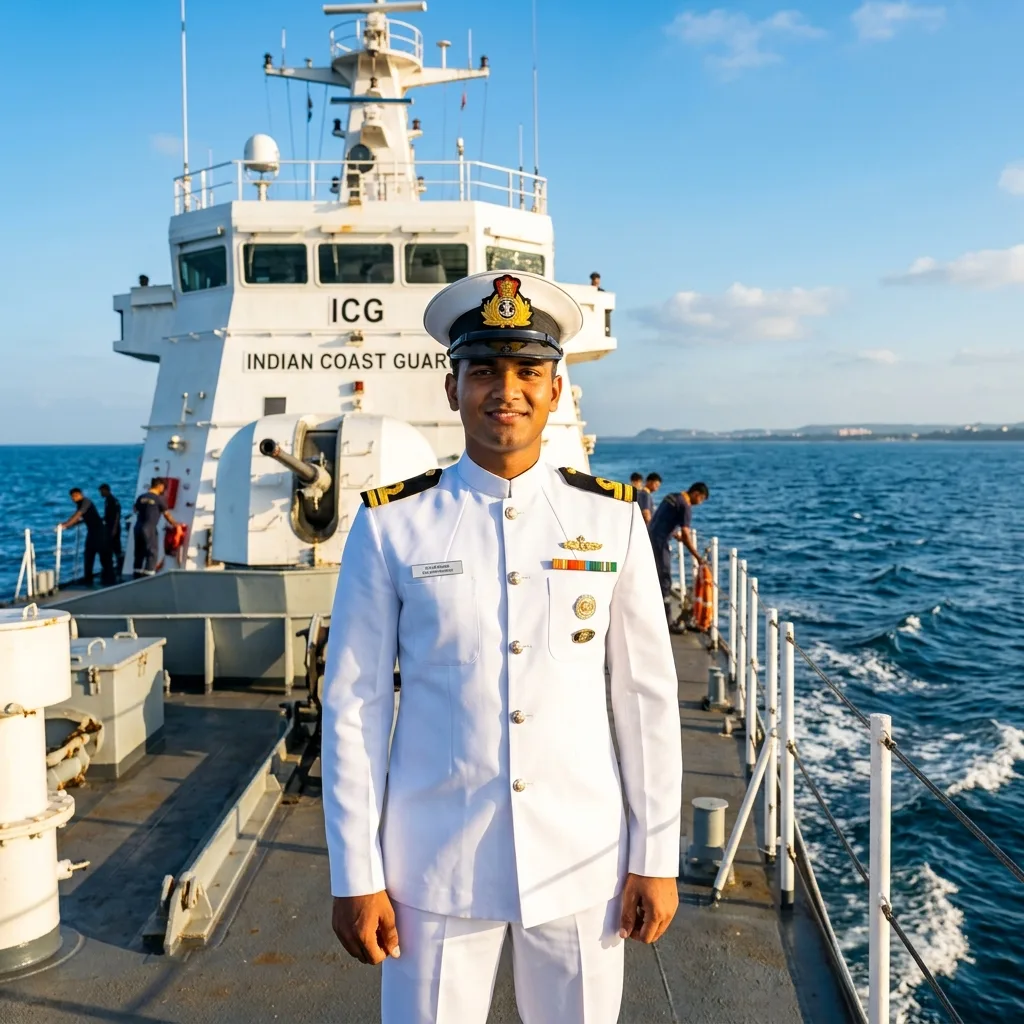
Introduction: Indian Coast Guard — India's Maritime Guardian
The Indian Coast Guard (ICG) is one of India's most elite and respected uniformed services. Established in 1978 under the Coast Guard Act, ICG operates under the Ministry of Defence and serves as India's primary maritime law enforcement, search and rescue, and coastal security agency.
With 158 ships and 66 aircraft (helicopters and fixed-wing), ICG is one of the largest coast guards in the world — protecting India's 7,516 km coastline, 12 nautical mile territorial waters, 200 nautical mile Exclusive Economic Zone (EEZ), and 2.4 million sq km of ocean.
Why Indian Coast Guard is special:
- Only sea-going defence job accessible to 10+2 and diploma holders (NDA/Navy require specific educational paths; ICG Navik accepts 10+2 science students)
- Yantrik is diploma holders' best defence career — Level 5 pay (Rs.29,200 basic) vs Level 3 for GD constables
- Coastal posting advantage — ICG posts along India's coast; coastal state candidates stay near home
- Unique mission — pollution control, anti-poaching, anti-piracy, disaster relief, search and rescue — unlike any other government force
- International operations — ICG operates in Indian Ocean Region; exposure to Sri Lanka, Maldives, Bangladesh coast guard coordination
Quick Reference:
- Posts: Navik (GD), Navik (DB), Yantrik
- Next Batch: 2027 (watch joinindiancoastguard.cdac.in)
- Authority: Indian Coast Guard, Ministry of Defence
- Training: INS Chilka, Odisha
- Website: joinindiancoastguard.cdac.in
Part 1: Three Posts Explained — Navik GD, Navik DB, Yantrik
Most candidates confuse these three posts. They are fundamentally different in qualification, salary, and job profile:
Navik (General Duty) — GD:
| Parameter | Detail |
|---|---|
| Qualification | 10+2 with Mathematics AND Physics (both mandatory) |
| Stream | Science only (PCM or PCB with Physics + Maths) |
| Pay Level | Level 3 |
| Basic Pay | Rs.21,700 |
| Age | 18-22 years |
| Role | Deck department — ship navigation, watchkeeping, seamanship |
| At Sea | Works on the bridge, operates navigation equipment |
Navik (Domestic Branch) — DB:
| Parameter | Detail |
|---|---|
| Qualification | 10th class pass (Matriculation) |
| Stream | Any — no specific subject requirement |
| Pay Level | Level 3 |
| Basic Pay | Rs.21,700 |
| Age | 18-22 years |
| Role | Domestic duties — cook, steward, hygienist onboard ships |
| At Sea | Works in the mess, galley (kitchen), and domestic services |
Yantrik:
| Parameter | Detail |
|---|---|
| Qualification | 10th pass + Diploma in Mechanical / Electrical / Electronics & Telecommunication Engineering |
| Stream | Technical — engineering diploma |
| Pay Level | Level 5 |
| Basic Pay | Rs.29,200 |
| Age | 18-22 years |
| Role | Engine room department — ship propulsion, machinery, electronics |
| At Sea | Works in engine room, maintains ship machinery and systems |
Key Comparison Table:
| Factor | Navik GD | Navik DB | Yantrik |
|---|---|---|---|
| Minimum Qualification | 10+2 (PCM/PCB with Maths) | 10th pass | 10th + Engineering Diploma |
| Pay Level | Level 3 | Level 3 | Level 5 |
| Starting Basic Pay | Rs.21,700 | Rs.21,700 | Rs.29,200 |
| Gross Salary | Rs.35,000-42,000 | Rs.35,000-42,000 | Rs.48,000-56,000 |
| In-Hand | Rs.30,000-37,000 | Rs.30,000-37,000 | Rs.42,000-50,000 |
| Best For | Science stream 10+2 holders | 10th pass, non-science | Diploma engineers |
| Prestige | High (Navigation) | Moderate | High (Technical) |
Part 2: Eligibility — Complete Requirements
Navik GD Eligibility:
Educational: 10+2 or equivalent from recognized board with Physics AND Mathematics as subjects. Minimum marks: 50% aggregate (check notification — some cycles ask 60%).
Age: 18-22 years on the date of enrollment. Relaxation: 5 years for SC/ST, 3 years for OBC.
Physical Standards:
| Parameter | Requirement |
|---|---|
| Height | Minimum 157 cm |
| Weight | Proportionate — BMI 16-25 |
| Chest | Should expand by minimum 5 cm |
| Vision | 6/6 in better eye, 6/9 in other (unaided) OR correctable to 6/6 and 6/9 with specs |
| Colour Vision | Must be CP-III (able to distinguish signal colors) |
| Hearing | Normal |
Unmarried Male only: ICG Navik is currently open only to unmarried Indian male citizens. Candidates must remain unmarried during training. (ICG is working on women recruitment for enrolled positions — currently limited to officer entry for women.)
Navik DB Eligibility:
Educational: 10th class (Matriculation) passed from recognized board — minimum 45-50% marks.
Age: 18-22 years. Same relaxation as GD.
Physical: Same as Navik GD — 157 cm height, proportionate weight, vision and hearing standards.
Yantrik Eligibility:
Educational: 10th class passed + Diploma in Engineering — specifically:
- Mechanical Engineering
- Electrical Engineering
- Electronics and Telecommunication Engineering
Diploma must be from government polytechnic or AICTE-recognized private polytechnic. Minimum 50-60% in diploma (verify from notification).
Age: 18-22 years. Relaxation: SC/ST 5 years, OBC 3 years.
Physical: Same standards as Navik.
Note on Vision for Yantrik: Yantrik works in engine room — vision requirement is slightly relaxed vs GD (GD requires better near-vision for navigation charting). Check notification for exact Yantrik vision standards.
Part 3: Selection Process — 4 Stages
Stage 1: Computer Based Examination (CBT)
All posts — Written Exam:
| Aspect | Navik GD | Navik DB | Yantrik |
|---|---|---|---|
| Questions | 100 | 50 | 60 |
| Duration | 60 minutes | 30 minutes | 45 minutes |
| Negative Marking | 0.25 per wrong | 0.25 per wrong | 0.25 per wrong |
| Language | English + Hindi | Hindi (mainly) | English + Hindi |
Navik GD CBT Sections:
| Section | Questions | Marks |
|---|---|---|
| English | 10 | 10 |
| Mathematics | 20 | 20 |
| General Science | 15 | 15 |
| General Knowledge/Current Affairs | 15 | 15 |
| Reasoning | 15 | 15 |
| Quantitative Aptitude | 15 | 15 |
| Physics/Chemistry | 10 | 10 |
| Total | 100 | 100 |
Yantrik CBT Sections:
| Section | Questions | Marks |
|---|---|---|
| English | 10 | 10 |
| Mathematics | 15 | 15 |
| General Science | 10 | 10 |
| General Knowledge | 10 | 10 |
| Reasoning | 10 | 10 |
| Technical (Diploma subject) | 5 | 5 |
| Total | 60 | 60 |
Stage 2: Physical Fitness Test (PFT)
PFT is qualifying — pass/fail, no marks:
| Test | Requirement |
|---|---|
| 1.6 km Run | Within 7 minutes |
| 20 Squat Ups (Uthak Baithak) | Complete in time |
| 10 Push-Ups | Standard form |
PFT is relatively accessible — far less demanding than Haryana Police PST (2.5 km in 12 min) or SSC GD (5 km in 24 min). The 1.6 km in 7 minutes (4:22/km pace) is challenging but achievable with 2-3 months of consistent running.
Stage 3: Initial Medical Examination
Detailed medical at a designated military hospital or ICG medical facility:
- Vision check (with/without glasses)
- Colour vision (Ishihara plates)
- Hearing test
- Blood tests (CBC, blood group, sugar)
- BP screening
- Chest X-ray
- General physical — flat feet, hernia, varicose veins check
- ENT examination
Stage 4: Final Enrollment at INS Chilka
After medical clearance — candidates report to INS Chilka (Chilika Lake, Odisha) for:
- Final document verification
- Oath taking
- Training commencement
Part 4: INS Chilka — The Starting Point of Every Coast Guard Career
INS Chilka is India's premier naval training establishment located on the shore of Chilika Lake, Puri district, Odisha. Every sailor who joins the Indian Navy AND every enrolled person who joins the Indian Coast Guard begins their career at INS Chilka.
Basic Training at INS Chilka:
Duration: 3-4 months (basic induction training)
What you learn:
- Seamanship basics — rope work, knots, rigging
- Ship terminology — bow, stern, port, starboard, forecastle, quarterdeck
- Swimming — ALL sailors must clear swimming test (critical safety requirement)
- Parade and drill — naval drill differs from army; ceremonial precision
- Physical training — daily PT, obstacle course
- Firefighting basics — ship fire is extremely dangerous; all personnel train
- Damage control — keeping ship afloat after emergency (flooding control)
- Naval etiquette and customs
- Hindi/English naval communication
The INS Chilka experience: Located on Asia's largest brackish water lake, INS Chilka is beautiful but demanding. The first weeks are the toughest — adaptation to military routine, 5:30 AM reveille, physical training, strict discipline. By week 6-8, most recruits have adjusted and begin enjoying the training. The camaraderie formed at INS Chilka lasts a lifetime — batchmates become lifelong friends.
After Basic Training:
- Navik GD: Advanced navigation and watchkeeping training
- Navik DB: Domestic services training — cooking (galley operations), mess management
- Yantrik: Engine room training — machinery operation, maintenance procedures
Part 5: Life Onboard a Coast Guard Ship
This is the aspect ZERO other blogs cover adequately — what daily life is actually like on an ICG vessel:
Types of Ships in ICG Fleet (158 total):
| Category | Type | Role |
|---|---|---|
| Offshore Patrol Vessels (OPV) | Large ships (100m+) | EEZ patrolling, anti-piracy |
| Fast Patrol Vessels (FPV) | Medium ships (50-70m) | Coastal patrol, fishermen check |
| Interceptor Boats (IB) | Small high-speed (30-40m) | Rapid interception, smuggling |
| Hovercraft | Unique vessels | Shallow water, beach access |
| Pollution Control Vessels | Specialized | Oil spill response |
| Air Cushion Vehicles | Amphibious | Island access, flood relief |
Ship Duty Cycle — What Your Life Looks Like:
Underway (At Sea): 3-4 weeks In Port (Shore Leave): 2-3 weeks
This alternating pattern continues throughout your sea-going career (first 15-18 years typically).
Onboard daily schedule:
6:00 AM: Reveille. Ablutions. Physical training on deck (weather permitting) — running laps of the ship deck, exercises.
7:00-7:30 AM: Breakfast in mess
8:00 AM: Work stations. Navik GD reports to bridge/deck — morning watchkeeping, navigation equipment checks. Yantrik reports to engine room — machinery checks, log reading.
12:00-1:30 PM: Lunch, rest
1:30-5:00 PM: Afternoon work — maintenance, training, duty watches
5:00-7:00 PM: Sports time (volleyball, carom, chess onboard), recreation
7:00 PM: Dinner
Watch system: ICG follows 4-hour watches: 0000-0400, 0400-0800, 0800-1200, 1200-1600, 1600-2000, 2000-2400. Every crew member stands watch duty — Navik GD as Lookout or Helmsman; Yantrik as Engine Room Watchkeeper.
Key reality: At sea — you are ALWAYS at work even when "off watch." A ship never stops — machinery runs 24/7, navigation continues 24/7. But within this structure, there are periods of genuine rest, recreation, and camaraderie that make ship life uniquely bonding.
Part 6: ICG Salary — Complete Structure
Navik GD/DB — Level 3 (7th Pay Commission):
| Component | Amount |
|---|---|
| Basic Pay | Rs.21,700 |
| Dearness Allowance (50%+) | Rs.11,000-12,000 |
| Military Service Pay | Rs.5,200 |
| Risk and Hardship Allowance | Rs.3,400-4,000 (sea duty) |
| Free Ration | Rs.5,000+ equivalent (free food at sea and in barracks) |
| Transport Allowance | Rs.1,200-2,000 |
| Sea Pay / Hard Area Allowance | Rs.1,500-3,000 |
| Gross Equivalent | Rs.48,500-57,700 |
| In-Hand (after NPS deductions) | Rs.42,000-52,000 |
Yantrik — Level 5 (7th Pay Commission):
| Component | Amount |
|---|---|
| Basic Pay | Rs.29,200 |
| Dearness Allowance | Rs.14,600-16,000 |
| Military Service Pay | Rs.5,200 |
| Risk and Hardship Allowance | Rs.4,200-5,000 (sea duty) |
| Free Ration | Rs.5,000+ equivalent |
| Technical Allowance | Rs.1,000-2,000 |
| Sea Pay | Rs.2,000-3,500 |
| Gross Equivalent | Rs.61,200-65,700 |
| In-Hand | Rs.54,000-60,000 |
Additional ICG Benefits:
| Benefit | Value |
|---|---|
| Free Ration | All meals FREE during sea duty and at shore establishments — saves Rs.5,000-8,000/month vs civilian life |
| Free Uniform | Complete uniform kit, including white formal dress + working uniform |
| Free Medical | ECHS (Ex-Servicemen Contributory Health Scheme) after retirement; service medical free |
| Free Housing | Government quarters at shore establishments; when at sea, no rent |
| DSOP Fund | Defence Services Officers Provident Fund equivalent — compulsory savings with interest |
| Group Insurance | AGIS (Army Group Insurance Scheme equivalent) — Rs.50-75 lakh coverage |
| Leave Travel Concession | Free rail travel for family twice a year |
| Canteen | CSD (Canteen Stores Department) access — discounted goods, alcohol, electronics |
| NPS Pension | 14% employer contribution toward NPS pension |
Part 7: ICG's Unique Mission — What Makes It Different
This is what sets ICG apart from ALL other government forces:
1. Search and Rescue (SAR) — Saving Lives at Sea:
ICG is India's primary Search and Rescue agency in the Indian Ocean Region. Since 1978, ICG has saved over 1,00,000 lives at sea — fishermen caught in storms, sailors from distressed ships, passengers from sinking vessels.
SAR operations involve:
- Responding to distress calls (MAYDAY signals)
- Deploying ships and helicopters (Chetak, ALH Dhruv) to locate distressed vessels
- Rescue swimmers jumping into rough seas to assist stranded persons
- Medical evacuation of injured at sea — ICG Dornier aircraft can fly to remote ocean areas
Career reality: An ICG Navik who participates in a successful rescue operation that saves 20 fishermen during a cyclone will remember that day for the rest of their life. This is genuinely life-saving work — rare in government service.
2. Marine Pollution Control:
ICG is India's national authority for marine pollution response. The ICG Pollution Control Vessels are equipped with:
- Oil containment booms (barriers that float and contain oil spills)
- Skimmer equipment (collects spilled oil from water surface)
- Dispersant spraying systems
- OSRV (Oil Spill Response Vessels) with specialized equipment
ICG has responded to major oil spills — MV Wisdom (2011), Ennore oil spill (2017), multiple tanker spills in Mumbai and Chennai waters. The technical complexity of pollution control makes Yantrik roles in PCVs particularly interesting.
3. Fishermen Protection:
India has over 4 million fishermen in 3,288 fishing villages along the coast. ICG:
- Patrols to ensure fishermen are not harassed by foreign vessels
- Rescues fishermen in distress during cyclones and storms
- Issues weather warnings to fishing fleet
- Resolves disputes at sea between Indian fishermen and foreign coast guards
This human element — protecting the livelihoods of millions of fishermen — gives ICG service a social purpose beyond just national security.
4. Anti-Poaching and Wildlife Protection:
India's marine zones include coral reefs, turtle nesting beaches, whale shark habitats. ICG:
- Prevents illegal fishing in Lakshadweep and Andaman waters
- Protects sea turtles nesting sites (Olive Ridley turtles — ICG has protected nesting beaches for decades)
- Anti-poaching patrols around Gulf of Mannar Marine National Park
- Prevents illegal export of reef fish and coral
5. Anti-Narcotics and Anti-Smuggling:
ICG coordinates with NCB (Narcotics Control Bureau) and Customs for:
- Drug trafficking by sea — India's western coast (Gujarat, Maharashtra) is a drug trafficking route from Pakistan/Afghanistan via Arabian Sea
- Gold smuggling — Arabian Sea route from Dubai to Kerala/Karnataka
- Arms trafficking — interdicting weapons destined for armed groups
ICG has seized tons of drugs and gold in major operations. These interception operations are high-stakes — sometimes involving armed confrontations with traffickers.
Part 8: Promotion Path — Navik to Pradhan Adhikari
ICG Enrolled Rank Structure:
| Rank | Equivalent Army Rank | Pay Level | Basic Pay | Timeline |
|---|---|---|---|---|
| Navik | Sepoy/Private | Level 3 | Rs.21,700 | Entry |
| Pradhan Navik | Lance Naik | Level 4 | Rs.25,500 | 4-6 years |
| Seaman (Haver Equivalent) | Naik | Level 4 | Rs.25,500 | 8-10 years |
| Petty Officer (PO) | Havildar | Level 6 | Rs.35,400 | 12-15 years |
| Petty Officer (Senior) | Naib Subedar | Level 7 | Rs.44,900 | 18-20 years |
| Pradhan Adhikari | Subedar | Level 8 | Rs.47,600 | 22-25 years |
Yantrik Rank Structure:
| Rank | Pay Level | Basic Pay | Timeline |
|---|---|---|---|
| Yantrik | Level 5 | Rs.29,200 | Entry |
| Pradhan Yantrik | Level 6 | Rs.35,400 | 4-6 years |
| Petty Officer (Tech) | Level 7 | Rs.44,900 | 10-14 years |
| Pradhan Sahayak Engineer | Level 8 | Rs.47,600 | 18-22 years |
Special Entry — Navik to Officer:
Exceptional Naviks/Yantriks can be commissioned as officers:
- Departmental entry for commissioned officer: After 5 years of service, ICG allows enrolled personnel to apply for ICG officer posts through special departmental exam
- Education requirement: Must complete graduation while in service (correspondence degree)
- Successful candidates get commissioned as Commissioned Officer — massive salary jump (Basic Rs.56,100 for Lieutenant equivalent)
This "soldier to officer" path — though competitive — is real and gives enrolled ICG personnel a genuine shot at the officer cadre.
Part 9: Preparation Strategy — CBT and PFT
CBT Preparation for Navik GD:
Mathematics (20 questions — most marks):
- Class 11-12 level mathematics — not just Class 10
- Algebra: Quadratic equations, linear equations, logarithms
- Trigonometry: Ratios, identities, heights and distances
- Mensuration: Areas, volumes, surface areas
- Statistics: Mean, median, mode, standard deviation
- Probability: Basic probability, Bayes theorem basics
Physics (10 questions):
- Mechanics: Motion, Newton's laws, energy, work, power
- Optics: Reflection, refraction, lenses, mirrors
- Electricity: Ohm's law, circuits, electrical power
- Waves: Sound, frequency, wavelength
- Modern physics: Basics (radioactivity, nuclear)
Reasoning (15 questions):
- Series completion
- Analogy
- Blood relations
- Direction sense (maritime context helps — north/south/east/west)
- Coding-decoding
- Matrix-based questions
Current Affairs (15 questions — GK):
- ICG-specific: Recent ICG operations, new ships commissioned, DG ICG name
- India's maritime geography: Indian Ocean, Bay of Bengal, Arabian Sea, coastal states, islands (Andaman, Lakshadweep)
- Defence news: Defence Minister, recent defence acquisitions
- General government: PM, Cabinet, recent events
PFT Preparation:
1.6 km run in 7 minutes: Month 1: Build base — run 1.6 km without stopping (even slowly) Month 2: Target 1.6 km in 9 minutes, then 8 minutes Month 3: Target 1.6 km in 7:30, then 7:00
20 squats + 10 push-ups: Train daily — these are achievable within 2-3 weeks of regular training.
Swimming: Unlike the Navy, ICG does NOT require swimming ability for recruitment test — swimming is taught at INS Chilka. However, being able to swim before joining gives you a significant advantage during training.
Part 10: ICG vs Indian Navy vs Agniveer — Which to Choose?
This comparison is the most commonly asked question among aspirants choosing between maritime defence careers:
| Factor | ICG Navik GD | Indian Navy Sailor | Agniveer (Navy) |
|---|---|---|---|
| Qualification | 10+2 (PCM) | 10+2 (PCM) or 10th | 10+2 (PCM) |
| Pay at Entry | Level 3 (Rs.21,700 basic) | Level 3 (Rs.21,700 basic) | Agniveer package — Rs.30,000 start |
| Permanent Service | YES — career job | YES — career job | NO — 4 years only |
| Pension | NPS after service | NPS after service | 25% retain after 4 years |
| Mission | Coastal, maritime, rescue | Combat, warfare, deterrence | Same as Navy (4 years) |
| Sea duty | Yes — coast-centric | Yes — ocean-going | Yes (4 years) |
| Family posting | Generally India's coast | Any naval base | Temporary |
| Risk | Moderate (rescue, interception) | High (military operations) | High |
| Prestige | High (uniformed service) | Very High (combat force) | Moderate (temporary) |
| After service | Full career (20-22 years) | Full career | Agniveer certificate |
| Ships | ICG vessels (smaller) | Warships (destroyers, submarines) | Navy warships |
ICG vs SSC GD Constable:
| Factor | ICG Navik GD | SSC GD Constable |
|---|---|---|
| Setting | Sea (ships, aircraft) | Land (jungle, border, city) |
| Lifestyle | Adventurous, dynamic | Structured, land-based |
| Salary | Similar basic + sea allowances | Similar basic |
| Mission | Maritime protection, rescue | Border security, internal security |
| Physical demand | Moderate (sea life) | Moderate (field duty) |
| Transfer | Coastal stations | Pan-India |
Who should choose ICG:
- If you love the sea, water, adventure — ICG is a dream career
- If you are from a coastal state (Maharashtra, Kerala, Gujarat, Andhra, Tamil Nadu, Odisha, WB, Goa) — coastal posting advantage
- If you have engineering diploma — Yantrik (Level 5) is unbeatable value vs any constable/GD post (Level 3)
- If you want permanent career (not temporary Agniveer) with unique mission
Part 11: ICG Districts and Coastal Commands
ICG Regional Structure:
| Region | Headquarters | Coastal States Covered |
|---|---|---|
| NW Region | Gandhinagar, Gujarat | Gujarat, Daman and Diu, Goa |
| W Region | Mumbai, Maharashtra | Maharashtra, Goa (south) |
| E Region | Chennai, Tamil Nadu | Tamil Nadu, Puducherry, Andhra Pradesh |
| NE Region | Kolkata, West Bengal | West Bengal, Odisha |
| A&N Region | Port Blair, Andaman | Andaman and Nicobar Islands |
| Lakshadweep | Kavaratti | Lakshadweep Islands |
District Headquarters (Coastal Stations):
Major ICG shore establishments where you may be posted:
- Okha, Gujarat: Northwest coast — Arabian Sea patrolling
- Mandvi, Gujarat: Historic maritime town
- Jamnagar, Gujarat: Near Reliance refinery — critical protection duty
- Mumbai (Versova), Maharashtra: ICG Mumbai — India's busiest maritime zone
- Goa: Panaji — beautiful posting, Konkan coast
- Mangalore, Karnataka: Arabian Sea station
- Kochi, Kerala: Major ICG air station + ships
- Chennai, Tamil Nadu: ICG Eastern Region HQ
- Visakhapatnam, Andhra: Eastern coast station
- Paradip, Odisha: Major port station
- Haldia, West Bengal: Near Kolkata port
- Port Blair, A&N: Island posting — unique experience
Coastal posting advantage: Unlike Indian Army (can be posted in Sikkim, Ladakh, Arunachal — far from home), ICG posting is almost always in a coastal city. For candidates from Maharashtra, Kerala, Gujarat, Tamil Nadu — ICG posting means staying close to home.
Part 12: Frequently Asked Questions
Q1. Can women join Indian Coast Guard as Navik/Yantrik? Currently, ICG's Navik and Yantrik recruitment is open to male candidates only. Women can join ICG as Officers (through ICG Officer recruitment — Assistant Commandant) which is open to graduates/engineers. ICG has been progressively increasing women officer intake. As of 2026, women officers serve as ship captains, pilots, and in all branches. Women enrolled (Navik level) recruitment is under consideration but not yet implemented. Check joinindiancoastguard.cdac.in for latest policy updates.
Q2. I am from an inland state (UP, Bihar, Rajasthan) — Can I join ICG? Yes — ICG is a national force, open to all Indian citizens regardless of home state. Being from an inland state is NO disqualification. Many ICG Naviks are from UP, Bihar, MP, Rajasthan. However, you will be posted to coastal stations — so adapting to coastal climate and sea life from an inland background is something to mentally prepare for. The sea is a great equalizer — your performance onboard depends on skill and dedication, not home state.
Q3. What happens if I fail the swimming test at INS Chilka? Swimming is taught at INS Chilka — NOT a pre-requirement for joining. Non-swimmers are given additional swimming instruction. You must pass the ICG swimming test (typically 50 meters within a time limit) during basic training to complete training and be fully enrolled. A small number of trainees who cannot clear swimming are given additional time and coaching. Very rarely — persistent inability to swim can affect completion. Start learning to swim NOW if you can't already — it will save stress at Chilka.
Q4. What is the retirement age in ICG? ICG enrolled personnel typically retire at 57 years of age or upon completing maximum service years (whichever earlier). Typical service: 22-25 years. Naviks joining at 18-22 years retire at 40-45 years approximately — still young enough for a second career. Many ex-ICG Naviks join merchant marine as sailors (their sea experience is valued) or take up government security jobs through ex-servicemen quota.
Q5. Is there a bond period? Can I resign from ICG? ICG service involves an initial engagement period — typically until age 57 or a minimum of 10 years (verify from service regulations). Resignation before completing minimum service requires repayment of training costs and approval from commanding officer. In practice, resignation is possible but uncommon — most who join stay for the full career. Financial security, camaraderie, and job satisfaction make ICG a long-term career for the vast majority.
Q6. How competitive is ICG recruitment? What is the expected cut-off? ICG is among India's most competitive defence recruitments. For Navik GD (02/2025 cycle reference): Out of lakhs of applicants, approximately 2-3 lakh appear for CBT. Cut-off for Navik GD (General category): approximately 55-65/100 (varies by cycle and competition level). Top scorers get first preference in posting. Yantrik (fewer applicants due to diploma requirement) is relatively less competitive — cut-off approximately 45-55/60. Start CBT preparation 3-4 months in advance for comfortable margin above cut-off.
Conclusion: Indian Coast Guard — A Career That Calls the Brave
7,516 km of coastline. 2.4 million sq km of Exclusive Economic Zone. 158 ships. 66 aircraft. 1,00,000+ lives saved since 1978.
The Indian Coast Guard is not just a government job — it is a calling. Every morning at sea, ICG personnel wake up to duties that directly protect India's maritime borders, economic assets, fishermen's lives, and marine environment. It is arguably the most meaningful uniformed service accessible to 10+2 and diploma holders.
For Yantrik aspirants — this is the single best defence career for diploma engineers in India. Level 5 pay (Rs.29,200 basic), sea allowances, free ration, and a career that leverages your technical education.
For Navik GD aspirants — if you have physics and mathematics in your 10+2 and you feel the pull of the sea — ICG Navik GD is where your career belongs.
Your action plan:
- Bookmark joinindiancoastguard.cdac.in — next notification expected late 2026/early 2027
- Start CBT preparation: Mathematics (10+2 level), Physics, Reasoning, Current Affairs
- Begin PFT training: 1.6 km in 7 minutes is your physical target
- Learn swimming: Not mandatory to join but extremely useful at INS Chilka training
- Maritime awareness: Follow ICG news — recent operations, new ships, DG ICG appointments
Stay updated with Indian Coast Guard Navik Yantrik 2026-27 notification, CBT date, result, and merit list at Government Job Result — India's most trusted government career resource.
Disclaimer: Salary figures based on 7th Pay Commission Level 3/5 basic + 2026 DA rates and published ICG allowances. Recruitment cycle status based on July 2026 research. Next notification expected late 2026/early 2027 — verify at joinindiancoastguard.cdac.in. Physical standards, eligibility, and age limits subject to official notification.
Part 13: CBT Preparation Deep Dive — Subject-wise Strategy
Mathematics for Navik GD (20 Questions — Highest Weightage):
Most candidates underestimate ICG Maths because it is 10+2 level — but the questions are genuinely difficult. Focus areas:
Algebra (4-5 questions expected):
- Quadratic equations — finding roots, nature of roots (discriminant)
- Logarithms — log properties, simplification
- Arithmetic Progression (AP) and Geometric Progression (GP) — nth term, sum of n terms
- Binomial theorem — basics (Class 11 level)
- Complex numbers basics — modulus, argument
Trigonometry (3-4 questions):
- Trigonometric ratios and identities — sin²x + cos²x = 1, and derivatives
- Inverse trigonometric functions — range, principal values
- Heights and distances problems — most commonly asked applied topic
- Sum and product formulas — sin(A+B), cos(A-B) etc.
Coordinate Geometry (2-3 questions):
- Straight lines — slope, intercept form, angle between lines, distance from point to line
- Circles — equation, center, radius, tangent conditions
- Parabola/Ellipse/Hyperbola — basic equations only
Calculus (2-3 questions):
- Limits — basic standard limits (sinx/x = 1 as x→0 etc.)
- Differentiation — standard formulas, chain rule, implicit differentiation
- Integration — basic integrals, definite integrals
- Maxima/minima — first and second derivative test
Statistics and Probability (2-3 questions):
- Mean, median, mode — for grouped and ungrouped data
- Standard deviation, variance
- Basic probability — addition and multiplication theorems
- Bayes theorem — basic application
Key insight: ICG Maths CBT is harder than NTPC/SSC MTS but easier than GATE. Target NCERT Class 11-12 Maths complete — that is sufficient.
Physics for Navik GD (10 Questions):
Most Frequently Asked Topics (based on previous ICG papers):
- Laws of motion — Newton's three laws applied problems
- Work, energy, power — conservation of energy problems
- Waves — wave speed equation v = fλ, types of waves
- Sound — speed in different media, echo calculations
- Light — Snell's law refraction, lens formula (1/v - 1/u = 1/f), power of lens
- Electricity — Ohm's law, series/parallel circuits, Joule's heating law
- Magnetic effects — Fleming's rules, force on current in magnetic field
- Modern physics — radioactive decay basics, half-life
- Semiconductors — p-type, n-type, diode, transistor basics
High-yield approach: Class 11-12 NCERT Physics (all chapters) + Previous ICG papers. Do not go beyond NCERT for physics.
English for All Posts (10 Questions):
Most Tested:
- Sentence correction — grammar (subject-verb agreement, tense consistency)
- Fill in the blanks — vocabulary, prepositions
- Reading comprehension (short passage — 1-2 paragraphs)
- Synonyms and antonyms
- One-word substitution
- Idioms and phrases (moderate difficulty)
- Spotting errors in sentences
ICG English level: Moderate — similar to SSC CHSL English. Not as difficult as SSC CGL. Focus on vocabulary and grammar rules.
General Knowledge / Current Affairs (15 Questions):
ICG-Specific GK (5-6 questions typically):
- Director General of ICG (verify current — DG ICG changes periodically)
- India's coastline length: 7,516 km
- Number of ICG ships: 158 (as of 2025-26 — verify current)
- Number of ICG aircraft: 66
- ICG established: February 1, 1977 (Coast Guard Act) — formally established August 18, 1978
- ICG motto: "Vayam Rakshamah" (We Protect)
- ICG Day: February 1 (Coast Guard Day — different from Raising Day)
- ICG Headquarters: New Delhi
- ICG Academy: Azhimala, Kerala (Officer training academy)
- INS Chilka: Basic training for enrolled
India Geography/Maritime (3-4 questions):
- India's Exclusive Economic Zone: 2.4 million sq km
- Arabian Sea (west), Bay of Bengal (east), Indian Ocean (south)
- India's island territories: Lakshadweep (Arabian Sea), Andaman and Nicobar (Bay of Bengal)
- India's longest coastline state: Gujarat (1,600 km)
- India's southernmost point: Indira Point, Great Nicobar Island
- India's only active volcano: Barren Island (Andaman)
Defence Current Affairs (4-5 questions):
- Recent ICG ship commissioning — ICGS Samudra Pehredar, ICGS Sujeet, new OPVs
- ICG operation names — Operation Sagar Kavach (coastal security exercises)
- India's defence budget 2026-27
- Major defence acquisitions — Tejas, P-8I, Chinook relevance to defence news
- Defence Minister, Chief of Defence Staff
Part 14: Yantrik — Diploma Engineer's Guide to ICG
Since Yantrik is the most underutilized and least-understood post, it deserves a dedicated deep dive:
What Yantrik Does Onboard Ship:
Engine Room Hierarchy: Every ship has an Engine Room — the heart of the vessel. In Indian Coast Guard, the engine room is managed by the Yantrik branch.
| Rank | Role |
|---|---|
| Yantrik (Entry) | Junior Engine Room Watchkeeper — learns systems, assists seniors |
| Pradhan Yantrik | Engine Room Watchkeeper — independent operation |
| Petty Officer (Tech) | Engine Room Section Head |
| Pradhan Sahayak Engineer | Senior Technical NCO — advises commissioned engineering officer |
Daily Yantrik Duties:
Watch-keeping (4 hours on, 8 hours off at sea):
- Monitor main engine parameters: RPM, temperature, pressure, oil level
- Check auxiliary machinery: generators, pumps, compressors, fans
- Bilge water level monitoring — prevent flooding
- Log all readings in Engine Room Log
Maintenance (in port or during off-watch):
- Routine maintenance schedules (RMS) — preventive maintenance for all machinery
- Troubleshooting breakdowns — a seized pump at sea must be repaired immediately
- Inventory of spare parts — critical for extended sea voyages
- Calibration of instruments
The Yantrik's unique advantage: Technical knowledge learned in ICG is directly applicable to merchant marine, industrial maintenance, and power sector. Ex-Yantrik personnel with experience are sought after in ports, shipyards, and industrial plants.
Yantrik Specializations:
Mechanical Yantrik:
- Main propulsion engines (diesel engines, gas turbines for newer vessels)
- Steering gear system
- Anchor windlass, capstan
- Refrigeration and air conditioning systems
- Fresh water distillation units
Electrical Yantrik:
- Ship's electrical distribution (440V, 220V, 24V DC systems)
- Generator management — parallel operation of diesel generators
- Navigation lights, alarm systems
- Battery charging and UPS systems
- Switchboard maintenance
Electronics and Telecommunication Yantrik:
- Radio communication equipment (HF, VHF, SSB)
- RADAR maintenance (basic maintenance — major repairs by specialists)
- GPS, GMDSS (Global Maritime Distress and Safety System) equipment
- Electronic navigation aids (ECDIS — Electronic Chart Display)
- Satellite communication terminals (INMARSAT systems)
Yantrik Exam Preparation (Technical Section):
For Mechanical Diploma holders:
- Thermodynamics: IC engines (diesel 4-stroke — marine diesel is 4-stroke), thermodynamic cycles
- Theory of Machines: Gears, bearings, shafts, couplings
- Fluid Mechanics: Pumps, valves, flow theory
- Engineering Materials: Corrosion (especially marine corrosion), material selection
- Workshop Technology: Manufacturing processes, measuring instruments
For Electrical Diploma holders:
- Electrical Machines: Generators, alternators, motors
- Power Systems: Parallel operation of generators
- Control Systems: PLC basics, instrumentation
- Electronics: Diodes, transistors, rectifiers, amplifiers
For Electronics Diploma holders:
- Communication systems: Modulation, radio transmission
- Digital electronics: Logic gates, flip-flops, ADC/DAC
- Microprocessors: 8051/8085 basics
- Signal processing: Filtering, amplification
Unique Yantrik advantage in exam: Technical section is only 5/60 questions — so even moderate technical preparation suffices. Focus more on English, Maths, GK, Reasoning (55 questions) where most marks are available.
Part 15: ICG Aircraft Wing — A Dream Posting
ICG's 66 aircraft create a unique career path not available in police or paramilitary forces:
ICG Air Stations (Where You Could Be Posted):
| Station | Location | Aircraft |
|---|---|---|
| CG Air Station Daman | Daman | Dornier Do-228 |
| CG Air Station Goa (Dabolim) | Goa | Chetak helicopter |
| CG Air Station Cochin | Kochi, Kerala | ALH Dhruv, Dornier |
| CG Air Station Chennai | Chennai, Tamil Nadu | Dornier, ALH |
| CG Air Station Visakhapatnam | Vizag, Andhra | Chetak, Dornier |
| CG Air Enclave Bhubaneswar | Odisha | Dornier |
| CG Air Station Kolkata | Kolkata | Chetak |
| CG Air Station Port Blair | Andaman | Dornier, ALH |
| CG Air Station Porbandar | Gujarat | Dornier |
| CG Air Station Ratnagiri | Maharashtra | ALH Dhruv |
Ground Crew at Air Stations:
Enrolled ICG personnel (Naviks and Yantriks) who are posted to air stations serve as:
- Aviation Ground Crew: Refueling, aircraft pushback, ground handling
- Armament Loading Crew: Loading rockets and weapons on ICG helicopter (for armed interceptions)
- SAR Equipment Crew: Preparing search and rescue equipment before missions
- Communications Support: Radio communication for air operations
Posting at air stations is considered a comfortable posting — regular hours (day operations mostly), beautiful coastal locations (Goa, Kochi, Vizag air stations are scenic), and direct involvement in exciting SAR operations.
ICG Helicopter Operations — The Most Exciting Part:
ICG operates Chetak (French-origin Alouette III) and ALH Dhruv (Indian-made Advanced Light Helicopter) for:
- Search and Rescue: Hoist operations — rescue diver lowered to sea surface to assist distressed sailors
- Medical Evacuation: Flying critically injured sailors or passengers from ships to hospitals
- Anti-poaching: Low-level patrol over coastal waters
- Anti-narcotics: Surveillance and interception support
- Disaster relief: Flood rescue in coastal areas (ICG Chetak rescued hundreds during 2018 Kerala floods)
The ICG SAR helicopter crew — pilot, observer, rescue diver — are among India's most skilled and courageous military personnel. Ground crew who support these operations share in the satisfaction of every successful rescue.
Part 16: ICG Special Units and Elite Roles
After gaining experience, exceptional ICG enrolled personnel can be selected for elite units:
Pradhan Navik (Diver) — ICG's Most Prestigious Enrolled Role:
Selected Naviks undergo diving training at INS Chilka and specialized diving schools:
- Free swimming diver: Basic underwater swimming
- SCUBA diver: Compressed air, underwater inspection
- SAR diver: Rescue diving — jumping from helicopter hoists into rough seas
ICG divers participate in:
- Rescue operations — swimming to distressed persons in rough sea
- Underwater ship hull inspection
- Mine clearance support
- Salvage operations
Physical requirements for diving selection: Additional physical fitness beyond basic Navik — strong swimmer, no ear problems, good physical health.
Dog Handler — ICG Explosive Detection Unit:
ICG maintains a canine unit at major ports for explosive detection and anti-narcotics. Selected Naviks are trained as dog handlers — specialized role with close bond with trained dogs. Posting at major commercial ports.
MARCOS Liaison Duty:
ICG coordinates with Indian Navy's MARCOS (Marine Commandos) for anti-piracy and counter-terrorism at sea. Senior ICG enrolled personnel serve as liaison at MARCOS bases — exposure to India's most elite special forces.
Pollution Control Specialist:
Selected Yantriks and Naviks undergo specialized training in:
- Oil spill response
- Chemical dispersant application
- Boom deployment
- Waste management at sea
Posting on Pollution Control Vessels — specialized ships with advanced equipment.
Part 17: Coastal States — ICG's Biggest Talent Pool
Understanding which states provide most ICG recruits helps you understand competition level and community:
State-wise Coastal Representation in ICG:
| State | Coastline | Recruitment Volume | Posting Advantage |
|---|---|---|---|
| Kerala | 580 km | Very High | Kochi Air Station, Beypore |
| Tamil Nadu | 1,076 km | Very High | Chennai, Rameshwaram |
| Andhra Pradesh | 974 km | High | Visakhapatnam |
| Maharashtra | 720 km | High | Mumbai, Ratnagiri |
| Gujarat | 1,600 km (longest) | High | Porbandar, Okha, Veraval |
| Goa | 105 km | Moderate | Dabolim (Goa) |
| Odisha | 480 km | High | Paradip, Bhubaneswar |
| West Bengal | 210 km | Moderate | Haldia, Kolkata |
| Karnataka | 300 km | Moderate | Mangalore |
Inland State Recruits:
Candidates from Bihar, UP, Rajasthan, MP, Haryana — all states without coastline — also join ICG in significant numbers. ICG is a truly national service. Inland state recruits often bring strong academic preparation (competitive exam culture) while adapting to sea life during training.
Community at INS Chilka: The training batch at INS Chilka is your community for life. You will train with candidates from Karnataka's fishing villages, Kerala's boat-building families, Bihar's agricultural backgrounds, and Gujarat's maritime trader heritage. This cross-cultural exposure is one of ICG's unique enriching aspects.
Part 18: Maritime Law — What ICG Enforces
Understanding the legal framework ICG enforces helps aspirants prepare for GK sections and understand the job better:
Key Legislation ICG Enforces:
Coast Guard Act 1978: The foundational legislation establishing ICG. Defines ICG's powers, jurisdiction, and duties. Gives ICG authority to stop, board, search, arrest, and seize vessels in Indian waters.
Maritime Zones of India Act 1976: Defines:
- Territorial Waters: 12 nautical miles from baseline — India's sovereignty
- Contiguous Zone: 12-24 nautical miles — customs/immigration enforcement
- EEZ (Exclusive Economic Zone): Up to 200 nautical miles — economic rights
- Continental Shelf: Beyond EEZ — seabed resource rights
ICG enforces India's rights in all these zones.
MARPOL (Marine Pollution Prevention): International convention preventing marine pollution. ICG enforces MARPOL in Indian waters — inspects ships for oil discharge, checks Oil Record Books, issues penalties for violations.
Wildlife Protection Act 1972: Protects marine species. ICG enforces against poaching of turtles, dolphins, whale sharks, and coral reef fauna. Violators face arrest and prosecution.
Customs Act 1962: ICG acts as an anti-smuggling agency — seizures of gold, drugs, and goods smuggled by sea are charged under Customs Act.
UNCLOS (UN Convention on the Law of the Sea): India's maritime jurisdiction follows UNCLOS. ICG personnel are trained on UNCLOS provisions — what actions can be taken at what distance from coast, rights of passage for foreign vessels, etc.
Part 19: ICG Welfare — Life Beyond Duty
Welfare Measures for ICG Enrolled Personnel:
CGWA (Coast Guard Wives Welfare Association): Active welfare association at all ICG stations. Organizes community events, supports families of deployed personnel, educational assistance for children.
ICG Canteen and Mess: Shore establishments have well-maintained messes (dining halls) with subsidized food. Quality of food at ICG establishments is generally rated positively — organized kitchen, balanced diet for physically active personnel.
Sports and Recreation: ICG actively promotes sports. ICG personnel participate in:
- Inter-service sports tournaments (cricket, volleyball, hockey)
- State and national level military sports
- Water sports — swimming, sailing, kayaking (natural advantage of coastal posting)
- ICG has produced national-level athletes in swimming and sailing
Education Support: ICG encourages enrolled personnel to complete higher education through:
- Correspondence courses (IGNOU — specifically for defence personnel)
- ICG sponsors education at IGNOU for selected personnel
- In-service courses at IGNOU allow Naviks to complete B.A./B.Com/B.Sc
- Degree completion enables eligibility for departmental officer entry
ICG Charitable Trust: Welfare fund providing financial assistance for:
- Education of ICG personnel's children
- Medical emergencies beyond official coverage
- Financial assistance for bereaved families
Part 20: Future of ICG — Growth Opportunities
The Indian Coast Guard is in an expansion phase that makes joining in 2026-27 particularly valuable:
ICG Modernization Plan (2025-2030):
Fleet Expansion:
- 40+ new vessels to be inducted by 2030 (OPVs, FPVs, Fast Interceptor Boats)
- 16 new Advanced Light Helicopters (ALH-MK III) on order
- 6 new Dornier-228 aircraft (upgraded version with glass cockpit)
- 2 new Pollution Control Vessels with advanced skimmer technology
Technology Upgrades:
- Integrated Coastal Surveillance System (ICSS) — radar network covering entire coastline
- VTMS (Vessel Traffic Management System) — tracking all vessels in Indian waters
- AIS (Automatic Identification System) — mandatory for larger vessels; ICG monitors all AIS data
- UAV integration — ICG is inducting drones for coastal surveillance
New Stations:
- New ICG stations at Hazira (Gujarat), Bhavnagar (Gujarat), Karwar (Karnataka)
- Enhanced presence in Lakshadweep — new patrol base
- Andaman and Nicobar expansion — critical for Indian Ocean presence
What this means for you: More ships = more sea billets = more promotion opportunities. The ICG of 2030 will be significantly larger than 2026. Officers and enrolled personnel joining in 2026-27 will benefit from this expansion — more ships to command, more responsibilities, faster promotion.
Extended FAQ (Part 2)
Q7. Is there a separate recruitment for ICG officer entry? How does it differ from Navik? Yes — ICG Officer Entry (Assistant Commandant) is entirely separate from Navik/Yantrik recruitment. Officer entry requires graduation (B.E./B.Tech for GD branch, Engineering + DGCA license for Aviation, LLB for Law, and other qualifications). Officers are commissioned — they are the equivalent of Lieutenants and above. Officers command ships, fly aircraft, lead operations. Naviks/Yantriks are enrolled — non-commissioned, they operate under officers. Both are uniformed ICG service but completely different career tracks. Navik-to-Officer promotion exists (departmental) but is the exception, not the rule.
Q8. What is the tattoo policy in ICG? ICG follows armed forces tattoo guidelines: Tattoos are permitted ONLY on inner forearm areas (not visible in short-sleeve shirt). No tattoos on face, neck, hands, or other visible areas. Tattoos with objectionable content (offensive to religion, women, national symbols) are disqualifying regardless of location. Existing tattoos are evaluated at medical examination — if within permitted guidelines, they don't disqualify. If you have visible tattoos — check specific ICG notification for current policy before applying.
Q9. What happens to my family during sea deployment? Family is stationed at the shore establishment where you are posted. ICG provides government quarters at shore bases (or HRA). During your 3-4 week sea deployment, your family stays at the shore base. ICG townships and shore establishments have communities of ICG families — support network exists. Communication: Satellite phone onboard allows limited personal calls home during sea deployment. Modern ships also have internet connectivity (limited bandwidth shared among crew). Being away from family for 3-4 weeks is the biggest personal adjustment — most ICG families adapt within 1-2 years.
Q10. Can I choose which type of ship I serve on? Ship posting is allocated by ICG administration based on service requirements and vacancies — not personal preference. However, specialization affects ship type: Yantriks with electronics diploma may be posted on larger electronics-intensive vessels. After initial posting, transfer requests for specific ship types can be submitted — approved based on vacancies and service requirements. Divers are posted on ships where diving capability is needed. Cooking-specialization DB Naviks are posted on ships with kitchen requirements. Generally, specialization creates alignment between your skills and ship assignment over time.
Q11. What is the ICG policy on mobile phones and personal devices at sea? Mobile phones are generally not permitted onboard ships while at sea (security concern — GPS location of military vessel could be tracked). At shore establishments, personal mobile use is permitted in residential areas. During port calls and shore leave — mobile phone use is free. ICG ships have limited satellite internet access primarily for official communication. During long sea voyages (10-21 days offshore), absence of personal communication is the norm. This digital detox aspect of ship life is challenging for the first few voyages but becomes routine.
Q12. I have a tattoo on my arm — will I be disqualified? As per current ICG policy: Tattoos visible in short-sleeve (half-sleeve) uniform — i.e., below elbow on outer forearm, on hands, fingers, neck, face — are typically disqualifying. Tattoos on inner forearm (inner wrist area), chest, back, and fully covered areas are generally permitted. Traditional tattoos specific to tribal/ethnic groups are treated with some flexibility. Each case is evaluated at medical examination. If in doubt — cover your tattoo at the initial PFT/DV stage and let the examining medical officer make the determination at formal medical exam. Do not assume disqualification — let the process decide.
Conclusion (Final): The Sea Awaits — Are You Ready?
Since February 1, 1977, the Indian Coast Guard has stood watch over India's blue waters. Through cyclones that would ground aircraft, through oil spills that threatened entire ecosystems, through drug interdictions that broke trafficking networks, through rescues that snatched thousands from the jaws of the sea — the ICG has served silently and effectively.
158 ships. 66 aircraft. 11,000+ officers and enrolled. 7,516 km of coastline to protect.
And now, with ICG's 2025-2030 expansion plan adding 40+ ships and new air assets, the force needs your generation's strength, technical skills, and courage to grow into the future.
For 10+2 Science holders (Navik GD): The sea is the most adventurous, meaningful career accessible with your qualification. Rs.42,000-52,000 in-hand, free food, housing, uniform, CSD canteen, and a life that no desk job can match.
For diploma engineers (Yantrik): Level 5 pay from Day 1. Rs.54,000-60,000 in-hand. Technical skills that grow into a specialized maritime career. No other government defence job gives diploma engineers Level 5 pay at entry.
For coastal state candidates: Your home state's coast is your workplace. Kochi, Visakhapatnam, Goa, Mumbai, Chennai, Kolkata — ICG posts at beautiful, culturally familiar coastal cities.
Your complete action plan:
- Bookmark joinindiancoastguard.cdac.in — check weekly for next notification (expected late 2026/early 2027)
- Start CBT preparation: Mathematics (Class 11-12 NCERT), Physics (NCERT), English (grammar + vocabulary), GK (ICG-specific + defence news)
- PFT training: 1.6 km run — build to 6:30 minutes (30-second buffer before 7-minute cut-off)
- Learn to swim: Not required for selection but required during training — start now
- ICG knowledge: Read about ICG history, operations, ships — GK section rewards this knowledge
- Physical fitness: 20 squats + 10 push-ups daily — maintain baseline fitness through the wait period
The Indian Ocean is India's ocean. The Indian Coast Guard is its guardian. Join the white uniform. Join the mission.
Stay updated with Indian Coast Guard Navik Yantrik 2026-27 notification, application date, CBT schedule, result, and cut-off at Government Job Result — India's most trusted government career resource.
Disclaimer: Ship counts (158 ships, 66 aircraft), salary figures (Level 3/5 based on 7th Pay Commission), and recruitment details based on publicly available ICG information as of July 2026. Next Navik/Yantrik batch expected late 2026/early 2027. ICG recruitment cycles vary — always verify from joinindiancoastguard.cdac.in. Physical standards, age limits, and eligibility criteria subject to official notification. Women's enrolled recruitment policy subject to change — check official notifications.