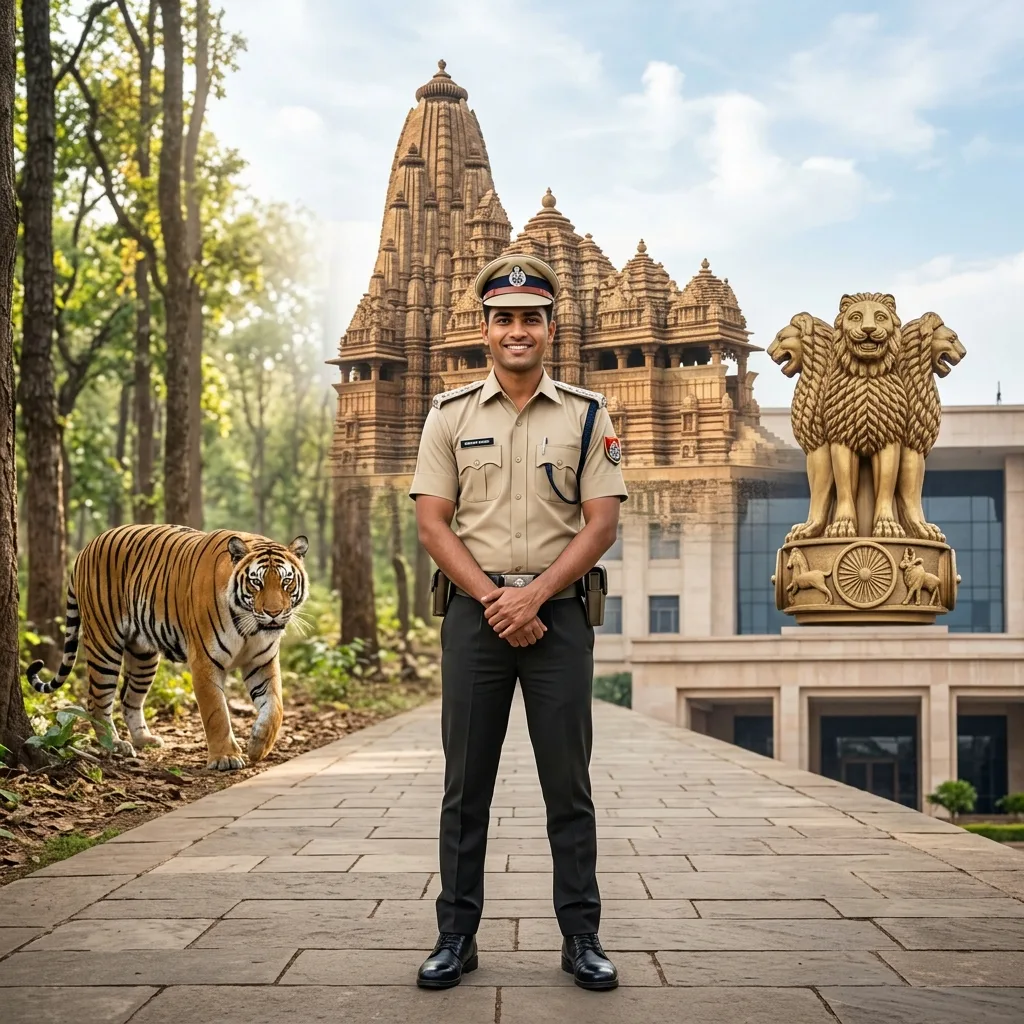
Introduction: MP Police Constable 2026 — Madhya Pradesh's Biggest Recruitment
Madhya Pradesh Chief Minister Dr. Mohan Yadav has officially approved recruitment of 9,662 police personnel in 2026 — the biggest law enforcement recruitment in MP's recent history. For every aspirant in Madhya Pradesh — and thousands across Hindi-speaking India — this is the opportunity of 2026.
Why MP Police Constable 2026 is different from every other police recruitment:
- 9,662 posts — one of the largest state police recruitments in India this year
- NO negative marking in written exam — attempt all 100 questions without fear
- Both written + physical scores count in merit — balanced selection system
- 12th pass eligible — accessible to millions of MP youth
- MP domicile required — less external competition, better chances for locals
- MPESB (MP Employees Selection Board) — known for transparent, professional conduct of exams
Madhya Pradesh — Why It Matters: MP is India's 5th largest state by area (308,252 sq km — larger than Italy!) with 8.5 crore population. 55 districts, 413 talukas, 52,117 villages — the MP Police covers this vast geography with dedication. Joining MP Police means serving India's heart — the state that connects North India to South, houses India's most tiger reserves, and holds civilizational treasures from Khajuraho to Sanchi.
Important: Official notification from MPESB at esb.mp.gov.in is expected soon. This guide covers all known details from official approvals and historical MP Police recruitment patterns. Always verify from official notification.
Quick Reference:
| Parameter | Details |
|---|---|
| Recruiting Body | MPESB (MP Employees Selection Board) |
| Total Posts Approved | 9,662 |
| Constable GD Posts | Approximately 7,500+ |
| Driver Constable Posts | 1,000 |
| Other Posts (SI, ASI etc.) | Remaining |
| Eligibility | 12th pass (Constable GD) |
| Notification expected | esb.mp.gov.in (watch for updates) |
| Official Website | esb.mp.gov.in |
Part 1: Post-wise Breakdown — GD, Driver, SI, and More
Post 1: Constable GD (General Duty) — Largest Category
Posts: Approximately 7,500+ (majority of 9,662)
Role: The frontline of Madhya Pradesh Police:
- Patrolling — foot, motorcycle, vehicle patrol in assigned area
- Law and order maintenance — rallies, events, festivals, elections
- FIR registration assistance and preliminary inquiry
- Traffic management at busy intersections
- VIP protection duties (rotating)
- Crime scene security
- Court duty — escorting accused, maintaining court premises
Qualifications: 12th pass (Intermediate/Higher Secondary)
Post 2: Constable Driver
Posts: 1,000
Role: Driving police vehicles — patrol cars, PCR vans, ambulances attached to police, prisoner transport vehicles.
Additional eligibility: Valid driving license (Light/Heavy Motor Vehicle as required by post)
Post 3: Sub-Inspector (SI) and Other Posts
Posts: Remaining from 9,662 total
Role: SI is an officer-level post — investigates cases, supervises constables, files charge sheets. Graduation required for SI.
Note: The 9,662 includes various ranks — check official notification for exact post-wise distribution when released.
Part 2: Eligibility — Complete Requirements
Educational Qualification:
| Post | Qualification |
|---|---|
| Constable GD | 12th pass (any stream) from MP Board or equivalent |
| Constable Driver | 10th pass + Valid Driving License |
| Sub-Inspector | Graduation from recognized university |
MP domicile: Mandatory — candidates must be domicile of Madhya Pradesh. Domicile certificate required from SDO/Tehsildar. This significantly reduces external competition compared to central government exams.
Age Limit:
| Category | Age Range |
|---|---|
| General (Male) | 18-33 years |
| General (Female) | 18-33 years |
| OBC (Male/Female) | 18-38 years (+5 years) |
| SC/ST (Male/Female) | 18-38 years (+5 years) |
Age calculated as on January 1, 2026 (verify from official notification — dates may differ).
Physical Standard Test (PST):
| Parameter | General/OBC/SC | ST |
|---|---|---|
| Male Height | 168 cm | 160 cm |
| Male Chest | 81 cm (unexpanded) / 86 cm (expanded) | 77 cm / 82 cm |
| Female Height | 155 cm | 145 cm |
| Female Weight | 47.5 kg minimum | 45 kg minimum |
PST is eliminatory — candidates not meeting height/chest/weight standards are eliminated before written exam.
Part 3: Selection Process — Written + Physical Combined Merit
MP Police's Unique Selection System:
What makes MP Police Constable selection different from most state police: BOTH written exam score AND physical efficiency test score contribute to the final merit list. This rewards candidates who are both academically prepared AND physically fit.
Stage 1: Physical Standard Test (PST)
Eliminatory — candidates measured for height, chest, weight. Those not meeting standards are eliminated. No marks — just pass/fail.
Stage 2: Computer-Based Written Exam (CBT)
| Parameter | Details |
|---|---|
| Mode | Computer-Based Test (CBT) |
| Questions | 100 |
| Marks | 100 |
| Duration | 2 hours |
| Negative Marking | NONE — attempt all 100 questions |
| Language | Hindi |
Subject-wise distribution (expected based on previous MP Police exams):
| Subject | Questions | Marks |
|---|---|---|
| General Knowledge and Current Affairs | 40 | 40 |
| General Hindi | 20 | 20 |
| General Mathematics | 20 | 20 |
| General Science | 10 | 10 |
| General Reasoning and Mental Ability | 10 | 10 |
| Total | 100 | 100 |
Strategic insight: No negative marking = attempt every single question. Even a blind guess gives 25% probability of a correct answer. Never leave any question blank. This is the most important strategy difference from SSC/RRB exams.
Stage 3: Physical Efficiency Test (PET)
PET events and marks (based on previous MP Police cycles):
For Male Candidates:
| Event | Distance/Standard | Marks |
|---|---|---|
| Running | 800m (time-based) | 25 marks |
| Long Jump | (distance-based) | 25 marks |
| Shot Put | 7.26 kg (distance-based) | 25 marks |
| High Jump | (height-based) | 25 marks |
For Female Candidates:
| Event | Distance/Standard | Marks |
|---|---|---|
| Running | 800m (time-based) | 25 marks |
| Long Jump | (distance-based) | 25 marks |
| Shot Put | 4 kg (distance-based) | 25 marks |
| High Jump | (height-based) | 25 marks |
Combined merit formula: Written Exam marks + PET marks = Final Merit Score This means PET is not just qualifying — it is merit-deciding. A candidate who scores 70/100 in CBT but 90/100 in PET may rank higher than a candidate scoring 80/100 in CBT and 60/100 in PET.
Stage 4: Document Verification (DV)
- 12th certificate and marksheet
- Domicile certificate (Madhya Pradesh)
- Category certificate (OBC/SC/ST — MP government issued)
- Age proof (10th certificate)
- Driving license (for Driver post)
Stage 5: Medical Examination
Standard medical fitness:
- Vision: Can wear spectacles (no strict unaided vision standard like railway A-2)
- General health: No significant physical disability
- Blood pressure, basic cardiac check
Part 4: Salary — Complete MP Police Constable Pay Structure
7th Pay Commission Salary:
MP Police Constable is in Level 3 of the 7th Pay Commission pay matrix:
| Component | Amount |
|---|---|
| Basic Pay (Level 3 entry) | Rs.21,700 |
| Dearness Allowance (DA) | Rs.11,000-12,500 |
| HRA (based on posting city) | Rs.1,700-4,000 |
| Travel Allowance (TA) | Rs.1,000-2,000 |
| Police Dress Allowance | Rs.500-1,000 |
| Gross Salary | Rs.35,900-41,200 |
| Deductions (NPS + others) | Rs.3,000-5,000 |
| Net In-Hand | Rs.32,000-38,000 |
MP Police Additional Allowances:
- Night Duty Allowance (night patrolling shifts)
- Risk Allowance (frontline policing)
- Washing Allowance (uniform maintenance)
- Annual Increment: 3% guaranteed
Salary Growth Over Career:
| Years of Service | Level | Basic Pay | In-Hand Approx |
|---|---|---|---|
| Entry (Constable) | Level 3 | Rs.21,700 | Rs.32,000-38,000 |
| After 5 years | Level 3 (increments) | Rs.25,000+ | Rs.38,000-44,000 |
| After 10 years (ASI) | Level 4-5 | Rs.25,500-29,200 | Rs.40,000-48,000 |
| After 20 years (SI) | Level 6 | Rs.35,400 | Rs.52,000-60,000 |
Departmental Promotion Path:
Constable → Head Constable → Assistant Sub-Inspector (ASI) → Sub-Inspector (SI) → Inspector → Deputy Superintendent of Police (DSP)
MPESB conducts internal departmental examinations for promotion. Constables who are academically strong can fast-track: after 5-6 years of service, appear for SI departmental promotion exam. A constable can become SI within 8-10 years with dedicated effort.
Part 5: MP GK Capsule — The Game-Changer Section
MP-specific General Knowledge is the section that separates local MP toppers from generic candidates. Since this exam is only for MP residents — MP GK carries high value. Mastering this section is your biggest competitive advantage:
Madhya Pradesh — The Complete GK Profile:
Basic Facts:
- Capital: Bhopal (also called City of Lakes — Bhopal has over 200 lakes)
- Area: 308,252 sq km — 5th largest state in India
- Population: 8.5 crore (2024 estimate)
- Districts: 55 (as of 2024)
- Official Language: Hindi
- State Animal: Barasingha (Swamp Deer)
- State Bird: Indian Paradise Flycatcher (Dudhraj)
- State Tree: Banyan (Bar/Bargad)
- State Flower: White Lily
Geography — Every Aspirant Must Know:
- Tropic of Cancer passes through MP (passes through Bhopal, Ujjain)
- Narmada River: Originates at Amarkantak (Anuppur district) — flows west through MP
- Tapti River: Originates at Betul district
- Chambal River: Originates near Mhow (Indore district)
- Son River: Originates near Amarkantak
- Vindhya Range: North MP — separates Gangetic plain from Deccan plateau
- Satpura Range: South MP — highest point Dhupgarh (1,350m) near Pachmarhi
- Pachmarhi: Only hill station in MP — "Queen of Satpura"
Historical Significance:
- Bhimbetka Rock Shelters: Raisen district — UNESCO World Heritage Site — 30,000-year-old rock paintings
- Sanchi Stupa: Raisen district — UNESCO World Heritage Site — Emperor Ashoka's Buddhist stupa (3rd century BC)
- Khajuraho Temples: Chhatarpur district — UNESCO World Heritage Site — 10th century Chandela dynasty temples
- Great Stupa of Sanchi: Oldest stone structure in India
- Gwalior Fort: "Pearl among the fortresses of Hind" — Emperor Babur's words
- Madhavrao Scindia: Gwalior's famous Scindia dynasty
Tiger State — Most Unique MP Identity: Madhya Pradesh has the HIGHEST number of tigers in India — approximately 785 tigers (2022 census):
- Bandhavgarh National Park: Highest tiger density in India — Umaria district
- Kanha National Park: Inspired Rudyard Kipling's "The Jungle Book" — Mandla/Balaghat district
- Pench National Park: Seoni/Chhindwara — also "Jungle Book" territory
- Satpura National Park: Hoshangabad
- Panna National Park: Chhatarpur — tiger reintroduction success story Total: 6 Tiger Reserves (highest in India)
Economic Identity:
- Soybean Bowl of India: MP produces 30%+ of India's soybean — Malwa plateau (Indore, Ujjain, Dewas)
- Opium: Mandsaur, Neemuch — licensed opium poppy cultivation
- Diamond Mining: Panna district — only diamond mine in India (NMDC-operated)
- Coal: Singrauli, Sohagpur (Shahdol division)
- Limestone: Satna, Katni — cement industry
- Marble: Jabalpur (Marble Rocks at Bhedaghat — Narmada gorge) and Rajasthan-border areas
Important Cities — Unique Identities:
| City | Known For |
|---|---|
| Bhopal | State capital, City of Lakes, Bhopal gas tragedy site (1984), Bharat Bhavan art center |
| Indore | Commercial capital, India's cleanest city (Swachh Survekshan champion multiple times), IIM Indore, SGSITS |
| Gwalior | Historical fort, music tradition (Gwalior Gharana of classical music), Tansen Samaroha |
| Jabalpur | High Court of MP, marble rocks (Bhedaghat), Dhuandhar waterfall, Bargi Dam |
| Ujjain | Religious capital, Mahakaleshwar Jyotirlinga, Kumbh Mela 2028 (next Simhastha), Vikram University |
| Pachmarhi | Only hill station in MP, British-era cantonment, Bison Lodge |
| Orchha | Ramraja Temple (only temple where Ram worshipped as king), Bundela Rajput heritage |
| Maheshwar | Holkar queen Ahilyabai Holkar's capital, handloom (Maheshwari sarees), Narmada ghats |
| Mandav (Mandu) | Ruins of Afghan Sultanate — Jahaz Mahal, Hindola Mahal, Rani Roopmati's Pavilion |
Government Schemes — MP Specific:
- Ladli Behna Yojana: Monthly stipend to women (Rs.1,250/month) — CM Shivraj's scheme, continued by Mohan Yadav government
- Mukhyamantri Kanya Vivah Yojana: Financial assistance for BPL families for daughters' marriage
- Mukhyamantri Jan Kalyan (Sambal) Yojana: Benefits for unorganized workers
- Mukhyamantri Kalyani Vivah Sahayata: Benefits for widows remarrying
- Mukhyamantri Swarozgar Yojana: Self-employment scheme
- MP Swasthya Setu: Health connectivity scheme
Rivers and Dams:
| River | Dam | Location |
|---|---|---|
| Narmada | Sardar Sarovar (Gujarat border), Indira Sagar, Omkareshwar | Khandwa/Khargone |
| Chambal | Gandhi Sagar | Mandsaur |
| Betwa | Rajghat Dam | Vidisha |
| Son | Bansagar Dam | Shahdol |
Religious Sites:
- 12 Jyotirlingas in India — 2 are in MP: Mahakaleshwar (Ujjain) and Omkareshwar (Khandwa)
- Maihar: Maa Sharda Devi temple — Satna district
- Chitrakoot: On MP-UP border — where Ram spent 11 of 14 years of exile
- Amarkantak: Sacred confluence — Narmada, Son, Johila rivers origin; Sharada Mata temple
Part 6: Written Exam Preparation — Subject-wise Strategy
General Knowledge and Current Affairs (40 marks):
MP History (8-10 questions):
- Gondwana Kingdom — Gond tribe history, Queen Durgavati (martyr — 1564)
- Bundela Rajputs — Orchha, Panna, Chhatarpur region history
- Maratha rule in MP — Scindias (Gwalior), Holkars (Indore), Bhonsles (Nagpur)
- British period — Central Provinces (Nagpur/Jabalpur), Bhopal Nawabs, 1857 revolt in MP (Mangal Pandey connection through Indore)
- MP state formation — November 1, 1956 (States Reorganisation Act)
- MP division into MP and Chhattisgarh — November 1, 2000
India History (5-7 questions):
- Mughal Empire — Akbar, Aurangzeb, major battles
- British expansion — Plassey 1757, Buxar 1764, Mysore wars
- Freedom movement — Non-Cooperation 1920, Civil Disobedience 1930, Quit India 1942
- Constitutional history — Constituent Assembly, Jan 26, 1950
Indian Polity (5-7 questions):
- Constitutional provisions — Fundamental Rights (Part III), Directive Principles (Part IV)
- Parliament — Lok Sabha (545 seats), Rajya Sabha (250 seats)
- President powers, Governor powers, Chief Minister
- MP in Parliament — 29 Lok Sabha seats, 11 Rajya Sabha seats
- Panchayati Raj — 73rd and 74th Amendment
Geography (5-7 questions):
- India — rivers, mountains, states, union territories
- MP geography (as detailed above)
- World geography basics — continents, oceans, major rivers
Current Affairs (8-10 questions):
- Last 6 months national and MP-specific
- Government schemes — PM Jan Dhan, PM Awas, PM Kisan, Ayushman Bharat
- Sports — India recent achievements, MP sports stars
- Awards — Bharat Ratna, Padma awards 2026
- MP government events and decisions
General Hindi (20 marks):
- Vyakaran (Grammar): Sandhi (vowel sandhi, consonant sandhi), Samasa (Dvandva, Tatpurush, Bahuvrihi, Avyayibhav), Karak (8 karakas), Kaal (past, present, future — their forms)
- Shabd gyan: Vilom shabd (antonyms), Paryayvachi shabd (synonyms), Anekarthi shabd (words with multiple meanings), Muhavare (idioms), Lokoktiyan (proverbs)
- Vakya: Vakya shuddhi (sentence correction), Vakya bhed (types of sentences)
- Ras, Chhand, Alankar: Basic literary concepts
- Hindi literature: Tulsidas (Ramcharitmanas), Kabir, Mirabai, Surdas (Bhakti movement poets), Munshi Premchand (Godaan, Nirmala), Mahadevi Verma (Chhayavad)
General Mathematics (20 marks):
- Number system: LCM, HCF, divisibility rules
- Percentage: Percentage change, profit/loss, discount
- Ratio and proportion: Mixture problems, age problems
- Simple and Compound Interest
- Time and Work: Work efficiency, pipes and cisterns
- Time, Speed, Distance: Average speed, train problems (relative speed)
- Mensuration: Area of triangle, rectangle, circle; Volume of cylinder, cone, sphere
- Basic Algebra: Linear equations, simple quadratic
General Science (10 marks):
- Physics: Force, motion, energy (Class 8-10 level); Sound (echo, ultrasound); Light (reflection, refraction); Electricity basics
- Chemistry: Metals and non-metals; Acids and bases; Chemical reactions in daily life
- Biology: Human body systems (digestive, respiratory, circulatory); Diseases and prevention; Nutrition
General Reasoning (10 marks):
- Series completion (number and alphabet)
- Analogy
- Odd one out
- Blood relations
- Directions
- Coding-decoding
- Arrangement and ranking
Part 7: Physical Training Guide — PET Preparation
Since PET marks contribute to final merit, physical preparation is equally important as written:
Running (800m) — How to Build Speed:
Target times for good marks:
- Male: Below 3 minutes for maximum marks, 3-3:30 minutes for moderate marks
- Female: Below 4 minutes for maximum marks
Training plan (6-week):
- Week 1-2: 5 km daily easy jog (build cardiovascular base)
- Week 3-4: Interval training — 200m fast + 200m walk x 4 repetitions (3 days/week), 4-5 km easy run (3 days/week)
- Week 5-6: 800m time trials — attempt 800m at race pace every alternate day, track improvement
Common mistakes:
- Starting too fast: Sprint start causes lactic acid buildup — you cannot sustain. Run first 400m at moderate pace, push in last 400m.
- Heel striking: Land on mid-foot for better efficiency
- Breathing: Breathe in through nose, out through mouth rhythmically
Long Jump — Technique and Training:
Target distances for good marks:
- Male: Above 5 meters
- Female: Above 3.5 meters
Technique:
- Approach run (10-15 strides): Gradually build speed
- Penultimate step (second-to-last): Lower hips slightly
- Takeoff: Plant foot flat, drive knee of free leg up powerfully
- Flight: Tuck both knees toward chest (hang style or hitch-kick)
- Landing: Both heels hit simultaneously, lean forward
Training: Plyometrics — box jumps, bounding, single-leg squats. Build explosive power in quadriceps and glutes.
Shot Put — Technique for Distance:
Weight: 7.26 kg (male), 4 kg (female) Target distance for good marks: Male: 7+ meters; Female: 5+ meters
Technique (Glide method — easier for beginners):
- Start at back of circle, hold shot put on neck/shoulder (not in palm, on fingers)
- Glide backward, build momentum
- Turn and extend arm powerfully, push (not throw) the shot put
- Follow-through — step over to prevent fouling
Training: Wrist curls, shoulder press, rotational exercises. Practice putting motion with lighter ball first.
High Jump (if applicable):
Fosbury Flop technique (arching back over bar) is most efficient — learn bar clearance technique from a physical trainer if needed.
Part 8: MP Police Structure — Know Your Organisation
Madhya Pradesh Police Hierarchy:
| Rank | Equivalent | Responsibilities |
|---|---|---|
| Director General of Police (DGP) | State police chief | Overall command of MP Police |
| Additional DGP (ADGP) | Senior IPS | Zone or range command |
| Inspector General (IG) | IPS officer | Range headquarters |
| Superintendent of Police (SP) | IPS/IPS direct entry | District police chief |
| Deputy Superintendent of Police (DSP) | State PCS | Sub-divisional command |
| Inspector | State Police Service | Circle command (group of thanas) |
| Sub-Inspector (SI) | Non-gazetted officer | Thana (police station) in-charge or investigation officer |
| Assistant Sub-Inspector (ASI) | Non-gazetted | Thana duty, investigation assistance |
| Head Constable | Senior constable | Senior frontline duty |
| Constable | Entry level | Frontline patrol, maintenance of law |
Entry point for candidates: Constable (direct recruitment via MPESB). Alternative entry: Sub-Inspector (direct recruitment for graduates), Dy.SP (via MPPSC PCS for state civil services).
MP Police Specialised Wings:
Madhya Pradesh Special Armed Force (SAF): Specialised force for law and order — used for riot control, VIP security, naxal operations. SAF constables may be drawn from regular police pool.
Hawai Police (Air Wing): MP Police has helicopter facilities for emergency response.
Cyber Crime Cell: MP Police's digital crime fighting wing — based in Bhopal, Indore, Gwalior.
Madhya Pradesh Police Wireless: Communications wing — radio, digital communication network.
Traffic Police: Major urban traffic management — Bhopal, Indore, Gwalior, Jabalpur have dedicated traffic police.
Part 9: Life as an MP Police Constable — Career Reality
Typical Daily Duties:
Morning (7:00 AM): Report at police station (Thana). Duty parade — all constables lined up, instructions from Inspector/SI.
7:30 AM-2:00 PM: Day shift patrolling — foot patrol in beat area or vehicle patrol. Checking suspicious persons, monitoring known criminal/history-sheeter locations. Ensuring markets and public places are safe.
Duty at PCR (Police Control Room): PCR van duty — respond to 100 (police helpline) calls. Reach incident, file report, call ambulance if needed, provide first response.
Court Duty: Accompany accused to court. Wait at court for hearing dates. Return accused to lockup. Collect summons/warrants for service.
Crime Scene Duty: Secure crime scene, maintain evidence integrity until forensic team arrives.
Festivals and Events:
Madhya Pradesh has some of India's most significant religious events — MP Police plays massive role:
- Simhastha Kumbh (Ujjain 2028): Next Kumbh Mela in Ujjain — 5 crore+ pilgrims. Massive police deployment.
- Mahakaleshwar festival days: Daily heavy footfall in Ujjain
- Khajuraho Dance Festival: Annual cultural event — security management
- Pachmarhi Tourist Season: Heavy tourist management duty
- Vindhyachal, Maihar, Chitrakoot pilgrimage: Festival season duty
Challenges and Opportunities:
Naxal/Left Wing Extremism: Some districts of MP (Balaghat, Mandla, Seoni, Chhindwara, Dindori) have/had LWE activity. Police serving in these areas receive additional allowances (hardship allowance) and gain specialized training in jungle warfare and counter-naxal operations.
Urban Policing: Bhopal, Indore, Gwalior, Jabalpur — busy urban postings with modern policing challenges: cyber crime, traffic management, organized crime monitoring. Interesting, fast-paced urban environment.
Part 10: MP Police Constable vs Other Police Constable Exams
Comprehensive Comparison:
| Factor | MP Police 2026 | UP Police Constable | Rajasthan Police | SSC GD (CAPF) |
|---|---|---|---|---|
| Posts | 9,662 | Varies (large batches) | 2,000-15,000 | 25,487 (2026) |
| Conducting Body | MPESB | UPPRPB | RPSC/Police Board | SSC |
| Eligibility | 12th pass | 12th pass | 12th pass | 10th pass |
| Pay Level | Level 3 (state) | Level 3 (state) | Level 3 (state) | Level 3 (central) |
| Basic Pay | Rs.21,700 | Rs.21,700 | Rs.21,700 | Rs.21,700 |
| Domicile Required | YES (MP only) | YES (UP only) | YES (RJ only) | NO (pan-India) |
| Negative Marking | NO | YES (0.25) | Varies | YES (0.25) |
| PET in Merit | YES (scores counted) | NO (PET qualifying only) | YES | YES (PET in merit) |
| Physical Standard Male Height | 168 cm | 168 cm | 168 cm | 170 cm (Gen) |
| MP GK Required | YES | NO | NO | NO |
| Written + Physical Merit | Combined | Written mainly | Varies | Written mainly |
Why MP Police Constable is Unique:
- No negative marking — your lowest-risk police exam
- PET in merit — rewards genuinely fit candidates
- MP domicile only — competition is LOCAL, not pan-India
- MP GK advantage — local knowledge gives edge to genuine MP residents
- 9,662 posts — one of the largest state police batches
Frequently Asked Questions
Q1. Can I apply for MP Police if I am from another state but studied 12th in MP? MP domicile requirement means candidates must be permanent residents of Madhya Pradesh — not just education in MP. Domicile is determined by permanent residence, not place of study. If your family is permanently settled in MP and you have domicile certificate from MP SDO/Tehsildar — you are eligible regardless of where you studied. If you are domicile of another state (UP, Rajasthan, Bihar etc.) — you are NOT eligible for MP Police, even if you studied in MP.
Q2. What is the exact cut-off for MP Police Constable? MP Police cut-off varies by category and the difficulty level of each batch. Indicative cut-offs from previous MP Police Constable cycles: General male: 55-70 out of 100 (written), OBC/SC: 50-65, ST: 45-60. Since PET also contributes marks, final cut-off (written + PET combined) varies. Strong physical performance can compensate for average written performance — unique to MP Police.
Q3. My height is 166 cm (male). Can I join MP Police? For General/OBC/SC male: Minimum height is 168 cm. You are 2 cm short — unfortunately you are NOT eligible for Constable GD in these categories. However, if you are from ST category — minimum height is 160 cm — you would be eligible. If you are General/OBC/SC — you cannot join as Constable GD but may explore other government career options. Note: Height cannot be increased medically — this is a fixed anatomical measurement.
Q4. I scored very well in written but failed PET. Can I still qualify? PET in MP Police is not purely eliminatory — it contributes marks to merit. However, a complete failure in a specific PET event (e.g., unable to complete the run within cutoff time) may have disqualifying minimums. The exact minimum qualifying marks for each PET event will be in the official MPESB notification. If you clear the minimum qualifying marks in PET but score low, your total (written + low PET) may still be sufficient for selection depending on competition.
Q5. After joining as Constable, how quickly can I become SI? Two routes: (1) Seniority-based promotion: Constable to Head Constable typically in 5-8 years, to ASI in 8-12 years, to SI in 15-20 years. (2) Departmental examination: MPESB conducts departmental promotion exams for serving constables. Clearing the SI promotion exam (which tests law, General Knowledge, and Hindi at graduation level) — a constable can become SI in 6-10 years. The fast-track path requires active preparation alongside duty.
Q6. What is the bond period after joining MP Police? MP Police constables sign a service bond — typically 5-7 years of mandatory service. Resigning before bond completion requires repaying training costs and may have other penalties. This bond is standard for state police services to prevent candidates from joining only to use the appointment letter for other applications. After bond period, resignation with proper notice (30-90 days) is typically possible.
Conclusion: Serve Madhya Pradesh — India's Heart
Madhya Pradesh is 308,252 sq km of India's most diverse geography — tiger forests to pilgrimage cities, marble gorges to soybean farms, diamond mines to tribal heartland. Its 8.5 crore people deserve a police force that is strong, fit, and dedicated.
9,662 posts. No negative marking. Both written and physical in merit. MP domicile advantage. The most accessible police examination in India's largest central state.
An MP Police Constable is not just a government employee. They are the person who a Bhopal shopkeeper calls when someone snatches their purse. They are the officer who controls traffic at Ujjain's Simhastha when 5 crore pilgrims converge. They are the constable who patrols Bandhavgarh to protect tigers from poachers. They are the person who brings safety to India's Heart.
Your action plan:
- Watch esb.mp.gov.in — official notification is expected soon
- Start MP GK immediately — this is your biggest edge as an MP resident
- Begin physical training — 800m running, long jump, shot put (PET is in merit, not just qualifying)
- Study General Hindi seriously — 20 marks purely from language proficiency
- No negative marking = attempt all 100 questions, always
Stay updated with MP Police Constable 2026 notification date, application form, exam date, admit card, result, and merit list at Government Job Result — India's most trusted government career resource.
Disclaimer: MP Police Constable 2026 details based on government approval announcements and historical MPESB recruitment patterns. Official detailed notification not yet released (as of July 2026). All eligibility criteria, physical standards, exam pattern, and salary details should be verified from official MPESB notification at esb.mp.gov.in when released. CM Mohan Yadav's 9,662 post approval confirmed by MP Home Department.
Part 11: MP Police — District-wise Posting Reality
Understanding where you may be posted helps aspirants make informed career decisions:
Madhya Pradesh — 55 Districts Across 10 Divisions:
| Division | Districts |
|---|---|
| Bhopal | Bhopal, Sehore, Raisen, Rajgarh, Vidisha |
| Indore | Indore, Dhar, Jhabua, Alirajpur, Barwani, Khargone, Burhanpur |
| Gwalior | Gwalior, Shivpuri, Guna, Ashok Nagar, Datia |
| Chambal | Morena, Bhind, Sheopur |
| Sagar | Sagar, Chhatarpur, Tikamgarh, Niwari, Damoh, Panna |
| Rewa | Rewa, Satna, Sidhi, Singrauli |
| Shahdol | Shahdol, Umaria, Anuppur, Dindori |
| Jabalpur | Jabalpur, Katni, Narsinghpur, Chhindwara, Seoni, Mandla, Balaghat |
| Ujjain | Ujjain, Dewas, Shajapur, Agar Malwa, Ratlam, Mandsaur, Neemuch |
| Narmadapuram | Hoshangabad, Harda, Betul |
Posting Types and Urban vs Rural:
Urban Postings (Most Sought After): Bhopal (capital), Indore (commercial capital), Gwalior, Jabalpur — these four cities offer the most modern policing experience:
- Modern police stations with computerized FIR systems
- Traffic police (separate wing in large cities)
- Cyber crime cell proximity
- Better infrastructure and amenities
- Faster transfer opportunities within city
Rural/Semi-Urban Postings: Most constables are initially posted in their home district or nearby districts. A constable from Betul district will likely be posted in Betul, Hoshangabad, or nearby Narmadapuram division districts.
Sensitive Areas: Some districts require additional mental preparation:
- Singrauli: Industrial district — coal mining area, industrial disputes, land acquisition issues
- Balaghat, Mandla, Dindori: Previously had LWE (Left Wing Extremism) influence — requires heightened vigilance but provides additional hardship allowances
- Morena, Bhind: Chambal region — historically associated with dacoity history, now largely peaceful but requires alert policing mindset
- Border districts: Sheopur (Rajasthan border), Jhabua/Alirajpur (Gujarat/Rajasthan border) — smuggling routes require vigilance
Transfer Policy:
MP Police constables are typically posted in their district/division for 3-5 years initially. Inter-division transfers possible on compassionate grounds (spouse posting, medical). Transfer requests are handled by Superintendent of Police (SP) at district level and DIG at divisional level.
Part 12: MP Police Training — What Happens After Selection
After MPESB merit list and DV, selected candidates undergo mandatory training:
Police Training Colleges in MP:
Central Police Training College (CPTC), Bhopal:
- Premier training institution of MP Police
- Basic constable training conducted here
- Duration: 9-12 months (residential, mandatory)
- Located: Bhopal campus
Police Training School (PTS) Indore:
- Indore-based training facility
- Handles Indore Range and Western MP recruits
Police Training School (PTS) Gwalior:
- Gwalior campus — trains North MP recruits
SAF (Special Armed Force) Training Centers:
- SAF constables get specialized training at SAF battalions
What Happens During Training:
Physical Conditioning (first 3 months):
- Daily PT (Physical Training): 6 AM parade, running (5-10 km), drills
- Unarmed combat: Self-defense basics
- Swimming (where facilities available)
- Yoga and meditation — mental fitness emphasis
Academic Training (months 4-9):
- Indian Penal Code (IPC) / Bharatiya Nyaya Sanhita (BNS): Crime definitions, punishment provisions
- Code of Criminal Procedure (CrPC) / Bharatiya Nagarik Suraksha Sanhita (BNSS): Investigation procedures, arrest rules, bail, FIR process
- Indian Evidence Act / Bharatiya Sakshya Adhiniyam (BSA): Evidence collection, witness examination
- MP Police Regulations: State-specific rules
- Traffic laws: MV Act provisions for traffic duty
- First Aid: Emergency medical response for constables at field incidents
Weapons Training:
- INSAS rifle: Standard service rifle — safe handling, maintenance, firing
- Pistol/Revolver: Personal sidearm basics
- Lathi (baton): Crowd control techniques
Law and Order Training:
- Crowd management techniques
- Section 144 CrPC deployment scenarios
- VIP security protocols
- FIR registration process (hands-on at station)
Probation Period:
After training — constables serve a 2-year probation period in the field. During probation:
- Performance evaluated by supervising officers
- APAR (Annual Performance Appraisal Report) written
- Any serious misconduct during probation can lead to termination
- After satisfactory probation — permanent appointment confirmed
Part 13: Legal Knowledge for MP Police Aspirants
Basic legal knowledge is increasingly tested in MP Police written exams and is essential for the job:
Bharatiya Nyaya Sanhita (BNS) 2023 — New Criminal Law:
India replaced the British-era Indian Penal Code (IPC) 1860 with Bharatiya Nyaya Sanhita (BNS) 2023, effective July 1, 2024. MP Police constables now work under these new laws:
Key BNS Sections (Commonly Tested):
| BNS Section | Offense | Punishment |
|---|---|---|
| Section 103 | Murder | Death or Life Imprisonment + fine |
| Section 105 | Culpable homicide not amounting to murder | 10 years to life + fine |
| Section 115 | Voluntarily causing hurt | 1 year or Rs.10,000 fine |
| Section 116 | Voluntarily causing grievous hurt | 7 years + fine |
| Section 303 | Theft | 3 years + fine |
| Section 304 | Theft in dwelling house | 7 years + fine |
| Section 309 | Robbery | 10 years + fine |
| Section 310 | Dacoity | 10 years to life |
| Section 316 | Criminal breach of trust | 3 years, or 7 years for specific persons |
| Section 318 | Cheating | 3 years + fine |
| Section 351 | Criminal assault | 3 months or Rs.1000 fine |
Important concept: Cognizable vs Non-Cognizable offenses:
- Cognizable (C): Police can arrest WITHOUT warrant. FIR must be registered. Examples: Murder, robbery, rape, dacoity, theft.
- Non-Cognizable (NC): Police CANNOT arrest without warrant. Written complaint filed. Examples: Cheating (in some cases), defamation, minor assault.
Bharatiya Nagarik Suraksha Sanhita (BNSS) 2023 — Procedure:
FIR Process (First Information Report):
- Any person can give information to police about a cognizable offense
- Police MUST register FIR — cannot refuse (Section 173 BNSS)
- FIR must be read to informant, signed by them
- Copy of FIR must be given free of cost to informant
- Zero FIR: FIR can be filed at ANY police station regardless of jurisdiction (introduced in BNSS)
Arrest Rules:
- For cognizable offenses: Police can arrest without warrant
- Arrested person must be informed of grounds of arrest immediately
- Arrested person has right to legal counsel (advocate)
- Must be produced before Magistrate within 24 hours of arrest
- Mandatory body camera recording of arrest in sensitive cases (new BNSS provision)
Bail:
- Bailable offense: Person has right to bail — police station itself can grant bail
- Non-bailable offense: Only Magistrate/Court can grant bail
MP-Specific Laws Tested:
MP Prohibition of Cow Slaughter Act: Protection of cattle — relevant for rural MP policing.
MP Gambling Act: Regulations for gambling activities — police regularly raid gambling dens.
Lok Ayog (Lokayukta): MP's anti-corruption watchdog — important for constables to know about reporting corruption.
Forest Laws: Since MP has massive forest cover and tiger reserves — Forest Act violations (poaching, illegal timber felling) are common police work in forest districts.
Part 14: MP Police Technology and Modern Policing
MP Police has invested significantly in technology-driven policing:
Dial 100 (now Dial 112):
MP Police's emergency response system is one of India's best:
- Integrated Emergency Response System — Police (112), Fire (101), Ambulance (108) all connected
- Response time target: 15 minutes in urban areas, 30 minutes in rural
- GPS-tracked PCR vans — central monitoring
- Constables in PCR vans report to Dial 112 control room
Constable's role in Dial 112: You may be posted to PCR (Police Control Room) van duty — this is one of the most dynamic postings. You respond to all types of emergencies — domestic violence, accidents, theft, medical emergencies. First responder training is essential.
CCTNS (Crime and Criminal Tracking Network System):
India-wide networked crime database:
- All FIRs filed digitally into CCTNS
- Criminal records accessible across India — if accused arrested in Indore has past cases in Delhi, constable can check immediately
- MP Police fully integrated with CCTNS
- Constables in thanas learn CCTNS data entry as part of training
MP Police Smart Helmet and Body Camera:
Modern MP Police stations are equipping constables with:
- Body-worn cameras during patrol — evidence recording, accountability
- Smart helmets for traffic police (Indore) — built-in camera
Cyberpolice Stations:
MP was among the first states to establish dedicated Cyber Crime Police Stations in major cities. Constables interested in technology can apply for posting/training in cyber cells:
- CGPDTM Registration Number tracking for online fraud
- Social media monitoring
- Cyber FIR registration
Women Safety:
Abhay (Safety App): MP Police app for women to send SOS with GPS location directly to nearest PCR van.
Women Police Stations: Every district has a Mahila Thana (Women Police Station) — constables can request posting.
Part 15: Physical Health and Long-Term Career Wellness
Police career involves physical and mental stressors. Preparation for these begins NOW:
Common Health Challenges for Police Constables:
Night Duty Health Impact:
- Rotating shifts (day, afternoon, night) disrupt circadian rhythm
- Long-term: Increased risk of metabolic syndrome, sleep disorders
- Solution: Consistent sleep schedule on off-days, blackout curtains for day sleeping, physical exercise even during non-duty hours
Stress and Mental Health: Police see difficult scenes — accidents, crimes, violence, death — regularly. Secondary traumatic stress (STS) or compassion fatigue is real:
- Symptoms: Nightmares, emotional numbness, irritability, alcohol dependence (major risk)
- Solution: MP Police has started counseling services in major districts. Talk to a colleague or counselor. Physical exercise is the best stress reliever. Strong family support system matters.
Musculoskeletal Issues:
- Long hours of standing, patrolling on foot, motorcycle patrolling — knee and back issues are common among veteran constables
- Prevention: Proper posture, good quality footwear (invest in proper boots), core strengthening exercises, regular stretching
Physical Training That Helps Your Career Long-Term:
Starting physical conditioning NOW — before training — gives you an enormous advantage:
Daily Routine for MP Police Aspirants:
| Time | Activity |
|---|---|
| 5:30 AM | Wake up |
| 5:45-6:45 AM | Run 5 km (build to 10 km over 2 months) |
| 6:45-7:15 AM | Long jump practice + Shot put practice |
| 7:15-7:30 AM | Cool down and stretch |
| Evening 5:00-6:00 PM | Strength training — push-ups, pull-ups, squats, core exercises |
Progressive running targets:
- Month 1: Complete 5 km in under 30 minutes
- Month 2: Complete 5 km in under 25 minutes
- Month 3: 800m in under 3:30 (male target)
- Exam day: 800m in under 3:00 for maximum marks
Part 16: MP GK Deep Dive — Advanced Module
Building on the GK capsule in Part 5, here is a deeper level for aspirants wanting complete mastery:
Important MP Personalities (Frequently Tested):
| Name | Field | Contribution |
|---|---|---|
| Chandrashekar Azad | Freedom Fighter | Born in Bhavra, Jhabua district MP. Led HSRA with Bhagat Singh. Died at Alfred Park, Allahabad (1931). |
| Tantya Bhil | Freedom Fighter/Folk Hero | Tribesman who robbed British and gave to poor — "Robin Hood of MP." Hanged 1889 at Jabalpur. |
| Queen Durgavati | Gond Queen | Ruled Gondwana from Singour fort. Fought Mughals (Asaf Khan) in 1564 — died in battle. Martyr. |
| Ahilyabai Holkar | Holkar Queen | Ruled Indore (Maheshwar capital). Built ghats, temples across India. Died 1795. |
| Rani Lakshmi Bai | 1857 Freedom Fighter | Fought British in Gwalior. Died 1858 in Gwalior — "Mardani" as called by Subhadra Kumari Chauhan. |
| Tansen | Classical Musician | One of the Navaratnas of Akbar. Born in Gwalior (Behat village, Gwalior district). |
| Kishore Kumar | Singer/Actor | Born in Khandwa, MP. India's most beloved playback singer. |
| Lata Mangeshkar | Singer | Born in Indore, MP. India's "Nightingale." |
| Shivraj Singh Chouhan | Politician | Former CM of MP (2005-2023), longest-serving CM of MP. |
| Mohan Yadav | Politician | Current CM of MP (December 2023-present). |
MP Records and Firsts:
- Largest city by area in MP: Indore (3,898 sq km urban area)
- MP's highest peak: Dhupgarh (1,350 m) — Pachmarhi, Betul/Hoshangabad border
- Longest river in MP: Narmada — 1,312 km total (1,077 km in MP)
- Largest dam in MP: Indira Sagar Dam (Narmada) — Narmada district — 12 billion cubic meter capacity
- MP's first university: Jiwaji University, Gwalior (1964)
- Cleanest city in India: Indore — won 7 consecutive Swachh Survekshan awards (2017-2023)
- India's largest Ramayan Murti: Orchha — Ram Raja Mandir
- First MP Chief Minister: Ravi Shankar Shukla (1956)
- Oldest rock art in India: Bhimbetka (30,000-year-old paintings)
National Parks and Wildlife Sanctuaries:
| Park/Sanctuary | District | Known For |
|---|---|---|
| Kanha National Park | Mandla/Balaghat | Barasingha (State Animal), Jungle Book inspiration, tigers |
| Bandhavgarh National Park | Umaria | Highest tiger density in India |
| Pench National Park | Seoni/Chhindwara | Mowgli's territory (Jungle Book) |
| Satpura National Park | Hoshangabad | Walking safaris (unique), rare wildlife |
| Panna National Park | Chhatarpur | Tiger reintroduction success, diamond mines nearby |
| Madhav National Park | Shivpuri | Sakhya Sagar Lake, crocodiles |
| Van Vihar National Park | Bhopal | Zoo + national park — within Bhopal city |
| Sanjay National Park | Sidhi/Singrauli | Remote forest — elephant habitat |
| Shivpuri Wildlife Sanctuary | Shivpuri | Chinkara, leopard |
| Chambal Wildlife Sanctuary | Morena/Bhind | Gharial, river dolphin, Indian skimmer |
Major Rivers and Tributaries:
Narmada System:
- Narmada originates: Amarkantak (Anuppur)
- Major tributaries in MP: Tawa (longest tributary — Hoshangabad), Hiran, Sher, Shakkar, Burhner, Banjor
- Major dams: Bargi (Jabalpur), Tawa (Hoshangabad), Indira Sagar (Khandwa), Omkareshwar (Khandwa), Maheshwar (Khargone)
Chambal System:
- Originates: Vindhya Range (near Mhow, Indore district)
- Flows through: Indore, Ujjain (Mandsaur), then Rajasthan, then UP
- Known for: Chambal ravines (historically dacoit territory), Gharial sanctuary, clean water
Son River:
- Originates: Amarkantak (same source area as Narmada — India's unique twin-river source)
- Flows east to Ganges (Bihar)
- Major dam: Bansagar (Shahdol/Rewa)
MP Tribal Communities (Important for Police Knowledge):
MP has India's largest scheduled tribe population (20%+ of MP population):
| Tribe | District/Region | Notable Feature |
|---|---|---|
| Gond | Central and Eastern MP (Mandla, Balaghat, Chhindwara) | Largest tribe in MP and India; Gond art (Digna) famous |
| Bhil | Western MP (Jhabua, Alirajpur, Dhar, Barwani) | Second largest; Bhil art famous; Chandrashekar Azad was from Bhil family |
| Baiga | Mandla, Dindori, Anuppur | Known for unique tattoo art (Godna); UNESCO heritage status |
| Sahariya | Shivpuri, Guna, Gwalior | One of India's primitive tribal groups (PVTGs) |
| Korku | Hoshangabad, Betul | Satpura forest tribes |
| Kol | Shahdol, Satna, Rewa | Vindhya region tribes |
Why tribal knowledge matters for MP Police: Large tribal population means many constables will work in tribal-majority districts. Cultural sensitivity, understanding tribal rights (Forest Rights Act 2006), and language basics (Gondi, Bhili) improve police-community relations significantly.
Part 17: Preparation Resources — Books, Apps, Coaching
Best Books for MP Police Constable Written Exam:
| Subject | Book | Publisher |
|---|---|---|
| MP GK (Most Important) | Madhya Pradesh Samanya Gyan | Arihant Publications |
| MP GK | MP Vishesh (MP Special) | Prabhat Prakashan |
| General Hindi | Samanya Hindi | Dr. Hardev Bahri (Arihant) |
| General Knowledge | Lucent's Samanya Gyan | Lucent Publication |
| Mathematics | Kiran's Arithmetic | Kiran Prakashan |
| General Science | Lucent's Samanya Vigyan | Lucent |
| Reasoning | RS Aggarwal Reasoning | S Chand |
| Previous Papers | MP Police Previous Year Papers | Arihant / Youth Competition |
Online Resources:
| Platform | What to Use |
|---|---|
| Testbook | MP Police mock tests, MP GK quizzes |
| Adda247 Hindi | MP Police-specific courses in Hindi |
| YouTube: Study91, Nitin Sir | Hindi-medium MP GK and general studies |
| MP ESBS Official App | Track notifications directly |
| Jagran Josh | MP current affairs daily |
Coaching Centers in MP:
If you prefer offline coaching:
- Bhopal: Multiple coaching institutes near Maharana Pratap Nagar, Ayodhya Bypass
- Indore: Vijay Nagar coaching hub — multiple MP Police specialist institutes
- Gwalior: Coaching near Lashkar and City Centre area
- Jabalpur: Wright Town and Napier Town coaching clusters
Note: Most toppers in MP Police exams are self-prepared — good books + previous papers + physical training is the winning formula. Coaching is supplementary.
Part 18: MP Police Welfare and Benefits
Government Quarters and Housing:
MP Police provides residential quarters for constables:
- Police Lines quarters — residential colonies adjacent to police stations and headquarters
- Typically 1BHK for constables and head constables
- Nominal rent deducted (Rs.100-500/month depending on quarter type)
- Not all constables get quarters immediately — depends on availability at posting location
- HRA (House Rent Allowance) paid if quarters not allotted
Medical Benefits:
- Government hospital treatment for constables and family
- MP Police Hospital (Bhopal) — dedicated police hospital
- CGHS-like facility at district headquarters hospitals
- In service injuries during duty: Full medical expenses covered by department
Sports and Welfare:
MP Police Sports: MP Police has a strong sports tradition:
- Annual Police Sports Meet at state level
- Sports quota constables (recruited based on sports achievement) — Excel in your sport and get direct preference
- Wrestling, kabaddi, cricket, athletics — MP Police fields strong teams in central police sports competitions
Police Welfare Fund:
- Monthly deduction for Police Welfare Fund
- Financial assistance in case of death in duty — family gets enhanced compensation
- Education scholarships for constables' children
Canteen Facility:
Police canteen (CSD-type) at district headquarters provides subsidized goods — rations, clothing, electronics at below-market prices.
Part 19: Special Categories and Reservation in MP Police
MP Government Reservation Policy:
| Category | Reservation % |
|---|---|
| Scheduled Tribe (ST) | 20% |
| Scheduled Caste (SC) | 16% |
| OBC | 27% |
| EWS (Economically Weaker Section) | 10% |
| General | 27% (unreserved) |
Women's reservation: 33% of constable posts are reserved for women within each category.
Horizontal Reservations (Cross-cutting):
- Ex-servicemen: 10% of posts reserved
- PwBD (Persons with Benchmark Disability): 4% of posts reserved (varies by post)
- Dependent of Freedom Fighter: Separate quota
OBC NCL Certificate:
For OBC candidates — ensure you have Non-Creamy Layer (NCL) certificate from MP government. Creamy layer OBC candidates (family income above Rs.8 lakh/year) are NOT eligible for OBC reservation — they compete in General category. NCL certificate must be recent (typically issued after specific cut-off date mentioned in notification).
Part 20: Complete MP Police Timeline — From Notification to Joining
Understanding the full recruitment timeline helps you plan:
Expected Timeline (Based on Previous MP Police Cycles):
| Phase | Expected Duration |
|---|---|
| Notification Release | Expected August-September 2026 |
| Application Window | 20-30 days from notification |
| Application Verification/Admit Card | 1-2 months after application close |
| Physical Standard Test (PST) | 2-3 months after notification |
| Written Exam (CBT) | 1-2 months after PST |
| PET (Physical Efficiency Test) | 1-2 months after CBT |
| Result and Merit List | 1-2 months after PET |
| Document Verification (DV) | 1-2 months after result |
| Medical Examination | Within DV period |
| Training begins | 2-4 months after DV |
| Completion of Training + Joining | 9-12 months after training start |
Total time from notification to joining: Approximately 18-24 months. This is normal for a large state police recruitment. Plan accordingly — do not quit current job/education prematurely.
Maintaining Eligibility Throughout:
- Age: Continue monitoring age — some constables cross upper age limit between notification and document verification if recruitment is delayed. Always check official notification for age cut-off date.
- Fitness: Maintain physical training throughout the long process — PET may be at any stage
- Documents: Keep all documents current — OBC NCL certificate has validity; domicile certificate may need renewal
- Application: Track your status on esb.mp.gov.in regularly — any corrections or notices are posted there
Extended FAQ (Part 2)
Q7. Can a woman wearing spectacles join MP Police? Yes — MP Police medical standard does not prohibit spectacles for Constable GD. Unlike railway A-2 medical (which requires 6/9 unaided vision), MP Police medical is standard government service medical. Candidates with corrected vision (using glasses or contact lenses) who meet the corrected vision standards are eligible. Very high spectacle numbers (extremely poor unaided vision) may face issues — an ophthalmologist pre-check is recommended before applying.
Q8. I am from SC category and my height is 166 cm (below 168 cm requirement). Am I eligible? Height standards in MP Police apply equally to all categories — SC/ST/OBC height relaxation applies to ST candidates only (minimum 160 cm). For SC candidates, the minimum height is still 168 cm (same as General/OBC). At 166 cm — an SC male candidate does not meet the physical standard and would be eliminated at PST stage. This is a common misunderstanding — only ST has lower height standard, not all reserved categories.
Q9. I have a criminal case against me (minor offense, acquitted). Can I join MP Police? Background verification is conducted for all police recruits. Any pending criminal case (even minor) can be a disqualifying factor during police recruitment. Acquittal typically resolves the issue — courts have found you not guilty. However: (1) Compromise cases (where complaint is withdrawn) — impact varies; (2) Traffic challans — typically not disqualifying; (3) Cases related to moral turpitude (sexual offense, theft, fraud) — even acquittal may be considered; (4) Cases still pending — typically disqualifying until resolved. Consult the official notification's character verification clause for specifics.
Q10. MP Police constable ke liye coaching necessary hai? Coaching is NOT necessary for MP Police Constable. The exam is 12th pass level (Hindi medium, MP syllabus). Thousands of constables have qualified with self-study: (1) Standard MP GK book + Lucent GK; (2) Class 10 Math (NCERT or Kiran Arithmetic); (3) Standard Hindi grammar book; (4) Daily MP news (Dainik Bhaskar, Patrika) for current affairs. Physical training is more important than coaching — PET scores count in merit. Spend more time on running track than coaching center.
Q11. What is the difference between MPESB and MPPSC for police recruitment? MPESB (MP Employees Selection Board) conducts: Constable, Head Constable, Driver Constable, and other non-gazetted police posts. MPPSC (Madhya Pradesh Public Service Commission) conducts: Deputy Superintendent of Police (DSP/ACP) through State Services Examination, Sub-Inspector (SI) in some cases. If you want to join as an officer (DSP level) — you need graduation + clear MPPSC State Services or MP Police SI exam. For Constable level (current recruitment) — MPESB is the correct body. The 9,662 posts announced by CM Mohan Yadav are being conducted by MPESB.
Q12. Can I prepare for MP Police and SSC GD simultaneously? Absolutely yes — there is approximately 70% syllabus overlap: General Knowledge (different focus — MP GK for MP Police vs national GK for SSC), Reasoning (identical), Mathematics (identical), General Science (identical). Key differences: (1) MP Police has General Hindi (20 marks) — Hindi grammar specific; SSC GD has English too; (2) MP Police has MP GK — prepare separately; (3) SSC GD has higher difficulty in Mathematics and has negative marking; (4) Physical standards differ slightly (SSC GD: 170 cm General male vs MP Police: 168 cm). Simultaneous preparation is time-efficient and doubles your chances.
Final Conclusion: Madhya Pradesh Police — Pride, Purpose, and Career
Madhya Pradesh is India's heart — and its police force is that heart's protective shield. From the tiger forests of Bandhavgarh to the ancient temples of Khajuraho, from the marble gorges of Bhedaghat to the urban bustle of Indore — MP Police constables serve the full breadth of India's most diverse state.
9,662 posts. No negative marking. Physical fitness in merit. MP domicile advantage. 12th pass eligible.
This is not just a government job — it is a calling to serve 8.5 crore people of Madhya Pradesh, to be the person they call when they need help, the uniform they respect, the presence that keeps the peace.
Your complete final action plan:
- Watch esb.mp.gov.in daily — notification expected soon — apply on Day 1 of application window
- MP GK: Start today — this is your biggest competitive advantage as an MP resident. Read about your own state's history, geography, and culture
- Physical training: Begin NOW — 800m running (target under 3 minutes), long jump, shot put. PET is in merit — every extra meter matters
- General Hindi: 20 marks — study grammar (Sandhi, Samas, Karak), synonyms-antonyms, idioms
- No negative marking = Attempt all 100 questions — this single strategy can add 5-8 extra marks compared to candidates who leave uncertain questions
- Documents ready: Domicile certificate (current), category certificate (OBC NCL — current year), 12th certificate, age proof
Stay updated with MP Police Constable 2026 notification date, application link, admit card, PET schedule, result, and merit list at Government Job Result — India's most trusted government career resource.
Disclaimer: MP Police Constable 2026 details based on CM Mohan Yadav's government approval announcement (July 2026) and historical MPESB recruitment patterns from previous MP Police Constable cycles. Official detailed notification from MPESB at esb.mp.gov.in not yet released as of July 26, 2026. All eligibility criteria, physical standards, exam pattern, salary, and reservation details must be verified from official MPESB notification when released. Post count of 9,662 from official MP Home Department approval.