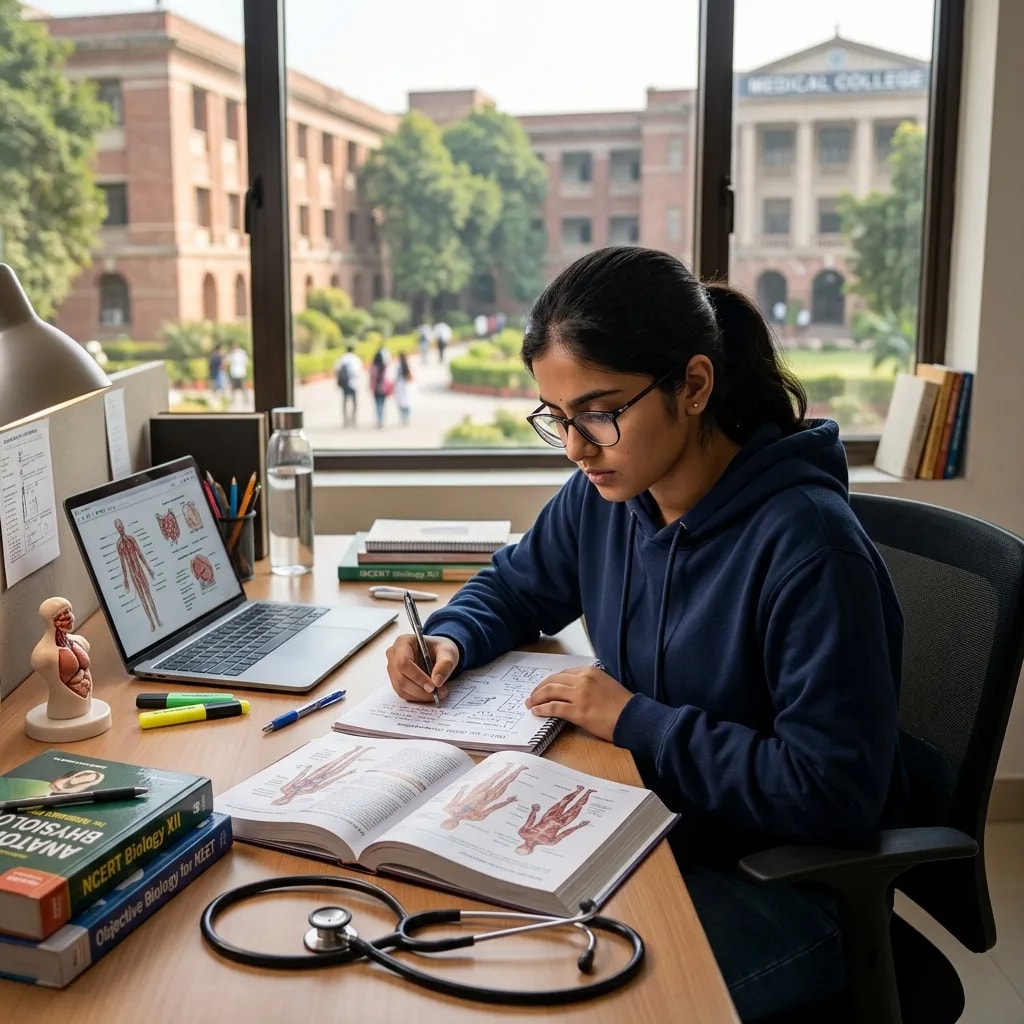
Introduction: Why NEET UG 2026 is Your Gateway to Medical Career
The NEET UG 2026 (National Eligibility cum Entrance Test - Undergraduate) is India's most competitive medical entrance examination, serving as the single gateway to MBBS, BDS, AYUSH, and Veterinary courses across India. With over 20 lakh candidates competing for approximately 1 lakh seats in medical colleges, NEET UG 2026 demands strategic preparation and unwavering dedication.
Quick Navigation: Exam Pattern | Syllabus | Preparation Strategy | Best Books | Mock Tests | FAQs
In this comprehensive NEET UG 2026 preparation guide, we'll cover everything from basic eligibility to advanced preparation strategies that have helped thousands of students score 650+ marks and secure admission in top government medical colleges including AIIMS, JIPMER, and state medical colleges.
What Makes NEET UG Special?
- Single Entrance Exam: One exam for all medical colleges in India
- Career Opportunity: Become a doctor and serve the nation
- High Salary: Starting salary of ₹6-10 lakhs per annum
- Job Security: Permanent government positions available
- Social Prestige: Respected profession in society
- Global Opportunities: Practice medicine worldwide
- Research Scope: Contribute to medical science
NEET UG 2026 Key Statistics
| Parameter | Details |
|---|---|
| Total Applicants (Expected) | 20+ Lakh |
| Total Seats (Approx) | 1,00,000+ |
| Competition Ratio | 1:20 |
| Qualifying Marks (General) | 50th Percentile (720/180) |
| Qualifying Marks (OBC/SC/ST) | 40th/40th/40th Percentile |
| Top Score Required (Govt College) | 650+ marks |
| Average Score (Private College) | 450-550 marks |
Table of Contents
Quick Links to Navigate This Guide:
Exam Overview
Syllabus & Preparation
- Complete Syllabus (Physics, Chemistry, Biology)
- 12-Month Study Plan
- Subject-wise Strategy
- Best Books & Resources
Strategy & Tips
College & Career
FAQs & Resources
Estimated Reading Time: 50 minutes | Last Updated: January 29, 2026
NEET UG 2026 Important Dates
NEET UG 2026 Notification: The National Testing Agency (NTA) will release the official NEET UG 2026 notification in December 2025. Keep checking the official website for updates.
| Event | Expected Date | Status |
|---|---|---|
| Official Notification Release | December 2025 | Awaited |
| Online Registration Start | January 2026 | Awaited |
| Last Date to Apply | February 2026 | Awaited |
| Application Correction Window | February 2026 | Awaited |
| Admit Card Release | April 2026 | Awaited |
| NEET UG 2026 Exam Date | First Sunday of May 2026 | Awaited |
| Answer Key Release | May 2026 | Awaited |
| Result Declaration | June 2026 | Awaited |
| Counselling Start (AIQ) | June-July 2026 | Awaited |
| State Counselling | July-August 2026 | Awaited |
Note: Official dates will be announced on NTA NEET Official Website. Bookmark this page for latest updates.
NEET UG 2026 Eligibility Criteria
Educational Qualification
For MBBS/BDS:
- Passed 10+2 or equivalent with Physics, Chemistry, Biology/Biotechnology and English
- Minimum 50% marks in PCB (40% for SC/ST/OBC, 45% for PwD)
- Must have passed from a recognized board (CBSE, State Boards, etc.)
For AYUSH Courses:
- Same as MBBS with PCB
- Some courses may accept Physics, Chemistry, Biology/Biotechnology
Age Limit
| Category | Minimum Age | Maximum Age |
|---|---|---|
| General/EWS | 17 years (as on 31st Dec 2026) | No upper limit |
| SC/ST/OBC | 17 years | No upper limit |
| PwD | 17 years | No upper limit |
Important: Candidates must complete 17 years of age on or before 31st December 2026.
Nationality Requirements
Eligible candidates:
- Indian Nationals
- NRIs (Non-Resident Indians)
- OCIs (Overseas Citizens of India)
- PIOs (Persons of Indian Origin)
- Foreign Nationals (15% AIQ seats)
Number of Attempts
No limit on the number of attempts. You can appear for NEET as many times as you want.
NEET UG 2026 Complete Exam Pattern
Exam Mode and Duration
Exam Mode: Offline (Pen and Paper Based)
Duration: 3 hours 20 minutes (200 minutes)
Medium: 13 languages (English, Hindi, Assamese, Bengali, Gujarati, Kannada, Malayalam, Marathi, Odia, Punjabi, Tamil, Telugu, Urdu)
Total Questions: 200 (180 to be attempted)
Total Marks: 720 marks
Subject-wise Distribution
| Subject | Total Questions | Questions to Attempt | Marks per Question | Total Marks |
|---|---|---|---|---|
| Physics | 50 (45+5 optional) | 45 | 4 | 180 |
| Chemistry | 50 (45+5 optional) | 45 | 4 | 180 |
| Biology (Botany) | 50 (45+5 optional) | 45 | 4 | 180 |
| Biology (Zoology) | 50 (45+5 optional) | 45 | 4 | 180 |
| Total | 200 | 180 | 4 | 720 |
Section-wise Structure
Each subject has TWO sections:
Section A: 35 questions (Compulsory)
Section B: 15 questions (Attempt any 10)
Important: If you attempt more than 10 questions in Section B, only the first 10 attempted will be evaluated.
NEET UG 2026 Marking Scheme
Positive and Negative Marking
| Answer Type | Marks |
|---|---|
| Correct Answer | +4 marks |
| Incorrect Answer | -1 mark |
| Unattempted | 0 marks |
Score Calculation Formula
Total Score = (Correct Answers × 4) - (Wrong Answers × 1)
Maximum Score = 720 marks
Minimum Score = -180 marks (if all wrong)
Qualifying Percentile
| Category | Qualifying Percentile | Approximate Marks |
|---|---|---|
| General/EWS | 50th Percentile | 720/180 (137-140 marks) |
| OBC | 40th Percentile | 720/180 (107-110 marks) |
| SC | 40th Percentile | 720/180 (107-110 marks) |
| ST | 40th Percentile | 720/180 (107-110 marks) |
| PwD | 45th Percentile | 720/180 (122-125 marks) |
Note: Qualifying marks vary each year based on difficulty level and number of candidates.
NEET UG 2026 Complete Syllabus
Physics Syllabus (Class 11 + 12)
Class 11 Physics Topics
1. Physical World and Measurement
- Units and Measurements
- Dimensional Analysis
- Significant Figures
- Errors in Measurement
- Precision and Accuracy
2. Kinematics
- Motion in a Straight Line
- Motion in a Plane
- Projectile Motion
- Uniform Circular Motion
- Relative Velocity
3. Laws of Motion
- Newton's Laws of Motion
- Friction
- Circular Motion
- Work, Energy and Power
- Collision
4. Gravitation
- Universal Law of Gravitation
- Acceleration due to Gravity
- Kepler's Laws
- Satellites
- Gravitational Potential Energy
5. Properties of Bulk Matter
- Mechanical Properties of Solids
- Mechanical Properties of Fluids
- Thermal Properties of Matter
- Thermodynamics
- Kinetic Theory of Gases
6. Oscillations and Waves
- Simple Harmonic Motion
- Wave Motion
- Sound Waves
- Doppler Effect
Class 12 Physics Topics
1. Electrostatics
- Electric Charges and Fields
- Electrostatic Potential
- Capacitance
- Gauss's Law
2. Current Electricity
- Electric Current
- Ohm's Law
- Kirchhoff's Laws
- Wheatstone Bridge
- Meter Bridge
3. Magnetic Effects of Current
- Magnetic Field
- Ampere's Law
- Biot-Savart Law
- Force on Moving Charge
- Magnetic Dipole
4. Electromagnetic Induction
- Faraday's Law
- Lenz's Law
- Self and Mutual Inductance
- AC Generator
5. Optics
- Ray Optics (Reflection, Refraction)
- Lens Formula
- Optical Instruments
- Wave Optics
- Interference and Diffraction
6. Modern Physics
- Dual Nature of Matter
- Photoelectric Effect
- Atoms and Nuclei
- Semiconductor Devices
- Communication Systems
Chemistry Syllabus (Class 11 + 12)
Class 11 Chemistry Topics
Physical Chemistry:
- Some Basic Concepts of Chemistry
- Structure of Atom
- Classification of Elements
- Chemical Bonding
- States of Matter (Gases and Liquids)
- Thermodynamics
- Equilibrium
- Redox Reactions
Inorganic Chemistry:
- Hydrogen
- S-Block Elements (Alkali and Alkaline Earth Metals)
- P-Block Elements
- Environmental Chemistry
Organic Chemistry:
- Purification and Characterization
- Organic Compounds with Functional Groups
- Hydrocarbons
- Basic Principles of Organic Chemistry
Class 12 Chemistry Topics
Physical Chemistry:
- Solutions
- Electrochemistry
- Chemical Kinetics
- Surface Chemistry
- Solid State
Inorganic Chemistry:
- General Principles of Isolation of Elements
- P-Block Elements
- D and F Block Elements
- Coordination Compounds
Organic Chemistry:
- Haloalkanes and Haloarenes
- Alcohols, Phenols and Ethers
- Aldehydes, Ketones and Carboxylic Acids
- Organic Compounds with Nitrogen
- Biomolecules
- Polymers
- Chemistry in Everyday Life
Biology Syllabus (Class 11 + 12)
Class 11 Biology Topics (Botany)
1. Diversity in Living World
- The Living World
- Biological Classification
- Plant Kingdom
- Animal Kingdom
2. Structural Organization
- Morphology of Flowering Plants
- Anatomy of Flowering Plants
- Structural Organization in Animals
3. Cell Structure and Function
- Cell: The Unit of Life
- Biomolecules
- Cell Cycle and Cell Division
4. Plant Physiology
- Transport in Plants
- Mineral Nutrition
- Photosynthesis
- Respiration in Plants
- Plant Growth and Development
Class 11 Biology Topics (Zoology)
1. Human Physiology
- Digestion and Absorption
- Breathing and Exchange of Gases
- Body Fluids and Circulation
- Excretory Products and Elimination
- Locomotion and Movement
- Neural Control and Coordination
- Chemical Coordination
Class 12 Biology Topics (Botany)
1. Reproduction
- Reproduction in Organisms
- Sexual Reproduction in Flowering Plants
- Human Reproduction
- Reproductive Health
2. Genetics and Evolution
- Principles of Inheritance
- Molecular Basis of Inheritance
- Evolution
3. Biology and Human Welfare
- Human Health and Disease
- Microbes in Human Welfare
- Strategies for Enhancement in Food Production
4. Biotechnology
- Biotechnology: Principles and Processes
- Biotechnology and its Applications
5. Ecology
- Organisms and Populations
- Ecosystem
- Biodiversity and Conservation
- Environmental Issues
Class 12 Biology Topics (Zoology)
1. Human Physiology (Advanced)
- Immune System
- Reproductive System
- Genetics and Genomics
2. Applied Biology
- Biotechnology Applications
- Human Health
- Animal Husbandry
Proven 12-Month Preparation Strategy
Month-wise Study Plan Overview
Visual Timeline:
Month 1-3: Foundation Building (NCERT Completion)
    ↓
Month 4-6: Concept Strengthening (Reference Books)
    ↓
Month 7-9: Practice & Revision (Mock Tests Start)
    ↓
Month 10-11: Intensive Practice (100+ Mock Tests)
    ↓
Month 12: Final Revision (Formula & Concept Revision)
    ↓
NEET UG 2026 Exam → 650+ Score → Top Medical College
Month 1-3: Foundation Building Phase
Goals:
- Complete NCERT (Class 11 & 12) for all subjects
- Build strong conceptual foundation
- Make comprehensive notes
- Understand basic concepts thoroughly
Daily Schedule (10-12 hours):
| Time | Subject | Activity | Duration |
|---|---|---|---|
| 6:00 AM - 8:00 AM | Physics | NCERT Reading + Numericals | 2 hours |
| 8:00 AM - 8:30 AM | Break | Breakfast | 30 min |
| 8:30 AM - 11:00 AM | Chemistry | NCERT + Reactions | 2.5 hours |
| 11:00 AM - 11:30 AM | Break | Short Break | 30 min |
| 11:30 AM - 2:00 PM | Biology | NCERT Reading + Diagrams | 2.5 hours |
| 2:00 PM - 3:00 PM | Break | Lunch + Rest | 1 hour |
| 3:00 PM - 5:00 PM | Revision | Previous Day Topics | 2 hours |
| 5:00 PM - 5:30 PM | Break | Tea Break | 30 min |
| 5:30 PM - 7:30 PM | Practice | NCERT Questions | 2 hours |
| 7:30 PM - 8:30 PM | Break | Dinner | 1 hour |
| 8:30 PM - 10:00 PM | Biology Revision | Diagrams + Facts | 1.5 hours |
| 10:00 PM - 10:30 PM | Daily Review | Notes Making | 30 min |
Weekly Tasks:
- Complete 2-3 chapters per subject
- Solve all NCERT exercises
- Make chapter-wise notes
- Revise previous week topics on Sunday
- Take weekly test (NCERT based)
Books to Focus:
- NCERT Physics (Class 11 & 12)
- NCERT Chemistry (Class 11 & 12)
- NCERT Biology (Class 11 & 12)
Important Tips:
- Read NCERT line by line
- Don't skip any topic
- Make notes while reading
- Solve all in-text questions
- Understand diagrams thoroughly
Month 4-6: Concept Strengthening Phase
Goals:
- Complete reference books
- Strengthen weak areas
- Start solving previous year questions
- Improve problem-solving speed
Daily Schedule (12-14 hours):
| Time | Subject | Activity | Duration |
|---|---|---|---|
| 5:30 AM - 8:00 AM | Physics | HC Verma/DC Pandey | 2.5 hours |
| 8:00 AM - 8:30 AM | Break | Breakfast | 30 min |
| 8:30 AM - 11:30 AM | Chemistry | OP Tandon/MS Chouhan | 3 hours |
| 11:30 AM - 12:00 PM | Break | Short Break | 30 min |
| 12:00 PM - 3:00 PM | Biology | Trueman's/Pradeep | 3 hours |
| 3:00 PM - 4:00 PM | Break | Lunch + Rest | 1 hour |
| 4:00 PM - 6:00 PM | Previous Year | NEET PYQs | 2 hours |
| 6:00 PM - 6:30 PM | Break | Tea Break | 30 min |
| 6:30 PM - 8:30 PM | Weak Topics | Focus on Mistakes | 2 hours |
| 8:30 PM - 9:30 PM | Break | Dinner | 1 hour |
| 9:30 PM - 11:30 PM | Biology Revision | Facts + Diagrams | 2 hours |
| 11:30 PM - 12:00 AM | Daily Review | Formula Revision | 30 min |
Weekly Tasks:
- Complete 3-4 chapters from reference books
- Solve 2 previous year papers
- Take 2 subject-wise tests
- Revise NCERT again
- Update notes with new concepts
Focus Areas:
- Organic Chemistry reactions
- Physics numericals
- Biology diagrams and facts
- Chemical equations
- Important formulas
Month 7-9: Practice & Revision Phase
Goals:
- Start full-length mock tests
- Improve time management
- Achieve 85%+ accuracy
- Complete entire syllabus revision
Daily Schedule (14-16 hours):
Morning Routine:
- 5:00 AM - 8:00 AM: Full-length Mock Test (3 hours)
- 8:00 AM - 8:30 AM: Breakfast
- 8:30 AM - 11:30 AM: Mock Test Analysis (3 hours)
Afternoon Routine:
- 11:30 AM - 2:30 PM: Weak Topics Practice (3 hours)
- 2:30 PM - 3:30 PM: Lunch + Rest
- 3:30 PM - 6:30 PM: Subject-wise Revision (3 hours)
Evening Routine:
- 6:30 PM - 7:00 PM: Tea Break
- 7:00 PM - 9:00 PM: Biology Intensive (2 hours)
- 9:00 PM - 10:00 PM: Dinner
- 10:00 PM - 12:00 AM: Formula & Fact Revision (2 hours)
Weekly Tasks:
- Attempt 4-5 full-length mock tests
- Analyze every question thoroughly
- Revise complete syllabus once
- Solve 5 previous year papers
- Focus on time management
Mock Test Strategy:
- Take test in exam-like environment
- Maintain OMR sheet practice
- Time each section properly
- Don't check answers during test
- Analyze mistakes thoroughly
Month 10-11: Intensive Practice Phase
Goals:
- Attempt 100+ mock tests
- Master time management
- Achieve 90%+ accuracy
- Build exam temperament
Daily Schedule (16-18 hours):
Morning Session:
- 4:30 AM - 7:30 AM: Mock Test 1 (3 hours)
- 7:30 AM - 8:00 AM: Breakfast
- 8:00 AM - 11:00 AM: Analysis + Weak Topics (3 hours)
Afternoon Session:
- 11:00 AM - 2:00 PM: Mock Test 2 (3 hours)
- 2:00 PM - 3:00 PM: Lunch + Rest
- 3:00 PM - 6:00 PM: Analysis + Practice (3 hours)
Evening Session:
- 6:00 PM - 6:30 PM: Tea Break
- 6:30 PM - 9:30 PM: Biology Intensive Revision (3 hours)
- 9:30 PM - 10:30 PM: Dinner
- 10:30 PM - 1:00 AM: Formula Revision + PYQs (2.5 hours)
Weekly Tasks:
- Attempt 10-12 full-length mock tests
- Solve 10 previous year papers
- Revise complete syllabus twice
- Focus on speed and accuracy
- Maintain error log
Important Focus:
- Biology: 90+ marks target
- Chemistry: 160+ marks target
- Physics: 140+ marks target
- Total Target: 650+ marks
Month 12: Final Revision Phase
Goals:
- Quick revision of entire syllabus
- Formula and fact memorization
- Maintain health and confidence
- Peak performance preparation
Daily Schedule (12-14 hours):
Morning:
- 5:00 AM - 8:00 AM: Mock Test (3 hours)
- 8:00 AM - 9:00 AM: Breakfast + Light Analysis
- 9:00 AM - 12:00 PM: Quick Revision (All Subjects) (3 hours)
Afternoon:
- 12:00 PM - 1:00 PM: Lunch + Rest
- 1:00 PM - 4:00 PM: Biology Revision (3 hours)
- 4:00 PM - 4:30 PM: Tea Break
Evening:
- 4:30 PM - 7:00 PM: Chemistry + Physics Revision (2.5 hours)
- 7:00 PM - 8:00 PM: Dinner
- 8:00 PM - 10:00 PM: Formula Sheet Revision (2 hours)
- 10:00 PM - 11:00 PM: Relaxation + Meditation (1 hour)
Last Week Strategy:
- Reduce study hours to 8-10 hours
- Focus only on revision
- No new topics
- Maintain health
- Stay positive and confident
- Sleep 7-8 hours daily
- Light exercise daily
Subject-wise Preparation Strategy
Physics: Master Strategy
Phase 1: Concept Building (Month 1-3)
NCERT Focus:
- Read NCERT thoroughly (Class 11 & 12)
- Understand every concept with examples
- Solve all in-text questions
- Practice all end-chapter problems
- Make formula sheets
Important Topics (High Weightage):
-
Mechanics (25-30 marks)
- Laws of Motion
- Work, Energy, Power
- Rotational Motion
- Gravitation
-
Electrodynamics (25-30 marks)
- Current Electricity
- Electrostatics
- Magnetic Effects
- Electromagnetic Induction
-
Modern Physics (15-20 marks)
- Atoms and Nuclei
- Dual Nature of Matter
- Semiconductor Devices
-
Optics (15-20 marks)
- Ray Optics
- Wave Optics
-
Thermodynamics & SHM (10-15 marks)
Phase 2: Problem Solving (Month 4-6)
Reference Books:
- HC Verma (Concepts of Physics Vol 1 & 2)
- DC Pandey (Understanding Physics Series)
- Previous Year NEET Questions
Practice Strategy:
- Solve 50+ numericals per chapter
- Focus on conceptual problems
- Learn shortcut methods
- Time yourself while solving
- Maintain error log
Phase 3: Speed Building (Month 7-12)
Mock Test Strategy:
- Attempt Physics section in 45-50 minutes
- Target 140+ marks (35+ correct)
- Focus on accuracy over speed initially
- Gradually increase speed
- Revise formulas daily
Important Formulas to Remember:
- All motion equations
- Energy and momentum formulas
- Electricity formulas (Ohm's Law, Power)
- Optics formulas (Lens, Mirror)
- Modern Physics equations
Common Mistakes to Avoid:
- Not understanding concepts
- Memorizing without understanding
- Skipping numerical practice
- Not revising formulas regularly
- Calculation errors
Chemistry: Master Strategy
Phase 1: Foundation (Month 1-3)
NCERT Mastery:
- Read NCERT line by line
- Understand every reaction mechanism
- Learn all chemical equations
- Practice naming compounds
- Make reaction charts
Subject Division:
Physical Chemistry (40-45 marks):
- Mole Concept
- Atomic Structure
- Chemical Bonding
- Thermodynamics
- Equilibrium
- Electrochemistry
- Chemical Kinetics
- Solutions
Inorganic Chemistry (40-45 marks):
- Periodic Table
- Chemical Bonding
- S-Block Elements
- P-Block Elements
- D and F Block Elements
- Coordination Compounds
- Qualitative Analysis
Organic Chemistry (40-45 marks):
- Basic Concepts (GOC)
- Hydrocarbons
- Haloalkanes and Haloarenes
- Alcohols, Phenols, Ethers
- Aldehydes and Ketones
- Carboxylic Acids
- Amines
- Biomolecules
- Polymers
Phase 2: Advanced Learning (Month 4-6)
Reference Books:
- Physical: OP Tandon, N Awasthi
- Inorganic: JD Lee, VK Jaiswal
- Organic: MS Chouhan, Himanshu Pandey
Preparation Tips:
For Physical Chemistry:
- Practice numerical problems daily
- Understand concepts thoroughly
- Learn all formulas
- Solve previous year questions
- Focus on mole concept
For Inorganic Chemistry:
- Make colorful charts
- Learn periodic trends
- Memorize important reactions
- Use mnemonics for memorization
- Revise regularly
For Organic Chemistry:
- Understand reaction mechanisms
- Learn name reactions
- Practice conversions
- Make reaction flowcharts
- Focus on GOC (General Organic Chemistry)
Phase 3: Mastery (Month 7-12)
Target Distribution:
- Physical Chemistry: 160+ marks (40+ correct)
- Inorganic Chemistry: 160+ marks (40+ correct)
- Organic Chemistry: 160+ marks (40+ correct)
- Total Target: 160+ marks
Revision Strategy:
- Revise NCERT every month
- Practice reactions daily
- Solve mock tests regularly
- Focus on weak areas
- Maintain formula sheets
Biology: Master Strategy (Highest Scoring Subject)
Phase 1: NCERT Mastery (Month 1-3)
Why Biology is Scoring:
- Direct questions from NCERT
- No calculations required
- Fact-based questions
- Can score 90% with NCERT alone
- Less time-consuming in exam
NCERT Reading Strategy:
- Read each line carefully
- Underline important points
- Learn all diagrams
- Memorize scientific names
- Make short notes
Important Topics (High Weightage):
Botany (90 marks):
-
Plant Physiology (20-25 marks)
- Photosynthesis
- Respiration
- Plant Growth
- Mineral Nutrition
-
Reproduction (15-20 marks)
- Sexual Reproduction in Plants
- Plant Reproduction
-
Genetics (15-20 marks)
- Principles of Inheritance
- Molecular Basis
-
Ecology (15-20 marks)
- Ecosystem
- Biodiversity
- Environmental Issues
-
Cell Biology (10-15 marks)
Zoology (90 marks):
-
Human Physiology (30-35 marks)
- Digestion
- Breathing
- Circulation
- Excretion
- Neural Control
- Endocrine System
-
Reproduction (15-20 marks)
- Human Reproduction
- Reproductive Health
-
Genetics & Evolution (15-20 marks)
- Inheritance
- Evolution
-
Biotechnology (10-15 marks)
-
Animal Diversity (10-15 marks)
Phase 2: Diagram & Fact Mastery (Month 4-6)
Diagram Practice:
- Draw all NCERT diagrams
- Label them properly
- Understand their functions
- Practice daily
- Make diagram booklet
Fact Memorization:
- Scientific names
- Diseases and causative agents
- Vitamins and deficiency diseases
- Hormones and functions
- Enzymes and their roles
Reference Books:
- Trueman's Biology (Vol 1 & 2)
- Pradeep's Biology
- GR Bathla (Objective Biology)
- Previous Year NEET Questions
Phase 3: Scoring 90+ (Month 7-12)
Target: 360+ marks (90+ correct answers)
Daily Revision:
- Revise 2-3 chapters daily
- Practice diagrams
- Learn 20 new facts daily
- Solve 100 MCQs daily
- Revise previous day topics
Exam Strategy:
- Attempt Biology first (saves time)
- Target 50-55 minutes for Biology
- Attempt all questions you know
- Mark doubtful for review
- Don't waste time on unknown questions
Memory Techniques:
- Use mnemonics
- Make acronyms
- Create mind maps
- Use flashcards
- Group study for discussions
Best Books for NEET UG 2026
Physics Books
Must-Have Books:
-
NCERT Physics (Class 11 & 12) ⭐⭐⭐⭐⭐
- Foundation building
- Conceptual clarity
- Board exam preparation
- Price: Free (PDF available)
-
HC Verma - Concepts of Physics (Vol 1 & 2) ⭐⭐⭐⭐⭐
- Best for concept building
- Excellent numericals
- Detailed explanations
- Price: ₹800-1000
-
DC Pandey - Understanding Physics Series ⭐⭐⭐⭐
- Topic-wise practice
- Good for JEE + NEET
- Moderate to difficult level
- Price: ₹1500-2000 (set)
-
Previous Year NEET Questions ⭐⭐⭐⭐⭐
- Understand exam pattern
- Important topics identification
- Must solve 10 years
- Price: ₹300-500
Chemistry Books
Must-Have Books:
-
NCERT Chemistry (Class 11 & 12) ⭐⭐⭐⭐⭐
- Complete syllabus coverage
- Direct questions in NEET
- Must read 3-4 times
- Price: Free (PDF available)
-
Physical Chemistry:
- OP Tandon ⭐⭐⭐⭐⭐
- N Awasthi ⭐⭐⭐⭐
- Price: ₹600-800 each
-
Inorganic Chemistry:
- JD Lee ⭐⭐⭐⭐
- VK Jaiswal ⭐⭐⭐⭐
- Price: ₹700-900 each
-
Organic Chemistry:
- MS Chouhan ⭐⭐⭐⭐⭐
- Himanshu Pandey ⭐⭐⭐⭐
- Price: ₹600-800 each
Biology Books
Must-Have Books:
-
NCERT Biology (Class 11 & 12) ⭐⭐⭐⭐⭐
- 90% questions from NCERT
- Read 5-6 times minimum
- Learn every line
- Price: Free (PDF available)
-
Trueman's Biology (Vol 1 & 2) ⭐⭐⭐⭐⭐
- Excellent for NEET
- Topic-wise MCQs
- Detailed explanations
- Price: ₹1200-1500 (set)
-
Pradeep's Biology ⭐⭐⭐⭐
- Good for additional practice
- Detailed content
- Diagrams included
- Price: ₹800-1000
-
GR Bathla - Objective Biology ⭐⭐⭐⭐
- MCQ practice
- Previous year questions
- Topic-wise arrangement
- Price: ₹600-800
Additional Resources
Mock Test Series:
- Allen Test Series
- Aakash Test Series
- NEET Official Mock Tests (NTA)
- Online platforms (Unacademy, Vedantu)
Online Resources:
- Khan Academy (Free)
- BYJU'S NEET Preparation
- Unacademy Plus
- Physics Wallah (Free YouTube)
Apps for Practice:
- NEET Prep by Gradeup
- Embibe NEET Practice
- Toppr NEET App
- Doubtnut (Doubt solving)
Mock Test Strategy: The Game Changer
Why Mock Tests are Crucial
Statistics from NEET Toppers:
- 95% of toppers attempted 100+ mock tests
- Average score improvement: 80-120 marks
- Time management improved by 40%
- Accuracy increased from 70% to 90%
- Confidence level boosted significantly
When to Start Mock Tests
Timeline:
- Month 1-6: Focus on syllabus completion
- Month 7: Start with 1 mock test per week
- Month 8-9: Increase to 2-3 mock tests per week
- Month 10-11: Attempt 1-2 mock tests daily
- Month 12: Continue with 1 mock test daily
How to Attempt Mock Tests
Before the Test:
- Choose a quiet place
- Keep OMR sheet ready
- Set timer for 3 hours 20 minutes
- Keep water and snacks nearby
- Switch off mobile phone
During the Test:
- Start with Biology (easiest first)
- Then Chemistry
- Finally Physics
- Mark difficult questions for review
- Don't spend more than 1.5 minutes per question
- Fill OMR carefully
After the Test:
- Don't check answers immediately
- Take 30 minutes break
- Then analyze thoroughly
- Note down mistakes
- Revise weak topics
- Update error log
Mock Test Analysis Strategy
Step-by-Step Analysis:
-
Calculate Your Score
- Count correct answers
- Count wrong answers
- Calculate: (Correct × 4) - (Wrong × 1)
-
Subject-wise Analysis
- Physics: Correct/Wrong/Skipped
- Chemistry: Correct/Wrong/Skipped
- Biology: Correct/Wrong/Skipped
-
Topic-wise Analysis
- Identify weak topics
- Note repeated mistakes
- Focus on high-weightage topics
-
Time Management Analysis
- Time spent per subject
- Time per question
- Identify time-consuming topics
-
Error Classification
- Silly mistakes (calculation errors)
- Conceptual mistakes (lack of understanding)
- Unknown topics (need to study)
Recommended Mock Test Series
Free Mock Tests:
- NTA Official Mock Tests (Must attempt)
- NCERT Based Tests
- Previous Year Papers (10 years)
Paid Mock Test Series:
- Allen Test Series - ₹3000-5000
- Aakash Test Series - ₹3000-5000
- Unacademy Plus - ₹2000-4000
- Vedantu Test Series - ₹2000-3000
Time Management During Exam
Optimal Time Distribution
Total Time: 3 hours 20 minutes (200 minutes)
| Subject | Questions | Ideal Time | Time per Question |
|---|---|---|---|
| Biology | 90 | 50-55 minutes | 33-37 seconds |
| Chemistry | 45 | 50-55 minutes | 67-73 seconds |
| Physics | 45 | 50-55 minutes | 67-73 seconds |
| Review | - | 20-25 minutes | - |
| Total | 180 | 200 minutes | 67 seconds avg |
Subject-wise Strategy
Biology (Attempt First):
- Time: 50-55 minutes
- Target: 85-90 correct answers
- Strategy: Attempt all known questions first
- Skip unknown questions
- Mark for review if doubtful
Chemistry (Attempt Second):
- Time: 50-55 minutes
- Target: 40-42 correct answers
- Strategy: Start with Physical Chemistry
- Then Organic Chemistry
- Finally Inorganic Chemistry
Physics (Attempt Last):
- Time: 50-55 minutes
- Target: 35-38 correct answers
- Strategy: Attempt easy questions first
- Skip lengthy calculations
- Come back to difficult ones
Review Time:
- 20-25 minutes
- Review marked questions
- Check OMR filling
- Attempt skipped questions
- Don't change answers unless sure
Question Selection Strategy
Three-Pass Strategy:
First Pass (60-70 minutes):
- Attempt all easy questions
- Questions you know 100%
- Don't think too much
- Move fast
Second Pass (60-70 minutes):
- Attempt moderate questions
- Questions requiring calculation
- Questions with 70-80% confidence
- Use elimination method
Third Pass (40-50 minutes):
- Attempt difficult questions
- Use intelligent guessing
- Eliminate wrong options
- Review marked questions
OMR Filling Tips
Important Guidelines:
- Fill OMR after every 10 questions
- Use dark HB pencil
- Fill bubbles completely
- Don't make stray marks
- Keep OMR clean
- Double-check roll number
- Verify question number
Effective Revision Techniques
Revision Schedule
Month-wise Revision:
- Month 1-3: No revision (focus on learning)
- Month 4-6: Weekly revision of completed topics
- Month 7-9: Complete syllabus revision once
- Month 10-11: Complete syllabus revision twice
- Month 12: Daily quick revision
Subject-wise Revision Strategy
Physics Revision:
- Revise formulas daily (15 minutes)
- Solve 20 numericals daily
- Revise important concepts
- Practice previous year questions
- Focus on weak topics
Chemistry Revision:
- Revise reactions daily (30 minutes)
- Learn 10 new reactions daily
- Revise periodic table trends
- Practice naming compounds
- Solve MCQs daily
Biology Revision:
- Revise 2-3 chapters daily
- Practice diagrams (20 minutes)
- Learn 20 new facts daily
- Revise previous day topics
- Solve 100 MCQs daily
Revision Tools
Formula Sheets:
- Make subject-wise formula sheets
- Include all important formulas
- Add diagrams and flowcharts
- Revise daily before sleep
- Carry during exam
Flashcards:
- Make topic-wise flashcards
- Include key points only
- Use for quick revision
- Carry everywhere
- Revise during breaks
Mind Maps:
- Create chapter-wise mind maps
- Use colors and diagrams
- Connect related topics
- Visual memory aid
- Revise weekly
Short Notes:
- Make concise notes
- Include only important points
- Use bullet points
- Easy to revise
- Carry during exam
Common Mistakes to Avoid
Preparation Phase Mistakes
1. Not Following NCERT
- ❌ Mistake: Skipping NCERT for reference books
- ✅ Solution: Read NCERT 3-4 times minimum
2. Ignoring Weak Subjects
- ❌ Mistake: Focusing only on strong subjects
- ✅ Solution: Give equal time to all subjects
3. Not Making Notes
- ❌ Mistake: Reading without making notes
- ✅ Solution: Make concise notes while studying
4. Skipping Mock Tests
- ❌ Mistake: Not attempting enough mock tests
- ✅ Solution: Attempt 100+ mock tests
5. Irregular Study Schedule
- ❌ Mistake: Studying without proper schedule
- ✅ Solution: Follow fixed daily routine
6. Not Revising Regularly
- ❌ Mistake: Learning new topics without revision
- ✅ Solution: Revise daily and weekly
7. Ignoring Health
- ❌ Mistake: Studying 18+ hours without breaks
- ✅ Solution: Study 12-14 hours with proper breaks
Exam Day Mistakes
1. Not Reading Instructions
- ❌ Mistake: Starting exam without reading instructions
- ✅ Solution: Read all instructions carefully
2. Attempting Difficult Questions First
- ❌ Mistake: Wasting time on difficult questions
- ✅ Solution: Attempt easy questions first
3. Not Managing Time
- ❌ Mistake: Spending too much time on one subject
- ✅ Solution: Follow time distribution strictly
4. Changing Answers
- ❌ Mistake: Changing correct answers to wrong
- ✅ Solution: Change only if 100% sure
5. Panicking
- ❌ Mistake: Getting nervous and making mistakes
- ✅ Solution: Stay calm and focused
6. Not Filling OMR Properly
- ❌ Mistake: Making mistakes in OMR filling
- ✅ Solution: Fill carefully and double-check
Top Medical Colleges in India
Government Medical Colleges (Top 20)
| Rank | College Name | Location | NEET Cutoff (2025) |
|---|---|---|---|
| 1 | AIIMS Delhi | New Delhi | 99.99 percentile |
| 2 | PGIMER Chandigarh | Chandigarh | 99.95 percentile |
| 3 | CMC Vellore | Vellore | 99.90 percentile |
| 4 | KGMU Lucknow | Lucknow | 99.80 percentile |
| 5 | MAMC Delhi | New Delhi | 99.75 percentile |
| 6 | UCMS Delhi | New Delhi | 99.70 percentile |
| 7 | VMMC Delhi | New Delhi | 99.65 percentile |
| 8 | LHMC Delhi | New Delhi | 99.60 percentile |
| 9 | GMC Mumbai | Mumbai | 99.55 percentile |
| 10 | AFMC Pune | Pune | 99.50 percentile |
| 11 | JIPMER Puducherry | Puducherry | 99.45 percentile |
| 12 | BHU Varanasi | Varanasi | 99.40 percentile |
| 13 | AMU Aligarh | Aligarh | 99.35 percentile |
| 14 | GSVM Kanpur | Kanpur | 99.30 percentile |
| 15 | GMC Chandigarh | Chandigarh | 99.25 percentile |
| 16 | SCB Cuttack | Cuttack | 99.20 percentile |
| 17 | RIMS Ranchi | Ranchi | 99.15 percentile |
| 18 | IGMC Shimla | Shimla | 99.10 percentile |
| 19 | GMC Nagpur | Nagpur | 99.05 percentile |
| 20 | SMS Jaipur | Jaipur | 99.00 percentile |
State-wise Top Medical Colleges
Delhi:
- AIIMS Delhi
- MAMC (Maulana Azad Medical College)
- UCMS (University College of Medical Sciences)
- VMMC (Vardhman Mahavir Medical College)
- LHMC (Lady Hardinge Medical College)
Maharashtra:
- Grant Medical College, Mumbai
- BJ Medical College, Pune
- Seth GS Medical College, Mumbai
- TN Medical College, Mumbai
Karnataka:
- Bangalore Medical College
- Mysore Medical College
- KIMS Hubli
- VIMS Bellary
Tamil Nadu:
- Madras Medical College
- Stanley Medical College
- Kilpauk Medical College
- Coimbatore Medical College
Uttar Pradesh:
- KGMU Lucknow
- GSVM Kanpur
- BHU Varanasi
- AMU Aligarh
NEET UG 2026 Expected Cutoff
All India Quota (AIQ) Cutoff
| Category | Expected Cutoff Marks | Expected Percentile |
|---|---|---|
| General | 137-140 | 50th percentile |
| EWS | 137-140 | 50th percentile |
| OBC | 107-110 | 40th percentile |
| SC | 107-110 | 40th percentile |
| ST | 107-110 | 40th percentile |
| PwD (General) | 122-125 | 45th percentile |
Top College Cutoff (Expected)
For Government Medical Colleges:
- AIIMS Delhi: 710-720 marks
- MAMC Delhi: 690-700 marks
- UCMS Delhi: 680-690 marks
- State Medical Colleges: 550-650 marks
For Private Medical Colleges:
- Top Private: 550-600 marks
- Mid-tier Private: 450-550 marks
- Lower-tier Private: 400-450 marks
State Quota Cutoff (Varies by State)
High Cutoff States:
- Delhi: 650-700 marks
- Maharashtra: 600-650 marks
- Karnataka: 600-650 marks
- Tamil Nadu: 600-650 marks
Moderate Cutoff States:
- Uttar Pradesh: 550-600 marks
- Rajasthan: 550-600 marks
- Madhya Pradesh: 550-600 marks
- Gujarat: 550-600 marks
Lower Cutoff States:
- Bihar: 500-550 marks
- Jharkhand: 500-550 marks
- Odisha: 500-550 marks
- Chhattisgarh: 500-550 marks
Career Opportunities After MBBS
Medical Career Paths
1. Clinical Practice
- General Physician
- Specialist Doctor (after MD/MS)
- Super Specialist (after DM/MCh)
- Private Practice
- Hospital Employment
2. Government Jobs
- Medical Officer (State/Central)
- Railway Medical Officer
- Army Medical Corps
- ESIC Doctor
- CGHS Doctor
3. Teaching & Research
- Medical College Professor
- Research Scientist
- Clinical Researcher
- Medical Writer
4. Corporate Sector
- Medical Advisor
- Pharmaceutical Companies
- Medical Insurance
- Healthcare Management
5. Alternative Careers
- Medical Journalism
- Healthcare Consulting
- Medical Coding
- Hospital Administration
- Public Health
Salary Structure
Fresher (MBBS):
- Government: ₹60,000 - ₹80,000/month
- Private: ₹40,000 - ₹60,000/month
After MD/MS:
- Government: ₹1,00,000 - ₹1,50,000/month
- Private: ₹1,50,000 - ₹3,00,000/month
After DM/MCh (Super Specialist):
- Government: ₹2,00,000 - ₹3,00,000/month
- Private: ₹5,00,000 - ₹10,00,000/month
Private Practice:
- Established Doctors: ₹5 lakhs - ₹50 lakhs/month
- Super Specialists: ₹10 lakhs - ₹1 crore/month
Frequently Asked Questions
General Questions
Q1: What is the exam pattern of NEET UG 2026? A: NEET UG 2026 is a 3-hour 20-minute offline exam with 200 questions (180 to be attempted) covering Physics, Chemistry, and Biology. Each correct answer carries 4 marks with -1 negative marking.
Q2: Is NCERT enough for NEET UG 2026? A: NCERT is the foundation and covers 70-80% of NEET syllabus. For Biology, NCERT is sufficient. For Physics and Chemistry, you need reference books for additional practice.
Q3: How many hours should I study for NEET? A: Ideally, 10-14 hours daily with proper breaks. Quality matters more than quantity. Focus on understanding concepts rather than just reading.
Q4: Can I crack NEET in 6 months? A: Yes, if you have completed your 11th and 12th syllabus. Focus on NCERT, previous year questions, and mock tests. Study 14-16 hours daily with dedication.
Q5: Which subject should I focus more on? A: Biology is the highest scoring subject (360 marks). Focus on Biology first, then Chemistry, and finally Physics. Biology can be mastered with NCERT alone.
Preparation Questions
Q6: How many mock tests should I attempt? A: Minimum 100 mock tests. Start from Month 7 and gradually increase frequency. Attempt 1-2 mock tests daily in the last 2 months.
Q7: Should I join coaching for NEET? A: Not mandatory. Many students crack NEET through self-study. However, coaching provides structured guidance, study material, and competitive environment.
Q8: How to improve speed in NEET? A: Practice mock tests regularly, solve previous year questions, learn shortcuts, improve calculation speed, and follow time management strategy.
Q9: How to memorize Biology effectively? A: Read NCERT multiple times, make short notes, use mnemonics, practice diagrams daily, solve MCQs, and revise regularly.
Q10: Best time to start NEET preparation? A: Ideally from Class 11. However, you can start anytime. With dedicated preparation, even 1 year is sufficient to crack NEET.
Exam Day Questions
Q11: What to carry on exam day? A: Admit card, valid ID proof, passport size photographs, transparent water bottle, simple watch, and black/blue pen (for rough work).
Q12: Which subject to attempt first? A: Start with Biology (easiest and highest scoring), then Chemistry, and finally Physics. This strategy helps build confidence.
Q13: Should I attempt all questions? A: Attempt only questions you know. Don't guess randomly due to negative marking. Use intelligent guessing only when you can eliminate 2-3 options.
Q14: How to handle exam stress? A: Practice meditation, maintain healthy routine, sleep 7-8 hours, exercise daily, stay positive, and trust your preparation.
Q15: What if I make mistakes in OMR? A: Be very careful while filling OMR. Fill after every 10 questions. Double-check before final submission. No correction allowed after submission.
Post-Exam Questions
Q16: When will NEET UG 2026 result be declared? A: Expected in June 2026, approximately 4-5 weeks after the exam.
Q17: What is the counselling process? A: Three rounds of counselling: AIQ (All India Quota) by MCC, State Quota by respective states, and Deemed/Private colleges.
Q18: Can I get MBBS seat with 500 marks? A: Yes, you can get MBBS seat in private medical colleges or state quota depending on your category and state.
Q19: What if I don't qualify NEET? A: You can appear again next year. Alternatively, consider BDS, BAMS, BHMS, Nursing, Pharmacy, or other healthcare courses.
Q20: Can I change my exam center? A: No, exam center cannot be changed after application submission. Choose carefully during registration.
Success Stories from NEET Toppers
Topper 1: Soyeb Aftab (NEET 2020 - 720/720)
Background:
- From Odisha
- Studied in Regional Language School
- Self-study with online resources
Strategy:
- Focused on NCERT thoroughly
- Attempted 100+ mock tests
- Studied 10-12 hours daily
- Revised Biology 5 times
Key Advice: "NCERT is your Bible. Read it multiple times. Don't run after multiple books. Focus on understanding concepts rather than memorizing."
Topper 2: Akanksha Singh (NEET 2021 - 720/720)
Background:
- From Delhi
- Joined coaching institute
- Balanced school and coaching
Strategy:
- Made detailed notes
- Solved previous 15 years papers
- Focused on weak areas
- Maintained health and fitness
Key Advice: "Consistency is key. Study daily without fail. Take care of your health. Mock tests are game changers."
Topper 3: Mrinal Kutteri (NEET 2019 - 701/720)
Background:
- From Telangana
- Self-study approach
- Used online platforms
Strategy:
- NCERT + Standard reference books
- 150+ mock tests
- Daily revision schedule
- Focused on Biology
Key Advice: "Biology is your strength. Master it completely. Physics and Chemistry need consistent practice. Don't panic during exam."
Important Resources and Links
Official Websites
- NTA NEET Official: https://neet.nta.nic.in/
- MCC Counselling: https://mcc.nic.in/
- NCERT Official: https://ncert.nic.in/
- NMC (National Medical Commission): https://nmc.org.in/
Free Study Resources
- NCERT PDFs: Download from NCERT official website
- Previous Year Papers: Available on NTA website
- Khan Academy: Free video lectures
- Physics Wallah: Free YouTube lectures
Recommended YouTube Channels
- Physics Wallah (Alakh Pandey)
- Unacademy NEET
- NEET Preparation by Vedantu
- Biology by Shomu's Biology
- Chemistry by Arvind Arora
Mobile Apps
- NEET Prep by Gradeup
- Embibe NEET Practice
- Toppr NEET App
- Doubtnut (Doubt Solving)
- BYJU'S NEET App
Final Words of Motivation
Remember:
- NEET is not just an exam, it's your gateway to serving humanity
- Every doctor was once a NEET aspirant like you
- Your hard work today will save lives tomorrow
- Stay focused, stay dedicated, stay healthy
- Believe in yourself and your preparation
Success Mantra:
Dedication + Hard Work + Smart Strategy + Consistency = NEET Success
All the Best for NEET UG 2026!
May you score 650+ marks and secure admission in your dream medical college. Remember, the journey is tough but the destination is worth it. Stay motivated, stay focused, and keep working hard.
Your dream of becoming a doctor is just one exam away!
Related Articles:
- Complete Guide to Medical Entrance Exams 2026
- AIIMS MBBS 2026 Preparation Strategy
- JIPMER 2026 Complete Guide
- State Medical Entrance Exams 2026
- MBBS Abroad: Complete Guide
Stay Updated: Subscribe to our notifications for latest NEET updates, admit card alerts, result notifications, and counselling information.
Share This Guide: Help your friends succeed! Share this comprehensive NEET UG 2026 guide on WhatsApp, Telegram, Facebook, and Twitter.
Disclaimer: This guide is for informational purposes only. Please refer to official NTA NEET website for accurate and updated information. Cutoffs and dates mentioned are tentative and based on previous year trends.
Last Updated: January 29, 2026