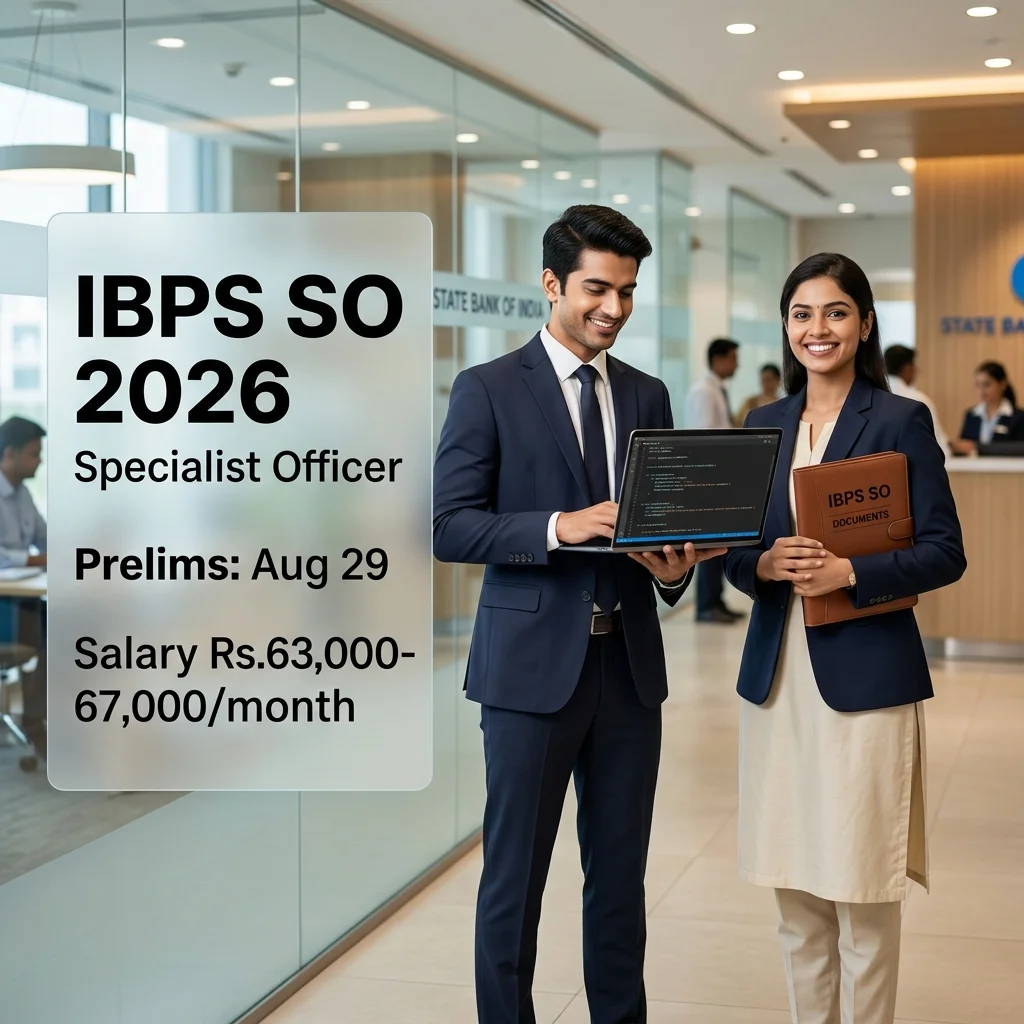
Introduction: IBPS SO 2026 — The Premium Banking Career for Professionals
While lakhs of candidates compete for IBPS Clerk and IBPS PO, the IBPS Specialist Officer (SO) remains the most premium, least-competed, and highest-value banking job available for professionals with specialised qualifications.
The IBPS SO CRP SPL-XVI 2026 recruitment is your opportunity to join a Public Sector Bank as a trained specialist — not as a generalist officer, but as an expert in your own professional domain. Engineers join as IT Officers. Agriculture graduates join as Agriculture Field Officers. Law graduates join as Law Officers. MBA-HR holders join as HR Officers.
Why IBPS SO 2026 is the most underrated banking opportunity in India:
- ✅ Lower Competition: Compared to IBPS PO (lakhs apply), IBPS SO applicants are far fewer — because qualification requirements are specialised
- ✅ Premium Salary: Rs.60,000–67,000/month in-hand — higher than IBPS Clerk, similar to IBPS PO
- ✅ Specialised Role: You work in your area of expertise — NOT at a cash counter
- ✅ Fast Career Growth: Specialist Officers often get promoted faster than general officers in their domain
- ✅ Interview Component: Only IBPS SO has an Interview (20% weightage) — professionals with good communication and domain knowledge score very high
- ✅ Prelims Aug 29, Mains Nov 1: Apply immediately when notification releases in July
If you have a professional degree (B.Tech, BSc Agriculture, LLB, MBA, or PG in Hindi/Sanskrit), IBPS SO 2026 is the perfect government banking job for you.
IBPS SO 2026: Key Highlights at a Glance
| Parameter | Details |
|---|---|
| Conducting Body | Institute of Banking Personnel Selection (IBPS) |
| Recruitment Batch | CRP SPL-XVI (Specialist Officers 2026) |
| Official Website | ibps.in |
| Notification Expected | July 2026 |
| Posts Available | 6 posts (IT Officer, AFO, Law Officer, HR Officer, Marketing Officer, Rajbhasha Adhikari) |
| Scale | Junior Management Grade Scale I (JMGS-I) |
| Banks Covered | 11 Public Sector Banks (same as IBPS Clerk/PO) |
| Minimum Qualification | Post-specific (B.Tech / BSc Agriculture / LLB / MBA etc.) |
| Age Limit | 20–30 years (with relaxation for SC/ST/OBC) |
| Preliminary Exam Date | August 29, 2026 |
| Mains Exam Date | November 1, 2026 |
| Interview | Yes — 20% weightage in final merit |
| Starting Basic Pay | Rs.48,480/month |
| Gross Salary | Rs.63,000–67,000/month |
| In-Hand Salary | Rs.56,000–62,000/month |
| Negative Marking | Yes — 0.25 marks per wrong answer |
IBPS SO 2026: Participating Banks
Just like IBPS Clerk and IBPS PO, IBPS SO recruits for 11 Public Sector Banks (PSBs):
| # | Bank | Headquarters |
|---|---|---|
| 1 | Bank of Baroda | Vadodara, Gujarat |
| 2 | Bank of India | Mumbai, Maharashtra |
| 3 | Bank of Maharashtra | Pune, Maharashtra |
| 4 | Canara Bank | Bengaluru, Karnataka |
| 5 | Central Bank of India | Mumbai, Maharashtra |
| 6 | Indian Bank | Chennai, Tamil Nadu |
| 7 | Indian Overseas Bank | Chennai, Tamil Nadu |
| 8 | Punjab & Sind Bank | New Delhi |
| 9 | Punjab National Bank | New Delhi |
| 10 | UCO Bank | Kolkata, West Bengal |
| 11 | Union Bank of India | Mumbai, Maharashtra |
Note: SBI does NOT participate in IBPS SO — SBI has its own Specialist Cadre Officer (SCO) recruitment separately.
IBPS SO 2026: Important Dates
| Event | Expected Date |
|---|---|
| Official Notification Release | July 2026 |
| Online Application Opens | July 2026 |
| Online Application Closes | August 2026 |
| Prelims Admit Card | Before August 29, 2026 |
| Preliminary Examination (Phase 1) | August 29, 2026 |
| Prelims Result | September–October 2026 |
| Mains Admit Card | Before November 1, 2026 |
| Main Examination (Phase 2) | November 1, 2026 |
| Interview | December 2026 – January 2027 |
| Provisional Allotment | February–March 2027 |
Act Now: The notification is expected in July — the window to apply is typically only 3–4 weeks. Keep monitoring ibps.in daily from July 1.
IBPS SO 2026: All 6 Posts — Detailed Eligibility
This is the most critical section — each post has different educational requirements:
Post 1: IT Officer (Scale I)
| Requirement | Details |
|---|---|
| Degree Required | 4-year Engineering/Technology degree (B.E. / B.Tech) in one of: Computer Science, Information Technology, Electronics, Electronics & Telecommunications, Electronics & Communication, Electronics & Instrumentation |
| Alternative 1 | Post-Graduate degree in the above-mentioned fields |
| Alternative 2 | Graduate degree in any discipline + DOEACC 'B' Level Certificate |
| Minimum Marks | As specified in notification (typically 60% aggregate for general category) |
| Age Limit | 20–30 years |
What an IT Officer does in a bank:
- Manages Core Banking Software (CBS) — Finacle, Temenos T24, BaNCS
- Handles cybersecurity threats, network security, firewall management
- Manages the bank's server infrastructure, cloud systems, data backup
- Implements and maintains mobile banking, internet banking, UPI systems
- Coordinates with NPCI, RBI's IT department for regulatory compliance
- Oversees software development projects and vendor management
Career Advantage: IT Officers in PSBs are being fast-tracked in the digital transformation era. Many banks are aggressively hiring IT Officers as they compete with fintech companies. IT Officers with good performance are promoted to Manager (Scale II) within 3–4 years.
Post 2: Agriculture Field Officer (AFO) (Scale I)
| Requirement | Details |
|---|---|
| Degree Required | 4-year degree (graduation) in ONE of: Agriculture, Horticulture, Animal Husbandry, Veterinary Science, Dairy Science, Fishery Science, Agricultural Engineering, Forestry, Agri-Marketing & Cooperation, Co-operation & Banking |
| Minimum Marks | As specified in notification |
| Age Limit | 20–30 years |
What an AFO does in a bank:
- Evaluates and sanctions agricultural loans (Kisan Credit Card, crop loans, equipment loans)
- Visits farms to assess land, crops, and creditworthiness of farmers
- Implements government agricultural schemes — PM Kisan, PMFBY (crop insurance), KCC
- Manages NPA recovery from agricultural borrowers
- Coordinates with NABARD for agricultural refinance schemes
- Participates in rural banking and financial inclusion camps
AFO is the most unique IBPS SO post — you spend time outdoors visiting farms, interacting with rural communities. Not a desk job. Candidates from agriculture families or rural backgrounds have a natural advantage.
Post 3: Law Officer (Scale I)
| Requirement | Details |
|---|---|
| Degree Required | Bachelor's Degree in Law (LLB) — 3-year LLB after graduation OR 5-year integrated BA LLB / BBA LLB / B.Com LLB |
| Additional Requirement | Must be enrolled as an Advocate with the Bar Council (active license required) |
| Age Limit | 20–30 years |
What a Law Officer does in a bank:
- Handles all legal matters of the bank's branches — loan recovery, property disputes
- Vets and drafts legal documents: mortgage deeds, loan agreements, surety bonds
- Represents the bank in Debt Recovery Tribunals (DRT), courts, consumer forums
- Manages SARFAESI Act actions — symbolic possession, physical possession of secured assets
- Handles cases under IBC (Insolvency and Bankruptcy Code)
- Advises management on legal compliance, RBI regulations, and new banking laws
- Reviews and approves title deeds and property documents before loan sanction
Law Officers are in extremely high demand because every bank has thousands of NPA cases in courts. A Law Officer with strong courtroom experience and knowledge of banking laws is invaluable.
Post 4: HR/Personnel Officer (Scale I)
| Requirement | Details |
|---|---|
| Degree Required | Graduation in any discipline PLUS a 2-year full-time Post-Graduate degree OR diploma in: Personnel Management / Industrial Relations / HRM / HRD / Social Work / Labour Law |
| Institutions | Must be from a university/institution recognised by the Government of India |
| Age Limit | 20–30 years |
What an HR Officer does in a bank:
- Manages the entire recruitment process for clerical and sub-staff positions
- Handles employee relations — grievances, disciplinary actions, transfers
- Administers payroll, pension, PF, gratuity, and leave management
- Implements training and development programs for bank staff
- Coordinates with IBPS, UPSC, and other agencies for recruitment compliance
- Manages industrial relations — handles staff unions, wage negotiations
- Oversees performance appraisal systems and promotion processes
Post 5: Marketing Officer (Scale I)
| Requirement | Details |
|---|---|
| Degree Required | Graduation in any discipline PLUS a 2-year full-time MBA (Marketing) OR MMS (Marketing) OR PGDBA / PGDBM / PGPM / PGDM with specialisation in Marketing |
| Minimum Marks | As specified in notification |
| Age Limit | 20–30 years |
What a Marketing Officer does in a bank:
- Develops and executes strategies to grow the bank's CASA deposits
- Manages relationships with corporate clients for salary accounts, current accounts
- Promotes new banking products — credit cards, insurance, mutual funds, wealth products
- Designs and implements customer acquisition campaigns
- Analyses competitor products and market trends
- Manages the bank's brand presence in their territory
- Achieves monthly targets for deposits, insurance, and third-party products
Post 6: Rajbhasha Adhikari (Scale I)
| Requirement | Details |
|---|---|
| Option 1 | Post-Graduate degree in Hindi with English as a compulsory/optional subject at graduation level |
| Option 2 | Post-Graduate degree in Sanskrit with English AND Hindi as subjects at graduation level |
| Age Limit | 20–30 years |
What a Rajbhasha Adhikari does in a bank:
- Implements the Official Language Policy (OLP) of the Government of India in the bank
- Translates official documents, circulars, and communications from English to Hindi
- Conducts Hindi workshops and training for staff
- Ensures Hindi usage in official correspondence meets government targets
- Prepares annual Hindi reports for the town official language implementation committee
- Manages the bank's Hindi library and publication of Hindi magazines/newsletters
IBPS SO 2026: Age Limit & Relaxation
General Age Limit:
| Parameter | Age |
|---|---|
| Minimum Age | 20 years |
| Maximum Age (General/EWS) | 30 years |
Age Relaxation:
| Category | Relaxation | Effective Upper Age |
|---|---|---|
| OBC (Non-Creamy Layer) | 3 years | 33 years |
| Scheduled Caste (SC) | 5 years | 35 years |
| Scheduled Tribe (ST) | 5 years | 35 years |
| PwBD (General) | 10 years | 40 years |
| PwBD (OBC) | 13 years | 43 years |
| PwBD (SC/ST) | 15 years | 45 years |
| Ex-Servicemen | Actual service + 3 years | No effective upper limit |
| Widows/Divorced Women (General) | 9 years | 39 years |
IBPS SO 2026: Application Fee
| Category | Fee |
|---|---|
| SC / ST / PwBD | Rs.175 (processing charges only) |
| General / OBC / EWS | Rs.850 |
Payment mode: Online — Net Banking, UPI, Debit/Credit Card at ibps.in
IBPS SO 2026: Selection Process
The IBPS SO selection has THREE stages (unlike IBPS Clerk which has no interview):
Stage 1: Preliminary Examination (Qualifying Only)
              ↓ (Shortlisted candidates called for Mains)
Stage 2: Main Examination (80% weightage in final merit)
              ↓ (Shortlisted candidates called for Interview)
Stage 3: Interview (20% weightage in final merit)
              ↓
Final Merit List = Mains (80%) + Interview (20%)
              ↓
Provisional Allotment to Banks
Key Selection Facts:
- Prelims marks do NOT count in the final merit — it is only qualifying
- Final merit = 80% Mains + 20% Interview
- Sectional cut-offs exist in BOTH Prelims and Mains
- Interview is conducted by panels of senior bankers + psychologists
IBPS SO 2026: Exam Pattern — Preliminary Examination
Prelims Pattern (IT Officer, AFO, HR Officer, Marketing Officer):
| Section | No. of Questions | Marks | Duration |
|---|---|---|---|
| English Language | 50 | 25 | — |
| Reasoning | 50 | 50 | — |
| Quantitative Aptitude | 50 | 50 | — |
| Total | 150 | 125 | 120 minutes |
Prelims Pattern (Law Officer & Rajbhasha Adhikari):
| Section | No. of Questions | Marks | Duration |
|---|---|---|---|
| English Language | 50 | 25 | — |
| Reasoning | 50 | 50 | — |
| General Awareness (with Banking Focus) | 50 | 50 | — |
| Total | 150 | 125 | 120 minutes |
Prelims Key Rules:
- ✅ Negative marking: -0.25 marks per wrong answer
- ✅ Sectional cut-offs: Must clear minimum marks in EACH section
- ✅ Prelims marks are NOT added to final merit — only qualifying
- ✅ Computer-Based Test (CBT) format
IBPS SO 2026: Exam Pattern — Main Examination
The Mains exam tests Professional Knowledge — the domain-specific knowledge for your chosen post:
Mains Pattern (All Posts except Rajbhasha):
| Section | Questions | Marks | Duration |
|---|---|---|---|
| Professional Knowledge (Post-Specific) | 60 | 60 | 45 minutes |
Mains Pattern (Rajbhasha Adhikari — Special):
| Section | Questions | Marks | Duration |
|---|---|---|---|
| Objective Professional Knowledge | 45 | 45 | 30 minutes |
| Descriptive (Translation + Essay in Hindi) | 2 questions | 25 | 30 minutes |
| Total | — | 70 | 60 minutes |
Mains Key Rules:
- ✅ Negative marking in objective part: -0.25 per wrong answer
- ✅ This is the merit-deciding paper — 80% of final score
- ✅ Professional Knowledge is entirely from your specific domain
- ✅ No general English or Reasoning in Mains — only your specialisation
IBPS SO 2026: Post-Wise Professional Knowledge Syllabus
IT Officer Professional Knowledge Syllabus:
Computer Fundamentals & Architecture:
- Data Representation (binary, octal, hexadecimal, BCD, ASCII, Unicode)
- Computer Organisation — CPU, ALU, Control Unit, Memory hierarchy (Cache, RAM, ROM)
- Input/Output devices and interfaces
- Number Systems and Boolean Algebra, Logic Gates (AND, OR, NOT, NAND, NOR, XOR)
Programming & Software Engineering:
- Programming paradigms — Procedural, OOP (Object-Oriented Programming)
- Java, Python, C++ — core concepts (class, object, inheritance, polymorphism, encapsulation)
- Data Structures — Arrays, Linked Lists, Stacks, Queues, Trees (Binary Search Tree), Graphs, Heaps
- Algorithms — Sorting (Bubble, Selection, Insertion, Merge, Quick), Searching (Linear, Binary)
- Algorithm complexity — Big O notation (O(n), O(log n), O(n²))
- Software Development Life Cycle (SDLC) — Waterfall, Agile, Scrum methodologies
- Software testing — Unit testing, Integration testing, UAT (User Acceptance Testing)
Database Management Systems (DBMS):
- Relational model — tables, keys (Primary Key, Foreign Key, Candidate Key)
- SQL — SELECT, INSERT, UPDATE, DELETE, JOIN (INNER, LEFT, RIGHT, FULL), GROUP BY, HAVING
- Normalisation — 1NF, 2NF, 3NF, BCNF (and why we normalise)
- Transaction management — ACID properties (Atomicity, Consistency, Isolation, Durability)
- Concurrency control — locks, deadlocks, two-phase locking
- NoSQL databases — MongoDB, Redis (basics and when to use vs SQL)
Networking & Security:
- OSI Model — 7 layers and their functions
- TCP/IP Model — 4 layers, TCP vs UDP
- IP addressing — IPv4, IPv6, subnetting, CIDR notation
- Networking devices — Router, Switch, Hub, Bridge, Gateway
- Protocols — HTTP, HTTPS, FTP, SMTP, POP3, IMAP, DNS, DHCP, SSH
- Network security — Firewall (stateful/stateless), VPN, IDS/IPS
- Cybersecurity threats — Phishing, Malware, Ransomware, SQL Injection, XSS (Cross-Site Scripting)
- Encryption — Symmetric (AES, DES) vs Asymmetric (RSA), Public Key Infrastructure (PKI)
- Digital Signatures and Certificates
Operating Systems:
- Process management — Process states, PCB, Scheduling algorithms (FCFS, SJF, Priority, Round Robin)
- Memory management — Paging, Segmentation, Virtual Memory, Page Replacement algorithms
- File systems — FAT32, NTFS, ext4
- Deadlock — Conditions, Prevention, Avoidance (Banker's Algorithm), Detection and Recovery
- Linux vs Windows — key differences, shell commands
Banking-Specific IT Knowledge (HIGH PRIORITY):
- Core Banking Solutions — Finacle (Infosys), Temenos T24, Oracle BaNCS, FinnOne
- Payment Systems — UPI (Unified Payments Interface), NEFT, RTGS, IMPS, NACH
- NPCI systems — NACH, NFS (National Financial Switch), RuPay, FASTag
- Mobile Banking and Internet Banking security frameworks
- Regulatory Frameworks — RBI IT Guidelines, Cyber Security Framework for Banks (2016)
- Cloud Computing — IaaS, PaaS, SaaS; AWS, Azure, GCP (basics)
- API Banking — Open Banking, RESTful APIs, JSON
Agriculture Field Officer (AFO) Professional Knowledge Syllabus:
Agronomy & Crop Production:
- Classification of crops (Kharif, Rabi, Zaid) — major crops, sowing/harvesting seasons
- Soil types in India — Alluvial, Black/Regur, Red, Laterite, Arid/Desert, Mountain soils
- Soil pH, soil testing, soil conservation methods (terracing, contour ploughing, windbreaks)
- Irrigation methods — Drip, Sprinkler, Canal, Well, Flood — pros and cons
- Crop rotation, intercropping, mixed cropping, relay cropping — benefits
- Fertilisers — NPK, micronutrients, organic vs chemical fertilisers, biofertilisers (Rhizobium, Azotobacter)
- Pesticides, herbicides, insecticides — types, precautions, integrated pest management (IPM)
- Important varieties of rice, wheat, maize, sugarcane, cotton, pulses (Bt Cotton, HYV seeds)
Horticulture:
- Classification of fruits — tropical, sub-tropical, temperate
- Important fruit crops: Mango (Alphonso, Dashehari, Langra varieties), Banana, Apple, Grapes, Citrus
- Vegetable cultivation — protected cultivation (greenhouses, polyhouses), hydroponics
- Post-harvest technology — cold storage, modified atmosphere storage, value addition
Animal Husbandry:
- Important cattle breeds — Gir, Sahiwal, Murrah buffalo, Hariana (indigenous); Jersey, Holstein (exotic)
- Poultry farming — broiler vs layer, common poultry diseases and vaccinations
- Fisheries — freshwater (Catla, Rohu), marine fisheries, aquaculture, blue revolution
- Animal diseases — Foot and Mouth, Anthrax, Rinderpest — symptoms and prevention
Agricultural Economics & Finance:
- Types of agricultural credit — short-term, medium-term, long-term
- Kisan Credit Card (KCC) — eligibility, limit, interest subvention
- NABARD — functions, refinance schemes, Rural Infrastructure Development Fund (RIDF)
- Agricultural insurance — PM Fasal Bima Yojana (PMFBY), Restructured Weather-Based Crop Insurance Scheme
- Minimum Support Price (MSP) — concept, how it is fixed (CACP recommendations)
- PM Kisan Samman Nidhi — benefits, eligibility
- Agricultural Marketing — APMC Act, e-NAM (National Agriculture Market)
- FPO (Farmer Producer Organisations) — benefits, NABARD support
Government Agricultural Schemes (Must Know):
| Scheme | Purpose |
|---|---|
| PM-KISAN | Rs.6,000/year income support to farmers |
| PM Fasal Bima Yojana (PMFBY) | Crop insurance against natural calamities |
| Soil Health Card Scheme | Free soil testing and fertiliser recommendations |
| PMKSY (PM Krishi Sinchayee Yojana) | Water conservation and micro-irrigation |
| e-NAM | National online agricultural market platform |
| PM Kisan Maan Dhan Yojana | Rs.3,000/month pension for small farmers at age 60 |
| RKVY (Rashtriya Krishi Vikas Yojana) | Capital investment in agriculture and allied sectors |
Law Officer Professional Knowledge Syllabus:
Banking Laws (Highest Priority):
- Banking Regulation Act, 1949 — key provisions on banking companies
- Reserve Bank of India Act, 1934 — RBI's regulatory powers
- SARFAESI Act, 2002 — enforcement of security interest without court intervention
- Symbolic possession vs Physical possession
- 60-day notice requirement (Section 13(2))
- Process of sale of secured assets
- Debt Recovery Tribunal Act (RDDBFI Act), 1993 — DRT jurisdiction, procedure
- Insolvency and Bankruptcy Code (IBC), 2016 — NCLT, resolution process, priority of claims
- Prevention of Money Laundering Act (PMLA), 2002 — banking obligations
- Foreign Exchange Management Act (FEMA), 1999
- Negotiable Instruments Act, 1881 — cheque, promissory note, bill of exchange
General Laws Applicable to Banking:
- Indian Contract Act, 1872 — essential of valid contract, offer, acceptance, consideration
- Transfer of Property Act, 1882 — sale, mortgage (types), charge, pledge, hypothecation
- Limitation Act, 1963 — time limits for filing suits (3 years for money, 12 years for mortgage)
- Consumer Protection Act, 2019 — banking services as consumers, NCDRC, SCDRC
- Information Technology Act, 2000 — electronic signatures, cybercrimes, banking IT obligations
- POCSO and other relevant social legislation
Evidence Law:
- Indian Evidence Act (now BSA 2023) — types of evidence, admissibility of electronic records
- Burden of proof in banking matters
HR/Personnel Officer Professional Knowledge Syllabus:
Human Resource Management:
- HRM functions — Recruitment, Selection, Training, Performance Appraisal, Compensation, Separation
- HR Planning — job analysis, job description, job specification
- Recruitment methods — internal vs external, campus recruitment
- Selection process — tests (aptitude, personality), GD, interview types (structured, unstructured, panel)
- Training methods — On-the-job (coaching, job rotation) vs Off-the-job (classroom, e-learning)
- Performance Appraisal — MBO, 360-degree feedback, Balanced Scorecard, BARS
- Compensation management — job evaluation, wage surveys, pay structure
- Organisational Behaviour — motivation theories (Maslow, Herzberg, McGregor X & Y), leadership styles
Industrial Relations & Labour Laws:
- Trade Unions Act, 1926
- Industrial Disputes Act, 1947 — strikes, lockouts, layoffs, retrenchment, ID resolution
- Factories Act, 1948 — working hours, safety, welfare provisions
- Minimum Wages Act, 1948
- Payment of Wages Act, 1936
- Employee Provident Fund and Miscellaneous Provisions Act, 1952 (EPF Act)
- Payment of Gratuity Act, 1972 — eligibility (5 years service), calculation (15 days × years)
- Workmen's Compensation Act, 1923 (now Employees Compensation Act)
- Maternity Benefit Act, 1961 (amended 2017 — 26 weeks paid maternity leave)
- Sexual Harassment of Women at Workplace Act, 2013 (POSH) — ICC constitution, complaint procedure
Banking HR Specific:
- IBPS structure and its role in banking HR
- Bipartite settlements in banking — wage revision history
- Officer Service Regulations and Clerks' Service Regulations
- Staff unions in PSBs — AIBOC, AIBOA, UFBU
- Staff welfare funds, staff housing loan policy, medical policy
IBPS SO 2026: Salary & Benefits
Salary Structure (After 12th Bipartite Settlement 2024–27):
| Component | Amount |
|---|---|
| Starting Basic Pay | Rs.48,480/month |
| Dearness Allowance (DA @ ~50%) | ~Rs.24,240/month |
| HRA (Metro City — 10% of Basic) | Rs.4,848/month |
| HRA (Other City — 9% of Basic) | Rs.4,363/month |
| Special Allowance | ~Rs.2,500/month |
| Gross Salary (Metro) | ~Rs.65,000–67,000/month |
| Gross Salary (Urban City) | ~Rs.63,000–65,000/month |
| In-Hand (after EPF, Tax deductions) | ~Rs.56,000–62,000/month |
Pay Scale Progression:
| Stage | Basic Pay | Timeframe |
|---|---|---|
| Entry (JMGS-I Scale) | Rs.48,480 | Year 1 |
| After 2nd increment | Rs.51,490 | Year 3 |
| After promotion to MMG-II (Manager) | Rs.64,820 | Year 4–7 |
| After promotion to MMG-III (Senior Manager) | Rs.76,010 | Year 8–12 |
| After promotion to SMG-IV (Chief Manager) | Rs.89,890 | Year 13–16 |
JMGS-I Scale: Rs.48,480 – 85,920 (full pay scale across all increments)
Additional Benefits:
| Benefit | Details |
|---|---|
| Medical | Hospitalisation for self, spouse, children, dependent parents |
| Pension | NPS (National Pension System) — 10% of basic + DA contributed by employee, 14% by bank |
| Gratuity | Tax-free up to Rs.20 lakh after 5 years of service |
| Housing Loan | Concessional interest rate home loan (significant saving over market rate) |
| Vehicle Loan | Subsidised two-wheeler and four-wheeler loans |
| LFC | Leave Fare Concession — travel expenses every 2 years for self + family |
| Quarters / HRA | Bank quarters at subsidised rent, or HRA if quarters not available |
| Professional Development | Funding for CAIIB, JAIIB, and domain-specific certifications |
IBPS SO 2026: Previous Year Cut-Off Analysis
Prelims Cut-Off (Out of 125):
| Post | General Category | OBC | SC | ST |
|---|---|---|---|---|
| IT Officer | 65–75 | 60–70 | 55–65 | 48–58 |
| Agriculture Field Officer | 68–78 | 62–72 | 56–66 | 50–60 |
| Law Officer | 62–72 | 56–66 | 50–60 | 44–54 |
| HR Officer | 72–82 | 66–76 | 58–68 | 52–62 |
| Marketing Officer | 70–80 | 64–74 | 58–68 | 52–62 |
Mains Cut-Off (Professional Knowledge — Out of 60):
| Post | General | OBC | SC | ST |
|---|---|---|---|---|
| IT Officer | 28–35 | 24–31 | 21–28 | 18–25 |
| AFO | 30–37 | 26–33 | 22–29 | 19–26 |
| Law Officer | 25–32 | 21–28 | 18–25 | 15–22 |
| HR Officer | 32–39 | 27–34 | 23–30 | 19–26 |
Note: Final merit = 80% Mains + 20% Interview. Candidates who score well in Professional Knowledge AND present confidently in Interview win the final allotment.
IBPS SO 2026: Preparation Strategy
For IT Officer — 3-Month Plan:
Month 1: Prelims Preparation
- Reasoning: Puzzles (15+ per day), Syllogism, Inequality, Coding-Decoding
- Quantitative: Simplification, Number Series, DI (2 sets/day), Arithmetic
- English: Reading Comprehension (2 passages/day), Error Detection, Cloze Test
Month 2: Professional Knowledge Foundation
- Week 1: Computer Fundamentals + Data Structures + Algorithms
- Week 2: DBMS (ACID, SQL queries, Normalisation)
- Week 3: Networking (OSI, TCP/IP, IP addressing, Security)
- Week 4: Operating Systems + Programming (Java/Python concepts) + Banking IT
Month 3: Mains Professional Knowledge Intensive
- Previous year IBPS SO IT Officer Professional Knowledge papers (last 5 years)
- Banking technology — NPCI, RTGS/NEFT, Core Banking
- Cybersecurity for banks — RBI IT guidelines, CERT-In regulations
- 3 full mock tests per week (Mains pattern)
- Interview preparation: Banking domain, IT trends in banking, current tech news
For Agriculture Field Officer — 3-Month Plan:
Month 1: Prelims
- Same Reasoning + QA + English preparation as IT Officer
Month 2: Core Agri Knowledge
- Week 1: Agronomy — crop types, Kharif/Rabi crops, soil types, irrigation
- Week 2: Horticulture + Animal Husbandry + Fisheries
- Week 3: Agricultural Economics + Credit + NABARD schemes
- Week 4: All Government Schemes — PMFBY, PM-KISAN, e-NAM, PMKSY
Month 3: Mains Intensive
- Previous year AFO Professional Knowledge papers
- Focus on government agricultural schemes (highest weight in exam)
- Agricultural marketing, FPO, MSP mechanism
- Mock tests + Interview prep (field visits, soil testing practical knowledge)
For Law Officer — 3-Month Plan:
Month 1: Prelims (Reasoning + English + General Awareness)
- Banking Awareness: 10 questions daily + monthly current affairs
- Reasoning: Puzzles, Syllogism, Inequalities
- English: Reading Comprehension, Para Jumbles, Error Detection
Month 2: Banking Laws
- SARFAESI Act — most important, practice all provisions
- IBC 2016 — NCLT, liquidation hierarchy, resolution process
- DRT Act, Banking Regulation Act, RBI Act
Month 3: Law Mains Intensive
- Previous year Law Officer Professional Knowledge papers
- Transfer of Property Act, Contract Act, NI Act
- Mock interview with banking law scenario questions
Best Books for IBPS SO 2026
Common Prelims (All Posts):
| Subject | Book | Publisher |
|---|---|---|
| Reasoning | Verbal and Non-Verbal Reasoning | R.S. Aggarwal |
| Quantitative Aptitude | Quantitative Aptitude | R.S. Aggarwal / S. Chand |
| English Language | Objective General English | S.P. Bakshi / Arihant |
| Banking GK (Law/Rajbhasha) | Handbook of Banking Awareness | Arihant |
| Complete Prelims Guide | IBPS SO Complete Guide | Arihant / Disha |
Post-Specific Mains Books:
| Post | Book | Publisher |
|---|---|---|
| IT Officer | IBPS SO IT Officer Professional Knowledge | Kiran / Arihant |
| IT Officer | Computer Awareness | Arihant / Unique |
| AFO | IBPS SO Agriculture Field Officer Guide | Arihant |
| AFO | Agriculture at a Glance | R.K. Sharma |
| Law Officer | IBPS SO Law Officer Guide | Singhal's / Arihant |
| Law Officer | Indian Banking Law and Practice | Taxmann |
| HR Officer | IBPS SO HR Officer Guide | Arihant |
| HR Officer | Industrial Relations and Labour Laws | C.B. Mamoria |
Sample Questions with Solutions
IT Officer Professional Knowledge:
Q1. In SQL, which of the following clauses is used to filter groups AFTER the GROUP BY clause?
- (A) WHERE
- (B) HAVING
- (C) FILTER
- (D) ORDER BY
Answer: (B) HAVING
WHERE filters individual rows BEFORE grouping. HAVING filters groups AFTER the GROUP BY clause has been applied. Example: SELECT dept, COUNT() FROM employees GROUP BY dept HAVING COUNT() > 5;
Q2. Which layer of the OSI model is responsible for establishing, managing, and terminating sessions between applications?
- (A) Transport Layer (Layer 4)
- (B) Network Layer (Layer 3)
- (C) Session Layer (Layer 5)
- (D) Application Layer (Layer 7)
Answer: (C) Session Layer (Layer 5)
The Session Layer (Layer 5) manages dialogue control and synchronisation between two communicating devices. It establishes, maintains, and terminates connections (sessions). Examples of session layer protocols: NetBIOS, RPC (Remote Procedure Call).
Agriculture Field Officer Professional Knowledge:
Q3. The Minimum Support Price (MSP) for agricultural crops in India is recommended by which body?
- (A) NABARD
- (B) NITI Aayog
- (C) Commission for Agricultural Costs and Prices (CACP)
- (D) Reserve Bank of India
Answer: (C) Commission for Agricultural Costs and Prices (CACP)
CACP (Commission for Agricultural Costs and Prices) is an advisory body under the Ministry of Agriculture that recommends MSP for 23 crops each year (14 Kharif + 6 Rabi + 3 others). The Cabinet Committee on Economic Affairs (CCEA) gives final approval.
Law Officer Professional Knowledge:
Q4. Under SARFAESI Act 2002, what is the mandatory notice period that a bank must give to a borrower before taking action to enforce a security interest?
- (A) 30 days
- (B) 45 days
- (C) 60 days
- (D) 90 days
Answer: (C) 60 days
Under Section 13(2) of the SARFAESI Act, a secured creditor (bank) must issue a 60-day notice to the borrower demanding repayment. Only if the borrower fails to repay within 60 days can the bank proceed with enforcing the security interest (taking possession, selling the asset).
IBPS SO 2026: Interview Preparation Guide
Unlike IBPS Clerk and IBPS PO (no interview), IBPS SO has a formal interview with 20% weightage. Here is how to excel:
Interview Panel Composition:
- 3–5 members including senior bankers, domain experts, and psychologists
- Duration: 15–30 minutes
Common Interview Questions by Post:
IT Officer:
- "Explain the difference between SQL and NoSQL databases with examples."
- "What is the role of NPCI in India's payment ecosystem?"
- "How would you implement a cybersecurity framework for a rural branch?"
- "Explain ACID properties with a banking transaction example."
Agriculture Field Officer:
- "What factors do you consider before recommending a Kisan Credit Card?"
- "How does PM Fasal Bima Yojana benefit farmers? What are its limitations?"
- "Explain what an NPA in agriculture is and how you would handle recovery."
- "What is e-NAM and how does it benefit farmers in your area?"
Law Officer:
- "Walk me through the SARFAESI action process from notice to sale."
- "What is the priority order of claims under IBC when a company is liquidated?"
- "A borrower challenges our SARFAESI action under DRT. What is your strategy?"
Interview Tips:
- Dress formally — Formals only. Men: formal shirt + trousers + tie. Women: formal suit or saree
- Research the bank — Know their recent quarterly results, new schemes, CEO name, tagline
- Domain confidence — Speak with authority about your professional knowledge area
- Banking motivation — Explain specifically WHY you want to join banking as an IT/Law/Agri specialist
- Current affairs — Know the latest RBI policy, banking sector news from last 3 months
Frequently Asked Questions — IBPS SO 2026
Q1. Can a final-year engineering student apply for IBPS SO IT Officer? This depends on the official notification. Generally, the degree must be completed before the specified cut-off date. Final-year students who will complete graduation before the date of joining may be eligible. Check the official notification carefully.
Q2. Is the IBPS SO exam the same difficulty as IBPS PO? The Prelims for IBPS SO (Reasoning, QA, English) is approximately the same difficulty as IBPS PO Prelims. However, the Mains for IBPS SO tests Professional Knowledge which is entirely domain-specific — not the same as IBPS PO Mains which tests banking generalist knowledge.
Q3. Can I apply for multiple posts in IBPS SO? No. IBPS SO allows application for only ONE post per recruitment cycle. Choose carefully based on your strongest qualification and interest.
Q4. What is the work location for an IBPS SO IT Officer? IT Officers are typically posted at the bank's Regional/Zonal IT Department, IT Hubs, or Head Office — not at branches. This means posting is usually in larger cities with the bank's IT infrastructure.
Q5. Can an Agriculture Field Officer be posted in a city, or only in rural areas? AFOs are typically posted in rural or semi-urban branches that have significant agricultural lending portfolios. This is by design — agricultural field work requires being near farming communities.
Q6. What is the promotion path for an IBPS SO? IBPS SO Scale I → Scale II (Manager) typically in 3–5 years → Scale III (Senior Manager) → Scale IV (Chief Manager) → Scale V (AGM) → Scale VI (DGM) → Scale VII (GM). Specialists can also move into general banking roles after Scale II.
Q7. Does IBPS SO have pension? Yes, all PSB employees (including IBPS SO) are covered under the New Pension System (NPS). Employer contributes 14% of basic + DA, and employee contributes 10% of basic + DA monthly.
Q8. Can an LLB student with only 3 years experience at the Bar apply? The notification requires registration with the Bar Council, not a minimum experience period. However, you should verify if the specific notification mentions any minimum years of Bar practice, as requirements sometimes vary.
IBPS SO 2026: Marketing Officer Professional Knowledge Syllabus
Marketing Officers handle the bank's business development, deposit growth, and customer acquisition. The Mains Professional Knowledge covers:
Core Marketing Concepts:
- Marketing Mix — 4Ps (Product, Price, Place, Promotion) and extended 7Ps for services (+ People, Process, Physical Evidence)
- Market Segmentation, Targeting, and Positioning (STP Framework)
- Consumer Behaviour — factors influencing purchase decisions (cultural, social, personal, psychological)
- SWOT Analysis, Porter's 5 Forces, BCG Matrix, Ansoff Matrix
- Product Life Cycle (PLC) — Introduction, Growth, Maturity, Decline stages
- Branding — Brand Equity, Brand Value, Brand Loyalty, co-branding
- Pricing Strategies — Cost-based, value-based, competition-based, penetration, skimming
- Distribution Channels — direct, indirect, multi-channel, omnichannel
Banking-Specific Marketing:
- CASA Deposits (Current Account Savings Account) — strategies to grow low-cost deposits
- Cross-selling and Up-selling in banks — selling insurance, mutual funds, credit cards to existing customers
- Retail Banking Products — home loans, personal loans, vehicle loans, education loans
- Digital Marketing for Banks — social media marketing, SEO, content marketing, mobile banking promotion
- Customer Relationship Management (CRM) — tools, benefits, implementation in banking
- Net Promoter Score (NPS) — measuring customer loyalty in banking
- Priority Banking and Wealth Management — High Net Worth Individual (HNI) segment
- Financial Inclusion — banking the unbanked, PMJDY, BC (Business Correspondent) model
Research & Analytics:
- Market Research — primary (surveys, interviews, observations) vs secondary (published data)
- Sampling methods — random, stratified, cluster, quota sampling
- Data analysis tools — basics of MS Excel, Google Analytics, CRM dashboards
- Marketing metrics — CAC (Customer Acquisition Cost), CLV (Customer Lifetime Value), ROI on marketing
IBPS SO 2026: Rajbhasha Adhikari Professional Knowledge Syllabus
Rajbhasha Adhikari is a unique post requiring expertise in Hindi language and Official Language Policy:
Official Language Policy & Regulations:
- Official Languages Act, 1963 — provisions for use of Hindi in Central Government offices
- Official Language Rules, 1976 — mandatory use of Hindi in Region A, B, C offices
- Region A states — UP, MP, Bihar, Rajasthan, Himachal, Uttarakhand, Haryana, Delhi
- Region B states — Maharashtra, Gujarat, Punjab
- Region C states — all other states (Tamil Nadu, Kerala, Karnataka, etc.)
- Annual Programme (Annual Programme for Official Language Implementation)
- Quarterly Progress Report (QPR) on Hindi implementation
- Town Official Language Implementation Committee (TOLIC) — composition and functions
Hindi Grammar & Language:
- Sandhi (Swar, Vyanjan, Visarg Sandhi) — rules and examples
- Samas (Compound words) — Tatpurusha, Dvandva, Bahuvrihi, Avyayibhav, Dwigushma
- Karak (Case markers) — 8 karakas with vibhakti
- Ling (Gender) — masculine/feminine rules in Hindi
- Vachan (Number) — singular to plural transformation rules
- Kriya (Verb types) — Sakarmak, Akarmak, Prernarthak, Sanyukt kriya
- Upsarg (Prefixes) and Pratyay (Suffixes) — Sanskrit, Hindi, and Urdu origin
- Vilom Shabd (Antonyms), Paryayvachi (Synonyms), Muhavare (Idioms), Lokoktiyan (Proverbs)
Translation Skills:
- Translation techniques — English to Hindi and Hindi to English
- Official terminology — banking terms in Hindi (e.g., Loan = Rin, Interest = Byaj, Bank = Abhilekh Sansthan, Account = Khata, Cheque = Cheque/Adesh Patr)
- Maintaining equivalence in meaning while adapting cultural context
- Common errors in official Hindi translation — false cognates, over-literal translation
Descriptive Section (Mains):
- Essay Writing in Hindi — topics like digital banking, financial inclusion, RBI policy, agriculture credit
- Translation Passages — typically 2 passages (one English to Hindi, one Hindi to English)
- Precis Writing — summarising a given passage in Hindi in 1/3 of its length
IBPS SO 2026: Banking Awareness Quick Reference
Banking Awareness is critical for Law Officer and Rajbhasha Adhikari Prelims, and for Interview preparation of all posts:
RBI Key Rates (As of June 2026):
| Rate | Current Value | What It Controls |
|---|---|---|
| Repo Rate | 6.00% | Rate at which RBI lends to banks overnight |
| Reverse Repo Rate | 3.35% | Rate at which RBI borrows from banks overnight |
| CRR (Cash Reserve Ratio) | 4.00% | % of deposits banks must keep with RBI in cash |
| SLR (Statutory Liquidity Ratio) | 18.00% | % of deposits banks must keep in approved securities |
| Bank Rate | 6.25% | Rate at which RBI provides long-term loans to banks |
| MSF (Marginal Standing Facility) | 6.25% | Emergency overnight borrowing rate for banks |
Important Banking Committees & Reports:
| Committee | Year | Subject / Recommendation |
|---|---|---|
| Narasimham Committee I | 1991 | Banking sector reforms — CRR/SLR reduction, PSB autonomy |
| Narasimham Committee II | 1998 | NPAs, capital adequacy, bank mergers |
| Malhotra Committee | 1994 | Insurance sector reforms — led to creation of IRDA |
| Raghuram Rajan Committee | 2009 | Financial sector reforms in India |
| P.J. Nayak Committee | 2014 | Governance of bank boards |
| Uday Kotak Committee | 2017 | Corporate governance — SEBI |
| Damodaran Committee | 2011 | Customer service in banks |
Key Banking Acts and Their Years:
| Act | Year | Purpose |
|---|---|---|
| RBI Act | 1934 | Establishes RBI, governs monetary policy |
| Banking Regulation Act | 1949 | Regulates banking companies in India |
| DICGC Act | 1961 | Deposit Insurance up to Rs.5 lakh |
| SARFAESI Act | 2002 | Banks can seize/sell secured assets without court |
| PMLA | 2002 | Prevention of Money Laundering |
| IBC (Insolvency & Bankruptcy Code) | 2016 | Time-bound resolution of NPAs |
| FEMA | 1999 | Foreign exchange regulation |
| NI (Negotiable Instruments) Act | 1881 | Cheques, promissory notes, bills of exchange |
| Consumer Protection Act | 2019 | Banking services covered under consumer rights |
Important Banking Abbreviations:
| Abbreviation | Full Form |
|---|---|
| NABARD | National Bank for Agriculture and Rural Development |
| SIDBI | Small Industries Development Bank of India |
| NHB | National Housing Bank |
| EXIM Bank | Export-Import Bank of India |
| MUDRA | Micro Units Development and Refinance Agency |
| PMJDY | Pradhan Mantri Jan Dhan Yojana |
| PMMY | Pradhan Mantri Mudra Yojana |
| CASA | Current Account and Savings Account |
| NPA | Non-Performing Asset |
| GNPA | Gross Non-Performing Asset |
| NNPA | Net Non-Performing Asset |
| ALM | Asset-Liability Management |
| CRAR | Capital-to-Risk-Weighted Asset Ratio |
| CBS | Core Banking Solution |
| UPI | Unified Payments Interface |
| NPCI | National Payments Corporation of India |
| NEFT | National Electronic Fund Transfer |
| RTGS | Real-Time Gross Settlement |
| IMPS | Immediate Payment Service |
IBPS SO IT Officer: Technical Quick Cheat Sheet
Important Port Numbers (Must Memorise):
| Protocol | Port Number | Use |
|---|---|---|
| HTTP | 80 | Web browsing (unsecured) |
| HTTPS | 443 | Secure web browsing (SSL/TLS) |
| FTP (Data) | 20 | File transfer (data channel) |
| FTP (Control) | 21 | File transfer (commands) |
| SSH | 22 | Secure remote access |
| Telnet | 23 | Remote access (unsecured — now deprecated) |
| SMTP | 25 | Sending emails |
| DNS | 53 | Domain name to IP resolution |
| DHCP | 67, 68 | Automatic IP address assignment |
| POP3 | 110 | Receiving emails (downloads and deletes) |
| IMAP | 143 | Receiving emails (keeps on server) |
| SNMP | 161 | Network device monitoring |
| HTTPS (SMTP) | 465 | Secure email sending |
| IMAPS | 993 | Secure IMAP (email) |
| MySQL | 3306 | Database connections |
| RDP | 3389 | Remote Desktop Protocol |
OSI Model — 7 Layers (Must Know):
| Layer | Name | Key Protocols/Devices |
|---|---|---|
| Layer 7 | Application | HTTP, HTTPS, FTP, SMTP, DNS, DHCP, POP3, IMAP |
| Layer 6 | Presentation | SSL/TLS, JPEG, MPEG, ASCII, encryption/decryption |
| Layer 5 | Session | NetBIOS, RPC, PPTP — manages sessions |
| Layer 4 | Transport | TCP (reliable), UDP (fast, unreliable), port numbers |
| Layer 3 | Network | IP, ICMP, OSPF, BGP, RIP — Router operates here |
| Layer 2 | Data Link | MAC addresses, Ethernet, PPP — Switch/Bridge operates here |
| Layer 1 | Physical | Cables (Cat5, fibre), Hub, signals (bits) |
Memory Trick: "All People Seem To Need Data Processing" (Application → Physical)
SQL Commands Quick Reference:
| Command | Category | Example |
|---|---|---|
| SELECT | DQL | SELECT name, salary FROM emp WHERE dept='IT'; |
| INSERT | DML | INSERT INTO emp VALUES (101, 'Rahul', 50000); |
| UPDATE | DML | UPDATE emp SET salary=60000 WHERE id=101; |
| DELETE | DML | DELETE FROM emp WHERE id=101; |
| CREATE | DDL | CREATE TABLE emp (id INT, name VARCHAR(50)); |
| ALTER | DDL | ALTER TABLE emp ADD COLUMN dept VARCHAR(20); |
| DROP | DDL | DROP TABLE emp; |
| TRUNCATE | DDL | TRUNCATE TABLE emp; (removes all rows, keeps structure) |
| COMMIT | TCL | Saves a transaction permanently |
| ROLLBACK | TCL | Reverses uncommitted transaction changes |
| GRANT | DCL | GRANT SELECT ON emp TO user1; |
| REVOKE | DCL | REVOKE SELECT ON emp FROM user1; |
SQL JOIN Types:
| JOIN Type | Returns |
|---|---|
| INNER JOIN | Only rows that match in BOTH tables |
| LEFT (OUTER) JOIN | All rows from left table + matching rows from right |
| RIGHT (OUTER) JOIN | All rows from right table + matching rows from left |
| FULL (OUTER) JOIN | All rows from both tables (nulls where no match) |
| CROSS JOIN | Every combination of rows from both tables (Cartesian product) |
| SELF JOIN | A table joined with itself |
IBPS SO vs SBI SCO vs RBI Officers: Which Is Best?
Many professionals wonder: which specialist banking officer role is better? Here is the complete comparison:
Salary Comparison:
| Parameter | IBPS SO (PSBs) | SBI SCO (SBI) | RBI Grade B (Officer) |
|---|---|---|---|
| Conducting Body | IBPS | SBI (own exam) | RBI (own exam) |
| Starting Basic Pay | Rs.48,480 | Rs.50,000 (approx) | Rs.55,200 |
| Gross Salary | Rs.63,000–67,000 | Rs.68,000–72,000 | Rs.85,000–95,000 |
| In-Hand Salary | Rs.56,000–62,000 | Rs.60,000–65,000 | Rs.78,000–85,000 |
| Perquisites | Good — standard PSB perks | Excellent — SBI-specific benefits | Exceptional — RBI-specific perks |
Career Comparison:
| Factor | IBPS SO | SBI SCO | RBI Grade B |
|---|---|---|---|
| Brand Value | Good (PSB) | Excellent (India's largest bank) | Exceptional (Central Bank) |
| Posting Locations | Across 11 PSBs — all states | SBI offices — all states, global | RBI offices — 31 cities only |
| International Posting | Rarely | Yes (SBI has overseas branches) | Sometimes (IMF, World Bank visits) |
| Promotion Speed | Moderate | Moderate to Fast | Moderate |
| Final Position | GM / CMD level | DGM / GM level | ED / Deputy Governor level |
| Exam Difficulty | Moderate | High (SBI-specific exam) | Very High (one of toughest) |
| Competition | Lower (specialist degree required) | Very High | Extremely High |
| Interview | Yes | Yes | Yes |
Eligibility Comparison:
| Post | IT Qualification | Agriculture | Law | HR/MBA |
|---|---|---|---|---|
| IBPS SO | B.Tech CS/IT/EC | BSc Agriculture | LLB | MBA-HR |
| SBI SCO | B.Tech + relevant exp | BSc Agriculture | LLB | MBA-HR |
| RBI Grade B | B.Tech (Officer Grade) | Not applicable | LLB (Legal Officer) | MBA-HR/Economics |
Verdict:
- Best for freshers: IBPS SO — lower competition, specialised role, good salary
- Ambitious students: SBI SCO — more prestigious, better pay, one bank's culture
- Highest achievement: RBI Grade B — exceptional salary, policy-level work, globally respected
IBPS SO 2026: AFO Field Assessment Guide — How to Evaluate a Farm Loan
Agriculture Field Officers are unique because their job requires physical farm visits for loan assessment. Here is a complete guide on how an AFO evaluates agricultural loan applications in the real world:
Step 1: Document Verification
Before the field visit, an AFO verifies:
| Document | Purpose |
|---|---|
| Khasra / Khatoni (7/12 Extract) | Confirms land ownership, area, and crop sown |
| Aadhaar + PAN | Identity and linkage to PM-KISAN, PMFBY |
| Soil Health Card | Identifies soil type, pH, nutrient deficiencies |
| Kisan Credit Card (existing) | Checks existing credit obligations |
| Bank statement | Cash flow patterns, existing EMIs |
| Crop insurance documents | PMFBY enrollment status |
Step 2: Field Visit Assessment
During the farm visit, an AFO evaluates:
Land Assessment:
- Physical area verification (matches Khasra record?)
- Land topography — flat, sloping, waterlogged? (affects irrigation and yield)
- Soil type — Black (cotton/sugarcane), Red (cereals), Alluvial (wheat/rice)
- Irrigation source — borewells, canals, tanks, rainfed? Seasonal reliability?
- Access road — can machinery and produce transport vehicles reach the farm?
Crop Assessment:
- Current crop stage — sowing, vegetative, flowering, harvest-ready?
- Crop variety — is it a High Yielding Variety (HYV) or local?
- Expected yield — compare with district average yield for that crop
- Evidence of pest/disease attack — yellowing leaves, stem borers, fungal growth?
Borrower Assessment:
- Years of farming experience
- Technology adoption — drip/sprinkler vs flood irrigation, tractor ownership
- Membership in farmer organisations (FPO, cooperative society)
- Market access — local mandi, contract farming, e-NAM registration
Step 3: Credit Assessment
After field visit, AFO calculates:
| Calculation | Formula |
|---|---|
| Scale of Finance (SOF) | Crop-wise limit set by District Level Technical Committee (DLTC) |
| KCC Limit (Short-term) | SOF × Cultivated Area + 10% (post-harvest/maintenance) + 20% (consumption) |
| KCC Limit (Term Loan) | Allied activities like animal husbandry, fisheries, machinery |
| Repayment Period | Aligned with crop cycle — Kharif crops repaid by March, Rabi by September |
Common Reasons for Agricultural Loan Rejection:
- Title dispute: Land is in father's name, court case pending — clear title required
- Already mortgaged: Land mortgaged with another lender — encumbrance check mandatory
- Defaulter history: Active NPA in another bank — CIBIL check reveals this
- Unviable area: Land too small (below 0.5 acres) for the loan quantum applied for
- Flood zone: Land in flood-prone area with no crop insurance — risk too high
IBPS SO 2026: Career Boosters — JAIIB & CAIIB Certifications
After joining as an IBPS SO, completing banking certifications significantly accelerates promotions:
JAIIB (Junior Associate of the Indian Institute of Bankers):
| Parameter | Details |
|---|---|
| Conducted by | Indian Institute of Banking and Finance (IIBF) |
| Eligibility | Any bank employee |
| Exam Pattern | 3 papers (Online MCQ) |
| Paper 1 | Principles and Practices of Banking |
| Paper 2 | Accounting and Finance for Bankers |
| Paper 3 | Legal and Regulatory Aspects of Banking |
| Passing Marks | 50% in each paper; 45% minimum with 50%+ aggregate |
| Salary Benefit | 1 increment on clearing JAIIB (significant financial gain) |
| Attempt Limit | 6 attempts (2 per year, 3 years) |
| Fee | Approximately Rs.3,000 per attempt |
CAIIB (Certified Associate of the Indian Institute of Bankers):
| Parameter | Details |
|---|---|
| Eligibility | Must have cleared JAIIB first |
| Exam Pattern | 4 papers (Online MCQ) |
| Paper 1 | Advanced Bank Management |
| Paper 2 | Bank Financial Management |
| Paper 3 | Advanced Business and Financial Management (New) |
| Paper 4 | Banking Technology (New) |
| Passing Marks | 50% in each paper; 45% minimum with 50%+ aggregate |
| Salary Benefit | 2 increments on clearing CAIIB |
| Combined Benefit (JAIIB + CAIIB) | 3 increments = approximately Rs.5,000–8,000/month permanent salary increase |
Specialist-Specific Certifications (Additional):
| Certification | Best For | Benefit |
|---|---|---|
| CISA (Certified Information Systems Auditor) | IT Officers | Global recognition, Rs.10–15 LPA in private sector |
| CISSP (Certified Information Security Professional) | IT Officers | Premier cybersecurity credential |
| AWS / Azure / GCP Cloud Certifications | IT Officers | Cloud banking is the future |
| CAIIB — IT elective paper | IT Officers | Specifically designed for bank IT officers |
| AFA (Associate of Finance and Accountancy) | HR / Marketing Officers | Adds financial knowledge |
More Sample Questions with Solutions — All Posts
Reasoning (Prelims — All Posts):
Q1. Five friends P, Q, R, S, and T are sitting in a row facing North. R sits third to the left of T. Q is between P and S. P is not at any end. How many people sit between P and T?
- (A) 1
- (B) 2
- (C) 3
- (D) Cannot be determined
Answer: (B) 2
Arrangement: S – Q – P – R – T (from left to right). Between P (position 3) and T (position 5): R is one, so 1 person sits between P and T. Wait — let me re-solve: If R sits 3rd to left of T, and T is at position 5, then R is at position 2. Q is between P and S, and P is not at any end. So positions: T(5), R(2), P(3), with Q between P and S. Arrangement: S(1)–R(2)–P(3)–Q(4)–T(5). Between P(3) and T(5) = Q(4) = 1 person. Answer: (A) 1.
Q2. In a certain code, "BANK" is written as "BNKA." How will "LOAN" be written in that code?
- (A) LONA
- (B) LAON
- (C) LOAN
- (D) LNOA
Answer: (A) LONA
Pattern: Letters 2 and 3 are swapped. BANK → B(A→N)(N→A)K = BNKA. Similarly, LOAN → L(O→A)(A→O)N = LONA.
Quantitative Aptitude (Prelims — IT/AFO/HR/Marketing):
Q3. A bank offers 8% simple interest per annum on savings. A depositor deposits Rs.25,000 for 3 years. What is the total amount at maturity?
- (A) Rs.30,000
- (B) Rs.31,000
- (C) Rs.25,600
- (D) Rs.31,500
Answer: (B) Rs.31,000
Simple Interest = P × R × T / 100 = 25,000 × 8 × 3 / 100 = Rs.6,000. Total amount = 25,000 + 6,000 = Rs.31,000.
IT Officer Professional Knowledge (Additional Questions):
Q4. Which of the following is a characteristic of a PRIMARY KEY in a relational database?
- (A) It can contain NULL values
- (B) There can be multiple primary keys in one table
- (C) It must be unique for every row and cannot be NULL
- (D) It can have duplicate values if combined with another column
Answer: (C) It must be unique for every row and cannot be NULL
A Primary Key uniquely identifies each record in a table. It has two mandatory properties: (1) UNIQUE — no two rows can have the same primary key value, and (2) NOT NULL — a primary key field can never be empty. There can only be one Primary Key per table (though it can be a composite key spanning multiple columns).
Q5. In the context of banking cybersecurity, what does "phishing" refer to?
- (A) Installing malicious software that encrypts files and demands payment
- (B) Fraudulent attempts to obtain sensitive information by impersonating a trusted entity via email/SMS/call
- (C) Unauthorised access to a computer system by exploiting software vulnerabilities
- (D) Flooding a server with excessive requests to make it unavailable
Answer: (B) Fraudulent attempts to obtain sensitive information by impersonating a trusted entity
Phishing is a social engineering attack where criminals impersonate banks, government agencies, or trusted brands to trick victims into revealing passwords, OTPs, card numbers, or Aadhaar. Option (A) is Ransomware, Option (C) is Hacking/Exploitation, Option (D) is a DDoS (Distributed Denial of Service) attack.
Agriculture Field Officer (Additional Questions):
Q6. Kisan Credit Card (KCC) scheme was introduced in which year, and what is its primary purpose?
- (A) 1995 — to provide pension to retired farmers
- (B) 1998 — to provide short-term credit for agricultural needs at subsidised interest rates
- (C) 2004 — to provide crop insurance to small and marginal farmers
- (D) 2011 — to transfer income support directly to farmer bank accounts
Answer: (B) 1998 — to provide short-term credit for agricultural needs at subsidised interest rates
The Kisan Credit Card (KCC) scheme was launched in 1998 based on the recommendation of the R.V. Gupta Committee. Its purpose is to provide farmers with flexible, timely, and adequate credit for agriculture needs (seed, fertiliser, pesticide), allied activities (animal husbandry, fisheries), and consumption needs. Government provides 2% interest subvention — effective interest rate for short-term loans up to Rs.3 lakh is 4% per annum.
Law Officer (Additional Questions):
Q7. Under the Insolvency and Bankruptcy Code (IBC), 2016, what is the maximum time period allowed for completing the Corporate Insolvency Resolution Process (CIRP)?
- (A) 90 days
- (B) 180 days (extendable to 270 days)
- (C) 180 days (extendable to 330 days)
- (D) 1 year with no extension
Answer: (C) 180 days (extendable to 330 days)
Under the IBC, once the CIRP is admitted by NCLT, the resolution must be completed within 180 days. This can be extended by a maximum of 90 additional days (with NCLT approval) — making the maximum period 330 days (not 270). If no resolution plan is approved within 330 days, the company goes into liquidation.
HR Officer (Additional Questions):
Q8. Under the Payment of Gratuity Act, 1972, what is the minimum number of years of continuous service required for an employee to be eligible for gratuity?
- (A) 3 years
- (B) 4 years and 240 days
- (C) 5 years
- (D) 10 years
Answer: (C) 5 years
The Payment of Gratuity Act, 1972 mandates that an employee must have completed a minimum of 5 years of continuous service to be eligible for gratuity upon resignation, retirement, or termination. The formula is: Gratuity = (Last drawn salary × 15/26) × Number of years of service. The maximum tax-exempt gratuity limit is Rs.20 lakh (as per current law).
IBPS SO 2026: Daily Study Timetable (3-Month Complete Schedule)
Month 1 — Prelims Foundation (August):
| Time | Activity (Weekdays) | Duration |
|---|---|---|
| 6:00–7:30 AM | Reasoning — Puzzles + Seating Arrangement | 1.5 hrs |
| 8:30–10:00 AM | Quantitative Aptitude — DI + Number Series | 1.5 hrs |
| 11:00–12:00 PM | English — RC + Error Detection | 1 hr |
| 3:00–4:00 PM | Professional Knowledge — 2 topics per day | 1 hr |
| 7:00–8:30 PM | Mock Quiz (50 questions, timed — 40 min) + Error Analysis | 1.5 hrs |
| 9:00–9:30 PM | Revision Notes + Banking Current Affairs | 30 min |
Prelims Focus Points — Month 1:
- Reasoning: Master Puzzle types (Linear, Circular, Floor, Box) — 30+ per week
- QA: Simplification, Approximation, Quadratic Equations (quick score topics)
- English: Grammar rules + 1 Reading Comprehension per day
Month 2 — Mains Professional Knowledge (September–October):
| Time | Activity | Duration |
|---|---|---|
| 6:30–8:00 AM | Professional Knowledge — Core Syllabus (your post) | 1.5 hrs |
| 9:00–10:30 AM | Professional Knowledge — Advanced Topics | 1.5 hrs |
| 11:30–12:30 PM | Previous Year Mains Papers (Professional Knowledge) | 1 hr |
| 3:00–4:00 PM | Banking Awareness + Current Affairs | 1 hr |
| 7:00–8:00 PM | Full Mains Mock Test (60 Qs, 45 min) | 1 hr |
| 8:30–9:00 PM | Weak Topic Revision | 30 min |
Professional Knowledge Weekly Schedule (IT Officer example):
- Monday: DBMS (SQL, Normalisation, Transactions)
- Tuesday: Networking (OSI, TCP/IP, Protocols, Security)
- Wednesday: Operating Systems (Process, Memory, Deadlock)
- Thursday: Programming & Data Structures (OOP, Arrays, Trees)
- Friday: Banking IT (CBS, NPCI, RBI IT Guidelines, Cybersecurity)
- Saturday: Previous Year IT Officer Papers (Full)
- Sunday: Revision + 2 Full Mains Mock Tests
Month 3 — Interview Preparation (November–December):
| Activity | Frequency | Duration |
|---|---|---|
| Current Banking News review | Daily | 20 min |
| Mock Interview with peer/mentor | 3 times per week | 30 min |
| Bank-specific research (assigned bank profile) | Weekly | 1 hr |
| Soft skills practice — STAR method answers | Daily | 30 min |
| Domain Deep Dive (advanced professional knowledge) | 5 days/week | 2 hrs |
| Group Discussion practice | 2 times per week | 30 min |
Interview Preparation Topics:
- Latest RBI Monetary Policy and its impact on banking
- India's current NPA situation and resolution efforts
- Digital payments growth — UPI milestone numbers
- Your assigned bank's recent financial results (quarterly report)
- Recent banking sector news — bank mergers, new product launches
- Your own career story — why banking? why specialist role?
Conclusion: IBPS SO 2026 — The Smart Choice for Professionals
The IBPS SO 2026 (CRP SPL-XVI) represents the most intelligent path into banking for qualified professionals. If you have a B.Tech, BSc Agriculture, LLB, MBA, or Hindi PG degree — this is a government job that respects your qualification and pays you to work in your field of expertise.
Your Action Plan:
- Today: Bookmark ibps.in — check daily from July 1 for notification
- July (When Notification is Live): Apply immediately — don't wait
- Month 1: Clear Prelims syllabus — Reasoning + QA + English/GK
- Month 2: Deep professional knowledge preparation for your specific post
- Month 3: Full mock tests + interview preparation
- After Prelims (Sep): Intensive Mains preparation + mock interviews
Your Target Scores:
- Prelims: 75+ out of 125 (General category)
- Mains Professional Knowledge: 38+ out of 60
- Interview: Present confidently, know your domain deeply, research your bank
Stay updated with IBPS SO 2026 notification, exam date, admit card, result, and interview schedule at Government Job Result — your complete government exam resource.
Disclaimer: All dates, eligibility criteria, exam patterns, and salary figures in this article are based on IBPS's official exam calendar, previous notifications, and the 12th Bipartite Settlement guidelines as of June 2026. Candidates must verify all information from the official notification at ibps.in when released.