Introduction: UP Police SI 2026 — Biggest State Police Job in India
When it comes to government jobs, Uttar Pradesh stands in a class of its own. With a population of 25 crore, UP is India's largest state — and its police recruitment is the largest state police recruitment exercise in the entire country.
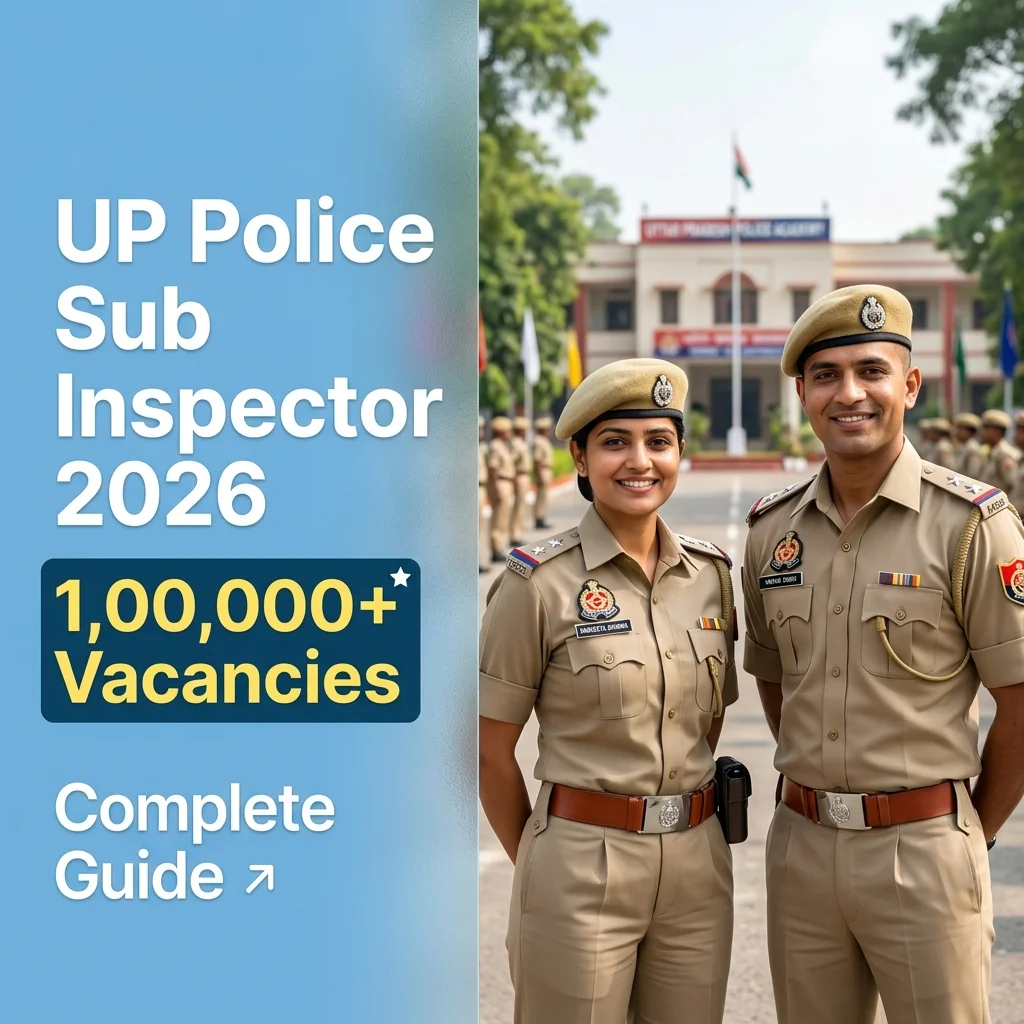
The Uttar Pradesh Police Recruitment and Promotion Board (UPPRPB) has announced plans for a massive recruitment drive with 1,00,000+ vacancies across various UP Police departments in 2026. Among all posts, the Sub-Inspector (SI) Civil Police is the most coveted — carrying authority, a uniform, government quarters, and a salary of ₹55,000–₹65,000/month.
Why UP Police SI 2026 is the most sought government job in North India:
- ✅ Vacancies: 1,00,000+ total across UP Police departments (historic high)
- ✅ Qualification: Any Graduation — no technical degree required
- ✅ Salary: ₹55,000–₹65,000/month in-hand (7th Pay Commission)
- ✅ Prestige: Uniformed service with authority, housing, and benefits
- ✅ No Interview: Merit-based — written exam + physical test only
- ✅ Age Limit: 21–28 years (with generous relaxation for SC/ST/OBC)
- ✅ Career Growth: SI → Inspector → DSP → SP — clear promotion path
If you are a graduate in Uttar Pradesh or want a prestigious police career in India's largest state, UP Police SI 2026 is your best opportunity. This guide covers everything you need to know.
UP Police SI 2026: Key Highlights at a Glance
| Parameter | Details |
|---|---|
| Recruiting Body | Uttar Pradesh Police Recruitment and Promotion Board (UPPRPB) |
| Post Name | Sub-Inspector (SI) — Civil Police |
| Official Website | uppbpb.gov.in |
| Total Expected Vacancies | 1,00,000+ (across all UP Police departments) |
| Current Active Cycle (4,543 posts) | In PET stage — June 29 to July 1, 2026 |
| New Notification (2026) | Expected later in 2026 |
| Minimum Qualification | Graduation in any discipline |
| Age Limit | 21–28 years |
| Written Exam | Online CBT — 160 Questions, 400 Marks, 2 Hours |
| No Negative Marking | ✅ No penalty for wrong answers |
| Physical Test | Physical Standard Test (PST) + Physical Efficiency Test (PET) |
| Selection Process | Written Exam → PST/DV → PET → Medical |
| Basic Pay | ₹35,400/month (7th Pay Commission, Level 6) |
| Gross Salary | ₹62,000–₹65,000/month |
| In-Hand Salary | ₹55,000–₹58,000/month |
| Probation Period | 2 years |
UP Police SI 2026: Important Dates
Current Active Recruitment (4,543 Posts — Advt. No. 2025):
| Event | Date |
|---|---|
| PET Admit Card Download | June 23, 2026 onwards |
| Physical Efficiency Test (PET) | June 29 – July 1, 2026 |
| Medical Examination | After PET (tentative) |
| Final Merit List | August–September 2026 (tentative) |
| Joining | October–November 2026 (tentative) |
Upcoming New Recruitment (1,00,000+ Posts — Expected):
| Event | Expected Date |
|---|---|
| New Notification Release | Later in 2026 |
| Online Application Window | To be announced |
| Written Exam (CBT) | 2026–2027 |
Start Preparation NOW: Regardless of when the new notification drops, the syllabus and exam pattern for UP Police SI has been consistent for years. Every week of preparation today is a competitive advantage tomorrow.
UP Police SI 2026: Conducting Body — UPPRPB
The Uttar Pradesh Police Recruitment and Promotion Board (UPPRPB) is the state authority responsible for all UP Police recruitment:
| Detail | Information |
|---|---|
| Full Name | Uttar Pradesh Police Recruitment and Promotion Board |
| Headquarters | Lucknow, Uttar Pradesh |
| Official Website | uppbpb.gov.in |
| Established | For managing all constable to SI level recruitment in UP |
| Jurisdiction | All 75 districts of Uttar Pradesh |
UP Police Structure — Where Does SI Fit?
Director General of Police (DGP) — Top of UP Police
         ↓
Additional Director General (ADG)
         ↓
Inspector General (IG) — Zone level
         ↓
Deputy Inspector General (DIG) — Range level
         ↓
Superintendent of Police (SP) — District level
         ↓
Additional Superintendent of Police (ASP)
         ↓
Deputy Superintendent of Police (DSP / Circle Officer)
         ↓
Inspector
         ↓
Sub-Inspector (SI) ← YOU START HERE
         ↓
Head Constable
         ↓
Constable
Sub-Inspector is the entry point for officer-level police service — you are NOT a constable. As an SI, you are in charge of a police station's investigation wing, leading constables and head constables under you.
UP Police SI 2026: Vacancy Details
Announced Vacancies:
| Recruitment | Vacancies | Status |
|---|---|---|
| Sub-Inspector Civil Police (Advt. 2025) | 4,543 | PET stage — June 29–July 1, 2026 |
| Sub-Inspector Confidential | 112 | Written exam Oct–Nov 2026 |
| New Recruitment Drive (2026) | 1,00,000+ across departments | Notification awaited |
UP Government has announced a historic recruitment drive for over 1 lakh posts across police departments. This includes Sub-Inspector (Civil Police), Sub-Inspector (Confidential), Platoon Commander (PAC), Fire Service, and more.
Category-Wise Reservation (Expected — As per UP Government Policy):
| Category | Reservation |
|---|---|
| Unreserved (General) | 40% |
| OBC (Other Backward Classes) | 27% |
| Scheduled Caste (SC) | 21% |
| Scheduled Tribe (ST) | 2% |
| Economically Weaker Section (EWS) | 10% |
Women Horizontal Reservation: 20% of total posts are reserved for women within each vertical category.
UP Police SI 2026: Eligibility Criteria
Educational Qualification:
| Requirement | Details |
|---|---|
| Minimum Qualification | Bachelor's Degree in any discipline from a recognized university |
| Acceptable Degrees | B.A., B.Sc., B.Com., B.Tech., BCA, BBA, LLB — any recognized graduation |
| Mark Requirement | No minimum percentage specified — just graduation pass |
| Appearing Candidates | Candidates in the final year of graduation may be eligible (check notification) |
Important: Unlike central exams, UP Police SI does NOT require a specific stream. An arts graduate, science graduate, commerce graduate — all are equally eligible.
Age Limit:
| Category | Minimum Age | Maximum Age |
|---|---|---|
| Male — General/EWS | 21 years | 28 years |
| Female — General/EWS | 21 years | 28 years |
Age Relaxation:
| Category | Relaxation | Effective Max Age |
|---|---|---|
| OBC (Male) | 3 years | 31 years |
| OBC (Female) | 3 years | 31 years |
| SC (Male — UP Domicile) | 5 years | 33 years |
| SC (Female — UP Domicile) | 5 years | 33 years |
| ST (Male — UP Domicile) | 5 years | 33 years |
| ST (Female — UP Domicile) | 5 years | 33 years |
| Ex-Servicemen | 3 years + military service | No upper age limit effectively |
| PwBD | 15 years | 43 years |
| State Government Employees | Up to 5 years | As per service rules |
Domicile Requirement: For SC/ST relaxations, the candidate must be a permanent resident (domicile) of Uttar Pradesh.
Nationality:
- Must be a citizen of India
- Must be a domicile of Uttar Pradesh (UP resident) — required for reservation benefits
Application Fee (Expected):
| Category | Fee |
|---|---|
| General / OBC / EWS | ₹400 |
| SC / ST | ₹400 |
| PwBD | Exempted |
Fee payment through online modes — UPI, Net Banking, Debit/Credit Card at the UPPRPB portal.
UP Police SI 2026: Selection Process — Complete Stages
The UP Police SI selection involves 4 stages:
Stage 1: Online Written Examination (CBT)
              ↓ (Shortlisted candidates called for Stage 2)
Stage 2: Document Verification (DV) + Physical Standard Test (PST)
              ↓ (Qualifying stage — pass/fail only)
Stage 3: Physical Efficiency Test (PET)
              ↓ (Qualifying stage — pass/fail only)
Stage 4: Medical Examination
              ↓
Final Merit List (based on Written Exam only)
              ↓
Joining & Training
Key Selection Facts:
- Only the Written Exam marks count for the final merit list
- PST, PET, and Medical are all qualifying stages (pass/fail — no marks added)
- There is NO interview — completely merit-based
- No negative marking in the written exam — attempt all questions
UP Police SI 2026: Written Exam Pattern (CBT)
Exam Pattern:
| Subject | No. of Questions | Total Marks | Duration |
|---|---|---|---|
| General Hindi | 40 | 100 | — |
| Basic Law / Constitution / General Knowledge | 40 | 100 | — |
| Numerical & Mental Ability | 40 | 100 | — |
| Mental Aptitude / IQ / Reasoning Ability | 40 | 100 | — |
| Total | 160 | 400 | 120 minutes (2 hours) |
Exam Key Rules:
- ✅ Each question = 2.5 marks
- ✅ NO negative marking — attempt every question
- ✅ Online mode (Computer-Based Test)
- ✅ Bilingual (Hindi + English) for most sections
- ✅ Qualifying marks: 35% in each subject AND 50% overall
- ✅ Merit list prepared from written exam marks only
Strategy: Since there is NO negative marking, never leave a question unanswered. Even if you guess, you have a 25% chance of being correct with no penalty.
UP Police SI 2026: Physical Standard Test (PST)
PST is a qualifying stage — you must MEET these standards to proceed. No marks are given.
Male Candidates:
| Category | Minimum Height | Chest (Unexpanded) | Chest (Expanded) | Min. Expansion |
|---|---|---|---|---|
| General / OBC / SC | 168 cm | 79 cm | 84 cm | 5 cm mandatory |
| ST (Scheduled Tribe) | 160 cm | 77 cm | 82 cm | 5 cm mandatory |
Female Candidates:
| Category | Minimum Height | Minimum Weight |
|---|---|---|
| General / OBC / SC | 152 cm | 40 kg |
| ST (Scheduled Tribe) | 147 cm | 40 kg |
Note for Females: No chest measurement is required. Only height and weight are checked.
Chest Expansion Tip (Male):
- Chest is measured at the fullest point of your chest
- Breathing technique: Fully exhale for unexpanded measurement, then breathe in deeply and hold for expanded measurement
- Train for chest expansion by practicing breathing exercises, swimming, and chest workouts
UP Police SI 2026: Physical Efficiency Test (PET)
PET is a running test — also qualifying only. You must complete the run within the specified time:
| Category | Distance | Time Limit |
|---|---|---|
| Male Candidates | 4.8 kilometres (4,800 metres) | 28 minutes |
| Female Candidates | 2.4 kilometres (2,400 metres) | 16 minutes |
PET Training Plan (8 Weeks Before Exam):
| Week | Male Target | Female Target |
|---|---|---|
| Week 1–2 | Run 2 km daily (no time pressure) | Run 1 km daily |
| Week 3–4 | Run 3 km in 20 minutes | Run 1.5 km in 12 minutes |
| Week 5–6 | Run 4 km in 26 minutes | Run 2 km in 14 minutes |
| Week 7 | Run 4.8 km in 30 minutes | Run 2.4 km in 17 minutes |
| Week 8 | Run 4.8 km in 27 minutes (under limit) | Run 2.4 km in 15 minutes |
Running Tips:
- Pace management is KEY: Start at 70% speed — do NOT sprint at the beginning
- For 4.8 km in 28 minutes → you need to maintain ~6 minutes per km pace
- Practice on the actual track surface (road or grass) — not just treadmill
- Train in the morning to acclimatize to outdoor conditions
- Stay hydrated and eat light before the test
UP Police SI 2026: Medical Examination
After clearing PET, selected candidates undergo a detailed medical examination:
Medical Standards:
| Requirement | Standard |
|---|---|
| Eyesight (Without Glasses) | 6/6 in one eye and 6/9 in the other |
| Eyesight (With Glasses) | 6/6 in each eye (spectacle power limit applies) |
| Colour Blindness | Colour blindness is disqualifying |
| Night Blindness | Disqualifying |
| Hearing | Normal hearing in both ears |
| Blood Pressure | Within normal range |
| Flat Foot | Disqualifying |
| Knock Knees / Bow Legs | Disqualifying |
| Varicose Veins | Disqualifying |
| Physical Deformity | No physical deformity that affects duties |
Important: Spectacle/lens wearers are allowed but power limits apply. Check the official notification for exact permitted spectacle power limits.
UP Police SI 2026: Complete Subject-Wise Syllabus
Subject 1: General Hindi (40 Questions — 100 Marks)
Hindi Grammar:
- Sandhi (Vowel and Consonant Sandhi)
- Samas (Compound words — Tatpurusha, Bahuvrihi, Dvandva, Avyayibhav, etc.)
- Vachya (Active/Passive voice in Hindi)
- Kaal (Past, Present, Future tenses)
- Karak (Cases — Karta, Karma, Karan, etc.)
- Ling (Gender — Strilinga, Pullinga)
- Vachan (Number — Ekavachan, Bahuvachan)
- Vilom Shabd (Antonyms)
- Paryayvachi Shabd (Synonyms)
- Muhavare and Lokoktiyan (Idioms and Proverbs)
- Vartani (Spelling errors — identify correct spelling)
Hindi Vocabulary:
- Tatsam-Tadbhav words (Sanskrit-origin vs adapted Hindi)
- Deshaj Shabd (Native words)
- Shabd Bhandar (Word knowledge)
- Anekarthi Shabd (Words with multiple meanings)
Applied Hindi:
- Unseen Passage (Apathit Gadyansh) — Comprehension questions
- Paraphrase (Gadya/Padya ka Saaransh)
- Letter Writing (Patra Lekhan) — if applicable
- Official and semi-official language usage
Scoring Strategy for General Hindi: This is the MOST scoring section for UP-based candidates who studied in Hindi medium. Target 36–38/40 correct. Focus on Sandhi, Samas, Vilom/Paryayvachi, and Muhavare — these form 60%+ of questions.
Subject 2: Basic Law / Constitution / General Knowledge (40 Questions — 100 Marks)
Indian Penal Code (IPC) — Most Important:
- IPC 1860 — Structure, offences against state, person, property
- Key Sections: 302 (Murder), 307 (Attempt to Murder), 376 (Rape), 420 (Cheating), 302, 304, 304A (Culpable Homicide), 323 (Hurt), 379/380/381 (Theft), 392/393 (Robbery), 497 (Adultery — struck down), 498A (Cruelty by husband), 304B (Dowry Death), 506 (Criminal Intimidation)
- Stages of crime: Intention → Preparation → Attempt → Commission
- General Exceptions: Self-defence, insanity, intoxication, necessity
Code of Criminal Procedure (CrPC) — Now BNSS 2023:
- Sections related to FIR, arrest, bail, warrant, summons
- Cognizable vs Non-Cognizable offences
- Compoundable vs Non-compoundable offences
- Section 154 (FIR), 41 (Arrest without warrant), 167 (Remand), 173 (Police Report)
- Note: BNSS (Bharatiya Nagarik Suraksha Sanhita) 2023 has replaced CrPC — study BNSS key changes
Indian Evidence Act (IEA) — Now BSA 2023:
- Types of evidence: Direct, Circumstantial, Documentary, Electronic
- Admissibility of confessions
- Burden of proof
- Note: BSA (Bharatiya Sakshya Adhiniyam) 2023 has replaced IEA
Indian Constitution:
- Preamble — Socialist, Secular, Democratic Republic
- Fundamental Rights (Articles 12–35)
- Directive Principles of State Policy (Articles 36–51)
- Fundamental Duties (Article 51A)
- Emergency Provisions (Articles 352, 356, 360)
- Parliament structure, President powers, Judiciary
- 73rd and 74th Amendments — Panchayati Raj and Urban Local Bodies
- Key Constitutional Articles: 14 (Equality), 19 (Freedoms), 21 (Right to Life), 32 (Constitutional Remedies)
Human Rights:
- National Human Rights Commission (NHRC) — composition, functions
- Universal Declaration of Human Rights (UDHR) — 1948
- Rights of women, children, minorities
- Protection of Civil Rights Act, 1955
- SC/ST (Prevention of Atrocities) Act, 1989
Women's Laws (HIGH PRIORITY for SI exam):
- Protection of Women from Domestic Violence Act, 2005
- Sexual Harassment of Women at Workplace Act, 2013 (POSH Act)
- Dowry Prohibition Act, 1961
- Maternity Benefit Act, 1961
- POCSO Act, 2012 (Protection of Children from Sexual Offences)
- Pre-Conception and Pre-Natal Diagnostic Techniques Act, 1994 (PC-PNDT)
Child Rights:
- Juvenile Justice (Care and Protection of Children) Act, 2015
- Right to Education Act, 2009 (RTE)
- Child Labour (Prohibition and Regulation) Amendment Act, 2016
Traffic Laws:
- Motor Vehicles Act, 1988 (Amended 2019)
- Traffic rules, offences, penalties
General Knowledge:
- History of UP — ancient, medieval, modern
- Geography of UP — rivers (Ganga, Yamuna, Sarayu, Gomti), districts, soil types
- UP Economy — agriculture (wheat, sugarcane, rice), industries
- Current Affairs — last 6 months (national and state-level)
- Science — basic physics, chemistry, biology (10th level)
- Sports — UP players, national and international events
Subject 3: Numerical & Mental Ability (40 Questions — 100 Marks)
Number System:
- Natural numbers, whole numbers, integers, rational numbers, irrational numbers
- LCM and HCF
- Divisibility rules (2, 3, 4, 5, 6, 7, 8, 9, 11)
- Prime numbers, composite numbers
- Square and square roots, cube and cube roots
Simplification:
- BODMAS rule
- Fractions and decimals
- Surds and indices
Percentage:
- Percentage calculation
- Percentage increase/decrease
- Successive percentage change
Profit, Loss and Discount:
- Cost Price, Selling Price, Marked Price
- Profit %, Loss %, Discount %
- Dishonest trading problems
Simple Interest and Compound Interest:
- SI formula: P×R×T/100
- CI formula: P(1+R/100)^n – P
- Difference between CI and SI
Average:
- Simple average
- Weighted average
- Change in average when a member joins/leaves
Ratio and Proportion:
- Simple ratio, compound ratio
- Direct and inverse proportion
- Partnership problems
Time and Work:
- Individual rates of work
- Combined work
- Pipes and cisterns
Time, Speed and Distance:
- Speed formula
- Relative speed (same/opposite direction)
- Train problems
- Boat and stream
Mixtures and Alligations:
- Mixing two solutions
- Finding ratio of mixing
Mensuration:
- 2D: Rectangle, Square, Triangle, Circle, Trapezium
- 3D: Cube, Cuboid, Cylinder, Cone, Sphere
Statistics (Basic):
- Mean, Median, Mode
- Range and standard deviation (basic)
- Bar graphs, Pie charts — reading and interpretation
Subject 4: Mental Aptitude / IQ / Reasoning Ability (40 Questions — 100 Marks)
Reasoning Ability:
- Analogy (word-based and number-based)
- Classification (Odd one out)
- Series completion (number and letter series)
- Coding-Decoding
- Blood Relations
- Direction and Distance
- Order and Ranking
- Alpha-Numeric Series
Mental Aptitude:
- Relationship Test
- Leadership qualities, Decision-making, Public dealing
- Integrity, Service orientation
- Adaptability under pressure
IQ-Based Questions:
- Pattern recognition
- Logical reasoning puzzles
- Statement and Conclusion
- Statement and Assumption
- Cause and Effect
Spatial Reasoning:
- Mirror Image
- Water Image
- Paper Folding and Cutting
- Embedded Figures
- Figure Completion
UP Police SI 2026: Salary & Benefits
Salary Structure (7th Pay Commission — Level 6):
| Component | Amount |
|---|---|
| Basic Pay | ₹35,400/month |
| Dearness Allowance (DA @ ~50%) | ~₹17,700/month |
| House Rent Allowance (HRA — varies by city) | ₹2,500–₹5,000/month |
| Medical Allowance | ₹1,000/month |
| Uniform Allowance | ₹500/month |
| Gross Salary | ~₹62,000–₹65,000/month |
In-Hand Salary (After Deductions):
| Location | In-Hand Salary |
|---|---|
| Lucknow (X City) | ~₹57,000–₹60,000/month |
| Other Cities / Districts | ~₹54,000–₹57,000/month |
| Rural / Small Town | ~₹52,000–₹55,000/month |
After deductions (GPF/NPS contribution, Income Tax deduction, Professional Tax): In-hand salary typically ranges ₹52,000–₹58,000/month.
Pay Scale Progression (7th Pay Commission):
| Level | Basic Pay | After Years |
|---|---|---|
| Entry — Sub-Inspector (Level 6) | ₹35,400 | Year 1 |
| After annual increments (3%) | ₹36,462 | Year 2 |
| — | ₹37,556 | Year 3 |
| After promotion to Inspector (Level 7) | ₹44,900 | After 5–7 years |
| After promotion to DSP (Level 10) | ₹56,100 | After 12–15 years |
| After promotion to SP (Level 13) | ₹1,23,100 | Senior level |
Additional Benefits & Allowances:
| Benefit | Details |
|---|---|
| Government Quarters | Police housing (rent-free or subsidised) at most postings |
| Uniform Allowance | Annual allowance for uniform and equipment |
| Medical Coverage | Government hospital treatment for self and family |
| GPF (Government Provident Fund) | Compulsory savings with government contribution |
| Gratuity | After 5 years of service |
| Leave Benefits | Casual Leave (CL), Earned Leave (EL), Medical Leave (ML) |
| Duty Leave | Special leave for official duties |
| Police Welfare Fund | Access to welfare schemes for police personnel |
| Pension | Old Pension Scheme (OPS) for UP Police (not NPS) — major benefit! |
| Commutation of Pension | Option to receive lump sum at retirement |
| Canteen Facilities | UPPCF (UP Police Canteen Facility) — subsidised goods |
Big Financial Advantage: UP Police follows the Old Pension Scheme (OPS) — NOT the New Pension Scheme (NPS). This means after retirement, you get a guaranteed pension equal to 50% of your last drawn basic pay for life. This is a massive benefit that most central government jobs no longer offer.
UP Police SI 2026: Previous Year Cut-Off Analysis
Written Exam Cut-Off (General Category — Out of 400):
| Recruitment Year | Total Vacancies | UR Cut-Off (Approx) | OBC | SC |
|---|---|---|---|---|
| 2021 (4,543 posts) | 4,543 | 260–280 | 245–265 | 220–240 |
| 2017 (4,672 posts) | 4,672 | 255–275 | 240–260 | 215–235 |
| 2016 (2,833 posts) | 2,833 | 250–270 | 235–255 | 210–230 |
2026 Estimate (For New Notification): With a larger vacancy pool, cut-offs may be slightly lower. For General category, targeting 260–275 out of 400 is a safe goal.
Subject-wise Safe Scores to Target:
| Subject | Safe Target | Max Marks |
|---|---|---|
| General Hindi | 85–95 | 100 |
| Law / Constitution / GK | 75–85 | 100 |
| Numerical & Mental Ability | 70–80 | 100 |
| Mental Aptitude / Reasoning | 75–85 | 100 |
| Total Target | 300–340 | 400 |
UP Police SI 2026: How to Apply Online
Step 1: Visit the Official Website
- Go to uppbpb.gov.in
- Look for the UP Police SI 2026 notification link — click when live
Step 2: Register
- Click "Apply Online" or "New Registration"
- Enter: Name, Father's name, Mobile number, Email ID, Date of Birth
- Note your Registration Number and Password
Step 3: Fill the Application Form
- Enter personal details (address, domicile, category)
- Educational qualifications (graduation degree, year, marks)
- Select exam centre preference (from available districts)
- Declare physical measurements (height, chest) honestly
Step 4: Upload Documents
- Photograph: JPG, 20–40 KB, recent (within 6 months), plain background
- Signature: JPG, 10–20 KB, signed on white paper
- Thumb impression: Left thumb
Step 5: Pay Application Fee
- General/OBC/EWS: ₹400 (expected)
- SC/ST: ₹400 (expected)
- Payment via: UPI, Net Banking, Debit/Credit Card
Step 6: Submit and Print
- Review all details carefully
- Click "Final Submit"
- Download and print the application form
Critical: Verify all details before submitting. Especially height and chest measurements for male candidates — false declarations can disqualify you at the PST stage and even lead to criminal action.
UP Police SI 2026: Preparation Strategy — 4-Month Plan
Overall Priority:
| Section | Weight | Importance | Target Score |
|---|---|---|---|
| General Hindi | 100/400 (25%) | HIGHEST for UP aspirants | 85–95 |
| Law / Constitution / GK | 100/400 (25%) | High — needs specific study | 75–85 |
| Numerical Ability | 100/400 (25%) | Moderate — scoring if prepared | 72–82 |
| Reasoning | 100/400 (25%) | Scoring — needs practice | 78–88 |
Month 1: Foundation Building
General Hindi:
- Week 1–2: Sandhi (all types), Samas (all 6 types), Karak — complete with practice sets
- Week 3: Muhavare and Lokoktiyan — memorise top 100 each
- Week 4: Vilom Shabd, Paryayvachi, Anekarthi — top 200 pairs each
Law / GK:
- Week 1: IPC key sections (learn section numbers + definition)
- Week 2: CrPC/BNSS fundamentals (FIR, arrest, bail, remand)
- Week 3: Indian Constitution (Preamble, Fundamental Rights, DPSP)
- Week 4: Women's laws, Child protection acts — all key provisions
Numerical Ability:
- Week 1–2: Percentage, Profit-Loss, SI/CI (solve 30 questions/day)
- Week 3–4: Time-Work, Speed-Distance, Average, Ratio
Reasoning:
- Week 1–2: Analogy, Classification, Series
- Week 3–4: Coding-Decoding, Blood Relations, Direction-Distance
Month 2: Deepening Knowledge
General Hindi:
- Advanced Grammar — Vachya (voice), Kaal (tense), Visheshan
- Unseen passage practice — 1 passage daily
- Tatsam-Tadbhav, Deshaj shabd mastery
Law / GK:
- Human Rights and Women's Laws (deep dive)
- UP-specific GK — History, Geography, Economy (crucial!)
- Current Affairs — start daily 15-minute current affairs reading
- Child rights, Traffic laws, Juvenile Justice Act
Numerical Ability:
- DI (Data Interpretation) — bar graphs, pie charts, tables: 2 sets/day
- Mixture-Alligation, Partnership, Mensuration
Reasoning:
- Statement-Conclusion, Statement-Assumption
- Syllogism, Number patterns
- Mirror Image, Embedded Figures
Month 3: Revision + Mock Tests
- Take 2 full mock tests per week (160 questions, 2 hours timed)
- Analyse mistakes — identify weak areas
- Current Affairs revision capsule
- IPC/BNSS — practice questions from previous years
- Hindi — solve last 5 years' question papers
Month 4: Final Sprint
- 4 mock tests per week — build speed and accuracy
- Focus on sections where score is lowest
- Memorise all IPC section numbers
- Hindi — targeted 10 muhavare / day revision
- Current affairs — last 3 months' major events
- Physical fitness: Run every day for PET preparation in parallel
Daily Study Timetable:
| Time | Subject | Duration |
|---|---|---|
| 6:00–7:00 AM | Physical Training (Running — PET preparation) | 1 hour |
| 8:00–9:00 AM | General Hindi | 1 hour |
| 10:00–11:30 AM | Law / Constitution / GK + Current Affairs | 1.5 hours |
| 12:00–12:30 PM | Current Affairs Reading (Hindi newspaper) | 30 minutes |
| 2:00–3:00 PM | Numerical Ability | 1 hour |
| 3:30–4:30 PM | Reasoning Ability | 1 hour |
| 7:00–8:30 PM | Mock Test / PYQ Practice | 1.5 hours |
| 9:00–9:30 PM | Revision of weak topics | 30 minutes |
Best Books for UP Police SI 2026
Recommended Books:
| Subject | Book | Publisher |
|---|---|---|
| General Hindi | Samanya Hindi | Hardev Bahri / Arihant |
| General Hindi | Hindi Sahitya aur Vyakaran | Unique Publications |
| IPC / CrPC / Law | Indian Penal Code (in Hindi) | Universal Law Publishing |
| New Criminal Laws | BNSS / BNS / BSA Guide | Singhal's Publications |
| Indian Constitution | Indian Polity | M. Laxmikanth / McGraw Hill |
| Reasoning | Verbal and Non-Verbal Reasoning | R.S. Aggarwal |
| Mathematics | Quantitative Aptitude | R.S. Aggarwal / S. Chand |
| GK + Current Affairs | Lucent's General Knowledge | Lucent Publications |
| UP GK | Uttar Pradesh General Knowledge | Arihant / Unique Publications |
| Complete Guide | UP Police SI Complete Guide | Arihant / Kiran / Disha |
| PYQ Papers | UP Police SI Solved Papers (last 10 years) | Kiran Prakashan |
Best Online Platforms:
| Platform | Why Use It |
|---|---|
| Testbook.com | Best UP Police SI mock tests in Hindi + English |
| Adda247.com | UP Police-specific video classes and tests |
| Mahendras.org | Competitive exam GK + Current Affairs |
| Safalta.com | Hindi-medium UP Police preparation |
| YouTube: Utkarsh Classes | Free Hindi classes for UP Police SI |
| YouTube: Nirman IAS | UP GK and Constitution classes |
UP Police SI 2026: Sample Questions with Answers
General Hindi (Grammar):
Q1. In the compound word 'Mata-Pita' (Mother-Father), which type of Samas (compound formation) is used?
- (A) Tatpurusha Samas
- (B) Dvandva Samas
- (C) Bahuvrihi Samas
- (D) Karmadharaya Samas
Answer: (B) Dvandva Samas In 'Mata-Pita', both words are equally important — 'Mata' (Mother) and 'Pita' (Father) hold equal significance, making it a Dvandva (copulative compound) Samas.
Q2. Which of the following is NOT a synonym of 'Agni' (Fire)?
- (A) Pavak
- (B) Vahni
- (C) Anal
- (D) Ambar
Answer: (D) Ambar 'Ambar' means 'Sky'. Pavak, Vahni, and Anal are all synonyms of 'Agni' (Fire).
Law / Constitution:
Q3. Under which section of the Indian Penal Code (IPC) is 'Murder' (Hatya) defined?
- (A) Section 299
- (B) Section 300
- (C) Section 302
- (D) Section 307
Answer: (B) Section 300 Section 300 defines Murder (Definition of Murder), while Section 302 prescribes the punishment for murder. Section 299 defines Culpable Homicide (Manav Vadh).
Q4. What is the full form of FIR?
- (A) First Information Record
- (B) First Intimation Report
- (C) First Information Report
- (D) Formal Information Report
Answer: (C) First Information Report FIR (First Information Report) — The first report filed with the police for a Cognizable Offence. It is registered under Section 154 of CrPC (now Section 173 of BNSS).
Numerical Ability:
Q5. The cost price of an item is Rs. 800. If it is sold at a 15% profit, what will be the selling price?
- (A) Rs. 880
- (B) Rs. 900
- (C) Rs. 920
- (D) Rs. 940
Answer: (C) Rs. 920 SP = CP x (100 + Profit%) / 100 = 800 x 115/100 = Rs. 920
Q6. Ram can complete a task in 12 days and Shyam can complete the same task in 15 days. In how many days will both complete the work together?
- (A) 6 days
- (B) 6 and 2/3 days
- (C) 7 days
- (D) 8 days
Answer: (B) 6 and 2/3 days Combined work per day = 1/12 + 1/15 = 5/60 + 4/60 = 9/60 = 3/20. Together they complete the work in 20/3 = 6 and 2/3 days.
Reasoning:
Q7. If BOOK is coded as DQQM, then how will FILE be coded?
- (A) HKNG
- (B) HKMG
- (C) HKNG
- (D) HIMG
Answer: (A) HKNG Pattern: Each letter moved +2 positions forward. B to D, O to Q, O to Q, K to M. So F to H, I to K, L to N, E to G = HKNG
UP Police SI vs Other State Police SI: Comparison
| Feature | UP Police SI | Delhi Police SI | Rajasthan Police SI | MP Police SI |
|---|---|---|---|---|
| Vacancies (2026) | 1,00,000+ | 1,000–2,000 | 2,000–5,000 | 2,000–4,000 |
| Basic Pay | ₹35,400 | ₹35,400 | ₹33,800 | ₹35,400 |
| In-Hand Salary | ₹55,000–₹58,000 | ₹58,000–₹62,000 | ₹48,000–₹52,000 | ₹50,000–₹55,000 |
| Pension | Old Pension (OPS) | NPS | NPS | NPS |
| Competition | Very High (crores apply) | High | High | High |
| Written Exam | 160 Q, 400 marks, 2hr | 200 Q, 200 marks, 2hr | 200 Q, 200 marks, 2hr | 200 Q, 200 marks, 2hr |
| Qualification | Graduation | Graduation + NCC/Sports preferred | Graduation | Graduation |
UP Police SI's biggest advantage over other state police: OLD PENSION SCHEME (OPS) — guaranteed pension of 50% of last basic pay for life. This is worth ₹50–60 lakhs more in retirement benefits compared to states on NPS.
Career Growth After Joining as UP Police SI
Promotion Path:
Sub-Inspector (SI) — Entry Level
         ↓ (5–7 years based on performance)
Inspector
         ↓ (8–12 years based on performance + departmental exam)
Deputy Superintendent of Police (DSP / Circle Officer)
         ↓ (via UP PSC / UPPCS or departmental promotion)
Additional Superintendent of Police (ASP)
         ↓
Superintendent of Police (SP)
How to Get Promoted:
Option 1: Departmental Promotion (Seniority + DPC)
- After serving as SI, you are considered for Inspector based on seniority
- DPC (Departmental Promotion Committee) reviews performance records
- Good Annual Confidential Reports (ACR) are critical
Option 2: Departmental Competitive Exam
- UPPRPB conducts internal promotion exams
- Written test + interview-based selection for Inspector to DSP promotion
Option 3: UPPCS (State PCS)
- While serving as SI, you can appear for UPPCS (UP Public Service Commission)
- If selected as DSP directly, you get a huge jump in rank and salary
- Many successful SIs have become IPS officers this way by clearing UPSC later
Life as a UP Police Sub-Inspector — What to Expect
Day-to-Day Duties:
Investigative Duties:
- Leading investigation of FIRs registered under your charge
- Visiting crime scenes, collecting evidence, preparing panchnama
- Recording statements of witnesses and suspects
- Filing charge sheets (challan) in court
- Appearing in court for case hearings
Administrative Duties:
- Supervising constables and head constables posted at the outpost
- Managing beat patrols and checkposts
- Preparing daily diary and maintaining station records
- Reviewing complaints received from the public
Public Interface:
- Meeting complainants and hearing their grievances
- Directing community policing activities
- VIP/VVIP security and escort duties (when assigned)
- Emergency response — law and order situations, processions, elections
Working Conditions:
- Shifts: Up to 12-hour shifts — no fixed 8-hour workday
- Postings: Anywhere across all 75 districts of UP
- Transfer policy: Typically transferred every 2–3 years
- On-call nature: Police duty means you can be called anytime in emergencies
- Uniform: Must be in uniform during duty hours
Common Mistakes UP Police SI Aspirants Make
Mistake 1: Not Giving Enough Time to General Hindi
This section is entirely in Hindi and accounts for 25% of marks. Many graduates (especially those who studied in English medium) underestimate Hindi grammar complexity. Sandhi and Samas alone can contribute 15–20 questions.
Mistake 2: Ignoring IPC Section Numbers
In the Law section, knowing the section NUMBER is as important as knowing the offence. Many candidates can describe murder but cannot say it's Section 300 that defines it and Section 302 that prescribes punishment. Memorise the key sections.
Mistake 3: Neglecting UP-Specific GK
While national GK gets covered in most books, UP-specific GK (UP history, geography, districts, economy) is often ignored. This can cost 8–12 marks easily. Buy a dedicated UP GK book.
Mistake 4: Not Training Physically in Parallel with Studies
Many candidates who clear the written exam fail at PET because they only started running 1 week before the test. Run every single day from Day 1 of preparation. The written exam is months away — PET preparation must be simultaneous.
Mistake 5: Providing False Physical Measurements
Some candidates exaggerate their height or chest measurements in the application. At the PST stage, you are physically measured. If your measurements don't match, you are disqualified — and you may face action for providing false information. Be honest.
Mistake 6: Skipping New Criminal Laws
India replaced IPC with BNS, CrPC with BNSS, and IEA with BSA in 2023–2024. Most old books still contain IPC/CrPC content. Make sure your preparation includes the new criminal laws that will be tested in 2026 exams.
Frequently Asked Questions — UP Police SI 2026
Q1. What is the minimum qualification for UP Police SI? A graduation degree in any discipline from a recognized university. Any stream — Arts, Science, Commerce, Engineering — all eligible.
Q2. Is there a domicile requirement? Yes. While any Indian citizen can apply, the age relaxation and reservation benefits require UP domicile. The state may also give preference to UP residents in posting allocation.
Q3. Is the exam conducted in Hindi or English? The exam is primarily in Hindi (bilingual for some sections). The General Hindi section is entirely in Hindi. Other sections may be in both Hindi and English.
Q4. How many times can I attempt UP Police SI? There is no attempt limit. You can attempt every year as long as you are within the age limit.
Q5. Is there a separate height relaxation for women? Yes. Female candidates require only 152 cm height (General/OBC/SC) or 147 cm (ST), which is significantly lower than male requirements (168 cm).
Q6. What is the difference between UP Police SI and UP Police Inspector? SI is recruited through UPPRPB's direct recruitment examination. Inspectors are typically promoted from SIs after 5–7 years of service. Both are gazetted police officers, but Inspector is one rank above SI.
Q7. Does UP Police follow Old Pension Scheme? Yes. UP Police personnel are covered under the Old Pension Scheme (OPS) — NOT the National Pension System (NPS). This means a guaranteed pension after retirement, which is a major financial advantage.
Q8. Can I appear for UP Police SI if I am currently in the final year of graduation? This depends on the notification. Usually, the degree must be completed before the date specified in the notification. Check the official notification for exact cut-off date for educational qualification.
UP Police SI 2026: Mool Vidhi (Basic Law) Cheat Sheet — IPC to BNS Mapping
With the recent criminal law reforms, UP Police SI 2026 exams will likely feature questions from the new Bharatiya Nyaya Sanhita (BNS) 2023 which replaced the IPC. Here is a powerful cheat sheet to remember the old IPC sections and their new BNS counterparts:
| Offence | Old IPC Section | New BNS 2023 Section | Description |
|---|---|---|---|
| Murder | Sec 302 | Sec 103 | Punishment for murder (Death or life imprisonment) |
| Culpable Homicide | Sec 304 | Sec 105 | Homicide not amounting to murder |
| Attempt to Murder | Sec 307 | Sec 109 | Attempt to commit murder |
| Rape | Sec 376 | Sec 64 | Punishment for rape |
| Gangrape | Sec 376D | Sec 70 | Stringent punishment for gangrape |
| Dowry Death | Sec 304B | Sec 80 | Death of a woman caused by burns/bodily injury within 7 years of marriage |
| Cheating / Fraud | Sec 420 | Sec 318(4) | Cheating and dishonestly inducing delivery of property |
| Theft | Sec 379 | Sec 303(2) | Punishment for theft |
| Robbery | Sec 392 | Sec 309 | Punishment for robbery |
| Dacoity | Sec 395 | Sec 310(2) | Robbery committed by 5 or more persons |
| Criminal Conspiracy | Sec 120B | Sec 61(2) | Punishment for criminal conspiracy |
| Sedition | Sec 124A | Sec 152 (Treason) | Acts endangering sovereignty, unity and integrity of India |
| Defamation | Sec 499/500 | Sec 356 | Includes community service as a new punishment |
| Snatching (New) | Not explicitly defined | Sec 304 | Newly defined offence for mobile/chain snatching |
| Mob Lynching (New) | No specific section | Sec 103(2) | Specific punishment for mob lynching based on race, caste, sex |
SEO Pro Tip for Aspirants: Examiners love to ask about the differences between old and new laws. Focus on newly added offences like "Snatching" and "Mob Lynching" which have specific sections now.
UP Police SI 2026: UP General Knowledge (GK) Quick Facts
UP GK is a game-changer in the General Knowledge section. Memorise these critical facts:
Geographical Facts:
- Total Area: 2,40,928 sq km (4th largest state in India)
- Total Districts: 75
- Total Divisions: 18
- Largest District (Area): Lakhimpur Kheri
- Smallest District (Area): Hapur
- Borders: 8 States (Uttarakhand, HP, Haryana, Rajasthan, MP, Chhattisgarh, Jharkhand, Bihar) + 1 UT (Delhi) + 1 Country (Nepal)
- Longest Border: With Madhya Pradesh (MP)
- Shortest Border: With Himachal Pradesh (HP)
- Only district touching 4 states: Sonbhadra (touches MP, Chhattisgarh, Jharkhand, Bihar)
Rivers & Cities:
| River | Major UP Cities on its Banks |
|---|---|
| Ganga | Kanpur, Varanasi, Prayagraj, Ghazipur, Garhmukteshwar |
| Yamuna | Agra, Mathura, Etawah, Prayagraj (Sangam) |
| Gomti | Lucknow, Jaunpur, Sultanpur |
| Sarayu | Ayodhya |
| Rapti | Gorakhpur |
UP Economy & Agriculture:
- First in India: Sugarcane production, Wheat production, Potato production, Milk production.
- Major Industries: Leather (Kanpur, Agra), Brassware (Moradabad), Glass/Bangles (Firozabad), Carpets (Bhadohi), Sports Goods (Meerut), Perfume (Kannauj), Silk Sarees (Varanasi).
UP Police SI 2026: Medical Test Rejection Reasons & Solutions
Many candidates clear the written and running tests, but fail the Medical Examination due to easily fixable issues. Here are the top rejection reasons and how to fix them before 2026:
1. Knock Knees (Genu Valgum)
- The Issue: When standing straight with ankles apart, the knees touch each other.
- The Fix: Place a pillow between your knees while sleeping. Practice exercises like side lunges, straight leg raises, and butterfly stretches daily.
- Status: Temporary rejection if mild, can be appealed.
2. Flat Foot (Pes Planus)
- The Issue: The arch of the foot collapses, and the entire sole touches the ground. This affects running endurance.
- The Fix: Walk barefoot on sand. Use orthotic arch-support insoles in your shoes. Pick up marbles with your toes to strengthen foot muscles.
- Status: Permanent rejection if severe.
3. Wax in Ears / Ear Infection
- The Issue: A very common and silly reason for temporary rejection. The doctor cannot see your eardrum due to wax.
- The Fix: Visit an ENT specialist exactly 3 days before your medical exam to get your ears professionally cleaned. DO NOT use earbuds yourself.
4. Overweight / Underweight
- The Issue: BMI outside the acceptable range. Female candidates strictly need a minimum of 40 kg.
- The Fix: Maintain your diet. If you are borderline underweight, drink water and eat bananas on the morning of the medical test to gain temporary weight.
UP Police SI 2026: Training Period at Police Training College (PTC)
What happens after you get selected? The exciting and gruelling training period begins!
Where does training happen?
Selected Sub-Inspectors are sent to various PTCs across Uttar Pradesh:
- PTC Moradabad (Dr. B.R. Ambedkar Police Academy)
- PTC Sitapur
- PTC Meerut
- PTC Gorakhpur
The 12-Month Training Schedule:
1. Indoor Training (Academics):
- Detailed study of BNS, BNSS, BSA (New Criminal Laws)
- Forensic science and crime scene investigation
- Cybercrime tracking and IT Act
- Criminology and human psychology
- VIP security protocols and riot control theories
2. Outdoor Training (Physical & Tactics):
- Morning (5:00 AM): 5-10 km running, PT, obstacle course
- Weapons Training: Handling INSAS rifles, AK-47, 9mm pistols, Glock, and riot gear (tear gas, rubber bullets)
- Unarmed Combat (UAC): Self-defence, judo, and crowd control tactics
- Drill: March past, saluting, and ceremonial parades
3. Practical Training (Field Attachment):
- After 12 months at PTC, SIs are attached to an active Police Station for 6 months of practical training under an experienced SHO (Station House Officer).
- You will learn how to write a General Diary (GD), file FIRs, and conduct actual investigations.
Salary during training: Yes, you receive a stipend! UP Police SIs receive their basic pay + DA during the training period (around ₹40,000–₹45,000/month). Allowances like HRA start after field posting.
UP Police SI 2026: Best Districts for Posting
UP has 75 districts grouped into different zones. Based on career growth, facilities, and lifestyle, here is how candidates typically prefer their postings:
1. Police Commissionerate Cities (Premium Postings)
UP has recently implemented the Police Commissionerate system in major cities. These offer excellent urban facilities, better schooling for kids, and exposure to modern policing:
- Lucknow, Gautam Buddha Nagar (Noida), Kanpur, Varanasi, Agra, Ghaziabad, Prayagraj.
- Pros: Excellent infrastructure, standard duty hours, corporate-style policing.
- Cons: Very high cost of living, heavy traffic management duties.
2. NCR Region (High Action)
- Meerut, Bulandshahr, Hapur, Baghpat.
- Pros: Close to Delhi, high-profile cases, excellent experience.
- Cons: High crime rate, politically sensitive.
3. Peaceful / Emerging Districts
- Bareilly, Gorakhpur, Jhansi, Ayodhya.
- Pros: Lower cost of living, manageable workload, good for family life.
- Cons: Fewer modern amenities compared to Noida/Lucknow.
Note: SIs are typically not posted in their home district (Grih Janpad) to ensure unbiased policing.
Conclusion: UP Police SI 2026 — Prepare Today for the Biggest Opportunity
The UP Police Sub-Inspector 2026 recruitment is not just another government exam — it is the single biggest state police recruitment in India's history, with 1,00,000+ vacancies across departments. For graduates in Uttar Pradesh and across India who want a prestigious, high-paying, uniformed government job with Old Pension Scheme benefits, this is the most powerful opportunity of the decade.
Your Preparation Roadmap:
- Start Today: Hindi grammar (Sandhi/Samas) + BNS/IPC key sections — 2 hours daily
- Month 1: Build complete subject foundation
- Month 2: Deep dive into Law, Hindi advanced grammar, UP GK
- Month 3–4: Full mock tests + physical fitness simultaneously
- Notification Day: Apply immediately — don't wait for last date
The Winning Targets:
- Written Exam: 300+ out of 400 (safely above cut-off)
- Hindi: 85–95 | Law/GK: 75–85 | Maths: 70–80 | Reasoning: 75–85
- PET: Start running 4.8 km training today
Stay updated with UP Police SI 2026 notification release date, exam schedule, admit card, result, and joining news at Government Job Result — your one-stop source for all UP and government exam updates.
Disclaimer: All data including vacancies, salary, physical standards, and exam pattern in this article are based on UPPRPB's historical recruitment data and official announcements as of June 2026. Candidates must verify all information from the official notification at uppbpb.gov.in when released. Actual vacancies, dates, and eligibility criteria may vary.