Introduction: IBPS Clerk 2026 — The Gateway to a Banking Career for Graduates
Every year, over 2 crore graduates in India dream of one thing: a permanent job in a Public Sector Bank (PSB). And for millions of them, the path begins with one exam — IBPS Clerk.
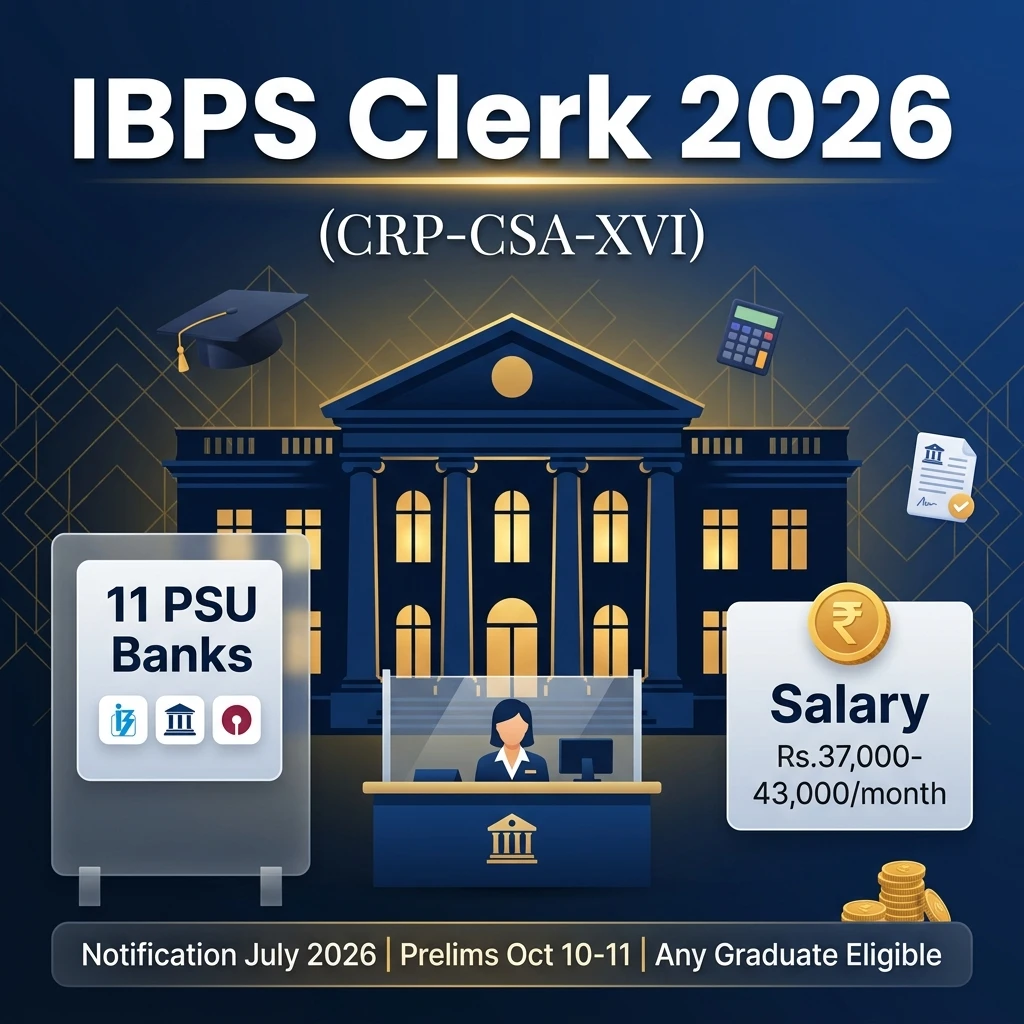
The Institute of Banking Personnel Selection (IBPS) conducts the Common Recruitment Process for Customer Service Associates (CRP-CSA) every year to fill thousands of Clerk-level vacancies in 11 of India's largest Public Sector Banks. The IBPS Clerk 2026 (CRP-CSA-XVI) notification is expected in July–August 2026, making this the most watched banking recruitment announcement of the year.
Why IBPS Clerk 2026 is unmissable:
- ✅ Qualification: Any Graduate Degree — any stream, any university
- ✅ Age Limit: 20–28 years — widest age range in banking exams
- ✅ Salary: ₹37,000–₹43,000/month in-hand (after 12th Bipartite Settlement)
- ✅ Posts Available: Thousands across 11 PSU banks — all states covered
- ✅ No Interview: Selection purely on exam merit — fair and transparent
- ✅ Benefits: Medical, pension, concessional loans, HRA, DA, career growth
With Prelims on October 10–11, 2026 and Mains on December 27, 2026, the preparation window is open now — and this complete guide covers everything you need.
IBPS Clerk 2026: Key Highlights at a Glance
| Parameter | Details |
|---|---|
| Conducting Body | Institute of Banking Personnel Selection (IBPS) |
| Exam Name | CRP-CSA-XVI (Common Recruitment Process — Customer Service Associates) |
| Post Name | Customer Service Associate / Clerk |
| Official Website | ibps.in |
| Notification Expected | July–August 2026 |
| Application Window | August 2026 (Expected) |
| Preliminary Exam | October 10 & 11, 2026 |
| Mains Exam | December 27, 2026 |
| Selection Process | Prelims (Qualifying) → Mains (Merit) |
| Interview | NO Interview |
| Minimum Qualification | Graduation in any discipline |
| Age Limit | 20–28 years |
| Basic Pay | ₹24,050/month |
| Gross In-Hand Salary | ₹37,000–₹43,000/month |
| Participating Banks | 11 Public Sector Banks |
| Vacancies | To be announced in notification |
IBPS Clerk 2026: Important Dates
| Event | Date |
|---|---|
| Notification Release | July–August 2026 (Expected) |
| Online Application Opens | August 2026 (Expected) |
| Last Date to Apply | August 2026 (Expected) |
| Fee Payment Deadline | With application close |
| Admit Card — Prelims | 2–3 weeks before Prelims |
| Preliminary Exam | October 10 & 11, 2026 |
| Prelims Result | November 2026 (Expected) |
| Admit Card — Mains | 2–3 weeks before Mains |
| Main Examination | December 27, 2026 |
| Mains Result | January–February 2027 (Expected) |
| Provisional Allotment | March–April 2027 (Expected) |
| Joining | April–May 2027 (Expected) |
Pro Tip: Do NOT wait for the notification to start preparing. IBPS Clerk syllabus is the same every year. Start now and use the next 3+ months for thorough preparation before Prelims in October.
IBPS Clerk 2026: The 11 Participating Public Sector Banks
IBPS Clerk is conducted for 11 Public Sector Banks (PSBs) under the Government of India:
| # | Bank Name | Headquarters |
|---|---|---|
| 1 | Bank of Baroda | Vadodara, Gujarat |
| 2 | Bank of India | Mumbai, Maharashtra |
| 3 | Bank of Maharashtra | Pune, Maharashtra |
| 4 | Canara Bank | Bengaluru, Karnataka |
| 5 | Central Bank of India | Mumbai, Maharashtra |
| 6 | Indian Bank | Chennai, Tamil Nadu |
| 7 | Indian Overseas Bank | Chennai, Tamil Nadu |
| 8 | Punjab & Sind Bank | New Delhi |
| 9 | Punjab National Bank | New Delhi |
| 10 | UCO Bank | Kolkata, West Bengal |
| 11 | Union Bank of India | Mumbai, Maharashtra |
Note: SBI (State Bank of India) and NABARD conduct their own separate examinations and are NOT part of IBPS Clerk. IBPS also conducts separate exams for RRBs (Regional Rural Banks) — those are different from this notification.
Which Bank is Best for IBPS Clerk?
Candidates often wonder which bank to prefer. Key factors:
| Bank | Strength | Good For |
|---|---|---|
| Bank of Baroda | Strong international presence | Those wanting global banking exposure |
| Punjab National Bank | Large domestic network, 2nd largest PSB | North India postings |
| Canara Bank | South India dominance, very stable | South India preference |
| Bank of India | Pan-India reach, good culture | All-India candidates |
| Union Bank of India | Large merged entity | Wide options |
| Bank of Maharashtra | Maharashtra-focused, growing | Maharashtra candidates |
Recommendation: Apply to all participating banks — you can select preferences during the application. Final allotment depends on your Mains score, vacancies, and preferences.
IBPS Clerk 2026: Vacancy Overview
The exact vacancy count is announced with the official notification. Historical trends:
Previous Year Vacancy Data:
| Year | Total Vacancies |
|---|---|
| IBPS Clerk 2023–24 (CRP-CSA-XIII) | 6,035 |
| IBPS Clerk 2022–23 (CRP-CSA-XII) | 7,855 |
| IBPS Clerk 2021–22 (CRP-CSA-XI) | 5,830 |
| IBPS Clerk 2020–21 (CRP-CSA-X) | 2,557 |
| IBPS Clerk 2019–20 (CRP-CSA-IX) | 12,075 |
2026 Estimate: Given banking sector expansion and replacement of retiring staff, IBPS Clerk 2026 is expected to have 5,000–8,000+ vacancies across all 11 banks.
Category-Wise Reservation:
| Category | Reservation |
|---|---|
| Unreserved (UR / General) | 40.5% |
| OBC (Non-Creamy Layer) | 27% |
| Scheduled Caste (SC) | 15% |
| Scheduled Tribe (ST) | 7.5% |
| Economically Weaker Section (EWS) | 10% |
State-Wise Distribution:
Vacancies are distributed state-wise. Candidates are allocated to states based on:
- The state where they appeared for the exam
- Their proficiency in the local/official language of the state
- Merit rank and vacancy availability
Critical: IBPS Clerk has a local language proficiency requirement. For example, to be posted in Tamil Nadu, you must know Tamil. Declare your regional language correctly in the application.
IBPS Clerk 2026: Eligibility Criteria
Educational Qualification:
| Requirement | Details |
|---|---|
| Minimum Education | Graduation in any discipline from a University recognised by the Government of India OR any equivalent qualification recognised as such by the Central Government |
| Acceptable Degrees | B.A., B.Sc., B.Com., B.Tech., BCA, BBA, B.Pharma — literally any recognised bachelor's degree |
| Year of Passing | You must have passed your degree on or before the date specified in the official notification |
| Computer Literacy | Knowledge of computer operations is required (MS Office, internet basics) |
| Local Language | Proficiency in the official language of the State/UT applied for (reading, writing, and speaking) is essential |
Important: Your mark percentage does not matter — even if you scored 40% in graduation (minimum passing marks), you are eligible for IBPS Clerk. Only the degree is required.
Age Limit (as on the cut-off date in the notification):
| Category | Minimum Age | Maximum Age |
|---|---|---|
| General / EWS | 20 years | 28 years |
Age Relaxation:
| Category | Relaxation | Effective Upper Limit |
|---|---|---|
| Scheduled Caste (SC) | 5 years | 33 years |
| Scheduled Tribe (ST) | 5 years | 33 years |
| OBC (Non-Creamy Layer) | 3 years | 31 years |
| PwBD (General) | 10 years | 38 years |
| PwBD (OBC) | 13 years | 41 years |
| PwBD (SC/ST) | 15 years | 43 years |
| Ex-Servicemen | Actual service period + 3 years | No upper limit applies |
| Widows/Divorced Women (General) | 9 years | 37 years |
| Widows/Divorced Women (OBC) | 12 years | 40 years |
| Widows/Divorced Women (SC/ST) | 14 years | 42 years |
Application Fee:
| Category | Fee |
|---|---|
| SC / ST / PwBD | ₹175 (processing charges only) |
| General / OBC / EWS | ₹850 |
Payment via online modes — Net Banking, IMPS, Credit/Debit Cards, UPI.
IBPS Clerk 2026: Selection Process
IBPS Clerk selection is a two-stage process — no interview, no group discussion:
Stage 1: Preliminary Examination (Qualifying)
              ↓ (Shortlisting for Mains)
Stage 2: Main Examination (Merit-based)
              ↓
Stage 3: Provisional Allotment to Banks
              ↓
Stage 4: Pre-joining Verification + Joining
Key Facts About Selection:
- Prelims marks do NOT count in the final merit list
- Only Mains marks determine your final rank and bank allocation
- There is NO interview — pure merit-based selection
- Final allotment is state-specific and language-specific
IBPS Clerk 2026: Exam Pattern — Preliminary Examination
Prelims Exam Pattern:
| Section | No. of Questions | Maximum Marks | Duration |
|---|---|---|---|
| English Language | 30 | 30 | 20 minutes |
| Numerical Ability | 35 | 35 | 20 minutes |
| Reasoning Ability | 35 | 35 | 20 minutes |
| Total | 100 | 100 | 60 minutes |
Prelims Key Rules:
- ✅ Each correct answer = 1 mark
- ❌ Negative marking: 0.25 marks deducted per wrong answer
- ✅ Sectional time limit — you CANNOT switch between sections; each section has exactly 20 minutes
- ✅ Bilingual (Hindi + English) except the English Language section
- ✅ Purpose: Only qualifying — just need to clear sectional and overall cutoffs to appear for Mains
- ❌ Prelims marks NOT added to final merit
Sectional Cut-off Strategy: You must clear the cut-off in ALL three sections individually. Even if you score 100 in Maths but fail the English cut-off, you will NOT qualify for Mains.
IBPS Clerk 2026: Exam Pattern — Main Examination
Mains Exam Pattern:
| Section | No. of Questions | Maximum Marks | Duration |
|---|---|---|---|
| General/Financial Awareness | 50 | 50 | 35 minutes |
| General English | 40 | 40 | 35 minutes |
| Reasoning Ability & Computer Aptitude | 50 | 60 | 45 minutes |
| Quantitative Aptitude | 50 | 50 | 45 minutes |
| Total | 190 | 200 | 160 minutes |
Mains Key Rules:
- ✅ Each correct answer marks vary by section (check above)
- ❌ Negative marking: 0.25 marks per wrong answer
- ✅ Sectional time limits — separate timer per section
- ✅ Mains score determines your final rank — this is the merit score
- ✅ There is NO descriptive paper for IBPS Clerk (unlike SBI Clerk)
- ✅ Computer Aptitude is combined with Reasoning — no separate section
IBPS Clerk 2026: Complete Subject-Wise Syllabus
Preliminary — English Language (30 Questions)
Reading Comprehension (8–10 questions):
- One passage (300–400 words) with questions on main idea, specific details, inference
- Vocabulary-based questions: synonym/antonym in context, phrase meaning
- Tone and purpose of the passage
Cloze Test (5–8 questions):
- A passage with 5–8 blanks — choose the most appropriate word for each blank
- Tests vocabulary, grammar, and contextual understanding
Error Detection / Spotting (4–6 questions):
- Sentence with 4 parts — identify the part with a grammatical error
- Tests: Tenses, Articles, Prepositions, Subject-Verb Agreement
Para Jumbles (4–5 questions):
- 5–6 sentences in jumbled order — arrange to form a coherent paragraph
Sentence Improvement (3–5 questions):
- Given sentence with an underlined part — choose the best grammatically correct alternative
Fill in the Blanks / Double Fillers (3–5 questions):
- One or two blanks in a sentence — choose the correct word(s) from options
Vocabulary:
- Synonyms and Antonyms (standalone or in reading comprehension)
- One-word substitution
- Idioms and phrases
Preliminary — Numerical Ability (35 Questions)
Simplification & Approximation (8–12 questions — HIGHEST weightage):
- BODMAS-based calculations
- Square roots, cube roots, fractions, surds
- Approximation (choose the nearest value)
Number Series (3–5 questions):
- Identify the missing number or wrong number in a series
- Types: Arithmetic, Geometric, Difference series, Square/Cube-based, Combination
Data Interpretation (5–10 questions):
- Bar Graph, Line Graph, Pie Chart, Table, Mixed DI
- Calculate ratio, percentage, average, difference from given data
- Usually 1 set = 5 questions
Arithmetic Topics (10–15 questions):
- Percentage (% of X, % change, successive %)
- Ratio and Proportion
- Profit, Loss, Discount
- Simple Interest and Compound Interest
- Average and Mixture/Alligations
- Time and Work (individual and combined)
- Pipes and Cisterns
- Time, Speed, and Distance (trains, boats, streams)
- Problems on Ages
Quadratic Equations (4–5 questions):
- Solve two quadratic equations and compare roots (x vs y)
Preliminary — Reasoning Ability (35 Questions)
Puzzles and Seating Arrangement (15–20 questions — CRITICAL):
- Linear seating arrangement (single/double row)
- Circular seating arrangement (facing in/out)
- Floor puzzles (people in multi-floor building)
- Box puzzles, Month/Day/Year-based puzzles
- Scheduling puzzles
Syllogism (3–5 questions):
- Two or three statements with all/some/no — determine which conclusions follow
Inequality (3–5 questions):
- Mathematical inequality: A > B ≥ C < D — determine relationships between A and D
Coding-Decoding (3–5 questions):
- Letter coding, Number coding, New pattern coding (word-based sentences)
Blood Relations (2–3 questions):
- Family tree-based relationship questions
Direction and Distance (2–3 questions):
- Person moves in directions — find final position or total distance
Order and Ranking (2–3 questions):
- Position of a person from left/right in a row
Alpha-Numeric Series (2–3 questions):
- Series with alphabets, numbers, symbols — find missing term
Machine Input-Output (3–5 questions — Mains mostly):
- Step-by-step transformation of a row of words/numbers
Mains — General/Financial Awareness (50 Questions)
Banking Awareness (15–20 questions — highest weightage):
- History of banking in India (nationalisation, RBI establishment, etc.)
- Types of banks (Commercial, Cooperative, RRBs, Payment Banks, Small Finance Banks)
- Functions of RBI (monetary policy, currency issue, banker's bank)
- Monetary Policy tools (Repo Rate, Reverse Repo, CRR, SLR, MSF, Bank Rate)
- SEBI, NABARD, EXIM Bank, NHB — functions
- Types of deposits (CASA, FD, RD, NRO, NRE)
- Types of loans (Home Loan, Education Loan, MUDRA, Priority Sector Lending)
- Financial Inclusion schemes (Jan Dhan, PMJDY, Business Correspondent model)
- Payment systems (UPI, NEFT, RTGS, IMPS, Cheque Clearing)
- Negotiable Instruments Act (Cheque, Demand Draft, Promissory Note)
- Basel norms (Basel I, II, III — Capital Adequacy Ratio)
- NPA (Non-Performing Asset) — classification, SARFAESI Act
- Government Securities, Treasury Bills, Certificate of Deposit
- IBPS, NPCI, NeSL — functions
Current Affairs (15–20 questions):
- Last 6 months: National news, Economic news, International relations
- Budget announcements (key allocations, new schemes)
- RBI Policy decisions (Repo Rate changes, new regulations)
- Major bank mergers and acquisitions
- New banking licenses/approvals
- Government financial schemes launched recently
- Awards and honours in banking/finance
- India's GDP growth data, inflation figures (CPI, WPI)
Indian Economy (5–8 questions):
- GDP, GNP, NNP, NDP — definitions and differences
- Union Budget — Revenue vs Capital Budget, Fiscal Deficit, Revenue Deficit
- Five-Year Plans and NITI Aayog
- Foreign Direct Investment (FDI), Foreign Portfolio Investment (FPI)
- Trade balance, Current Account Deficit, Balance of Payments
Static GK for Banking (5–8 questions):
- Headquarters of major banks and financial institutions
- Taglines of banks ("India's International Bank" = Bank of India, etc.)
- Governors of RBI (past and present)
- Finance Ministers of India (historical)
- First in banking (first bank in India, first private bank, first payment bank, etc.)
- Chairpersons of major banks and financial organisations
Mains — Reasoning Ability & Computer Aptitude (50 Questions)
Reasoning (35–40 questions — same topics as Prelims but harder):
- Complex puzzles (4–5 variables, 8+ people)
- Critical Reasoning (Statement-Assumptions, Statement-Conclusions, Cause-Effect)
- Data Sufficiency (Is data in statement I and/or II sufficient to answer?)
- Input-Output machines (3–4 steps of transformation)
- Direction-based puzzles (complex routes)
Computer Aptitude (10–15 questions):
- Computer fundamentals (CPU, RAM, ROM, Input/Output devices)
- Operating Systems (Windows, Linux basics — functions, shortcuts)
- MS Office (Word, Excel, PowerPoint — common shortcuts and functions)
- Internet concepts (HTTP, HTTPS, IP Address, Domain Name, Browser, Search Engine)
- Networking (LAN, WAN, MAN, Wi-Fi, Router, Switch)
- Database Management (DBMS basics — table, record, query, SQL basics)
- Cybersecurity basics (Firewall, Antivirus, Phishing, Malware, Encryption)
- Number Systems (Binary, Decimal, Hexadecimal conversions)
- Programming basics (Compiler, Interpreter, High/Low-level languages)
- Storage devices (HDD, SSD, USB Drive, Cloud Storage)
Mains — Quantitative Aptitude (50 Questions)
Data Interpretation (20–25 questions — MOST IMPORTANT for Mains):
- Mixed DI (Table + Graph, Pie + Bar, etc.)
- Missing data DI (calculate missing values then answer questions)
- Caselet DI (paragraph-based data, no graph)
- 3–5 DI sets with 4–5 questions each
Arithmetic (15–20 questions):
- All Prelims arithmetic topics but harder/multi-step problems
- Probability (basic)
- Permutation and Combination (basic)
- Mensuration (Area, Volume of 2D and 3D figures)
Quadratic Equations (4–5 questions):
- Same pattern as Prelims
Number Series (3–5 questions):
- Wrong number series (find the odd one out in series)
- Missing number (harder patterns)
IBPS Clerk 2026: Salary & Benefits — Complete Structure
After the 12th Bipartite Settlement (2024–2027), the salary of IBPS Clerks has been significantly revised:
Salary Breakdown:
| Component | Amount |
|---|---|
| Basic Pay (Starting) | ₹24,050/month |
| Dearness Allowance (DA @ ~56%) | ~₹13,468/month |
| HRA — Metro (10% of Basic) | ₹2,405/month |
| HRA — Urban (9% of Basic) | ₹2,165/month |
| HRA — Semi-Urban (8% of Basic) | ₹1,924/month |
| Special Allowance | ~₹1,200/month |
| Transport Allowance | ~₹1,200/month |
| Gross Salary (Metro City) | ~₹42,000–₹43,000/month |
| Gross Salary (Urban/State Capital) | ~₹39,000–₹41,000/month |
| Gross Salary (Semi-Urban/Rural) | ~₹37,000–₹39,000/month |
In-Hand Salary (after deductions): After PF (EPF), Professional Tax, and NPS deductions, in-hand salary ranges from ₹33,000–₹39,000/month depending on city.
Pay Scale Progression (IBPS Clerk):
| Stage | Basic Pay | Approximate Years |
|---|---|---|
| Entry Level | ₹24,050 | Year 1 |
| After 1st increment | ₹25,025 | Year 2 |
| After regular increments | ₹30,000–₹35,000 | Year 5–7 |
| After 10 years | ₹40,000–₹45,000 | Year 10 |
| Senior Clerk / After promotion | ₹45,000–₹55,000 | Year 12–15 |
IBPS Clerk pay scale: ₹24,050 – ₹64,480 (entry to maximum basic pay across all increments and special increments)
Additional Benefits & Perks:
| Benefit | Details |
|---|---|
| Medical Benefits | Hospitalisation reimbursement for self, spouse, children, and dependent parents |
| Pension | Pension under Defined Contribution Pension Scheme (New Pension System — NPS) |
| Gratuity | After 5 years of service — up to ₹20 lakhs tax-free |
| Leave | Privilege Leave (PL), Casual Leave (CL), Sick Leave (SL) — generous entitlement |
| Loans | Concessional home loan, vehicle loan, personal loan at subsidised interest rates |
| Housing | Leased accommodation or HRA — depending on bank and location |
| LFC (Leave Fare Concession) | Travel expenses paid every 2 years (for self + family) |
| Quarters | Bank-owned quarters in some locations at subsidised rent |
| Staff Welfare | Recreation facilities, clubs, staff associations |
IBPS Clerk 2026: Previous Year Cut-Off Analysis
Prelims Cut-Off (Out of 100):
| Category | General Cut-Off Range |
|---|---|
| General (UR) | 65–75 (varies by state) |
| OBC | 60–70 |
| SC | 55–65 |
| ST | 50–60 |
Prelims cut-off is relatively easier to clear since it's only qualifying. Focus on Mains preparation from Day 1.
Mains Cut-Off (Out of 200) — State-wise Sample:
| State | UR Cut-Off | OBC | SC | ST |
|---|---|---|---|---|
| Delhi | 82–90 | 76–84 | 68–76 | 62–70 |
| Maharashtra | 78–86 | 72–80 | 65–72 | 58–66 |
| Uttar Pradesh | 76–84 | 70–78 | 62–70 | 56–64 |
| Tamil Nadu | 72–80 | 66–74 | 60–68 | 54–62 |
| West Bengal | 74–82 | 68–76 | 60–68 | 54–62 |
| Karnataka | 70–78 | 64–72 | 58–66 | 52–60 |
| Rajasthan | 72–80 | 66–74 | 58–66 | 52–60 |
| Bihar | 70–78 | 64–72 | 56–64 | 50–58 |
| Gujarat | 68–76 | 62–70 | 56–64 | 50–58 |
| Punjab | 74–82 | 68–76 | 60–68 | 54–62 |
Note: These are estimates based on CRP-CSA-XIII and XII data. Actual 2026 cut-offs depend on vacancies per state, total candidates, and paper difficulty.
IBPS Clerk 2026: How to Apply Online — Step-by-Step
Step 1: Visit ibps.in
- Go to the official website: www.ibps.in
- Click on "CRP-CSA-XVI" (IBPS Clerk 2026) when the notification goes live
Step 2: Registration
- Click on "Click Here to Apply Online"
- Register with your basic details: Name, Mobile, Email, DOB
- Note your Registration Number and Password
Step 3: Fill Application Form
- Log in with your registration number and password
- Fill all sections: Personal info, Educational details, Bank preference, State preference, Language declaration
- Select which banks you wish to apply for
- Declare your local language proficiency
Step 4: Upload Documents
- Photo: 20–50 KB, JPG format, plain background, recent
- Signature: 10–20 KB, JPG format, signed on white paper with blue/black pen
- Thumb Impression: Left thumb for Male, Right thumb for Female (some cycles require this)
Step 5: Pay Application Fee
- General/OBC/EWS: ₹850 | SC/ST/PwBD: ₹175
- Payment: Online — UPI, Net Banking, Debit/Credit Card
Step 6: Final Submit and Print
- Review all details — once submitted, most details cannot be changed
- Click "Final Submit"
- Print/save the application confirmation
Language Declaration is critical: You must declare the local language of the state where you wish to be posted. IBPS may conduct a language test before joining for some states.
IBPS Clerk 2026: Preparation Strategy — 3-Month Plan
Phase 1 (Months 1–2): Build Foundation + Prelims Readiness
Reasoning — Target: 30–33/35 in Prelims:
| Week | Topic |
|---|---|
| Week 1 | Puzzles (Linear, Circular) — Solve 10 puzzles/day |
| Week 2 | Syllogism, Inequality, Coding-Decoding |
| Week 3 | Blood Relations, Direction, Ranking + Mixed Puzzles |
| Week 4 | Floor Puzzles, Box Puzzles, Input-Output |
| Week 5–6 | PYQ practice + Mock tests (Reasoning only) |
| Week 7–8 | Full Prelims mocks — analyse scores |
Numerical Ability — Target: 28–32/35 in Prelims:
| Week | Topic |
|---|---|
| Week 1 | Simplification and Approximation (30 Q/day) |
| Week 2 | Number Series (all types — 20 Q/day) |
| Week 3 | Arithmetic (Percentage, Profit/Loss, SI/CI) |
| Week 4 | DI — Bar and Pie Charts (2 sets/day) |
| Week 5 | Arithmetic (Time-Work, Speed-Distance, Ages) |
| Week 6 | Quadratic Equations + Mixed Arithmetic PYQ |
| Week 7–8 | Full sets — 35 questions in 20 minutes |
English Language — Target: 22–26/30 in Prelims:
| Week | Topic |
|---|---|
| Week 1 | Reading Comprehension (2 passages/day) |
| Week 2 | Error Detection + Sentence Improvement |
| Week 3 | Cloze Test (2/day) + Fill in Blanks |
| Week 4 | Para Jumbles (3/day) + Vocabulary |
| Week 5–8 | PYQ papers + Timed English section practice |
Phase 2 (Month 3+): Mains-Level Preparation
GK/Financial Awareness — Target: 35–42/50:
- Daily Routine:
- Morning: 15 minutes current affairs (app or PDF)
- Evening: 10 banking awareness questions
- Resources: AffairsCloud, Banking Awareness by Arihant, IBPS Clerk GK Power Capsule
- Focus Areas: RBI policies (most questions), Govt financial schemes, Budget highlights, Bank headquarters/taglines
Computer Aptitude — Target: 12–15/15:
- This is the easiest section if you know basics
- Study: Computer Fundamentals (1 week), MS Office shortcuts (1 week), Networking and Cybersecurity basics (1 week)
- 15 minutes daily is sufficient — do NOT over-invest time here
Quantitative Aptitude (Mains) — Target: 38–45/50:
- Focus 60% of time on Data Interpretation — it carries the most marks
- Practice Caselet DI (paragraph-based) — hardest type but high marks
- Practice Mixed DI (Table + Pie Chart combined) — very commonly asked
- Maintain speed: Target 50 questions in 45 minutes (54 seconds/question)
Daily Timetable:
| Time | Activity | Duration |
|---|---|---|
| 6:00–7:00 AM | Current Affairs + Banking Awareness | 1 hour |
| 9:00–10:30 AM | Quantitative Aptitude (DI + Arithmetic) | 1.5 hours |
| 11:00 AM–12:00 PM | Reasoning (Puzzles + Mains topics) | 1 hour |
| 2:00–3:00 PM | English (RC + Grammar) | 1 hour |
| 4:00–4:30 PM | Computer Aptitude | 30 minutes |
| 7:00–8:30 PM | Full-length Mock Test (3 per week) | 1.5 hours |
| 9:00–9:30 PM | Error Analysis of mock test | 30 minutes |
Best Books and Resources for IBPS Clerk 2026
Recommended Books:
| Subject | Book | Author/Publisher |
|---|---|---|
| Quantitative Aptitude | Quantitative Aptitude for Competitive Exams | R.S. Aggarwal / S. Chand |
| Quantitative Aptitude | Magical Book on Quicker Maths | M. Tyra / BSC Publishing |
| Reasoning | A Modern Approach to Verbal & Non-Verbal Reasoning | R.S. Aggarwal |
| Reasoning (Advanced) | Analytical Reasoning | MK Pandey / BSC Publishing |
| English | Objective General English | S.P. Bakshi / Arihant |
| English Grammar | Plinth to Paramount (Vol. 1 & 2) | Neetu Singh / KD Campus |
| Banking Awareness | Handbook of Banking Awareness | Arihant Publications |
| GK + Current Affairs | Lucent's General Knowledge + AffairsCloud PDF | Monthly free download |
| Computer Awareness | Computer Awareness | Arihant / Kiran |
| Complete Guide | IBPS Clerk CRP-CSA Guide | Arihant / Disha Publication |
| Previous Year Papers | IBPS Clerk Chapterwise Solved Papers | Kiran Prakashan |
Best Online Platforms:
| Platform | Why Use It |
|---|---|
| Testbook.com | Best IBPS-specific mock tests, huge PYQ bank |
| Oliveboard.in | High-quality mock tests with detailed analysis |
| Adda247.com | Free video lessons + IBPS mock tests |
| AffairsCloud.com | Best free daily current affairs + banking awareness |
| Bankersadda.com | Banking sector news + daily quiz |
| Unacademy / BYJU's | Live classes for Banking |
IBPS Clerk 2026: Sample Questions with Solutions
Quantitative Aptitude:
Q1. The ratio of milk to water in 60 litres of mixture is 3:2. How much water must be added to make the ratio 3:4?
- (A) 20 litres
- (B) 24 litres
- (C) 28 litres
- (D) 30 litres
Answer: (B) 24 litres
Solution: Milk = 3/5 × 60 = 36 litres. Water = 2/5 × 60 = 24 litres. New ratio needed = 3:4. Milk stays 36 litres. So water = 36 × 4/3 = 48 litres. Additional water needed = 48 – 24 = 24 litres.
Q2. A train 200 metres long crosses a platform 300 metres long in 25 seconds. What is the speed of the train?
- (A) 72 km/hr
- (B) 60 km/hr
- (C) 80 km/hr
- (D) 90 km/hr
Answer: (A) 72 km/hr
Solution: Total distance = Length of train + Length of platform = 200 + 300 = 500 metres. Speed = 500/25 = 20 m/s = 20 × 18/5 = 72 km/hr.
Reasoning Ability:
Q3. In a row of students, Riya is 15th from the left end and 20th from the right end. How many students are in the row?
- (A) 33
- (B) 34
- (C) 35
- (D) 36
Answer: (B) 34
Solution: Total students = (Position from left) + (Position from right) – 1 = 15 + 20 – 1 = 34 students.
Banking Awareness:
Q4. Which of the following is NOT a function of the Reserve Bank of India?
- (A) Issue of currency notes
- (B) Acting as banker to the government
- (C) Providing home loans to citizens
- (D) Managing foreign exchange reserves
Answer: (C) Providing home loans to citizens
RBI's core functions include: currency issue, banking regulation, government banker, foreign exchange management, monetary policy. Providing home loans to individuals is done by commercial banks and housing finance companies (like NHB-backed HFCs), NOT by RBI.
Q5. What does the abbreviation NEFT stand for?
- (A) National Electric Funds Transfer
- (B) National Electronic Funds Transfer
- (C) Non-Electronic Funds Transfer
- (D) National Efficient Funds Transaction
Answer: (B) National Electronic Funds Transfer
NEFT (National Electronic Funds Transfer) is a payment system maintained by RBI for electronic transfer of funds between bank accounts. It operates on a batch settlement basis (as opposed to RTGS which is real-time gross settlement).
IBPS Clerk vs Other Banking Exams: Comparison
| Feature | IBPS Clerk 2026 | SBI Clerk 2026 | IBPS PO 2026 | SBI PO 2026 |
|---|---|---|---|---|
| Conducting Body | IBPS | SBI | IBPS | SBI |
| Post | Customer Service Associate | Junior Associate | Probationary Officer | Probationary Officer |
| Qualification | Graduation (any) | Graduation (any) | Graduation (any) | Graduation (any) |
| Age Limit | 20–28 | 20–28 | 20–30 | 21–30 |
| Basic Pay | ₹24,050 | ₹24,050 | ₹41,960 | ₹41,960 |
| In-Hand Salary | ₹37,000–₹43,000 | ₹38,000–₹44,000 | ₹65,000–₹75,000 | ₹67,000–₹78,000 |
| Interview | NO | NO | YES (30 marks) | YES (30 marks) |
| Banks | 11 PSBs | SBI only | 11 PSBs | SBI only |
| Competition | Very High | Very High | Extremely High | Extremely High |
| Difficulty | Moderate | Moderate | High | High |
| Promotion Path | Clerk → Officer (via JAIIB/CAIIB + promotion exam) | Same | PO → Manager → AGM | Same |
Strategy Recommendation: Prepare for IBPS Clerk + IBPS PO simultaneously — the syllabus overlaps ~70%. IBPS Clerk gives you a bank job even if you miss PO; PO preparation makes Clerk mains easier.
Career Growth Path for IBPS Clerk
Promotion Ladder:
Clerk / Customer Service Associate (JMGS-I equivalent)
         ↓ (Internal Written Test / IBPS PO)
Junior Management Grade Scale I — Officer (after 3–5 years)
         ↓ (Performance + Test)
Middle Management Grade Scale II — Manager
         ↓
Middle Management Grade Scale III — Senior Manager
         ↓
Senior Management Grade Scale IV — Chief Manager
         ↓
Senior Management Grade Scale V — Assistant General Manager
         ↓
Top Management — General Manager / Executive Director / MD & CEO
How to Get Promoted from Clerk to Officer:
Option 1: Internal Written Test
- After minimum 3 years as Clerk, you can appear for internal promotion tests
- Pass the written test → become Officer (JMGS-I)
Option 2: JAIIB + CAIIB Certificates
- JAIIB (Junior Associate of the Indian Institute of Bankers) — pass both papers to get increment + promotion points
- CAIIB (Certified Associate of the Indian Institute of Bankers) — advanced level, significant promotion weightage
- Many clerks clear JAIIB within 1–2 years of joining
Option 3: Appear for IBPS PO
- While working as Clerk, you can still appear for IBPS PO exam
- If selected as PO externally, you directly join as Officer Scale I
Common Mistakes IBPS Clerk Aspirants Make
Mistake 1: Ignoring Mains from the Start
The biggest strategic error — candidates prepare only for Prelims and then scramble for Mains. Since ONLY Mains marks count for selection, preparation for Mains topics (DI, GK, Computer) should begin from Day 1.
Mistake 2: Not Tracking State-wise Cut-offs
IBPS Clerk cut-offs vary dramatically by state. A score of 75/200 might clear cut-off in Arunachal Pradesh but fail in Maharashtra. Research your target state's historical cut-off before setting goals.
Mistake 3: Skipping Banking Awareness
General/Financial Awareness has 50 questions in Mains. This is NOT a section where you can "wing it." Banking awareness requires dedicated study — it's the most differentiating section among toppers.
Mistake 4: Not Declaring Local Language Correctly
IBPS Clerk is a state-specific job. If you declare a language you don't know, you may fail the language test before joining and lose your selection. Be honest and accurate.
Mistake 5: Over-Investing in Computer Aptitude
Computer section has 10–15 questions out of 190 — only ~7% weightage. Many candidates spend weeks on it. Spend 2 weeks maximum and move on to DI and GK, which are far more impactful.
Mistake 6: Not Taking Sectional Mock Tests
The sectional time limits (20 minutes per section in Prelims, separate timers in Mains) mean you must practice with time pressure. Taking full mocks without timing sections is poor preparation.
Frequently Asked Questions — IBPS Clerk 2026
Q1. Is there a negative marking in IBPS Clerk Prelims and Mains? Yes. Both Prelims and Mains have negative marking of 0.25 marks (1/4 mark) per wrong answer. Skip questions where you are not confident.
Q2. Can I apply for IBPS Clerk after failing in a previous attempt? Yes, absolutely. There is NO limit on the number of attempts for IBPS Clerk — you can attempt every year as long as you meet the age eligibility.
Q3. Which subject should I focus on most for Mains? General/Financial Awareness — it has 50 questions and 50 marks, and is a subject that separates toppers from the rest. Also focus heavily on Data Interpretation under Quantitative Aptitude.
Q4. Can candidates from any state apply for IBPS Clerk? Yes. Candidates from any state can apply. However, you must know the official language of the state where you want to be posted. For example, if you apply for posting in Karnataka, you must know Kannada.
Q5. Is IBPS Clerk a permanent job? Yes. After a probation period (usually 6 months to 1 year), you become a permanent confirmed employee of the bank.
Q6. What is the difference between IBPS Clerk and SBI Clerk? IBPS Clerk recruits for 11 Public Sector Banks under IBPS. SBI Clerk (Junior Associate) recruits specifically for State Bank of India. SBI is India's largest bank — highly prestigious — but the exam is harder. Both have similar pay structures and eligibility.
Q7. Can I get a posting in my home state? IBPS tries to post candidates in their preferred state, but it is not guaranteed. Final posting depends on vacancies available, your merit rank, and language proficiency. Declare your preferred state carefully during application.
Q8. What is the probation period for IBPS Clerk? The probation period is generally 6 months to 1 year, depending on the bank. After successful completion of probation (including JAIIB examination in some banks), you are confirmed as a permanent employee.
IBPS Clerk 2026: Banking Awareness Complete Quick Reference
This is the highest-scoring section of Mains — master it completely.
RBI Monetary Policy Rates (Current — 2026):
| Rate | Current Value | Meaning |
|---|---|---|
| Repo Rate | 6.25% | Rate at which RBI lends money to commercial banks overnight |
| Reverse Repo Rate | 6.00% (typically Repo – 25 bps) | Rate at which RBI borrows from banks |
| Bank Rate | 6.50% | Rate for long-term borrowing from RBI |
| CRR (Cash Reserve Ratio) | 4.00% | % of deposits banks must keep as cash with RBI |
| SLR (Statutory Liquidity Ratio) | 18.00% | % of deposits banks must maintain in liquid assets (gold, govt securities) |
| MSF (Marginal Standing Facility) | 6.50% | Emergency overnight borrowing — higher than repo |
Memory Trick: MSF > Bank Rate > Repo > Reverse Repo rate — in descending order of rate
Bank Headquarters & Taglines (Must Know for IBPS Clerk GK):
| Bank | Headquarters | Tagline |
|---|---|---|
| State Bank of India | Mumbai | "The Banker to Every Indian" |
| Bank of Baroda | Vadodara, Gujarat | "India's International Bank" |
| Punjab National Bank | New Delhi | "The Name You Can Bank Upon" |
| Canara Bank | Bengaluru | "Together We Can" |
| Union Bank of India | Mumbai | "Good People to Bank With" |
| Bank of India | Mumbai | "Relationships Beyond Banking" |
| Indian Bank | Chennai | "Your Own Bank" |
| Bank of Maharashtra | Pune | "One Family One Bank" |
| Central Bank of India | Mumbai | "Central to You Since 1911" |
| Indian Overseas Bank | Chennai | "Good People to Grow With" |
| UCO Bank | Kolkata | "Honours Your Trust" |
| Punjab & Sind Bank | New Delhi | "Where Service is a Way of Life" |
| Reserve Bank of India | Mumbai | Not applicable (Regulator) |
| NABARD | Mumbai | "Development Bank of the Nation" |
| EXIM Bank | Mumbai | Promotes international trade |
Important Banking Acts & Laws:
| Act | Year | Purpose |
|---|---|---|
| Reserve Bank of India Act | 1934 | Established RBI, its functions and powers |
| Banking Regulation Act | 1949 | Regulates banking companies in India |
| Negotiable Instruments Act | 1881 | Governs cheques, promissory notes, bills of exchange |
| SARFAESI Act | 2002 | Allows banks to recover NPAs without court intervention |
| FEMA (Foreign Exchange Management Act) | 1999 | Manages foreign exchange transactions |
| Prevention of Money Laundering Act (PMLA) | 2002 | Prevents money laundering in banking |
| Insolvency and Bankruptcy Code (IBC) | 2016 | Resolves corporate insolvency |
| Payment & Settlement Systems Act | 2007 | Regulates payment systems (UPI, NEFT, RTGS) |
Types of Bank Accounts:
| Account Type | Full Form / Description | Key Feature |
|---|---|---|
| SB Account | Savings Bank Account | Low minimum balance, interest ~2.5–4% |
| CA | Current Account | No interest, unlimited transactions, for businesses |
| FD | Fixed Deposit | Locked for fixed tenure, higher interest (5–8%) |
| RD | Recurring Deposit | Monthly fixed amount deposited, earns interest |
| NRE Account | Non-Resident External | For NRIs — tax-free in India, fully repatriable |
| NRO Account | Non-Resident Ordinary | For NRI income earned in India — taxable |
| FCNR Account | Foreign Currency Non-Resident | Held in foreign currency, for NRIs |
| CASA | Current Account + Savings Account | Combined term — banks' low-cost fund source |
Payment Systems in India:
| System | Full Form | Key Features |
|---|---|---|
| NEFT | National Electronic Funds Transfer | Batch-wise, any amount, works 24x7 since Dec 2019 |
| RTGS | Real Time Gross Settlement | Real-time, minimum ₹2 lakhs, large transactions |
| IMPS | Immediate Payment Service | Instant 24x7 transfer, up to ₹5 lakhs |
| UPI | Unified Payments Interface | Mobile-based instant transfer, very popular |
| NACH | National Automated Clearing House | Bulk payments (salary, dividends, EMIs) |
| Cheque | Paper instrument | Physical payment, takes 1-2 days via CTS |
| DD | Demand Draft | Pre-paid instrument, bank guaranteed |
| AEPS | Aadhaar Enabled Payment System | Uses Aadhaar biometrics — financial inclusion |
India's Banking History — Important Firsts:
| First | Details |
|---|---|
| First Bank in India | Bank of Hindustan (1770) — no longer exists |
| Oldest Surviving Bank in India | State Bank of India (est. 1806 as Bank of Calcutta) |
| First RBI Governor | Osborne Smith (British, 1935) |
| First Indian RBI Governor | C.D. Deshmukh (1943) |
| First Nationalisation of Banks | 1969 — 14 banks nationalised by PM Indira Gandhi |
| Second Nationalisation | 1980 — 6 more banks nationalised |
| First Private Bank (Post-Liberalisation) | HDFC Bank (1994) |
| First Payment Bank in India | Airtel Payments Bank (2017) |
| First Small Finance Bank | Capital Small Finance Bank (2016) |
| First Women's Bank | Bharatiya Mahila Bank (2013 — now merged with SBI) |
| First Bank to Introduce ATM in India | HSBC (1987, Mumbai) |
| First Indian Bank to Open Overseas Branch | Bank of India (London, 1946) |
IBPS Clerk 2026: Computer Aptitude Quick Reference
MS Office Keyboard Shortcuts (Most Tested):
| Shortcut | Action |
|---|---|
| Ctrl + C | Copy |
| Ctrl + V | Paste |
| Ctrl + X | Cut |
| Ctrl + Z | Undo |
| Ctrl + Y | Redo |
| Ctrl + S | Save |
| Ctrl + A | Select All |
| Ctrl + B | Bold |
| Ctrl + I | Italic |
| Ctrl + U | Underline |
| Ctrl + P | |
| Ctrl + F | Find |
| Ctrl + H | Find & Replace |
| Ctrl + N | New file/document |
| Ctrl + O | Open file |
| Alt + F4 | Close application |
| Ctrl + Home | Go to beginning of document |
| Ctrl + End | Go to end of document |
| F1 | Help |
| F5 | Refresh (Browser) / Go To (MS Word) |
Computer Fundamentals:
| Term | Definition |
|---|---|
| CPU | Central Processing Unit — brain of the computer; processes instructions |
| RAM | Random Access Memory — temporary, volatile memory; data lost on shutdown |
| ROM | Read-Only Memory — permanent memory; stores BIOS |
| HDD | Hard Disk Drive — permanent storage; mechanical, slower |
| SSD | Solid State Drive — permanent storage; no moving parts, faster than HDD |
| GPU | Graphics Processing Unit — processes graphics and display |
| Cache | Ultra-fast memory between CPU and RAM (L1, L2, L3 levels) |
| Motherboard | Main circuit board connecting all components |
| BIOS | Basic Input/Output System — first program to run when PC starts |
| OS | Operating System — manages hardware and software (Windows, Linux, macOS) |
Networking Terms:
| Term | Full Form | Description |
|---|---|---|
| LAN | Local Area Network | Small area — office, school building |
| WAN | Wide Area Network | Large area — country-wide, internet |
| MAN | Metropolitan Area Network | City-wide network |
| IP Address | Internet Protocol Address | Unique address for each device on network |
| DNS | Domain Name System | Converts domain names to IP addresses |
| HTTP | HyperText Transfer Protocol | Unsecured web communication |
| HTTPS | HTTP Secure | Encrypted web communication (has padlock) |
| Router | — | Connects different networks, assigns IP addresses |
| Firewall | — | Blocks unauthorized network access |
| VPN | Virtual Private Network | Encrypted, private connection over internet |
| Bandwidth | — | Maximum data transfer rate of a network |
Number Systems — Quick Conversions:
| Decimal | Binary | Hexadecimal |
|---|---|---|
| 0 | 0000 | 0 |
| 5 | 0101 | 5 |
| 10 | 1010 | A |
| 15 | 1111 | F |
| 16 | 10000 | 10 |
Formula: Decimal to Binary → Divide by 2, write remainders from bottom to top
IBPS Clerk 2026: State-Wise Language Requirements
This is one of the most critical aspects candidates miss. IBPS Clerk is a state-specific job — you MUST know the local language:
| State / UT | Required Local Language |
|---|---|
| Andhra Pradesh | Telugu |
| Arunachal Pradesh | English / Hindi (no major regional language test) |
| Assam | Assamese |
| Bihar | Hindi |
| Chhattisgarh | Hindi |
| Goa | Konkani / English |
| Gujarat | Gujarati |
| Haryana | Hindi |
| Himachal Pradesh | Hindi |
| Jammu & Kashmir | Urdu / Hindi / Dogri |
| Jharkhand | Hindi |
| Karnataka | Kannada |
| Kerala | Malayalam |
| Madhya Pradesh | Hindi |
| Maharashtra | Marathi |
| Manipur | Meitei (Manipuri) / English |
| Meghalaya | English / Khasi |
| Mizoram | Mizo / English |
| Nagaland | English |
| Odisha | Odia |
| Punjab | Punjabi |
| Rajasthan | Hindi |
| Sikkim | English / Nepali |
| Tamil Nadu | Tamil |
| Telangana | Telugu / Urdu |
| Tripura | Bengali / Kokborok |
| Uttar Pradesh | Hindi |
| Uttarakhand | Hindi |
| West Bengal | Bengali |
| Delhi | Hindi / English |
Important: You must be able to read, write, and speak the declared language. Some banks conduct a language proficiency test before joining. If you fail, you may lose the offer letter.
IBPS Clerk 2026: JAIIB & CAIIB Exam Guide for Clerks
After joining as an IBPS Clerk, these two exams are the FASTEST way to get salary increment and promotion:
JAIIB (Junior Associate of the Indian Institute of Bankers):
| Detail | Information |
|---|---|
| Conducted by | IIBF (Indian Institute of Banking and Finance) |
| Exam Frequency | Twice a year (May and November) |
| Papers | 3 papers: Indian Economy & Indian Financial System + Principles & Practices of Banking + Accounting & Financial Management |
| Mode | Online (Computer-Based Test) |
| Passing Marks | 50 out of 100 in each paper |
| Benefit | 2 increments in basic pay after passing all 3 papers |
| Time to Clear | Can be cleared within 1–2 years of joining |
CAIIB (Certified Associate of the Indian Institute of Bankers):
| Detail | Information |
|---|---|
| Prerequisite | Must have passed JAIIB first |
| Exam Frequency | Twice a year |
| Papers | 2 compulsory + 1 elective (Advanced Bank Management, Bank Financial Management, etc.) |
| Benefit | 2 more increments + significant weight in promotion |
| Promotion Impact | Clerks with JAIIB + CAIIB are promoted to Officer faster than others |
Golden Rule: Clear JAIIB in your FIRST attempt after joining. The 2 increments alone mean ₹2,000–₹3,000 more per month for life — that's ₹24,000–₹36,000 more annually!
IBPS Clerk 2026: What to Expect on Your First Day in a Bank
Many candidates wonder what actually happens when you join. Here's a realistic picture:
First Week — Induction:
- Reporting to the allocated branch/office with all original documents
- Character verification (police verification form to submit)
- Medical examination at designated hospital
- Bank-issued ID card, login credentials, and system access
First Month — Training:
- Classroom training at a training centre (usually 2–4 weeks)
- Topics: Banking basics, CBS (Core Banking Software) training, KYC norms, AML procedures, customer service protocols, product knowledge (savings accounts, FDs, loans, insurance products)
- Online e-learning modules assigned by the bank
- Assigned a mentor (senior employee) at the branch
Daily Work as an IBPS Clerk:
- Cash transactions: Accepting deposits, processing withdrawals, handling cash counter
- Account opening: Helping customers open savings, current, RD, FD accounts
- Customer service: Addressing queries, resolving complaints, updating passbooks
- Cheque processing: Clearing cheques, DDs, updating records
- Digital banking: Helping customers with mobile banking, UPI, net banking
- Data entry: Updating customer records in CBS software
- Cross-selling: Offering insurance, mutual funds, credit cards to customers
Work Hours:
- Typical hours: 9:30 AM to 5:30 PM (Monday to Saturday — 2nd and 4th Saturday off)
- Lunch: 1:30–2:00 PM (30 minutes)
- Overtime: May be required during month-end or quarter-end
IBPS Clerk 2026: Maths & Reasoning Quick Tricks
Simplification Tricks:
Percentage Fraction Equivalents (memorise these):
| Percentage | Fraction |
|---|---|
| 10% | 1/10 |
| 12.5% | 1/8 |
| 16.67% | 1/6 |
| 20% | 1/5 |
| 25% | 1/4 |
| 33.33% | 1/3 |
| 37.5% | 3/8 |
| 50% | 1/2 |
| 62.5% | 5/8 |
| 66.67% | 2/3 |
| 75% | 3/4 |
| 87.5% | 7/8 |
Use: Instead of calculating 33.33% of 90 → use 1/3 of 90 = 30. Saves 10+ seconds per question.
Quadratic Equation Trick:
If x² – 5x + 6 = 0:
- Split middle term: x² – 3x – 2x + 6 = 0 → x(x–3) – 2(x–3) = 0 → (x–2)(x–3) = 0
- Roots: x = 2 or x = 3
- OR use Product-Sum method: Product = 6, Sum = 5 → factors are 2 and 3
Reasoning — Syllogism Quick Method:
| Statement | Valid Conclusions |
|---|---|
| All A are B | Some B are A ✅ |
| No A is B | No B is A ✅ |
| Some A are B | Some B are A ✅ |
| Some A are not B | No definite conclusion about B |
Rule: "All + All = All" | "All + No = No" | "Some + All = Some" | "Some + No = Some Not"
IBPS Clerk 2026: Document Verification Checklist
When shortlisted for Mains or provisional allotment, keep these documents ready:
Original Documents:
| Document | Details |
|---|---|
| Graduation Certificate & Marksheets | All semester/year marksheets + degree certificate |
| 10th & 12th Certificates | Board certificates + marksheets |
| Date of Birth Proof | 10th board certificate (preferred) |
| Aadhaar Card | Original |
| PAN Card | Original (important for joining) |
| Category Certificate | SC/ST/OBC/EWS in prescribed format |
| OBC NCL Certificate | Fresh one (usually required within 1 year) |
| Caste Certificate | If applicable |
| Domicile Certificate | State-issued |
| Local Language Certificate | From school/college (where medium of instruction was local language) |
| Experience Certificate | If any banking/work experience |
| Passport Size Photos | 6–8 copies (same as application) |
| Application Printout | Confirmation page |
Self-Attested Photocopies:
- 2 sets of ALL documents listed above
Common DV Rejection Reasons:
- Degree not complete — Appearing candidates rejected if degree not awarded by DV date
- OBC NCL certificate expired — Must be within 1 year typically
- Local language certificate missing — Declare language only if you can prove it
- Photo mismatch — Use the same photo throughout the process
- Category certificate not in IBPS format — Check exact format on ibps.in
Conclusion: IBPS Clerk 2026 — Your Banking Career Starts Now
The IBPS Clerk 2026 (CRP-CSA-XVI) is one of the most competitive, most rewarding, and most sought-after government job exams in India. With notification expected in July–August 2026, Prelims on October 10–11, and Mains on December 27, you have approximately 4 months to prepare — and every day counts.
Your 4-Month Action Plan:
- Right Now: Start Simplification + Puzzles (30 minutes/day) — build speed
- Month 1: Complete Prelims syllabus (Reasoning + Maths + English)
- Month 2: Begin Mains preparation — DI, Banking Awareness, Computer
- Month 3: Take 3–4 full Prelims mocks/week — target 75–80/100
- After Prelims: Intense Mains preparation — GK capsule + advanced DI
The Winning Formula:
- Prelims: Clear all 3 sectional cut-offs — focus on accuracy over speed
- Mains: Score 80+ out of 200 — dominate GK, DI, and English
- Consistency: 1 mock test every 3 days + daily GK — non-negotiable
Stay updated with IBPS Clerk admit card, answer key, result, and joining notifications at Government Job Result — your one-stop source for all banking and government exam updates.
Disclaimer: All dates, exam pattern details, and salary figures in this article are based on IBPS's official exam calendar, historical recruitment data, and the 12th Bipartite Settlement as of June 2026. Candidates must verify all details from the official notification available at ibps.in when released.