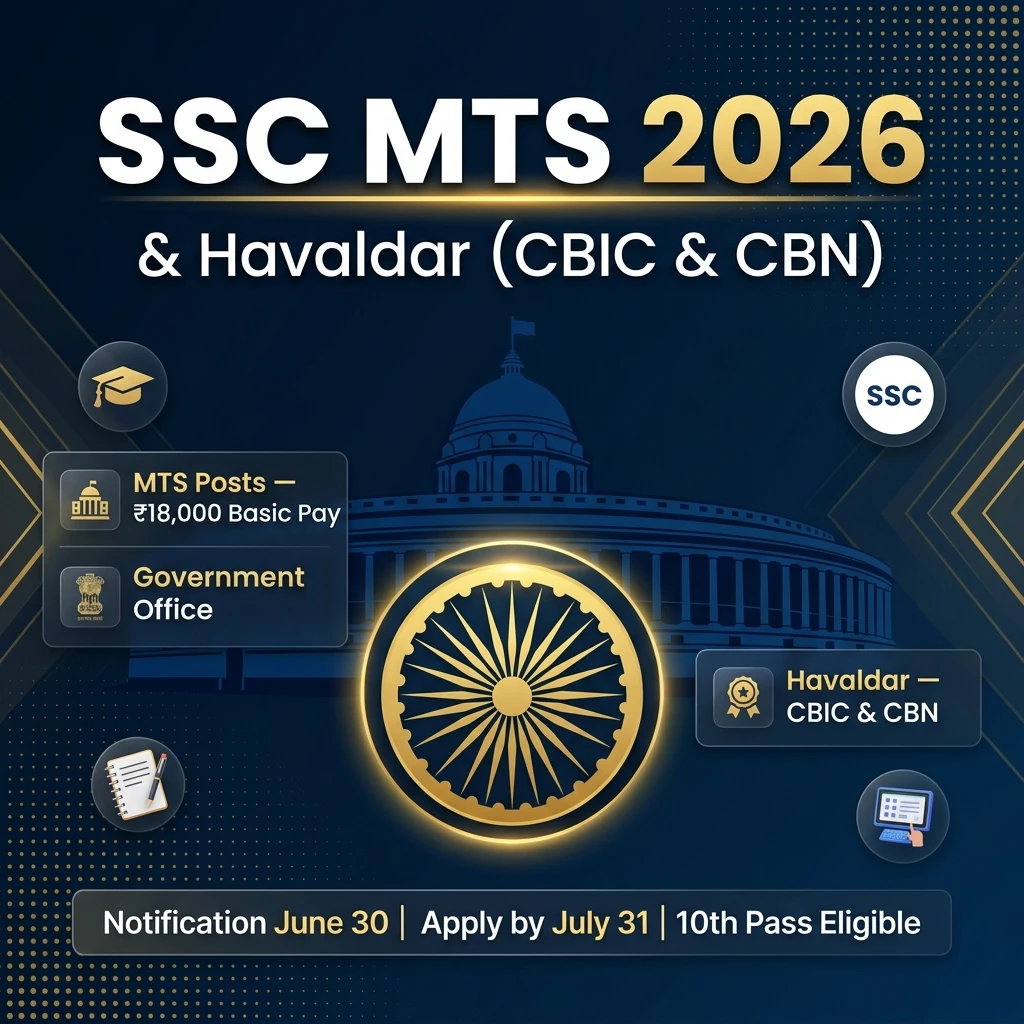
Introduction: SSC MTS 2026 — The Biggest Government Job Opportunity for 10th Pass Candidates
Every year, crores of 10th pass students across India ask one question: "What government job can I get with just Matriculation?" The answer, year after year, is the same: SSC MTS — the Staff Selection Commission Multi-Tasking Staff exam.
The SSC MTS & Havaldar (CBIC & CBN) 2026 notification is officially scheduled to release on June 30, 2026 — making this the most important recruitment announcement of the year for India's massive 10th-pass workforce.
Here is why SSC MTS 2026 is extraordinary:
- ✅ Minimum Qualification: Only 10th Pass (Matriculation) — no degree needed
- ✅ Age Limit: 18–25 years (MTS) and 18–27 years (Havaldar) — very wide range
- ✅ Vacancies: Thousands of posts across every state and union territory
- ✅ Salary: ₹25,000–₹35,000/month in-hand including all allowances
- ✅ Job Type: Permanent Central Government Group-C post
- ✅ Posting: In central government offices across India — near home possible
With application closing on July 31, 2026, and the Computer-Based Examination expected in September–November 2026, this guide gives you everything you need — from registration to final selection.
SSC MTS & Havaldar 2026: Key Highlights at a Glance
| Parameter | Details |
|---|---|
| Conducting Body | Staff Selection Commission (SSC) |
| Post Names | Multi-Tasking (Non-Technical) Staff (MTS) + Havaldar (CBIC & CBN) |
| Group & Category | Group-C, Non-Gazetted, Non-Ministerial |
| Official Website | ssc.gov.in |
| Notification Release | June 30, 2026 |
| Application Start | June 30, 2026 |
| Last Date to Apply | July 31, 2026 |
| Exam Mode | Computer-Based Examination (CBE) |
| Number of Sessions | 2 sessions in same day (Session 1 + Session 2) |
| Negative Marking | Session 1: NONE |
| Minimum Qualification | 10th Pass / Matriculation |
| Age Limit (MTS) | 18–25 years |
| Age Limit (Havaldar) | 18–27 years |
| Basic Pay | ₹18,000/month (Pay Level 1) |
| Gross Monthly Salary | ₹25,000–₹35,000 (including DA + HRA + TA) |
SSC MTS & Havaldar 2026: Important Dates
| Event | Date |
|---|---|
| Notification Release | June 30, 2026 |
| Online Application Opens | June 30, 2026 |
| Last Date to Apply | July 31, 2026 |
| Last Date for Fee Payment | July 31, 2026 |
| Application Correction Window | August 2026 (Expected — 5 to 7 days) |
| Admit Card Release | 2–3 weeks before exam |
| Computer-Based Examination | September to November 2026 |
| Answer Key Release | Within 1 week of exam |
| Result Declaration | 6–8 weeks after exam |
| PET/PST (Havaldar only) | After CBE result |
| Document Verification | After PET/PST (Havaldar) or CBE (MTS) |
| Final Allotment / Joining | 2027 (Expected) |
Important: Apply well before July 31 — SSC servers experience heavy traffic on the last 2–3 days. Submitting early avoids technical errors and fee payment failures.
SSC MTS & Havaldar 2026: Post Details
What is SSC MTS (Multi-Tasking Staff)?
MTS employees are Group-C, non-gazetted central government employees who provide general support services in various Union Government Ministries, Departments, and Offices. Their duties include:
- Filing, photocopying, and maintaining records
- Operating and maintaining office equipment (photocopier, fax, etc.)
- Delivering dak (mail/documents) within and outside the office
- Cleaning and maintenance of office premises
- Assisting in routine office operations
- Attending to visitors and guiding them
Posting: MTS employees can be posted in any ministry, department, or attached office of the Government of India across all states and union territories.
What is Havaldar (CBIC & CBN)?
The Havaldar post is specifically for two organizations:
-
CBIC (Central Board of Indirect Taxes and Customs): The apex body for Customs, GST, and Excise duties. Havaldars here work at Customs houses, inland container depots, and central excise offices.
-
CBN (Central Bureau of Narcotics): Under the Ministry of Finance, CBN controls narcotics. Havaldars here work at narcotic testing labs, enforcement offices, and field units.
Havaldar Duties:
- Guard duty at sensitive government premises
- Escorting valuables and official consignments
- Patrolling and security functions
- Assisting senior officers in field operations (CBN)
Key Difference from MTS: Havaldar is a more physically active role requiring physical fitness standards, while MTS is an office-support role.
SSC MTS & Havaldar 2026: Vacancy Breakdown
The exact vacancy count for 2026 will be declared in the official notification on June 30, 2026. Based on historical SSC MTS data:
Previous Year Vacancy Trends:
| Year | Total MTS Vacancies | Havaldar Vacancies | Total Combined |
|---|---|---|---|
| SSC MTS 2024 | ~8,200 | ~1,000 | ~9,200 |
| SSC MTS 2023 | ~11,409 | ~529 | ~11,938 |
| SSC MTS 2021 | ~7,301 | ~448 | ~7,749 |
Estimate for 2026: Based on government expansion trends, SSC MTS 2026 is expected to have 8,000–12,000+ vacancies across MTS and Havaldar posts combined. The exact number will be confirmed in the official notification.
Category-Wise Reservation:
| Category | Reservation |
|---|---|
| Unreserved (UR) | 40.5% |
| Other Backward Classes (OBC) | 27% |
| Scheduled Caste (SC) | 15% |
| Scheduled Tribe (ST) | 7.5% |
| Economically Weaker Section (EWS) | 10% |
State/Region-Wise Distribution:
SSC allocates vacancies across all regional SSC offices. Candidates apply region-wise based on their preferred exam centre state:
| SSC Region | States Covered |
|---|---|
| Central Region (CR) | UP, Uttarakhand, Bihar, Jharkhand |
| Eastern Region (ER) | West Bengal, Odisha, A&N Islands |
| Karnataka Kerala Region (KKR) | Karnataka, Kerala, Lakshadweep |
| Madhya Pradesh Region (MPR) | MP, Chhattisgarh |
| North Western Sub-Region (NWR) | Chandigarh, Punjab, Haryana, HP, J&K, Ladakh |
| Northern Region (NR) | Delhi, Rajasthan |
| North Eastern Region (NER) | Assam, Meghalaya, Manipur, Tripura, Nagaland, Arunachal, Mizoram, Sikkim |
| Southern Region (SR) | Andhra Pradesh, Tamil Nadu, Puducherry |
| South Western Region (SWR) | Goa, Maharashtra, Gujarat, Dadra & NH, D&D |
| Western Region (WR) | Maharashtra (remaining), Gujarat (remaining) |
SSC MTS & Havaldar 2026: Eligibility Criteria
Educational Qualification
| Post | Minimum Qualification |
|---|---|
| MTS (Multi-Tasking Staff) | Matriculation (10th Standard Pass) from a recognized Board |
| Havaldar (CBIC & CBN) | Matriculation (10th Standard Pass) from a recognized Board |
No higher education required. Candidates with 12th pass, graduation, or post-graduation degrees are all eligible — but the minimum requirement is only 10th pass. Over-qualified candidates frequently apply and get selected.
Age Limit (as on the cut-off date specified in the 2026 notification)
| Post | Minimum Age | Maximum Age |
|---|---|---|
| MTS | 18 years | 25 years |
| Havaldar (CBIC & CBN) | 18 years | 27 years |
Age Relaxation:
| Category | Relaxation |
|---|---|
| Scheduled Caste (SC) | 5 years |
| Scheduled Tribe (ST) | 5 years |
| OBC (Non-Creamy Layer) | 3 years |
| PwBD (General) | 10 years |
| PwBD (OBC) | 13 years |
| PwBD (SC/ST) | 15 years |
| Ex-Servicemen (General) | 3 years (after deducting service period) |
| Ex-Servicemen (OBC) | 6 years |
| Ex-Servicemen (SC/ST) | 8 years |
| Widow/Divorced Women (General) | Up to 35 years |
| Widow/Divorced Women (OBC) | Up to 38 years |
| Widow/Divorced Women (SC/ST) | Up to 40 years |
Nationality:
Candidates must be:
- A citizen of India, OR
- A subject of Nepal/Bhutan, OR
- A Tibetan refugee who came to India before January 1, 1962, OR
- A person of Indian origin migrated from Pakistan, Burma, Sri Lanka, East African Countries with intent to permanently settle in India
SSC MTS & Havaldar 2026: Application Fee
| Category | Fee |
|---|---|
| General / OBC / EWS | ₹100 |
| SC / ST / PwBD / Ex-Servicemen | Nil (Exempt) |
| All Women Candidates | Nil (Exempt) |
Payment Mode: Online — Net Banking, UPI, Credit/Debit Card. The fee is non-refundable (unlike RRB which refunds fee).
SSC MTS & Havaldar 2026: Selection Process
For MTS Posts:
Stage 1: Computer-Based Examination (CBE)
              ↓
Stage 2: Document Verification (DV)
              ↓
Stage 3: Medical Examination (if required)
For Havaldar (CBIC & CBN) Posts:
Stage 1: Computer-Based Examination (CBE)
              ↓
Stage 2: Physical Efficiency Test (PET) + Physical Standard Test (PST)
              ↓
Stage 3: Document Verification (DV)
              ↓
Stage 4: Medical Examination
Key Point: MTS has NO physical test. Havaldar candidates must pass PET/PST after clearing CBE.
SSC MTS & Havaldar 2026: Exam Pattern — Complete Breakdown
The Computer-Based Examination (CBE) consists of two mandatory sessions on the same day with a break in between.
Session 1 (Qualifying Only — No Negative Marking)
| Subject | No. of Questions | Maximum Marks | Duration |
|---|---|---|---|
| Numerical & Mathematical Ability | 20 | 60 | — |
| Reasoning Ability & Problem-Solving | 20 | 60 | 45 Minutes |
| Total | 40 | 120 | 45 Minutes |
Critical Rules for Session 1:
- ✅ NO negative marking — attempt all 40 questions
- ✅ Each question = 3 marks
- ✅ Purpose: Only to qualify, NOT for merit ranking
- ✅ Candidates scoring below the qualifying cut-off in Session 1 are NOT evaluated in Session 2
- ❌ Session 1 marks are NOT counted in the final merit list
Session 2 (Merit Determining — Negative Marking Applies)
| Subject | No. of Questions | Maximum Marks | Duration |
|---|---|---|---|
| General Awareness | 25 | 75 | — |
| English Language & Comprehension | 25 | 75 | 45 Minutes |
| Total | 50 | 150 | 45 Minutes |
Critical Rules for Session 2:
- ⚠️ Negative marking of 1 mark per wrong answer — do NOT guess blindly
- ✅ Each correct answer = 3 marks
- ✅ Session 2 marks determine the final merit rank and allocation of posts/states
- ✅ Final merit = Session 2 marks only
Overall Exam Summary:
| Session 1 | Session 2 | Total | |
|---|---|---|---|
| Questions | 40 | 50 | 90 |
| Marks | 120 | 150 | 270 |
| Duration | 45 min | 45 min | 90 min |
| Negative Marking | NO | YES (–1 mark) | — |
| Counts for Merit | NO | YES | — |
For PwBD candidates: Compensatory time of 20 minutes extra per session is provided (65 minutes per session instead of 45).
SSC MTS & Havaldar 2026: Physical Standards for Havaldar
Only candidates who clear the CBE are called for PET/PST for Havaldar posts.
Physical Efficiency Test (PET):
| Test | Male | Female |
|---|---|---|
| Walking | 1,600 metres in 15 minutes | 1 kilometre in 20 minutes |
| Cycling | 8 kilometres in 30 minutes | 3 kilometres in 25 minutes |
Candidates must pass BOTH walking AND cycling. Failure in either test = disqualification from Havaldar post (but eligible for MTS allocation if CBE marks qualify).
Physical Standard Test (PST):
| Standard | Male | Female |
|---|---|---|
| Height | Minimum 157.5 cm | Minimum 152 cm |
| Chest (Male only) | 76 cm (unexpanded) | N/A |
| Weight (Female only) | N/A | Minimum 48 kg |
Relaxation in Physical Standards:
| Community | Height Relaxation |
|---|---|
| Scheduled Tribe (ST) | 5 cm (Male: 152.5 cm) |
| Hilly/Tribal areas residents | 5 cm relaxation in height |
| PwBD candidates | Applicable relaxation as per post requirement |
SSC MTS & Havaldar 2026: Complete Subject-Wise Syllabus
Session 1 — Numerical & Mathematical Ability (20 Questions)
This section tests basic 10th-level mathematics:
Arithmetic (60–70% of questions):
- Number System (integers, fractions, decimals, HCF, LCM)
- Simplification (BODMAS rules)
- Ratio and Proportion
- Percentage
- Profit, Loss, and Discount
- Simple Interest and Compound Interest
- Time and Work
- Time, Speed, and Distance
- Average and Ages
- Mixtures and Alligations
Algebra & Geometry (20–25% of questions):
- Basic algebraic equations
- Triangles (Pythagoras theorem, properties)
- Circles (basic properties)
- Mensuration (area and perimeter of rectangles, squares, triangles, circles)
- Coordinate Geometry (basic plotting)
Statistics (5–10% of questions):
- Mean, Median, Mode
- Range, basic data interpretation (tables, bar graphs, pie charts)
Most Important Topics for MTS Maths (Based on PYQ Analysis):
- Percentage — 3–4 questions every exam
- Ratio & Proportion — 2–3 questions
- Profit & Loss — 2–3 questions
- SI/CI — 1–2 questions
- Time, Speed & Distance — 1–2 questions
Session 1 — Reasoning Ability & Problem-Solving (20 Questions)
Verbal Reasoning:
- Analogy (word-based and number-based)
- Odd One Out (Classification)
- Series (letter, number, mixed)
- Coding and Decoding
- Blood Relations
- Arrangement and Order (linear, circular)
- Direction and Distance
- Ranking and Comparison
- Mathematical Operations (BODMAS logic)
- Syllogism (basic)
- Venn Diagram
- Missing Number in a Matrix
Non-Verbal Reasoning:
- Mirror Image and Water Image
- Figure Completion
- Paper Folding and Cutting
- Embedded Figures
- Counting Figures (triangles, squares, rectangles)
- Pattern Completion
High-Scoring Reasoning Topics (PYQ-Based):
- Analogy — 3–5 questions guaranteed
- Series — 3–4 questions
- Mirror Image — 2–3 questions
- Odd One Out — 2–3 questions
- Coding-Decoding — 2 questions
Session 2 — General Awareness (25 Questions)
This section carries the highest mark value for merit and is often the biggest differentiator:
Indian History (3–4 questions):
- Ancient India (Indus Valley Civilization, Vedic Age, Maurya Empire, Gupta Empire)
- Medieval India (Delhi Sultanate, Mughal Empire, Vijayanagara, Maratha Empire)
- Modern India (British rule, freedom struggle, independence movement, key events 1857–1947)
- Important historical figures (Gandhi, Nehru, Bhagat Singh, Subhas Chandra Bose, etc.)
Indian Geography (3–4 questions):
- Physical geography (Himalayas, rivers, lakes, plateaus, plains)
- Climate of India (monsoon, seasons)
- Natural resources (minerals, forests, agriculture)
- National Parks and Wildlife Sanctuaries
- Important dams and rivers
- States and capitals, UT and capitals
Indian Polity & Constitution (3–4 questions):
- Preamble, Fundamental Rights, Directive Principles
- Parliament (Lok Sabha, Rajya Sabha) — composition and powers
- President, Vice President, Prime Minister — roles
- Supreme Court and High Courts
- Constitutional Amendments (key ones: 42nd, 44th, 73rd, 74th, 86th, etc.)
- Emergency Provisions
- Panchayati Raj
Indian Economy (2–3 questions):
- Budget terminology (fiscal deficit, revenue deficit, GDP, GNP, NNP)
- Government schemes (PM Awas Yojana, Ayushman Bharat, MGNREGA, etc.)
- Reserve Bank of India (functions, monetary policy)
- Five-year plans (brief overview)
- WTO, IMF, World Bank — basic knowledge
General Science (3–4 questions):
- Physics (Newton's Laws, motion, heat, light, electricity basics)
- Chemistry (elements, compounds, acids/bases, common chemical reactions)
- Biology (human body systems, cell, diseases, nutrition, vitamins)
- Inventions and Inventors
- Scientific instruments
Current Affairs (5–6 questions — highest single weightage):
- National news (government decisions, inaugurations, appointments)
- International affairs (summits, treaties, foreign policy)
- Awards and Honours (Nobel Prize, Padma Awards, Bharat Ratna, sports awards)
- Sports news (Olympics, Cricket, FIFA, Commonwealth Games)
- Science and Technology (ISRO missions, AI, satellites, defence tech)
- Books and Authors
- Deaths of notable personalities
Strategy for GK: Current affairs from the last 6 months before exam date carry maximum questions. Supplement with Lucent's GK for static topics.
Session 2 — English Language & Comprehension (25 Questions)
Note: Session 2 English is available only in English (not in regional languages). This is the primary reason many candidates lose marks — English must be genuinely prepared.
Vocabulary (8–10 questions):
- Synonyms (choose the word with closest meaning)
- Antonyms (choose the word with opposite meaning)
- One-Word Substitution (one word for a phrase/definition)
- Idioms and Phrases (meaning of common idiomatic expressions)
- Correct Spelling (identify correctly/incorrectly spelled word)
Grammar (8–10 questions):
- Parts of Speech (Noun, Pronoun, Verb, Adjective, Adverb, Preposition, Conjunction, Interjection)
- Tenses (identify and correct tense errors)
- Subject-Verb Agreement (singular/plural errors)
- Articles (a/an/the — usage)
- Prepositions (in/on/at/by/for/with — usage)
- Voice (Active to Passive and vice versa)
- Narration (Direct to Indirect and vice versa)
- Sentence Improvement (choose the best grammatical version)
- Error Spotting (identify the erroneous part in a sentence)
- Fill in the Blanks (choose the correct word to complete)
Reading Comprehension (5–7 questions):
- A short passage (100–150 words) with 4–5 questions
- Questions test: main idea, specific details, vocabulary in context, inference
High-Scoring English Topics:
- Fill in the Blanks — 3–5 questions (easiest to score)
- Error Spotting — 3–4 questions
- Synonyms/Antonyms — 4–6 questions combined
- Reading Comprehension — 4–5 questions (time-consuming but predictable)
SSC MTS & Havaldar 2026: Salary & Benefits — Complete Details
Basic Pay and Pay Level:
Both MTS and Havaldar posts are under the 7th Pay Commission Pay Level 1:
| Component | Amount |
|---|---|
| Basic Pay (Level 1) | ₹18,000/month |
| Dearness Allowance (DA @ 55%) | ₹9,900/month |
| HRA — X City (30% of Basic) | ₹5,400/month |
| HRA — Y City (20% of Basic) | ₹3,600/month |
| HRA — Z City (10% of Basic) | ₹1,800/month |
| Transport Allowance (X City) | ₹1,350/month |
| Transport Allowance (Y/Z City) | ₹900/month |
| Gross Salary (X City) | ~₹34,650/month |
| Gross Salary (Y City) | ~₹32,400/month |
| Gross Salary (Z City) | ~₹30,600/month |
X Cities (highest HRA): Delhi, Mumbai, Kolkata, Chennai, Hyderabad, Bengaluru
Y Cities (medium HRA): All state capitals and cities with population 5 lakh+
Z Cities (lowest HRA): All remaining towns and rural areas
Under 8th Pay Commission (Expected 2026–27):
The 8th Pay Commission is expected to be implemented from January 2026. With a projected fitment factor of 2.86:
| Component | Current (7th CPC) | Expected (8th CPC) |
|---|---|---|
| Basic Pay | ₹18,000 | ₹51,480 |
| Gross Salary (X City) | ~₹34,650 | ~₹80,000+ |
This would make SSC MTS one of the highest-paying 10th-pass government jobs in the country after the 8th Pay Commission revision.
Additional Perks and Benefits:
| Benefit | Details |
|---|---|
| Job Security | Permanent Central Government job — near-impossible to be terminated |
| Pension | National Pension Scheme (NPS) — Government contributes 14% of basic pay |
| Medical Facilities | CGHS (Central Government Health Scheme) for self and family |
| Leave Entitlement | 8 Casual Leaves + 30 Earned Leaves + Half-Pay Leave + Medical Leave/year |
| Gratuity | After 5 years of service — up to 16.5x basic pay |
| Provident Fund | Government contributes 14% additionally toward NPS |
| Holidays | 17 Gazetted holidays + 2 Restricted holidays per year |
| Annual Increment | 3% guaranteed annual increment on basic pay |
| Promotion Path | MTS → LDC (Lower Division Clerk) → UDC → Inspector level (through departmental exams) |
| Transfer | Usually within state/region of posting preference |
SSC MTS & Havaldar 2026: Previous Year Cut-Off Analysis
SSC MTS cut-offs are state-wise and category-wise, not a single national cut-off. Below are reference ranges based on SSC MTS 2023 and 2024:
Session 2 Cut-Off Range (out of 150 marks):
| State/Category | General (UR) | OBC | SC | ST | EWS |
|---|---|---|---|---|---|
| Delhi/NCR | 110–125 | 100–115 | 90–105 | 80–95 | 105–120 |
| Uttar Pradesh | 105–120 | 95–110 | 85–100 | 75–90 | 100–115 |
| Maharashtra | 100–115 | 90–105 | 80–95 | 72–87 | 95–110 |
| Karnataka | 95–110 | 87–102 | 78–93 | 70–85 | 90–105 |
| Tamil Nadu | 95–112 | 88–103 | 80–95 | 70–85 | 90–108 |
| West Bengal | 100–118 | 92–108 | 82–98 | 74–88 | 95–112 |
| Bihar/Jharkhand | 100–115 | 90–105 | 80–95 | 72–87 | 95–112 |
| Rajasthan | 98–113 | 88–103 | 78–93 | 70–85 | 93–108 |
| North East States | 80–95 | 72–87 | 65–78 | 58–72 | 75–90 |
Important: These are estimates based on historical data. Actual 2026 cut-offs depend on: number of vacancies in each state, paper difficulty level, total candidates who appeared, and normalisation (if multiple shifts are conducted).
Key Insight — What Matters for Ranking:
Since Session 2 is the only merit-determining factor (150 marks total — 75 GK + 75 English), your score out of 150 decides everything. The candidate who scores higher in Session 2 gets:
- Higher state preference (allocated to more preferred state)
- Better ministry/department allocation
- Havaldar post over MTS (if physically fit)
Realistic Target:
- For General/OBC in competitive states (Delhi, UP, Maharashtra): Score 115+/150 in Session 2
- For SC/ST in any state: Score 80+/150 in Session 2
- For North-East/Hilly states: Score 75+/150 in Session 2
SSC MTS & Havaldar 2026: How to Apply Online — Step-by-Step
Step 1: One-Time Registration (OTR) on ssc.gov.in
If you have NOT registered on the new SSC portal before:
- Go to ssc.gov.in
- Click on "One-Time Registration" (OTR)
- Enter your name (as on Aadhaar), DOB, Aadhaar number, mobile number, email ID
- Verify via OTP
- Upload photo and signature
- Complete your OTR profile — save your OTR ID
Returning candidates: If you registered for any previous SSC exam, your OTR ID is already created. Log in with OTR ID and password.
Step 2: Apply for SSC MTS & Havaldar 2026
- Log in with OTR ID
- Find "SSC MTS & Havaldar 2026" notification and click "Apply"
- Select your preferred post: MTS / Havaldar / Both (if eligible)
- Select preferred exam region and state
- Select preferred exam language (English, Hindi, or regional language — Session 1 only; Session 2 English is compulsory in English)
Step 3: Pay Application Fee
- General/OBC/EWS: ₹100
- SC/ST/PwBD/Women/Ex-Servicemen: FREE
- Payment modes: Net Banking / UPI / Debit Card / Credit Card
Step 4: Final Submission
- Review all details carefully
- Submit the application
- Download and save the confirmation page (PDF)
- Note your Application Number
Correction Window: SSC usually opens a 5–7 day window to correct errors (except name, DOB, and category). Use this to fix any mistake instead of submitting a new application.
SSC MTS vs SSC Havaldar: Which One Should You Choose?
Many candidates are confused about whether to apply for MTS, Havaldar, or both. Here is a clear comparison:
| Factor | MTS Post | Havaldar Post |
|---|---|---|
| Work Nature | Office support, filing, clerical assistance | Security/guard duties, patrolling, field work |
| Physical Fitness Test | NOT required | Required (walking + cycling + height/weight) |
| Age Limit | 18–25 years | 18–27 years |
| Posting | In any Government ministry/department | CBIC or CBN offices (Customs, GST, Narcotics) |
| Uniform | No uniform (civilian attire) | Uniform required |
| Work Hours | Standard office hours (9 AM–6 PM) | Shift duties possible |
| Promotion Path | MTS → LDC → UDC → Inspector | Havaldar → Head Havaldar → Inspector |
| Preferred For | Those who want office work, stable hours | Those who are physically fit, prefer field roles |
Recommendation: Apply for BOTH MTS and Havaldar (if you meet the age and physical standards for Havaldar). Higher Session 2 scores first go to Havaldar allocation (if PET/PST passed), then remaining to MTS. Applying for both maximizes your chances.
SSC MTS 2026: Preparation Strategy
For Beginners (3+ Months Before Exam):
Month 1: Foundation — Master Session 1 Subjects
Maths (Numerical & Mathematical Ability — 20 questions, 60 marks):
- Week 1: Number System, LCM/HCF, BODMAS, Simplification (15 questions/day)
- Week 2: Percentage, Profit/Loss, Discount, SI/CI (20 questions/day)
- Week 3: Ratio/Proportion, Averages, Ages, Time-Work (20 questions/day)
- Week 4: Time-Speed-Distance, Mensuration basics, PYQ revision (25 questions/day)
Reasoning (20 questions, 60 marks):
- Week 1: Analogy, Series, Classification (30 questions/day)
- Week 2: Coding-Decoding, Blood Relations, Direction & Distance (25 questions/day)
- Week 3: Mirror Image, Water Image, Paper Folding, Figure Completion (25 questions/day)
- Week 4: Mixed PYQ practice (30 questions/day)
GK (Static — foundation for Session 2):
- Start Lucent's GK — read Indian History chapter in Week 1-2
- Read Indian Geography in Week 3-4
- 15 minutes daily is enough at this stage
Month 2: Session 2 — English and GK Deep Dive
English (25 questions, 75 marks — entire Session 2 English marks):
- Week 1: Vocabulary — Synonyms/Antonyms (30 words/day using word lists)
- Week 2: Grammar — Tenses, Subject-Verb Agreement, Articles, Prepositions
- Week 3: Sentence Improvement, Error Spotting, Fillers
- Week 4: Reading Comprehension practice (2 passages/day) + full PYQ revision
GK — Current Affairs + Static:
- Daily: Read one current affairs summary (15–20 minutes) — AffairsCloud monthly PDF
- Weekly: One chapter of Lucent's GK (Polity → Economy → Science)
- Target: Cover 6 months of current affairs before exam
Month 3: Integration and Mock Tests
| Week | Focus |
|---|---|
| Week 1 | Session 1 full-length mocks (attempt all 40 questions — no negative marking) |
| Week 2 | Session 2 focused practice (GK + English combined — 50 Qs in 45 minutes) |
| Week 3 | Full-length exam simulation (Session 1 + break + Session 2 in one sitting) |
| Week 4 | Weak area revision + final 3 PYQ papers complete |
Daily Routine (3-Month Plan):
| Time | Activity | Duration |
|---|---|---|
| Morning | Maths (arithmetic problems) | 1 hour |
| Late Morning | Reasoning (mixed practice) | 45 minutes |
| Afternoon | English (grammar/vocabulary) | 1 hour |
| Evening | Current Affairs + GK reading | 30 minutes |
| Night | Mock test (alternate days) OR previous day revision | 45 minutes |
Last-Minute Strategy (1 Month or Less Before Exam):
If you have only 4 weeks:
Week 1: Session 1 only — Master Maths and Reasoning using PYQ papers Week 2: Session 2 only — Do all SSC MTS previous year GK and English questions Week 3: 1 full mock daily + 30-min GK capsule daily Week 4: Revision only — formulas, word lists, important static GK facts. No new topics.
Best Books and Resources for SSC MTS 2026
Recommended Books:
| Subject | Book Title | Author / Publisher |
|---|---|---|
| Mathematics | Fast Track Objective Arithmetic | Rajesh Verma / Arihant |
| Mathematics | Quantitative Aptitude | R.S. Aggarwal / S. Chand |
| Reasoning | Modern Approach to Verbal & Non-Verbal Reasoning | R.S. Aggarwal |
| English Grammar | Plinth to Paramount (Vol. 1 & 2) | Neetu Singh / KD Campus |
| English Vocabulary | Word Power Made Easy | Norman Lewis |
| General Awareness | Lucent's General Knowledge | B.B. Mishra |
| Current Affairs | AffairsCloud Monthly PDF | Free download |
| Complete SSC MTS Guide | SSC MTS & Havaldar Exam Guide | Arihant / Kiran Publication |
| Previous Year Papers | SSC MTS PYQ Chapterwise | Kiran Prakashan |
Online Platforms for Practice:
| Platform | Best Feature |
|---|---|
| Testbook.com | SSC-specific mock tests, huge PYQ bank |
| Adda247.com | Free and paid SSC MTS full-length tests |
| Oliveboard.in | High-quality CBE interface simulation |
| Gradeup/BYJU'S Exam Prep | Daily GK quizzes + English grammar |
| AffairsCloud.com | Free current affairs — daily + monthly PDF |
SSC MTS 2026: Sample Questions with Explanations
Maths — Session 1:
Q1. If a shopkeeper sells 12 items for ₹8, how much profit or loss percentage does he make if he bought 8 items for ₹8?
- (A) 25% profit
- (B) 50% profit
- (C) 33.33% loss
- (D) 50% loss
Answer: (B) 50% profit Cost price of 12 items = 12 × (8/8) = ₹12. Selling price of 12 items = 12 × (8/12) = ₹8. Wait — let's recalculate: CP of 8 items = ₹8, so CP per item = ₹1. SP of 12 items = ₹8, so SP per item = ₹8/12 = ₹0.67. Loss! Let's use the simpler version: CP per dozen = ₹8. SP per dozen = ₹12. Profit = ₹4. Profit% = 4/8 × 100 = 50%.
Q2. Find the LCM of 12, 18, and 24.
- (A) 72
- (B) 36
- (C) 48
- (D) 144
Answer: (A) 72 12 = 2² × 3. 18 = 2 × 3². 24 = 2³ × 3. LCM = 2³ × 3² = 8 × 9 = 72.
Reasoning — Session 1:
Q3. In a code language, FLOWER = REWOLF. What is GARDEN in that code?
- (A) NEDRAG
- (B) NEGARD
- (C) DRAGEN
- (D) REDNAG
Answer: (A) NEDRAG Pattern: Word is reversed. FLOWER → REWOLF (reversed). GARDEN → NEDRAG (reversed).
General Awareness — Session 2:
Q4. The Preamble of the Indian Constitution was amended by which Constitutional Amendment Act?
- (A) 24th Amendment Act
- (B) 42nd Amendment Act
- (C) 44th Amendment Act
- (D) 86th Amendment Act
Answer: (B) 42nd Amendment Act (1976) The 42nd Constitutional Amendment Act (1976) added the words "Socialist," "Secular," and "Integrity" to the Preamble of the Indian Constitution.
Q5. Which of the following is NOT a UNESCO World Heritage Site in India?
- (A) Qutub Minar, Delhi
- (B) Kaziranga National Park, Assam
- (C) Lal Quila (Red Fort), Delhi
- (D) Jim Corbett National Park, Uttarakhand
Answer: (D) Jim Corbett National Park Jim Corbett National Park is NOT a UNESCO World Heritage Site (it is famous as India's first national park). Qutub Minar, Kaziranga National Park, and Lal Quila (Red Fort) are all UNESCO World Heritage Sites.
English — Session 2:
Q6. Choose the word most opposite in meaning to: BENEVOLENT
- (A) Generous
- (B) Malevolent
- (C) Peaceful
- (D) Indifferent
Answer: (B) Malevolent BENEVOLENT means well-wishing, kind, charitable. Its antonym is MALEVOLENT — wishing harm to others, evil-intentioned.
Q7. Fill in the blank: The committee ______ a decision after a long deliberation.
- (A) reached
- (B) did
- (C) made
- (D) took
Answer: (C) made The correct collocation is "made a decision." "Took a decision" is also acceptable in British English, but "made" is the standard SSC preference. "Reached a decision" and "took a decision" are both valid in real usage but SSC typically expects "made a decision."
Common Mistakes SSC MTS Aspirants Make
Mistake 1: Attempting All Session 2 Questions Carelessly
Session 2 has negative marking of 1 mark per wrong answer with 3 marks per correct answer. One wrong answer cancels the benefit of one correct answer and costs you 2 net marks. Strategy: Skip a question if you cannot eliminate at least 2 wrong options.
Mistake 2: Not Qualifying Session 1 Seriously
Many candidates think "Session 1 doesn't count for merit, so I'll skip difficult questions." Wrong — you must qualify Session 1 to have Session 2 marks counted. Target: Attempt all 40 Session 1 questions (no negative marking) and score the minimum qualifying marks.
Mistake 3: Ignoring Current Affairs
General Awareness has 25 questions — and 5–7 of them are typically current affairs from the last 6 months. These are "free marks" for candidates who read news daily. A 15-minute daily current affairs habit can add 15–21 marks to your Session 2 score.
Mistake 4: Weak English Preparation
Many candidates from Hindi-medium backgrounds skip English preparation. But English has 25 questions in Session 2 — that's 75 marks out of 150. You CANNOT clear state cut-offs by ignoring English. Focus on vocabulary (synonyms, antonyms, one-word substitution) and basic grammar — these alone cover 15–18 questions.
Mistake 5: Not Applying Region-Wise Strategically
Different SSC regions have very different cut-offs. For example, North East region cut-offs are typically 20–30 marks lower than Delhi or Maharashtra cut-offs for the same category. If you are willing to work anywhere, apply strategically.
SSC MTS vs Other 10th Pass Government Jobs: Comparison
| Feature | SSC MTS 2026 | RRB Group D | Post Office GDS | SSC GD Constable |
|---|---|---|---|---|
| Qualification | 10th Pass | 10th Pass | 10th Pass | 10th Pass |
| Age Limit | 18–25 (MTS) | 18–33 | 18–40 | 18–23 |
| Physical Test | NO (MTS) | YES (PET) | NO | YES (PET/PST) |
| Salary | ₹18,000 (Level 1) | ₹18,000 (Level 1) | ₹12,000–₹29,380 (TRCA) | ₹21,700 (Level 3) |
| Job Nature | Office work | Railway duties | Delivery/postal | Armed forces |
| Vacancies (2026) | 8,000–12,000 | — | ~44,000 (GDS) | — |
| Competition | Very High | High | Very High | Very High |
| Exam Difficulty | Moderate | Easy-Moderate | Easy | Moderate |
Best Choice for Who:
- Want office environment + central gov't job: SSC MTS
- Want better long-term salary + promotion: SSC GD Constable (higher pay scale)
- Want easiest exam with most vacancies: Post Office GDS
- Have ITI qualification too: RRB Technician Grade 3 (better pay)
Career Growth Path After Joining as SSC MTS
Promotion Ladder:
MTS (Level 1 — ₹18,000 Basic)
         ↓ (through Departmental Exam or Seniority)
Lower Division Clerk / LDC (Level 2 — ₹19,900 Basic)
         ↓ (Departmental exam — LDCE)
Upper Division Clerk / UDC (Level 4 — ₹25,500 Basic)
         ↓ (Departmental exam / seniority)
Assistant (Level 6 — ₹35,400 Basic)
         ↓ (Selection grade)
Section Officer (Level 7 — ₹44,900 Basic)
         ↓
Under Secretary → Deputy Secretary → Director
Internal Departmental Exam (LDCE) for MTS:
- MTS employees who have completed 2 years of service and passed 12th standard are eligible to appear for the departmental exam to become LDC
- This is the most common promotion path and many MTS employees become LDC within 3–5 years
- From LDC, the path to Assistant/Section Officer is well-established
Salary Growth Over a Career (MTS Entry):
| Years of Service | Grade/Level | Basic Pay | Gross Salary (Y-City) |
|---|---|---|---|
| Entry | MTS Level 1 | ₹18,000 | ~₹32,400 |
| 5 years | MTS + increments | ₹20,800 | ~₹36,200 |
| 8 years | LDC Level 2 | ₹22,000 | ~₹39,000 |
| 12 years | UDC Level 4 | ₹29,200 | ~₹52,000 |
| 18 years | Assistant Level 6 | ₹44,900 | ~₹78,000 |
| 25 years | Section Officer Level 7 | ₹53,100 | ~₹90,000 |
Frequently Asked Questions — SSC MTS & Havaldar 2026
Q1. Can I apply for both MTS and Havaldar in SSC MTS 2026? Yes. A single application form lets you opt for both posts. Your CBE marks determine merit, and if you clear PET/PST for Havaldar, you get priority allocation for Havaldar posts. If you do not clear PET/PST, you remain eligible for MTS allocation.
Q2. Is there any interview in SSC MTS 2026? No. There is absolutely no interview. Final selection is based only on: CBE Session 2 merit + PET/PST (for Havaldar) + Document Verification.
Q3. Is SSC MTS a transferable job? Yes. Like all central government posts, MTS employees can be transferred. However, transfers are usually within the same ministry/department and often within the same region or state. Most employees spend their entire career in the state they were posted in initially.
Q4. Is SSC MTS a gazetted post? No. SSC MTS is a non-gazetted post. Gazetted posts typically start from Grade Pay 4200 (Pay Level 6) and above.
Q5. Can I join MTS and simultaneously prepare for SSC CGL or UPSC? Yes. Many SSC MTS employees prepare for higher-level exams. You get study leave provisions (Half Pay Leave can be used), reasonable working hours, and job security that allows continued preparation. This is actually one of the strategic advantages of joining MTS — financial security while preparing for higher exams.
Q6. What is the difference between SSC MTS and SSC CHSL? SSC CHSL (10+2) requires 12th pass and offers posts like Lower Division Clerk, Postal Assistant, Data Entry Operator at Pay Level 2–4 (₹19,900–₹25,500 basic). SSC MTS requires only 10th pass and offers posts at Pay Level 1 (₹18,000 basic). MTS has lower pay but lower qualification, while CHSL has higher pay and better posting profiles.
Q7. How many attempts are allowed for SSC MTS? There is NO limit on the number of attempts — you can apply every year as long as you meet the age criteria. Once you cross the upper age limit (25 years for MTS general category), you can no longer apply.
Q8. What is the posting preference — can I choose my state? During the application, you select your preferred exam centre state. SSC tries to post candidates in their preferred region, but final posting depends on vacancy distribution and merit rank. There is no guarantee of home-state posting.
Exam Day Guide for SSC MTS 2026
What to Carry:
| Item | Details |
|---|---|
| Admit Card | Printed clearly on A4 paper (colour or B&W both fine) |
| Photo ID (Original) | Aadhaar / Voter ID / Passport / PAN Card / Driving Licence |
| 2 Passport Photos | Same as uploaded during registration |
| Pen | For rough work (if rough sheet is provided) |
| Water Bottle | Transparent plastic only |
Prohibited Items:
❌ Mobile phone / smartwatch / digital watch
❌ Bluetooth or wireless earphones
❌ Calculator
❌ Books, notes, or study material
❌ Any electronic device
❌ Wallet with metallic objects
Smart Strategy for SSC MTS CBE:
Session 1 (45 minutes, 40 questions, NO negative marking):
- Attempt ALL 40 questions — there is zero risk
- Spend 30 seconds per easy question, up to 90 seconds for harder ones
- Target: 36–40/40 questions attempted (aim for 100% attempt rate)
Break between sessions: Use it wisely
- Do NOT discuss answers with other candidates
- Refresh your GK notes mentally (current affairs, dates, awards)
- Eat something light if the break allows
Session 2 (45 minutes, 50 questions, WITH negative marking):
- Do NOT attempt questions you are not confident about
- Recommended order: GK first (faster) → English second
- GK: 20 minutes for 25 questions (48 seconds/question)
- English: 22 minutes for 25 questions (52 seconds/question — Reading Comprehension takes more time)
- Last 3 minutes: Review marked-for-review questions
SSC MTS 2026: Mathematics Quick Formula Sheet
Master these formulas for Session 1 — the most frequently tested shortcuts in SSC MTS:
Percentage Shortcuts:
- % increase = (Increase / Original) × 100
- % decrease = (Decrease / Original) × 100
- Price × Quantity = Expenditure — if price increases by x%, quantity must decrease by x/(100+x) × 100% to keep expenditure same
- Successive % change: A% then B% net = A + B + AB/100
Profit & Loss Shortcuts:
- Profit% = (Profit / CP) × 100
- SP = CP × (100 + Profit%) / 100
- CP = SP × 100 / (100 + Profit%)
- If SP of X articles = CP of Y articles → Profit% = (Y–X)/X × 100
- Dishonest trader using false weight: Profit% = (True weight – False weight) / False weight × 100
Simple & Compound Interest:
- SI = P × R × T / 100
- CI = P × (1 + R/100)ⁿ – P
- Difference between CI and SI for 2 years = P × (R/100)²
- Difference between CI and SI for 3 years = P × R²(300+R) / 100³
Time, Speed & Distance:
- Speed = Distance / Time
- Average speed for equal distances at S1 and S2 = 2S1×S2 / (S1+S2)
- Relative speed: Same direction = S1 – S2 | Opposite direction = S1 + S2
- Time for train to cross a pole = Length of train / Speed
- Time for train to cross a platform = (Length of train + Length of platform) / Speed
Time & Work:
- If A does work in X days, A's 1 day work = 1/X
- A and B together: 1 day work = 1/A + 1/B → Together complete in AB/(A+B) days
- Pipe filling: If A fills in X hrs, B drains in Y hrs → Net = XY/(Y–X) hrs (if Y>X)
Ratio & Proportion:
- If A:B = m:n, then A = m/(m+n) × Total | B = n/(m+n) × Total
- Compound ratio of a:b and c:d = ac:bd
- If A:B = 2:3 and B:C = 4:5, then A:B:C = 8:12:15
Mensuration Quick Reference:
| Shape | Area | Perimeter |
|---|---|---|
| Rectangle | l × b | 2(l + b) |
| Square | a² | 4a |
| Triangle | ½ × b × h | a + b + c |
| Circle | πr² | 2πr |
| Trapezium | ½(a+b)×h | sum of all sides |
| Shape | Volume | Surface Area |
|---|---|---|
| Cube | a³ | 6a² |
| Cuboid | l×b×h | 2(lb+bh+lh) |
| Cylinder | πr²h | 2πr(r+h) |
| Cone | ⅓πr²h | πr(l+r) |
| Sphere | 4/3πr³ | 4πr² |
SSC MTS 2026: English Grammar Quick Reference
The most commonly tested grammar rules in SSC MTS — memorise these before exam day:
Tenses — Most Common Errors:
| Tense | Formula | Example |
|---|---|---|
| Simple Present | Subject + V1 (s/es) | He works hard. |
| Present Continuous | Subject + is/am/are + V-ing | She is studying. |
| Simple Past | Subject + V2 | They played cricket. |
| Past Continuous | Subject + was/were + V-ing | He was sleeping. |
| Simple Future | Subject + will/shall + V1 | I will go tomorrow. |
| Present Perfect | Subject + has/have + V3 | She has finished. |
| Past Perfect | Subject + had + V3 | He had left before I came. |
Subject-Verb Agreement — Key Rules:
- Two singular subjects joined by "and" → Plural verb: Ram and Shyam are friends.
- "Either/Neither...or/nor" → verb agrees with nearest subject: Neither the boys nor the girl has come.
- Collective nouns → Singular verb: The committee has decided.
- "Each/Every/Either/Neither" → always Singular verb: Each of the students was present.
- Indefinite pronouns (everyone, someone, no one) → Singular: Everyone is happy.
Articles — Key Rules:
- Use "a" before consonant sounds: a university (you-sound), a one-day match (wun-sound)
- Use "an" before vowel sounds: an hour (silent H), an honest man
- Use "the" before: superlatives (the best), unique things (the sun), specific things already mentioned
Active to Passive Voice — Formula:
- Active: Subject + Verb + Object
- Passive: Object + helping verb (be) + V3 + by + Subject
- Example: Ram writes a letter → A letter is written by Ram
Common One-Word Substitutions (High Frequency in SSC):
| Phrase | One-Word |
|---|---|
| One who cannot die | Immortal |
| One who hates women | Misogynist |
| One who hates mankind | Misanthrope |
| One who can speak two languages | Bilingual |
| One who eats both plants and animals | Omnivore |
| Fear of water | Hydrophobia |
| Fear of heights | Acrophobia |
| Murder of one's father | Patricide |
| Murder of one's mother | Matricide |
| A place where aircraft are kept | Hangar |
| Written by hand | Manuscript |
| One who studies stars and planets | Astronomer |
| Government by the people | Democracy |
| Government by the rich | Plutocracy |
High-Frequency Synonyms & Antonyms (SSC PYQ-Based):
| Word | Synonym | Antonym |
|---|---|---|
| Benevolent | Charitable, Generous | Malevolent, Cruel |
| Candid | Frank, Honest | Deceitful, Evasive |
| Diligent | Industrious, Hardworking | Lazy, Idle |
| Eloquent | Fluent, Articulate | Inarticulate, Mumbling |
| Frugal | Thrifty, Economical | Wasteful, Extravagant |
| Gullible | Naïve, Credulous | Skeptical, Cynical |
| Hostile | Unfriendly, Antagonistic | Friendly, Amicable |
| Impeccable | Flawless, Perfect | Flawed, Imperfect |
| Jovial | Cheerful, Merry | Gloomy, Melancholy |
| Knave | Rogue, Villain | Honest person, Saint |
| Lucid | Clear, Transparent | Vague, Obscure |
| Meticulous | Careful, Precise | Careless, Negligent |
SSC MTS 2026: General Awareness — Must-Know Static GK
This static GK is tested repeatedly across SSC exams. Master it before the exam:
Indian Constitution — Key Articles:
| Article | Subject |
|---|---|
| Article 14 | Right to Equality |
| Article 19 | Right to Freedom (6 freedoms) |
| Article 21 | Right to Life and Personal Liberty |
| Article 21A | Right to Education (6-14 years) |
| Article 32 | Right to Constitutional Remedies (Dr Ambedkar called it "Heart of Constitution") |
| Article 40 | Directive: Organise Village Panchayats |
| Article 44 | Uniform Civil Code |
| Article 51A | Fundamental Duties (11 duties — added by 42nd Amendment) |
| Article 112 | Union Budget |
| Article 123 | President's Ordinance power |
| Article 352 | National Emergency |
| Article 356 | President's Rule in state |
| Article 360 | Financial Emergency |
| Article 370 | (Now abrogated) Special status of J&K |
Important Constitutional Amendments:
| Amendment | Year | What Changed |
|---|---|---|
| 1st | 1951 | Land reform — 9th Schedule added |
| 7th | 1956 | Reorganisation of states |
| 24th | 1971 | Parliament can amend Fundamental Rights |
| 42nd | 1976 | "Socialist, Secular, Integrity" added to Preamble |
| 44th | 1978 | Right to Property removed from Fundamental Rights |
| 52nd | 1985 | Anti-defection law added |
| 61st | 1989 | Voting age reduced from 21 to 18 years |
| 73rd | 1992 | Panchayati Raj — constitutional status |
| 74th | 1992 | Urban local bodies — constitutional status |
| 86th | 2002 | Article 21A — Free and compulsory education |
| 101st | 2016 | GST introduced |
| 103rd | 2019 | 10% EWS reservation |
India's Important Firsts:
| First | Person/Place |
|---|---|
| First Prime Minister of India | Jawaharlal Nehru |
| First President of India | Dr. Rajendra Prasad |
| First Woman Prime Minister | Indira Gandhi |
| First Woman President | Pratibha Patil |
| First Chief Justice of India | Harilal Jekisundas Kania |
| First INA Woman Soldier | Lakshmi Sahgal |
| First Indian in Space | Rakesh Sharma (1984) |
| First Indian to win Nobel Prize | Rabindranath Tagore (Literature, 1913) |
| First Indian to win Olympic Gold | Abhinav Bindra (Shooting, 2008) |
| First Five-Year Plan | 1951-1956 |
| First General Elections in India | 1951-52 |
| First National Park in India | Jim Corbett (1936) |
National Parks — State-wise:
| National Park | State | Famous For |
|---|---|---|
| Jim Corbett | Uttarakhand | Bengal Tiger (First NP in India) |
| Kaziranga | Assam | One-horned Rhinoceros |
| Sundarbans | West Bengal | Royal Bengal Tiger, Mangroves |
| Ranthambore | Rajasthan | Bengal Tiger |
| Kanha | Madhya Pradesh | Tiger, Barasingha |
| Gir | Gujarat | Asiatic Lion (Only habitat) |
| Periyar | Kerala | Elephant, Tiger |
| Valley of Flowers | Uttarakhand | Alpine flowers, Biodiversity |
| Nagarhole | Karnataka | Elephant, Tiger |
| Manas | Assam | Golden Langur, Tiger |
Science: Quick GK for SSC MTS
| Vitamin | Deficiency Disease | Source |
|---|---|---|
| A | Night blindness | Carrot, milk, eggs |
| B1 (Thiamine) | Beriberi | Whole grains, legumes |
| B12 | Anaemia (Pernicious) | Meat, dairy, eggs |
| C | Scurvy | Citrus fruits |
| D | Rickets (children), Osteomalacia (adults) | Sunlight, fish oil |
| K | Blood clotting failure | Green vegetables |
| Acid/Chemical | Common Name | Use |
|---|---|---|
| NaCl | Common Salt | Cooking |
| NaHCO₃ | Baking Soda | Cooking, medicine |
| Na₂CO₃ | Washing Soda | Cleaning |
| CaSO₄ | Plaster of Paris | Medical casts |
| H₂SO₄ | Sulphuric Acid | Batteries, fertilisers |
| HCl | Hydrochloric Acid | Stomach acid, cleaning |
| CaCO₃ | Limestone/Marble | Construction |
SSC MTS 2026: Document Verification — Complete Checklist
After clearing the CBE, shortlisted candidates receive DV call letters. Here is exactly what to bring:
Original Documents (Mandatory):
| Document | Details |
|---|---|
| 10th Marksheet | All subjects marksheet — original |
| 10th Passing Certificate | Board certificate confirming pass |
| Date of Birth Proof | 10th board certificate preferred |
| Aadhaar Card | Original |
| PAN Card | Original (if available) |
| Voter ID | If Aadhaar not available |
| Category Certificate (SC/ST/OBC) | Issued by Competent Authority in prescribed format |
| OBC Non-Creamy Layer Certificate | Must be RECENT — usually within 1 year of DV date |
| EWS Certificate | From Competent Authority (usually Tehsildar) |
| Domicile Certificate | State-issued |
| Ex-Serviceman Discharge Certificate | If claiming Ex-SM relaxation |
| PwBD Certificate | From District Medical Board |
| Passport Size Photos | 4–6 copies, same as uploaded |
| Application Print | Printed confirmation of submission |
Self-Attested Photocopies:
- 2 sets of ALL documents listed above
Common DV Rejection Reasons:
- OBC NCL certificate expired — Get a fresh one before attending DV
- Name mismatch between Aadhaar and application form (even minor spelling differences)
- Category certificate not in prescribed SSC format — Check SSC website for exact format
- Photograph different from the one uploaded in the application
- No domicile certificate for candidates claiming state preference
SSC MTS 2026: Post-Joining Training Details
Once selected and medically fit, new MTS appointees go through an induction process:
Joining Process:
- Offer Letter: Received from the allocated ministry/department
- Character & Antecedent Verification: Police verification of background (done by government — takes 4–8 weeks)
- Medical Examination: At the designated government hospital before joining
- Joining Date: Usually 30–60 days after offer letter
- Probation Period: 2 years from joining date
During Probation:
- Salary starts from Day 1 of joining (₹18,000 basic + allowances)
- Performance is assessed by the reporting officer
- Probation can be extended by 1 year if performance is unsatisfactory
- After successful probation completion: Confirmation as permanent employee
Initial Training:
- A foundational course (typically 2 weeks) covering:
- Government rules and regulations (GFR — General Financial Rules)
- Service rules (Leave rules, conduct rules, disciplinary rules)
- Office procedures and file management
- Computer basics (if required by the posting department)
- RTI (Right to Information Act) awareness
Key Service Rules to Know After Joining:
- CCS (Conduct) Rules, 1964 — Code of conduct for all central government employees
- CCS (Leave) Rules, 1972 — Governs all types of leave
- FR/SR (Fundamental Rules / Supplementary Rules) — Pay rules
- CCS (CCA) Rules, 1965 — Disciplinary and appeal rules
SSC MTS 2026: Important Government Schemes for GK
These government schemes are among the most frequently tested topics in General Awareness:
PM-Led Flagship Schemes (Must Know):
| Scheme | Launch Year | Objective |
|---|---|---|
| PM Awas Yojana (Urban) | 2015 | Housing for all by 2022 — affordable housing |
| PM Awas Yojana (Gramin) | 2016 | Pucca houses for rural poor |
| Ayushman Bharat PM-JAY | 2018 | Health insurance ₹5 lakh/family/year — world's largest |
| PM KISAN | 2019 | ₹6,000/year income support to farmers |
| PM SVANidhi | 2020 | Micro-credit loans for street vendors |
| PM Gati Shakti | 2021 | Multi-modal infrastructure connectivity |
| PM Vishwakarma | 2023 | Support for traditional artisans and craftsmen |
| Jal Jeevan Mission | 2019 | Tap water to every rural household by 2024 |
| Swachh Bharat Mission | 2014 | Open defecation free India, cleanliness |
| Digital India | 2015 | Digital infrastructure and e-governance |
| Make in India | 2014 | Boost manufacturing, attract investment |
| Skill India Mission | 2015 | Skilling 40 crore people by 2022 |
| Stand Up India | 2016 | Loans to SC/ST/Women entrepreneurs |
| Start Up India | 2016 | Support for startups and innovation |
| MGNREGA | 2005 | 100 days guaranteed rural employment |
| Jan Dhan Yojana | 2014 | Financial inclusion — bank account for all |
| Ujjwala Yojana | 2016 | Free LPG connections to BPL women |
| Mudra Yojana | 2015 | Loans up to ₹10 lakh for micro-enterprises |
Banking & Finance Terms for SSC GK:
| Term | Meaning |
|---|---|
| Repo Rate | Rate at which RBI lends to banks |
| Reverse Repo Rate | Rate at which RBI borrows from banks |
| CRR (Cash Reserve Ratio) | % of deposits banks must keep with RBI as cash |
| SLR (Statutory Liquidity Ratio) | % of deposits banks must maintain in liquid assets |
| MSF (Marginal Standing Facility) | Emergency overnight borrowing rate for banks |
| Bank Rate | Rate at which RBI lends for longer periods |
| Inflation | General increase in price level over time |
| GDP | Gross Domestic Product — total value of goods & services produced |
| GNP | Gross National Product — GDP + net factor income from abroad |
| Fiscal Deficit | Government expenditure exceeds revenue (excluding borrowings) |
| Revenue Deficit | Revenue expenditure exceeds revenue receipts |
SSC MTS 2026: Havaldar Training & Career at CBIC/CBN
Life at CBIC (Central Board of Indirect Taxes and Customs):
CBIC Havaldars work in one of India's most dynamic government departments — managing India's Customs, GST, and Central Excise functions.
Typical Posting Locations for CBIC Havaldar:
- Customs Houses (Mumbai, Delhi, Chennai, Kolkata, Bengaluru)
- Inland Container Depots (ICD)
- Air Cargo Complexes at International Airports
- Sea Customs at Ports
- Central GST/Excise offices across India
Day-to-Day Work at CBIC:
- Assisting Customs Officers during examination of goods
- Guarding government property and seized goods
- Maintaining records and assisting with paperwork
- Escorting consignments and valuable goods
- Crowd management at busy customs examination areas
Career Path at CBIC — Havaldar:
Havaldar (Level 1) → Head Havaldar → Tax Assistant (via LDCE)
→ Upper Division Clerk → Inspector (CGST/Customs)
→ Superintendent → Additional Commissioner → Commissioner
Life at CBN (Central Bureau of Narcotics):
CBN Havaldars work in India's anti-narcotics enforcement — a prestigious and impactful role under the Ministry of Finance.
CBN Office Locations:
- Headquarters: Gwalior, Madhya Pradesh
- Zonal Offices: Neemuch (MP), Khandwa (MP), Indore (MP), Rajasthan, and other states
- Regional Opium Testing Laboratories
Work at CBN:
- Security of opium cultivation and storage areas
- Assisting in narcotic enforcement operations
- Guarding classified government premises
- Escorting narcotics-related convoys
SSC MTS 2026: OTR Registration — Detailed New Portal Guide
The SSC shifted to a new portal with OTR (One-Time Registration) system. Many candidates get confused. Here is a step-by-step guide:
Step 1: Go to the Right Website
- Official SSC OTR Portal: ssc.gov.in → Click "Register/Login" at top right
- Do NOT use any other website
Step 2: Create OTR Profile
- Click "Register (New Candidate)"
- Select registration type: Aadhaar-based (recommended) or Mobile/Email-based
- Enter Aadhaar number → Verify via OTP on Aadhaar-linked mobile
- Your name and DOB auto-fill from Aadhaar — do NOT edit these
- Enter email ID (for future communications)
- Create a strong password (8+ characters, uppercase + lowercase + number + symbol)
- Click "Create Account"
Step 3: Complete OTR Profile
After registration, log in and complete your profile:
- Personal details (father's name, mother's name, gender)
- Correspondence address (where documents will be sent)
- Educational details — 10th pass board, year, marks
- Category selection (General / OBC / SC / ST / EWS / PwBD)
- Ex-serviceman status
Step 4: Upload Photo and Signature
- Photo: Size 10–100 KB, JPG/JPEG format, plain light background, full face visible, recent (within 6 months)
- Signature: Size 5–50 KB, JPG/JPEG format, signed with black/blue ink on white paper, scanned clearly
- Note: The SAME photo and signature will be used for ALL future SSC exams through this OTR — choose carefully
Step 5: Save OTR ID
Your OTR ID is your permanent SSC identity. Save it and the password securely. You will use the SAME OTR ID to apply for SSC CGL, CHSL, GD Constable, and all future SSC exams.
Conclusion: SSC MTS & Havaldar 2026 — Apply by July 31, Start Preparation Today
The SSC MTS & Havaldar 2026 recruitment is the single biggest government job opportunity for 10th pass candidates in India this year. With notification releasing on June 30, 2026, and applications closing on July 31, 2026, the window is narrow — but the rewards are significant: a permanent, pensioned, secure Central Government job with a salary of ₹25,000–₹35,000/month and a clear career promotion path.
Your Action Plan:
- June 30, 2026: Check ssc.gov.in for the official notification PDF
- June 30 – July 5, 2026: Complete OTR registration and fill the application form
- By July 20, 2026: Submit application and pay fee (avoid last-minute rush)
- July 31, 2026: Absolute final deadline
- Immediately after applying: Start daily preparation with this guide's strategy
The simplest winning formula for SSC MTS 2026:
- Session 1: Attempt all 40 questions (no risk, no negative marking)
- Session 2 GK: Read current affairs daily for 15 minutes + Lucent's GK
- Session 2 English: Master synonyms, antonyms, fill-in-the-blanks, and error spotting
- Score 110+ in Session 2 (out of 150) in competitive states
Stay updated with SSC MTS admit card releases, answer key, and result notifications by visiting Government Job Result — your one-stop source for all SSC and government exam updates.
Disclaimer: All dates, vacancy estimates, salary figures, and exam pattern details in this article are based on SSC's official exam calendar and historical recruitment data as of June 2026. Candidates are strongly advised to verify all information from the official notification PDF available at ssc.gov.in once released on June 30, 2026.