Introduction: UGC NET June 2026 — India's Most Important Teaching & Research Eligibility Exam
If you dream of becoming a college professor, university lecturer, or a funded PhD researcher in India, there is one exam that stands between you and that goal: the UGC NET (National Eligibility Test).
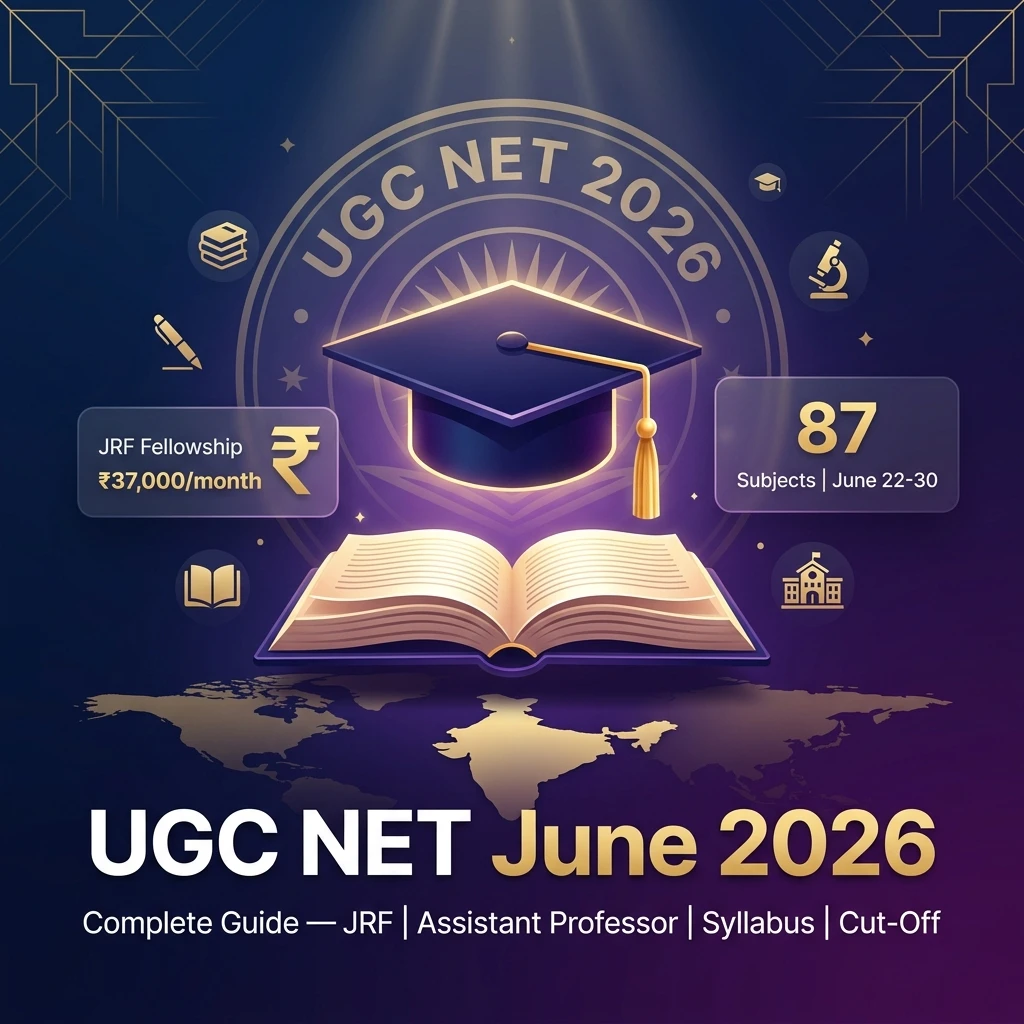
The UGC NET June 2026 examination is currently being conducted by the National Testing Agency (NTA) from 22 June 2026 to 30 June 2026 in Computer-Based Test (CBT) mode across all major cities in India. With over 87 subjects covered, this single exam determines eligibility for two of the most prestigious career paths in Indian academia:
-
Junior Research Fellowship (JRF) — A fully funded research fellowship worth ₹37,000/month (rising to ₹42,000/month after 2 years), allowing you to pursue a PhD at a UGC-recognized university with financial security.
-
Assistant Professor Eligibility — The mandatory qualification required to be appointed as a permanent faculty member (Lecturer/Assistant Professor) at any central university, state university, or college in India.
With lakhs of aspirants appearing in every cycle, and the demand for qualified teaching faculty at an all-time high due to India's rapidly expanding higher education system, UGC NET has become one of the most competitive and sought-after examinations in the country.
This comprehensive guide covers everything you need to know about UGC NET June 2026 — from the admit card and exam schedule to the JRF salary, cut-off analysis, Paper 1 syllabus, and a complete preparation strategy for upcoming cycles.
UGC NET June 2026: Key Highlights at a Glance
| Parameter | Details |
|---|---|
| Exam Name | UGC National Eligibility Test (NET) June 2026 |
| Conducting Body | National Testing Agency (NTA) |
| Official Website | ugcnet.nta.nic.in |
| Notification Released | 29 April 2026 |
| Exam Dates | 22 June 2026 to 30 June 2026 |
| Mode of Exam | Computer-Based Test (CBT) |
| Number of Subjects | 87 (Including 2 new subjects: Forestry & Statistics) |
| Number of Papers | 2 (Paper I + Paper II — conducted in one 3-hour session) |
| Negative Marking | NO Negative Marking |
| Admit Card Released | 17 June 2026 |
| Result Expected | July–August 2026 |
| Purpose | JRF + Assistant Professor Eligibility |
UGC NET June 2026: Exam Schedule & Important Dates
The NTA has released the complete subject-wise schedule for UGC NET June 2026. The exam is being conducted over 9 days (22 June to 30 June 2026) in two shifts per day:
- Shift 1: 9:00 AM to 12:00 PM
- Shift 2: 3:00 PM to 6:00 PM
Complete Timeline — UGC NET June 2026
| Event | Date |
|---|---|
| Official Notification Release | 29 April 2026 |
| Online Application Opens | 29 April 2026 |
| Last Date to Apply | 20 May 2026 |
| Application Correction Window | 22–24 May 2026 |
| Admit Card Released | 17 June 2026 |
| UGC NET June 2026 Exam | 22 June – 30 June 2026 |
| Provisional Answer Key Release | July 2026 (Expected) |
| Challenge Period for Answer Key | July 2026 |
| Result Declaration | July – August 2026 |
| JRF Award Letters | 2-3 months after result |
How to Download Admit Card: Visit ugcnet.nta.nic.in → Click on "Download Admit Card" → Enter Application Number + Password/Date of Birth → Download and print.
What Is UGC NET? Understanding JRF vs Assistant Professor
Before diving into preparation, it is crucial to understand what UGC NET actually qualifies you for — and why the distinction between JRF and Assistant Professor eligibility matters.
What Does Clearing UGC NET Mean?
Clearing UGC NET means NTA has determined, based on your total score in Paper I and Paper II, that you meet the academic standard required for either:
Option A: Junior Research Fellowship (JRF)
- You scored above the JRF cut-off (higher threshold).
- You are eligible to receive a monthly fellowship of ₹37,000 (JRF rate) from UGC.
- You can pursue a full-time PhD at any recognized university under a guide.
- After 2 years, upon performance review and upgradation to SRF (Senior Research Fellow), stipend rises to ₹42,000/month.
- JRF has an upper age limit of 30 years (relaxable for reserved categories).
Option B: Assistant Professor Eligibility (Only)
- You scored above the qualifying cut-off but below the JRF cut-off.
- You are eligible to apply for Assistant Professor/Lecturer positions at colleges and universities.
- There is no upper age limit for this category.
- You are NOT eligible for the JRF fellowship, but can still do a PhD through other funding routes (GATE, CSIR, institution scholarships, etc.).
Why This Distinction Matters:
| Feature | JRF | Assistant Professor Only |
|---|---|---|
| Monthly Fellowship | ₹37,000 → ₹42,000 | None (salary once employed) |
| PhD Funding | Fully Funded | Self-funded / other schemes |
| Age Limit | 30 years (relaxable) | No age limit |
| Cut-Off Score Required | Higher | Lower |
| Career Path | Research → Professor | Teaching from day one |
| Validity of Certificate | 3 years from NET result | Lifetime (no expiry) |
Key Insight: If you are below 30 years of age, always aim for JRF — the monthly ₹37,000 stipend + free PhD is a tremendous financial advantage. If you are above 30, your certificate still qualifies you for every Assistant Professor vacancy in the country.
UGC NET 2026: Eligibility Criteria
Before appearing for the exam (or for future cycles), confirm that you meet the eligibility requirements:
1. Educational Qualification
- Minimum: Master's degree or equivalent from any UGC-recognized university.
- For General/EWS candidates: Minimum 55% marks in Master's degree.
- For OBC (NCL), SC, ST, PwD, Third Gender candidates: Minimum 50% marks in Master's degree.
- Final Year Students: Candidates in the final year of their Master's degree (or awaiting results) are eligible to apply provisionally. They must submit proof of passing at the time of document verification after selection.
2. Age Limit
| Category | For JRF | For Assistant Professor |
|---|---|---|
| General (UR) | Maximum 30 years | No age limit |
| OBC (NCL) | Maximum 33 years (3 years relaxation) | No age limit |
| SC/ST/PwD | Maximum 35 years (5 years relaxation) | No age limit |
| Women | Maximum 35 years | No age limit |
| LWE Affected Areas | Maximum 35 years | No age limit |
3. Number of Attempts
There is no limit on the number of attempts for UGC NET — you can appear as many times as needed (subject to age limit for JRF).
4. New Subjects Added in 2026
In UGC NET June 2026, NTA added 2 new subjects bringing the total to 87 subjects:
- Forestry (New)
- Statistics (New)
UGC NET 2026: Exam Pattern — Complete Breakdown
Structure of the Exam
UGC NET is conducted as a single 3-hour session with both papers in one sitting:
| Paper | Type | Questions | Marks | Time |
|---|---|---|---|---|
| Paper I | General Teaching & Research Aptitude | 50 MCQs | 100 marks | — |
| Paper II | Subject-Specific | 100 MCQs | 200 marks | — |
| Total | — | 150 MCQs | 300 marks | 3 Hours |
Critical Exam Rules:
- ✅ NO Negative Marking — Attempt every question. Never leave any question blank.
- ✅ Both papers are conducted in the same 3-hour window without a break.
- ✅ All questions are Multiple Choice Questions (MCQs) with 4 options.
- ✅ Each correct answer = +2 marks. Wrong answer = 0 marks.
- ✅ Exam is in both English and Hindi (except English Literature Paper II).
- ✅ Candidates must complete both papers to be eligible for evaluation.
Strategic Insight: Since there is NO negative marking, a perfect strategy is to spend 60–70 minutes on Paper I (which you can complete faster with practice) and 110–120 minutes on Paper II. Never leave any question unanswered in the last 2 minutes.
UGC NET Paper I: Complete Syllabus (All Candidates)
Paper I is common for all candidates regardless of subject. It tests your aptitude for teaching and research. This paper has 10 units with 5 questions each (50 questions total):
Unit 1: Teaching Aptitude
- Nature, objectives, levels, and characteristics of teaching
- Learner's characteristics
- Factors affecting teaching
- Methods of teaching in Institutions of Higher Learning
- Teaching support systems and evaluation systems
Unit 2: Research Aptitude
- Research: Meaning, Types, and Characteristics
- Positivism and post-positivistic research paradigms
- Methods of research (Experimental, Descriptive, Historical, Qualitative)
- Research Ethics
- Paper, Article, Workshop, Seminar, Conference, Symposium — differences
- Thesis and Article writing: Format and styles of referencing
Unit 3: Reading Comprehension
- A passage is given and questions are asked based on the passage.
- Focus: Comprehension, inference, analysis
Unit 4: Communication
- Communication: Nature, characteristics, types
- Effective communication
- Barriers to communication and measures
- Mass communication and its implications
- Cultural aspects of communication
Unit 5: Mathematical Reasoning & Aptitude
- Types of reasoning (Deductive, Inductive, Abductive)
- Mathematical Aptitude: Number sequence, Fraction, Time, Speed, Distance, Percentage, Profit & Loss, Interest, Averages
Unit 6: Logical Reasoning
- Structure of arguments (premises, conclusion)
- Evaluating and distinguishing deductive and inductive reasoning
- Analogies, Venn diagrams, Indian Logic (Pramana)
- Syllogism, Logical Diagrams
Unit 7: Data Interpretation
- Sources, acquisition, and classification of data
- Quantitative and Qualitative Data
- Graphical representation: Bar Chart, Histogram, Pie Chart, Table-Chart, Line Chart
- Data Interpretation — Reading and analysing graphs
Unit 8: Information & Communication Technology (ICT)
- ICT: General abbreviations and terminology
- Basics of internet, intranet, email, audio/video conferencing
- Digital initiatives in Higher Education
- ICT and governance (e-governance)
Unit 9: People, Development & Environment
- Development and environment: Millennium development goals
- Natural hazards and their mitigation strategies
- Environmental pollution and climate change
- Sustainable development (Definition and concept)
- Energy and deforestation
Unit 10: Higher Education System
- Institutions of Higher Learning in India
- Formal and distance education in India
- Professional and technical education in India
- Value education and ethics in Higher Education
- Governance, polity, and administration of Higher Education
- Recent developments in Higher Education: National Education Policy 2020
Paper I Preparation Tips:
- Units 5 (Mathematical Reasoning) and 7 (Data Interpretation) are most calculation-heavy — practice them daily.
- Units 9 and 10 are most static GK-type — read NCERT + NEP 2020 once thoroughly.
- Unit 3 (Comprehension) is free marks — always attempt all 5 questions.
- Target: 80+/100 in Paper I to have a comfortable cushion for JRF cut-off.
UGC NET Paper II: Subject-Specific Guide
Paper II is based on your chosen subject at the Master's level. With 87 subjects available, it is impossible to list all syllabi here. However, here are the most popular subjects and where to find their syllabus:
Top 10 Most Popular UGC NET Subjects (By Number of Candidates)
| Rank | Subject | Code |
|---|---|---|
| 1 | Commerce | 08 |
| 2 | Education | 09 |
| 3 | English | 30 |
| 4 | Computer Science & Applications | 87 |
| 5 | History | 05 |
| 6 | Political Science | 02 |
| 7 | Economics | 01 |
| 8 | Sociology | 14 |
| 9 | Management | 17 |
| 10 | Hindi | 20 |
Where to Download Subject Syllabus: Visit ugcnet.nta.nic.in → "Information Bulletin" or "Syllabus" section → Download the PDF for your specific subject.
Paper II Strategy Tips:
- Paper II tests in-depth domain knowledge at the Master's degree level.
- Focus on Previous Year Questions (PYQs) — the pattern of questions repeats significantly across cycles.
- For theory-heavy subjects (History, Political Science, Sociology), use the IGNOU Study Material which is perfectly aligned with UGC NET syllabus.
- For quantitative subjects (Economics, Statistics, Commerce), practice numerical problems from your subject's standard textbooks.
- Target: 140+/200 in Paper II (for JRF in popular subjects). For Assistant Professor, 120+/200 is a safe target.
UGC NET 2026: JRF Fellowship — Full Salary & Benefits Breakdown
This is the section that motivates lakhs of students to appear for UGC NET. Here is the complete financial picture of what a JRF fellow receives:
Monthly Stipend Structure
| Fellowship Stage | Duration | Monthly Stipend |
|---|---|---|
| JRF (Junior Research Fellow) | First 2 years | ₹37,000/month |
| SRF (Senior Research Fellow) | Remaining 3 years (after JRF upgradation) | ₹42,000/month |
Additional Benefits for JRF Holders:
| Benefit | Amount/Type |
|---|---|
| Contingency Grant (JRF) | ₹10,000/year for books, journals, research materials |
| Contingency Grant (SRF) | ₹20,500/year |
| HRA (House Rent Allowance) | As per government rules for the city |
| Medical Benefits | Through university/institute |
| Total PhD Duration | Maximum 5 years (2 JRF + 3 SRF) |
Total Fellowship Earnings Over 5 Years (Approximate):
| Year | Stage | Monthly | Annual |
|---|---|---|---|
| Year 1 | JRF | ₹37,000 | ₹4,44,000 |
| Year 2 | JRF | ₹37,000 | ₹4,44,000 |
| Year 3 | SRF (Post-Upgrade) | ₹42,000 | ₹5,04,000 |
| Year 4 | SRF | ₹42,000 | ₹5,04,000 |
| Year 5 | SRF | ₹42,000 | ₹5,04,000 |
| Total | — | — | ₹24,00,000+ |
Key Point: A JRF fellowship essentially means you get ₹24 Lakh+ over 5 years to complete your PhD — while also receiving free tuition, university facilities, and academic mentorship. This is one of the most financially secure pathways to a research career in India.
What Happens After JRF/PhD?
After completing your PhD with JRF funding:
- Assistant Professor at a central/state university (starting salary ₹57,700/month at Level 10, rising significantly under 8th Pay Commission).
- Post-Doctoral Fellowship — Apply for UGC or DST post-doctoral fellowships.
- Research Scientist — Government research organizations like CSIR, DRDO, ICMR, BARC.
- Associate Professor / Professor — Career progression within academia (7th CPC pay at Level 11, 12, 13, 14).
UGC NET 2026: Cut-Off Analysis — What Score Do You Need?
The UGC NET cut-off works on a percentile-based system. Here is how it works and what scores you should target:
Understanding the Cut-Off System:
-
NTA does NOT pre-announce cut-offs. Cut-offs are calculated after the exam based on:
- Total number of candidates who appeared
- Difficulty level of the exam
- Number of JRF slots and AP eligibility slots available
-
Minimum Qualifying Marks (aggregate of Paper I + Paper II):
| Category | Minimum Qualifying Marks | Total Marks | Minimum % |
|---|---|---|---|
| General / EWS | 120 marks out of 300 | 300 | 40% |
| SC / ST / OBC (NCL) / PwD / Third Gender | 105 marks out of 300 | 300 | 35% |
- Actual Selection Cut-Off for JRF and AP eligibility is significantly higher than the minimum qualifying marks — especially in popular subjects.
Estimated Subject-Wise Cut-Off Trends (Based on Previous Cycles)
| Subject | JRF Cut-Off (Approx, General) | AP Only Cut-Off (Approx, General) |
|---|---|---|
| Commerce | 215–230 / 300 | 180–195 / 300 |
| English | 205–220 / 300 | 172–188 / 300 |
| Computer Science | 195–210 / 300 | 165–180 / 300 |
| History | 195–210 / 300 | 165–180 / 300 |
| Economics | 200–215 / 300 | 170–185 / 300 |
| Political Science | 192–208 / 300 | 162–178 / 300 |
| Education | 205–218 / 300 | 172–185 / 300 |
| Hindi | 198–212 / 300 | 168–182 / 300 |
| Sociology | 195–210 / 300 | 162–178 / 300 |
| Management | 210–225 / 300 | 178–193 / 300 |
Note: These are approximate ranges based on previous UGC NET cycles. Actual UGC NET June 2026 cut-offs will be released by NTA after the result in July–August 2026.
Score Targets for UGC NET June 2026 (Recommended):
| Target | Paper I Score | Paper II Score | Total |
|---|---|---|---|
| Safe JRF (Most subjects) | 80+ / 100 | 145+ / 200 | 225+ / 300 |
| Safe AP Eligibility | 70+ / 100 | 125+ / 200 | 195+ / 300 |
| Minimum to Qualify | 50+ / 100 | 70+ / 200 | 120+ / 300 (Gen) |
How to Check UGC NET June 2026 Result & Download Scorecard
Once the result is declared (expected July–August 2026), here is how to check:
- Visit ugcnet.nta.nic.in
- Click on "View Result / Score Card" link on the homepage
- Enter your Application Number and Date of Birth or Password
- Click "Submit"
- Your result will show:
- Paper I marks (out of 100)
- Paper II marks (out of 200)
- Total marks (out of 300)
- Status: JRF Qualified / AP Qualified / Not Qualified
- Download and print your scorecard for records
Important: Keep your UGC NET scorecard safe — it is valid for lifetime for Assistant Professor eligibility, and for 3 years for JRF (you must join a PhD program within 3 years of the JRF result).
Career After UGC NET: Salary & Growth Prospects
Assistant Professor Salary at Central Universities (7th Pay Commission)
| Pay Level | Designation | Basic Pay | Gross Monthly Salary |
|---|---|---|---|
| Level 10 | Assistant Professor | ₹57,700 | ₹1,10,000–₹1,25,000 |
| Level 11 | Senior Assistant Professor | ₹68,900 | ₹1,30,000–₹1,50,000 |
| Level 12 | Associate Professor | ₹1,01,500 | ₹1,85,000–₹2,10,000 |
| Level 13A | Professor | ₹1,31,400 | ₹2,40,000–₹2,70,000 |
| Level 14 | Senior Professor / Dean | ₹1,44,200 | ₹2,60,000–₹3,00,000 |
Under 8th Pay Commission (Expected 2026): All the above figures are projected to increase by approximately 2x–2.5x, making a fresh Assistant Professor's gross salary potentially ₹2,20,000–₹2,50,000/month — one of the highest starting salaries in the public sector.
Additional Benefits for University Faculty:
- ✅ HRA: 27% of Basic Pay (X-City Universities like Delhi, Mumbai)
- ✅ Academic Grade Pay + Grade Pay increments
- ✅ CPF/GPF Contribution by government
- ✅ Medical Facilities for self and family
- ✅ Accommodation on campus (in many central universities)
- ✅ Leave Travel Concession (LTC)
- ✅ Sabbatical Leave for research (typically 1 year every 7 years)
- ✅ Pension under NPS/UPS
- ✅ Summer/Winter vacation — 60+ working days per year
- ✅ Research Grant eligibility from UGC, DST, DBT, ICSSR
UGC NET 2026 Preparation Strategy: Complete Month-by-Month Roadmap
Whether you are appearing in the current June 2026 cycle or preparing for the December 2026 cycle, this strategy applies:
For December 2026 cycle: You have approximately 5–6 months from now. This is ample time to clear UGC NET from scratch.
Phase 1 (Months 1–2): Foundation & Syllabus Mastery
Paper I Foundation:
- Download the official Paper I syllabus from ugcnet.nta.nic.in
- Complete all 10 units in a structured manner:
- Week 1: Teaching Aptitude + Research Aptitude (Units 1 & 2) — Read NCERT-level content + notes from any UGC NET Paper I book
- Week 2: Communication + ICT + Higher Education System (Units 4, 8, 10) — Static content, read once carefully
- Week 3: Mathematical Reasoning + Data Interpretation + Logical Reasoning (Units 5, 6, 7) — Practice 20 questions daily
- Week 4: People & Environment + Reading Comprehension (Units 3 & 9)
Paper II Foundation:
- Get the official syllabus of your chosen subject
- Map the syllabus to your Master's degree textbooks
- Identify which chapters/units carry the most previous year questions (PYQ analysis)
- Complete the first reading of ALL units from your standard textbooks
Daily Study Hours Recommended: 4–5 hours
Phase 2 (Months 3–4): Intensive Practice & PYQ Analysis
Paper I:
- Attempt previous year Paper I papers from at least the last 6 UGC NET cycles
- Focus heavily on the reasoning and data interpretation sections — these are highly scoring and can be mastered with practice
- Practice 50 Paper I mock questions every alternate day
- Target by Month 4: Consistently scoring 72–80+ in Paper I mock tests
Paper II:
- Complete a minimum of 3 readings of the entire syllabus
- Solve at least 200–300 previous year Paper II questions from the last 5–7 years
- Make subject-specific notes and mind maps for quick revision
- Join an online mock test series (Testbook, Unacademy, BYJU's NET, or NET specific platforms)
Daily Study Hours Recommended: 6–7 hours
Phase 3 (Month 5 — Revision & Mocks):
- Full-length Mock Tests: Give 3–4 full UGC NET mock tests (Paper I + Paper II together, timed at 3 hours)
- Analysis: Spend equal time analyzing mock tests as giving them — understand WHY you got questions wrong
- Revision: Revise your short notes for Paper I and Subject Paper II
- Weekly Full Paper Revision: Cover each Paper I unit at least twice
Target by End of Month 5:
- Paper I: 78–85/100
- Paper II: 140–160/200
- Total: 218–245/300 (comfortably above JRF cut-off)
Phase 4 (Final 2–3 Weeks — Sprint):
- Stop learning new topics. Focus 100% on revision and mock tests.
- Attempt 2 full mock tests per week.
- Go through your "mistake log" — the list of questions you got wrong in mocks — and revise those specific topics.
- 2 Days Before Exam: Read only your short notes. Do not attempt full tests. Rest well.
- Night Before Exam: Eat well, sleep 7–8 hours. Do NOT study late into the night.
Best Books for UGC NET Preparation 2026
Paper I — Best Books
| Book | Author/Publisher | Why Recommended |
|---|---|---|
| UGC NET Paper I (General Paper) | K.K. Singh / Arihant | Comprehensive coverage of all 10 units |
| NTA UGC NET Paper I Guide | R. Gupta / Ramesh Publishing | Good for previous year questions |
| Teaching & Research Aptitude | S. Singh / Upkar Prakashan | Traditional standard reference |
| Data Interpretation Practice Book | Any standard Aptitude book (R.S. Aggarwal level) | For Units 5, 6, 7 |
Paper II — Subject-Specific (Examples)
| Subject | Recommended Source |
|---|---|
| Commerce | ICAI Study Material + UGC NET Commerce PYQ |
| English | Enotes / IGNOU Study Material + PYQ |
| Computer Science | Testbook/Adda247 NET CS Module |
| History | IGNOU MEH Series + Modern India (Bipin Chandra) |
| Economics | IGNOU MEC Series + PYQ |
| Political Science | IGNOU MPS Series + NCERT Class 12 |
| Education | IGNOU MEd Study Material |
Golden Rule for Paper II: IGNOU study material for your subject is the single best resource for UGC NET. It is free (downloadable from egyankosh.ac.in), written at the exact level tested in NET, and covers the entire syllabus systematically.
Online Mock Test Platforms:
| Platform | Features |
|---|---|
| Testbook.com | Largest UGC NET question bank, subject-wise mocks |
| Unacademy | Live classes + mocks (paid subscription) |
| Adda247 (NET section) | Affordable mock packages |
| NTA Official Practice | Free official mocks at nta.ac.in |
| Gradeup/BYJU's Exam Prep | Subject-specific NET preparation |
Common Mistakes UGC NET Aspirants Make
Mistake 1: Neglecting Paper I
Many subject-matter experts underestimate Paper I thinking "it's just general knowledge." Reality: Paper I cuts can be ruthless. A student who scores 145/200 in Paper II but only 55/100 in Paper I (total 200/300) will NOT qualify for JRF in most popular subjects. Paper I needs dedicated 40-50 minutes of daily practice.
Mistake 2: Studying from Too Many Books
"More books = better preparation" is a myth. Pick ONE comprehensive book for Paper I and your subject's IGNOU material for Paper II. Master these completely rather than skimming 5–6 books.
Mistake 3: Not Solving Previous Year Questions
UGC NET has a high repetition rate — especially in Paper I. The NTA often repeats concepts, calculations, and even specific question formats. If you have not solved at least the last 5 years' papers for your subject, you are leaving guaranteed marks on the table.
Mistake 4: Leaving Questions Blank (NO NEGATIVE MARKING!)
Since there is absolutely NO negative marking in UGC NET, never leave a single question unanswered. Even random guessing gives you a 25% chance of scoring +2 marks. In the last few minutes of the exam, mark an answer for every unanswered question.
Mistake 5: Ignoring the Exam Timer During Mock Tests
Many students study well but panic in the actual exam because they are not used to the 3-hour format. Always practice Paper I + Paper II together in a single 3-hour block — never practice them separately.
Frequently Asked Questions — UGC NET 2026
Q1. When will the UGC NET June 2026 result be declared? Answer: The UGC NET June 2026 result is expected in July–August 2026, approximately 3–4 weeks after the exam concludes on 30 June 2026. The provisional answer key will be released first (usually within 1–2 weeks of the last exam date), followed by challenges, and then the final result.
Q2. What is the UGC NET JRF stipend amount in 2026? Answer: The JRF stipend is ₹37,000 per month for the first 2 years (JRF stage). After upgradation to Senior Research Fellowship (SRF), it increases to ₹42,000 per month for the remaining period (up to 3 more years). Additionally, a contingency grant of ₹10,000/year (JRF) and ₹20,500/year (SRF) is provided.
Q3. Is UGC NET required for PhD admission? Answer: From the academic year 2022-23, the UGC mandated that universities must give preference to UGC NET JRF holders for PhD admission with fellowship. However, UGC NET is NOT mandatory for PhD admission — universities may admit candidates through their own entrance tests (PhD-CET). NET JRF simply guarantees both admission preference and financial fellowship.
Q4. How many times is UGC NET conducted per year? Answer: UGC NET is currently conducted twice a year — once in June and once in December. So if you miss or do not qualify in June 2026, the next opportunity is the December 2026 cycle, with applications expected to open in October 2026.
Q5. Is UGC NET Paper I common for all subjects? Answer: Yes. Paper I (Teaching and Research Aptitude) is exactly the same for ALL candidates regardless of their chosen subject. Only Paper II varies based on your selected subject.
Q6. Can an engineering graduate appear for UGC NET? Answer: Yes, provided you have a Master's degree (MTech, MSc, MBA, etc.) in a relevant subject. Engineering graduates with an MSc in Computer Science, Mathematics, or related subjects can appear for UGC NET in those subjects.
Q7. If I qualify UGC NET for Assistant Professor, is there any vacancy notification I should apply to? Answer: Yes. Qualifying UGC NET does not guarantee a job — it only makes you eligible to apply. You must separately apply to:
- Central university vacancies announced by individual universities (check their official websites)
- State university/college vacancies announced through state government boards
- NVS (Navodaya Vidyalaya Samiti) / KVS (Kendriya Vidyalaya Sangathan) PGT vacancies (require NET or SET)
- Private university faculty vacancies (NET preferred but not always mandatory)
Q8. What is the difference between UGC NET and CSIR NET? Answer: UGC NET covers humanities, social sciences, commerce, education, and some science subjects. CSIR NET (conducted separately by CSIR) covers science subjects specifically: Life Sciences, Chemical Sciences, Physical Sciences, Mathematical Sciences, and Earth Sciences. Science students should check which exam applies to their subject.
UGC NET vs Other Teaching Eligibility Exams: Which Is Right for You?
| Exam | Conducted By | Subjects Covered | For Which Posts |
|---|---|---|---|
| UGC NET | NTA | 87 subjects (Humanities, Social Sciences, Commerce, etc.) | College/University Lecturer + JRF |
| CSIR NET | CSIR/NTA | 5 Science subjects (Life, Chemical, Physical, Math, Earth) | Science College Faculty + JRF |
| SET/SLET | State Govt Bodies | Similar to UGC NET (State-specific) | State college lecturer only |
| GATE | IITs/IISC | Engineering and some Science subjects | Research in PSUs, IIT PhD |
| CTET/TET | CBSE / State Boards | School teaching eligibility | KVS, NVS, School teachers (NOT college) |
Key Clarification: UGC NET and CSIR NET are the two paths to college/university teaching. SET/SLET qualifies you only for teaching in that particular state's colleges — UGC NET gives nationwide eligibility.
UGC NET Exam Day Guide: What to Do on the Day of Exam
Preparation is important, but exam day strategy is equally critical. Here is a complete step-by-step guide for the day of your UGC NET June 2026 exam:
Documents to Carry (Mandatory)
| Document | Details |
|---|---|
| Admit Card | Printed on A4 paper (colour or black & white both accepted) |
| Original Photo ID | Aadhaar Card, PAN Card, Passport, Voter ID, or Driving Licence |
| Recent Passport Photograph | 2 copies (same as uploaded in application) |
| PwD Certificate | Only if applicable |
Strictly Prohibited Items: Mobile phones, smartwatches, calculators, earphones, wallet (use a transparent pouch), food/water (check centre rules), any electronic device.
Exam Day Timeline (Shift 1 Example — 9:00 AM Exam)
| Time | Action |
|---|---|
| 6:30 AM | Wake up. Light breakfast. No heavy meals — avoid indigestion. |
| 7:00 AM | Leave for exam centre. Account for traffic. |
| 8:00 AM | Reach centre. Biometric/photo verification begins |
| 8:30 AM | Enter exam hall. Get seated. Read instructions on screen. |
| 9:00 AM | Exam begins. Start with Paper I. |
| 10:00–10:10 AM | If you finish Paper I early, switch to Paper II. |
| 10:10 AM | Paper II begins (even if you haven't finished Paper I — manage time). |
| 11:50 AM | Last 10 minutes — mark ALL unanswered questions (no negative marking!). |
| 12:00 PM | Exam ends. Submit. |
Smart Exam Strategies:
For Paper I (60–70 minutes recommended):
- Start with Reading Comprehension (Unit 3) — guaranteed 10 marks if you read the passage carefully.
- Then do ICT (Unit 8) and Higher Education System (Unit 10) — mostly factual.
- Finish with Mathematical Reasoning (Unit 5) and Data Interpretation (Unit 7).
- Skip and come back to difficult questions — do NOT get stuck.
For Paper II (110–120 minutes recommended):
- Start with the sections where you are strongest — build confidence.
- In the last 10 minutes, mark an answer for EVERY unanswered question (random guessing is better than leaving blank — NO negative marking).
- Do not change an answer unless you are 100% sure — first instinct is usually correct.
Important Rules Inside the Exam Hall:
- ✅ Your computer screen will show one question at a time. You can navigate forward and backward.
- ✅ You can "Mark for Review" questions and return to them.
- ✅ The screen timer counts down — always check the time.
- ✅ If your computer has a technical issue, immediately inform the invigilator — extra time is given in genuine cases.
- ❌ Do NOT submit the exam before the timer ends — spend remaining time reviewing marked questions.
UGC NET 2026: Documents Required for Application (Next Cycle)
For aspirants preparing for the December 2026 UGC NET cycle, here is the complete documents checklist for the application form:
Documents to Keep Ready Before Applying:
| Document | Specification |
|---|---|
| Passport Size Photograph | Recent (last 6 months), plain white background, 10–200 KB, JPEG format |
| Scanned Signature | On white paper, 4–30 KB, JPEG format |
| Category Certificate | SC/ST/OBC-NCL/PwD (if applicable), issued by competent authority |
| OBC Non-Creamy Layer Certificate | Must be recent (usually within 1 year) — very important |
| EWS Certificate | Income and Asset Certificate from competent authority |
| PwD Certificate | From District Medical Board or equivalent |
| Aadhar Card Number | Mandatory for all candidates (Aadhaar verification is now compulsory) |
| Master's Degree Certificate/Marksheet | Clearly showing percentage/CGPA and subject |
| Third Gender Certificate | If applicable |
Application Fee (Based on Previous Years):
| Category | Application Fee |
|---|---|
| General / EWS (Male/Transgender) | ₹1,150 |
| OBC (NCL) (Male/Transgender) | ₹600 |
| SC / ST / PwD / Female (All categories) | ₹325 |
Payment Mode: Online only — Net Banking, Credit/Debit Card, UPI. No offline payment accepted.
UGC NET Answer Key 2026: How to Challenge Wrong Answers
After each UGC NET exam, NTA releases a Provisional Answer Key before the final result. This is your opportunity to challenge any question you believe has a wrong answer.
Answer Key Challenge Process:
Step 1: Visit ugcnet.nta.nic.in when the provisional answer key link is active (usually 1–2 weeks after the last exam date).
Step 2: Login with your Application Number and Password.
Step 3: View the provisional answer key question-by-question.
Step 4: If you believe an answer is incorrect:
- Click "Challenge" on that specific question.
- Upload supporting evidence (textbook page scan, journal article, official reference).
- Pay the challenge fee: ₹200 per question challenged (refunded if your challenge is accepted).
Step 5: Submit all challenges within the window (usually 2–3 days).
Step 6: NTA reviews all challenges with a panel of subject experts.
Step 7: The final answer key is released after review. Challenges accepted → that question's answer is corrected in the final key → scores are recalculated for ALL candidates.
Tips for Effective Answer Key Challenges:
- Only challenge questions where you have strong supporting evidence from standard textbooks or official government publications.
- The ₹200 fee is non-refundable if your challenge is rejected — be selective.
- For Paper I questions, reference NTA's own published study material or NCERT-level books.
- Do NOT challenge based solely on "I think this is wrong" — you need proof.
UGC NET Subject-Wise Detailed Preparation Tips: Top 5 Subjects
1. Commerce (Most Popular — Subject Code 08)
Key Areas to Focus:
- Financial Accounting and Reporting (AS, IND-AS)
- Business Statistics and Research Methodology
- Financial Management (Capital Structure, Working Capital, Valuation)
- Business Environment and International Trade
- Management Principles (Functions, Theories, HRM)
- Marketing Management
- Income Tax and GST (Taxation basics)
- Cost Accounting (Marginal Costing, Standard Costing)
High-Scoring Topics (Appear in Every Exam):
- Accounting Standards (AS 1 to AS 29) — 4–6 questions every cycle
- Capital Budgeting Techniques (NPV, IRR, Payback) — 3–4 questions
- Porter's 5 Forces + Marketing concepts — 3–4 questions
- GST basics — 2–3 questions (post-2017)
Best Resources: ICAI Study Material (Intermediate Level) + Previous Year UGC NET Commerce Papers (2016–2025)
2. English (Subject Code 30)
Key Areas to Focus:
- Literary Criticism and Theory (New Criticism, Poststructuralism, Feminist, Postcolonial)
- Major Authors: Chaucer, Shakespeare, Milton, Dryden, Pope, Wordsworth, Keats, Eliot, Woolf, Joyce
- Indian Writing in English (Tagore, R.K. Narayan, Rushdie, Arundhati Roy)
- American and World Literature
- Language and Linguistics (Phonetics, Morphology, Syntax, Semantics)
- History of English Literature (Periods: Old English → Modern)
High-Scoring Topics:
- Literary Theory terms (Derrida, Said, Eagleton) — always 5–8 questions
- Novel and Drama (Shakespeare's plays, Victorian novels) — 8–10 questions
- Indian Writing in English — 4–6 questions (increasingly important)
- Linguistics basics — 3–5 questions
Best Resources: IGNOU MEG (Master of Arts English) Study Material (Free from egyankosh.ac.in) + M.H. Abrams "A Glossary of Literary Terms"
3. Education (Subject Code 09)
Key Areas to Focus:
- Philosophical and Sociological Foundations of Education
- Educational Psychology (Theories of Learning — Pavlov, Skinner, Bandura, Vygotsky, Piaget)
- Curriculum Development and Pedagogy
- Educational Technology and ICT
- Statistics in Education (Mean, Median, Mode, SD, Correlation, T-test)
- Educational Research Methods
- School Administration and Management
- National Education Policy (NEP) 2020 — VERY important
High-Scoring Topics:
- NEP 2020 — 4–6 questions (mandatory in every recent cycle)
- Theories of Learning + Motivation — 5–7 questions
- Educational Statistics (Descriptive statistics, Normal Distribution) — 4–5 questions
- Bloom's Taxonomy and Teaching Methods — 3–4 questions
Best Resources: IGNOU B.Ed. and M.Ed. Study Material + J.C. Aggarwal "Essentials of Educational Psychology"
4. Computer Science and Applications (Subject Code 87)
Key Areas to Focus:
- Data Structures (Arrays, Linked Lists, Trees, Graphs, Sorting algorithms)
- Algorithms and Complexity (Time complexity, Big-O notation, NP-Completeness)
- Database Management Systems (SQL, Normalization, ER Model, Transactions)
- Computer Networks (OSI Model, TCP/IP, Routing, Subnetting)
- Operating Systems (Process Management, Memory Management, Deadlock)
- Programming Concepts (OOP, Java, C++ basics)
- Software Engineering (SDLC models, Testing, UML)
- Web Technologies and Cloud Computing
- Artificial Intelligence and Machine Learning Basics
High-Scoring Topics:
- Data Structures questions (Trees, Sorting, Searching) — 8–12 questions every cycle
- DBMS (SQL queries, Normalization, Joins) — 8–10 questions
- Computer Networks (OSI layers, IP addressing) — 6–8 questions
- Algorithms (Time complexity) — 5–7 questions
Best Resources: Testbook/Adda247 UGC NET CS module + Forouzan "Data Communications and Networking" + Korth "Database System Concepts"
5. History (Subject Code 05)
Key Areas to Focus:
- Ancient Indian History (Indus Valley, Vedic Age, Mauryan, Gupta)
- Medieval Indian History (Delhi Sultanate, Mughal Empire, Bhakti Movement)
- Modern Indian History (British Rule, Freedom Struggle, Partition)
- World History (Renaissance, Reformation, Enlightenment, World Wars)
- Historiography (Schools of thought, Methods of history writing)
- Social and Economic History of India
- Archaeological Sources and Numismatics
High-Scoring Topics:
- Mughal Empire + British Rule — 8–12 questions every cycle
- Freedom Struggle (1857–1947) — 5–8 questions
- Ancient India Dynasties + Culture — 5–7 questions
- Historiography (Marxist, Subaltern, Cambridge School) — 4–6 questions
Best Resources: IGNOU MHI Series (Free from egyankosh.ac.in) + Bipin Chandra "Modern India" + R.S. Sharma "Ancient India"
UGC NET State SET/SLET vs UGC NET: Which Should You Choose?
Many aspirants are confused between UGC NET and their State SET/SLET (State Eligibility Test). Here is the complete comparison:
UGC NET vs State SET — Detailed Comparison
| Feature | UGC NET | State SET / SLET |
|---|---|---|
| Conducted By | NTA (National Testing Agency) | State Government / State Agency |
| Validity | Pan-India (all states and union territories) | Only valid in that specific state |
| JRF Eligibility | YES — JRF available for UGC NET qualifiers | NO — State SET does not give JRF |
| Exam Frequency | Twice/year (June + December) | Once/year (varies by state) |
| Difficulty Level | Higher (national competition) | Slightly easier (state-level) |
| Central University Jobs | Eligible (IIT, DU, BHU, JNU, etc.) | NOT eligible for Central Universities |
| State University Jobs | Eligible | Eligible (within that state only) |
| Private University Jobs | Most prefer UGC NET | Accepted in some states |
| Certificate Validity | Lifetime (AP) / 3 years (JRF) | Lifetime (in most states) |
| Application Fee | ₹325–₹1,150 | ₹300–₹900 (varies by state) |
State-Wise SET Exam Bodies (Major States):
| State | SET Exam Name | Website |
|---|---|---|
| Maharashtra | MH SET | setexam.unipune.ac.in |
| Karnataka | KSET | kset.uni-mysore.ac.in |
| Kerala | KSET | lbscentre.kerala.gov.in |
| Gujarat | GSET | gujaratset.ac.in |
| Tamil Nadu | TNSET | tnscst.ac.in |
| West Bengal | WBSET | wbcsc.ac.in |
| Rajasthan | RSMSSB SET | rsmssb.rajasthan.gov.in |
| Uttar Pradesh | UP SET | uppsc.up.nic.in |
| Andhra Pradesh | AP SET | apset.net.in |
| Telangana | TS SET | tsset.org |
Which Should You Choose?
Choose UGC NET if:
- You want to teach at Central Universities (DU, BHU, JNU, Hyderabad Central, etc.)
- You want to apply for the JRF fellowship and do a funded PhD
- You want maximum flexibility to work in any state in India
- You want recognition in private universities (most prefer UGC NET)
Also appear for State SET if:
- You specifically want to teach in your home state's colleges
- You want an additional safety net in case you don't clear UGC NET in the same cycle
- Your target institution is a state-funded college (many state colleges require SET, not NET)
Best Strategy: Appear for BOTH UGC NET and your State SET in the same year. The syllabus overlaps significantly (Paper I is almost identical). Double your chances of certification with minimal extra effort.
Top Universities/Institutions for JRF Research in India
If you qualify UGC NET with JRF, you need to secure a PhD admission at a recognized institution within 3 years. Here are the most prestigious institutions where JRF holders pursue research:
Tier 1: Central Universities & Deemed Universities
| Institution | Known For | NIRF Ranking |
|---|---|---|
| IISc Bangalore | Science, Engineering, Research | #1 University (NIRF 2024) |
| JNU (Jawaharlal Nehru University) | Social Sciences, Humanities, Sciences | Top 10 |
| Delhi University (DU) | All disciplines, strong Arts/Commerce | Top 10 |
| BHU (Banaras Hindu University) | Largest Central University, all streams | Top 15 |
| Hyderabad Central University (UoH) | Sciences, Social Sciences | Top 20 |
| TISS (Tata Institute of Social Sciences) | Social Work, Education, Policy | Top 20 |
| Jadavpur University | Engineering, Humanities | Top 20 |
| Aligarh Muslim University (AMU) | All disciplines | Top 15 |
| Pondicherry University | Sciences, Social Sciences, Tamil Studies | Top 30 |
| Jamia Millia Islamia | Media, Social Sciences, Sciences | Top 25 |
Tier 2: IITs for JRF in Humanities & Social Sciences
Many IITs have strong Humanities and Social Sciences departments that accept JRF scholars:
- IIT Delhi (Department of Humanities and Social Sciences)
- IIT Bombay (History, Philosophy, Economics, Psychology)
- IIT Madras (Management, Development Studies)
- IIT Kanpur (Economics, English, Philosophy)
Advantage of IIT for Non-Engineering JRF: Excellent research infrastructure, international collaborations, and a degree with "IIT" brand value — even for humanities/social science PhDs.
How to Apply for PhD After JRF:
- Wait for your JRF Award Letter — NTA sends it 2–3 months after result.
- Shortlist 5–8 institutions based on your subject and research interests.
- Check their PhD admission schedule — most announce in December–January.
- Apply online to each institution (separate application fee for each).
- Appear for PhD entrance test (most Central Universities have their own test + JRF holders may get direct interview).
- Interview and Allotment of Guide — select your research supervisor.
- Register for PhD — your JRF fellowship begins from the month of registration.
Time Limit: Your JRF certificate is valid for 3 years from the result date. You must complete PhD registration within this period to avail the fellowship. If you miss this window, you lose the fellowship (though your AP eligibility remains for life).
UGC NET 2026: Category-Wise Cut-Off Trend Analysis
How Category-Wise Cuts Work:
NTA publishes separate cut-offs for each category — General, EWS, OBC (NCL), SC, ST, and PwD. Here is the approximate category-wise cut-off pattern based on historical data:
Category-Wise Cut-Off (Approximate, Major Subjects)
For JRF (Approximate cut-off based on historical trends):
| Category | Commerce | English | Computer Science | History |
|---|---|---|---|---|
| General/UR | 215–230 | 205–220 | 195–210 | 195–210 |
| EWS | 205–220 | 198–212 | 188–202 | 188–202 |
| OBC (NCL) | 200–215 | 192–208 | 182–196 | 182–196 |
| SC | 185–200 | 178–192 | 168–182 | 168–182 |
| ST | 178–192 | 170–185 | 160–174 | 160–174 |
| PwD | 175–190 | 168–182 | 158–172 | 158–172 |
For Assistant Professor (Approximate cut-off):
| Category | Commerce | English | Computer Science | History |
|---|---|---|---|---|
| General/UR | 180–195 | 172–188 | 165–180 | 165–180 |
| EWS | 172–187 | 164–180 | 157–172 | 157–172 |
| OBC (NCL) | 168–183 | 160–175 | 152–167 | 152–167 |
| SC | 155–170 | 148–163 | 140–155 | 140–155 |
| ST | 148–163 | 140–155 | 132–147 | 132–147 |
| PwD | 145–160 | 138–153 | 128–143 | 128–143 |
Important Note: These are historical trend estimates. Actual cuts vary significantly every cycle based on paper difficulty. In a difficult paper year, even General candidates may qualify JRF at lower scores like 195/300. In an easy paper year, the cut-off can rise to 235+/300 in popular subjects like Commerce.
How to Use Category Advantage Strategically:
- SC/ST candidates: Even with 35% minimum qualification marks (105/300), you can qualify. But to get JRF in competitive subjects, aim for 185+ to be safe.
- OBC (NCL) candidates: With 3 years age relaxation for JRF and ~15-mark lower cut-offs, OBC aspirants have a significant advantage — use it wisely.
- PwD candidates: Significant marks relaxation + 5-year age relaxation (for JRF). PwD candidates qualifying UGC NET also get additional support during PhD (accessible infrastructure, extended fellowship period in some cases).
Daily Study Timetable for UGC NET December 2026 Aspirants
If you are starting preparation now for the December 2026 cycle, here is a complete daily timetable:
For Working Professionals (4–5 Hours/Day Available):
| Time Slot | Activity |
|---|---|
| 6:00–7:00 AM | Paper I — Mathematical Reasoning / Data Interpretation / Logical Reasoning (Units 5, 6, 7) |
| 7:00–7:30 AM | Reading: Newspaper headlines / Current Affairs (15 min) + Paper I flashcard revision (15 min) |
| Work Hours | — |
| 8:00–9:30 PM | Paper II — Main subject study (topic-wise, chapter-by-chapter) |
| 9:30–10:00 PM | Solve 20 Previous Year Questions (mix of Paper I and Paper II) |
| 10:00–10:30 PM | Review mistakes from today's practice + Update mistake log |
| Weekend (Saturday) | Full-length Paper I Mock Test + Analysis (3 hours) |
| Weekend (Sunday) | Paper II subject reading (5 hours) + Weekly revision |
For Full-Time Aspirants (7–8 Hours/Day Available):
| Time Slot | Activity |
|---|---|
| 6:00–6:30 AM | Light exercise + mental freshness |
| 6:30–8:00 AM | Paper I — Teaching Aptitude + Research Aptitude (Units 1 & 2) |
| 8:00–8:30 AM | Breakfast break |
| 8:30–10:30 AM | Paper II — Main subject (Topic-wise study, 2 units per day) |
| 10:30–11:30 AM | Paper I — Data Interpretation + Mathematical Reasoning (practice 20 questions) |
| 11:30 AM–1:00 PM | Paper II — Previous Year Questions + IGNOU material reading |
| 1:00–2:00 PM | Lunch + Rest |
| 2:00–4:00 PM | Paper II — Theory revision + Mind maps + Notes making |
| 4:00–4:30 PM | Break |
| 4:30–6:00 PM | Paper I — ICT, Communication, Higher Education, Environment (Units 4, 8, 9, 10) |
| 6:00–7:00 PM | Mock test: 50 Paper I questions (timed — 60 minutes) |
| 7:00–8:00 PM | Analyze mock results + Revise weak areas |
| 8:00 PM onward | Rest + Light reading (no heavy study after 8 PM) |
Weekly Milestones to Track Progress:
| Week | Paper I Goal | Paper II Goal |
|---|---|---|
| Week 1–2 | Complete Units 1, 2 (Teaching + Research Aptitude) | Complete first 3 units of subject syllabus |
| Week 3–4 | Complete Units 4, 8, 10 (Communication, ICT, Higher Ed) | Complete units 4–6 + first revision of 1–3 |
| Week 5–6 | Complete Units 5, 6, 7 (Reasoning + DI) | Complete units 7–9 |
| Week 7–8 | Complete Units 3, 9 + First full revision | Complete entire syllabus (1st reading) |
| Week 9–12 | Mock tests (70+ target) + PYQ solving | 2nd reading + PYQ solving (200+ questions) |
| Week 13–16 | Mock tests daily (75+ target) + Weak area focus | 3rd reading + Full mock tests |
| Week 17–20 | Sprint phase — mocks + revision only | Sprint phase — PYQ + mock analysis |
UGC NET December 2026: What to Expect
For aspirants who could not appear in June 2026 (or want another shot), the UGC NET December 2026 cycle is coming:
Expected Timeline for UGC NET December 2026:
| Event | Expected Date |
|---|---|
| Notification Release | October 2026 |
| Application Opens | October 2026 |
| Last Date to Apply | November 2026 |
| Admit Card | November–December 2026 |
| Exam Dates | December 2026 (Exact dates TBA) |
| Result | January–February 2027 |
Key Differences Between June and December Cycles:
| Aspect | June Cycle | December Cycle |
|---|---|---|
| Competition Level | Higher (more fresh graduates) | Slightly lower |
| Paper Difficulty | Variable | Variable |
| Result Timeline | July–August | January–February |
| JRF Start | Immediately after joining PhD | Immediately after joining PhD |
| Age Eligibility Cut-off Date | 1 June | 1 December |
Strategic Advice: If you qualified in June 2026 for AP but not JRF, and you are under 30 years old, appear again in December 2026 specifically targeting JRF. You will be better prepared with June 2026 experience, and JRF gives you the ₹37,000/month fellowship.
UGC NET Paper I: Sample Questions with Answers & Explanation
Here are sample UGC NET Paper I questions (similar to previous year pattern) to give you a feel for what is asked:
Unit 5 — Mathematical Reasoning (Sample):
Q1. If the average of 5 consecutive even numbers is 14, what is the largest of these numbers?
- (A) 16
- (B) 18
- (C) 20
- (D) 22
Answer: (B) 18 Explanation: Let the numbers be x, x+2, x+4, x+6, x+8. Average = (5x+20)/5 = x+4 = 14. So x = 10. Numbers: 10, 12, 14, 16, 18. Largest = 18.
Q2. A train 150 metres long passes a platform 100 metres long in 25 seconds. The speed of the train is:
- (A) 36 km/h
- (B) 40 km/h
- (C) 45 km/h
- (D) 50 km/h
Answer: (A) 36 km/h Explanation: Total distance = 150 + 100 = 250 metres. Time = 25 seconds. Speed = 250/25 = 10 m/s = 10 × 18/5 = 36 km/h.
Unit 6 — Logical Reasoning (Sample):
Q3. All flowers are plants. All plants need water. Which of the following conclusions is valid?
- (A) All plants are flowers
- (B) All flowers need water
- (C) Water is needed only by plants
- (D) Flowers do not need water
Answer: (B) All flowers need water Explanation: Classic syllogism. Since all flowers → plants, and all plants → need water, therefore all flowers → need water. Option (A) is the converse (invalid). Option (C) is too broad (invalid).
Unit 7 — Data Interpretation (Sample):
Q4. In a survey of 400 students, 250 play cricket, 180 play football, and 60 play both. How many students play neither cricket nor football?
- (A) 30
- (B) 20
- (C) 40
- (D) 50
Answer: (A) 30 Explanation: Students playing cricket OR football = 250 + 180 – 60 = 370. Students playing neither = 400 – 370 = 30.
Unit 1 — Teaching Aptitude (Sample):
Q5. Which of the following is the most important characteristic of a good teacher?
- (A) Subject knowledge and communication skills
- (B) Strict discipline in the classroom
- (C) Giving frequent tests and assessments
- (D) Following the textbook strictly
Answer: (A) Subject knowledge and communication skills Explanation: According to educational psychology, the most important teacher qualities are subject mastery and effective communication — both are necessary to facilitate meaningful learning. Strict discipline and frequent tests alone do not constitute good teaching.
Unit 10 — Higher Education System (Sample):
Q6. The National Education Policy (NEP) 2020 proposes a school curriculum structure of:
- (A) 10+2
- (B) 5+3+3+4
- (C) 8+2+2
- (D) 4+4+4
Answer: (B) 5+3+3+4 Explanation: NEP 2020 proposes a new school curriculum structure: Foundational Stage (5 years: age 3–8), Preparatory Stage (3 years: age 8–11), Middle Stage (3 years: age 11–14), and Secondary Stage (4 years: age 14–18). This replaces the old 10+2 system.
Practice Tip: Solve at least 500 such questions across all 10 Paper I units before your exam. The NTA tests similar concepts repeatedly — the "flavour" of questions is consistent across cycles.
UGC NET After Result: Step-by-Step — What to Do Next
If You Qualify for JRF:
Step 1: Download and save your UGC NET JRF Scorecard from ugcnet.nta.nic.in.
Step 2: Wait for the JRF Award Letter (sent by UGC/NTA approximately 2–3 months after result).
Step 3: Find a Research Guide — This is the most critical step. Start networking with professors in your field. Attend departmental seminars, read their research papers, send professional emails expressing interest.
Step 4: Apply for PhD admissions at your target institutions (Central Universities, IITs, IIScs, etc.) — usually applications open in December–January.
Step 5: Appear for PhD Entrance Test + Interview — Most institutions shortlist JRF holders for direct interview (bypassing written test in many cases).
Step 6: After admission, register your JRF with UGC through your institution. Your stipend begins from the month of registration.
Step 7: Complete your PhD within 5 years (2 JRF + 3 SRF) while conducting original research.
If You Qualify Only for Assistant Professor:
Step 1: Download and save your UGC NET Scorecard — this is your lifetime eligibility certificate.
Step 2: Start monitoring Central University vacancy notifications at centraluniversityrecruitment.com and individual university websites.
Step 3: Check State University vacancy notifications through your state government's higher education department.
Step 4: Prepare your academic portfolio: updated CV, research publications (if any), teaching experience, conference participation.
Step 5: Apply to vacancies as they are announced. Shortlisting is typically based on: NET qualification + academic record + publications + experience.
Step 6: Appear for Interview/Presentation — most institutions require a demo lecture + research proposal for faculty positions.
If You Did Not Qualify (Scored Below Cut-Off):
Do NOT be disheartened. UGC NET has no limit on attempts. Here is your action plan:
- Download the Provisional Answer Key and calculate your exact score.
- Identify your weak sections — was it Paper I or Paper II that pulled you down?
- Plan for December 2026 cycle — you have 5–6 months for focused preparation.
- Enroll in a structured mock test series — take at least 15–20 full mocks before the next attempt.
- Study the subject syllabus more deeply — especially units where you lost marks.
Motivation: Many toppers in UGC NET cleared it in their 3rd or 4th attempt. Consistency beats talent. One exam does not define your academic career.
Conclusion: UGC NET 2026 — Your Gateway to India's Most Respected Career
The UGC NET June 2026 is more than just an exam — it is the key that unlocks one of India's most intellectually fulfilling and financially secure career paths.
With the 8th Pay Commission expected to revise university faculty salaries upward significantly, an Assistant Professor at a Central University could earn a gross salary of ₹2,20,000–₹2,50,000 per month in the coming years. Add to this the 60+ days of leave annually, pension, campus accommodation, sabbatical leave for research, and the intellectual freedom of academic life — and it becomes clear why UGC NET qualified faculty positions are among the most coveted jobs in India.
If you are appearing in the June 2026 cycle: Give your best. With no negative marking, attempt every single question. Stay calm, manage your 3-hour session wisely (1 hour for Paper I, 2 hours for Paper II), and trust your preparation.
If you are preparing for December 2026: Start today. Five months is more than enough time to clear UGC NET from scratch with the right strategy, the right books, and consistent daily practice.
Stay updated with the latest UGC NET result dates, answer key releases, and December 2026 cycle notifications by visiting Government Job Result — India's trusted source for government exam updates.
Disclaimer: All exam dates, stipend amounts, and salary figures mentioned in this article are based on official NTA notifications and UGC guidelines as of June 2026. Candidates are advised to verify the latest information directly from ugcnet.nta.nic.in before making any decisions.