Introduction: Agniveer Vayu 2026 — Serve the Nation, Wear the Blue Uniform
The Indian Air Force (IAF) is one of the most prestigious armed forces in the world. For every young Indian who has looked up at the sky and dreamed of flying fighter jets, wearing the iconic sky-blue uniform, and serving the nation with honour — the Agniveer Vayu scheme is your official gateway.
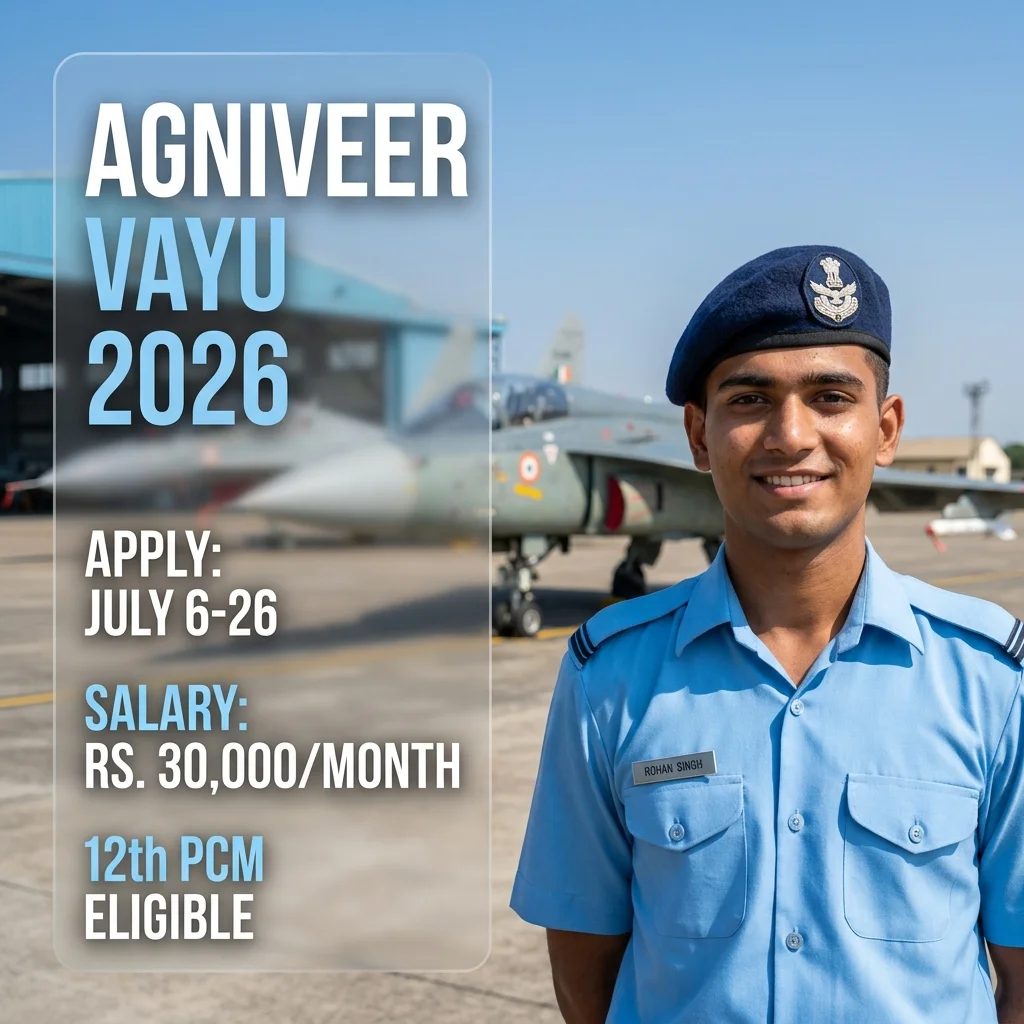
The Agniveer Vayu Intake 02/2027 notification has been released by the Indian Air Force. Applications open from July 6, 2026, and the online examination is scheduled for September 22–23, 2026. This is not just a job — it is a life-defining opportunity.
Why Agniveer Vayu 2026 is the most aspirational youth opportunity in India:
- ✅ Qualification: Only 12th pass with Physics, Maths & English (PCM) required — NO graduation needed
- ✅ Salary: Rs.30,000/month (Year 1) rising to Rs.40,000/month (Year 4)
- ✅ Seva Nidhi: Rs.11.71 lakh tax-free lump sum after 4 years
- ✅ Permanent Absorption: Top 25% can get permanent IAF service after 4 years
- ✅ Priority Hiring: Special priority in CAPF, State Police, and many central govt jobs after service
- ✅ Skills & Training: World-class Air Force technical training (aviation, electronics, IT, logistics)
- ✅ Benefits during service: Free ration, accommodation, medical, uniform, 30-day annual leave
- ✅ Both Male & Female: Open for unmarried male AND female candidates
If you are between 17.5 and 21 years old and have passed your 12th with PCM — this guide is your complete roadmap to Agniveer Vayu 2026.
Agniveer Vayu 2026: Key Highlights at a Glance
| Parameter | Details |
|---|---|
| Recruitment Body | Indian Air Force (IAF) |
| Recruitment Batch | Agniveervayu Intake 02/2027 |
| Official Website | iafrecruitment.edcil.co.in |
| Application Start Date | July 6, 2026 |
| Application Last Date | July 26, 2026 |
| Application Fee | Rs.550 + 18% GST = Rs.649 (approx) |
| Online Exam Date | September 22–23, 2026 |
| Minimum Qualification | 12th pass (PCM for Science group) |
| Age Limit | Born between July 1, 2005 – January 1, 2010 |
| Marital Status | Unmarried only (Male & Female) |
| Starting Salary | Rs.30,000/month (Year 1) |
| Seva Nidhi Corpus | Rs.11.71 lakh (tax-free) after 4 years |
| Permanent Absorption | Up to 25% of batch may be absorbed in regular IAF |
| Service Duration | 4 years (Agniveer period) |
Agniveer Vayu 2026: Important Dates
| Event | Date |
|---|---|
| Official Notification Release | June 2026 |
| Online Application Opens | July 6, 2026 |
| Online Application Closes | July 26, 2026 |
| Application Fee Payment Deadline | July 26, 2026 |
| Admit Card for Online Exam | September 2026 (before exam) |
| Online Written Examination (Phase 1) | September 22–23, 2026 |
| Phase 2 (PFT + Medical) | October–December 2026 (tentative) |
| Final Merit List & Enrolment | Early 2027 |
| Training Commencement (Batch 02/2027) | Early 2027 |
Act Fast: The application window is only 21 days (July 6–26). Do not delay — technical errors and last-minute website traffic can cause issues. Apply by July 15 to be safe.
Agniveer Vayu 2026: What is the Agnipath Scheme?
Before applying, every candidate must understand what the Agnipath Scheme actually is:
- The Agnipath Scheme was launched by the Government of India in June 2022 to transform how the armed forces (Army, Navy, Air Force) recruit short-term personnel.
- Under this scheme, youth are recruited as "Agniveers" for a fixed period of 4 years.
- After 4 years, up to 25% of the batch may be offered permanent enrolment in the regular armed forces cadre based on merit and organisational requirements.
- The remaining 75% are discharged with a tax-free Seva Nidhi package of Rs.11.71 lakh and priority preference in various government and private sector jobs.
Agniveer Vayu — Who Are They?
Agniveers in the Indian Air Force are NOT just ground support staff. They are trained technical professionals in highly specialised IAF trade categories:
- Airmen in Technical Trades: Aircraft maintenance, avionics, missile systems, radar operations, engine technicians
- Airmen in Non-Technical Trades: Logistics, administration, accounts, education, medical support, meteorology, IT
- Air Force Police (Security): Guarding air bases, VIP security, physical security duties
After the 4-year tenure, IAF Agniveers possess world-class technical skills that are highly valued by aviation companies, defence manufacturers, DRDO, and electronics firms.
Agniveer Vayu 2026: Eligibility Criteria
Educational Qualification:
Agniveer Vayu has TWO different groups with different educational requirements:
Group X (Science Subjects — Technical Trades):
| Requirement | Details |
|---|---|
| Minimum Qualification | 12th pass (10+2 Intermediate) |
| Mandatory Subjects | Physics, Mathematics, and English |
| Minimum Marks | At least 50% marks in aggregate AND at least 50% marks in English individually |
| Also Eligible | 3-year Diploma in Engineering (Mechanical/Electrical/Electronics/Computer) with Physics, Maths, English — minimum 50% aggregate + 50% in English |
| Also Eligible | 2-year ITI/Vocational course in Physics/Maths stream from a recognised board |
Group X leads to Technical trades — Aircraft Technician, Electronics Fitter, Mechanical System Fitter, etc. Higher pay and more specialised training.
Group Y (Other Than Science Subjects — Non-Technical Trades):
| Requirement | Details |
|---|---|
| Minimum Qualification | 12th pass (10+2 Intermediate) — Any Stream |
| Mandatory Subjects | English is mandatory |
| Minimum Marks | At least 50% marks in aggregate AND at least 50% marks in English individually |
| Streams Accepted | Arts, Commerce, Science (without PCM), or any other stream |
| Note | PCM students can also apply for Group Y if they want non-technical trades |
Group Y leads to Non-Technical trades — IAF Police, Logistics Assistant, Medical Assistant, Accounts, Education Instructor, Hindi translator, Musician, etc.
Age Limit:
| Criterion | Details |
|---|---|
| Date of Birth Range | Born between 01 July 2005 and 01 January 2010 (both dates inclusive) |
| Minimum Age at Enrolment | 17.5 years |
| Maximum Age at Enrolment | 22 years |
| Age Relaxation | No age relaxation for any category under Agnipath scheme |
Quick Check: Born between July 1, 2005 and January 1, 2010? ✅ You are eligible.
Other Eligibility Conditions:
| Condition | Requirement |
|---|---|
| Nationality | Indian citizen |
| Marital Status | Unmarried only (both male and female) — must remain unmarried during the 4-year service |
| Gender | Both Male and Female candidates eligible |
| Character | No criminal record. Must not have been dismissed from any government service |
| Domicile | Candidates from all states and UTs of India can apply — no domicile restriction |
Agniveer Vayu 2026: Application Fee
| Category | Fee |
|---|---|
| All Candidates (General, SC, ST, OBC, EWS) | Rs.550 + 18% GST ≈ Rs.649 |
Note: Unlike most government exams, there is NO fee exemption for SC/ST/OBC candidates in Agniveer Vayu. All candidates pay the same fee.
Payment Mode: Online only — Net Banking, UPI, Debit Card, Credit Card at iafrecruitment.edcil.co.in
Agniveer Vayu 2026: Selection Process — All 4 Stages
Selection for Agniveer Vayu is a multi-stage process conducted across approximately 6 months:
Stage 1: Online Written Examination (Phase 1 — STAR)
              ↓ (Merit-based shortlisting)
Stage 2A: Document Verification
              ↓
Stage 2B: Physical Fitness Test (PFT)
              ↓
Stage 2C: Adaptability Test 1 & 2
              ↓
Stage 3: Medical Examination
              ↓
Final Merit List & Provisional Selection
              ↓
Training at Air Force Training Establishment
Key Selection Facts:
- Only the Written Exam marks are used to prepare the final merit list
- Physical Fitness Test (PFT) and Medical are qualifying stages (pass/fail only)
- There is NO interview — completely objective/merit-based
- Females and Males have separate merit lists and physical standards
Agniveer Vayu 2026: Exam Pattern (Online Written Examination — STAR)
The Phase 1 written exam is called STAR (Selection Test for Airmen Recruitment). It is an online Computer-Based Test (CBT).
You can choose to appear for ONE or BOTH groups:
Option 1 — Science Subjects Only (Group X):
| Subject | No. of Questions | Marks | Duration |
|---|---|---|---|
| English | 20 | 20 | — |
| Physics | 25 | 25 | — |
| Mathematics | 25 | 25 | — |
| Total | 70 | 70 | 60 minutes |
Option 2 — Other Than Science (Group Y):
| Subject | No. of Questions | Marks | Duration |
|---|---|---|---|
| English | 20 | 20 | — |
| Reasoning & General Awareness (RAGA) | 30 | 30 | — |
| Total | 50 | 50 | 45 minutes |
Option 3 — Combined (Group X + Y):
| Subject | No. of Questions | Marks | Duration |
|---|---|---|---|
| English | 20 | 20 | — |
| Physics | 25 | 25 | — |
| Mathematics | 25 | 25 | — |
| Reasoning & General Awareness (RAGA) | 30 | 30 | — |
| Total | 100 | 100 | 85 minutes |
Marking Scheme:
- ✅ +1 mark for every correct answer
- ❌ -0.25 mark (negative marking) for every wrong answer
- ⬜ No marks deducted for unattempted questions
Strategy Recommendation: Apply for Combined (Group X + Y) — it gives you two chances to qualify (either as Group X or Group Y) and significantly increases your selection probability. Group X has higher technical trade opportunities; Group Y is easier to score in.
Agniveer Vayu 2026: Complete Subject-Wise Syllabus
English Syllabus (20 Questions — Both Groups):
Grammar:
- Tenses (Simple, Continuous, Perfect — all forms)
- Articles (A, An, The — correct usage)
- Prepositions (In, On, At, For, Since, etc.)
- Adjectives and Adverbs
- Subject-Verb Agreement (singular/plural matching)
- Voice — Active and Passive Voice transformation
- Direct and Indirect Speech (Narration)
- Conjunctions and Conditionals (If-clauses)
- Modals (Can, Could, Should, Would, Must, May, Might)
Vocabulary:
- Synonyms and Antonyms (from 10th–12th standard level)
- One-word substitution
- Idioms and Phrases
- Phrasal Verbs (take off, give up, look into, etc.)
Reading & Usage:
- Reading Comprehension (short passage with 3–4 questions)
- Fill in the Blanks (choose correct word from options)
- Error Spotting (find the grammatically incorrect part of a sentence)
- Sentence Completion and Sentence Improvement
English Tip: This section is the SAME for both Group X and Group Y — and both groups need 50% marks in English to qualify. Practice 20 questions daily. Focus on Grammar rules and Vocabulary.
Physics Syllabus (25 Questions — Group X only):
Mechanics:
- Physical World and Measurement (units, dimensions, significant figures)
- Laws of Motion (Newton's Laws, friction, circular motion)
- Work, Energy, and Power (kinetic energy, potential energy, conservation)
- Gravitation (Kepler's laws, satellite motion, escape velocity)
- Properties of Bulk Matter (elasticity, viscosity, surface tension)
- Thermodynamics (First and Second Law, heat engines, entropy)
- Kinetic Theory of Gases (ideal gas equation, mean free path)
- Oscillations and Waves (SHM, wave motion, Doppler effect)
Electricity & Magnetism:
- Electric Charges and Fields (Coulomb's law, electric field, flux)
- Electrostatic Potential and Capacitance
- Current Electricity (Ohm's law, Kirchhoff's laws, Wheatstone bridge)
- Magnetic Effects of Current (Biot-Savart Law, Ampere's law, solenoid)
- Electromagnetic Induction (Faraday's laws, Lenz's law, self/mutual inductance)
- Alternating Current (RMS values, resonance, power factor, transformers)
- Electromagnetic Waves (types of waves, speed of light)
Optics & Modern Physics:
- Ray Optics and Optical Instruments (mirrors, refraction, lenses, microscope)
- Wave Optics (Young's double slit, diffraction, polarisation)
- Dual Nature of Radiation and Matter (photoelectric effect, de Broglie wavelength)
- Atoms and Nuclei (Rutherford model, Bohr model, radioactivity, nuclear reactions)
- Electronic Devices (semiconductors, diodes, transistors, logic gates)
Physics Tip: Focus on Mechanics and Electricity & Magnetism — they together contribute 50%+ of Physics questions. Learn all key formulas. Numericals from NCERT 11th and 12th are most important.
Mathematics Syllabus (25 Questions — Group X only):
Algebra:
- Sets, Relations, and Functions
- Complex Numbers and Quadratic Equations
- Matrices and Determinants
- Permutations and Combinations
- Binomial Theorem
- Sequences and Series (AP, GP, HP)
- Linear Inequalities
Coordinate Geometry:
- Straight Lines (equations, slope, intercepts)
- Conic Sections (Circles, Parabola, Ellipse, Hyperbola — standard equations)
- 3D Geometry (distance formula, direction cosines, equations of lines and planes)
Calculus:
- Limits and Continuity
- Differentiation (all rules — product, quotient, chain rule, implicit)
- Applications of Derivatives (maxima, minima, increasing/decreasing functions)
- Integration (definite and indefinite — all standard forms)
- Applications of Integration (area under curves)
- Differential Equations (order, degree, variable separable method)
Trigonometry:
- Trigonometric functions, identities, and equations
- Inverse Trigonometric Functions
- Heights and Distances (practical problems)
Statistics & Probability:
- Measures of Dispersion (mean, variance, standard deviation)
- Probability (classical, addition, multiplication theorems)
- Conditional Probability, Bayes' Theorem
- Bernoulli Trials and Binomial Distribution
Maths Tip: IAF Maths questions are from 12th NCERT standard. Master Calculus (Differentiation + Integration) and Coordinate Geometry — they contribute the most marks. Solve all NCERT examples and exercises first, then move to previous year IAF question papers.
Reasoning & General Awareness — RAGA (30 Questions — Group Y only):
Reasoning Ability:
- Verbal Reasoning: Analogy, Classification, Series Completion, Coding-Decoding
- Blood Relations, Direction and Distance
- Syllogism (All/Some/No type statements)
- Statement and Assumption/Conclusion
- Number and Letter Series
- Matrix and Figure patterns
- Non-Verbal Reasoning: Mirror Image, Water Image, Paper Folding, Embedded Figures
General Awareness:
- History of India: Ancient, Medieval, Modern (Freedom Movement, 1947 and after)
- Indian Geography: Physical features, rivers, climate, soils, forests
- Indian Polity & Constitution: Parliament, Fundamental Rights, Preamble
- Indian Economy: Budget, GDP, inflation, Five-Year Plans, NITI Aayog
- Science & Technology (Basic): Inventions, discoveries, space missions (ISRO), nuclear energy
- Current Affairs: Last 6 months — national and international events
- Defence & IAF Specific: Indian Air Force history, aircraft types, IAF operations, IAF day (Oct 8), Air Force stations, air marshals (past and present), major IAF exercises
RAGA Tip: In General Awareness, IAF-specific questions have highest priority. Learn the IAF's history, famous operations (Operation Meghdoot, Operation Safed Sagar, Operation Sindoor 2025), aircraft (Su-30MKI, Tejas, Rafale, C-130J Hercules), and current IAF Chief of Air Staff.
Agniveer Vayu 2026: Physical Fitness Test (PFT)
Phase 2 includes the Physical Fitness Test — a qualifying stage with no marks. You must PASS all events:
Physical Standards — Male Candidates:
| Event | Standard Required |
|---|---|
| 1.6 km Run | Complete in 6 minutes 30 seconds or less |
| Push-ups | Minimum 10 push-ups |
| Sit-ups | Minimum 10 sit-ups |
| Squats (Uthak-Baithak) | Minimum 20 squats |
Physical Standards — Female Candidates:
| Event | Standard Required |
|---|---|
| 1.6 km Run | Complete in 8 minutes or less |
| Push-ups | Minimum 10 push-ups (with knees on ground — modified) |
| Sit-ups | Minimum 10 sit-ups |
| Squats (Uthak-Baithak) | Minimum 20 squats |
PFT Training Plan (8 Weeks Before Physical Test):
| Week | Daily Running Target | Exercises |
|---|---|---|
| Week 1–2 | Run 1 km at easy pace daily | 5 push-ups, 5 sit-ups, 10 squats |
| Week 3–4 | Run 1.6 km in 8 minutes | 8 push-ups, 8 sit-ups, 15 squats |
| Week 5–6 | Run 1.6 km in 7 minutes | 10 push-ups, 10 sit-ups, 20 squats (target met!) |
| Week 7 | Run 1.6 km in 6:30 (exactly) | 12 push-ups, 12 sit-ups, 25 squats |
| Week 8 | Run 1.6 km in under 6 minutes (buffer!) | 15 push-ups, 15 sit-ups, 30 squats |
Key Advice: For the 1.6 km run, practice at the same time of day as your exam (usually morning). The IAF conducting body checks a candidate's capability — you must do ALL events consecutively, not one at a time with breaks.
Agniveer Vayu 2026: Adaptability Tests
The Adaptability Test is unique to IAF Agniveer and tests your psychological suitability for military life:
Adaptability Test 1 (AT-1):
- Paper-based psychological assessment
- Tests: Stress tolerance, decision-making under pressure, team orientation, leadership aptitude, ability to follow orders
- NOT a pass/fail test — it provides a psychological profile used in final evaluation
Adaptability Test 2 (AT-2):
- Group Discussion or situational judgment tasks
- Scenario-based: "If your team member is injured during training, what do you do?"
- Tests: Communication, problem-solving, courage, adaptability to unexpected situations
Preparation: These tests cannot be "crammed." Be genuine, confident, and logical in your answers. Read about IAF culture, discipline, and core values before the test. Candidates who show clear motivation to serve in IAF score better.
Agniveer Vayu 2026: Medical Examination Standards
The final stage is a comprehensive medical examination. Below are the key standards:
Eyesight:
| Condition | Group X (Technical) | Group Y (Non-Technical) |
|---|---|---|
| Distant Vision (Without Glasses) | 6/6 in one eye, 6/9 in other | 6/6 in one eye, 6/9 in other |
| Correctable to | 6/6 with glasses | 6/6 with glasses |
| Colour Vision | CP-II (required for most X trades) | CP-III acceptable for most Y trades |
| Spectacle Power Limit | Within permitted range (specified in notification) | — |
Other Medical Standards:
| Parameter | Requirement |
|---|---|
| Height | Minimum 152.5 cm (male), 152 cm (female) |
| Weight | Proportionate to height and age (BMI-based) |
| Chest | Well-proportioned, good expansion |
| Hearing | Normal hearing — must pass audiometry |
| Flat Foot | Disqualifying for most technical trades |
| Dental | Good dental health, no significant decay |
| Tattoo | Tattoos NOT allowed on face, neck, or hands |
| Varicose Veins | Disqualifying |
Agniveer Vayu 2026: Salary & Financial Benefits
Monthly Salary During 4-Year Service:
| Year | Monthly Package (Total) | In-Hand Pay (After Corpus Deduction) |
|---|---|---|
| Year 1 | Rs.30,000/month | Rs.21,000/month |
| Year 2 | Rs.33,000/month | Rs.23,100/month |
| Year 3 | Rs.36,500/month | Rs.25,550/month |
| Year 4 | Rs.40,000/month | Rs.28,000/month |
Corpus Fund: 30% of monthly package is deducted as Agniveer's contribution to the Seva Nidhi Corpus Fund. The Government of India contributes an equal matching amount. This builds up to Rs.11.71 lakh over 4 years.
Additional Benefits During Service:
| Benefit | Details |
|---|---|
| Free Accommodation | Barrack accommodation at IAF station provided |
| Free Ration (Food) | Full ration provided at the station mess |
| Free Uniform | All uniform sets provided by IAF |
| Medical Coverage | Full medical treatment (self) at IAF hospitals |
| Risk & Hardship Allowance | Additional allowance for special duty/hazardous work |
| Annual Leave | 30 days paid annual leave per year |
| Skill Training | World-class technical and vocational training |
| Non-Contributory Insurance | Rs.48 lakh life insurance cover during service |
| Ex-Gratia Compensation | Rs.44 lakh for disability during duty; Rs.1 crore for death during operations |
The Seva Nidhi Package — Rs.11.71 Lakh:
After completing the 4-year Agniveer tenure, candidates who are NOT absorbed into permanent IAF service receive:
| Component | Amount |
|---|---|
| Agniveer's contribution (30% × 4 years with interest) | ~Rs.5.86 lakh |
| Government's matching contribution (with interest) | ~Rs.5.85 lakh |
| Total Seva Nidhi Package | Rs.11.71 lakh (approx, tax-free) |
Tax-Free: The Seva Nidhi amount is completely exempt from Income Tax under a special provision — a significant financial advantage over many civilian savings instruments.
Agniveer Vayu 2026: Career After 4 Years
After the 4-year Agniveer service, candidates have multiple strong options:
Option 1: Permanent Absorption in IAF (25% of batch)
- The Indian Air Force selects the top 25% of each Agniveer batch for permanent enrolment as regular Air Force airmen
- Selection criteria: Performance during 4 years, discipline record, physical fitness, and a centralized selection test
- Once permanently absorbed, the airman serves a full career (20+ years) with pension, promotions (up to the rank of Master Warrant Officer), and all regular Armed Forces benefits
Option 2: Defence & Central Armed Police Forces
- Dedicated priority reservation in:
- CAPF (BSF, CISF, CRPF, ITBP, SSB, NSG) — Constable/Head Constable level
- Coast Guard
- Defence Civilian posts (DRDO, Ordnance Factories, Military Stations)
- Age relaxation of 3–5 years over and above the normal upper limit
Option 3: State Police & Government Jobs
- Many state governments (Maharashtra, Gujarat, Haryana, MP, etc.) have announced priority hiring and age relaxation for Agniveers in state police recruitment
- UP Police, Delhi Police, CISF, and many other forces actively prefer Agniveer veterans
Option 4: Private Sector (Aviation & Defence Industry)
- IAF-trained Agniveers (especially Group X — Technical) have extremely high demand in:
- Civil Aviation: Airlines (IndiGo, Air India) actively hire IAF-trained aircraft maintenance engineers
- Defence Manufacturing: HAL (Hindustan Aeronautics Limited), BEL (Bharat Electronics), DRDO labs
- IT & Electronics: With IAF avionics and electronics training, Group X Agniveers command Rs.4–8 lakh annual CTC in Year 1 of private jobs
Option 5: Higher Education
- Many universities and technical institutes offer bridge courses and priority admission to Agniveers for engineering degrees and diplomas
- The National Skill Qualification Framework (NSQF) certificate awarded to Agniveers adds significant academic credit
Agniveer Vayu vs Agniveer Army vs Agniveer Navy: Comparison
| Feature | Agniveer Vayu (Air Force) | Agniveer (Army) | Agniveer (Navy) |
|---|---|---|---|
| Conducting Body | Indian Air Force | Indian Army | Indian Navy |
| Qualification (Minimum) | 12th PCM (Group X) / 12th Any (Group Y) | 10th (General Duty) / 12th for other categories | 10th / 12th (trade-specific) |
| Technical Exam Syllabus | Physics, Maths, English — 12th standard | Science & Maths — 10th standard | Science & Maths — 10th/12th |
| Starting Salary | Rs.30,000/month | Rs.30,000/month | Rs.30,000/month |
| Seva Nidhi | Rs.11.71 lakh | Rs.11.71 lakh | Rs.11.71 lakh |
| Physical Test | 1.6 km run in 6:30 (male) | 1.6 km run + beam, push-ups (harder) | Swimming test required |
| Trades | Aircraft tech, Avionics, Electronics, Security | Infantry, Artillery, Medical, Signals | Sailor MR, AA, SSR |
| Prestige | Air Force — highest technical prestige | Army — largest force | Navy — niche, prestigious |
| Private Job Scope | Excellent (aviation/electronics) | Good | Good (marine industry) |
Recommendation: Agniveer Vayu has the best civilian career transition value — Air Force technical training (avionics, electronics, aircraft maintenance) is directly applicable in the civil aviation and defence manufacturing industries, commanding the highest starting salaries among the three services.
Agniveer Vayu 2026: How to Apply Online (Step-by-Step)
Step 1: Visit Official Website
- Go to iafrecruitment.edcil.co.in after July 6, 2026
- Click on "Apply for Agniveervayu Intake 02/2027"
Step 2: Register
- Click "New Registration"
- Enter: Name, Email ID, Mobile Number, Date of Birth
- Receive OTP on registered mobile — verify and complete registration
- Note your Registration ID and Password safely
Step 3: Fill Application Form
- Log in with Registration ID and Password
- Fill in all personal details: Name, Father's Name, Mother's Name, address, state, nationality
- Enter educational details: 12th board, year, marks in individual subjects (Physics, Maths, English separately)
- Select your preferred Exam Group: Group X / Group Y / Both
- Select preferred exam centre city (up to 3 choices)
Step 4: Upload Documents
- Recent Photograph: JPG format, passport size, plain white background, without spectacles, 10–40 KB
- Signature: JPG format, signed on white paper with blue or black ink, 10–30 KB
- Ensure photo is recent — taken within 6 months of application
Step 5: Pay Application Fee
- Fee: Rs.550 + 18% GST = approximately Rs.649
- Payment via: UPI, Net Banking, Debit Card, Credit Card
- Download and save the fee payment receipt
Step 6: Final Submit and Print
- Review ALL details carefully — especially your date of birth and marks
- Click "Final Submit"
- Print the application confirmation page — you will need it at Phase 2
Critical: The 12th board exam marks you enter must exactly match your actual marksheet. At Document Verification (DV), each subject's marks are cross-checked. Any discrepancy can result in disqualification.
Agniveer Vayu 2026: Preparation Strategy — 2.5 Month Plan
Applications close July 26 and exam is September 22–23. That gives you approximately 57 days to prepare.
Week-by-Week Plan (Combined Group X + Y):
Weeks 1–2 (Foundation — July):
| Subject | Target |
|---|---|
| Maths | NCERT 11th Chapters: Straight Lines, Sequences, Quadratic Equations, Sets |
| Physics | NCERT 11th Chapters: Laws of Motion, Work-Energy, Waves |
| English | Learn 10 Tenses, Articles, and Prepositions rules |
| RAGA | Start Reasoning: Analogy, Classification, Series (30 Q/day) |
| Physical | Begin running 1 km daily, 10 push-ups + sit-ups |
Weeks 3–4 (Core Syllabus — July–August):
| Subject | Target |
|---|---|
| Maths | NCERT 12th: Integration, Differentiation, 3D Geometry, Probability |
| Physics | NCERT 12th: Electricity, Magnetism, Optics, Modern Physics |
| English | Synonyms/Antonyms (100 pairs), Reading Comprehension (1 passage/day) |
| RAGA | GK: IAF History, Current Affairs (daily 15 min), Coding-Decoding |
| Physical | Run 1.6 km in 8 minutes |
Weeks 5–6 (Advanced Practice — August):
| Subject | Target |
|---|---|
| Maths | Previous year IAF papers — all Maths questions solved |
| Physics | Previous year IAF papers — all Physics questions solved |
| English | Error Spotting + Fill in the Blanks (30 Q/day) |
| RAGA | Blood Relations, Direction, Statement-Conclusion |
| Physical | Run 1.6 km in 7 minutes, all PFT standards met |
Weeks 7–8 (Mock Tests + Revision — August–September):
| Activity | Frequency |
|---|---|
| Full Length STAR Mock Test (100 Q, 85 min) | 4 times per week |
| Error Analysis and Weak Topic Revision | Daily |
| Physical Test Practice (All 4 events) | Daily |
| IAF GK Capsule (Current Affairs + IAF Facts) | Daily 20 min |
Daily Timetable for Agniveer Vayu Preparation:
| Time | Activity | Duration |
|---|---|---|
| 5:30–6:30 AM | Physical Training: Running + Push-ups + Sit-ups + Squats | 1 hour |
| 8:00–9:30 AM | Mathematics (NCERT + PYQs) | 1.5 hours |
| 10:00–11:30 AM | Physics (NCERT + PYQs) | 1.5 hours |
| 12:00–12:30 PM | General Awareness + IAF Current Affairs | 30 minutes |
| 2:00–3:00 PM | English (Grammar + Vocabulary + RC) | 1 hour |
| 3:30–4:30 PM | Reasoning Ability (RAGA) | 1 hour |
| 7:00–8:30 PM | Mock Test or Previous Year Paper (timed) | 1.5 hours |
| 9:00–9:30 PM | Error analysis + Revision of wrong answers | 30 minutes |
Best Books for Agniveer Vayu 2026
Recommended Books:
| Subject | Book | Author / Publisher |
|---|---|---|
| Physics | NCERT Physics Part 1 & Part 2 (11th + 12th) | NCERT |
| Physics (Advanced) | Concepts of Physics Vol. 1 & 2 | H.C. Verma / Bharati Bhawan |
| Mathematics | NCERT Mathematics (11th + 12th) | NCERT |
| Mathematics (Practice) | R.D. Sharma Mathematics | R.D. Sharma / Dhanpat Rai |
| English | Objective General English | S.P. Bakshi / Arihant |
| English Grammar | Wren & Martin (High School English Grammar) | Wren & Martin |
| Reasoning (RAGA) | Verbal and Non-Verbal Reasoning | R.S. Aggarwal |
| General Awareness | Lucent's General Knowledge | Lucent Publications |
| Complete Guide | Agniveer Vayu Complete Guide | Arihant / Kiran |
| Previous Year Papers | IAF Airmen/Agniveer Solved Papers (last 5 years) | Kiran Prakashan |
Best Online Resources:
| Platform | Why Use It |
|---|---|
| NCERT website (ncert.nic.in) | Free official textbooks for Physics and Maths |
| Testbook.com | Best Agniveer Vayu mock tests in IAF exam format |
| Adda247.com | Dedicated Agniveer preparation course + tests |
| Safalta.com | Agniveer Vayu video classes |
| YouTube: DEFENCE ADDA | Free IAF-specific Physics, Maths classes |
| YouTube: Agniveer Preparation | Free RAGA and English prep for Group Y |
Sample Questions with Detailed Solutions
Physics (Group X):
Q1. A ball is thrown vertically upward with a velocity of 20 m/s. What is the maximum height reached? (g = 10 m/s²)
- (A) 10 m
- (B) 20 m
- (C) 40 m
- (D) 5 m
Answer: (B) 20 m
Solution: Using v² = u² – 2gh. At maximum height, v = 0. So 0 = (20)² – 2(10)(h). h = 400/20 = 20 metres.
Q2. An electric bulb of 100 W is used for 10 hours daily. How many units (kWh) of electricity does it consume in 30 days?
- (A) 25 kWh
- (B) 30 kWh
- (C) 35 kWh
- (D) 40 kWh
Answer: (B) 30 kWh
Solution: Energy = Power × Time = 100 W × 10 h × 30 days = 30,000 Wh = 30 kWh (30 units).
Mathematics (Group X):
Q3. What is the derivative of y = x³ + 3x² – 5x + 2?
- (A) 3x² + 6x – 5
- (B) 3x² + 6x + 5
- (C) x² + 6x – 5
- (D) 3x² + 3x – 5
Answer: (A) 3x² + 6x – 5
Solution: dy/dx = 3x² + 3(2x) – 5 + 0 = 3x² + 6x – 5. (Power rule applied to each term)
English (Both Groups):
Q4. Choose the correct sentence:
- (A) She have been working since morning.
- (B) She has been working since morning.
- (C) She is working since morning.
- (D) She has been work since morning.
Answer: (B) She has been working since morning.
"Since" indicates a specific point in time → requires Present Perfect Continuous tense. "She" is third person singular → "has" is correct, not "have".
RAGA — Reasoning (Group Y):
Q5. If BLUE is coded as 2-12-21-5, then RED is coded as:
- (A) 18-5-4
- (B) 17-4-3
- (C) 18-4-5
- (D) 19-5-4
Answer: (A) 18-5-4
Pattern: Each letter is represented by its position in the alphabet. R=18, E=5, D=4. So RED = 18-5-4.
Agniveer Vayu 2026: Important IAF Facts for GK Section
| Topic | Key Facts |
|---|---|
| IAF Founded | October 8, 1932 |
| IAF Day | October 8 (celebrated every year) |
| IAF Motto | "Nabah Sparsham Deeptam" (Touch the Sky with Glory) — from Bhagavad Gita |
| Current Air Chief Marshal | AP Singh (as of June 2026) |
| Major IAF Aircraft | Su-30MKI (primary air superiority), Tejas Mk1A (indigenous), Rafale (French), C-17 Globemaster, C-130J Hercules |
| IAF Headquarters | New Delhi |
| Western Air Command HQ | New Delhi |
| Eastern Air Command HQ | Shillong |
| Southern Air Command HQ | Thiruvananthapuram |
| Training Command HQ | Bangalore |
| Major IAF Stations | Hindon, Pathankot, Ambala, Srinagar, Leh, Jorhat, Pune, Tambaram |
| Operation Meghdoot | 1984 — IAF captured Siachen Glacier |
| Operation Safed Sagar | 1999 — IAF operations during Kargil War |
| Surya Kiran Aerobatic Team | IAF's display aerobatic team (uses BAE Hawk aircraft) |
| Tejas | India's first indigenously designed and manufactured fighter aircraft by HAL |
| First IAF Chief of Air Staff | Air Marshal Sir Thomas Elmhirst |
| First Indian IAF Chief | Air Marshal Subroto Mukerjee |
Common Mistakes Agniveer Vayu Aspirants Make
Mistake 1: Applying Only for Group Y to "Play It Safe"
Many PCM students apply only for Group Y thinking the exam is easier. This is a wrong strategy — Group X Technical trades have better career prospects and higher private-sector demand. Apply for Combined (X+Y) to maximise your chances.
Mistake 2: Ignoring English Despite Scoring Well in PCM
English has a separate qualifying cutoff of 50% marks in English — independent of aggregate marks. A candidate who scores 90% aggregate but only 40% in English is disqualified. Treat English as critically as Physics and Maths.
Mistake 3: Starting Physical Training After the Written Exam
Many candidates think, "I will clear the exam first, then train physically." The PFT comes immediately after the exam at Phase 2. By the time results come, you have only 2–3 weeks. Start physical training from Day 1 of preparation.
Mistake 4: Not Memorising IAF-Specific GK
RAGA's General Awareness section has IAF-specific questions every time — IAF history, aircraft, operations, air force stations. Most students prepare generic GK but miss these specialised questions. A dedicated 1-hour study of IAF facts can score 5–6 extra marks easily.
Mistake 5: Using Spectacles/Contacts During Eye Test
The medical eye test checks vision WITHOUT correction (spectacles/contacts) first. Some candidates try to wear lenses for the test — this is detected and causes immediate disqualification. Know your actual uncorrected vision and check the specification in the notification carefully before applying.
Frequently Asked Questions — Agniveer Vayu 2026
Q1. Can a candidate who failed 12th in first attempt appear for Agniveer Vayu? Yes. The notification does not restrict candidates who failed in their first attempt. What matters is that you have a valid 12th pass certificate with the required subjects and minimum marks from a recognised board (CBSE, State Board, etc.).
Q2. Can I appear for both Group X and Group Y in the same attempt? Yes. The Combined option (Group X + Y) is available. You appear for all 100 questions (85 minutes). Based on your score, you may qualify for either Group X, Group Y, or both. This is the recommended strategy.
Q3. What happens if I score well but fail the medical? If you are medically unfit, you are rejected at the medical stage. However, you have the right to appeal and undergo a Review Medical Board (RMB) at a designated Armed Forces hospital if you believe the initial assessment was incorrect.
Q4. Is there any training allowance during the 4-year service? Yes. Throughout your 4-year service, you receive the monthly salary package (Rs.30,000 to Rs.40,000) along with free food, accommodation, medical, and uniform. There is no separate training allowance during initial training at ATS (Air Training Squadron).
Q5. After 4 years, can I rejoin the IAF as a regular airman? Yes, if you are among the top 25% who are offered permanent enrolment, you can continue as a regular IAF airman with a full service career. However, if you are in the 75% who exit, re-entry into the IAF is generally not possible.
Q6. I have a tattoo on my wrist. Am I eligible? Tattoos are NOT allowed on the face, neck, or hands (including wrists). If your tattoo is on a body part covered by uniform (arms above wrist, back, chest, legs), it may be acceptable depending on its size and content. The final decision is at the discretion of the medical examining authority.
Q7. Is there a preference given to candidates from specific states? No. There is no state-wise reservation or preference in Agniveer Vayu. Candidates from all 28 states and 8 Union Territories of India are evaluated on equal merit. However, exam centres are available in most major cities across India.
Q8. What if I am unable to run 1.6 km in 6:30 minutes on the day of PFT? If you fail the PFT, you are rejected at Phase 2. There is no second chance within the same recruitment batch. You can apply again in the next Agniveer Vayu intake. This is why physical preparation from Day 1 is non-negotiable.
Agniveer Vayu 2026: Complete IAF Trade Guide — What Will You Actually Do?
One of the biggest questions every aspirant has is: "What kind of work will I do in the Air Force?" Here is a detailed guide to every trade available under Agniveer Vayu:
Group X (Science/Technical Trades):
| Trade Code | Trade Name | What You Do |
|---|---|---|
| AE(M) | Airmen Electronics (Mechanical) | Maintain aircraft engines, hydraulic systems, landing gear, fuel systems. Work on aircraft like Su-30MKI, Tejas, Rafale |
| AE(L) | Airmen Electronics (Electronics) | Maintain avionics, radar systems, navigation equipment, electronic warfare systems, communication instruments on aircraft |
| AE(W) | Airmen Electronics (Weapons) | Handle aircraft weapon systems — rockets, missiles (BrahMos, Astra), bombs, guns, and loading/unloading of armaments |
| Auto Tech | Automobile Technician | Maintain ground vehicles at air force stations — trucks, aircraft tow vehicles, crash fire tenders, fuel bowsers |
| MSAI | Marine, Scientific & AI Tech | Maintain meteorological instruments, scientific lab equipment, weather stations at IAF bases |
| Electrical | Electrical Technician | Maintain electrical power supply systems, generators, UPS, ground support electrical equipment, hangars |
Career Value: AE(M) and AE(L) trades are the most valued — airlines like IndiGo, Air India, and SpiceJet actively hire IAF-trained aircraft technicians. Average starting salary after 4-year IAF service: Rs.4–7 lakh per annum.
Group Y (Non-Technical Trades):
| Trade Code | Trade Name | What You Do |
|---|---|---|
| IAF(P) | IAF Police / Security | Guard IAF air stations and aircraft from unauthorised entry, threats, and sabotage. VIP security, perimeter patrol, dog handling units |
| IAF(S) | Support Staff | Administrative duties — office work, filing, records management, postal duties, coordination within the IAF station |
| Logistics | Logistics Assistant | Manage stores, inventory, spare parts for aircraft and station, procurement and distribution |
| Accounts | Accounts Clerk | Handle financial records, pay accounts, bills, reimbursements for IAF personnel |
| Education Instructor | Education Assistant | Teach literacy, basic education to lower-category IAF staff; assist in training schools |
| Hindi Translator | Hindi Typist / Translator | Official Hindi language work, translation of documents, Hindi typing |
| Medical Assistant | Medical Assistant | Assist Medical Officers at IAF hospitals and dispensaries — patient care, inventory of medicines, first aid |
| Meteorology | Met Observer | Observe and record weather data at airfields. Extremely critical for flight operations — bad weather grounding decisions |
| Musician | Band Musician | Part of the IAF Band — ceremonial duties, Republic Day parade, National events, medals ceremonies |
Best Group Y Trade: IAF Police (IAF-P) — physical nature, high responsibility, and provides excellent experience for later entry into CISF, CRPF, or state police jobs post-Agniveer service.
Agniveer Vayu 2026: Life at Air Training Squadron (ATS) — Your First 6 Weeks
After provisional selection, you join the IAF at one of the Air Training Squadrons (ATS). Here is what your first 6 weeks look like — the toughest but most transformative period:
ATS Locations (where initial training happens):
- ATS Belagavi (Karnataka) — Primary ATS for most Agniveer Vayu intakes
- ATS Tambaram (Tamil Nadu)
- ATS Yelahanka (Bangalore)
Week 1–2: Ragging Induction (Toughest Week)
- Wake up at 4:30 AM (reveille)
- Uniform, bedding, kit — everything must be arranged to exact military specifications
- Roll call, Physical Training (PT) — 1 hour minimum
- Marching drills: 6+ hours of parade ground drill daily
- Introduction to military etiquette — saluting, addressing senior officers
- Medical re-examination and document verification at ATS
- First week is deliberately tough — only genuinely motivated candidates remain
Week 3–4: Academics Begin
- Classroom sessions: Air Force Act, Uniform regulations, IAF history
- Weapons handling: Basic rifle drill (even Group Y learns basic weapon safety)
- Continued physical training and drill
- Introduction to trade-specific technical subjects
Week 5–6: Field Training Integration
- Trade-specific workshops begin
- Technical Agniveers visit aircraft hangars for first time
- Group activities — team-building, leadership exercises
- Final assessment — those who clear this move to Main Training Phase
Reality Check: The first 6 weeks at ATS are physically and mentally demanding. Candidates who trained physically before joining find it significantly easier. That is why starting physical preparation from Day 1 of your written exam prep is essential.
Agniveer Vayu 2026: Previous Year Cut-Off Analysis
Understanding historical cut-offs helps you set the right target score. Below are approximate cut-offs from previous IAF Airmen/Agniveer batches:
Group X (Science — Physics, Maths, English) Cut-Offs:
| Batch | Total Marks | Qualifying Cut-Off (approx) | General Category Merit Cut-Off |
|---|---|---|---|
| Agniveer Vayu 01/2023 | 70 | 28 (40%) | 50–55 |
| Agniveer Vayu 02/2023 | 70 | 28 (40%) | 48–53 |
| Agniveer Vayu 01/2024 | 70 | 30 (43%) | 50–56 |
| Agniveer Vayu 02/2024 | 70 | 30 (43%) | 51–57 |
| Agniveer Vayu 01/2025 | 70 | 31 (44%) | 53–58 |
Group Y (RAGA — English + Reasoning & GK) Cut-Offs:
| Batch | Total Marks | Qualifying Cut-Off (approx) | General Category Merit Cut-Off |
|---|---|---|---|
| Agniveer Vayu 01/2023 | 50 | 20 (40%) | 36–40 |
| Agniveer Vayu 02/2023 | 50 | 20 (40%) | 35–39 |
| Agniveer Vayu 01/2024 | 50 | 21 (42%) | 37–41 |
| Agniveer Vayu 01/2025 | 50 | 22 (44%) | 38–43 |
Subject-Wise Safe Score Targets for 2026:
| Subject | Total Questions | Safe Target Score |
|---|---|---|
| English (both groups) | 20 | 14–16 (70–80%) — English cutoff is tough! |
| Physics (Group X) | 25 | 16–18 |
| Mathematics (Group X) | 25 | 17–20 |
| RAGA (Group Y) | 30 | 20–24 |
| Group X Combined Target | 70 | 50–55+ out of 70 |
| Group Y Combined Target | 50 | 37–42+ out of 50 |
Trend: Cut-offs have been rising slightly each batch as more candidates prepare. For 2026, target 55+/70 for Group X and 40+/50 for Group Y to have a strong probability of merit-list selection.
Agniveer Vayu 2026: Physics Quick Formula Sheet
Memorise these key formulas for the exam:
Mechanics Formulas:
| Topic | Formula |
|---|---|
| Equations of Motion | v = u + at; s = ut + ½at²; v² = u² + 2as |
| Newton's Second Law | F = ma |
| Gravitational Force | F = Gm₁m₂/r² |
| Escape Velocity | ve = √(2gR) = 11.2 km/s (Earth) |
| Orbital Velocity | vo = √(gR) = 7.9 km/s (Earth) |
| Kinetic Energy | KE = ½mv² |
| Potential Energy | PE = mgh |
| Power | P = Work/Time = Fv |
| Centripetal Acceleration | a = v²/r = ω²r |
| Simple Pendulum Period | T = 2π√(L/g) |
Electricity & Magnetism Formulas:
| Topic | Formula |
|---|---|
| Coulomb's Law | F = kq₁q₂/r² (k = 9×10⁹ N m²/C²) |
| Electric Field | E = F/q = kq/r² |
| Ohm's Law | V = IR |
| Resistance in Series | R = R₁ + R₂ + R₃ |
| Resistance in Parallel | 1/R = 1/R₁ + 1/R₂ + 1/R₃ |
| Electric Power | P = VI = I²R = V²/R |
| Capacitance | C = Q/V |
| Faraday's Law | EMF = -N(dΦ/dt) |
| Transformer Ratio | Vs/Vp = Ns/Np |
Optics Formulas:
| Topic | Formula |
|---|---|
| Mirror Formula | 1/f = 1/v + 1/u |
| Magnification (Mirror) | m = -v/u |
| Snell's Law | n₁ sin θ₁ = n₂ sin θ₂ |
| Lens Formula | 1/f = 1/v - 1/u |
| Lens Maker's Formula | 1/f = (n-1)(1/R₁ - 1/R₂) |
| Refractive Index | n = c/v = sin i/sin r |
Modern Physics Formulas:
| Topic | Formula |
|---|---|
| Photoelectric Effect | KE_max = hν - φ (φ = work function) |
| de Broglie Wavelength | λ = h/mv = h/p |
| Radioactive Decay | N = N₀e^(-λt) |
| Half-Life | t₁/₂ = 0.693/λ |
| Mass-Energy Equivalence | E = mc² |
Agniveer Vayu 2026: Mathematics Quick Formula Sheet
Trigonometry Quick Reference:
| Identity | Formula |
|---|---|
| Pythagorean | sin²θ + cos²θ = 1; 1 + tan²θ = sec²θ; 1 + cot²θ = cosec²θ |
| Double Angle | sin 2θ = 2 sin θ cos θ; cos 2θ = cos²θ - sin²θ |
| Sum Formulas | sin(A+B) = sinA cosB + cosA sinB |
| Product to Sum | 2 sinA cosB = sin(A+B) + sin(A-B) |
| Values at 0°,30°,45°,60°,90° | sin: 0, ½, 1/√2, √3/2, 1; cos: 1, √3/2, 1/√2, ½, 0 |
Calculus Quick Reference:
| Operation | Formula |
|---|---|
| d/dx (xⁿ) | nxⁿ⁻¹ |
| d/dx (sin x) | cos x |
| d/dx (cos x) | -sin x |
| d/dx (tan x) | sec²x |
| d/dx (eˣ) | eˣ |
| d/dx (ln x) | 1/x |
| ∫xⁿ dx | xⁿ⁺¹/(n+1) + C |
| ∫sin x dx | -cos x + C |
| ∫cos x dx | sin x + C |
| ∫eˣ dx | eˣ + C |
| ∫1/x dx | ln |
Coordinate Geometry Quick Reference:
| Topic | Formula |
|---|---|
| Distance Formula | d = √[(x₂-x₁)² + (y₂-y₁)²] |
| Section Formula (internal) | x = (mx₂+nx₁)/(m+n); y = (my₂+ny₁)/(m+n) |
| Slope of Line | m = (y₂-y₁)/(x₂-x₁) = tan θ |
| Equation of Line | y - y₁ = m(x - x₁) |
| Circle (centre h,k) | (x-h)² + (y-k)² = r² |
| Parabola | y² = 4ax (focus at a, 0) |
Probability & Statistics:
| Concept | Formula |
|---|---|
| P(A or B) | P(A) + P(B) - P(A∩B) |
| P(A and B) | P(A) × P(B) (if independent) |
| Conditional Probability | P(A/B) = P(A∩B)/P(B) |
| Bayes' Theorem | P(A/B) = P(B/A)P(A)/P(B) |
| Mean | Σf·x / Σf |
| Variance | σ² = Σf(x-x̄)²/Σf |
Agniveer Vayu 2026: Document Verification (DV) Checklist for Phase 2
When shortlisted for Phase 2, you must bring ALL documents to the Airmen Selection Centre (ASC). Missing even one can get you rejected:
Original Documents (Mandatory):
| Document | Details |
|---|---|
| 12th Marksheet | Original board marksheet showing subject-wise marks (Physics, Maths, English separately) |
| 12th Pass Certificate | Issued by the Board of Education |
| 10th Marksheet | For date of birth proof (preferred over any other document) |
| 10th Pass Certificate | Issued by Board |
| School Leaving Certificate | For confirming date of birth and character |
| Aadhaar Card | Original (mandatory identity proof) |
| PAN Card | If available (not mandatory but helpful) |
| Domicile / Residence Certificate | Issued by competent authority (Tehsildar/SDM) |
| Category Certificate (if SC/ST/OBC) | Issued in prescribed format by competent authority |
| Character Certificate | From the Head of Institution (Principal of Last School/College) |
| ONLINE Application Printout | Phase 1 application confirmation page |
| Admit Card | Phase 1 written exam admit card |
| Score Card | Phase 1 examination result/score card |
Photographs:
- Minimum 10–15 passport-size photographs — same as application photo (plain white background, no glasses)
- Bring extra — they are required at every stage (medical, joining, etc.)
If Applicable:
| Document | Requirement |
|---|---|
| Diploma Certificate | If applying on the basis of engineering diploma |
| ITI Certificate | If applying on the basis of vocational/ITI course |
| NCC Certificate (A/B/C Grade) | Gives bonus marks/preference in some trades |
| Sports Certificate | National/State level sports recognition (can give preference) |
| Ex-Serviceman Certificate | If father/guardian is ex-serviceman |
Self-Attested Photocopies:
- 2 complete sets of ALL documents listed above (self-attested with your signature)
Critical Warning: Your 12th marksheet must clearly show INDIVIDUAL subject marks — not just aggregate. If you appeared under any board that gives combined marks, get a detailed marksheet. The IAF verifies each subject's marks separately at DV.
Agniveer Vayu vs 4 Years in a Private Job: The Real Comparison
Many candidates wonder: "Is Agniveer Vayu worth it compared to a private job?" Here is an honest, data-based comparison:
Financial Comparison (Over 4 Years):
| Parameter | Agniveer Vayu (4 Years) | Private Job (4 Years) — Average Fresher |
|---|---|---|
| Average Monthly In-Hand | Rs.23,400 avg (Yr 1-4 combined) | Rs.15,000–25,000 (BPO/retail/sales) |
| Total In-Hand Over 4 Years | ~Rs.11.23 lakh | ~Rs.7.2 lakh–12 lakh |
| Lump Sum at End | Rs.11.71 lakh (Seva Nidhi — Tax Free!) | Rs.0 (no equivalent payout) |
| Total 4-Year Financial Value | ~Rs.22.94 lakh | ~Rs.7–12 lakh |
| Accommodation Cost | FREE (IAF barracks) | Rs.3,000–8,000/month rent |
| Food Cost | FREE (IAF mess) | Rs.3,000–5,000/month |
| Medical Cost | FREE (IAF hospital) | Rs.500–2,000/month insurance |
| Training/Skill | World-class IAF technical training (worth Rs.5 lakh equivalent) | Basic on-the-job training |
| Life Insurance | Rs.48 lakh coverage | Must buy separately (~Rs.10,000/year) |
Conclusion: Accounting for free food, accommodation, medical, and the Rs.11.71 lakh Seva Nidhi, the total financial value of 4 years as an Agniveer Vayu is nearly Rs.22–25 lakh — far exceeding what most private sector jobs offer to freshers without a degree. Plus, the IAF training adds tremendous value to your resume.
Non-Financial Comparison:
| Factor | Agniveer Vayu | Private Job |
|---|---|---|
| Career Certainty After 4 Years | High (CAPF priority, aviation jobs, state police preference) | Uncertain (layoffs, performance-based) |
| Skill Value | Aircraft maintenance = Rs.4–8 LPA in aviation after service | Varies widely |
| Respect & Social Status | Extremely high — IAF uniform commands highest respect | Moderate |
| Physical Fitness | Guaranteed — daily PT and discipline | Sedentary desk job |
| Travel | IAF postings across India (Leh, Andaman, NE India) — unique experience | Office/same city |
| Permanent Job Option | Yes — 25% absorbed in regular IAF | No equivalent |
| Government Benefits (Later) | CAPF/Police priority hiring with age relaxation | No equivalent |
Conclusion: Agniveer Vayu 2026 — Your Sky Is the Limit
The Agniveer Vayu 2026 (Intake 02/2027) is not just a job — it is your opportunity to wear the sky-blue uniform of one of the world's most advanced air forces, earn a strong salary, develop world-class technical skills, and serve the nation with pride. With applications opening July 6, 2026, and the exam on September 22–23, every single day of preparation from TODAY matters.
Your 2.5-Month Action Plan:
- Today: Apply on iafrecruitment.edcil.co.in the moment it opens (July 6)
- Week 1–2: Master NCERT Physics (11th) + Maths (11th) + Begin running daily
- Week 3–4: NCERT Physics (12th) + Maths (12th) + English grammar rules
- Week 5–6: Full previous year IAF paper practice + run 1.6 km in 7 min
- Week 7–8: 4 full mock tests per week + all PFT standards cleared
- Exam Week: Light revision, sleep well, appear with full confidence
The Winning Formula:
- Written Exam: Score 60%+ in English (mandatory), and 55%+ overall
- Physical: Clear all PFT events with at least 20% buffer above minimum
- Medical: Know your medical status early — check eyes, flat foot, tattoos
Stay updated with Agniveer Vayu 2026 admit card, result, Phase 2 schedule, and joining news at Government Job Result — your one-stop source for all defence and government exam updates.
Disclaimer: All dates, eligibility criteria, salary figures, and exam pattern details in this article are based on the official Agniveer Vayu Intake 02/2027 notification and Government of India's Agnipath Scheme guidelines as of June 2026. Candidates must verify all information from the official website at iafrecruitment.edcil.co.in before applying.