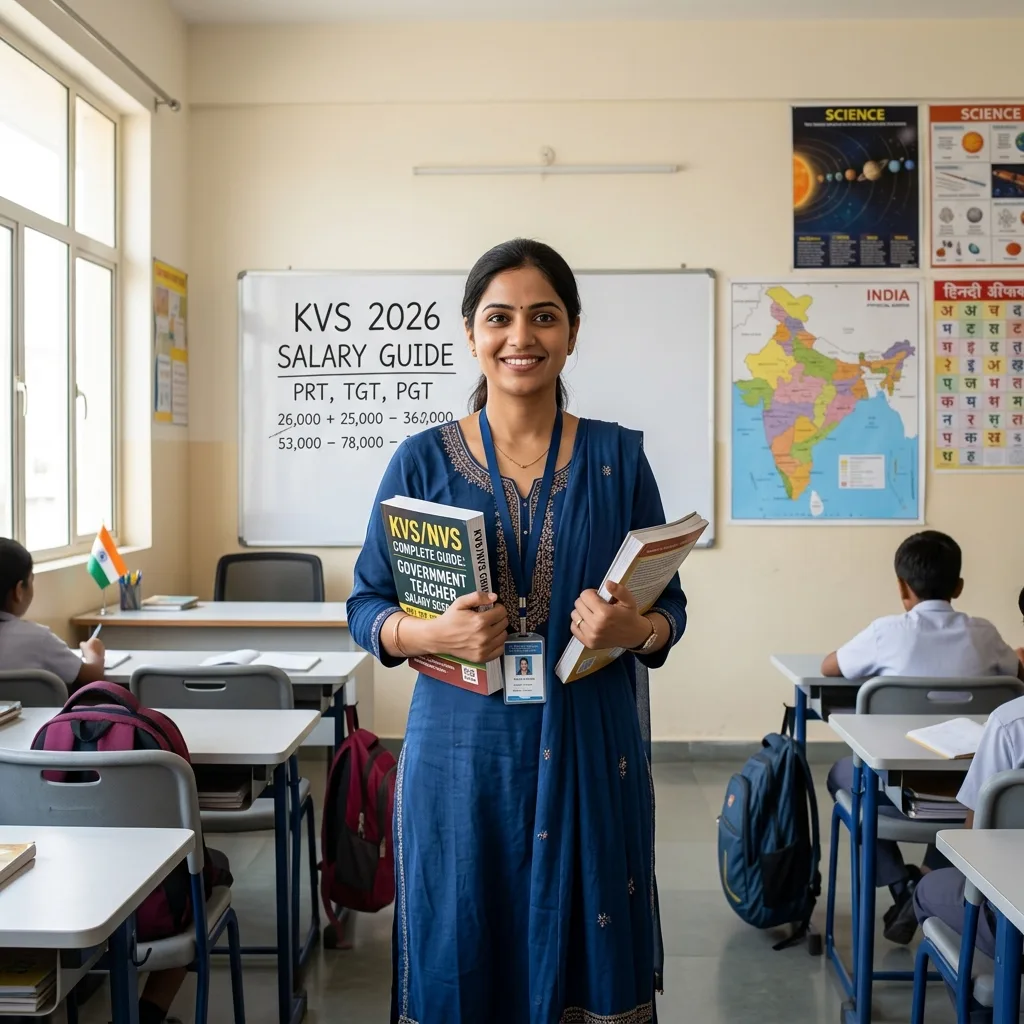
Introduction: Why Government Teaching Is India's Most Sought-After Career
Every year, nearly 30–40 lakh candidates appear for CTET (Central Teacher Eligibility Test) alone — making teaching one of the most competitive government career tracks in India.
And there is a simple reason: government teacher jobs offer a combination of salary, stability, respect, and work-life balance that is almost impossible to find elsewhere.
- A KVS TGT earns Rs.62,000–68,000/month in-hand with no weekend work
- A KVS PGT earns Rs.70,000–78,000/month with 2-month summer vacation
- An NVS TGT gets free accommodation, free food, and Rs.60,000+ salary on campus
- Pension, CGHS medical, LTC — benefits private school teachers can only dream of
This comprehensive guide answers every question about government teacher salary in India in 2026 — from the first paycheque to the retirement corpus.
Master Salary Table: All Government Teacher Posts (2026)
| Post | Organisation | Pay Level | Basic Pay | In-Hand Salary (Approx) |
|---|---|---|---|---|
| PRT (Primary) | KVS | Level 6 | Rs.35,400 | Rs.50,000–56,000 |
| TGT (Trained Graduate) | KVS | Level 7 | Rs.44,900 | Rs.62,000–68,000 |
| PGT (Post Graduate) | KVS | Level 8 | Rs.47,600 | Rs.70,000–78,000 |
| PRT | NVS | Level 6 | Rs.35,400 | Rs.48,000–54,000 (+ free boarding) |
| TGT | NVS | Level 7 | Rs.44,900 | Rs.58,000–64,000 (+ free boarding) |
| PGT | NVS | Level 8 | Rs.47,600 | Rs.65,000–72,000 (+ free boarding) |
| Primary Teacher | DSSSB (Delhi) | Level 6 | Rs.35,400 | Rs.50,000–55,000 |
| TGT | DSSSB (Delhi) | Level 7 | Rs.44,900 | Rs.60,000–65,000 |
| PGT | DSSSB (Delhi) | Level 8 | Rs.47,600 | Rs.68,000–74,000 |
| Assistant Teacher (UP) | State Govt UP | State Pay | Rs.25,000–32,000 | Rs.35,000–45,000 |
| TGT (UP) | State Govt UP | State Pay | Rs.29,200–35,400 | Rs.42,000–52,000 |
| PGT (UP) | State Govt UP | State Pay | Rs.35,400–44,900 | Rs.50,000–62,000 |
| Assistant Professor | State University | Academic Pay | Rs.57,700 | Rs.75,000–90,000 |
Part 1: KVS Teacher Salary — Complete In-Hand Breakdown
Kendriya Vidyalaya Sangathan (KVS) is India's premier central government school network — 1,248 schools across India, including schools in foreign countries (Moscow, Kathmandu, Tehran). KVS teachers are Central Government employees under the Ministry of Education.
KVS PRT (Primary Teacher) Salary:
PRT teaches Classes I–V in KVS schools.
| Component | Amount (Delhi posting — X city) | Amount (Small city — Z city) |
|---|---|---|
| Basic Pay | Rs.35,400 | Rs.35,400 |
| Dearness Allowance (50%) | Rs.17,700 | Rs.17,700 |
| HRA (27% for X city) | Rs.9,558 | Rs.3,186 (9% for Z city) |
| Transport Allowance | Rs.3,600 + DA | Rs.1,800 + DA |
| Gross Salary | ~Rs.66,258 | ~Rs.57,386 |
| NPS Deduction (10%) | -Rs.3,540 | -Rs.3,540 |
| CGHS Contribution | -Rs.500 | -Rs.500 |
| Income Tax | ~Rs.500–1,000 | ~Rs.500 |
| In-Hand Monthly | ~Rs.61,718 | ~Rs.52,846 |
HRA Note (DA at 50%): DA of 50% triggers HRA enhancement — X cities 27% of basic, Y cities 18%, Z cities 9%. KVS PRT in Delhi receives Rs.9,558 HRA vs Rs.3,186 in a smaller town — a Rs.6,372/month difference.
KVS TGT (Trained Graduate Teacher) Salary:
TGT teaches Classes VI–X in KVS schools.
| Component | Amount (Delhi — X city) | Amount (Y city) |
|---|---|---|
| Basic Pay | Rs.44,900 | Rs.44,900 |
| Dearness Allowance (50%) | Rs.22,450 | Rs.22,450 |
| HRA | Rs.12,123 (27%) | Rs.8,082 (18%) |
| Transport Allowance | Rs.3,600 + DA | Rs.1,800 + DA |
| Gross Salary | ~Rs.84,473 | ~Rs.78,432 |
| NPS Deduction | -Rs.4,490 | -Rs.4,490 |
| CGHS + Income Tax | -Rs.2,000–3,000 | -Rs.2,000 |
| In-Hand Monthly | ~Rs.77,983 | ~Rs.71,942 |
KVS PGT (Post Graduate Teacher) Salary:
PGT teaches Classes XI–XII in KVS schools.
| Component | Amount (Delhi) | Amount (Y city) |
|---|---|---|
| Basic Pay | Rs.47,600 | Rs.47,600 |
| Dearness Allowance (50%) | Rs.23,800 | Rs.23,800 |
| HRA | Rs.12,852 (27%) | Rs.8,568 (18%) |
| Transport Allowance | Rs.3,600 + DA | Rs.1,800 + DA |
| Gross Salary | ~Rs.88,652 | ~Rs.82,368 |
| NPS Deduction | -Rs.4,760 | -Rs.4,760 |
| CGHS + Income Tax | -Rs.2,000–3,000 | -Rs.2,000 |
| In-Hand Monthly | ~Rs.81,892 | ~Rs.75,608 |
KVS Principal Salary (Career Peak for Teachers):
| Component | Amount |
|---|---|
| Pay Level | Level 12 |
| Basic Pay | Rs.78,800 |
| DA (50%) | Rs.39,400 |
| HRA (27%) | Rs.21,276 |
| Gross Salary | ~Rs.1,42,000+ |
| In-Hand Monthly | ~Rs.1,25,000–1,35,000 |
Part 2: KVS Teacher Benefits Beyond Salary
This is what makes KVS far superior to any private school:
Leave Entitlements:
| Leave Type | Days Per Year | Details |
|---|---|---|
| Casual Leave | 8 days | For personal/family needs |
| Half Pay Leave | 20 days | Counted as half day each |
| Earned Leave | 30 days (accumulates) | Max 300 days can be accumulated |
| Summer Vacation | 50–60 days | Full paid vacation (May–June) |
| Winter Vacation | 10–15 days | Full paid vacation (December) |
| Maternity Leave | 180 days | With full pay — 3 children maximum |
| Child Care Leave | 730 days | For children up to 18 years — 2 spells of 365 days |
| Study Leave | Up to 2 years | For higher education — full or half pay |
Reality Check: A KVS teacher gets ~75–85 official working days OFF per year (summer + winter + casual + earned). A private school teacher gets 10–15 days and often works on weekends and holidays.
Medical Benefits (CGHS):
- CGHS covers teacher, spouse, dependent children, and dependent parents
- All government hospitals free OPD consultation + medicines
- Private hospital treatment reimbursed as per CGHS rates
- Annual medical value: Rs.1,50,000–5,00,000 (depending on family health needs)
Leave Travel Concession (LTC):
- Every 2 years: Travel to hometown with full fare reimbursement (2nd class AC train)
- Every 4 years: "All India LTC" — travel anywhere in India with family, full reimbursement
- Average annual LTC value: Rs.30,000–80,000
Children Education Allowance:
- Rs.2,250/month per child (maximum 2 children)
- Annual benefit: Rs.54,000 per child — Rs.1,08,000/year for 2 children
Pension (NPS — Post-2004 Employees):
KVS teachers recruited after 2004 are under NPS:
- Employee contributes 10% of basic pay monthly
- Government contributes 14% of basic pay monthly
- Total corpus accumulated over 30-year career: ~Rs.2.5–4 crore
- Monthly pension at retirement: Approximately Rs.45,000–75,000/month
Part 3: NVS Teacher Salary — Plus the Residential Bonus
Navodaya Vidyalaya Samiti (NVS) runs 661 Jawahar Navodaya Vidyalayas across India — one per district, serving gifted students from rural backgrounds. All NVS teachers live on campus in school-provided accommodation. This fundamentally changes the economics of the job.
NVS vs KVS — The Key Difference:
| Factor | KVS | NVS |
|---|---|---|
| School Type | Day school | Fully residential (students live on campus) |
| Teacher Residence | Teachers live off-campus | Teachers live ON campus (free accommodation) |
| Free Accommodation | No | Yes — government quarters on campus |
| Free Meals | No | Yes — NVS teachers eat in school mess at nominal charge |
| Work Hours | 8 AM–2 PM (standard) | Extended — teachers are house masters/wardens |
| Location | Cities and towns | Mostly rural/semi-urban (1 per district) |
| Transfer Policy | Pan-India within KVS | Pan-India within NVS |
| Social Environment | Goes home after school | Lives in school campus community |
NVS TGT Real Monthly Value:
| Component | Cash Value |
|---|---|
| In-Hand Salary | Rs.58,000–64,000 |
| Free Accommodation (market equivalent) | Rs.8,000–20,000/month (rural to semi-urban) |
| Free/Subsidised Meals | Rs.3,000–5,000/month |
| Free Electricity + Water | Rs.1,500–3,000/month |
| Total Real Monthly Value | Rs.70,000–92,000/month |
NVS is genuinely better financially than KVS for single teachers. The free accommodation eliminates rent — India's biggest monthly expense. A KVS TGT in Delhi earns more in salary but spends Rs.15,000–25,000 on rent, erasing much of the advantage.
NVS House Master Allowance:
NVS teachers assigned House Mastership (caring for residential students) receive Rs.3,000–5,000/month additional allowance — unique to NVS.
Part 4: DSSSB Teacher Salary (Delhi Government Schools)
DSSSB (Delhi Subordinate Services Selection Board) recruits teachers for Delhi Government schools:
| Post | Pay Level | Basic Pay | In-Hand (Delhi X city HRA) |
|---|---|---|---|
| Primary Teacher (MCD) | Level 6 | Rs.35,400 | Rs.52,000–56,000 |
| TGT (DoE Delhi) | Level 7 | Rs.44,900 | Rs.64,000–70,000 |
| PGT (DoE Delhi) | Level 8 | Rs.47,600 | Rs.72,000–78,000 |
Advantage of DSSSB: Posted only in Delhi — no transfer to other states. If you are from Delhi or want to live in Delhi, DSSSB is ideal.
Part 5: State Government Teacher Salary Comparison
State government teacher salaries vary significantly. Here is a state-wise comparison for TGT level (2026):
| State | TGT Basic Pay | DA % | In-Hand (Approx) |
|---|---|---|---|
| Maharashtra | Rs.44,900 | 42% | Rs.58,000–64,000 |
| Karnataka | Rs.42,900 | 38% | Rs.54,000–60,000 |
| Tamil Nadu | Rs.44,900 | 46% | Rs.58,000–65,000 |
| Uttar Pradesh | Rs.29,200–35,400 | 26% | Rs.42,000–52,000 |
| Bihar | Rs.25,000–31,000 | 18% | Rs.35,000–44,000 |
| Rajasthan | Rs.33,800–39,100 | 30% | Rs.48,000–56,000 |
| Madhya Pradesh | Rs.32,000–38,000 | 28% | Rs.46,000–54,000 |
| West Bengal | Rs.29,900–37,400 | 24% | Rs.42,000–50,000 |
| Andhra Pradesh | Rs.37,100 | 34% | Rs.52,000–58,000 |
| Kerala | Rs.42,900 | 36% | Rs.56,000–62,000 |
| Punjab | Rs.35,400–41,500 | 30% | Rs.50,000–58,000 |
Key Observation: KVS and NVS teachers consistently earn Rs.8,000–15,000 more per month than state government teachers at the same level — due to higher Central Government DA and better HRA structure.
Part 6: Eligibility — CTET, B.Ed, and Subject Requirements
PRT (Primary Teacher) Eligibility:
| Requirement | Details |
|---|---|
| Education | Senior Secondary (12th) with minimum 50% marks |
| Professional Qualification | 2-year D.El.Ed OR B.Ed from NCTE-recognised institute |
| CTET | CTET Paper I (Classes I–V) is mandatory |
| Age Limit | 18–30 years for KVS (with standard category relaxations) |
TGT (Trained Graduate Teacher) Eligibility:
| Requirement | Details |
|---|---|
| Education | Bachelor's degree with minimum 50% marks in relevant subject |
| Professional Qualification | B.Ed (Bachelor of Education) from NCTE-recognised university |
| CTET | CTET Paper II (Classes VI–VIII) is mandatory |
| Subjects | English, Hindi, Sanskrit, Maths, Science, Social Studies, Computer Science, Art, Music, PET |
| Age Limit | 18–35 years (KVS) |
PGT (Post Graduate Teacher) Eligibility:
| Requirement | Details |
|---|---|
| Education | Postgraduate degree (MA/M.Sc/M.Com) with minimum 50% marks |
| Professional Qualification | B.Ed from recognised university |
| CTET | NOT required for PGT |
| Subjects | Physics, Chemistry, Biology, Maths, English, Hindi, History, Geography, Economics, Commerce, CS |
| Age Limit | 18–40 years (KVS) |
CTET — The Gateway Examination:
| Parameter | Details |
|---|---|
| Conducting Body | CBSE |
| Frequency | Usually 2 times per year |
| Papers | Paper I (for PRT), Paper II (for TGT) |
| Duration | 2.5 hours per paper |
| Questions | 150 MCQs (1 mark each, no negative marking) |
| Pass Marks | 60% = 90/150 (General) |
| Validity | Lifetime (permanent since 2021) |
| Attempts | Unlimited |
CTET Paper I Syllabus (PRT — Classes I to V):
| Section | Questions | Marks |
|---|---|---|
| Child Development and Pedagogy | 30 | 30 |
| Language I (Hindi/English) | 30 | 30 |
| Language II (Any other language) | 30 | 30 |
| Mathematics | 30 | 30 |
| Environmental Studies | 30 | 30 |
| Total | 150 | 150 |
CTET Paper II Syllabus (TGT — Classes VI to VIII):
| Section | Questions | Marks |
|---|---|---|
| Child Development and Pedagogy | 30 | 30 |
| Language I | 30 | 30 |
| Language II | 30 | 30 |
| Subject Specific (Maths/Science or Social Studies) | 60 | 60 |
| Total | 150 | 150 |
Part 7: Career Progression — From PRT to Commissioner
KVS Career Ladder:
| Position | Pay Level | In-Hand (Approx) | How to Reach | Timeline |
|---|---|---|---|---|
| PRT | Level 6 | Rs.50,000–56,000 | KVS recruitment exam | Year 0 |
| Senior PRT (Time-Bound) | Level 6 (higher cell) | Rs.55,000–62,000 | 12 years service automatically | Year 12 |
| TGT | Level 7 | Rs.62,000–68,000 | Departmental promotion exam | Year 10–15 |
| PGT | Level 8 | Rs.70,000–78,000 | Departmental promotion | Year 15–20 |
| Vice Principal | Level 9 | Rs.78,000–88,000 | KVS VP promotion exam | Year 18–22 |
| Principal | Level 12 | Rs.1,20,000–1,35,000 | DPC promotion | Year 22–28 |
| Education Officer | Level 13 | Rs.1,35,000–1,50,000 | Merit-based at KVS HQ | Year 28–32 |
| Deputy Commissioner (KVS) | Level 14 | Rs.1,44,200+ | KVS senior cadre | Year 32–36 |
30-Year Blueprint: CTET to Principal
Year 1–12 (PRT Stage): Teach Classes I–V. Build classroom expertise. Appear for CTET Paper II. Begin B.Ed if not done. Earn Rs.50,000–62,000/month.
Year 12–20 (TGT Stage): Departmental promotion to TGT. Teach Classes VI–X. Begin postgraduate degree for PGT eligibility. Earn Rs.62,000–75,000/month.
Year 20–27 (PGT/VP Stage): Vice Principal promotion via DPC. Manage school administration. Earn Rs.78,000–88,000/month.
Year 27–35 (Principal Stage): Run a full KVS school of 800–2,000 students. Lead 40–80 teachers. Earn Rs.1,20,000–1,35,000/month.
Retirement: NPS pension corpus Rs.3–5 crore. Monthly pension Rs.60,000–1,00,000/month.
Part 8: KVS vs NVS — Comprehensive Comparison
| Factor | KVS (Kendriya Vidyalaya) | NVS (Navodaya Vidyalaya) |
|---|---|---|
| School Count | 1,248 schools | 661 schools |
| School Type | Day school | Fully residential |
| Teacher Residence | Own arrangement | Free campus accommodation |
| Free Meals | No | Yes (subsidised mess) |
| Cash Salary | Slightly higher | Slightly lower cash but massive in-kind |
| Work Hours | 8 AM–2 PM (schoolday) | Extended — evening/weekend residential duty |
| Posting Location | Cities, towns, military stations | Mostly rural/semi-urban districts |
| Family Life | Normal family life | Family accommodation on campus |
| Transfer Frequency | Every 5–7 years typically | Every 3–5 years |
| Competition in Exam | Very High | High (slightly lower) |
| International Schools | Yes (Moscow, Tehran, Kathmandu) | No |
| Student Quality | Mixed backgrounds | Highly talented (rural merit selection) |
Recommendation:
- KVS: Married with family, city posting preference, value personal time after school
- NVS: Single, want maximum savings via free accommodation, comfortable with rural posting
Part 9: KVS/NVS Recruitment Process — Step by Step
KVS PRT/TGT/PGT Exam Pattern:
| Section | Questions | Marks |
|---|---|---|
| General English | 10 | 10 |
| General Hindi | 10 | 10 |
| General Knowledge and Current Affairs | 40 | 40 |
| Reasoning Ability | 20 | 20 |
| Computer Literacy | 10 | 10 |
| Pedagogy and Teaching Ability | 10 | 10 |
| Professional Knowledge (Subject + Pedagogy) | 100 | 100 |
| Total | 200 | 200 |
Duration: 3 hours. No negative marking in KVS exam.
Steps After Exam:
- Written Exam — shortlisted on merit
- Document Verification — degrees, B.Ed, CTET, category certificates
- Medical Fitness — vision, hearing, general health
- Appointment Order — from KVS HQ
- Probation — 2 years, then confirmed in service
Part 10: CTET 90-Day Preparation Strategy
Child Development and Pedagogy (30 questions — Target: 26+):
| Topic | Questions | Strategy |
|---|---|---|
| Piaget, Vygotsky, Kohlberg theories | 5–7 | Memorise stage-by-stage — Piaget's 4 stages, Vygotsky's ZPD, Kohlberg's 6 moral stages |
| Gardner, Sternberg Intelligence | 2–3 | Gardner's 8 intelligences + Sternberg's Triarchic |
| Pavlov, Skinner, Thorndike Learning | 3–4 | Classical conditioning, Operant conditioning, Trial-Error |
| Assessment and Evaluation | 3–4 | Formative vs Summative, CCE |
| Inclusive Education / RTE | 3–4 | RTE 2009, CWSN, learning disabilities |
| Teaching Methods | 3–4 | Constructivist, problem-based, activity-based learning |
| Motivation | 2–3 | Maslow's hierarchy, intrinsic vs extrinsic |
Language Sections (60 questions — Target: 52+):
- Reading Comprehension (10Q): Answer directly from text — no inference beyond text
- Unseen Poem (5Q): Literary devices, theme identification
- Grammar (10Q): Spotting errors, fill-in-the-blanks — standard grammar rules
- Pedagogy (5Q): Language acquisition theories — Chomsky's LAD, Krashen's hypothesis
Maths — Paper I (30Q — Target: 26+):
| Topic | Questions |
|---|---|
| Number System | 4–5 |
| Geometry | 4–5 |
| Mensuration | 3–4 |
| Data Handling | 3–4 |
| Maths Pedagogy | 8–10 |
90-Day Study Schedule:
Month 1 (Days 1–30): CDP fundamentals (Piaget, Vygotsky, Kohlberg, Skinner, Maslow), Language I grammar rules, Basic Maths (Number System, Fractions), EVS (Food, Shelter, Family).
Month 2 (Days 31–60): CDP application-based questions (50 practice questions), Language II + pedagogy, Maths Pedagogy, EVS Pedagogy. First CTET Paper I full mock test.
Month 3 (Days 61–90): Daily mock test every alternate day. Weak area intensive revision. Previous year CTET 2021–2024 papers complete (3 papers each session). Final GK revision for CTET.
Daily Schedule (90 days):
- 7–8 AM: CDP (1 hour)
- 9–10 AM: Language I (1 hour)
- 11–12 PM: Subject/EVS (1 hour)
- 4–5 PM: Language II (1 hour)
- 7–7:30 PM: CTET mock question practice (30 min)
Part 11: Subject-Wise Best Teacher Opportunities
| Subject | Demand | KVS/NVS Vacancies/Year | Competition | Notes |
|---|---|---|---|---|
| Mathematics | Very High | 500–800 | High | Every school needs Maths at all levels |
| Science (Physics/Chemistry/Biology) | Very High | 400–700 | High | PGT Physics and Chemistry most in demand |
| English | Very High | 600–900 | Very High | Every school PRT to PGT |
| Hindi | High | 400–600 | Moderate | Less competition than English |
| Computer Science | High | 200–400 | Moderate | Growing demand, fewer qualified teachers |
| Physical Education (PET) | Moderate | 150–250 | Low | Less candidates with PE + B.Ed |
| Music/Art | Low | 50–100 | Low | Very few vacancies, very low competition |
| Sanskrit | Low-Moderate | 80–150 | Very Low | Few candidates, good probability |
Best Combinations for Maximum Opportunity:
- Maths + Science (PRT level) — highest demand everywhere
- English (PRT/TGT/PGT) — permanent demand
- Computer Science (TGT/PGT) — growing, less competition
- Sanskrit (TGT) — very low competition, decent vacancies
Part 12: Salary Growth — 30-Year Financial Projection
| Year | Age | Post | Basic Pay | In-Hand Salary | Annual Income |
|---|---|---|---|---|---|
| 2026 | 25 | TGT (joining) | Rs.44,900 | Rs.65,000/month | Rs.7,80,000 |
| 2031 | 30 | Senior TGT | Rs.50,500 | Rs.73,000/month | Rs.8,76,000 |
| 2036 | 35 | PGT (promotion) | Rs.47,600 | Rs.72,000/month | Rs.8,64,000 |
| 2041 | 40 | Vice Principal | Rs.53,100 | Rs.85,000/month | Rs.10,20,000 |
| 2046 | 45 | Principal | Rs.78,800 | Rs.1,25,000/month | Rs.15,00,000 |
| 2051 | 50 | Education Officer | Rs.1,00,000 | Rs.1,50,000/month | Rs.18,00,000 |
| 2056 | 55 | Deputy Commissioner | Rs.1,44,200 | Rs.2,00,000+/month | Rs.24,00,000 |
| 2060 | 59 | Retirement | — | NPS pension Rs.80,000–1,20,000/month | Pension for life |
8th Pay Commission Impact: With 2.0x fitment factor, TGT basic pay jumps to ~Rs.89,800. In-hand salary would cross Rs.1,30,000/month at joining — making KVS TGT one of the highest-paying non-officer government positions in India.
Part 13: Real Success Stories
Story 1: Seema — KVS PGT Economics, 2024 (Delhi)
Background: Seema from Bhopal. MA Economics (72%). Was working as a private school teacher for 3 years at Rs.18,000/month — no benefits, no job security.
Her Strategy: "I cleared CTET 2022 with 134/150 in Paper II. Then prepared for KVS PGT Economics. KVS syllabus matched my MA Economics subjects perfectly — Microeconomics, Macroeconomics, Indian Economy, Statistics."
Her Result: KVS PGT Economics, Delhi (Army School). In-hand: Rs.81,000/month.
Before vs After:
- Private School: Rs.18,000/month, 6-day week, no benefits, no job security
- KVS PGT: Rs.81,000/month, CGHS, LTC, summer vacation, permanent job
Her Message: "3 saal private mein kaam kiya — 18,000 rupaye, Sundays ko bhi school, bimaar hone par leave nahi. Ab KVS mein hoon. 81,000 rupaye in-hand, May-June full paid vacation, CGHS family medical. Teaching wahi hai — but the difference between private and KVS is like black and white."
Story 2: Ramesh — NVS TGT Maths, 2023 (Chhattisgarh)
Background: Ramesh from Raipur. B.Sc Maths + B.Ed. Applied for NVS TGT Mathematics. Got posted in rural Chhattisgarh JNV.
NVS Reality: "I get a 2-BHK government quarter on campus, free electricity, free water, and mess food at Rs.50/day. My cash salary is Rs.58,000/month — I spend only Rs.7,000/month personally. I save Rs.51,000 every month."
Monthly Financial Reality:
- Cash in-hand: Rs.58,000
- Monthly expenditure: Rs.7,000
- Monthly savings: Rs.51,000
- Annual savings: Rs.6,12,000
His Message: "Log sochte hain NVS rural posting bad hai. Main kehta hoon — NVS rural posting mein main Rs.51,000 bachata hoon per month. Delhi KVS mein hote toh rent mein Rs.20,000 jaate. 5 saal mein Rs.30 lakh savings. Ye private job kabhi nahi de sakti."
Story 3: Anjali — KVS PRT, 2024 (Delhi University B.El.Ed Graduate)
Background: Anjali from Delhi. B.El.Ed (4-year integrated teacher training) from Delhi University. Applied directly for KVS PRT — B.El.Ed counts as CTET Paper I equivalent for PRT.
Her Score: KVS PRT written exam — 168/200. Ranked 23rd in Delhi region merit list.
Posting: KVS, New Delhi (X city HRA). In-hand: Rs.61,700/month.
Her Message: "B.El.Ed ke baad sabne kaha private school mein kaam karo. Maine seedha KVS ka exam diya. Pehle attempt mein select ho gayi. 61,700 rupaye per month, CGHS, 2 mahine summer vacation, children education allowance. 24 saal ki hoon. Ye private sector mein 30 saal mein bhi nahi milta."
Frequently Asked Questions
Q1. Is B.Ed compulsory for KVS PRT? Candidates with D.El.Ed (2-year Diploma in Elementary Education) are also eligible for PRT. However, CTET Paper I clearance is mandatory. Check the specific KVS notification — norms evolve with NEP 2020 implementation.
Q2. What is the age limit for KVS TGT? General: 18–35 years. SC/ST: 5 years relaxation (up to 40). OBC: 3 years (up to 38). PwBD: 10 years (up to 45). KVS employees seeking departmental promotion have no upper age restriction.
Q3. If I clear CTET, am I automatically a KVS teacher? No. CTET is only the eligibility certificate. After clearing CTET, you must separately apply for KVS/NVS/DSSSB recruitment exams when notifications are released. CTET makes you eligible — each organisation then conducts its own exam.
Q4. Which is harder — KVS exam or CTET? Most candidates find CTET easier than KVS written exam. CTET tests eligibility-level knowledge (pass rate 15–25%). KVS written exam is more competitive — cut-offs are higher because fewer posts and more qualified candidates.
Q5. Can a PRT become PGT? Yes. A PRT can become TGT by completing graduation + B.Ed and appearing for departmental promotion exam. A TGT can become PGT by completing postgraduation. KVS provides study leave for higher education.
Q6. Do KVS teachers get transferred? Yes — transfers anywhere in India where KVS schools operate (1,248 schools). Typically every 5–7 years. Mutual transfers, family circumstances (spouse location, medical), and NE/international posting rotations are considered. International postings (Moscow, Tehran, Kathmandu) are competitive — merit and seniority-based.
Part 14: Government Teacher vs Private School Teacher — The Real Comparison
Most teaching aspirants have worked in private schools before clearing KVS/NVS exams. This comparison is based on real experiences:
| Parameter | KVS/NVS Government Teacher | Good Private School Teacher |
|---|---|---|
| Monthly Salary (TGT level) | Rs.62,000–68,000 in-hand | Rs.25,000–45,000 (varies widely) |
| Job Security | Permanent after 2-year probation | Contract — renewable annually |
| Summer Vacation | 50–60 days paid | 20–30 days (may need to attend school) |
| Winter Vacation | 10–15 days paid | 7–10 days |
| Medical Benefits | CGHS — entire family covered | ESI or group insurance (limited) |
| Pension | NPS corpus Rs.3–5 crore | Usually no pension |
| Salary Increment | Annual government increment (3% of basic) | Depends on school management |
| Maternity Leave | 180 days full pay | 26–84 days (varies by state and school) |
| Child Care Leave | 730 days over career | Rarely available |
| Saturday Working | No (5-day week in KVS) | Yes (most private schools) |
| Teaching Load | 40–45 periods/week maximum | Often 50–60 periods/week |
| After School Hours | Free — professional life ends at school gates | Frequent parent meetings, events, rehearsals |
| Transfer Risk | Pan-India (but within KVS/NVS system) | Can be transferred to sister schools or terminated |
| Respect and Status | Central Government officer — official status | Private employee — less institutional backing |
| LTC Travel | Full reimbursement — India + hometown | None |
| 8th Pay Commission Benefit | Direct — immediate salary hike when implemented | None — no pay commission |
| Salary at Age 50 | Rs.1,00,000–1,25,000/month (Principal level) | Rs.50,000–70,000 (senior teacher) |
Financial Impact Over 30 Years:
| Calculation | KVS TGT | Good Private School TGT |
|---|---|---|
| Average monthly salary (30-year average) | Rs.80,000 | Rs.40,000 |
| Total salary earned (30 years) | Rs.2,88,00,000 | Rs.1,44,00,000 |
| NPS/Pension value at retirement | Rs.3,00,00,000 | Rs.0 |
| CGHS medical savings (30 years) | Rs.50,00,000 | Rs.0 |
| LTC + other benefits (30 years) | Rs.20,00,000 | Rs.0 |
| Total lifetime financial advantage | Rs.6,00,00,000+ | Rs.1,44,00,000 |
The KVS TGT earns Rs.4.5 crore MORE in total lifetime value than a comparable private school teacher. This is the real cost of not clearing the government teacher exam.
Part 15: A Day in the Life — KVS TGT (English, Delhi School)
Understanding the actual daily life of a KVS teacher helps aspirants prepare mentally and emotionally for what they are working toward:
Weekday Schedule (Monday–Friday):
6:30 AM: Wake up. KVS schools typically start at 8 AM — teachers are expected at 7:45 AM.
7:30 AM: Arrive at school. Morning assembly preparation. The PT (Physical Training) teacher leads assembly — other teachers supervise students in their respective houses/sections.
8:00 AM: Assembly — national anthem, prayer, thought of the day (student speaker), news headlines (student), and announcements.
8:20 AM: Period 1 begins. KVS schools follow a 8-period day with 45-minute periods. A TGT typically teaches 5–6 periods per day.
Period Structure (typical TGT workday):
- Period 1 (8:20–9:05): Class 9A — Chapter reading and discussion
- Period 2 (9:05–9:50): Class 8B — Grammar lesson (Active/Passive Voice)
- Period 3 (9:50–10:35): Free period — correction of previous day's notebooks
- Break (10:35–10:50): Tea break in staffroom
- Period 4 (10:50–11:35): Class 10A — Board exam preparation — essay writing
- Period 5 (11:35–12:20): Class 9B — Reading comprehension
- Lunch (12:20–1:00): Lunch break — staffroom or school canteen
- Period 6 (1:00–1:45): Class 8A — Literature (poem analysis)
- Period 7 (1:45–2:30): Free period — examination duty or co-curricular activity
2:30 PM: School ends. Teacher leaves school. Arrives home by 3:00–3:30 PM.
Evening (3:30–6:00 PM): Personal time — family, exercise, personal projects. No mandatory school work except notebook correction (done at school during free periods) and lesson planning (30–45 minutes on alternate days).
Key Reality: A KVS teacher's evening is genuinely free. This is fundamentally different from private school teachers who attend parent meetings, late-evening events, and mandatory Saturday functions.
KVS Teacher's Annual Calendar:
| Month | Activity |
|---|---|
| April | New academic year begins, new students enrolled |
| May | Board exam result correction (if examiner duty), summer vacation begins mid-May |
| June | Summer vacation continues — full paid |
| July | School reopens — new academic cycle begins |
| August | Independence Day preparations, mid-term tests begin |
| September | Mid-term examinations |
| October | Dussehra/Puja vacations (10–12 days) |
| November | Pre-board preparations |
| December | Half-yearly exams, Winter vacation (10–15 days) |
| January | Board exam preparation intensive, Republic Day event |
| February | Board practical exams begin |
| March | Board examinations (Classes 10 and 12) — school ends early; teacher exam duty |
The Summer Vacation Reality: May 15–June 30 = 45–46 days fully paid. During summer vacation, KVS teachers receive their full salary. They do not need to attend school. This is the most valuable benefit that no private job or corporate career can replicate.
Part 16: Army Schools, Sainik Schools, and Kendriya Vidyalayas — Lesser-Known Teaching Opportunities
Beyond KVS and NVS, several other prestigious central government teaching institutions hire teachers:
Army Schools (Army Welfare Education Society — AWES):
| Parameter | Details |
|---|---|
| Number of Schools | 137 Army schools across India |
| Run by | Army Welfare Education Society (AWES) under Indian Army |
| Exam | AWES CSB (Common Selection Board) exam |
| Posts | PRT (Level 6), TGT (Level 7), PGT (Level 8) |
| Eligibility | Same as KVS — degree + B.Ed + CTET |
| Salary | Equivalent to KVS — 7th CPC pay scales |
| Special Feature | Located in Army cantonment areas — secure, campus-based environment |
| Application | awes.edu.in when notification released |
AWES Advantage: Army school postings are typically in well-maintained cantonment areas — green, clean, secure environments. Teachers get access to Army welfare facilities (CSD canteen, medical, sports clubs). Competition is lower than KVS because fewer people know about AWES.
Sainik Schools (National Sainik Schools Society):
| Parameter | Details |
|---|---|
| Number of Schools | 33 Sainik Schools across India |
| Run by | Ministry of Defence / National Sainik Schools Society |
| Posts | PGT (all subjects), PRT, Computer Teacher |
| School Type | Fully residential — students live on campus |
| Salary | 7th CPC equivalent — PGT Level 8 |
| Additional Benefit | Free residential accommodation on campus for teachers |
| Application | sainikschoolsociety.in — check for notifications |
Sainik School Advantage: Similar to NVS — residential, campus accommodation. But Sainik Schools are more prestigious (prepare students for NDA) and located in scenic, well-maintained military-affiliated campuses.
Navodaya Vidyalaya Staff Selection Exam vs KVS Exam Comparison:
| Factor | KVS Exam | NVS Exam | AWES CSB Exam |
|---|---|---|---|
| Application Volume | Very High (20–30 lakh) | High (10–15 lakh) | Moderate (3–5 lakh) |
| Exam Difficulty | High | High | Moderate |
| Cut-Off | High | High | Lower |
| Selection Probability | Lower | Moderate | Higher |
| Salary | Highest cash | High (+ free boarding) | Equivalent to KVS |
| Work Environment | Day school | Residential | Residential (cantonment) |
Strategic Insight: If you are serious about government teaching, apply for ALL THREE — KVS, NVS, and AWES — when notifications are released. Syllabus overlap is 90%. One preparation serves all three exams. AWES has the highest selection probability due to lower competition.
Part 17: State Teacher Recruitment Exams — Complete Guide
Central government teaching (KVS/NVS) is not the only path. State government teacher exams offer good salaries and home-state posting:
Major State Teacher Recruitment Exams 2026:
| State | Exam Name | Posts | TGT Salary | Application |
|---|---|---|---|---|
| Uttar Pradesh | UPSESSB (UP TGT/PGT) | 7,000–15,000 per cycle | Rs.42,000–52,000 | upsessb.org |
| Bihar | BPSC TRE (Teacher Recruitment Exam) | 10,000–70,000 per cycle | Rs.38,000–48,000 | bpsc.bih.nic.in |
| Rajasthan | REET + Rajasthan Teacher Exam | 30,000–50,000 | Rs.48,000–56,000 | reetbser2024.in |
| Madhya Pradesh | MP TET + MP Teacher Bharti | 15,000–30,000 | Rs.46,000–54,000 | peb.mp.gov.in |
| Maharashtra | Maharashtra TET + District Bharti | 10,000–25,000 | Rs.56,000–62,000 | mahatet.in |
| Karnataka | KTET + DTEE Selection | 5,000–15,000 | Rs.52,000–58,000 | schooleducation.kar.nic.in |
| Tamil Nadu | TNTET + TRBLE | 5,000–15,000 | Rs.58,000–64,000 | trb.tn.nic.in |
| Delhi | DSSSB | 2,000–5,000 | Rs.60,000–65,000 | dsssb.delhi.gov.in |
| West Bengal | WB TET + SSC (WB) | 10,000–20,000 | Rs.42,000–50,000 | wbssc.wb.gov.in |
| Andhra Pradesh | AP TET + APTTC | 5,000–10,000 | Rs.50,000–56,000 | aptet.apcfss.in |
State vs Central Teaching: Which Is Better?
| Factor | State Teacher | KVS/NVS (Central) |
|---|---|---|
| Salary | Rs.42,000–64,000 (varies by state) | Rs.62,000–78,000 (uniform nationally) |
| DA | State DA (typically lower than Central) | Central DA (higher, revised faster) |
| Transfer | Within state — easier home posting | Pan-India |
| Language | State language required | English/Hindi primarily |
| Pension (Post-2004) | State NPS | Central NPS |
| CGHS | No (state health scheme instead) | Yes (CGHS — better) |
| LTC | State-specific LTC | All-India LTC |
| Competition | Very High (millions apply) | High |
| Career Growth | Head Teacher → BEO → DEO → ADEO → SEO | PRT → TGT → PGT → VP → Principal → EO → DC |
Best State Teacher Jobs (salary + stability combined):
- Maharashtra TGT — Rs.56,000–62,000, one of India's strongest state pay structures
- Tamil Nadu TGT — Rs.58,000–64,000, strong state education department
- Karnataka TGT — Rs.52,000–58,000, Bengaluru postings possible
- Delhi DSSSB TGT — Rs.60,000–65,000 + Delhi HRA (essentially comparable to KVS)
- Rajasthan TGT — Rs.48,000–56,000 + home state posting advantage
UP UPSESSB TGT — India's Largest Teacher Recruitment:
The Uttar Pradesh Secondary Education Service Selection Board (UPSESSB) conducts TGT and PGT exams for the country's most populous state. With 1.5 lakh+ secondary schools, UP has the largest teacher workforce in India.
| Parameter | Details |
|---|---|
| Exam Name | UPSESSB TGT/PGT |
| Vacancies | 7,000–15,000 (TGT) per cycle |
| Subject | 15+ subjects including Hindi, English, Maths, Science, Sanskrit, Social Studies, Home Science |
| Eligibility | Graduation in subject + B.Ed + CTET or UPTET |
| TGT Salary | Pay Level 7 (State) — Rs.29,200–35,400 basic + allowances = Rs.42,000–52,000 in-hand |
| Age Limit | 21–40 years (General) |
| Selection | Written exam (Mains only — no prelims) |
BPSC TRE (Bihar) — 2024–2026 Mega Recruitment:
Bihar's BPSC Teacher Recruitment Exam has become one of India's most watched teacher exams — with mega recruitment drives of 50,000–70,000 posts:
| Parameter | Details |
|---|---|
| Conducting Body | BPSC |
| Posts | Primary (1–5), Upper Primary (6–8), Secondary (9–10), Senior Secondary (11–12) |
| Scale 1 (Primary) | Rs.25,000–31,000 basic — in-hand Rs.38,000–44,000 |
| Scale 2 (Secondary) | Rs.31,000–39,100 basic — in-hand Rs.44,000–52,000 |
| Scale 3 (Senior Secondary) | Rs.39,100 basic — in-hand Rs.52,000–60,000 |
| Selection | BPSC Teacher Mains exam (subject knowledge + general studies) |
Part 18: B.Ed Guide — Best Colleges, Fees, and Distance Mode
Since B.Ed is mandatory for most government teaching posts, choosing the right B.Ed program is critical:
Types of B.Ed Programs:
| Type | Duration | Mode | Cost | Best For |
|---|---|---|---|---|
| Regular B.Ed (2-year) | 2 years | Full-time college | Rs.20,000–1,50,000 total | Best qualification — preferred by KVS/NVS |
| Integrated B.El.Ed (4-year) | 4 years | Full-time (after 12th) | Rs.40,000–2,00,000 total | Best for PRT — directly eligible without CTET in some states |
| Integrated B.Sc/BA B.Ed (4-year) | 4 years | Full-time (after 12th) | Rs.50,000–2,50,000 total | Degree + B.Ed combined — time-saving |
| Distance B.Ed (IGNOU/State Open) | 2 years | Distance mode | Rs.15,000–25,000 total | For working professionals in service |
Best B.Ed Colleges in India (Government/Low-Cost):
| College | Location | Annual Fees | Intake |
|---|---|---|---|
| IGNOU B.Ed (Distance) | Pan-India (online) | Rs.8,000–10,000/year | Largest intake in India |
| Regional Institute of Education (RIE), Mysore | Mysore, Karnataka | Rs.10,000–15,000/year | Central government RIE |
| RIE, Bhopal | Bhopal, MP | Rs.10,000–15,000/year | Central government RIE |
| RIE, Bhubaneswar | Bhubaneswar, Odisha | Rs.10,000–15,000/year | Central government RIE |
| RIE, Ajmer | Ajmer, Rajasthan | Rs.10,000–15,000/year | Central government RIE |
| RIE, Shillong | Shillong, Meghalaya | Rs.10,000–15,000/year | Central government RIE |
| State Government DIETs | All states | Rs.5,000–15,000/year | State government — affordable |
RIE (Regional Institutes of Education) are the gold standard for B.Ed in India — run by NCERT under the Ministry of Education. RIE graduates are highly preferred by KVS and NVS. Admission is through the RIE Joint Entrance Test (held by NCERT annually).
Distance B.Ed — For Those Already Working:
If you are already a teacher in a private school and want to become eligible for KVS/NVS, you can do B.Ed through distance mode while working:
| Institute | Distance B.Ed Fee | Duration | Recognition |
|---|---|---|---|
| IGNOU | Rs.16,500 total | 2 years | NCTE recognised — accepted by KVS |
| Indira Gandhi National Open University | Rs.16,500 | 2 years | Most widely accepted |
| State Open Universities (Nalanda, Vardhman, etc.) | Rs.10,000–20,000 | 2 years | State-specific acceptance |
Critical Warning: Many private institutes offer "B.Ed" without proper NCTE recognition. Always verify on NCTE's official website (ncte.gov.in) before enrolling. Unrecognised B.Ed degree = ineligible for government teaching + wasted 2 years + wasted money.
Part 19: Women in Government Teaching — The Best Government Career for Women
Government teaching is widely acknowledged as India's most women-friendly government career. Here is why:
Why Government Teaching Is Ideal for Women:
| Factor | Details |
|---|---|
| Gender Representation | 60–70% of KVS/NVS teachers are women — majority workforce |
| Work Hours | 8 AM–2:30 PM — home for afternoon for family responsibilities |
| Summer Vacation | 50–60 days paid — home during children's summer break |
| Maternity Leave | 180 days full pay — 3 instances |
| Child Care Leave | 730 days over career — for children up to 18 years |
| Transfer Flexibility | Spouse posting policy — transfers to spouse's location on request |
| Safety | School campus — safe, structured environment |
| No Night Shifts | No irregular hours — predictable routine |
| Dignity | "Madam" title — respected profession with social standing |
| Social Mobility | Especially transformative for women from rural/semi-urban backgrounds |
Maternity and Child Care Leave Deep Dive:
Maternity Leave (ML):
- Duration: 180 calendar days for first 2 children
- Pay: Full pay during entire maternity leave
- Third child: 90 days maternity leave
- During Exam Season: If maternity leave overlaps with school exams, substitute teacher handles classes — no penalty to the teacher
Child Care Leave (CCL):
- Total: 730 days over entire career (not per child)
- Purpose: Care of children up to 18 years (for illness, school needs, exams, etc.)
- Pay: Full pay for first 365 days, 80% pay for next 365 days
- How to Use: Can be taken in minimum 15-day spells — not necessarily continuously
- Value: Effectively gives women 2 years of paid time off to raise children throughout their career
Paternity Leave (for male teachers):
- 15 calendar days — to be availed within 6 months of child's birth/adoption
Spouse Posting Policy — Critical for Married Women:
If both spouses are Central Government employees (both KVS teachers, or one KVS + one from another Central Govt department), KVS policy allows posting request to the same city/region. This prevents the common problem of couples being posted in different cities.
KVS Spouse Posting Rules:
- Applicable when both spouses are Central Government employees
- Request must be submitted at the time of transfer
- KVS tries to accommodate within the available vacancy framework
- Transfers to cities with large KVS presence (Delhi, Mumbai, Bengaluru, Hyderabad) are easier to accommodate
Role Model Teachers — Women Who Built Extraordinary Careers:
Sneha Mathur — KVS Principal, Level 12, Delhi: Joined as PRT at 24. Completed M.Ed in service. Promoted to TGT at 36, PGT at 41, Vice Principal at 47, Principal at 52. Current salary: Rs.1,28,000/month. "I have raised two children, never missed a parent-teacher meeting at my own children's school, and I am a Principal. Government teaching gave me everything."
Priya Krishnan — NVS TGT Chemistry, Bangalore: Single woman, joined NVS at 27. Free campus accommodation eliminated Rs.18,000/month rent. Saves Rs.45,000/month. Built Rs.40 lakh corpus in 8 years of service. "My father said woman should stay home. I am a NVS teacher — government employee, Rs.60,000+ salary, free house, security. Who is at home now?"
Part 20: Retirement Benefits — The Complete Picture
Most people focus only on the active salary. The retirement package of a KVS teacher is equally impressive:
NPS Retirement Corpus Calculation (KVS TGT joining at 25):
| Year | Age | Basic Pay | Monthly NPS Contribution (Employee 10%) | Govt Contribution (14%) | Total Annual Addition |
|---|---|---|---|---|---|
| 2026 | 25 | Rs.44,900 | Rs.4,490 | Rs.6,286 | Rs.1,29,312 |
| 2031 | 30 | Rs.52,000 | Rs.5,200 | Rs.7,280 | Rs.1,49,760 |
| 2036 | 35 | Rs.60,200 | Rs.6,020 | Rs.8,428 | Rs.1,73,376 |
| 2041 | 40 | Rs.69,700 | Rs.6,970 | Rs.9,758 | Rs.2,00,736 |
| 2046 | 45 | Rs.80,700 | Rs.8,070 | Rs.11,298 | Rs.2,32,416 |
Estimated NPS Corpus at Retirement (Age 60):
- Conservative return (8% p.a.): Rs.2,80,00,000 (Rs.2.8 crore)
- Moderate return (10% p.a.): Rs.4,20,00,000 (Rs.4.2 crore)
- Optimistic return (12% p.a.): Rs.6,50,00,000 (Rs.6.5 crore)
Monthly Annuity from NPS at Retirement:
- At Rs.3 crore corpus, annuity rate 6%: Rs.1,50,000/year = Rs.12,500/month (annuity purchase)
- Remaining 60% corpus (Rs.1.8 crore) is lumpsum — tax free
The Real Retirement Picture: A KVS TGT retiring after 35 years service gets:
- Rs.1.8–3.9 crore lumpsum (60% of NPS corpus — tax free)
- Monthly pension Rs.8,000–15,000 from annuity (40% of corpus)
- CGHS medical for life (family coverage — worth Rs.1–3 lakh/year)
- Gratuity: 1/4th of Basic Pay + DA × 33 = approximately Rs.12–18 lakh
DCRG (Death-cum-Retirement Gratuity):
Formula: Basic Pay + DA × (Length of Service / 4) — capped at Rs.25 lakh
For a teacher retiring with 35 years service:
- Basic Pay at retirement (Principal): Rs.78,800–1,00,000
- DCRG = Rs.78,800 × 1.5 × (35/4) = approximately Rs.10–15 lakh
Earned Leave Encashment at Retirement:
Maximum 300 days of accumulated Earned Leave can be encashed at retirement. At Basic Pay + DA:
- Basic Pay at retirement: Rs.78,800 (Principal level)
- DA 50%: Rs.39,400
- Daily rate: (Rs.1,18,200 / 30) = Rs.3,940
- 300 days × Rs.3,940 = Rs.11,82,000 (approximately Rs.12 lakh) — fully tax free
Total Retirement Benefits Package (KVS TGT Joining 2026):
| Benefit | Estimated Amount |
|---|---|
| NPS Lumpsum (60% corpus at retirement) | Rs.2,50,00,000–3,90,00,000 |
| Monthly NPS Annuity | Rs.10,000–15,000/month for life |
| DCRG Gratuity | Rs.10,00,000–15,00,000 |
| Earned Leave Encashment | Rs.10,00,000–12,00,000 |
| CGHS Medical (lifetime value) | Rs.30,00,000–60,00,000 |
| Total Estimated Retirement Value | Rs.3,00,00,000–5,00,00,000+ |
A KVS teacher retiring in 2060 will have a total retirement value of Rs.3–5 crore — making this one of the most financially rewarding government careers available through a non-IAS/IPS examination route.
Part 21: KVS and NVS 2026 Exam Calendar and Preparation Timeline
Expected KVS 2026 Recruitment Timeline:
| Event | Expected Period |
|---|---|
| KVS Notification Release | August–September 2026 |
| Online Application Window | August–October 2026 (30–45 day window) |
| KVS Written Exam (PRT/TGT/PGT) | November–December 2026 |
| Result Declaration | January–February 2027 |
| Document Verification | February–March 2027 |
| Joining | April 2027 (start of new academic year) |
KVS 2026 Preparation Plan (Starting July 2026):
If Notification Comes in September 2026 (2.5 months available):
| Month | Focus Areas |
|---|---|
| July 2026 (Month 1) | Subject Knowledge — complete NCERT of your teaching subject (6th–12th) + graduation-level topics. Reasoning basics. General English grammar revision. |
| August 2026 (Month 2) | Pedagogy (CDP theories, teaching methods, RTE 2009, CCE). Current Affairs (last 3 months — monthly magazine). Computer Literacy basics — MS Office, internet terms. |
| September 2026 (Month 3) | Full-length KVS mock tests (2 per week). Subject Knowledge intensive (most marks come from here). Previous year KVS papers. Weak area intensive revision. |
Subject Knowledge Section Strategy (100 marks — most critical):
For TGT English:
- Grammar (Tenses, Active-Passive, Parts of Speech, Direct-Indirect) — 20 marks
- Literature (Poetry, Drama, Fiction — British and Indian) — 25 marks
- Language Teaching Methodology — 15 marks
- Reading Comprehension — 15 marks
- Writing Skills — 10 marks
- Vocabulary (Synonyms, Antonyms, Idioms, One Word Substitution) — 15 marks
For TGT Mathematics:
- Algebra (Polynomials, Quadratic equations, progressions) — 20 marks
- Geometry (Triangles, circles, coordinate geometry) — 20 marks
- Trigonometry and its applications — 15 marks
- Statistics and Probability — 15 marks
- Mensuration — 10 marks
- Number System and Commercial Maths — 10 marks
- Teaching Methodology (Maths Pedagogy) — 10 marks
Books Specifically for KVS Exam:
| Resource | For Which Section |
|---|---|
| KVS TGT/PGT Chapterwise Papers (Kiran Prakashan) | Best previous year question book |
| NCERT textbooks of your subject (6th–12th) | Subject Knowledge — covers 60% of paper |
| Child Development and Pedagogy (Arihant) | Pedagogy section of KVS |
| Lucent's General Knowledge | GK section |
| R.S. Aggarwal — Verbal and Non-Verbal Reasoning | Reasoning section |
| SP Bakshi Objective English | English section |
| KVS Previous Year Papers (free PDF at kvsangathan.nic.in) | Best exam practice |
Part 22: Teaching Beyond Schools — Government College and University Jobs
Government teaching opportunities extend far beyond KVS and NVS. For those with postgraduate or PhD qualifications:
Assistant Professor (Government College):
| Parameter | Details |
|---|---|
| Pay Level | Academic Level 10 (equivalent to central govt) |
| Basic Pay | Rs.57,700 |
| DA (50%) | Rs.28,850 |
| HRA | Rs.15,579 (27% Delhi) |
| In-Hand Salary | Rs.78,000–85,000/month |
| Work Hours | 16 teaching hours/week (4 hours/day, 4 days) |
| Vacation | 30 days winter + 60 days summer = 90 days paid vacation/year |
| Research Allowance | Rs.5,000–8,000/month additional (for active researchers) |
| Eligibility | Postgraduate (55%) + NET/SET clearance OR PhD |
NET (National Eligibility Test) — Gateway to College Teaching:
UGC-NET is conducted by NTA twice a year — the primary eligibility test for:
- Assistant Professor in Central and State government colleges
- Junior Research Fellowship (JRF) — Rs.31,000/month stipend for PhD research
| NET Paper | Topics | Duration |
|---|---|---|
| Paper I (All subjects) | Teaching Aptitude, Research, Reading Comprehension, Logical Reasoning, Data Interpretation, IT, Environment | 1 hour |
| Paper II (Subject-specific) | Postgraduate-level subject knowledge in your discipline | 2 hours |
UGC-NET Qualification = Lifetime eligibility for Assistant Professor posts across India.
Associate Professor and Professor (Senior Ranks):
| Post | Pay Level | Basic Pay | In-Hand |
|---|---|---|---|
| Assistant Professor | Level 10 | Rs.57,700 | Rs.78,000–85,000 |
| Associate Professor | Level 13A | Rs.1,31,400 | Rs.1,90,000–2,10,000 |
| Professor | Level 14A | Rs.1,44,200 | Rs.2,10,000–2,30,000 |
A government college Professor earns Rs.2,10,000–2,30,000/month with 90 days of paid vacation per year. This is the highest-paying teaching position in government employment in India.
Frequently Asked Questions (Extended)
Q7. Can I do B.Ed while working as a private school teacher? Yes. IGNOU offers a 2-year distance B.Ed program that can be pursued while working. Cost is approximately Rs.16,500 total. However, you must attend contact sessions (about 20 days per year at designated study centres). This allows you to earn B.Ed qualification without leaving your current job. After completing B.Ed, you become eligible for KVS/NVS/State teacher exams.
Q8. Is CTET Paper II sufficient for KVS TGT or do I need something more? CTET Paper II is the eligibility requirement (Classes VI–VIII). KVS TGT teaches up to Class X — KVS accepts CTET Paper II as sufficient eligibility for TGT. However, your Subject Knowledge in the written exam will be tested at graduation + a bit beyond level. So CTET clearance + KVS written exam score = selection criteria. Both are separate hurdles.
Q9. What is the difference between KVS PRT and KVS Primary Teacher (Class I–V)? In KVS terminology, PRT (Primary Teacher) IS the Primary Teacher who teaches Classes I–V. The post title is PRT in official documents. Teaching subjects at PRT level: all subjects (Maths, English, Hindi, EVS) — PRT is a class teacher, not a subject specialist.
Q10. How many times can I appear for KVS exam? There is no limit on the number of attempts — you can appear for KVS exam as many times as you want, as long as you meet the age criteria. The age limit (18–30 for PRT, 18–35 for TGT, 18–40 for PGT) with standard relaxations is the only constraint. Many candidates appear 3–5 times before clearing.
Q11. Is KVS exam easier or harder than UPSC? UPSC CSE is significantly harder — 3-stage exam (Prelims + Mains + Interview), syllabus covers all of 12th + graduation + current affairs + essay + ethics. KVS exam is a single-stage 200-question MCQ test in 3 hours — subject knowledge focused. KVS is comparable in difficulty to SSC CGL but with a subject specialisation component. Most candidates who prepare sincerely for 3–4 months clear KVS written exam.
Q12. Can a science graduate teach English in KVS as TGT English? No. KVS TGT English requires a Bachelor's degree with English as a main subject (BA English/BA English Honours). A B.Sc graduate cannot apply for TGT English regardless of their English proficiency. Subject-wise eligibility is strict in KVS recruitment.
Conclusion: Government Teaching Is the Best Career Choice for 2026 Graduates
If you are a fresh graduate or postgraduate asking "what is the most stable, well-paying, dignified career I can pursue?" — the answer is government teaching.
Consider what you get:
- Rs.62,000–80,000/month in-hand from Day 1 (KVS TGT/PGT)
- 2 months summer vacation fully paid every year
- CGHS medical for your entire family for life
- NPS pension building Rs.3–5 crore corpus over 30 years
- LTC to travel India with family every 4 years
- Children Education Allowance Rs.2,250/month per child
- Work-life balance no private job can match
- Social respect of educating India's next generation
The path is clear: B.Ed degree → CTET → KVS/NVS written exam. 1–2 years of focused preparation after graduation. The reward: 35 years of financial security, dignity, and purpose.
No other Rs.65,000+/month central government job gives you summers off to spend with your family.
Stay updated with the latest KVS, NVS, DSSSB, and State Teacher recruitment notifications, CTET results, and preparation tips at Government Job Result — India's most comprehensive government exam resource.
Disclaimer: All salary figures are based on 7th Pay Commission rates with 50% DA as of July 2026. In-hand salary varies based on city of posting (X/Y/Z HRA category) and individual deductions. 8th Pay Commission implementation will revise all salary figures. KVS, NVS, and DSSSB eligibility norms may change with each recruitment cycle — always verify with the official notification.