Introduction: The Last Mile — Why Interview Preparation Is Different
You have solved thousands of practice questions. You have memorised dates, formulas, and current affairs. You have cleared the written exam. And now you face the one stage that operates on completely different rules from everything you have prepared for so far: the government job interview.
The interview is not a test of your knowledge alone. It tests:
- Who you are as a person — your values, your composure, your self-awareness
- How you think — your analytical ability, your balanced judgment
- Whether you fit — the ethos, culture, and demands of the government service you are applying for
The tragic reality: thousands of candidates who deserve to succeed fail interviews because they have never been taught how interviews actually work. They walk in over-prepared on facts but under-prepared on personality, communication, and presence.
This guide fixes that. It covers every type of government job interview in India — UPSC, SSC, Banking, Railway, State PSC — with specific strategies, 50+ actual questions with ideal answers, body language techniques, dress codes, and preparation timelines.
Part 1: Understanding Different Types of Government Interviews
Not all government interviews are the same. Each has a different purpose, format, and assessment criteria:
| Interview Type | Exam | Duration | Panel Size | What Is Tested |
|---|---|---|---|---|
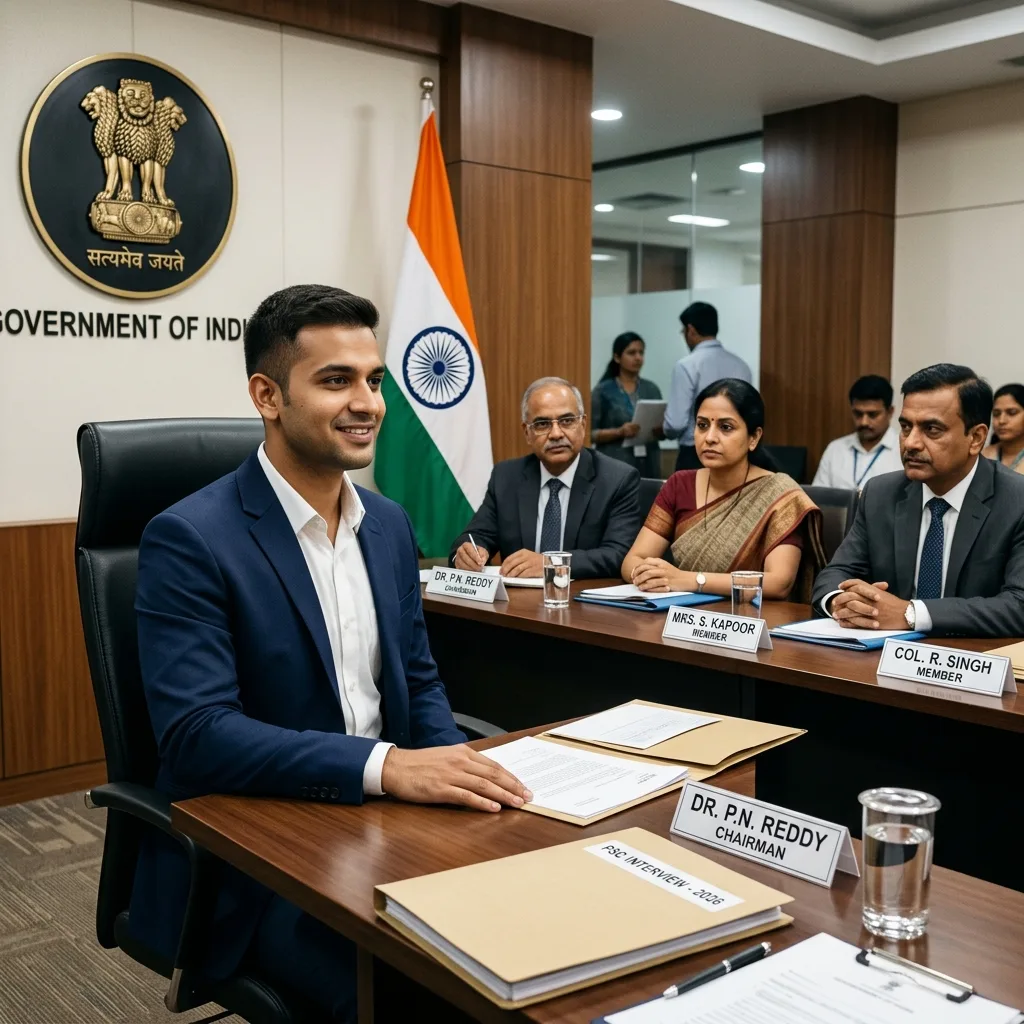
| UPSC Personality Test | UPSC CSE | 25-45 min | 5 members | Administrative suitability, values, balanced thinking |
| SSC CPO Interview | SSC CPO | 15-25 min | 3-5 members | Communication, law enforcement suitability |
| SBI PO Interview | SBI PO | 20-30 min | 3-5 members | Banking knowledge, confidence, communication |
| IBPS PO/SO Interview | IBPS PO, SO | 20-30 min | 3-5 members | Banking awareness, subject knowledge, personality |
| RBI Grade B Interview | RBI Grade B | 30-45 min | 5+ members | Economics, finance, analytical ability |
| State PSC Interview | State Civil Services | 20-40 min | 4-5 members | State-specific issues, administrative aptitude |
| Railway Interview | RRB NTPC, JE | 15-20 min | 3 members | Technical knowledge, communication |
| Defence SSB | NDA, CDS, AFCAT | 5 days | Multiple assessors | Officer-like qualities, leadership, personality |
Part 2: UPSC Civil Services Personality Test — The Gold Standard
The UPSC Civil Services Interview (officially called Personality Test) carries 275 marks — a significant portion of the final selection. Many candidates who score well in Mains fail to convert due to poor interview performance.
What the UPSC Board Actually Looks For
The board assesses five core attributes:
| Attribute | What It Means | How It Is Tested |
|---|---|---|
| Mental alertness | Quick, clear thinking | Rapid-fire factual questions |
| Critical powers of assimilation | Ability to analyse and synthesise | Opinion questions, current affairs |
| Clear and logical exposition | Can you communicate clearly? | How you structure your answers |
| Balance of judgment | Can you see multiple perspectives? | Controversial topic questions |
| Variety and depth of interest | Are you a well-rounded person? | Hobby questions, optional subject |
UPSC DAF (Detailed Application Form) — The Foundation of Your Interview
Your DAF is the most important document for UPSC interview preparation. Every line is a potential conversation:
Critical DAF Sections and How to Prepare Them:
-
Educational Background: Every degree, institution, and percentage is a question source
- Example: "You studied Physics Hons from Delhi University. How does the scientific method apply to administration?"
- Example: "Your 12th score was 94% but your graduation score was 72%. What happened?"
-
Optional Subject: Deep knowledge will be tested — know 3 facts you can connect to current affairs
-
Hobbies and Interests: List only genuine hobbies — prepare 3 levels deep
- If you list "Reading" — know: what books, which authors, what themes, what impact
- If you list "Trekking" — know: peaks climbed, skills required, environmental impact
- If you list "Classical Music" — know: gharana, famous artists, history
-
Home State/District: Know your home state inside out
- Major rivers, dams, national parks, historical monuments
- Key industries, tribes, languages, festivals
- Current issues — development challenges, state government schemes
- Recent news from your district
-
Work Experience: Every job is a potential source of questions
- What did you learn? Why did you leave? How does it prepare you for civil services?
UPSC Interview: 25 Most Asked Questions with Ideal Answers
Q1. Tell me about yourself.
Deliver a 90-second structured answer:
- Brief personal background — hometown, family (20 seconds)
- Educational journey and what shaped your thinking (30 seconds)
- Why civil services — what moment/experience inspired you (30 seconds)
- What you bring to the service (10 seconds)
Avoid: Reading off your CV. Memorised-sounding monologues.
Q2. Why do you want to join civil services after working in [private sector]?
Be honest about the pull of public service — impact at scale, policy influence, working for the nation's most vulnerable. Frame your private sector experience as an asset: "My 3 years in X gave me understanding of Y, which I want to apply in Z ministry."
Avoid: "Job security" or "salary and pension" — these signal wrong motivation.
Q3. What are the three biggest challenges facing India today?
Choose challenges that connect to your optional subject or home state — it shows depth. Structure each point as: problem → scale → root cause → your suggested approach. Always keep answers balanced.
Example structure: "Climate change poses existential risk for India's coastal and agricultural regions. With 600 million people dependent on agriculture and 7,516 km of coastline, the challenge has three dimensions — adaptation, mitigation, and financing. As an IAS officer, I would focus on mainstreaming climate risk into district planning processes."
Q4. What is your greatest weakness?
Choose a REAL weakness — not a disguised strength. Then show what you have done to address it.
Example: "I tend to overthink decisions and seek too much consensus before acting. I have been actively working on this by setting personal decision deadlines and trusting my analysis more — a skill that civil services itself will help me develop through responsibility and accountability."
Q5. If you were the DM of your home district, what would be your first priority?
Know your home district's specific problems. Mention a real, concrete issue with a specific, actionable intervention. Show you understand both the problem and the administrative tools available.
Q6. What is the difference between a politician and a bureaucrat?
A politician is elected, represents the people's mandate, and is accountable to voters. A bureaucrat is permanent, provides continuity and expertise, and is accountable to constitutional norms and service rules. The politician sets policy direction; the bureaucrat implements it effectively and impartially. Both are essential — neither functions well without the other.
Q7. India has a strong IIT/IIM system but still faces poverty. How do you explain this?
Acknowledge the real paradox — elite institutions produce talent but most of it flows abroad or to urban centres. Discuss: mismatch between elite education and mass employment needs, rural-urban divide in education quality, the need for vocational education alongside academic excellence.
Q8. If you are posted in a remote tribal district with no connectivity, how will you work?
Show adaptability and ground-level thinking. Focus on: building community trust first, working through panchayat and village-level institutions, using oral/community communication where written fails, finding local solutions rather than imposing urban frameworks.
Q9. Your senior orders you to do something you believe is wrong. What will you do?
This tests integrity AND wisdom — not just one:
- Step 1: Seek clarification — perhaps you misunderstood
- Step 2: Express your concern in writing through proper channels
- Step 3: If clearly illegal/unconstitutional — decline, citing the specific rule/act
- Step 4: If merely a difference of opinion — comply while noting disagreement on record
Avoid: Blind compliance ("I will just follow orders") or theatrical refusal ("I will resign immediately")
Q10. Why are you a better candidate than others appearing today?
Do NOT compare yourself to unknown others. Instead state your specific strengths: "I cannot speak to other candidates. What I can say is that my background in X, my experience in Y, and my commitment to Z make me genuinely prepared for the responsibilities of this service."
Q11. What motivates you more — power or service?
"Neither in isolation. Power without accountability corrupts governance. Service without authority is ineffective. Civil services provides the unique combination — the authority to implement change and the accountability to the public to do so ethically. It is the accountability that makes the power meaningful."
Q12. How would you handle corruption if you encountered it as a district official?
Step 1: Document evidence carefully. Step 2: Report through proper internal channel — vigilance wing, anti-corruption bureau. Step 3: If internal channels are compromised — approach Lokayukta or CBI. Step 4: Ensure your own conduct is impeccable — lead by example. Note: never take unilateral action that damages the case.
Q13. What is your opinion on China's rise and its implications for India?
China's rise presents both challenges and opportunities for India. Challenges: border tensions (Ladakh, Arunachal), trade deficit of over Rs.1.2 lakh crore, market dependency on Chinese electronics and APIs. Opportunities: India as an alternative manufacturing destination, diversifying supply chains, QUAD strategic partnership. India's response should be: military modernisation, economic de-risking without complete decoupling, and diplomatic engagement.
Q14. Why are you interested in [specific service — IPS/IAS/IFS]?
Be specific. "I want IPS because law enforcement directly impacts the safety and dignity of every Indian citizen — particularly women and marginalised communities. I want to contribute to police reforms that make the force more transparent, more community-connected, and more professional."
Q15. Tell us about a failure in your life and what you learned from it.
Share a genuine failure — not a humble brag. Show what the failure taught you, how you changed because of it, and how that lesson would make you a better officer. Honesty about failure signals self-awareness and maturity.
Part 3: Banking Interviews — SBI PO, IBPS PO, RBI Grade B
Banking interviews are shorter and more structured than UPSC but test specific domain knowledge alongside personality:
Banking Interview: What the Panel Looks For
| Factor | Weightage | How to Demonstrate |
|---|---|---|
| Banking and Financial Awareness | 40% | Know RBI policies, banking terms, current schemes |
| Communication Skills | 25% | Clear, confident, grammatically correct English |
| Personality and Confidence | 20% | Eye contact, composure, positive body language |
| Why Banking | 15% | Genuine, thoughtful motivation |
Banking GK Cheat Sheet: Master These 30 Terms Before Your Interview
| Term | Simple Definition |
|---|---|
| Repo Rate | Rate at which RBI lends to commercial banks (currently 6.25%) |
| Reverse Repo Rate | Rate at which RBI borrows from banks (currently 3.35%) |
| CRR (Cash Reserve Ratio) | % of deposits banks must keep as cash with RBI (currently 4%) |
| SLR (Statutory Liquidity Ratio) | % of deposits banks must keep in liquid assets (currently 18%) |
| NPA (Non-Performing Asset) | Loan where borrower has not paid for 90+ days |
| NEFT | National Electronic Funds Transfer — batched, any amount |
| RTGS | Real Time Gross Settlement — instant, min Rs.2 lakh |
| IMPS | Immediate Payment Service — instant, 24x7, max Rs.5 lakh |
| UPI | Unified Payments Interface — bank-to-bank via VPA |
| CASA Ratio | Current + Savings Account deposits as % of total — higher = better for bank |
| KYC | Know Your Customer — mandatory ID verification |
| Priority Sector Lending | 40% of loans must go to priority sectors (agriculture, MSME, etc.) |
| Capital Adequacy Ratio (CAR) | Bank capital as % of risk-weighted assets — min 10.5% required |
| Basel III | International banking regulation framework for capital adequacy |
| Jan Dhan Yojana | Financial inclusion — zero-balance accounts for unbanked |
| Mudra Loan | Loans for micro enterprises (Shishu: up to Rs.50K, Kishor: up to Rs.5L, Tarun: up to Rs.10L) |
| SARFAESI Act | Banks can seize assets of defaulters without court order |
| IBC (Insolvency Code) | Framework for resolving corporate insolvency in time-bound manner |
| NBFC | Non-Banking Financial Company — can lend but cannot accept savings deposits |
| Microfinance | Small loans to low-income groups, especially women, without traditional collateral |
| Bancassurance | Banks selling insurance products through their network |
| Core Banking System (CBS) | Centralised banking system linking all branches for real-time processing |
| SWIFT | International bank messaging system for cross-border transactions |
| Letter of Credit (LC) | Bank guarantee for international trade payment |
| Financial Inclusion Index (FI-Index) | RBI's composite index to measure banking access (currently 64.2 out of 100) |
| Insolvency Resolution Process | IBC process to resolve defaulting companies — 330 day deadline |
| EMI | Equated Monthly Instalment — fixed monthly loan repayment |
| ROA / ROE | Return on Assets / Return on Equity — bank profitability measures |
| MSP (Minimum Support Price) | Government-guaranteed minimum price for farm produce — affects Kisan Credit Card |
| Digital Rupee (e-CBDC) | RBI's digital currency pilot — central bank digital currency |
15 Most Asked Banking Interview Questions
Q1. Why do you want to join banking?
"Banking is the backbone of economic development. A bank officer works at the intersection of personal financial empowerment and national growth. I want to contribute to financial inclusion — helping small businesses and rural customers access credit and savings — while building a career in a sector that is both stable and constantly evolving with technology."
Q2. What would you do if a customer is angry and shouting at you?
"I would remain calm and let the customer finish expressing their concern without interrupting. I would acknowledge their frustration — 'I understand this has been stressful for you' — and then ask specific questions to understand the problem. I would focus on finding a solution within my authority, escalating to my supervisor if needed. Angry customers, when handled with patience and professionalism, often become loyal customers."
Q3. Where do you see yourself in 5 years?
"I see myself growing within the bank — mastering branch operations in the initial years, earning JAIIB and CAIIB certifications, and eventually moving into credit management or MSME lending. I want to be a branch manager within 5-7 years with both technical expertise and a genuine client portfolio."
Q4. What is financial inclusion and why is it important?
Financial inclusion is ensuring all individuals — particularly unbanked rural and low-income citizens — have access to affordable financial services: savings, credit, insurance, and payments. India had 190 million unbanked adults in 2014; Jan Dhan Yojana has opened 53 crore accounts. Financial inclusion reduces dependence on moneylenders (who charge 24-60% interest) and brings more money into the formal economy.
Q5. Explain the difference between a Savings Account and Current Account.
| Feature | Savings Account | Current Account |
|---|---|---|
| Purpose | Personal savings | Business transactions |
| Interest | Yes (3.5-4% typically) | No |
| Transaction Limit | Limited free transactions | Unlimited transactions |
| Minimum Balance | Lower | Higher (often Rs.5,000-25,000) |
| Who Uses It | Individuals, salaried employees | Businesses, traders |
| Overdraft | Generally not available | Available |
Q6. What is UPI and why has it been so successful?
UPI (Unified Payments Interface) is a real-time payment system by NPCI allowing instant bank-to-bank transfer using a Virtual Payment Address. India processes over 14 billion UPI transactions per month — the world's largest real-time payment network. Success factors: zero transaction fee, works on basic smartphones, interoperable across all banks, 24x7 availability, no need to share bank account number.
Q7. What is the difference between SBI and private banks?
SBI is a public sector bank (GoI owns 57.5%) — primary focus is financial inclusion, priority sector lending, rural banking. Private banks (HDFC, ICICI, Axis) are profit-focused — better technology, customer service, but less rural presence. Both serve essential roles: SBI reaches where private banks won't; private banks innovate where SBI is slower to change.
Q8. Why should we hire you specifically?
Mention 3 specific things: your academic preparation (specific banking GK you have studied), communication ability, and genuine motivation. "I have specifically studied RBI's 2025-26 monetary policy framework, understand the MSME lending challenges that banks face, and I am motivated by the financial inclusion mission that banking represents."
Part 4: SSC CPO Interview — Delhi Police SI and CAPF SI
Key Legal Knowledge for SSC CPO Interview:
New Criminal Laws (Effective July 1, 2024):
| Old Act | New Act | Purpose |
|---|---|---|
| IPC (Indian Penal Code) | BNS (Bharatiya Nyaya Sanhita) | Defines crimes and punishments |
| CrPC (Code of Criminal Procedure) | BNSS (Bharatiya Nagarik Suraksha Sanhita) | Investigation and trial procedure |
| IEA (Indian Evidence Act) | BSA (Bharatiya Sakshya Adhiniyam) | Rules of evidence in court |
Know these for SSC CPO interview:
- Cognizable vs Non-Cognizable offence
- Bailable vs Non-bailable offence
- Powers of police to arrest without warrant (BNS Section 35)
- First Information Report (FIR) process
- Zero FIR — can be filed at any police station regardless of jurisdiction
- POCSO Act — Protection of Children from Sexual Offences
- Cyber crimes and their relevant sections
10 SSC CPO Most Asked Questions:
Q1. Why do you want to join Delhi Police / CAPF?
"Law enforcement is not just a job — it is a service to the nation's safety. I am motivated by the opportunity to directly protect citizens and maintain public order. My physical fitness, mental discipline, and commitment to justice align perfectly with the values of the force I am joining."
Q2. What is Zero FIR?
A Zero FIR is an FIR filed at any police station — regardless of where the crime occurred. It was introduced to ensure no victim is turned away due to jurisdictional issues. After registering a Zero FIR, the police station transfers it to the police station having jurisdiction. It is especially important for time-sensitive cases like missing persons or serious crimes.
Q3. How would you handle a crowd control situation?
Assessment, communication, and graduated response: First assess the nature of the crowd and trigger. Attempt verbal communication and persuasion through community leaders. Deploy minimum force necessary, escalating only if non-violent methods fail. Coordinate with senior officers. Document everything for accountability. The goal is always to restore order with minimum harm.
Q4. What is cybercrime? Give 3 examples.
Cybercrime is any criminal activity involving computers or networks. Examples: (1) Online financial fraud — UPI scams, phishing, fake websites (2) Cyberbullying and harassment — stalking, threats, morphed images (3) Ransomware — malicious software that encrypts victim's data and demands payment. Report to: cybercrime.gov.in or call 1930 (national helpline).
Q5. How would you handle domestic violence complaints?
Take the complaint seriously — do not dismiss or minimise. Register FIR under BNS Section 115 (hurt) or relevant sections. Coordinate with Protection Officer under Domestic Violence Act. Arrange safe shelter if the victim is at immediate risk. Ensure medical examination if injuries are present. Follow up to ensure the victim's safety — do not treat it as a private family matter.
Part 5: State PSC Interviews — State-Specific Preparation
What to Know for State PSC Interviews:
1. State-Specific Current Issues:
- Major government schemes launched by the state in last 1 year
- Infrastructure projects — highways, dams, smart cities
- Agricultural challenges and government response
- State budget allocations and key priorities
2. State Geography:
- Rivers, lakes, dams, wildlife sanctuaries, national parks
- Districts, divisions, major cities, tribal areas
- Natural resources, mining, forest cover
3. State Economy:
- Major industries, MSME clusters
- Agricultural production — key crops, MSP issues
- State GDP, fiscal deficit, debt situation
- Investment MoUs signed
4. Common State PSC Questions:
- "What are the major development challenges in your home district?"
- "How would you address farmer distress in this state?"
- "If appointed as SDM of a tribal district, what would be your first 30 days?"
- "What are your views on the proposed [state-specific project]?"
- "Explain the [state flagship scheme] and its impact so far."
Part 6: Body Language Mastery — The Silent Interview
Research consistently shows that interviewers form their primary impression within the first 90 seconds — before you have answered a single question. Your body language IS your first answer.
Entering the Interview Room:
| Action | Correct Way | Wrong Way |
|---|---|---|
| Knock | 2 firm knocks, wait for "come in" | Barging in without knocking |
| Walk in | Walk with purpose, upright posture | Shuffling, looking at the floor |
| Greet | "Good morning/afternoon, Sir/Ma'am" with eye contact | Only nodding, no eye contact |
| Sitting | Wait to be invited; pull chair quietly; sit fully back | Sitting immediately without invitation |
During the Interview — Full Checklist:
Posture:
- Sit upright with your back touching the chair — not slouched or hunched forward
- Both feet flat on the floor — do not cross legs or swing feet
- Hands rested calmly on the table or your lap — not fidgeting
Eye Contact:
- Maintain natural, steady eye contact with the person asking the question
- Shift gaze to other panel members when answering — do not stare at one person only
- Blink naturally — do not stare unblinkingly
Voice:
- Speak at a moderate pace — not rushing or too slow
- Keep volume consistent — do not trail off at the end of sentences
- Pause before answering — 2-3 seconds of thought is professional
- Avoid "umm," "like," "you know," "actually" — filler words signal poor preparation
Exiting Correctly:
- Wait for the panel to signal ("Thank you, you may go")
- Stand up calmly, push the chair in gently
- Say clearly: "Thank you for your time, Sir/Ma'am" — smile genuinely
- Walk to the door confidently, exit, and close the door gently
- Do NOT express relief loudly outside — some panels can still hear
Part 7: Dress Code — Look the Part
Male Candidates:
| Item | Recommended | Avoid |
|---|---|---|
| Shirt | Plain light colour — white, light blue, light grey | Bright patterns, checks, half-sleeves |
| Trousers | Dark formal — navy, charcoal, dark grey, black | Jeans, chinos, light trousers |
| Blazer | Dark navy or charcoal (recommended for UPSC) | Bright colours, casual blazers |
| Shoes | Black leather formal, well-polished | Sports shoes, loafers, sandals |
| Hair | Well-groomed, neatly combed | Messy, dyed, very long hair |
| Fragrance | Light, subtle — if at all | Strong perfume or cologne |
Female Candidates:
| Item | Recommended | Avoid |
|---|---|---|
| Outfit | Formal saree (muted colours) OR formal salwar kameez OR formal western suit | Trendy/casual, revealing outfits |
| Colours | Muted, professional — navy, grey, maroon, white, pastels | Neon, bright patterns, heavily embellished |
| Hair | Neatly tied back — bun, braid, or low ponytail | Loose flowing hair |
| Jewellery | Minimal — small studs, simple necklace at most | Heavy jewellery, multiple bangles |
| Footwear | Closed-toe formal heels (1-2 inch) or formal flats | Open-toe shoes, very high heels |
The Golden Rule: Your clothing should never distract the panel from what you are saying.
Part 8: How to Handle Difficult Interview Questions
Type 1: The "I Don't Know" Moment
Wrong approach: Making up an answer. Bluffing.
Right approach: "I am not certain of the exact answer, Sir. My understanding is [your best guess + reasoning]. I would want to verify the exact figure before making a decision based on it."
This shows intellectual honesty + reasoning ability — valued traits in all government services.
Type 2: The Provocative / Controversial Question
Questions like: "Do you think reservations are fair?" "Should India have a Uniform Civil Code?" "Is foreign investment good for India?"
Right approach: Acknowledge multiple perspectives. State your position carefully with reasoning. Show respect for opposing views. Avoid political rhetoric.
Example: "This is a complex policy question with genuine arguments on both sides. [Give argument FOR and AGAINST]. My own view is [measured position], but I recognise that reasonable people can disagree based on their values and their reading of the data."
Type 3: The Stress Question / Aggressive Panel
Sometimes a panel member will seem rude or challenge your answer aggressively.
Right approach: Remain calm. Respond with the same tone and confidence. If corrected and they are right: "You are absolutely right, Sir — I stand corrected." If you know you are correct: politely hold your position with evidence.
The panel is not genuinely angry — they are testing whether pressure breaks your composure.
Type 4: The Silence Trap
After you answer, the panel may stare at you without speaking.
Right approach: Meet their gaze calmly and wait. Silence is not rejection. Do not add unnecessary qualifications to fill the silence — it weakens a good answer.
Part 9: 30-Day Interview Preparation Plan
Week 1: Know Yourself
| Days | Task |
|---|---|
| Day 1-2 | Write down every DAF entry. Under each, write 10 potential questions |
| Day 3-4 | Research every DAF entry deeply (hometown, college, hobbies, work) |
| Day 5-6 | Prepare "Tell me about yourself" — write, practise, record, refine |
| Day 7 | Practise 20 DAF-based questions in front of mirror or with a friend |
Week 2: Domain Knowledge
| Days | Task |
|---|---|
| Day 8-10 | Current affairs revision — last 6 months. Focus: economy, polity, international, science |
| Day 11-12 | Domain knowledge (banking terms, law/polity for CPO, state issues for PSC) |
| Day 13-14 | Read 5 Hindu/IE editorials — practise forming balanced opinions on current issues |
Week 3: Practice and Feedback
| Days | Task |
|---|---|
| Day 15-17 | Mock interview with friends or family — record it on video |
| Day 18 | Watch recording — identify filler words, poor posture, eye contact issues |
| Day 19-20 | Mock interview with a senior/mentor — get external feedback |
| Day 21 | Attend a group mock interview session if available |
Week 4: Polish and Logistics
| Days | Task |
|---|---|
| Day 22-24 | Revise weak areas from mock feedback |
| Day 25 | Finalise interview outfit — wear it once, check for fit, iron, polish shoes |
| Day 26 | Research interview venue — travel route, time required |
| Day 27-28 | Light revision — current affairs, DAF points |
| Day 29 | Keep all documents organised |
| Day 30 | Interview Day: Wake early, dress fully, leave with 60-minute buffer |
Part 10: Documents Checklist for Government Job Interviews
| Document | Copies Required |
|---|---|
| Interview call letter / admit card | 2 originals |
| Photo ID proof (Aadhaar / Passport / Voter Card) | Original + 2 photocopies |
| Passport-size photographs | 6-8 (recent, same as application) |
| 10th Marksheet and Certificate | Original + 3 photocopies |
| 12th Marksheet and Certificate | Original + 3 photocopies |
| Graduation Marksheets (all semesters) | Original + 3 photocopies each |
| Graduation Degree Certificate | Original + 3 photocopies |
| Category Certificate (OBC/SC/ST/EWS) | Original + 3 photocopies |
| Domicile Certificate | Original + 3 photocopies |
| Experience Certificate (if applicable) | Original + 3 photocopies |
| No Objection Certificate (if employed) | Original + 1 photocopy |
| Character Certificate | Original |
| DAF Printout (UPSC only) | 2 copies |
Carry all documents in a neat, organised file folder — not loose papers.
Part 11: Real Success Stories
Story 1: Sanjay — UPSC CSE 2024, IPS (AIR 187)
Background: Sanjay from Lucknow. 3rd attempt. Had failed interview twice with good Mains scores.
What changed in the 3rd attempt:
- Joined a mock interview group — did 15 practice sessions
- Stopped trying to give "correct" answers — started giving honest, balanced answers
- Revised home state (UP) current affairs very deeply — knew everything about his own district
His interview highlight: "The board asked me about the Gangetic plain dolphin because I had listed wildlife conservation as a hobby. I knew everything about it. They asked about sand mining threat to Ganga. I connected it to my home district of Unnao. The board was visibly engaged. The interview lasted 45 minutes — a very good sign."
His message: "I failed two interviews despite strong Mains scores because I was giving textbook answers. The third time, I just spoke genuinely — my opinions, my experiences, my passion. I got 236/275. Be yourself — the board wants a person, not a knowledge repository."
Story 2: Priya — SBI PO 2025
Background: Priya from Pune. Commerce graduate. Selected in SBI PO on 2nd attempt.
First attempt mistake: She said "I don't know" to the Repo Rate question — she knew it was around 6% but was not sure of the exact figure. Panel marked her down.
Second attempt: She checked the latest RBI MPC decision 2 days before the interview. She walked in knowing the exact Repo Rate, CRR, and SLR figures.
Her interview highlight: "They asked me to explain financial inclusion to a farmer who has never been to a bank. I said: 'Imagine a post office in your village — except this one saves your money safely, lends you money for seeds at a lower rate than a moneylender, and sends money to your son in the city instantly on your phone.' The panel smiled. One member said 'Good analogy.'"
Her message: "Know your banking basics perfectly. Practice explaining concepts in simple language. And please — know the current Repo Rate. Every banking interview asks this. Missing it signals you are not serious about the sector."
Story 3: Ramesh — UP PSC PCS (SDM), 2nd Attempt
Background: Ramesh from Ballia, UP. First attempt failed despite clearing written exam comfortably.
First attempt failure: He knew national current affairs well but struggled when asked about UP-specific schemes — "UP Mukhyamantri Jan Arogya Yojana," local development challenges in eastern UP.
Second attempt: He spent 2 weeks specifically on UP government schemes (Mukhyamantri Udyami Yojana, One District One Product, UP expressway grid), UP's economic challenges, and his home district Ballia's specific issues.
His interview highlight: "They asked me: 'Ballia is known for freedom fighters but economically lags behind. Why and what would you do as an SDM?' I gave a 4-minute detailed answer about the district's challenges, why agriculture-only dependence has held it back, and three specific interventions I would make. The panel chairman nodded and said 'Well prepared.'"
Common Interview Mistakes and How to Avoid Them
| Mistake | How Common | How to Avoid |
|---|---|---|
| Saying "I don't know" without any further effort | Very Common | Always try: "My understanding is..." before admitting uncertainty |
| Speaking too fast when nervous | Very Common | Practice slow, deliberate speaking — take 3 deep breaths before entering |
| Not knowing basic current affairs from last 30 days | Common | Read newspaper every single day for 1 month before interview |
| Not researching your own DAF/application form | Common | Every line of your DAF should be prepared 3 levels deep |
| Giving extreme or political opinions on controversial topics | Common | Always give balanced perspective with multiple viewpoints |
| Arriving late or barely on time | Occasional | Arrive 60 minutes early — sit outside, calm yourself |
| Wearing wrinkled, casual, or flashy clothes | Occasional | Do a dress rehearsal 3 days before. Iron everything. Polish shoes. |
| Fidgeting with hands, pen, or clothing | Very Common | Practice keeping hands still in your lap during mock interviews |
| Not asking for clarification when question is unclear | Common | Say: "Could you please rephrase the question, Sir?" — this is professional |
| Bluffing when caught with a wrong answer | Occasional | Say: "I stand corrected, Sir" graciously — intellectual honesty is respected |
Frequently Asked Questions
Q1. Should I prepare in Hindi or English for government interviews? For UPSC, you may choose your medium — most panels are comfortable with either. For Banking and SSC CPO, English is expected but basic Hindi is accepted. State PSC interviews are often conducted in the state language + Hindi + English. Always respond in the language you are most fluent in — clarity matters more than the language.
Q2. I stammer slightly when nervous. Will this disqualify me? No. A mild stammer does not disqualify you. What matters is your content, clarity of thought, and composure. Inform the panel early if needed: "I occasionally stammer when nervous — please bear with me." This self-awareness actually impresses panels.
Q3. How do I answer if I genuinely disagree with a government policy? You can disagree — civil servants are expected to have independent analytical minds. Express disagreement constructively: acknowledge the policy's intent, note your concern with specific reasoning, and suggest an improvement. Do NOT dismiss or ridicule any government policy or political leader.
Q4. Can I wear glasses to the interview? Yes — glasses are completely acceptable in government job interviews. They do not affect selection. If you normally wear glasses, wear them — a naturally comfortable you is better.
Q5. How many mock interviews should I do? Minimum 5-7 mock interviews — at least 3 with people who do not know you well. For UPSC, aim for 10-15 mocks. The goal is not to memorise answers but to develop comfort, poise, and natural articulation under pressure.
Q6. What if a panel member asks something completely outside my preparation? Step 1: Take 3 seconds to organise your thoughts. Step 2: Acknowledge what you know and what you are uncertain about. Step 3: Reason through the question logically. Step 4: If completely lost: "I do not have enough knowledge on this specific point to give a reliable answer, but my instinct, based on [related knowledge], would be..." This demonstrates intellectual honesty and analytical thinking.
Part 12: Current Affairs Mastery for Government Interviews
Current affairs is the single most important preparation area for every government job interview — it signals that you are an informed, engaged citizen who cares about the world you want to serve.
The 6-Month Current Affairs Framework
Do not try to memorise everything. Instead, build a structured mental map of the 8 most important areas:
| Area | Why It Matters | Key Sources |
|---|---|---|
| Economy and Budget | Most government decisions are economic — every panel asks about it | RBI Annual Report, Union Budget 2026-27, ET/Business Standard |
| Indian Foreign Policy | India's global position, bilateral relations, international organisations | MEA website, The Hindu International edition |
| Defence and Security | Essential for UPSC, SSC CPO, CAPF — internal security, border issues | PIB Defence releases, The Print |
| Social Issues | Poverty, gender, education, health — directly relevant to government work | NFHS-5 data, Economic Survey, Lancet India studies |
| Environment and Climate | COP agreements, India's NDC, green energy targets, pollution | MoEFCC, Down To Earth magazine |
| Science and Technology | AI, space (ISRO), digital India, health tech | ISRO.gov.in, DST.gov.in |
| State-Specific News | Critical for State PSC — local schemes, governance | State government website, state edition newspaper |
| International Current Affairs | G20, UN, BRICS, global conflicts, trade | PIB, BBC, Hindu International |
How to Read the Newspaper for Interview Preparation
Most candidates read the newspaper the wrong way — they read it for facts. For interview preparation, you must read it for analysis:
Wrong way: "I read that India's GDP grew 7.2% this year."
Right way: "India's GDP grew 7.2% this year. Why? Primarily driven by services sector and public infrastructure spending. What does this mean? Government has fiscal space to spend more. What are the risks? Manufacturing still sluggish, rural demand weak. What should the government do? [Your policy recommendation]."
Every news article should produce 3 things in your mind:
- The fact (what happened)
- The context (why it happened, what led to it)
- The implication (what should be done, what are the risks)
The "Current Affairs Card" Method
For each important news item, create a mental "card" with 5 fields:
| Field | Example — UPI Milestone |
|---|---|
| What | India crossed 14 billion UPI transactions in June 2026 |
| Who | NPCI, RBI, all participating banks |
| Why significant | World's largest real-time payment volume; surpassed all other countries |
| Challenges | Fraud prevention, interoperability with CBDC, small merchant adoption |
| What next | UPI expansion to 20 countries via RBI partnership, CBDC integration |
This "card" format is exactly what an interview panel expects when they ask about any current issue.
Interview-Specific Current Affairs Cheat Sheet (July 2026)
| Topic | Key Data Point | Interview Angle |
|---|---|---|
| GDP Growth | India 7.2% (FY26) — fastest major economy | Services-driven; manufacturing needs push |
| Inflation (CPI) | ~4.2% (within RBI 4% ± 2% target) | RBI has room for rate cuts |
| Repo Rate | 6.25% (RBI MPC June 2026) | Signals monetary policy stance |
| Unemployment Rate | ~7.8% (CMIE) — youth unemployment higher | MSME credit, skilling, manufacturing PLI |
| Digital India | 1.3 billion Aadhaar, 53 crore Jan Dhan accounts | Financial inclusion progress |
| ISRO | Gaganyaan test flights completed, Chandrayaan-3 success | India space power — scientific capability |
| PM Surya Ghar Yojana | 1 crore household rooftop solar target | Green energy transition, rural electricity |
| 8th Pay Commission | Implementation expected Jan 2026 | Salary hike for 50 lakh central employees |
| Nari Shakti Vandan Act | 33% women reservation in Lok Sabha and Assemblies | Gender representation, political empowerment |
| India-China Relations | Partial buffer zone disengagement in Ladakh | Border management, strategic patience |
| BRICS 2024 | New members — Egypt, Ethiopia, Iran, UAE, Saudi Arabia joined | India's multilateral influence |
| PLI Scheme | 14 sectors, Rs.1.97 lakh crore incentive | Manufacturing push, import substitution |
Part 13: RBI Grade B Interview — The Most Specialised Government Interview
RBI Grade B is one of the most prestigious (and toughest) government job interviews in India. The panel consists of senior RBI officials with deep expertise — you must be prepared at a much higher level than regular banking interviews:
RBI Grade B Interview: Format and Marks
| Component | Marks | Notes |
|---|---|---|
| Phase I CBT | 200 marks | General, Economics, Finance, Management |
| Phase II CBT | 300 marks | Economic and Social Issues, English, Finance |
| Interview | 75 marks | Deep domain assessment |
| Final Selection | Phase II + Interview | Phase I is just qualifying |
What RBI Grade B Panel Expects
The RBI interview panel — typically comprising 5-6 senior RBI officials including an Executive Director level officer — expects you to:
- Think like an economist — not just state facts but analyse policy trade-offs
- Connect macroeconomics to Indian context — theory meets Indian data
- Have opinions — hedged, balanced, but genuine analytical positions
- Know RBI's current concerns — read RBI's Annual Report, Monetary Policy Report, and Financial Stability Report
RBI Grade B: 15 Deep-Dive Interview Questions
Q1. What is the current monetary policy stance of RBI and why?
As of June 2026, RBI maintains a neutral stance (shifted from withdrawal of accommodation). This means: inflation is within target (4.2%), growth is robust (7.2%), and RBI has flexibility to cut rates if needed. The stance shift signals RBI is balancing: (1) bringing real interest rates to supportive levels, (2) not letting inflation re-emerge, (3) maintaining financial stability.
Q2. Explain the transmission mechanism of monetary policy in India.
When RBI changes the Repo Rate, the transmission chain is: Repo Rate → MCLR (Marginal Cost of Lending Rate) → Bank lending rates → Borrowing costs for businesses and households → Investment and consumption → GDP growth and inflation.
The key problem in India: transmission is incomplete and slow. Banks are reluctant to pass rate cuts fully to customers due to: (a) high NPA burden, (b) stickiness of deposit rates, (c) government borrowing crowding out private credit.
Q3. What is inflation targeting and how does India's framework work?
India adopted flexible inflation targeting in 2016. The framework: (1) MPC (Monetary Policy Committee) — 6 members, 3 from RBI, 3 from government — decides policy rates by vote. (2) Target: CPI inflation at 4% (±2% band). (3) If inflation stays outside the band for 3 consecutive quarters, RBI must explain to the government in writing.
The debate: Should the target be raised to 5% or 6% to allow lower real interest rates? Counter: credibility of the framework depends on maintaining the 4% anchor.
Q4. What is the current account deficit (CAD) and what are its implications?
CAD = difference between imports and exports of goods, services, and transfers. A higher CAD means India is importing more than it exports — requiring foreign capital to finance the gap. Implications: (1) Rupee depreciation pressure, (2) dependence on volatile FPI inflows, (3) higher external vulnerability. Key concern: oil import bill is the biggest driver of India's CAD — every $10/barrel increase in crude oil = ~0.4% worsening of CAD.
Q5. How does RBI manage the exchange rate?
RBI does not target a specific exchange rate — it intervenes to prevent excessive volatility. Tools: (1) Direct intervention — buying/selling USD in spot market, (2) Forward market intervention, (3) Foreign exchange swap auctions. Current forex reserves: ~$680 billion (June 2026) — among world's largest. Challenge: managing hot money flows (FPI equity/debt) that cause sharp INR swings.
Q6. What is the MSME credit gap and how can RBI address it?
India has 63 million MSMEs employing 110 million people, contributing 30% of GDP. Yet formal credit reaches only 16% of MSME demand — a credit gap of Rs.20-25 lakh crore. Barriers: lack of collateral, poor credit history, high transaction costs for banks.
RBI solutions: (1) Account Aggregator framework — enables data-based lending without collateral, (2) TReDS (Trade Receivables Discounting System) — allows MSMEs to discount invoices, (3) Priority sector lending mandate, (4) Co-lending model with NBFCs for last-mile reach.
Part 14: The Psychology of Government Interviews — Understanding What Assessors Actually Think
Most candidates focus 100% on content and 0% on understanding the psychology of the assessor. This is a massive mistake.
How an Interview Panel Forms Its Opinion
Research on interview psychology shows that assessors make their primary judgment within the first 4-7 minutes. After that, they unconsciously seek confirmation of that initial impression. This means:
- If you make a great first impression, the panel will be lenient about occasional weak answers
- If you make a poor first impression, they will scrutinise every response more harshly
The first 4-7 minutes cover: your entry, your greeting, your posture, and your answer to "Tell me about yourself."
The "Halo Effect" in Government Interviews
The halo effect is a cognitive bias where one positive trait causes the assessor to rate other traits more positively too. In government interviews:
- A candidate who speaks with genuine passion about their motivations triggers the halo effect — suddenly their knowledge seems better
- A candidate who demonstrates excellent knowledge of their home state triggers the halo effect — suddenly their general knowledge seems better too
How to trigger the halo effect:
- Show genuine enthusiasm when talking about your motivation for joining the service
- Demonstrate specific, detailed knowledge of your home district or state
- Give one exceptionally well-structured, nuanced answer early in the interview
Why Some "Average" Candidates Clear Interviews That "Brilliant" Ones Fail
Common observation among interview panels: candidates with 95th percentile knowledge scores sometimes get lower interview marks than candidates with 75th percentile knowledge — because:
| Over-Prepared (Textbook) Candidate | Genuinely Prepared (Self-Aware) Candidate |
|---|---|
| Gives long, information-dense answers | Gives structured, appropriately-scoped answers |
| Sounds like they are reading from a textbook | Sounds like they are thinking through the problem |
| Talks AT the panel | Has a conversation WITH the panel |
| Gets defensive when challenged | Accepts corrections graciously |
| Has memorised "UPSC-approved" opinions | Has genuine, reasoned opinions |
| Expresses certainty about everything | Expresses appropriate uncertainty where warranted |
The panel has interviewed hundreds of candidates. They can distinguish between a person speaking from genuine understanding and a person reciting memorised content. Be the former.
How to Appear Confident Without Being Arrogant
Government interview panels value confidence but are put off by arrogance — especially in freshers:
Confident behaviours:
- Making eye contact while speaking
- Pausing to think before answering (shows thoughtfulness, not nervousness)
- Saying "In my view..." or "My reading of this issue is..."
- Accepting corrections graciously without being self-deprecating
Arrogant behaviours (avoid these):
- Interrupting the panel member before they finish the question
- Dismissing the panel's premise: "That's not how it works..."
- Showing impatience when they ask follow-up questions
- Over-explaining as if the panel does not understand the topic
- Name-dropping: "As I read in Amartya Sen's..." — panels see through this
Part 15: IBPS SO Specialist Officer Interview — Domain-Specific Preparation
IBPS SO interview is different from IBPS PO — it tests deep specialised knowledge based on the post you have applied for:
IT Officer Interview (Scale I):
Core topics to master:
- Networking basics (TCP/IP, OSI model, firewalls)
- Cybersecurity (types of attacks — phishing, DDoS, SQL injection; CERT-In guidelines)
- Database management (SQL, DBMS concepts, data integrity)
- Cloud computing (AWS, Azure basics, SaaS/PaaS/IaaS)
- Digital banking technology (CBS, UPI architecture, blockchain basics)
Most asked IT Officer interview questions:
-
"What is the difference between symmetric and asymmetric encryption?"
- Symmetric: same key for encryption and decryption (AES, DES) — faster, used for bulk data
- Asymmetric: public key encrypts, private key decrypts (RSA) — slower, used for secure key exchange
- SSL/TLS uses both: asymmetric for initial handshake, symmetric for session data
-
"How does UPI work technically?"
- Customer creates VPA (Virtual Payment Address) — e.g., name@bankname
- Payment request goes to NPCI via PSP (Payment Service Provider — PhonePe, GPay, etc.)
- NPCI routes to beneficiary bank using IMPS rails
- IMPS settles in real-time; confirmation returned to both parties
- Entire process: 2-8 seconds
-
"What is cybersecurity and what are banks' primary threats in 2026?" Primary threats: (1) Phishing/vishing attacks targeting customers, (2) Ransomware on bank systems, (3) API security vulnerabilities in digital banking, (4) Insider threats, (5) SIM swap fraud. Banks respond with: MFA (multi-factor authentication), real-time transaction monitoring, AI-based fraud detection, CERT-In compliance.
Agriculture Officer Interview (Scale I):
Core topics:
- Crop production, soil science, irrigation, crop protection
- Government agriculture schemes (PM-KISAN, PMFBY, Kisan Credit Card)
- Agricultural credit, Kisan Credit Card structure
- Rural development, FPOs (Farmer Producer Organisations)
- Climate-resilient agriculture, organic farming
Most asked questions:
-
"How does the Kisan Credit Card work and what is its interest subsidy?" KCC provides revolving credit up to Rs.3 lakh at 7% interest (4% after 3% interest subvention by government for timely repayment). Covers: crop loans, post-harvest expenses, maintenance, allied activities.
-
"What is PM-KISAN and what are its limitations?" PM Pradhan Mantri Kisan Samman Nidhi provides Rs.6,000/year (3 instalments of Rs.2,000) directly to farmer bank accounts. Over 11 crore farmers covered. Limitations: (1) Small amount — not enough to meaningfully reduce input costs, (2) Excludes landless labourers, (3) Does not address price risk.
Law Officer Interview (Scale I):
Core topics:
- Banking laws (Banking Regulation Act, RBI Act, SARFAESI Act, IBC)
- Contract law, negotiable instruments
- Consumer protection (Consumer Protection Act 2019)
- KYC/AML compliance regulations
- FEMA (Foreign Exchange Management Act)
Most asked questions:
-
"What is SARFAESI Act and how does it help banks?" SARFAESI (Securitisation and Reconstruction of Financial Assets and Enforcement of Security Interest) Act 2002 allows banks to recover NPAs without going to court — they can directly seize and sell collateral after 60-day notice. Threshold: loans above Rs.1 lakh, secured assets only.
-
"What are the key differences between DRT and SARFAESI for NPA recovery?" SARFAESI: bank initiates, no court needed, faster (6-12 months). DRT (Debt Recovery Tribunal): court-like process, more thorough legal protection for both parties, takes 2-5 years typically. Banks prefer SARFAESI for efficiency; borrowers prefer DRT for due process.
Part 16: Group Discussion — For Exams Where GD Precedes Interview
Some government exams (especially banking) conduct a Group Discussion (GD) before the personal interview. Your GD performance affects both the GD marks and, indirectly, the interview panel's impression:
How GDs Are Evaluated:
| Parameter | Weightage | What Assessors Look For |
|---|---|---|
| Content Quality | 30% | Relevance, accuracy, depth of points |
| Communication | 25% | Clarity, fluency, appropriate vocabulary |
| Leadership | 20% | Initiating, summarising, keeping discussion on track |
| Listening and Building | 15% | Responding to others' points, not just stating your own |
| Composure | 10% | Staying calm when others speak over you |
GD Strategy: Step by Step
Before GD starts:
- Know the most common GD topics for 2026: Digital India, Climate change, Women empowerment, MSME credit gap, India as manufacturing hub, AI in banking, Financial inclusion
- For each topic, prepare: 3 points IN FAVOUR + 3 points AGAINST + 1 balanced conclusion
When topic is announced (preparation time: 2-3 minutes):
- Quickly jot down: 3-4 key points, 1-2 statistics, 1 balanced conclusion
- Decide: should you initiate? (Only if you have strong content — initiating and then going blank is worse than not initiating)
Opening the GD (if you initiate):
- State the topic and your angle clearly in 30-45 seconds
- Introduce 1-2 points, then invite others: "These are my initial thoughts — I am curious what others think about..."
- Do NOT monologue — GD is a discussion, not a speech
During the GD:
- Listen actively — build on others' points: "Building on what X said about Y, I would add..."
- Use names if known: it creates rapport and shows you are listening
- Bring in quiet participants: "We have not heard from everyone — [name], what is your view?"
- If someone interrupts you: pause, let them finish, then say "I would like to complete my point if I may..."
Summarising the GD (if you get to close):
- Cover ALL main points raised (not just yours)
- Give a balanced conclusion — not winner/loser but nuanced
- 45-60 seconds maximum
GD Topics with Quick Content for 2026:
"Is Artificial Intelligence a threat to banking jobs?"
FOR (AI replaces jobs): AI handles: loan processing, fraud detection, customer service (chatbots), KYC verification, credit scoring. 30% of routine banking tasks can be automated.
AGAINST (AI creates jobs): AI creates new roles: AI trainers, data analysts, cybersecurity experts, relationship managers for complex products. Historical pattern — technology replaces tasks, not people.
BALANCED CONCLUSION: AI will transform banking jobs rather than eliminate them. The key is proactive reskilling — banks and government must invest in training employees for AI-augmented roles, not wait for displacement to happen.
"Should all government services be digital-only?"
FOR: Cost reduction, speed, transparency, no corruption in delivery, 24x7 availability.
AGAINST: 37% of rural India lacks smartphones, 19% lacks internet. Elderly and disabled citizens face barriers. Single points of failure in cyberattacks.
BALANCED CONCLUSION: Digital-first, not digital-only. Maintain physical alternatives for vulnerable populations while aggressively expanding digital access — Jan Dhan + mobile + internet coverage together make digital inclusion possible.
Part 17: Post-Interview Etiquette and What to Do After the Interview
Most candidates do not think about post-interview behaviour — but it matters:
Immediately After the Interview:
-
Write down every question asked — within 30 minutes while memory is fresh. This is invaluable for:
- Understanding your performance honestly
- Preparing better for the next attempt if needed
- Sharing with others preparing for the same exam (builds your reputation as a generous resource)
-
Assess your performance honestly:
- Which questions did you answer confidently and accurately?
- Which answers were weak, incomplete, or wrong?
- Was your body language controlled or did you fidget?
- Did you answer "Tell me about yourself" smoothly?
-
Do NOT discuss your interview in the waiting area in a way that demoralises others who are yet to go in. Be supportive — karma works in surprising ways.
Waiting for Results:
-
Do not stop preparation — if you have cleared the written exam of this recruitment, use the waiting period to prepare for the next stage (document verification, medical) or the next recruitment altogether.
-
Do not obsessively check for result updates — this anxiety is counterproductive. Set one time per day to check — morning or evening. For the rest of the day, prepare.
-
If you do not get selected: Request feedback from panel if the organisation allows it. Many State PSCs provide individual feedback to candidates. Use this for your next attempt.
If You Are Selected — What Happens Next:
| Stage | What Happens | Timeline |
|---|---|---|
| Provisional Selection | Merit list published — your name appears | 2-4 weeks after interview |
| Document Verification | Physical verification of all original documents at designated centre | 1-2 months after result |
| Medical Examination | Physical and medical fitness check | 1-2 months after DV |
| Police Verification | Background check through local police | 1-2 months |
| Joining Letter | Official appointment letter issued | 2-6 months after interview |
| Training | Pre-joining training / induction | Immediately after joining |
Critical: During waiting period between interview and joining:
- Keep all documents safe — especially originals
- Do not make any financial commitments based on unconfirmed selection
- Continue appearing for other government exams — until you physically receive the joining letter and join, your selection is provisional
Part 18: Special Interview Challenges — How to Handle Them
Challenge 1: You Are Much Older Than Typical Candidates
Many candidates appear for banking or SSC interviews at age 29-32 (maximum age limit). The panel sometimes asks: "Why so late? Why are you only now trying for a government job?"
Ideal response: "My journey to this interview has taken longer because I was [genuinely describe what you were doing — working, family responsibility, earlier attempts]. That experience has made me more mature, more certain of what I want, and more prepared to serve. I am not young in years at the start of my career, but I bring a life experience and seriousness of purpose that younger candidates may still be developing."
Challenge 2: You Have Changed Streams / Careers Multiple Times
"You did engineering, then worked in IT, and now want to become an IAS. Why this inconsistency?"
Ideal response: "My path has been exploratory — which I believe is healthy for a young person. Engineering taught me analytical rigour. My time in the IT sector showed me how technology can scale solutions. Both experiences have convinced me that the highest leverage point for solving India's problems is public policy and administration. My background is not inconsistency — it is unique preparation."
Challenge 3: You Have Low Marks in Graduation
"Your 12th marks were 87% but your graduation is 62%. What happened?"
Do NOT make excuses. Be honest: "I went through a difficult personal period in my second year that affected my performance [if true]. I have learned from that experience — my final year scores were 74%, and my UPSC mains performance reflects the focused preparation I have undertaken since."
Challenge 4: You Are From a Non-English Background
"Your English is hesitant — how will you communicate with senior officials?"
Ideal response: "English is not my first language, and I acknowledge that my spoken fluency is still developing. However, my written English is strong [if true], and I am actively improving my spoken fluency through daily practice. More importantly, my strongest skill is clear thinking and problem-solving — which I believe will be more valuable in administration than linguistic perfection."
Challenge 5: You Failed Previous Attempts
"This is your third attempt. What makes you think you will be a good officer after repeatedly failing?"
Ideal response: "Each attempt has made me a better candidate. My first attempt taught me the exam pattern. My second attempt improved my answer writing and interview skills. This third attempt, I am approaching with a level of preparation, self-awareness, and genuine understanding of the role that I simply did not have earlier. The persistence required to keep trying is, I would argue, exactly the persistence that administration demands."
Part 19: Interview Vocabulary — Sophisticated Words and Phrases to Use
Using precise, sophisticated vocabulary signals education and clear thinking. Here are 30 words/phrases that genuinely impress government interview panels:
Instead of "I think"... use:
| Basic Phrase | Sophisticated Alternative |
|---|---|
| "I think" | "In my considered view..." / "My analysis suggests..." |
| "It's important" | "This is of significant consequence because..." |
| "A lot of people" | "A substantial proportion of the population..." |
| "The government should" | "The policy imperative would be to..." |
| "Good idea" | "A compelling intervention / a prudent approach" |
| "Problem" | "Challenge" / "impediment" / "structural constraint" |
| "Help" | "Facilitate" / "enable" / "catalyse" |
| "Big difference" | "Significant differential" / "substantial divergence" |
| "I don't know exactly" | "I am not certain of the precise data, but..." |
| "Things are changing" | "We are witnessing a structural shift in..." |
Useful Linking Phrases:
| Type | Phrases |
|---|---|
| Adding a point | "Furthermore..." / "In addition to this..." / "Building on this..." |
| Contrasting | "However..." / "On the other hand..." / "That said..." |
| Concluding | "In sum..." / "Taken together..." / "The net effect is..." |
| Acknowledging complexity | "This is a multidimensional issue..." / "The answer is nuanced..." |
| Showing balance | "There are legitimate arguments on both sides..." |
| Hedging appropriately | "Subject to verification of the exact data..." |
| Agreeing with correction | "You make an excellent point, Sir. I stand corrected." |
| Seeking clarification | "Could you please elaborate on the specific aspect you are asking about?" |
Phrases to AVOID in Government Interviews:
- "Actually..." (overused, sounds like you are correcting someone)
- "Obviously..." (dismissive — nothing is obvious to everyone)
- "Basically..." (signals imprecision)
- "Totally / absolutely" as filler words
- "Like" as a filler: "The policy is like, important because..."
- "You know what I mean?" — makes you sound uncertain
- "I read somewhere that..." — cite a specific source or do not cite at all
Conclusion: The Interview Is a Conversation, Not an Examination
The most common misconception about government job interviews is that they are high-stakes examinations where you need to give "correct" answers to pre-set questions.
They are not. They are conversations between experienced professionals who genuinely want to like and select you. The panel is NOT hoping you fail. They want to recommend you. They are looking for reasons to say yes. Give them those reasons:
- Be genuine — a real, self-aware, thoughtful person always impresses more than a polished robotic answer-dispenser
- Be prepared — know your DAF, know current affairs, know domain basics — preparation gives you confidence
- Be composed — the single trait that separates successful candidates from nervous ones is the ability to think clearly under pressure
- Be curious — show genuine interest in public service, the organisation, and the challenges of the role
Every successful government officer you admire sat in the same chair you will sit in. They were nervous too. The difference is that they prepared, showed up fully present, and had a genuine conversation.
Prepare well. Walk in confidently. Be yourself. And make the government proud to select you.
Stay updated with the latest government job notifications, interview dates, preparation tips, and expert guides at Government Job Result — India's most comprehensive government exam resource.
Disclaimer: Interview questions, formats, and marking criteria are based on information available from official UPSC, IBPS, SBI, SSC, and State PSC notifications and candidate feedback as of July 2026. Individual interview panels may vary in approach and questions. Candidates should verify current exam patterns from official sources.
The most common misconception about government job interviews is that they are high-stakes examinations where you need to give "correct" answers to pre-set questions.
They are not. They are conversations between experienced professionals who genuinely want to like and select you. The panel is NOT hoping you fail. They want to recommend you. They are looking for reasons to say yes. Give them those reasons:
- Be genuine — a real, self-aware, thoughtful person always impresses more than a polished robotic answer-dispenser
- Be prepared — know your DAF, know current affairs, know domain basics — preparation gives you confidence
- Be composed — the single trait that separates successful candidates from nervous ones is the ability to think clearly under pressure
- Be curious — show genuine interest in public service, the organisation, and the challenges of the role
Every successful government officer you admire sat in the same chair you will sit in. They were nervous too. The difference is that they prepared, showed up fully present, and had a genuine conversation.
Prepare well. Walk in confidently. Be yourself. And make the government proud to select you.
Stay updated with the latest government job notifications, interview dates, preparation tips, and expert guides at Government Job Result — India's most comprehensive government exam resource.
Disclaimer: Interview questions, formats, and marking criteria are based on information available from official UPSC, IBPS, SBI, SSC, and State PSC notifications and candidate feedback as of July 2026. Individual interview panels may vary in approach and questions. Candidates should verify current exam patterns from official sources.