Introduction: Your Gateway to Indian Railways Career
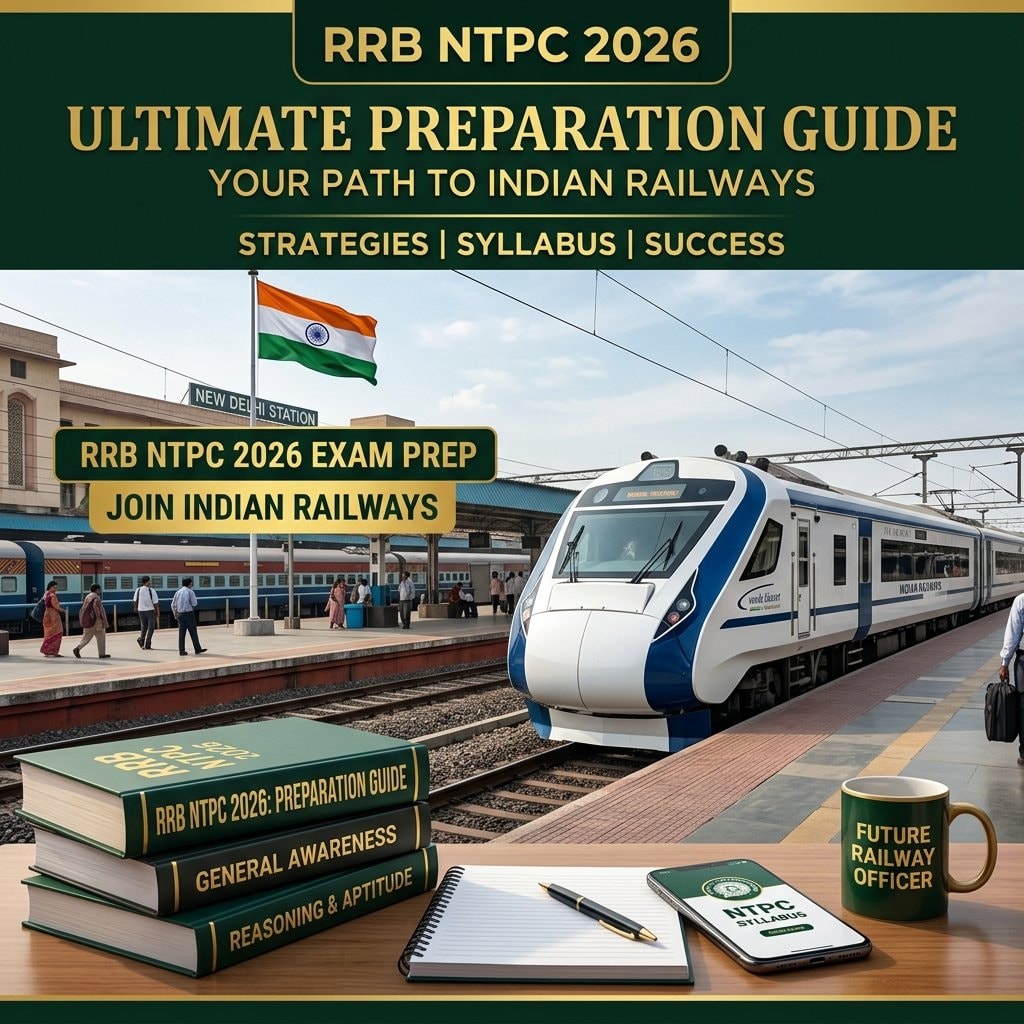
The Railway RRB NTPC (Non-Technical Popular Categories) 2026 examination is one of India's largest recruitment drives, offering lakhs of aspirants the opportunity to join Indian Railways - the world's fourth-largest railway network. With over 1.5 crore candidates competing for approximately 35,000+ vacancies across various posts, strategic preparation is crucial for success.
Quick Navigation: Exam Pattern | Syllabus | Preparation Strategy | Best Books | Salary Details | Job Profiles | FAQs
Why Choose Railway RRB NTPC?
Career Benefits:
- Job Security: Permanent government position with pension
- Attractive Salary: ₹19,900 to ₹35,400 (Pay Level 2-6)
- Career Growth: Regular promotions and increments
- Work-Life Balance: Fixed duty hours with weekly offs
- Free Travel: Concessional railway passes for self and family
- Medical Benefits: Comprehensive healthcare facilities
- Accommodation: Railway quarters at nominal rent
- Prestige: Respected position in Indian Railways
RRB NTPC 2026 Statistics:
- Total Vacancies: 35,000+ posts (expected)
- Total Applications: 1.5+ crore candidates
- Selection Rate: 0.2-0.3%
- Average Attempts: 2-3 attempts for success
- Preparation Time: 4-6 months recommended
RRB NTPC 2026 Important Dates
| Event | Expected Date 2026 | Status |
|---|---|---|
| Official Notification | March 2026 | Awaited |
| Online Application Start | March 2026 | Awaited |
| Last Date to Apply | April 2026 | Awaited |
| CBT-I Admit Card | June 2026 | Awaited |
| CBT-I Exam Date | July-August 2026 | Awaited |
| CBT-I Result | September 2026 | Awaited |
| CBT-II Admit Card | October 2026 | Awaited |
| CBT-II Exam Date | November 2026 | Awaited |
| CBT-II Result | December 2026 | Awaited |
| Skill Test/Typing Test | January 2027 | Awaited |
| Document Verification | February 2027 | Awaited |
| Final Result | March 2027 | Awaited |
Official Website: https://www.rrbcdg.gov.in/
RRB NTPC 2026 Eligibility Criteria
Educational Qualification
Post-wise Qualification:
Undergraduate Level (Pay Level 2):
- 10+2/Intermediate or equivalent
- Posts: Commercial cum Ticket Clerk, Accounts Clerk cum Typist, Junior Clerk cum Typist, Trains Clerk, etc.
Graduate Level (Pay Level 5-6):
- Bachelor's Degree in any discipline
- Posts: Station Master, Goods Guard, Senior Commercial cum Ticket Clerk, Senior Clerk cum Typist, Junior Account Assistant cum Typist, etc.
Age Limit (As on January 1, 2026)
| Category | Minimum Age | Maximum Age |
|---|---|---|
| General/EWS | 18 years | 33 years |
| OBC | 18 years | 36 years |
| SC/ST | 18 years | 38 years |
| PwD (General) | 18 years | 43 years |
| PwD (OBC) | 18 years | 46 years |
| PwD (SC/ST) | 18 years | 48 years |
| Ex-Servicemen | 18 years | 38 years |
Physical Standards
For Certain Posts (Station Master, Goods Guard):
Male Candidates:
- Height: 157.5 cm
- Chest: 81 cm (unexpanded), 85 cm (expanded)
Female Candidates:
- Height: 152 cm
- Weight: Proportionate
Vision Standards:
- Distant Vision: 6/12, 6/12 (with glasses)
- Near Vision: 0.6, 0.6 (with glasses)
- Color Vision: Normal (for certain posts)
RRB NTPC 2026 Exam Pattern
Stage 1: CBT-I (Computer Based Test - First Stage)
Exam Mode: Online (Computer-based)
Duration: 90 minutes (120 minutes for PwD)
Total Questions: 100
Total Marks: 100
Negative Marking: 1/3 mark (0.33) for each wrong answer
Section-wise Distribution
| Section | Questions | Marks | Topics |
|---|---|---|---|
| General Awareness | 40 | 40 | Current Affairs, GK, Indian Railways |
| Mathematics | 30 | 30 | Class 10 level |
| General Intelligence & Reasoning | 30 | 30 | Logical Reasoning |
| Total | 100 | 100 | - |
Important Points:
- Questions from all sections appear together (no sectional timing)
- Can attempt questions in any order
- Qualifying nature (marks not counted for final merit)
- Cutoff varies by post and category
- Normalization applied if exam in multiple shifts
CBT-I Cutoff Trends (General Category):
- Graduate Posts: 65-75 marks
- Undergraduate Posts: 55-65 marks
Stage 2: CBT-II (Computer Based Test - Second Stage)
Exam Mode: Online (Computer-based)
Duration: 90 minutes (120 minutes for PwD)
Total Questions: 120
Total Marks: 120
Negative Marking: 1/3 mark (0.33) for each wrong answer
Section-wise Distribution
| Section | Questions | Marks | Difficulty |
|---|---|---|---|
| General Awareness | 50 | 50 | Moderate-Difficult |
| Mathematics | 35 | 35 | Moderate-Difficult |
| General Intelligence & Reasoning | 35 | 35 | Moderate-Difficult |
| Total | 120 | 120 | - |
Important Points:
- Questions are more difficult than CBT-I
- Marks counted for final merit
- Normalization applied
- Final selection based on CBT-II marks
CBT-II Cutoff Trends (General Category):
- Graduate Posts: 70-80 marks
- Undergraduate Posts: 60-70 marks
Stage 3: Skill Test/Typing Test (For Specific Posts)
Typing Test (For Clerk Posts):
- Speed Required: 30 words per minute (English) or 25 words per minute (Hindi)
- Duration: 15 minutes
- Nature: Qualifying only
Computer Based Aptitude Test (For Station Master, Traffic Assistant):
- Duration: 60 minutes
- Nature: Qualifying only
RRB NTPC 2026 Detailed Syllabus
General Awareness (40-50 Questions)
Current Affairs (15-20 questions):
- National and international events (last 6 months)
- Government schemes and policies
- Important days and dates
- Awards and honors
- Sports events and winners
- Books and authors
- Appointments and resignations
- Summit and conferences
Indian Railways (5-8 questions):
- History of Indian Railways
- Railway zones and divisions
- Important railway projects
- Railway budget highlights
- New trains and routes
- Railway safety measures
- Railway modernization
- Railway ministers and officials
Static General Knowledge (15-20 questions):
Indian History:
- Ancient India (Indus Valley, Vedic Period)
- Medieval India (Delhi Sultanate, Mughals)
- Modern India (British Rule, Freedom Struggle)
- Post-Independence India
Indian Geography:
- Physical features (mountains, rivers, plateaus)
- Climate and monsoon
- Natural resources
- States and capitals
- Important places
Indian Polity:
- Indian Constitution
- Fundamental Rights and Duties
- Union and State Government
- Parliament and Judiciary
- Important constitutional bodies
Indian Economy:
- Basic economic concepts
- Five Year Plans
- Budget and taxation
- Banking system
- Economic reforms
General Science:
- Physics (motion, energy, light, sound)
- Chemistry (elements, compounds, acids, bases)
- Biology (human body, diseases, nutrition)
- Environmental science
Miscellaneous:
- Indian culture and heritage
- Art and literature
- Famous personalities
- Countries and capitals
- International organizations
Mathematics (30-35 Questions)
Number System (3-4 questions):
- Types of numbers
- HCF and LCM
- Divisibility rules
- Factors and multiples
- Prime numbers
Simplification (5-7 questions):
- BODMAS rule
- Fractions and decimals
- Square roots and cube roots
- Surds and indices
Percentage (3-4 questions):
- Basic percentage
- Percentage increase/decrease
- Successive percentage
Ratio and Proportion (2-3 questions):
- Simple ratio
- Direct and inverse proportion
- Partnership
Average (2-3 questions):
- Simple average
- Weighted average
Interest (2-3 questions):
- Simple interest
- Compound interest
Profit and Loss (2-3 questions):
- Cost price and selling price
- Profit and loss percentage
- Discount
Time and Work (2-3 questions):
- Work efficiency
- Pipes and cisterns
Time, Speed and Distance (3-4 questions):
- Basic concepts
- Relative speed
- Train problems
- Boat and stream
Algebra (2-3 questions):
- Linear equations
- Quadratic equations
Geometry (2-3 questions):
- Lines and angles
- Triangles
- Circles
Mensuration (2-3 questions):
- Area and perimeter
- Volume and surface area
Data Interpretation (3-5 questions):
- Tables
- Bar graphs
- Pie charts
General Intelligence & Reasoning (30-35 Questions)
Analogies (3-4 questions):
- Word analogies
- Number analogies
- Letter analogies
Classification (2-3 questions):
- Odd one out
- Grouping
Series (4-5 questions):
- Number series
- Letter series
- Missing number
Coding-Decoding (3-4 questions):
- Letter coding
- Number coding
- Substitution
Blood Relations (2-3 questions):
- Family tree
- Relationship problems
Direction Sense (2-3 questions):
- Distance and direction
- Shortest distance
Ranking and Arrangement (2-3 questions):
- Position from left/right
- Total persons
Syllogism (3-4 questions):
- Basic syllogism
- Conclusions
Statement and Assumptions (2-3 questions):
- Implicit assumptions
Puzzles (3-4 questions):
- Seating arrangement
- Floor puzzles
Miscellaneous (5-7 questions):
- Venn diagrams
- Mirror images
- Water images
- Paper folding
- Cube and dice
- Clock and calendar
Proven Preparation Strategy
4-Month Preparation Plan
Month 1: Foundation Building
Goals:
- Understand exam pattern
- Complete basic syllabus
- Start newspaper reading
- Build concepts
Daily Schedule (6-8 hours):
- Morning (2 hours): Mathematics (concepts + 30 questions)
- Afternoon (1.5 hours): Newspaper + current affairs
- Evening (2 hours): Reasoning (concepts + 30 questions)
- Night (1.5 hours): General awareness + revision
Weekly Tasks:
- Complete 2-3 chapters per subject
- Solve 1 previous year paper (sectional)
- Make notes of formulas and facts
- Take 1 sectional test
Month 2: Advanced Preparation
Goals:
- Complete entire syllabus
- Improve speed and accuracy
- Start mock tests
- Focus on weak areas
Daily Schedule (8-10 hours):
- Morning (2.5 hours): Mathematics (50 questions)
- Afternoon (2 hours): General awareness + current affairs
- Evening (2.5 hours): Reasoning (50 questions)
- Night (2 hours): Revision + mock test analysis
Weekly Tasks:
- Solve 2 previous year papers
- Take 2 sectional tests
- Take 1 full-length mock test
- Update current affairs notes
Month 3: Intensive Practice
Goals:
- Master time management
- Achieve 85%+ accuracy
- Attempt maximum mock tests
- Perfect exam strategy
Daily Schedule (10-12 hours):
- Morning: 1 full-length mock test (1.5 hours)
- Analysis: 2 hours
- Practice: 4 hours (weak areas)
- Current Affairs: 2 hours
- Revision: 1.5 hours
Weekly Tasks:
- Attempt 5-6 mock tests
- Solve 3-4 previous year papers
- Revise all formulas daily
- Update current affairs
Month 4: Final Revision
Goals:
- Quick revision
- Mock tests daily
- Stay confident
- Maintain health
Daily Schedule (8-10 hours):
- Morning: Mock test (1.5 hours)
- Analysis: 1.5 hours
- Revision: 4 hours (all subjects)
- Current Affairs: 2 hours
- Formula practice: 1 hour
Last Week:
- Light revision only
- 1 mock test daily
- Current affairs focus
- Stay calm and confident
Subject-wise Strategy
Mathematics Strategy
Phase 1: Concept Building
- Study from Class 10 NCERT
- Learn all basic formulas
- Solve easy questions
- Focus on accuracy
Phase 2: Speed Building
- Learn shortcut techniques
- Practice mental calculations
- Time yourself
- Solve 50+ questions daily
Phase 3: Mastery
- Solve previous year questions
- Attempt mock tests
- Maintain 90%+ accuracy
- Complete 30 questions in 25 minutes
Important Tips:
- Learn tables up to 30
- Learn squares up to 50
- Learn cubes up to 30
- Practice approximation
- Use elimination method
Reasoning Strategy
Phase 1: Basic Reasoning
- Learn all reasoning types
- Understand logic
- Solve easy questions
- Build foundation
Phase 2: Advanced Practice
- Practice puzzles daily
- Learn shortcut methods
- Improve speed
- Solve 50+ questions daily
Phase 3: Perfection
- Solve previous year questions
- Attempt mock tests
- Maintain 85%+ accuracy
- Complete 30 questions in 25 minutes
Important Tips:
- Practice puzzles daily (5-7)
- Learn pattern recognition
- Use elimination method
- Don't spend too much time on one question
General Awareness Strategy
Current Affairs:
- Read newspaper daily (The Hindu/Indian Express)
- Make monthly notes
- Focus on last 6 months
- Revise regularly
Static GK:
- Make subject-wise notes
- Use mnemonics
- Revise weekly
- Focus on important topics
Indian Railways:
- Follow railway news
- Learn about zones and divisions
- Know important projects
- Study railway budget
Preparation Tips:
- Read newspaper daily (30 minutes)
- Make notes (15 minutes)
- Weekly revision (2 hours)
- Monthly compilation
Mock Test Strategy
Timeline:
- Month 2: 1 mock test per week
- Month 3: 3-4 mock tests per week
- Month 4: 5-6 mock tests per week
After Each Mock:
- Analyze all questions
- Identify weak areas
- Note silly mistakes
- Revise concepts
- Improve strategy
Best Mock Test Series:
- Adda247
- Testbook
- Oliveboard
- Gradeup
- Previous year papers
Salary Structure and Benefits
Pay Level Structure
| Post | Pay Level | Basic Pay | Gross Salary | In-Hand |
|---|---|---|---|---|
| Junior Clerk cum Typist | Level 2 | ₹19,900 | ₹35,000 | ₹28,000 |
| Commercial cum Ticket Clerk | Level 2 | ₹19,900 | ₹35,000 | ₹28,000 |
| Accounts Clerk cum Typist | Level 3 | ₹21,700 | ₹38,000 | ₹30,000 |
| Junior Account Assistant | Level 4 | ₹25,500 | ₹44,000 | ₹35,000 |
| Senior Clerk cum Typist | Level 5 | ₹29,200 | ₹50,000 | ₹40,000 |
| Station Master | Level 6 | ₹35,400 | ₹60,000 | ₹48,000 |
Additional Benefits
Allowances:
- Dearness Allowance (DA)
- House Rent Allowance (HRA)
- Transport Allowance (TA)
- Running Allowance (for certain posts)
- Night Duty Allowance
Perquisites:
- Free railway passes for self and family
- Concessional railway tickets
- Medical facilities
- Railway quarters at nominal rent
- Leave Travel Concession (LTC)
- Children education allowance
Retirement Benefits:
- Provident Fund
- Gratuity
- Pension
- Leave encashment
Job Profiles and Career Growth
Popular Posts
1. Station Master:
- Manage station operations
- Train operations coordination
- Passenger safety
- Staff management
- Pay Level: 6
2. Goods Guard:
- Freight train operations
- Cargo safety
- Documentation
- Train movement coordination
- Pay Level: 5
3. Commercial cum Ticket Clerk:
- Ticket booking
- Passenger assistance
- Revenue collection
- Customer service
- Pay Level: 2
4. Accounts Clerk cum Typist:
- Financial documentation
- Account maintenance
- Data entry
- Report preparation
- Pay Level: 3
Career Growth
Promotion Hierarchy:
Junior Clerk (Level 2)
    ↓ (3-4 years)
Senior Clerk (Level 5)
    ↓ (5-6 years)
Chief Clerk (Level 6)
    ↓ (7-8 years)
Assistant (Level 7)
    ↓ (10-12 years)
Senior Assistant (Level 8)
Recommended Books
Mathematics:
- R.S. Aggarwal: Quantitative Aptitude
- Rakesh Yadav: Class Notes
- Kiran Publication: Railway Mathematics
Reasoning:
- R.S. Aggarwal: Reasoning
- Rakesh Yadav: Reasoning Class Notes
- Kiran Publication: Railway Reasoning
General Awareness:
- Lucent's General Knowledge
- Arihant: General Awareness
- Pratiyogita Darpan (Monthly)
- Railway Awareness by Kiran
Previous Year Papers:
- Kiran: RRB NTPC Previous Papers
- Arihant: RRB NTPC Solved Papers
Frequently Asked Questions
Q1: Can I crack RRB NTPC in first attempt?
Answer: Yes! With 4-6 months of dedicated preparation, proper strategy, and regular mock tests, first attempt success is possible.
Q2: Is coaching necessary?
Answer: Not mandatory. Self-study with good books and online resources is sufficient. Join test series for practice.
Q3: How many hours to study daily?
Answer: 6-8 hours for serious preparation. Quality matters more than quantity.
Q4: Which section is most important?
Answer: All sections are equally important. Focus on your weak areas while maintaining strong sections.
Q5: How important is current affairs?
Answer: Very important! 40% of General Awareness is current affairs. Read newspaper daily.
Conclusion
Cracking RRB NTPC 2026 requires dedication, smart preparation, and consistent effort. Follow this guide, practice regularly, and success will be yours!
All the best for RRB NTPC 2026! 🚂
Stay Updated:
Disclaimer: Information based on previous patterns. Refer to official notification for accurate details.