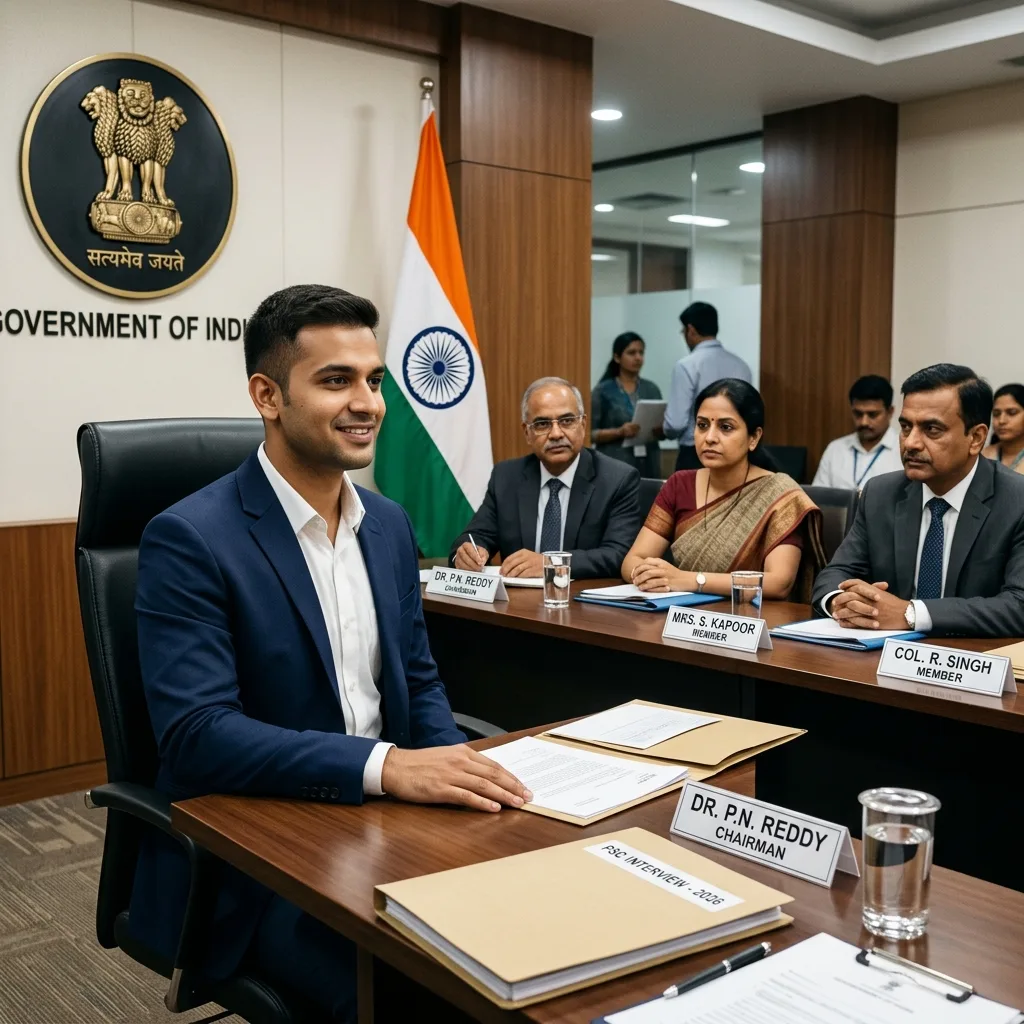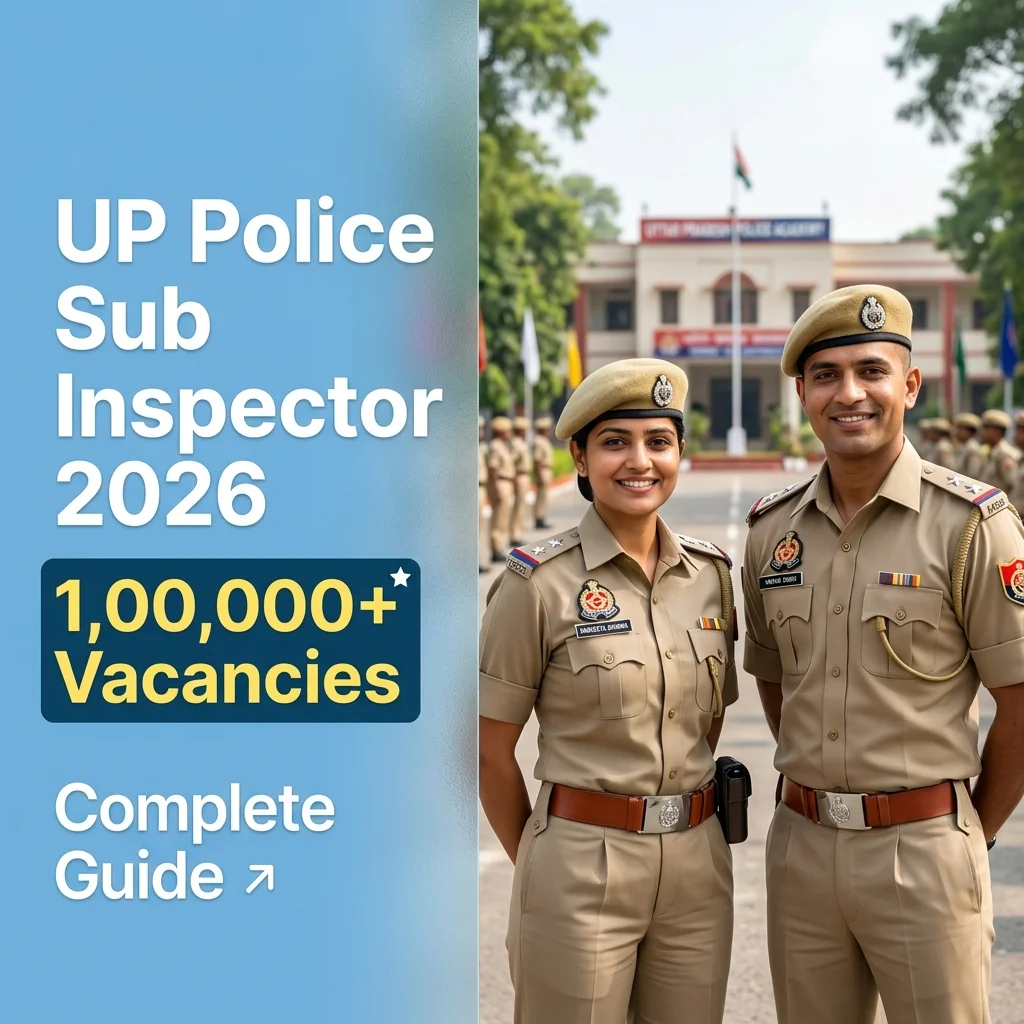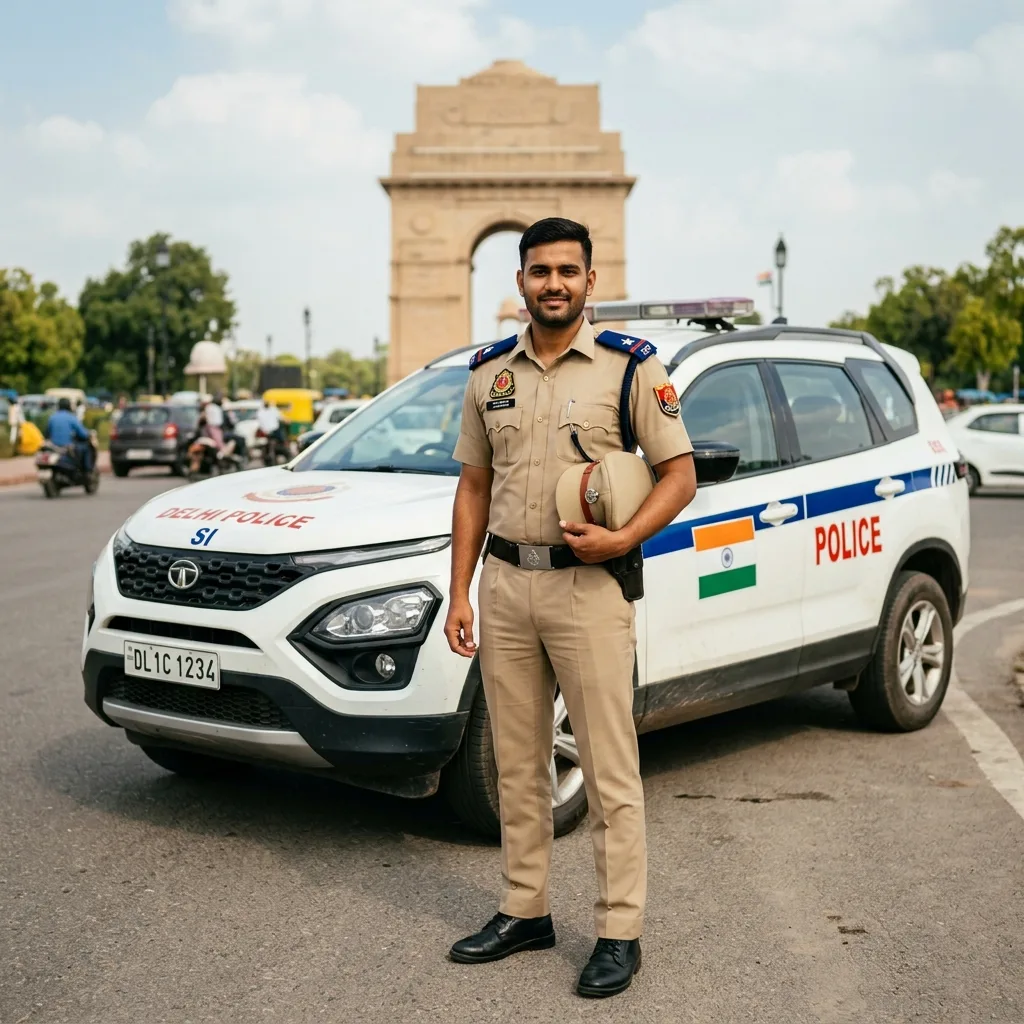
Introduction: SSC CPO — India's Most Prestigious Police Officer Exam
The SSC CPO (Combined Police Organisations) examination is conducted by the Staff Selection Commission to recruit Sub-Inspectors (SI) in two of India's most respected law enforcement organisations:
- Delhi Police — India's largest metropolitan police force, directly under the Union Government (Central Government, not state)
- CAPF (Central Armed Police Forces) — BSF, CRPF, CISF, ITBP, and SSB — the paramilitary backbone of India's internal security
An SSC CPO Sub-Inspector is not a constable — it is an officer-level position. You lead teams, investigate cases, and carry the responsibility of public order and national security.
Why SSC CPO is the most powerful graduate-level uniformed government exam:
- Salary: Rs.47,000–54,000/month in-hand — among the highest for SSC exams
- Status: Delhi Police SI is the most prestigious metropolitan police officer post in India
- Central Government: Same CGHS, LTC, and 7th Pay Commission benefits as IAS-level officers
- Career Path: From SI, you can rise to Inspector, DSP, SP, and beyond through departmental exams
- Driving Licence Bonus: Only SSC exam that values a skill you already have
SSC CPO 2026: Notification Details
| Parameter | Details |
|---|---|
| Conducting Body | Staff Selection Commission (SSC) |
| Exam Name | CPO (Combined Police Organisations) SI/ASI Exam 2026 |
| Posts | SI in Delhi Police, SI/ASI in CAPFs |
| Expected Notification | July–August 2026 (check ssc.gov.in) |
| Application Mode | Online at ssc.gov.in |
| Expected Vacancies | 4,000–8,000+ posts (varies by cycle) |
| Total Selection Stages | 4 (Paper I CBT + PET/PST + Paper II CBT + Medical) |
Posts Covered Under SSC CPO:
| Post | Organisation | Pay Level | Gender |
|---|---|---|---|
| Sub-Inspector (GD) | Delhi Police | Level 6 | Male and Female |
| Sub-Inspector (GD) | BSF (Border Security Force) | Level 6 | Male |
| Sub-Inspector (GD) | CRPF (Central Reserve Police Force) | Level 6 | Male |
| Sub-Inspector (GD) | CISF (Central Industrial Security Force) | Level 6 | Male and Female |
| Sub-Inspector (GD) | ITBP (Indo-Tibetan Border Police) | Level 6 | Male |
| Sub-Inspector (GD) | SSB (Sashastra Seema Bal) | Level 6 | Male |
| Assistant Sub-Inspector (Steno) | CISF | Level 5 | Male and Female |
Eligibility Criteria for SSC CPO 2026
Educational Qualification:
| Requirement | Details |
|---|---|
| Minimum Education | Bachelor's degree from a recognised university — ANY stream |
| Final Year Students | Eligible to apply, but must produce degree certificate by the time of document verification |
| Additional Requirement (Delhi Police Male SI) | Valid Driving Licence for LMV (both Motorcycle and Car) is mandatory by the date of PET/PST |
Important: A valid driving licence is ONLY mandatory for Delhi Police SI (male). CAPF SI posts do not require a driving licence.
Age Limit:
| Category | Age Limit |
|---|---|
| General (UR) | 20–25 years |
| OBC | 20–28 years (3 years relaxation) |
| SC/ST | 20–30 years (5 years relaxation) |
| Ex-Servicemen | 20–30 years (3–8 years based on service, category-wise) |
| Widows/Divorced Women | Up to 35 years (General), 38 years (OBC), 40 years (SC/ST) |
| J&K Domicile (1980–89) | 5 years additional relaxation |
| Defence Personnel disabled in operations | 3 years additional relaxation |
Age Calculation: Age is calculated as on the crucial date mentioned in the official notification — typically August 1, 2026. Apply ONLY after verifying your exact age against the official notification.
Physical Standards (PST) — Mandatory Before Paper II:
| Parameter | Male — General | Male — Hill/North-East/ST | Female — General | Female — Hill/North-East/ST |
|---|---|---|---|---|
| Height | 170 cm | 165 cm | 157 cm | 152 cm |
| Chest (unexpanded) | 80 cm | 78 cm | Not applicable | Not applicable |
| Chest (expanded) | 85 cm (min 5 cm expansion) | 83 cm | Not applicable | Not applicable |
| Weight | Proportionate to height | Proportionate to height | 48 kg minimum | 45 kg minimum |
Hill/North-East/ST relaxation applies to candidates from: Hill areas of Garhwal, Kumaon, Himachal Pradesh, Gorkha, Dogra, Maratha, Leh and Ladakh, Manipur, Tripura, Mizoram, Meghalaya, Nagaland, Arunachal Pradesh, Sikkim, and Scheduled Tribe communities.
Physical Endurance Test (PET) — Complete Standards
The PET is conducted after PST and is qualifying in nature — you must pass to appear for Paper II:
Male Candidates PET Standards:
| Event | Standard Required | Time Limit |
|---|---|---|
| Race (1.6 km) | Must complete | 6.5 minutes (6 min 30 sec) |
| Race (100 metres) | Must complete | 16 seconds |
| Long Jump | Minimum distance | 3.65 metres (3 chances) |
| High Jump | Minimum height | 1.2 metres (3 chances) |
| Shot Put (7.26 kg) | Minimum distance | 4.5 metres (3 chances) |
Female Candidates PET Standards:
| Event | Standard Required | Time Limit |
|---|---|---|
| Race (800 metres) | Must complete | 4 minutes |
| Race (100 metres) | Must complete | 18 seconds |
| Long Jump | Minimum distance | 2.7 metres (3 chances) |
| High Jump | Minimum height | 0.9 metres (3 chances) |
Critical: PET is qualifying only — it does NOT add marks to your final score. But if you fail ANY single event, you are immediately disqualified regardless of your Paper I score. Start physical training from Day 1 of your preparation.
PET Training Plan: 12-Week Programme
Weeks 1–3: Base Building
| Day | Exercise | Target |
|---|---|---|
| Monday | 1.6 km run | Complete in under 9 minutes |
| Tuesday | 100m sprint practice | 6-8 sprints with rest |
| Wednesday | Long Jump technique + standing broad jump | Practice landing form |
| Thursday | 1.6 km run | Reduce by 15 seconds from Day 1 |
| Friday | High Jump technique + approach run | Practice clearance |
| Saturday | Shot put practice | Learn correct throwing technique |
| Sunday | Rest or light yoga/stretching | — |
Weeks 4–6: Speed and Strength
| Day | Exercise | Target |
|---|---|---|
| Monday | 1.6 km run | Under 7.30 minutes |
| Tuesday | 100m sprint | Under 17 seconds |
| Wednesday | Long Jump + approach run | 3.2 metres consistently |
| Thursday | 2 km run (buffer training) | Under 10 minutes |
| Friday | High Jump + approach runs | 1.1 metres consistently |
| Saturday | Shot put weighted practice | 4.2 metres consistently |
| Sunday | Full PET simulation (all events) | Record your times |
Weeks 7–9: Target Level
| Day | Exercise | Target |
|---|---|---|
| Monday | 1.6 km run | Under 6.30 minutes |
| Tuesday | 100m sprint | Under 16.5 seconds |
| Wednesday | Long Jump | 3.5+ metres consistently |
| Thursday | 1.6 km time trial | Beat personal best |
| Friday | High Jump | 1.2 metres clearance |
| Saturday | Full PET simulation | All events at passing standard |
| Sunday | Active recovery — swimming or cycling | — |
Weeks 10–12: Buffer Zone
| Day | Exercise | Target |
|---|---|---|
| Monday | 1.6 km run | Under 6 minutes (buffer above standard) |
| Tuesday | 100m sprint | Under 15.5 seconds (buffer) |
| Wednesday | Long Jump + High Jump | Both well above minimum |
| Thursday | Endurance run 3 km | Maintain base fitness |
| Friday | Shot put + High Jump | Consistency drills |
| Saturday | Full exam-condition PET simulation | All 5 events at passing standard |
| Sunday | Rest | — |
Nutrition for PET Preparation:
- Protein: 1.2–1.5 g per kg body weight daily (eggs, chicken, dal, paneer, milk)
- Carbohydrates: Whole grains, oats, rice — energy for training
- Hydration: 3–4 litres water daily
- Avoid: Oily/fried food, excessive sugar, alcohol — they reduce stamina and increase fat
SSC CPO 2026 Exam Pattern
Paper I (Computer-Based Test):
| Subject | Questions | Marks | Duration |
|---|---|---|---|
| General Intelligence and Reasoning | 50 | 50 | — |
| General Knowledge and General Awareness | 50 | 50 | — |
| Quantitative Aptitude | 50 | 50 | — |
| English Comprehension | 50 | 50 | — |
| Total | 200 | 200 | 2 hours |
Negative Marking: 0.25 marks deducted per wrong answer
Paper I Qualifying Marks:
- General: 45% (90/200)
- OBC/Ex-Servicemen: 40% (80/200)
- SC/ST: 35% (70/200)
After Paper I: Candidates shortlisted for PET/PST based on performance. After passing PET/PST: All physically qualified candidates appear for Paper II.
Paper II (Computer-Based Test):
| Subject | Questions | Marks | Duration |
|---|---|---|---|
| English Language and Comprehension | 200 | 200 | 2 hours |
Negative Marking: 0.25 marks deducted per wrong answer
Paper II is specifically designed to test your English language skills in depth — it is NOT an easy paper. Many candidates who pass Paper I easily struggle in Paper II due to lack of English preparation.
Medical Examination (DME):
The Detailed Medical Examination is the final stage — conducted after Paper II:
| Parameter | Standard |
|---|---|
| Eye Vision | 6/6 and 6/9 without glasses (near vision N6 and N9) |
| Colour Vision | Must distinguish red, green, blue, yellow |
| Knock Knees | Not acceptable |
| Flat Feet | Not acceptable |
| Hearing | Normal without hearing aid |
| Speech | No stammer or speech impediment |
| Blood Pressure | Normal range |
| General Health | No chronic disease, disability, or substance dependency |
Complete Syllabus: SSC CPO Paper I and Paper II
General Intelligence and Reasoning (50 Questions):
| Topic | Types of Questions |
|---|---|
| Analogy | Word analogy, letter analogy, number analogy |
| Classification | Odd one out — words, letters, numbers |
| Series | Number series, letter series, figure series |
| Coding-Decoding | Letter shift coding, number coding, word substitution |
| Blood Relations | Direct relations, mixed-generation problems |
| Direction and Distance | Navigation problems, final position |
| Ranking and Arrangement | Linear, circular, alphabetical |
| Mathematical Operations | Symbol substitution problems |
| Venn Diagrams | Set relationships represented visually |
| Syllogism | Premise-conclusion deductive reasoning |
| Non-Verbal Reasoning | Figures series, mirror images, paper folding/cutting, embedded figures, pattern completion |
| Puzzle | Sitting arrangement, scheduling, distribution |
| Missing Number | Matrix-based number problems |
| Statement-Assumption | Critical reasoning problems |
High-Yield Topics (attempt these first): Analogy + Classification + Series + Coding-Decoding + Blood Relations = 25–30 marks guaranteed if practiced daily
General Knowledge and General Awareness (50 Questions):
| Topic | Approximate Weightage |
|---|---|
| Current Affairs (last 6 months) | 15–18 questions |
| General Science (Physics, Chemistry, Biology) | 8–10 questions |
| Indian History | 5–7 questions |
| Indian Geography | 4–5 questions |
| Indian Polity and Constitution | 4–5 questions |
| Economics (Basic) | 3–4 questions |
| Sports | 2–3 questions |
| Books and Authors | 1–2 questions |
| Awards and Honors | 1–2 questions |
| Miscellaneous | 3–5 questions |
Current Affairs Focus Areas for SSC CPO:
- National schemes and policies (especially law enforcement related: POCSO, Cybercrime, border security)
- Defence and security news (border incidents, new weapons/equipment induction)
- Government appointments (DGPs, Chiefs of CAPF forces, Home Secretary)
- Sports — major tournaments, Indian winners
- Science and technology — ISRO, DRDO news
Quantitative Aptitude (50 Questions):
| Topic | Expected Questions |
|---|---|
| Number System (LCM, HCF, Factors) | 3–4 |
| Percentage | 3–4 |
| Profit and Loss | 3–4 |
| Simple and Compound Interest | 3–4 |
| Ratio and Proportion | 2–3 |
| Time and Work | 2–3 |
| Speed, Distance, Time | 2–3 |
| Mixture and Allegations | 2–3 |
| Algebra (Linear equations, polynomials) | 3–4 |
| Geometry (Circle, Triangle, Quadrilateral) | 3–4 |
| Mensuration (Area, Volume) | 3–4 |
| Trigonometry | 3–4 |
| Data Interpretation | 5–6 |
| Average | 2–3 |
Paper I Maths Difficulty: Moderate — 10th to 12th standard NCERT level. Focus on speed and accuracy — 200 questions in 120 minutes = average 36 seconds per question.
English Comprehension Paper I — and Paper II Deep Dive:
Paper I English (50 Questions — Basic):
| Topic | Questions |
|---|---|
| Spotting Errors | 8–10 |
| Sentence Improvement | 5–8 |
| Active/Passive Voice | 4–5 |
| Direct/Indirect Speech | 3–5 |
| Synonyms and Antonyms | 5–7 |
| One Word Substitution | 3–5 |
| Fill in the Blanks | 4–5 |
| Idioms and Phrases | 3–5 |
| Reading Comprehension | 5–8 |
Paper II English (200 Questions — Advanced):
This is where many candidates lose out. Paper II is ENTIRELY English — 200 questions in 2 hours:
| Topic | Questions (Approx.) |
|---|---|
| Spotting Errors in Sentences | 25–35 |
| Sentence Improvement | 20–25 |
| Active/Passive Voice | 15–20 |
| Direct/Indirect Speech | 15–20 |
| Reading Comprehension (4–5 passages) | 30–40 |
| Cloze Test (2 passages) | 20–25 |
| Synonyms and Antonyms | 15–20 |
| One Word Substitution | 10–15 |
| Idioms and Phrases | 10–15 |
| Fill in the Blanks (with grammar focus) | 10–15 |
| Sentence Rearrangement (Para Jumbles) | 10–15 |
Paper II English Preparation Strategy:
- Grammar First: Master 12 grammar rules that explain 80% of spotting error questions: Subject-Verb Agreement, Tense Consistency, Pronoun Reference, Article Usage, Preposition, Comparison, Parallelism, Modifier Placement, Conditional Sentences, Voice, Narration, Gerund vs. Infinitive
- Vocabulary: Learn 15 new words daily from Day 1. By exam day (90 days), you will know 1,350+ words — this directly helps Synonyms/Antonyms and Cloze Test
- Reading Comprehension: Read 1 English newspaper editorial daily — The Hindu or Indian Express. Practice identifying main idea, inference, and author's tone
- Mock Tests: Take 1 full Paper II mock test per week from Month 2 onward
Salary Structure: SSC CPO Sub-Inspector In-Hand Breakdown
The SSC CPO salary is one of the best among SSC exams:
Basic Salary and Grade:
| Component | Amount |
|---|---|
| Pay Scale | Level 6 (Rs.35,400 – Rs.1,12,400) |
| Starting Basic Pay | Rs.35,400 per month |
| Pay Band | PB-2 (Pre-7th Pay Commission designation) |
Monthly Salary Calculation (At Joining — 2026):
| Component | Delhi Police SI (X City — Delhi) | CAPF SI (Field Posting) |
|---|---|---|
| Basic Pay | Rs.35,400 | Rs.35,400 |
| Dearness Allowance (DA) | Rs.17,700 (50% of basic, July 2026) | Rs.17,700 |
| House Rent Allowance (HRA) | Rs.8,496 (24% — Delhi X city) | Rs.5,310 (15% — Y city) |
| Transport Allowance (TA) | Rs.3,600 + DA (Delhi) | Rs.1,800 + DA |
| Gross Salary | ~Rs.65,196 | ~Rs.60,210 |
| NPS Deduction (10%) | -Rs.3,540 | -Rs.3,540 |
| CGHS/CGEGIS | -Rs.500–1,000 | -Rs.500–1,000 |
| Income Tax | ~Rs.1,000–2,000 | ~Rs.1,000–2,000 |
| In-Hand Salary | ~Rs.59,000–62,000 | ~Rs.54,000–57,000 |
HRA City Categories (2026 DA of 50%):
- X Cities (Delhi, Mumbai, Kolkata, Chennai, Bengaluru, Hyderabad): 27% of basic = Rs.9,558/month
- Y Cities (Lucknow, Jaipur, Patna, Bhopal, etc.): 18% of basic = Rs.6,372/month
- Z Cities (All other places): 9% of basic = Rs.3,186/month
Annual CTC (Total Compensation):
| Component | Amount |
|---|---|
| Annual Basic Pay | Rs.4,24,800 |
| Annual DA (50%) | Rs.2,12,400 |
| Annual HRA | Rs.1,01,952 (Delhi posting) |
| Annual TA | Rs.43,200 |
| Leave Travel Concession (LTC) | Rs.50,000–1,00,000 (every 4 years, counted annually) |
| CGHS Medical (estimated annual value) | Rs.1,20,000–3,00,000 (family coverage) |
| Government Quarters (if allotted) | Rs.1,80,000–3,00,000 savings (market rent equivalent) |
| Total Annual CTC (with hidden benefits) | Rs.10–15 lakh |
Salary Growth Timeline:
| Years of Service | Increment | Basic Pay | In-Hand Salary (Approx.) |
|---|---|---|---|
| At Joining | — | Rs.35,400 | Rs.59,000 |
| After 5 years | Annual increments | Rs.41,100 | Rs.67,000 |
| Promotion to Inspector (after 8–12 yrs) | Level 7 | Rs.44,900 | Rs.80,000 |
| After promotion + 5 years | Senior Inspector | Rs.50,000+ | Rs.90,000 |
| DSP (if cleared departmental exam) | Level 10 | Rs.56,100 | Rs.1,10,000 |
Career Progression: From SI to SP
One of the most compelling aspects of SSC CPO is the clear career progression path:
Delhi Police Career Ladder:
| Rank | Pay Level | How to Reach | Approximate Time |
|---|---|---|---|
| Sub-Inspector (SI) | Level 6 | SSC CPO joining | Year 0 |
| Inspector | Level 7 | Departmental promotion exam | Year 8–12 |
| Assistant Commissioner of Police (ACP) | Level 10 | Departmental promotion | Year 15–18 |
| Deputy Commissioner of Police (DCP) | Level 12 | UPSC LDCE or promotion | Year 20–22 |
| Additional Commissioner | Level 14 | Senior IPS-level promotion | Year 25+ |
CAPF Career Ladder (BSF/CRPF/CISF/ITBP/SSB):
| Rank | Pay Level | How to Reach |
|---|---|---|
| Sub-Inspector | Level 6 | SSC CPO joining |
| Inspector | Level 7 | Departmental promotion exam |
| Sub-Inspector / Subedar | Level 7–8 | Promotion with seniority |
| Assistant Commandant | Level 10 | UPSC CAPF AC exam (separate exam) |
| Commandant | Level 13 | UPSC/DPC promotion |
| Deputy Inspector General (DIG) | Level 14 | Senior promotion |
Shortcut to Officer: If you are already an SI and want to become an Assistant Commandant directly, you can appear for the UPSC CAPF AC exam — no age restriction for serving CAPF personnel (up to 35 years). Many SIs have used this route to jump 3 pay levels.
Previous Year Cut-Off Analysis
Understanding actual cut-offs removes fear and sets realistic targets:
SSC CPO Paper I Previous Year Cut-Offs (Out of 200):
| Year | Male — General | Male — OBC | Male — SC | Male — ST |
|---|---|---|---|---|
| CPO 2024 | 155.78 | 142.50 | 128.25 | 115.40 |
| CPO 2023 | 152.94 | 139.28 | 124.56 | 111.83 |
| CPO 2022 | 149.32 | 136.15 | 121.40 | 108.25 |
SSC CPO Paper II Cut-Offs (Out of 200 — English Only):
| Year | Male — General | Male — OBC | Male — SC | Male — ST |
|---|---|---|---|---|
| CPO 2024 | 89.25 | 79.50 | 68.25 | 58.10 |
| CPO 2023 | 87.60 | 77.85 | 66.50 | 56.40 |
Cut-Off Analysis:
- Paper I General cut-off (~77%) is achievable with 3–4 months of focused preparation — you need 155/200
- Paper II General cut-off (~45%) means you need only 90/200 in English — surprisingly accessible if you have basic grammar skills
- The real differentiator is Paper I score — candidates who score 170+ in Paper I are virtually guaranteed final selection after passing PET and Paper II
State-Wise Delhi Police vs CAPF: Which is Better?
Most SSC CPO aspirants face a choice — if they qualify for both, which posting should they prefer?
| Factor | Delhi Police SI | CAPF SI (BSF/CRPF/etc.) |
|---|---|---|
| Posting Location | Primarily Delhi and NCR | Anywhere in India — including border areas, remote forests, urban deployments |
| Nature of Work | Criminal investigation, traffic management, community policing, crime prevention | Border guarding, counter-insurgency, VIP protection, disaster relief, anti-Naxal operations |
| Family Life | Better — family lives in Delhi, no frequent relocation | More difficult — frequent transfers, border postings, peace postings cycle |
| Salary (Delhi) | Higher — X city HRA of 27% | Lower — Y/Z city HRA depending on posting |
| Housing | Delhi Police quarters in Delhi — very valuable (market rent Rs.15,000–40,000/month saved) | CAPF barracks/quarters at posting location |
| Prestige | Very high — Delhi Police is a brand | Equally high — national recognition as CAPF officers |
| Physical Risk | Moderate — city policing | Higher — border duties, anti-insurgency operations |
| Career Growth | Fast — Delhi Police departmental exams are frequent | Good — UPSC CAPF AC route available |
Recommendation: Delhi Police SI is generally preferred for family stability, quality of life, and salary (due to Delhi HRA). CAPF SI is better for those who want adventure, field exposure, and patriotic satisfaction of border/internal security duty.
90-Day SSC CPO Preparation Strategy
Month 1 (Days 1–30): Foundation
Daily Schedule:
| Time | Subject | Target |
|---|---|---|
| 6:00–7:30 AM | Physical Training — Running + Sprints + Jumps | Build base fitness |
| 8:00–9:30 AM | Maths — Number System, Percentage, Profit-Loss, SI/CI, Ratio | Cover 1 topic per day, 30 practice questions |
| 10:00–11:00 AM | Reasoning — Analogy, Classification, Series, Coding-Decoding | 50 questions daily |
| 12:00–1:00 PM | English — Grammar (Tenses, Subject-Verb, Prepositions) | 1 grammar chapter per day |
| 3:00–4:00 PM | GK — Indian History, Indian Polity (NCERT 6th–10th) | 1 NCERT chapter per day |
| 7:00–7:30 PM | Current Affairs — Daily newspaper or Adda247 current affairs | Note important points |
| 9:00–10:00 PM | Vocabulary Building — 15 new words with usage | Wordpandit app or newspaper |
Month 2 (Days 31–60): Intensive Practice
Topic Coverage:
- Maths: Complete Geometry, Mensuration, Trigonometry, Data Interpretation, Algebra
- Reasoning: Complete Puzzles, Syllogism, Non-Verbal Reasoning
- English Paper II: Reading Comprehension — 1 passage daily (from The Hindu editorial), Para Jumbles, Cloze Test
- GK: Geography, Economics, Science — NCERT 8th–10th
- Physical: All PET events should reach 90% of required standard by Month 2 end
Mock Test Schedule:
- Paper I mock: 2 per week (Saturday and Wednesday)
- Analyse every mock: which section lost most marks? Fix that section in the next week
Month 3 (Days 61–90): Final Sprint
Day-by-Day Focus:
| Days | Task |
|---|---|
| Day 61–70 | Full-length mock tests every alternate day (Paper I + Paper II) |
| Day 71–75 | Complete current affairs revision — last 3 months |
| Day 76–78 | Weak area intensive revision (based on mock analysis) |
| Day 79–80 | Physics + Chemistry + Biology GK revision |
| Day 81–83 | Previous year paper analysis (last 3 years CPO papers) |
| Day 84–86 | English Paper II — practice 200-question mock (2 hours) |
| Day 87–88 | All formulae revision — Speed-Distance, SI-CI, Mensuration |
| Day 89 | Light revision — GK quick notes, current affairs summary |
| Day 90 | Rest — eat well, sleep 8 hours, lay out documents and clothes |
Book List: Best Resources for SSC CPO 2026
For Reasoning:
| Book | Author/Publisher | Why It's Good |
|---|---|---|
| A Modern Approach to Verbal and Non-Verbal Reasoning | R.S. Aggarwal | Most comprehensive — covers all SSC topics |
| Analytical Reasoning | M.K. Pandey | Excellent for puzzles and seating arrangement |
| Kiran's SSC Reasoning | Kiran Prakashan | Previous year questions compilation |
For Quantitative Aptitude:
| Book | Author/Publisher | Why It's Good |
|---|---|---|
| Quantitative Aptitude | R.S. Aggarwal | Gold standard for SSC Maths |
| Fast Track Objective Arithmetic | Rajesh Verma | Quick methods, speed techniques |
| Kiran's SSC Mathematics | Kiran Prakashan | Previous year questions with solutions |
For General Knowledge:
| Book | Author/Publisher | Why It's Good |
|---|---|---|
| Lucent's General Knowledge | Lucent Publications | Best static GK comprehensive book |
| NCERT 6th–12th (History, Geography, Polity, Science) | NCERT | Free PDF — covers 90% of SSC GK syllabus |
| Manorama Yearbook 2026 | Manorama | Best current affairs annual compilation |
For English:
| Book | Author/Publisher | Why It's Good |
|---|---|---|
| Objective English | SP Bakshi | Grammar rules + exercise bank — best for SSC |
| High School English Grammar | Wren and Martin | Classic grammar reference |
| Word Power Made Easy | Norman Lewis | Vocabulary building — 30 chapters of word groups |
| Kiran's SSC English | Kiran Prakashan | Previous year CPO English questions |
Online Platforms:
| Platform | Cost | Best For |
|---|---|---|
| Testbook.com | Rs.200–400/month | SSC CPO full-length mocks — best mock quality |
| Adda247 | Rs.250–400/month | SSC CPO course + current affairs |
| Gradeup (BYJU's Exam Prep) | Rs.300–500/month | SSC CPO chapter-wise tests |
| YouTube — Wifistudy | Free | SSC CPO live classes — Reasoning and Maths |
| YouTube — Khan Sir Patna | Free | GK and Current Affairs — large following |
Medical Examination: Detailed Standards and Common Rejections
The SSC CPO medical examination (DME) is more stringent than most government exams. Know the standards early:
Eye Vision Standards:
| Eye | Standard (Distant Vision) | Standard (Near Vision) |
|---|---|---|
| Better Eye | 6/6 | N6 |
| Worse Eye | 6/9 | N9 |
Without glasses or contact lenses — this is uncorrected (naked eye) vision. Glasses are NOT allowed in SSC CPO medical examination.
If you currently wear glasses: Get your eyes tested NOW. If your uncorrected vision is 6/12 or worse, you may need laser correction surgery (LASIK). LASIK surgery takes 3–6 months to stabilise, and you must wait 6 months after surgery before appearing for medical. Plan accordingly.
Common Medical Rejection Reasons:
| Issue | Solution |
|---|---|
| Poor uncorrected eyesight | LASIK surgery at least 6 months before medical (Rs.25,000–40,000 per eye) |
| Colour blindness | No cure — test yourself using Ishihara plates at eye clinic before applying |
| Flat feet | Walk barefoot on sand daily, arch-strengthening exercises for 3–6 months |
| Knock knees | Physiotherapy exercises — correct before medical |
| Varicose veins | Consult a vascular surgeon early — surgical correction if severe |
| Underweight (below minimum) | High-protein diet + weight training — reach minimum weight before medical |
| Dental issues | Visit dentist 6 months before — fill cavities, extract severely damaged teeth |
| Heart irregularities | ECG and echo cardiogram to rule out murmurs or arrhythmia |
Pro Tip: Get a pre-medical examination at a government/district hospital (cost: Rs.500–1,500) before the SSC CPO medical. This gives you 3–6 months to correct any issues.
Real Success Stories: From Aspirant to Sub-Inspector
Story 1: Deepak — SSC CPO 2023, Delhi Police SI (General Category)
Background: Deepak from Meerut, UP. Civil Engineering graduate from a private college (72%). Had appeared for SSC CGL twice but barely missed cut-off.
Strategy: "CPO's physical component actually helped me — I had been running daily for SSC GD prep. I channelled that fitness into CPO. For Paper I, my Maths was already strong from CGL prep. I focused my new effort entirely on Paper II English — I read The Hindu editorial every day for 90 days and did 15 Paper II mocks."
Paper I Score: 168/200 (General cut-off: 155). Paper II Score: 112/200 (General cut-off: 89). Final merit: Cleared easily.
His message: "Delhi Police SI is not just a job — it is a lifestyle. Posted in South Delhi, I work in one of India's safest and most prestigious police jurisdictions. My in-hand salary in Delhi with HRA is Rs.61,000/month. My equivalent-educated friends in private sector get Rs.35,000–40,000 with no security. CPO is underrated — people focus on CGL and forget that CPO gives you a uniform, a rank, a weapon, and Rs.60,000/month at 24."
Story 2: Preeti — SSC CPO 2024, CISF SI (Female)
Background: Preeti from Jaipur. BA History graduate. Had always wanted to be in a uniformed force but missed Rajasthan Police (state exam). She appeared for SSC CPO because CISF recruits female SIs.
Physical Challenge: "I was not physically fit at all when I started. 800 metres in 4 minutes was impossible for me — I could barely run 400 metres. I hired a local physical trainer for Rs.1,500/month and trained for 5 months. By exam time, I was running 800 metres in 3 minutes 42 seconds — 18 seconds under the requirement."
Her message: "CISF SI has posted me at a major international airport — I manage security operations, supervise 20+ CISF constables, and work in one of India's most modern, air-conditioned work environments. My salary is Rs.54,000/month in-hand. As a woman from a middle-class family in Jaipur, this has been completely life-changing. And I can look at myself in the mirror every day knowing I am protecting the nation."
Frequently Asked Questions
Q1. Is a driving licence mandatory for all SSC CPO posts? No. A valid LMV driving licence (both motorcycle and car) is mandatory ONLY for Male Sub-Inspector posts in Delhi Police. Female Delhi Police SI posts and ALL CAPF SI posts (BSF, CRPF, CISF, ITBP, SSB) do not require a driving licence. Check the specific notification for exact requirements.
Q2. Can I apply for SSC CPO without completing graduation? Final-year graduation students may apply, but they must submit their graduation certificate by the date of document verification after clearing all exam stages. If you cannot produce the degree by then, your candidature will be cancelled.
Q3. I have tattoos on my body. Can I still join Delhi Police/CAPF? Tattoos are generally permitted on inner forearm (below elbow) and some other approved locations. Tattoos on the face, neck, hands, or visible areas in uniform are typically not permitted. The specific rules vary slightly between Delhi Police and each CAPF — check the official notification. Traditional/tribal tattoos get special consideration.
Q4. My height is 168 cm (2 cm below General standard of 170 cm). Am I disqualified? If you are from a Hill region, North-Eastern state, or are a Scheduled Tribe candidate, the height standard is reduced to 165 cm — you may qualify under this relaxation. If you are a General/OBC candidate from the plains, unfortunately 168 cm does not meet the 170 cm minimum requirement. Candidates sometimes challenge height measurements — ensure you are measured without footwear and in the morning (height is slightly taller in morning).
Q5. Can I prepare for SSC CPO and SSC CGL simultaneously? Yes — with strategic overlap. Reasoning, Maths, and GK syllabus is 80% similar. The main difference: CPO requires Paper II (English only), while CGL has a different Tier II (Maths + English). If you train for both, prioritise physical fitness for CPO and Maths/English depth for CGL. Most coaching institutes offer joint SSC CPO + CGL courses.
Q6. After joining as CAPF SI, can I appear for UPSC CAPF AC exam? Yes. In-service CAPF personnel have an upper age relaxation of up to 35 years for UPSC CAPF AC exam. If you join as SI at age 23 and appear for CAPF AC at age 31–34, you are still eligible. Clearing CAPF AC makes you an Assistant Commandant (Level 10) — jumping from Level 6 directly to Level 10 in one exam.
Q7. What is the difference between SSC CPO and state police SI exams? SSC CPO SI is a Central Government post (Level 6, DA-revised national salary, CGHS medical, LTC). State Police SI (e.g., UP Police SI, Rajasthan Police SI) is a state government post — generally lower salary (Rs.35,000–48,000 depending on state and DA), state-specific HRA, and state government rules. SSC CPO SI is significantly better in terms of salary, benefits, and status. The only advantage of state SI is posting near your home state, which some candidates value for family reasons.
Part 8: Paper I Topic-Wise Strategy — How to Score 170+ Out of 200
Scoring 170+ in Paper I puts you in the top 5–10% of all SSC CPO candidates — virtually guaranteeing final selection after PET/PST and Paper II. Here is the section-wise attack plan:
Reasoning Strategy (Target: 45+/50):
Reasoning is the highest-scoring section for prepared candidates — it is entirely logical, not fact-based. With the right practice, you can score 47–50 consistently.
Attack Order (by difficulty → time ratio):
| Priority | Topic | Target Questions | Time Budget |
|---|---|---|---|
| 1 (Easiest) | Series (Number/Letter) | 4–5 questions | 3 minutes |
| 2 | Coding-Decoding | 4–5 questions | 4 minutes |
| 3 | Analogy | 4–5 questions | 3 minutes |
| 4 | Classification (Odd one out) | 3–4 questions | 3 minutes |
| 5 | Blood Relations | 2–3 questions | 4 minutes |
| 6 | Direction and Distance | 2–3 questions | 3 minutes |
| 7 | Ranking and Arrangement | 2–3 questions | 3 minutes |
| 8 | Venn Diagrams | 2–3 questions | 3 minutes |
| 9 | Non-Verbal (Mirror/Figure) | 4–5 questions | 6 minutes |
| 10 | Puzzles / Matrix | 3–4 questions | 5 minutes |
| Skip last | Syllogism (if struggling) | 2–3 questions | Leave for end |
30-Second Shortcut Rules:
- Analogy: Always check the relationship type (synonyms, part-whole, degree, tool-use, cause-effect) first — then apply consistently
- Coding: Look for +1/–1/+2 letter shifts first; then reverse alphabet; then position-based
- Series: Check differences first (D1, D2, D3) — then squares/cubes — then alternating patterns
- Blood Relations: Draw the family tree on rough paper — never try to solve it mentally
Maths Strategy (Target: 38+/50):
Maths is where most candidates lose marks due to calculation errors and time waste. Use the 3-pass approach:
Pass 1 (First 15 minutes — 30 questions): Attempt ALL easy questions first:
- Number System (LCM, HCF, Divisibility) — 4 questions
- Percentage — 3 questions
- Profit and Loss — 3 questions
- Simple and Compound Interest — 3 questions
- Ratio and Proportion — 3 questions
- Average — 2 questions
- Data Interpretation (simple bar/pie chart) — 3 questions
Pass 2 (Next 10 minutes — 15 questions): Medium questions:
- Time and Work — 3 questions
- Speed Distance Time — 3 questions
- Mensuration (area calculations) — 3 questions
- Algebra (linear equations) — 3 questions
- Mixture and Alligation — 2 questions
Pass 3 (Final 5 minutes — remaining): Hard/skip:
- Complex Trigonometry — attempt only if formula is clear
- Geometry proof-based — skip if uncertain
- Compound DI — only if time allows
Time-Saving Tricks:
- Never calculate exact values when approximate is enough (percentage questions)
- Use options — substitute back into the equation instead of solving
- For Trigonometry: memorise sin 30, 45, 60, 90 and cos values — 80% of questions use these
- For Mensuration: memorise area formulas for all 10 shapes — questions are direct formula applications
GK Strategy (Target: 38+/50):
GK is unpredictable but strategically manageable with smart coverage:
High-Yield GK Areas for SSC CPO specifically (police/defence focus):
- Indian Constitution + Polity: Fundamental Rights (Art 12–35), Directive Principles, Emergency Provisions (Art 352, 356, 360), President/PM powers, Parliament structure — 8–10 questions guaranteed
- Current Affairs (last 6 months): National appointments (Chief Justice, CBI Director, NSA), defence acquisitions (new fighter jets, missile systems), important government schemes — 15 questions
- Science (Physics + Chemistry + Biology): Force and motion basics, chemical reactions, human biology — 8–10 questions
- History: Freedom movement (1857 to 1947), medieval India (Mughal Empire), ancient India (Maurya, Gupta) — 5 questions
- Geography: Rivers, dams, passes, peaks, national parks, climate zones, world geography basics — 5 questions
- Sports: Recent World Cup, Olympics, cricket/hockey news, Indian sports awards — 3–4 questions
- Science and Technology: ISRO missions, DRDO weapons, AI policies, digital India milestones — 3 questions
GK Daily 15-Minute Plan:
- 7 minutes: Read Adda247 or Testbook daily current affairs
- 5 minutes: Revise 20 facts from Lucent's GK (different page each day)
- 3 minutes: 10 GK practice questions (flashcard or quiz app)
English Paper I Strategy (Target: 43+/50):
Paper I English is moderate — Spotting Errors and Reading Comprehension carry maximum marks:
Spotting Errors (10 questions — master this first): The 5 grammar rules that explain 90% of spotting error questions in SSC CPO:
- Subject-Verb Agreement: "Each of the students have/has studied..." — singular verb with singular subject
- Tense Consistency: "He was walking and suddenly stops" → "stopped"
- Article Usage: "a" before consonant sounds, "an" before vowel sounds — "an MBA" (M sounds like "em")
- Pronoun Reference: "Everyone must carry their own..." vs "Everyone must carry his/her own..."
- Preposition: "discuss about" is wrong → "discuss" (no preposition needed); "different from" not "different than"
Reading Comprehension (8 questions — high return):
- Read the questions FIRST, then read the passage with the questions in mind
- Main idea question: Find the sentence that the author keeps returning to
- Inference questions: The answer is implied but never directly stated — pick the closest logical conclusion
- Vocabulary in context: Use surrounding sentences to determine meaning — ignore your prior knowledge of the word
Part 9: SSC CPO vs SSC CGL — Which Should You Prioritise?
This is the most common strategic dilemma for graduate-level SSC aspirants. Here is an honest, detailed analysis:
The Core Difference:
| Aspect | SSC CGL | SSC CPO |
|---|---|---|
| Minimum Qualification | Graduation | Graduation |
| What You Become | Desk officer (Income Tax, Customs, CBI, Audit) | Uniformed police officer (Delhi Police/CAPF) |
| Physical Test | None | Mandatory PET/PST |
| Starting Rank | Inspector/Auditor/DEO | Sub-Inspector |
| Starting Pay Level | Level 6–7 (varies by post) | Level 6 |
| Paper Difficulty | Higher — Tier I + Tier II (Maths + English + Stats/Finance) | Moderate — Paper I + Paper II (English only) |
| English Requirement | Moderate | Very High (Paper II = 200 English questions) |
| Competition | ~30 lakh applications | ~10–15 lakh applications |
| Posts Available | 10,000–17,000 per cycle | 4,000–8,000 per cycle |
| Selection Probability | Low (more competition) | Moderate (less competition, physical filter) |
| Work Environment | Office — 9 to 6, desk-based, paperwork | Field + office — dynamic, outdoor, high-responsibility |
| Prestige (Social) | High — Income Tax / CBI Inspector | Very High — Delhi Police SI in uniform |
| Career Ceiling | Joint Secretary level (via UPSC LDCE) | IG/DGP level (via promotion/UPSC LDCE) |
Who Should Choose SSC CPO:
- If you are physically fit OR willing to get fit in 3–4 months
- If you want a uniformed position with public authority and social respect
- If your English is strong (Paper II is the differentiator)
- If you find desk jobs boring — you want an active, field-based career
- If your Maths is weak — CPO has no advanced Maths in Paper II (only English)
Who Should Choose SSC CGL:
- If you have a specific target post — CBI Inspector, Income Tax, Customs
- If physical fitness is a genuine challenge you cannot overcome in time
- If you want maximum flexibility in posting (CGL posts are across all central departments)
- If your Maths is very strong — Tier II Maths rewards strong quantitative candidates
The Smart Strategy: Prepare for Both
The good news: SSC CPO Paper I and SSC CGL Tier I have ~80% syllabus overlap. Reasoning, Maths (up to Tier I level), GK, and English Paper I are essentially the same exam.
Combined preparation plan:
- Month 1–3: Prepare for both Paper I / Tier I simultaneously
- Month 4 onward: Bifurcate — SSC CGL Tier II focus (Maths/Stats) vs SSC CPO Paper II focus (English only)
- Physical training: Start from Day 1 regardless — it boosts mental performance and helps CDS/CAPF too
Part 10: CAPF Forces Comparison — Which Force to Prefer?
If you qualify for multiple CAPF forces in SSC CPO, you need to make a preference decision. Here is the honest comparison:
BSF (Border Security Force):
| Parameter | Details |
|---|---|
| Strength | 2.6 lakh personnel — India's largest paramilitary |
| Role | Guarding India-Pakistan and India-Bangladesh borders |
| Posting | Punjab, Rajasthan (Pakistan border), West Bengal, Assam, Meghalaya (Bangladesh border) |
| Field Conditions | Harsh — desert (Rajasthan), swamps (Bengal/Assam), extreme cold |
| Special Benefits | Gallon allowance, border duty allowance, ration benefits |
| Risk Level | High — active cross-border incidents, Pakistan-BSF tensions |
| Best For | Candidates wanting front-line border duty and adventure |
CRPF (Central Reserve Police Force):
| Parameter | Details |
|---|---|
| Strength | 3.25 lakh personnel — world's largest paramilitary force |
| Role | Internal security, anti-Naxal operations, election duty, law and order |
| Posting | Chhattisgarh, Jharkhand (Naxal areas), J&K, North-East, peace postings across India |
| Field Conditions | Variable — jungle warfare (Naxal areas) to urban deployment |
| Special Benefits | Anti-Naxal operations risk pay, jungle warfare allowance |
| Risk Level | Very High — highest casualties among CAPFs in Naxal operations |
| Best For | Candidates willing for high-risk counter-insurgency and anti-Naxal duty |
CISF (Central Industrial Security Force):
| Parameter | Details |
|---|---|
| Strength | 1.85 lakh personnel |
| Role | Guarding airports, nuclear plants, oil refineries, Space Centres, metro rail, government buildings |
| Posting | Major cities — Delhi, Mumbai, Chennai, Bengaluru, Hyderabad (airport postings), NTPC plants, ISRO centres |
| Field Conditions | Best among CAPFs — modern airports, controlled environments |
| Special Benefits | Airport duty allowance, industrial security allowance |
| Risk Level | Low to Moderate — security focused rather than combat |
| Best For | Candidates wanting modern work environment, good postings, and quality of life |
| Female Opportunities | Best CAPF for female candidates — dedicated women security at airports |
ITBP (Indo-Tibetan Border Police):
| Parameter | Details |
|---|---|
| Strength | 89,000 personnel |
| Role | Guarding India-China (Tibet) border — entire Himalayan frontier from Ladakh to Arunachal Pradesh |
| Posting | High-altitude posts — Ladakh, Himachal Pradesh, Uttarakhand, Sikkim, Arunachal Pradesh |
| Field Conditions | Extreme — altitude 9,000–18,000 feet, temperatures -40°C, snow-covered terrain |
| Special Benefits | High Altitude Allowance (Rs.10,000–25,000/month), HAPO (High Altitude Pulmonary Oedema) medical support |
| Risk Level | High — extreme weather conditions, China border tension since Galwan 2020 |
| Best For | Physically exceptional candidates who love mountains and want frontier duty |
SSB (Sashastra Seema Bal):
| Parameter | Details |
|---|---|
| Strength | 73,000 personnel |
| Role | Guarding India-Nepal and India-Bhutan borders |
| Posting | Uttarakhand, UP, Bihar, West Bengal, Sikkim, Assam borders with Nepal; Assam, West Bengal borders with Bhutan |
| Field Conditions | Moderate — hilly terrain, forest areas, but no extreme altitude like ITBP |
| Special Benefits | Border duty allowance, jungle allowance in certain sectors |
| Risk Level | Moderate — open borders with Nepal and Bhutan, cross-border crime management |
| Best For | Candidates wanting North-East posting, less extreme than ITBP, more border management than combat |
Force Preference Recommendation:
| Priority | Force | Reason |
|---|---|---|
| 1st | CISF | Best quality of life, modern work environment, urban postings, lowest physical risk |
| 2nd | Delhi Police SI | Best salary (Delhi HRA), prestigious, city-based, family-friendly |
| 3rd | BSF | Clear mission (border guarding), good benefits, moderate risk |
| 4th | SSB | Less competitive posting, decent conditions |
| 5th | CRPF | High risk (Naxal operations) but important national duty |
| 6th | ITBP | Extreme conditions — only for mountain enthusiasts |
Part 11: A Day in the Life — Delhi Police Sub-Inspector
Understanding what you are working toward makes preparation more meaningful. Here is a realistic account of a day in the life of a Delhi Police SI posted in an urban district:
Morning Shift (7:00 AM to 3:00 PM):
6:30 AM: Wake up, uniform check — khaki pressed, boots polished, belt buckle shined. Delhi Police uniform represents the force's image. An SI in wrinkled uniform gets noticed — for the wrong reasons.
7:00 AM: Reach Police Station. Attend morning parade and shift briefing with SHO (Station House Officer). Review overnight incidents: FIRs registered, arrests made, cases pending.
7:30 AM: Review your current active cases — typically 10–25 cases at various stages: investigation, charge sheet, court appearance pending. Update case diaries. Call complainants who need follow-up.
9:00 AM: Field duty begins. May include:
- Patrolling your beat area (typically 10–15 localities under your station)
- Following up on an ongoing investigation — visiting crime scene, recording witness statements
- Serving court summons or arrest warrants
- Verifying a complainant's address for a pending case
- Attending a traffic accident scene in your area
11:00 AM: Return to station with field inputs. Interrogation of a suspect in a theft case — recording statement. Writing investigation report for a 3-week-old case ready for charge sheet.
1:00 PM: Lunch break (30–45 minutes). Police station mess or outside.
1:45 PM: Court duty — attending metropolitan magistrate's court to represent the FIR in a criminal case. Delhi Police SIs spend significant time in court.
3:00 PM: Shift ends. Brief incoming shift SI on pending matters. Sign out.
Night Shift (11:00 PM to 7:00 AM):
Night shifts are more intense in Delhi Police. The night shift SI is the de facto commanding officer of the police station during the quiet hours — responsible for every incident that occurs.
11:00 PM: Shift briefing. Review law-and-order situation in the area — any processions, VIP movements, known criminal activity expected.
12:00 AM–3:00 AM: Active patrol in the area. Night patrol is critical — most thefts, burglaries, and violent incidents occur between midnight and 3 AM. The SI leads 2–3 constables in a patrol vehicle.
2:30 AM: Receive a PCR call about a domestic disturbance. Reach the location, mediate between parties, ensure immediate safety, file the necessary report. Domestic cases are among the most emotionally demanding — not all policing is chasing criminals.
4:00 AM–6:00 AM: Station quiet period. Catch up on pending paperwork — investigation reports, DD (Daily Diary) entries, case updates.
6:30 AM: Brief the incoming morning shift SI. Sign out.
Challenges of the Job (Honest Assessment):
| Challenge | Reality |
|---|---|
| Irregular Hours | Shifts rotate — day, evening, night. Family events often conflict |
| Court Duty | Delhi Police SIs spend significant time in courts — time-consuming |
| Investigation Pressure | Court deadlines for charge sheets, pressure to solve cases |
| Public Perception | Some citizens are hostile or disrespectful — patience is essential |
| Physical Demands | Standing for hours, field duty in heat and rain |
| Transfer Policy | Delhi Police transfers are within Delhi — no inter-state posting |
Rewards of the Job:
| Reward | Reality |
|---|---|
| Authority | You carry a weapon, a badge, and the power to protect — this is not available in any desk job |
| Respect | Delhi Police SI uniform commands respect in Indian society |
| Salary | Rs.59,000–62,000/month in-hand in Delhi — excellent for the role |
| Pension and Security | NPS pension + CGHS family medical for life |
| Career Growth | Clear ladder: SI → Inspector → ACP → DCP |
| Satisfaction | Solving a case, reuniting a missing person with family, stopping a crime — no private job gives this |
Part 12: Women in Delhi Police and CAPF — Complete Guide
SSC CPO is one of the few central government exams that actively recruits female candidates into uniformed officer positions. This section is specifically for female aspirants:
Female Vacancy Distribution:
| Force | Female SI Vacancies | Notes |
|---|---|---|
| Delhi Police SI | 33% reservation for female candidates | Horizontally reserved in each category |
| CISF SI | Open to female candidates | Airport security has dedicated women teams |
| CRPF SI | Limited female vacancies | Mahila Battalion postings |
| BSF | Currently male-only for SI GD | — |
| ITBP | Currently male-only for SI GD | — |
| SSB | Currently male-only for SI GD | — |
Female Physical Standards (PST):
| Parameter | Female — General | Female — Hill/North-East/ST |
|---|---|---|
| Height | 157 cm | 152 cm |
| Weight | 48 kg minimum | 45 kg minimum |
| Chest | Not tested | Not tested |
Female PET Standards:
| Event | Standard | Time Limit |
|---|---|---|
| 100 metres race | Must complete | 18 seconds |
| 800 metres race | Must complete | 4 minutes (240 seconds) |
| Long Jump | 2.7 metres minimum | 3 chances |
| High Jump | 0.9 metres minimum | 3 chances |
Female PET Training Plan (12 Weeks Specific):
Biggest Challenge for Female Candidates: The 800 metre run in 4 minutes. This requires a pace of 30 seconds per 100 metres — which is faster than most untrained women run. It is absolutely achievable with dedicated training:
Week 1–2 (Base): Walk 800 metres, note time. Jog 200 metres, walk 200 metres, repeat for 1 km total. Target: Complete 800 metres in under 7 minutes.
Week 3–4 (Stamina): Jog continuously for 400 metres without stopping. Alternate: jog 400m, walk 200m, jog 200m. Target: Complete 800 metres in under 5 minutes 30 seconds.
Week 5–6 (Speed): Run 400 metres in under 2 minutes 10 seconds (that is the pace needed for 800 metres in 4 minutes). Practice 4×200 metre sprints with 60-second recovery.
Week 7–8 (Race Condition): Run 800 metres continuously, timing yourself. Target: Under 4 minutes 30 seconds consistently.
Week 9–10 (Buffer): Run 800 metres under 3 minutes 50 seconds (10-second buffer above requirement). Practice the 100 metre sprint — 18 seconds is comfortable for most fit women.
Week 11–12 (Simulation): Full PET simulation: 100m sprint + 800m run + Long Jump + High Jump on same day. Ensure all events pass simultaneously — not just individually.
Women-Specific Issues:
During menstrual cycle and PET: You cannot reschedule the PET — the date is fixed. Track your cycle in advance. If the PET falls during your period: consult your gynecologist, stay hydrated, use pain management as medically advised, and remember that many female athletes compete and win during menstrual cycles. Mental preparation is as important as physical.
Delhi Police Women Sub-Inspector — Role:
- Mandatory for recording statements of female complainants (no male officer can do this alone)
- Essential for raids on establishments where female suspects may be present
- Women SIs are increasingly assigned to cyber crime units, child protection units, and anti-trafficking units — specialised roles with high social impact
- 33% reservation means female candidates from strong states (UP, MP, Rajasthan, Bihar) have very good selection probability
Part 13: SSC CPO Application Process — Step by Step Guide
Applying correctly is as important as preparing well. A rejected application wastes your preparation:
Step 1: Watch for Official Notification
Where to check:
- SSC Official Website: ssc.gov.in
- SSC Regional Offices websites (SSCER, SSCNR, SSCWR, etc.)
- Government Job Result: governmentjobresult.com (we publish within hours of official release)
What the notification contains:
- Total vacancies (force-wise and category-wise)
- Important dates (application open, application close, exam date)
- Crucial date for age calculation
- Eligibility criteria (any changes from previous year)
- Exam centre list and fee details
Step 2: Online Registration
SSC CPO applications are submitted ONLY through ssc.gov.in. No offline/postal applications accepted.
New Registration (first-time SSC applicants):
- Go to ssc.gov.in → "New User? Register Now"
- Fill: Name, Date of Birth, Mobile Number, Email
- Submit → OTP verification on mobile and email
- Note your Registration ID and Password carefully
Existing SSC Registration: Log in with your existing Registration ID — you can use the same ID for multiple SSC exams.
Step 3: Fill the Application Form
Fill the form carefully — errors here cannot be corrected later:
| Section | What to Fill | Common Mistake |
|---|---|---|
| Personal Details | Name exactly as per 10th certificate, DOB, Gender, Nationality | Wrong DOB = disqualification |
| Contact Details | Active mobile number, email you check regularly | Use email checked daily — all communications go here |
| Address | Permanent + Correspondence address — PIN code is critical | Wrong PIN = wrong exam centre |
| Education | Degree name, university, year of passing, percentage | Approximate percentage is fine — exact % checked at DV |
| Category | General/OBC/SC/ST/EWS — select correctly | Wrong category = loss of relaxation |
| Driving Licence | Valid DL for LMV (if applying for Delhi Police SI male) | Mandatory — if absent, Delhi Police SI application rejected |
| Photo | Recent (within 3 months), white background, frontal face, 20–50 KB | Old or unclear photo = application rejection |
| Signature | Black ink on white paper, clear, 10–30 KB | Stamped or computerized signatures rejected |
| Exam Centre | Choose 3 preferred centres in priority order | Choose centres near your home — travel cost and familiarity |
Step 4: Payment
| Category | Fee Amount | Payment Modes |
|---|---|---|
| General / OBC / EWS | Rs.100 | Online: Net Banking, UPI, Debit/Credit Card |
| SC / ST | Exempted (Rs.0) | — |
| Female Candidates (All categories) | Exempted (Rs.0) | — |
| Ex-Servicemen | Exempted (Rs.0) | — |
Keep the payment confirmation / transaction number screenshot — required for admit card download.
Step 5: Print Application
After successful payment, print the complete application form (Part I and Part II). Keep 3 copies:
- 1 for Document Verification
- 1 for your reference file
- 1 spare copy
Step 6: Download Admit Card
Admit cards are released on ssc.gov.in approximately 2–3 weeks before the exam. Download and print — do NOT rely on digital copy at the exam centre.
What to carry on exam day:
- Printed admit card (take 2 copies)
- Original photo ID (Aadhaar / Passport / Voter ID / Driving Licence)
- 2 recent passport-size photographs (same as on application)
- Black/blue ballpoint pen (even for CBT — for rough work if rough sheets provided)
Part 14: SSC CPO Training Academy — What Happens After Selection
Most guides stop at "how to clear the exam." This section covers what happens AFTER you are selected — the training academy experience that shapes you into a Sub-Inspector:
Delhi Police Training:
Training Academy: Delhi Police Training College (DPTC), Jharoda Kalan, Delhi (for basic training) and various specialised training centres
Training Duration: 9 months (approximately)
Training Structure:
| Phase | Duration | Content |
|---|---|---|
| Physical Training | All 9 months (daily) | Running, drill, PT exercises, parade |
| Law and Legal Training | 3 months | BNS/BNSS/BSA (new criminal laws), IPC/CrPC basics, Evidence Act, criminal procedures |
| Weapons Training | 2 months | Revolver, INSAS rifle, SLR — firing ranges, weapon handling, safety |
| Investigative Training | 2 months | Crime scene management, FIR writing, panchnama, forensic basics |
| Traffic Management | 1 month | Traffic laws, accident investigation, VIP convoy management |
| Community Policing | 1 month | Beat management, community relations, public interaction |
| Practical Attachment | 2 months | Posted to a live police station under senior SI supervision |
Training Academy Daily Routine:
| Time | Activity |
|---|---|
| 5:30 AM | Wake up |
| 6:00–7:30 AM | Physical Training (PT) — running, drill, exercises |
| 7:30–8:30 AM | Breakfast and preparation for classes |
| 9:00 AM–1:00 PM | Academic classes (Law, Investigation, Administration) |
| 1:00–2:00 PM | Lunch |
| 2:00–4:00 PM | Skill training (Weapons, Driving, First Aid) |
| 4:00–5:30 PM | Sports/Games (mandatory physical activity) |
| 7:00–9:00 PM | Self-study and class preparation |
| 10:00 PM | Lights out |
Salary During Training: You receive your full Sub-Inspector salary during training — approximately Rs.59,000/month in-hand.
CAPF Training (for BSF/CRPF/CISF/ITBP/SSB SIs):
Each CAPF has its own dedicated training academy:
| Force | Training Academy | Location |
|---|---|---|
| BSF | BSF Academy | Tekanpur, Gwalior (MP) |
| CRPF | CRPF Academy and RTCs | Mundka (Delhi), various Regional Training Centres |
| CISF | CISF Training Centre | Hyderabad and Mumbai |
| ITBP | ITBP Academy | Mussoorie, Uttarakhand |
| SSB | SSB Training Centre | Hazaribagh, Jharkhand |
CAPF Training Duration: 12–18 months (longer than Delhi Police due to paramilitary requirements)
Key CAPF Training Elements:
- Combat and tactical training — counter-insurgency, border patrol tactics
- Weapons: Assault rifles (AK-47, INSAS), Light Machine Guns, grenades
- Jungle survival and map reading
- Force-specific specialisation (border management for BSF/ITBP, crowd control for CRPF, industrial security for CISF)
- Physical training is more intense than Delhi Police — CAPF training is designed for combat readiness
Part 15: Previous Year SSC CPO Paper Analysis
Understanding what SSC actually asks is more valuable than any syllabus booklet. Here is a topic-wise breakdown of actual SSC CPO 2024 questions:
Paper I — Reasoning: What Was Actually Asked in 2024
| Topic | Questions Asked | Difficulty | Notes |
|---|---|---|---|
| Analogy | 5 | Easy | Word and semantic analogies — no tricks |
| Classification | 5 | Easy-Moderate | Odd one out including shapes |
| Number Series | 4 | Easy | Difference series, ratio series |
| Letter Series | 3 | Easy | Alphabet position-based |
| Coding-Decoding | 4 | Moderate | Letter shift coding, conditional coding |
| Blood Relations | 3 | Moderate | Mixed-generation, complex family trees |
| Direction | 3 | Easy | Final position after multiple turns |
| Ranking | 2 | Easy | Linear seating, ranking from top/bottom |
| Syllogism | 4 | Moderate | 2-statement, possibility type included |
| Mirror Image | 3 | Easy | Clock and figure mirrors |
| Figure Completion | 3 | Moderate | Matrix-based pattern completion |
| Venn Diagram | 3 | Easy | Set relationship — 2 and 3 circles |
| Puzzle | 4 | Moderate | Scheduling, distribution type |
| Non-Verbal | 4 | Moderate | Paper folding/cutting, hidden figures |
2024 Observation: Syllogism increased from 2 to 4 questions. Matrix puzzles increased. Pure verbal analogy decreased.
Paper I — Maths: What Was Actually Asked in 2024
| Topic | Questions Asked | Difficulty | Notes |
|---|---|---|---|
| Data Interpretation (Bar/Pie) | 5 | Easy-Moderate | 1 set of 5 questions — DI is growing |
| Percentage | 4 | Easy | Direct calculation type |
| Trigonometry | 4 | Moderate | sin/cos/tan identities, elevation/depression |
| Geometry | 4 | Moderate | Circle theorems, triangle properties |
| Profit and Loss | 3 | Easy | Including discount and marked price |
| Time and Work | 3 | Easy-Moderate | Pipes and cisterns included |
| SI and CI | 3 | Easy | Direct formula application |
| Mensuration | 3 | Moderate | Combination of shapes |
| Speed Distance Time | 3 | Easy | Train crossing type |
| Ratio and Proportion | 3 | Easy | Mixture, partnerships |
| Number System | 3 | Easy | LCM, HCF, divisibility |
| Algebra | 4 | Moderate | Quadratic, linear system, identities |
| Average | 3 | Easy | Direct average, weighted average |
| Misc | 3 | Moderate | Permutation/Combination basics |
2024 Observation: DI increased significantly. Trigonometry remained high. Number system decreased. Overall difficulty was moderate — 170+ scorers needed accuracy not just speed.
Paper I — GK: What Was Actually Asked in 2024
| Topic | Questions | Sample Questions |
|---|---|---|
| Current Affairs | 18 | Nobel Prizes 2024, CWG/Olympics 2024, government schemes launched, diplomatic meetings |
| History | 6 | Quit India Movement, Maratha history, ancient coins, Vedic period |
| Polity | 6 | Constitutional amendments, Lok Sabha Speaker powers, Fundamental Duties |
| Geography | 5 | River tributaries, national parks, climate types, soil types |
| Science (Physics) | 4 | Laws of motion, light refraction, electric circuits |
| Science (Chemistry) | 4 | Elements and compounds, acids-bases-salts, metal properties |
| Science (Biology) | 4 | Human body systems, plant biology, disease vectors |
| Computer | 2 | Basic terms, internet protocols |
| Awards and Sports | 1 | Khel Ratna, Dronacharya recipients |
Conclusion: Why SSC CPO Is the Most Underrated SSC Exam
Most SSC aspirants focus on SSC CGL (the "prestigious" exam) and ignore SSC CPO. This is a strategic mistake.
Consider this comparison:
| Factor | SSC CGL (Inspector) | SSC CPO (Sub-Inspector) |
|---|---|---|
| Eligibility | Graduation | Graduation |
| Starting Pay Level | Level 7 (Inspector) | Level 6 (SI) |
| Starting Basic Pay | Rs.44,900 | Rs.35,400 |
| In-Hand Salary (Delhi) | Rs.75,000–80,000 | Rs.59,000–62,000 |
| Uniform | No | Yes |
| Physical Test | No | Yes (PET/PST) |
| Career Peak | Deputy Secretary (Central Govt) | DGP/IG (top police officer) |
| Social Status | High | Very high (uniform + rank) |
The reality: SSC CPO SI grows into an Inspector, then ACP, then DCP. Many SSC CPO recruits who clear departmental exams or UPSC LDCE end up as IPS-equivalent gazetted officers. The career trajectory is exceptional — and the starting uniform of Delhi Police SI commands respect no CGL clerk posting can match.
If you have the fitness and the ambition, SSC CPO is not Plan B — it is Plan A.
Apply online at ssc.gov.in when the official notification is released. Start your physical training TODAY. Begin your academic preparation this week.
Stay updated with the latest SSC CPO notifications, exam dates, admit cards, results, and preparation tips at Government Job Result — India's most comprehensive government exam resource.
Disclaimer: All details regarding SSC CPO 2026 — vacancy count, dates, eligibility, syllabus, and salary — are based on the pattern of previous SSC CPO notifications and official SSC communications as of July 2026. The official 2026 notification from SSC will be the final authority. Candidates must verify all details from the official notification at ssc.gov.in before applying.
Most SSC aspirants focus on SSC CGL (the "prestigious" exam) and ignore SSC CPO. This is a strategic mistake.
Consider this comparison:
| Factor | SSC CGL (Inspector) | SSC CPO (Sub-Inspector) |
|---|---|---|
| Eligibility | Graduation | Graduation |
| Starting Pay Level | Level 7 (Inspector) | Level 6 (SI) |
| Starting Basic Pay | Rs.44,900 | Rs.35,400 |
| In-Hand Salary (Delhi) | Rs.75,000–80,000 | Rs.59,000–62,000 |
| Uniform | No | Yes |
| Physical Test | No | Yes (PET/PST) |
| Career Peak | Deputy Secretary (Central Govt) | DGP/IG (top police officer) |
| Social Status | High | Very high (uniform + rank) |
The reality: SSC CPO SI grows into an Inspector, then ACP, then DCP. Many SSC CPO recruits who clear departmental exams or UPSC LDCE end up as IPS-equivalent gazetted officers. The career trajectory is exceptional — and the starting uniform of Delhi Police SI commands respect no CGL clerk posting can match.
If you have the fitness and the ambition, SSC CPO is not Plan B — it is Plan A.
Apply online at ssc.gov.in when the official notification is released. Start your physical training TODAY. Begin your academic preparation this week.
Stay updated with the latest SSC CPO notifications, exam dates, admit cards, results, and preparation tips at Government Job Result — India's most comprehensive government exam resource.
Disclaimer: All details regarding SSC CPO 2026 — vacancy count, dates, eligibility, syllabus, and salary — are based on the pattern of previous SSC CPO notifications and official SSC communications as of July 2026. The official 2026 notification from SSC will be the final authority. Candidates must verify all details from the official notification at ssc.gov.in before applying.