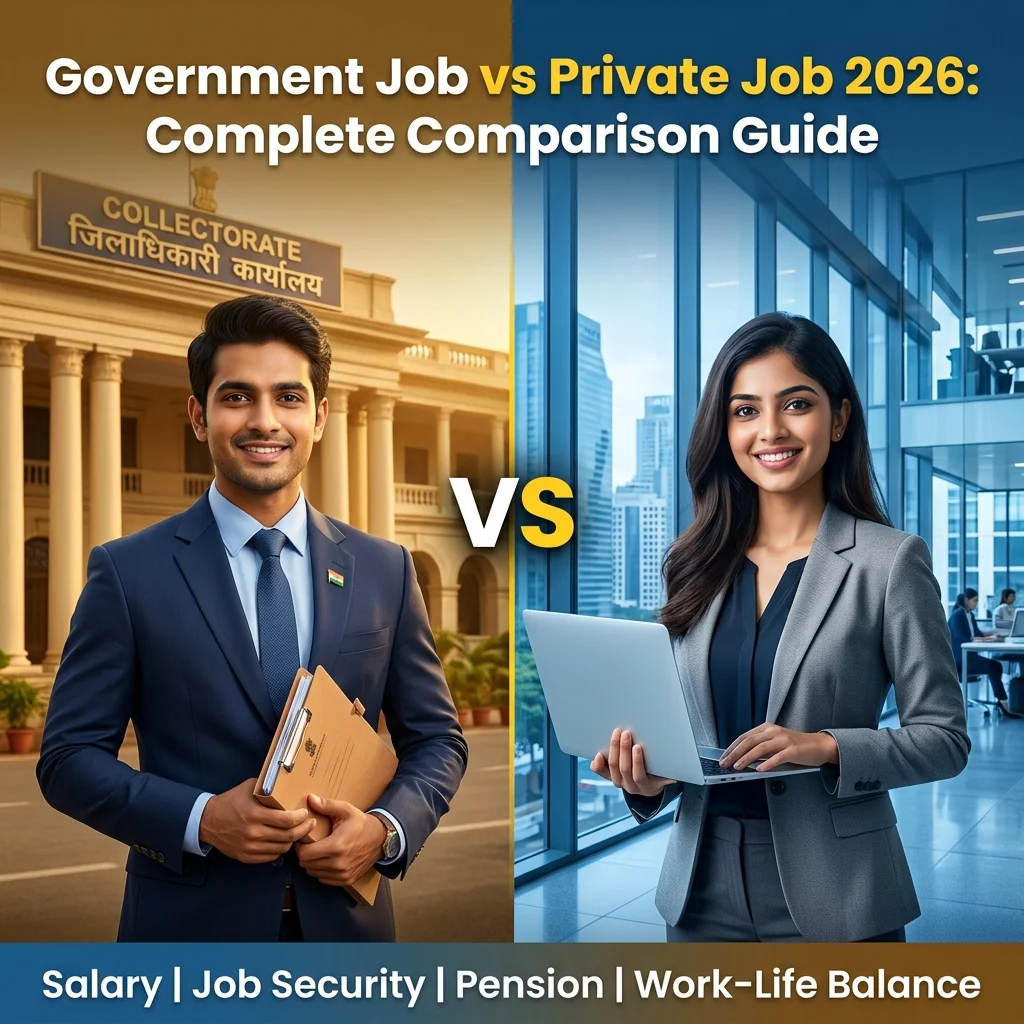
Introduction: India's Biggest Career Dilemma in 2026
Every year, millions of Indian graduates face the same fundamental question that can define the next 30 years of their professional life:
"Should I prepare for a government job — or should I take that private sector offer?"
Your father says: "Beta, sarkari naukri lo — life set ho jayegi."
Your college friend says: "Bhai, private mein 3 guna package milta hai startups mein."
Your college placement officer says: "Government jobs are outdated — private sector is the future."
The truth is far more nuanced than either extreme. Both sectors have strong advantages AND real disadvantages — and the right choice depends entirely on your personality, financial goals, family situation, and risk appetite.
This is India's most honest, data-backed comparison of government jobs vs private jobs in 2026. No propaganda for either side — just the real picture.
At a Glance: The Complete Comparison Table
| Parameter | Government Job | Private Job |
|---|---|---|
| Starting Salary (Graduate Level) | Rs.25,000–65,000/month | Rs.15,000–60,000/month |
| Annual Salary Growth | 3–5% (DA + increments) | 8–15% (performance-based) |
| 10-Year Salary Potential | Rs.55,000–1,20,000/month | Rs.50,000–3,00,000+/month |
| Job Security | ⭐⭐⭐⭐⭐ Extremely high | ⭐⭐ Moderate (market-dependent) |
| Pension after Retirement | NPS (10% + 14% match by Govt) | EPF only (no guaranteed pension) |
| Medical Benefits | Lifetime — self + family | During employment only |
| Work Hours | Fixed (9 AM–5:30 PM typically) | Variable (often 9–10 hrs/day) |
| Work-Life Balance | ⭐⭐⭐⭐ Generally good | ⭐⭐⭐ Varies widely |
| Leaves Per Year | 30–45 days (Casual + Earned + Medical) | 12–21 days (varies by company) |
| Promotions | Seniority-based (slow) | Performance-based (fast) |
| Transfer Risk | High (all-India postings) | Low to moderate (city-based) |
| Social Prestige | Very high (especially IAS, police, banking) | Moderate to high |
| Corruption Risk | Present in some sectors | Present in private sector too |
| Learning & Skill Growth | Slow (structured training) | Fast (exposure to latest tech) |
| Loan Benefits | Concessional home/vehicle loans | Market rate loans |
| Layoff Risk | Almost nil | Significant during economic slowdowns |
| Entry Difficulty | High (competitive exams) | Moderate (based on skills + interview) |
| Age to Join | 18–35 years (exam dependent) | Any age (experience matters) |
Factor 1: Salary Comparison — The Complete Real Picture
Starting Salary (Entry Level, Graduate):
Government Sector Starting Salaries (7th Pay Commission / 12th Bipartite):
| Post | Level | Starting Gross Salary |
|---|---|---|
| IAS / IPS / IFS (UPSC) | Level 10 | Rs.56,100 + allowances = ~Rs.85,000/month |
| SSC CGL (Group B Officer) | Level 7 | Rs.44,900 + allowances = ~Rs.65,000/month |
| IBPS PO / SBI PO (Bank Officer) | JMG Scale I | Rs.48,480 + DA/HRA = ~Rs.65,000/month |
| UP Police SI / Delhi Police SI | Level 6 | Rs.35,400 + allowances = ~Rs.60,000/month |
| SSC CHSL (LDC/DEO) | Level 4 | Rs.25,500 + allowances = ~Rs.38,000/month |
| SSC MTS | Level 1 | Rs.18,000 + allowances = ~Rs.26,000/month |
| RRB NTPC (Clerk/TA) | Level 2-5 | Rs.19,900–29,200 + allowances = ~Rs.30,000–45,000/month |
| IBPS Clerk | Clerks Grade | Rs.17,900 + allowances = ~Rs.32,000/month |
Private Sector Starting Salaries (Fresh Graduate — 2026):
| Sector | Role | Starting Salary Range |
|---|---|---|
| IT (Tier-1 Companies — TCS, Infosys, Wipro) | Software Engineer | Rs.3.6–7 LPA = ~Rs.30,000–58,000/month |
| IT (Startups / Product Companies) | Software Engineer | Rs.8–20 LPA = ~Rs.65,000–1,65,000/month |
| Banking (Private — HDFC, ICICI, Axis) | Sales Officer / RM | Rs.3–5 LPA = ~Rs.25,000–42,000/month |
| Manufacturing / Core Engineering | Junior Engineer | Rs.3–6 LPA = ~Rs.25,000–50,000/month |
| MBA (IIM / Top B-School) | Management Trainee | Rs.15–35 LPA = ~Rs.1,25,000–2,90,000/month |
| MBA (Average College) | Sales Manager / HR | Rs.4–8 LPA = ~Rs.33,000–67,000/month |
| BBA / Commerce Graduate | Accountant / Analyst | Rs.2.5–4 LPA = ~Rs.21,000–33,000/month |
| Arts Graduate | HR / Admin / Marketing | Rs.2–4 LPA = ~Rs.17,000–33,000/month |
The 10-Year Salary Trajectory — Government vs Private:
| Year | Government Officer (SSC CGL) | IT Professional (Average Performer) |
|---|---|---|
| Year 1 | Rs.65,000/month | Rs.35,000/month |
| Year 3 | Rs.72,000/month | Rs.50,000/month |
| Year 5 | Rs.80,000/month | Rs.75,000/month |
| Year 7 | Rs.92,000/month | Rs.1,00,000/month |
| Year 10 | Rs.1,10,000/month | Rs.1,50,000/month |
| Year 15 | Rs.1,40,000/month | Rs.2,00,000/month |
| Year 20 | Rs.1,70,000/month | Rs.2,50,000–5,00,000/month |
Key Insight: Government salaries start relatively well and are stable, but private sector salaries of high performers (especially in IT, consulting, finance) eventually overtake and surpass government salaries significantly — but this requires consistent performance and upskilling. An average private sector professional may NOT earn more than a government officer at the 10–15 year mark.
Factor 2: Job Security — The Biggest Differentiator
Government Job Security:
Government employees in India have one of the strongest job protections in the world:
- Layoffs are virtually impossible: A confirmed government employee (after probation) can only be dismissed through a formal departmental inquiry — a process that takes years and requires substantial proof of gross misconduct
- Recession-proof: The 2008 financial crisis, COVID-19 pandemic, and all economic slowdowns — government jobs were unaffected while private sector saw millions of layoffs
- Article 311 Protection: Indian Constitution protects government employees from arbitrary dismissal — they cannot be removed without a full inquiry and opportunity to defend themselves
- Performance pressure: Much lower than private sector — you will NOT lose your job for one bad year
Private Job Security in 2026:
The private sector landscape has changed dramatically:
- Tech layoffs 2022–2025: Over 5 lakh Indian IT professionals lost their jobs as global tech companies (Meta, Google, Amazon, Microsoft, TCS, Infosys, Wipro) downsized
- AI disruption: Automation and AI are eliminating entire job categories — data entry, routine coding, customer support, content writing
- Contract/gig work rising: Many private employers are shifting from permanent employment to contract-based hiring — no job security, no benefits
- Performance targets: Missing quarterly targets can result in PIPs (Performance Improvement Plans) and eventual termination
Statistical Reality: In the 2024–25 recession period, India's private sector saw an estimated 8–12 lakh job losses in IT/manufacturing. Government sector: Zero forced layoffs.
Factor 3: Pension & Retirement Benefits
Government Pension (NPS for New Employees):
All central government employees who joined after January 1, 2004 are under the National Pension System (NPS):
| Parameter | Details |
|---|---|
| Employee Contribution | 10% of Basic Pay + DA every month |
| Government Contribution | 14% of Basic Pay + DA every month |
| Total Monthly Contribution | 24% of salary |
| Investment | In diversified market-linked funds (equity + debt) |
| Returns | ~10–12% annually (historically) |
| At Retirement (60 years) | 40% as lump sum (tax-free); 60% as annuity (monthly pension) |
| Estimated Pension | Rs.40,000–70,000/month for 25 years of service |
Note: Some state government employees (like in many state police forces, including UP Police) are still under the Old Pension Scheme (OPS) which guarantees 50% of last drawn salary as pension — significantly better than NPS.
Private Sector Retirement Benefits:
| Benefit | Details |
|---|---|
| EPF (Employee Provident Fund) | 12% of Basic from employee + 12% from employer (of which 8.33% goes to EPS — pension) |
| EPS (Employees Pension Scheme) | Pension capped at Rs.7,500/month (if not under higher salary formula) — extremely low |
| Gratuity | 15/26 × Last Salary × Years of Service (tax-free up to Rs.20 lakh) — only after 5 years |
| Voluntary NPS | Employee can contribute voluntarily — no mandatory employer match |
| Total Monthly Pension (Average) | Rs.5,000–15,000/month (EPF + EPS) — far below government |
The Retirement Gap is Massive: A government officer retiring after 25 years of service gets Rs.40,000–70,000/month pension. A private sector employee (non-executive) with EPF gets Rs.5,000–15,000/month. The gap is Rs.35,000–55,000/month for life after retirement.
Factor 4: Work-Life Balance
Government Job Work Hours:
| Parameter | Central Government | State Government | PSB (Banks) |
|---|---|---|---|
| Working Hours | 9:00 AM – 5:30 PM | 10:00 AM – 5:00 PM (varies) | 10:00 AM – 5:00 PM |
| Saturdays | Working (2nd and 4th off) | State-specific | Alternate Saturdays working |
| Sundays | Always off | Always off | Always off |
| Public Holidays | 14+ national holidays + 2 restricted holidays | 14+ national + additional state holidays | 14+ bank holidays |
| Casual Leave | 8 days/year | 8–12 days/year | 12 days/year |
| Earned Leave | 30 days/year (can accumulate up to 300 days!) | 15–30 days/year | 30 days/year |
| Medical Leave | 20 days/year (half pay) | 20 days/year | 12 days/year |
| Maternity Leave | 180 days (26 weeks) fully paid | 180 days | 180 days |
| Paternity Leave | 15 days | 15 days | 15 days |
| Total Annual Leaves | 52+ days | 45–60 days | 54+ days |
Private Job Work Hours (2026 Reality):
| Sector | Average Daily Hours | Saturdays | Total Annual Leaves |
|---|---|---|---|
| IT (Service Companies) | 9–10 hours | Usually off | 21–28 days |
| IT (Product/Startup) | 10–14 hours | Often working | 15–21 days |
| Banking (Private) | 10–12 hours | Always working | 15–18 days |
| Manufacturing | 8–9 hours | Half day | 21–25 days |
| Sales/Marketing | 10–12 hours | Often working | 15–21 days |
| Consulting (Big 4) | 12–16 hours | Often working | 15–21 days |
The Leave Difference: A government employee gets 52–60 leaves per year; a private IT employee gets 21–28. Over a 25-year career, the government employee gets approximately 750+ more leave days — that is over 2 years of extra personal time.
Factor 5: Allowances & Hidden Benefits
Government Allowances (Often Ignored in Salary Comparisons):
| Allowance | Details | Approximate Value |
|---|---|---|
| Dearness Allowance (DA) | Currently ~50% of basic — revised every 6 months | 50% of Basic Pay |
| House Rent Allowance (HRA) | 10–27% of Basic depending on city | Rs.5,000–15,000/month |
| Travel Allowance (TA) | Daily/monthly commute compensation | Rs.1,000–3,000/month |
| Government Quarters | Free or highly subsidised official residence in major cities | Market value Rs.15,000–50,000/month |
| Medical Reimbursement | CGHS (Central Govt Health Scheme) — all medical expenses covered | Unlimited |
| Concessional Home Loan | Interest rate 1–2% below market rate | Rs.2,000–5,000/month saving |
| Children Education Allowance | Rs.2,250/month per child (up to 2 children) | Rs.4,500/month (2 children) |
| LTC (Leave Travel Concession) | Travel for self + family every 4 years (twice in home town, once all-India) | Rs.25,000–75,000 per LTC |
| Uniform Allowance | For uniformed services | Rs.10,000–20,000/year |
| Night Duty Allowance | For shift workers | Rs.1,000–3,000/shift |
Total value of allowances: For a central government officer, the total annual value of allowances (CGHS, HRA, LTC, CEA, govt quarters equivalent) can exceed Rs.3–5 lakh per year — which is often NOT counted when people compare "salaries."
Private Sector Allowances:
| Benefit | Typical Private Company | Premium Companies (MNCs) |
|---|---|---|
| Health Insurance | Rs.3–5 lakh/year (self + spouse + 2 children only during employment) | Rs.5–10 lakh/year |
| Leave Travel | 0–1 flight ticket/year | Business class + hotel |
| Mobile Allowance | Rs.500–2,000/month | Company phone |
| Internet Allowance | Rs.500–1,500/month | Company provides |
| Food | Subsidised canteen / meal card Rs.2,500/month | Free food at office |
| Car / Cab | Executive level only | Executive + manager levels |
Factor 6: Career Growth & Promotions
Government Sector Promotion Timeline:
| Cadre | Year 1 | Year 5–7 | Year 10–12 | Year 18–20 | Year 25+ |
|---|---|---|---|---|---|
| IAS | Sub-Divisional Magistrate | District Magistrate (DM) | Additional Secretary | Joint Secretary | Secretary / Cabinet Secretary |
| SSC CGL (Inspector) | Inspector | Senior Inspector | Superintendent | Asst Commissioner | Joint Commissioner |
| Bank PO (JMGS-I) | Probationary Officer | Manager (Scale II) | Senior Manager | Chief Manager | AGM → DGM → GM |
| Central Police (CAPF ASI) | Assistant Sub-Inspector | Sub-Inspector | Inspector | DSP | SP level (via DPC) |
Reality of Government Promotions:
- Based primarily on seniority and departmental exams — NOT pure performance
- If two people join the same year, they get promoted roughly at the same time
- Fast-track promotions exist in some services (like IAS — merit-based for very high performers)
- DPC (Departmental Promotion Committee) meets every 1–3 years to review promotion eligibility
Private Sector Promotion Timeline:
| Level | Typical Timeline | Based On |
|---|---|---|
| Fresher → Junior | 1–2 years | Good performance + skills |
| Junior → Mid-level | 2–4 years | Strong performance + domain expertise |
| Mid-level → Senior | 3–5 years | Leadership skills + business impact |
| Senior → Team Lead/Manager | 2–4 years | People management + delivery |
| Manager → Director | 3–6 years | Strategic thinking + P&L responsibility |
| Director → VP/CXO | 4–8 years | Executive leadership |
Reality of Private Promotions:
- Purely performance and skills based — your work determines your growth
- A high performer can reach Director/VP level in 10–12 years
- A low performer can be stuck at the same level for 5+ years or be laid off
- Job hopping is common and often the fastest way to get promoted (salary jump 20–40%)
Factor 7: Transfers & Posting
Government Job Transfers:
This is one of the most discussed drawbacks of government jobs — and it is real:
| Service | Transfer Frequency | Coverage Area |
|---|---|---|
| IAS/IPS/IFS | Every 3–5 years | Pan-India (any state or any country) |
| Central Police (BSF, CRPF, CISF) | Every 2–3 years | Pan-India (including remote areas: Leh, NE, Andaman) |
| SSC CGL (Inspector/Tax) | Every 3 years | Region-specific (North, South, East, West) |
| Banking (PSBs) | Every 3–5 years | Within bank's region (North Zone, South Zone etc.) |
| State Police / Teachers | State-specific | Within the state |
| Doctors (ESIC/AIIMS) | Every 3 years | Pan-India |
Impact of Transfers:
- Children's schooling is disrupted — new city, new school, new friends
- Spouse's career is impacted if they have a private job
- Rental costs, moving expenses
- Adapting to a new city, new language (in some cases)
- BUT: Many officers genuinely enjoy the variety — new cities, new experiences, new cultures
Transfer Mitigation: Spouses who are also government employees can apply for "same station" posting. Many officers strategically apply for home-state cadres. Transfer policies have become more transparent and humane in recent years.
Private Job Transfers:
- Most private jobs (especially IT) are city-locked — you work in the city where you were hired
- Transfers are usually voluntary (relocation with package)
- Remote work has made location even less relevant post-2020
- Company offices are typically in major metros — Bangalore, Pune, Hyderabad, Delhi NCR, Mumbai, Chennai
Factor 8: Social Prestige in India
This is a factor that is uniquely Indian — and very real in terms of matrimonial prospects, family pride, and community standing:
Government Jobs Prestige Ranking:
| Post | Social Prestige | Why |
|---|---|---|
| IAS / IPS Officer | ⭐⭐⭐⭐⭐ Highest | Commands enormous power, authority, and respect. "Collector sahab" status. |
| Judge / Civil Judge | ⭐⭐⭐⭐⭐ Highest | Constitutional authority, extremely respected |
| Doctor (AIIMS/ESIC) | ⭐⭐⭐⭐⭐ Highest | Medical + government = ultimate combination |
| Army / Navy / Air Force Officer | ⭐⭐⭐⭐⭐ Very High | Uniform, discipline, national service |
| Bank Manager (PSB) | ⭐⭐⭐⭐ High | Stable, respected, city-based |
| SSC CGL Officer / Income Tax | ⭐⭐⭐⭐ High | Power, city posting, respected |
| Teacher (Government School/College) | ⭐⭐⭐⭐ High | Respected profession, stable |
| Police SI / Constable | ⭐⭐⭐ Moderate–High | Uniform, authority, but variable by region |
| Railway Employee | ⭐⭐⭐ Moderate | Stable, but perceived as lower prestige |
Private Jobs Prestige (2026):
| Role | Social Prestige |
|---|---|
| Software Engineer (Google/Microsoft/Amazon) | ⭐⭐⭐⭐⭐ Very High — "FAANG employee" status |
| Entrepreneur / Startup Founder | ⭐⭐⭐⭐ High if successful |
| MBA (IIM) + MNC Job | ⭐⭐⭐⭐ High |
| IT Engineer (TCS/Infosys) | ⭐⭐⭐ Moderate |
| BPO / Call Centre | ⭐⭐ Lower |
| Sales / Insurance Agent | ⭐⭐ Lower |
Matrimonial Reality: In a significant part of India (especially semi-urban and rural areas), a government job STILL holds the highest matrimonial value — even if a private sector person earns more. "Sarkari naukri" is seen as more secure and prestigious by families.
Factor 9: Who Should Choose Which?
Choose Government Job If:
✅ You value security over speed — You sleep better knowing your job is permanent
✅ You have family responsibilities — Parents dependent on you, can't risk unemployment
✅ You want predictable work hours — Regular 9–5 lifestyle matters to you
✅ Pension matters — You want guaranteed income post-retirement
✅ You are patient — Willing to study 1–3 years for competitive exams
✅ You live in a semi-urban/rural area — Government jobs are available everywhere; good private jobs are city-centric
✅ Marriage/family considerations — If your potential match or family prefers sarkari naukri
✅ You want social authority — IAS, IPS, magistrate, judge — real power and impact
✅ Long-term thinking — You look 25–30 years ahead, not just next 2 years
Choose Private Job If:
✅ You have high-demand technical skills — AI/ML, full-stack dev, data science, finance
✅ You can't wait 2–3 years — Need immediate income, can't afford to prepare for government exams
✅ Growth is your priority — Want Director/VP title within 10 years
✅ You're comfortable with risk — Don't mind market uncertainty, layoff possibilities
✅ You are entrepreneurial — Want to build products, start something of your own eventually
✅ Metro city preference — Love Bangalore/Gurgaon/Hyderabad lifestyle, don't want transfers
✅ International opportunities — Want to work abroad (private sector H1B, L1 visa routes)
✅ Niche expertise — Your skill set (e.g., IIT/IIM degree, chartered accountancy) commands premium private market salaries
The "Hybrid Strategy" — Best of Both Worlds
Many smart Indians in 2026 follow a hybrid approach that maximises their career options:
Strategy 1: Join Private, Prepare Simultaneously
- Take a private sector job (IT, banking, any field) after graduation
- Use your income to fund your government exam preparation
- Prepare for 1–2 government exams simultaneously (e.g., IBPS PO, SSC CGL, UPSC)
- Join government service when selected — resign from private without financial stress
- Risk: Exam pressure + job pressure simultaneously is mentally taxing
Strategy 2: Dedicate 2 Years to Government Exam, Then Decide
- After graduation, give 2 years exclusively to serious government exam preparation
- If selected, join government and enjoy a stable, prestigious career
- If not selected after 2 years of genuine effort, pivot to private sector with fresh energy
- Risk: 2-year income gap, but eliminates the distraction of dual commitment
Strategy 3: Start Private, Build Skills, Lateral Entry to Government
- Spend 3–5 years in private sector gaining technical skills (IT, finance, law, HR)
- Apply for lateral entry positions in government (DPIIT, NITI Aayog accept lateral entrants at Joint Secretary level)
- Join IBPS SO / RBI specialists as an experienced professional
- Best for: IT professionals, finance experts, lawyers, agriculture specialists
Salary Showdown: Real-Life Comparison Scenarios
Scenario 1: Rahul (IIT Kanpur, BTech CSE)
- Government Path: IAS (UPSC Rank 80) — Year 1 salary: Rs.80,000/month + government quarters + CGHS + LTC. Year 20 salary: Rs.1,80,000/month + pension Rs.70,000/month after retirement.
- Private Path: Software Engineer at Google India — Year 1: Rs.1,60,000/month. Year 10 (Senior Engineer): Rs.4,50,000/month. Year 20 (Director/VP): Rs.10,00,000+/month — BUT high stress, no guaranteed pension.
- Verdict: For pure wealth creation, Google. For impact, prestige, and stability: IAS.
Scenario 2: Priya (BA Economics, Average College)
- Government Path: IBPS Clerk — Year 1: Rs.32,000/month. Year 10 (Officer by internal exam): Rs.70,000/month. Year 25 (Senior Manager): Rs.1,20,000/month + pension.
- Private Path: Sales Officer at HDFC Bank — Year 1: Rs.22,000/month. Year 5 (Branch Manager): Rs.65,000/month. Year 15 (Regional Head): Rs.2,50,000/month — if very high performer. Average: Rs.80,000/month by Year 15.
- Verdict: IBPS Clerk wins on security and consistency. Private banking wins only for exceptional performers.
Scenario 3: Suresh (BSc Agriculture, Rural Background)
- Government Path: Agriculture Field Officer (IBPS SO AFO) — Rs.65,000/month in-hand. Transfer risk, but job security. Pension, CGHS, LTC.
- Private Path: Agri input company sales executive — Rs.25,000–40,000/month + incentives. High travel, target pressure, no pension.
- Verdict: AFO wins decisively for Suresh — significant salary advantage AND security.
Government Job Benefits Not Counted in "Salary"
Most people compare government vs private salaries wrong — they only look at take-home pay and ignore these enormous benefits:
| Benefit | Annual Monetary Value | Private Equivalent |
|---|---|---|
| CGHS (Government medical) | Rs.1–5 lakh/year (family coverage, no premium) | Rs.20,000–50,000/year insurance premium |
| Government Quarters (in cities) | Rs.1.8–6 lakh/year (subsidised or free rent) | Rs.1.8–6 lakh/year market rent |
| Concessional Home Loan | Rs.40,000–80,000/year saved (2% lower interest on Rs.50 lakh loan) | Full market interest |
| Children Education Allowance | Rs.54,000/year (for 2 children) | None |
| LTC (every 4 years) | Rs.25,000–75,000 per occurrence = Rs.6,000–18,750/year | None |
| Pension (NPS at 14% match) | Rs.80,000–2,00,000/year additional (employer NPS contribution) | 12% EPF only |
| TOTAL HIDDEN ANNUAL VALUE | Rs.4–14 lakh/year | Minimal |
True Comparison: Add Rs.4–14 lakh/year to every government salary when comparing with private. A government officer earning Rs.60,000/month gross is effectively earning Rs.90,000–1,20,000/month in total compensation package value.
Impact of 8th Pay Commission on Government Salaries
The 8th Pay Commission (expected implementation from January 2026) is set to significantly change the salary landscape:
| Parameter | Expected Change |
|---|---|
| Fitment Factor | Expected 2.57–2.86x (vs 2.57x in 7th Pay Commission) |
| Minimum Pay | Expected to rise from Rs.18,000 to Rs.40,000–52,000/month |
| Level 6 (Police SI, many SSC CGL posts) | From Rs.35,400 to approximately Rs.70,000–80,000/month |
| Level 10 (IAS, Group A Officers) | From Rs.56,100 to approximately Rs.1,10,000–1,30,000/month |
| DA Merger | Current DA (50%) likely to be merged into Basic Pay |
| Effective Date | January 1, 2026 (with arrears from that date) |
Important: If 8th Pay Commission recommendations are implemented, government starting salaries will jump 30–40% — making them much more competitive with private sector starting packages, while retaining all the security and pension benefits.
Frequently Asked Questions
Q1. Is government job better than private job in India for 2026? There is no universal "better" answer — it depends on your priorities. Government jobs offer superior security, pension, and work-life balance. Private jobs offer faster salary growth and performance-based rewards. The right choice depends on your risk appetite, skill set, family situation, and long-term goals.
Q2. Can a government employee do freelancing or a private side job? No. Central Government Service Rules prohibit government employees from engaging in trade, business, or employment outside their government duties without prior permission. State rules vary. Violation can result in disciplinary action. However, passive investments (stocks, mutual funds, real estate) are generally allowed.
Q3. Is the private sector salary always higher than government? Not always. Entry-level private jobs often pay LESS than government jobs (especially SSC CGL, IBPS PO level). Senior government officers (IAS, High Court Judges, RBI Grade B) earn competitive or superior total compensation packages compared to mid-level private professionals when all benefits are factored in.
Q4. Can you switch from government job to private sector? Yes. You can resign from a government job and join the private sector. Many IIT/IIM educated IAS officers have resigned to join startups, consulting firms, or MNCs at senior levels. However, you lose all seniority benefits, pension rights (NPS corpus is yours to keep), and job security.
Q5. What is the biggest financial risk of a private job? The biggest risk is the lack of guaranteed retirement income. Private sector EPF pension is capped at Rs.7,500/month — extremely inadequate for post-retirement expenses in 2026. Private sector employees must actively build their own retirement corpus through NPS, mutual funds, and real estate.
Q6. Which is better for women — government job or private? Government jobs are generally more family-friendly for women — better maternity leave (26 weeks), childcare leave, creche facilities in major departments, transfer requests for family reasons, and safe working environments. Private sector is catching up (especially MNCs) but government still wins on family-friendliness.
Q7. How long does it take to get a government job after graduation? Typically 1–4 years of preparation for competitive exams. Some people clear exams in their first or second attempt (1–2 years); others take 3–5 years. The average time from graduation to joining a government service is approximately 2–3 years for dedicated, consistent preparation.
Q8. What government jobs can I get with an Arts degree? Arts graduates can appear for: UPSC (IAS, IPS, IFS), SSC CGL (all posts), IBPS PO/Clerk (banking), UP Police/State Police SIs, CTET/TET (teaching), UGC NET (Assistant Professor), UPSC CAPF, Post Office GDS, and many state government jobs. An Arts degree is eligible for most government exams.
10 Biggest Myths About Government Jobs — Busted
Many young Indians make career decisions based on myths rather than facts. Here is the truth behind the most common misconceptions:
Myth 1: "Government employees are lazy and do no work"
Reality: This stereotype is outdated and dangerously misleading. Government officers at IAS, UPSC, and senior levels routinely work 12–14 hour days. District Magistrates handle crises, elections, and disasters 24/7. Bank Managers have aggressive business targets. Income Tax Officers conduct late-night raids. The administrative machinery that runs India's 1.4 billion people is operated by dedicated government employees.
Myth 2: "Government salary is much lower than private"
Reality: As detailed in this guide, an SSC CGL officer earns Rs.65,000/month gross — comparable to most IT freshers at TCS/Infosys. When hidden benefits (CGHS worth Rs.1–3 lakh, government quarters worth Rs.2–5 lakh, LTC, CEA) are added, the real compensation gap is much smaller than people assume. After the 8th Pay Commission, government salaries will be significantly higher.
Myth 3: "You cannot grow in a government job"
Reality: IAS officers reach Secretary (equivalent to CMD of India's largest corporations) by year 25. Bank officers become GMs (paying Rs.3–5 lakh/month) by age 50. SSC CGL officers become Additional Commissioner of Income Tax. There IS growth — it is seniority-based rather than performance-based, but it is very real.
Myth 4: "Government jobs are only for people who couldn't get private sector jobs"
Reality: UPSC CSE (IAS exam) has a success rate of 0.1% — making it one of the hardest exams in the world. IBPS PO selects only 0.5–1% of applicants. SSC CGL takes the top 0.3–0.8%. The most competitive minds in India compete intensely for government positions. The assumption that government jobs are a "consolation prize" is factually wrong.
Myth 5: "Government jobs have no innovation or new technology"
Reality: GSTN (GST Network), DigiLocker, UMANG app, PM GatiShakti portal, GeM (Government e-Marketplace) — these are world-class digital systems built by government IT teams. ISRO built the Chandrayaan and Mangalyaan missions. DRDO developed the BrahMos missile. India's UPI payment system (NPCI — government body) is the world's most advanced real-time payment infrastructure.
10 Biggest Myths About Private Jobs — Busted
Myth 1: "Private sector always pays more than government"
Reality: False for most graduates. Entry-level private jobs (BPO, retail banking, manufacturing, sales) often pay Rs.15,000–25,000/month — LESS than an IBPS Clerk (Rs.32,000/month) or SSC MTS (Rs.26,000/month). Only top-tier IT companies and IIM-level MBA placements genuinely exceed senior government salaries.
Myth 2: "Private sector is more meritocratic"
Reality: Private sector also has significant office politics, favouritism, and nepotism — especially in promotions to senior management. Internal politics at large corporations (TCS, Infosys, big banks) is just as real as in government departments. The difference is it is less transparent in private.
Myth 3: "AI and technology will make private sector jobs future-proof"
Reality: AI is ELIMINATING private sector jobs at an unprecedented scale. Cognizant, TCS, Infosys, and Wipro have announced aggressive hiring freezes and automation-driven headcount reductions. Routine IT jobs (testing, data entry, basic coding) are being replaced by AI tools. Government jobs — which involve human judgment, administration, and policy — are far less vulnerable to AI replacement.
Myth 4: "Private sector has better work-life balance because of flexibility"
Reality: Hybrid/remote work flexibility exists at some companies — but comes with extended working hours (responding to messages at 10 PM, Sunday calls, global team meetings at midnight). Government employees' 5:30 PM closing time is a constitutional protection, not a suggestion.
Myth 5: "Private sector companies are financially more stable"
Reality: India has seen thousands of private company shutdowns, startup failures (Byjus, Ola Electric struggles, BYJU'S insolvency), and mass layoffs. The Government of India has existed since 1947 and will continue regardless of market conditions. "Too big to fail" is a more accurate description of the Indian government than of any private company.
25-Year Wealth Building: Government vs Private — The Complete Financial Model
Let us compare the actual wealth accumulated by a government employee vs a private employee over 25 years, accounting for salary, investment, and retirement benefits:
Candidate Profile:
- Both are 22 years old graduates joining in 2026
- Both are equally disciplined investors
- Government: SSC CGL Group B Officer (starting Rs.65,000/month gross)
- Private: IT Engineer at TCS (starting Rs.35,000/month gross)
Year-by-Year Take-Home Pay Comparison:
| Year | Government Take-Home | Private Take-Home | Private (High Performer) |
|---|---|---|---|
| Year 1 | Rs.55,000 | Rs.28,000 | Rs.45,000 |
| Year 3 | Rs.62,000 | Rs.38,000 | Rs.70,000 |
| Year 5 | Rs.70,000 | Rs.50,000 | Rs.1,00,000 |
| Year 10 | Rs.90,000 | Rs.70,000 | Rs.1,80,000 |
| Year 15 | Rs.1,15,000 | Rs.90,000 | Rs.2,50,000 |
| Year 20 | Rs.1,45,000 | Rs.1,10,000 | Rs.3,50,000 |
| Year 25 | Rs.1,75,000 | Rs.1,30,000 | Rs.4,50,000 |
Retirement Corpus Comparison (at age 47, after 25 years):
| Component | Government Employee | Private Employee (Average) | Private (High Performer) |
|---|---|---|---|
| NPS / EPF Corpus | Rs.80–1,20 lakh (NPS with 14% govt match) | Rs.25–40 lakh (EPF only at 12%) | Rs.60–90 lakh |
| Monthly Pension for Life | Rs.40,000–55,000/month (annuity from NPS) | Rs.7,500/month (EPS cap) | Rs.0 (no pension) |
| Gratuity | Rs.12–18 lakh | Rs.5–10 lakh | Rs.10–20 lakh |
| Government Quarters Savings | Rs.30–75 lakh (25 years of saved rent) | Rs.0 | Rs.0 |
| CGHS Value (lifetime) | Rs.15–30 lakh (lifetime medical coverage) | Rs.0 after retirement | Rs.0 after retirement |
Post-Retirement Monthly Income:
| Source | Government | Private (Average) | Private (High Performer) |
|---|---|---|---|
| Monthly Pension | Rs.40,000–55,000 | Rs.7,500 (EPS max) | Rs.0 |
| NPS/EPF Monthly Withdrawal | Included in pension | Rs.10,000–20,000 (corpus drawdown) | Rs.40,000–80,000 (corpus drawdown) |
| Total Monthly Post-Retirement Income | Rs.40,000–55,000 | Rs.17,500–27,500 | Rs.40,000–80,000 |
| Medical Coverage | Lifetime CGHS — Rs.0 cost | Private insurance Rs.30,000–60,000/year | Private insurance — high cost |
Key Insight: An average private sector employee retires with dramatically lower monthly income than a government employee. Only a high-performing private sector professional who actively invests in NPS, mutual funds, and real estate can match government retirement benefits — requiring discipline that most people do not maintain.
Field-Wise Comparison: Which Sector Wins in Your Domain?
1. Information Technology (IT / Computer Science):
| Factor | Government IT Jobs | Private IT Jobs |
|---|---|---|
| Examples | NIC, DRDO, ISRO, BSNL, IBPS SO IT Officer, PSB Digital Teams | TCS, Infosys, Wipro, Google, Startup |
| Starting Salary | Rs.45,000–70,000/month (NIC/DRDO) | Rs.25,000–1,60,000/month (range is massive) |
| Technology Stack | Mostly legacy (older systems, slower adoption) | Cutting-edge (Cloud, AI, DevOps, Microservices) |
| Skill Growth | Slow — government systems change slowly | Extremely fast — must upskill continuously |
| Job Security | Permanent | Layoff risk (as witnessed 2022–25) |
| Verdict | If job security matters + you want stability: Go Government. If you want bleeding-edge tech exposure + high salary potential: Go Private. |
2. Medical / Healthcare:
| Factor | Government Doctor | Private Doctor |
|---|---|---|
| Examples | AIIMS, ESIC, Railways hospital, CGHS, State hospitals | Max Hospital, Apollo, Fortis, private clinics |
| Starting Salary | Rs.80,000–1,40,000/month (government medical officers) | Rs.60,000–2,50,000/month (varies by hospital + specialisation) |
| Patient Volume | Very high — government hospitals are flooded | Manageable — private patients |
| Medical Equipment | AIIMS = world-class. State hospitals = varies | Premium hospitals = excellent. Tier 2 = moderate |
| Research Opportunities | AIIMS offers excellent research. State hospitals: limited | Limited except top hospital research cells |
| Verdict | Government medical jobs (especially AIIMS, ESIC) are highly prestigious with excellent salary + security + research. Private sector offers higher private practice income but no security or pension. |
3. Law & Legal:
| Factor | Government Law Jobs | Private Law Jobs |
|---|---|---|
| Examples | Civil Judge, Public Prosecutor, Law Officer (IBPS SO), AG Office | Law firm associate, corporate counsel, self-practice |
| Starting Salary | Rs.55,000–80,000/month (Judicial Service) | Rs.20,000–60,000/month (law firm fresher) |
| Growth Ceiling | High Court Judge → Supreme Court (requires ability + seniority) | Senior Partner level (Rs.5–30 lakh/month) |
| Job Security | Judges = constitutional protection; Law officers = permanent | Private firms fluctuate with corporate activity |
| Prestige | Judges = highest constitutional prestige | Senior Partners at top firms = very high |
| Verdict | Judicial services (Civil Judge) offer unmatched prestige and security. IBPS SO Law Officer offers banking + legal expertise. Top law firms offer far higher financial ceiling but very competitive. |
4. Teaching & Education:
| Factor | Government Teacher | Private School/College Teacher |
|---|---|---|
| Examples | KVS, NVS, State Board teachers, College Lecturers (UGC), NIT/IIT professors | Private schools, coaching institutes, private colleges |
| Starting Salary | Rs.45,000–80,000/month (KVS PGT = Rs.62,000+; UGC Assistant Professor = Rs.70,000+) | Rs.15,000–40,000/month (most private schools) |
| Job Security | Permanent after probation | Contract-based in most private schools |
| Summer/Winter Vacations | Full pay during vacations (60+ days/year) | Often unpaid or reduced pay during long breaks |
| Pension | NPS (government match 14%) | EPF only |
| Verdict | Government teaching is overwhelmingly better — higher pay, superior security, and paid vacations. Private teaching only makes sense for coaching institute senior faculty (who earn Rs.1–5 lakh/month) or premium universities. |
5. Agriculture / Rural Development:
| Factor | Government Agriculture Jobs | Private Agri Jobs |
|---|---|---|
| Examples | IBPS SO AFO, NABARD Officer, Agriculture Department Inspector | Input companies (IFFCO, Coromandel), agri-tech startups |
| Starting Salary | Rs.55,000–70,000/month | Rs.25,000–45,000/month |
| Field Exposure | Real farm visits, rural community work | Sales-heavy, target-driven |
| Job Security | Permanent | Market-dependent |
| Verdict | Government agriculture jobs win decisively — better pay AND more meaningful field work without the target pressure of private agri sales. |
Top 10 Highest Paying Government Jobs in India 2026
Many people think government jobs are low-paying. Here are the highest paying government positions with actual salary figures:
| Rank | Post | Appointing Body | Monthly Gross Salary | Key Perk |
|---|---|---|---|---|
| 1 | IAS (Secretary to GoI) | UPSC | Rs.2,50,000/month | Official residence, car, staff |
| 2 | RBI Grade B Officer (Level 7) | RBI | Rs.1,50,000–2,00,000/month | RBI quarters in prime Mumbai, low-cost staff canteen |
| 3 | SEBI Grade A Officer | SEBI | Rs.1,20,000–1,60,000/month | Excellent perks, city postings |
| 4 | High Court / Supreme Court Judge | Appointment Committee | Rs.2,50,000–2,80,000/month (HC) | Official residence, constitutional protection |
| 5 | UPSC Chairperson / Members | GoI | Rs.2,50,000/month | Senior constitutional post |
| 6 | PSU CEO / CMD (ONGC, NTPC, SBI) | Govt appointment | Rs.3,00,000–8,00,000/month | Company car, official apartment |
| 7 | SBI MD / GM Level | IBPS/SBI Board | Rs.2,00,000–3,50,000/month | Bank's premium employee benefits |
| 8 | DRDO Scientist F/G | DRDO | Rs.1,20,000–1,80,000/month | Research freedom, publications |
| 9 | ISRO Scientist/Engineer H | ISRO | Rs.1,20,000–1,70,000/month | National pride + excellent facilities |
| 10 | Indian Air Force Group Captain | IAF | Rs.1,00,000–1,40,000/month | Free accommodation, ration, medical |
Key Insight: India's highest paid government officials (PSU CEOs, Constitutional post holders, senior IAS) earn Rs.3–8 lakh/month — competitive with top private sector CXO compensation when benefits like official residence, security, and pension are included.
Work Culture Comparison: Government vs Private
Decision-Making Speed:
| Parameter | Government | Private |
|---|---|---|
| Process | Multi-level approval, file movement, noting system | Can be approved by one manager in a meeting |
| Speed | Slow — days to months for decisions | Fast — hours to days |
| Accountability | Diffused — shared across hierarchy | Clear — individual accountability |
| Audit Trail | Mandatory — every decision documented | Required by regulation but often informal |
Innovation Culture:
| Parameter | Government | Private |
|---|---|---|
| New Ideas | Possible but slow to implement (requires policy change) | Encouraged and rewarded |
| Failure Tolerance | Very low — failures lead to inquiries | High in startups — "fail fast, learn fast" |
| Technology Adoption | Slow (CERT-In, FinMin approvals required) | Rapid |
| Exceptions | ISRO, DRDO, NIC — genuinely innovative | Legacy IT companies also stagnate |
Office Environment:
| Parameter | Government | Private |
|---|---|---|
| Hierarchy | Strict — always address seniors as "Sir/Madam" | Varies — startups are flat, MNCs are hierarchical |
| Dress Code | Formal (most services) or uniform | Business casual to casual (IT sector) |
| Social Interaction | Strong internal community (transfers create bonds) | Team-based but may change with layoffs |
| Language | Hindi + regional language in most offices | English dominant in metros |
| Office Facilities | Varies — old government offices vs modern PSUs | Generally modern in large companies |
Government Exam Calendar 2026: When to Apply for Top Jobs
If you decide to pursue a government career, here is the 2026 recruitment calendar to plan your preparation:
| Month | Major Exam / Notification | Posts | Eligibility |
|---|---|---|---|
| January 2026 | UPSC CSE Notification | ~1,000 IAS/IPS/IFS/IDAS posts | Graduation |
| January 2026 | RBI Grade B Notification | ~250–300 posts | Graduation |
| February 2026 | IBPS Clerk CRP | ~5,000–8,000 posts | Graduation |
| March 2026 | SSC CGL Notification | ~10,000+ posts | Graduation |
| April 2026 | IBPS PO CRP | ~3,000–5,000 posts | Graduation |
| May 2026 | SSC CPO Notification | ~1,000–2,000 posts | Graduation |
| May 2026 | UPSC CAPF AC | ~250+ posts | Graduation |
| June 2026 | SSC CHSL Notification | ~5,000+ posts | 12th Pass |
| July 2026 | Agniveer Vayu 02/2027 Application | Thousands | 12th PCM |
| July 2026 | IBPS SO Notification | ~1,500–2,500 posts | Degree-specific |
| July 2026 | UP PCS Notification | ~500+ posts | Graduation |
| August 2026 | IBPS SO Prelims | Exam date | — |
| September 2026 | Agniveer Vayu Exam | Exam date | — |
| October 2026 | SSC CPO Paper-I | Exam date | — |
| November 2026 | IBPS SO Mains | Exam date | — |
| December 2026 | UPSC CSE Mains | Exam date | — |
Planning Tip: Many candidates appear for 3–5 government exams simultaneously to maximise their probability of selection. The exams are often months apart, allowing parallel preparation. Always check official websites (ssc.gov.in, ibps.in, upsc.gov.in) for exact dates.
Skills That Win in BOTH Government and Private Sectors
Whether you choose government or private, these skills will accelerate your growth in ANY sector:
1. Communication Skills (Written + Verbal)
- Government: File noting, report writing, public addressing, court proceedings
- Private: Email communication, presentations, client calls, team meetings
- How to build: Read newspapers daily, write essays/reports, practice public speaking
2. Data Analysis & Basic Excel
- Government: Budget preparation, survey data, statistical reports
- Private: Business analysis, dashboards, performance reports
- How to build: Learn MS Excel (VLOOKUP, Pivot Tables), basic SQL, Power BI basics
3. Time Management
- Government: Managing multiple files, court deadlines, policy timelines
- Private: Project deadlines, sprint targets, client deliverables
- How to build: Use time blocking, Pomodoro technique, task prioritisation
4. Problem-Solving Under Pressure
- Government: Crisis management, natural disaster response, law & order situations
- Private: Client escalations, system failures, business challenges
- How to build: Case study practice, mock government scenario exercises, aptitude tests
5. Financial Literacy
- Government: Budget interpretation, financial reports, economic policies
- Private: P&L understanding, cash flow, investment evaluation
- How to build: Read RBI annual report, company annual reports, basic accounting books
6. Leadership & Team Management
- Government: Managing teams of junior staff, coordination with departments
- Private: Team leadership, people management, cross-functional coordination
- How to build: Take leadership roles in college, NGO work, community projects
7. Digital Literacy & Cybersecurity Awareness
- Government: DigiLocker, GeM, PFMS, government apps
- Private: SaaS tools, cloud platforms, security protocols
- How to build: Complete free Google/Microsoft digital certifications, stay updated on tech news
Age-Wise Career Decision Guide: What to Do at Every Stage
Your ideal career path changes depending on how old you are right now. Here is exactly what to do at each age:
At 18–21 (Final Year School / Early College):
If targeting Government:
- Focus on getting a good graduation degree — most government exams require graduation (12th-only options: SSC CHSL, MTS, Agniveer, Constable GD)
- Start reading a newspaper daily — The Hindu or Hindustan Times — builds GK foundation over years
- Begin Maths and Reasoning practice alongside college — these take the most time to master
- Choose subjects aligned with specific government exams (Agriculture degree for AFO, LLB for Law Officer)
If targeting Private:
- Focus on skill-building: coding (Python, Java), accounting software, graphic design tools
- Take internships seriously — even unpaid ones add to your resume and teach real skills
- Consider professional certifications during college: Google Cloud, AWS Fundamentals, CFA Level 1
At 22–25 (Fresh Graduate / First Job):
If targeting Government:
- This is the GOLDEN WINDOW — you have age on your side, fewer responsibilities, maximum energy
- Attempt 3–5 exams per year to maximise chances: IBPS PO, SSC CGL, UPSC Prelims, State PSC
- Can take a part-time private job (BPO, online work) to fund preparation without financial pressure
- Join coaching if needed — Unacademy, Testbook, or offline coaching for UPSC/SSC
If targeting Private:
- Join the best brand-name company you can get — the first company name on your CV matters for next 5 years
- Do NOT job-hop in the first year — build credibility and skills
- Start saving 20–30% of salary from Day 1 — SIP in mutual funds, even Rs.2,000/month is enough to begin
At 26–29 (Experienced Professional / Multiple Attempts):
For Government Aspirants — Tough Love:
- Honestly assess your progress: How many attempts? What were your scores versus cut-off?
- If you are consistently within 2–5 marks of cut-off, continue — you are extremely close
- If you are 15+ marks below cut-off even after 3–4 attempts, seriously consider pivoting to private sector
- Consider lower-competition government exams (State Panchayat Secretary, Patwari, Forest Guard, IBPS Clerk) as backup if UPSC/SSC CGL is not working out
- Age Reality: UPSC allows up to 6 attempts till age 32. SSC CGL allows till age 32. Banking allows till 30 (33 OBC). You still have meaningful time — but urgency is real.
For Private Sector:
- This is your prime growth period — push aggressively for managerial roles and salary hikes
- If you are still in the same designation after 4 years, switch companies — it is the fastest way to grow
- By age 28, you should be earning Rs.50,000–80,000/month (IT) or Rs.40,000–60,000/month (other sectors)
At 30–35 (Mid-Career Crossroads):
Government Job Path:
- Most Central government exam upper age limits are 30–35 (with OBC/SC/ST relaxation going up to 33–37)
- If you have not cleared any exam by 32 (General category), it may be time to fully commit to private sector
- Explore LATERAL ENTRY — DPIIT and NITI Aayog announce Joint Secretary and Director level positions for professionals with 10–15 years of experience
- State government jobs and PSU management trainee posts (through GATE, BHEL, NTPC, GAIL) often have higher or flexible age limits
Private Sector:
- This is your peak earning decade — push for senior manager or director roles
- Start building your self-made pension fund aggressively: SIP, NPS voluntary, real estate
- Upskill in AI/ML, data science, cloud — these are the recession-resistant skills of 2026
Real Success Stories: 3 Indians Who Made the Right Choice
Story 1: Pradeep — The Government Path Wins
Background: Pradeep from Muzaffarnagar, UP. Engineering graduate (2019) from a Tier-3 private college. Got placed at a BPO in Noida at Rs.22,000/month.
Decision: Quit the BPO job after 8 months of saving. Gave 2 full years exclusively to SSC CGL preparation. Cleared SSC CGL in 2022 (Rank 234) — selected as Income Tax Inspector.
Current Status (2026):
- Monthly gross salary: Rs.68,000/month
- Government quarter in Laxmi Nagar, Delhi — market rent value Rs.25,000/month (he pays Rs.500/month as nominal HRA deduction)
- CGHS coverage for entire family — parents' heart surgery fully covered at AIIMS Delhi
- Building NPS corpus with 14% employer match — projected retirement value Rs.1.8 crore
- Net financial position: Saving Rs.25,000/month after all expenses
His Quote: "Those 2 years felt like I was going backwards. But when I see BPO batchmates still at Rs.30,000 after 7 years with no job guarantee, I know I made the right call. The Rs.12 lakh I saved in rent alone in 3 years of government quarter is more than I earned in 8 months at BPO."
Story 2: Meghna — The Private Sector Triumph
Background: Meghna from Bengaluru, Karnataka. B.Tech Computer Science from VIT (2018). Joined TCS as a fresher at Rs.3.6 LPA.
Decision: Never prepared for government exams. Focused entirely on upskilling — completed AWS Solution Architect certification, learned React.js, got TOGAF Enterprise Architecture certified.
Career Progression:
- TCS (2018–20): Rs.3.6 → Rs.4.8 LPA through performance bonuses
- Switched to Freshworks (2020): Rs.9 LPA (87% hike — product company vs service company)
- Promoted to Senior Engineer (2022): Rs.14 LPA
- Switched to Paytm (2024): Rs.22 LPA
- Current (2026, age 30): Rs.27 LPA at a fintech startup building payment infrastructure
Financial Status:
- SIP of Rs.60,000/month since 2020 — mutual fund corpus now Rs.38 lakh
- NPS voluntary contributor: Rs.10,000/month
- HDFC home loan for her 2BHK in Whitefield — will complete in 8 years
- No employer pension — building own retirement fund through disciplined investing
Her Quote: "I had friends who prepared for UPSC for 5 years. I respect their dedication deeply. But in those 5 years, I compounded my skills. At 30, I earn Rs.2.25 lakh/month. I am building my own pension through mutual funds. The math works perfectly — IF you stay disciplined."
Story 3: Ramesh — The Hybrid Strategy
Background: Ramesh from Jaipur, Rajasthan. B.Com graduate (2019). Joined a local CA firm at Rs.18,000/month.
Decision: Prepared for IBPS Clerk alongside his CA firm job — only 2 focused hours per day. Cleared IBPS Clerk in 2020 on his first attempt. Joined Union Bank of India as Clerk.
Current Status (2026):
- Promoted internally to Officer Scale I (2024) through internal promotion exam — bypassed competitive external recruitment
- Current salary: Rs.58,000/month gross
- Working hours: 10 AM–5 PM, Sundays always off, Alternate Saturdays off
- Wife is a government school teacher — dual government income household
- Currently preparing for JAIIB certification — will give 1 additional increment (Rs.3,000/month for life)
His Quote: "I am not the richest among my friends. But when IT companies were firing people in 2023, I slept without a single worry. My job is permanent. My family is stable. My parents see me with pride. That peace of mind has real financial value that no CTC comparison chart shows."
State-Wise Best Government Job Opportunities in India
The best government job targets vary significantly by which state you live in. Here is your state-specific guide:
Uttar Pradesh (UP):
| Exam | Conducting Body | Vacancies | Eligibility |
|---|---|---|---|
| UPPSC PCS (SDM, DSP, BDO) | UPPSC | 200–400/year | Graduation |
| UP Police Sub-Inspector | UPPRPB | 5,000–10,000/batch | Graduation |
| UP Police Constable | UPPRPB | 50,000–1,00,000+/batch | 12th Pass |
| UP TGT/PGT Teacher | UP Madhyamik Shiksha Board | 5,000–10,000/year | B.Ed + Subject degree |
| UP LT Grade Teacher | UPHESC | 5,000+/year | Graduation |
| UP Lekhpal (Revenue Clerk) | UP Revenue Board | 5,000+/year | 12th Pass |
| UP Junior Engineer | UPPSC | 2,000+/year | Diploma/B.Tech |
Bihar:
| Exam | Conducting Body | Vacancies | Eligibility |
|---|---|---|---|
| BPSC (SDO, DSP, BDO) | BPSC | 200–400/year | Graduation |
| Bihar Police Sub-Inspector | BPSSC | 1,000–2,000/batch | Graduation |
| Bihar Police Constable | BPSSC | 20,000–40,000/batch | 12th Pass |
| Bihar STET Teacher | BSEB | 5,000–10,000/year | B.Ed |
| Bihar Panchayat Sachiv | State Government | 2,000–5,000/year | 12th Pass |
| Bihar Revenue Worker (Amin/Kanungo) | State Revenue | 1,000+/year | 12th Pass |
Rajasthan:
| Exam | Conducting Body | Vacancies | Eligibility |
|---|---|---|---|
| RPSC RAS (Deputy Collector, DSP) | RPSC | 150–300/year | Graduation |
| RPSC 2nd Grade Teacher | RPSC | 10,000+/year | Graduation + B.Ed |
| REET Teacher (1st & 2nd Grade) | RBSE | 15,000–30,000/year | D.Ed / B.Ed |
| Rajasthan Police Constable | Rajasthan Police | 5,000–15,000/batch | 10th / 12th |
| RSMSSB Patwari | RSMSSB | 5,000+/year | Graduation |
| RPSC Junior Engineer | RPSC | 2,000+/year | B.Tech / Diploma |
Madhya Pradesh (MP):
| Exam | Conducting Body | Vacancies | Eligibility |
|---|---|---|---|
| MPPSC (Dy. Collector, DSP) | MPPSC | 200–500/year | Graduation |
| MP Vyapam Various Posts | MP Vyapam / MPESB | Multiple exams throughout year | 10th to Graduation |
| MP Police Constable | MPESB | 5,000–10,000/batch | 12th Pass |
| MP TET / Samvida Teacher | State Tribal/School Dept | 10,000+/year | B.Ed |
| MP Patwari | MP Revenue Board | 5,000+/year | Graduation |
| MP Sub-Engineer | MP PSC / MPESB | 1,000+/year | Diploma |
Investment Strategy: Government Employees — Build Wealth Beyond NPS
Government employees already have NPS and job security — but many make critical personal finance mistakes:
5 Smart Money Moves for Government Employees:
1. Maximise NPS Tier 2 Contributions:
- Tier 1 is mandatory — but Tier 2 is a voluntary, flexible investment account
- Central government employees' Tier 2 NPS contributions are now tax-deductible under Section 80C
- Invest minimum Rs.5,000–10,000/month in Tier 2 NPS equity fund — gets compound growth + tax benefit
2. Use Government Concessional Home Loan Early:
- Most PSBs offer government employees home loans at 0.5–1% below standard market rate
- On a Rs.50 lakh, 20-year loan: this saves Rs.7–12 lakh in total interest over the loan tenure
- Key strategy: Buy a house in your HOME city (not current posting city) — rent it out while living in government quarters. At retirement, you have a paid-off home AND rental income
3. Equity SIP in Addition to NPS:
- Government employees often skip equity entirely — this is a mistake
- After NPS contribution, start Rs.5,000–10,000/month SIP in Nifty 50 Index Fund
- Rs.5,000/month at 12% CAGR over 25 years = Rs.94 lakh corpus at no extra effort
4. Children's Education Fund — Start Day 1:
- Sukanya Samriddhi Yojana (SSY) for daughters: 8.2% guaranteed + tax-free maturity — open immediately at birth
- PPF for each child: Rs.5,000/month × 15 years = Rs.17 lakh tax-free corpus at maturity
5. Adequate Term Insurance (Often Skipped):
- CGEIS (government group insurance) covers only Rs.1–2 lakh — completely inadequate in 2026
- Buy a pure term insurance policy of Rs.1 crore — costs only Rs.8,000–12,000/year at age 25
- Family depends on your government salary; protect it with proper life insurance
Investment Strategy: Private Employees — Build Your Own Pension
Private employees have no guaranteed pension — they must build their own retirement income systematically:
The "Self-Made Pension" Blueprint:
Target: Rs.2 crore+ corpus by age 50 to sustain Rs.60,000–80,000/month post-retirement income
Step 1 — Never Touch Your EPF:
- Do NOT withdraw EPF between jobs — even partial withdrawal kills the compounding power
- Consider VPF (Voluntary Provident Fund) — contribute extra over mandatory 12%. Earns same safe EPF rate (8.25%) with fully tax-free returns
Step 2 — NPS Additional Contribution (Tax-Free Extra Benefit):
- Rs.50,000 additional NPS contribution per year gives extra tax deduction under 80CCD(1B) — over and above your 80C limit
- Rs.50,000/year × 25 years at 10% CAGR = Rs.54 lakh corpus tax-efficiently
Step 3 — Equity SIP (Most Important):
- Invest 20–30% of take-home salary in diversified equity mutual funds from Month 1 of employment
- Recommended allocation: Nifty 50 Index Fund (50%) + Midcap 150 Index Fund (30%) + Active Flexi Cap Fund (20%)
- Rs.15,000/month SIP at 12% CAGR over 25 years = Rs.2.83 crore corpus
Step 4 — Real Estate (Wealth Anchor):
- Buy a home for self-living by age 30–33 before EMI capacity decreases
- Consider a Tier-2 city flat as a rental asset — Rs.15,000–25,000/month rental income adds significantly to post-retirement income
Step 5 — Emergency Fund + Critical Insurance:
- Maintain 6 months' expenses in liquid mutual fund (do NOT keep in savings account at 3%)
- Buy family health insurance (Rs.10 lakh floater) + term life insurance (Rs.1 crore) from first paycheck
25-Year Corpus Target:
| Investment | Monthly Amount | 25-Year Corpus |
|---|---|---|
| EPF + VPF | Rs.12,000 | Rs.85 lakh |
| NPS Voluntary | Rs.4,200 | Rs.55 lakh |
| Equity SIP | Rs.15,000 | Rs.2.83 crore |
| Real Estate Equity | EMI payment | Rs.60–80 lakh (appreciated value) |
| Total Portfolio | ~Rs.46,000/month | Rs.4.2–4.5 crore |
Post-retirement income at 4% Safe Withdrawal Rate (SWR): Rs.70,000–90,000/month — matching or exceeding government pension IF you maintain discipline for 25 years.
The Late Starter's Complete Guide: Getting a Government Job at 28–35
"I am 28/30/32 — is it too late to get a government job?" This is India's most common career anxiety question. Here is the complete honest answer:
What You Can Still Do at Age 28–30 (General Category):
| Exam | Max Age (General) | Remaining Attempts | Strategy |
|---|---|---|---|
| UPSC CSE | 32 (6 total attempts) | 2–4 attempts | Only if scoring 80%+ in serious mock tests |
| SSC CGL | 32 | 4–6 attempts | Most accessible; focus exclusively for 1 year |
| IBPS PO | 30 | Last 1–2 chances | Banking — fastest turnaround time (6–8 months prep) |
| IBPS Clerk | 28 (+ 3 OBC) | Last chance | Easier exam, good security, internal promotion possible |
| IBPS SO (Specialist) | 30 | 1–2 chances | Your professional degree = advantage over generalists |
| State PSC (UPPSC/BPSC/RPSC/MPPSC) | 38–40 (most states) | Many attempts | Lower competition than UPSC; state-based advantage |
What You Can Do at 30–35 (OBC Category — 3 Years Extra):
- OBC effectively gives you ages 30–35 for Central Govt exams (33 for IBPS, 35 for UPSC)
- Use this window for: IBPS SO (professional qualification advantage), State PSC exams, UGC NET (no upper age limit!)
Government Options With No or High Upper Age Limits:
| Opportunity | Age Limit | Posts |
|---|---|---|
| UGC NET (Assistant Professor) | No upper age limit | College/University teaching — prestigious, secure |
| Judicial Services (Civil Judge) | 35–40 (varies by state) | Judge — constitutional post, highest prestige |
| DRDO CEPTAM (Scientist/Tech) | 28–35 | Defence research scientist |
| PSU via GATE | 28–32 (varies by PSU) | ONGC, NTPC, BHEL, GAIL engineer posts |
| Lateral Entry (GoI) | 40–45 | Joint Secretary / Director for domain experts with 15+ years |
| State Medical Officer | 40 (most states) | Government doctor — MBBS required |
| State PWD/Irrigation Engineer | 40 | Government engineer with B.Tech |
Honest Advice for 30+ Aspirants: Do not let social pressure or "sunk cost" thinking keep you preparing for an exam you are realistically unable to crack. If your mock test scores are consistently 15–20 marks below cut-off after 3+ years of honest preparation, the wisest decision is to commit fully to the private sector path and build wealth there. A private salary of Rs.60,000–1,00,000/month from age 30 to 55 creates enormous wealth — if invested wisely.
The Family Impact: How Each Career Shapes Your Household
Career choice is never just about you — it shapes your entire family's life for 30+ years:
Impact on Spouse's Career:
| Scenario | Outcome |
|---|---|
| Both Government (transferable) | Best case — mutual transfer policy exists; can request same-city posting; very stable financially |
| One Govt (transferable) + One Private | Tension when transferred — spouse must find new private job in new city |
| Both Private (city-based) | Maximum flexibility — can pick city together; both careers uninterrupted |
| One Govt + One Govt (same department) | Usually manageable through compassionate posting requests |
Impact on Children's Education:
| Factor | Government Family (Transferred Every 3–5 Years) | Private Family (Stable City) |
|---|---|---|
| School Continuity | Changes every 3–5 years — disrupts friendships and academic consistency | Same school K–12 — deep roots, consistent academics |
| Board Continuity | May shift between state boards (CBSE/State) | CBSE or ICSE from nursery to Class 12 — consistency |
| Extra-Curricular | Disrupted — sports teams, music schools, coaching classes change | Can pursue long-term interests (3–5 year music course, sports academy) |
| Adaptation Skills | Children become very adaptable, socially confident — genuine positive | Can become comfortable but less adaptable |
| Education Allowance | Government CEA: Rs.2,250/month per child (tax-free) | Must bear full cost |
Impact on Ageing Parents:
| Factor | Government Employee | Private Employee |
|---|---|---|
| Medical Coverage | CGHS covers dependent parents hospitalisation — HUGE benefit (surgeries, ICU, dialysis all covered) | Parents need separate health insurance: Rs.25,000–50,000/year premium; co-pay on claims |
| Transfer Risk | May be posted 500–1,000 km away from ageing parents | City-based — can stay near parents and visit easily |
| Financial Reliability | Permanent salary — parents can depend on you for monthly support | Salary continuity risk during layoffs |
| Retirement Timeline | Government retirement at 58–60 — can care for parents in old age | Variable — some retire early (FIRE), most work till 60+ |
Conclusion: Make Your Choice Based on Facts, Not Fear
The debate between government jobs and private jobs in India is ultimately a false binary. The best career decision is the one that aligns with your specific situation, values, and goals — not what your neighbour did or what a YouTube video told you.
The Honest Summary:
- 🏛️ Government Job: Choose it for security, pension, work-life balance, and prestige — not because you are afraid of private sector
- 💼 Private Job: Choose it for rapid growth, higher earning potential, and skill development — not because government preparation looks hard
The 2026 Reality: With the 8th Pay Commission making government salaries much more competitive, AND with AI-driven private sector disruption making private jobs less secure, the gap between the two sectors is narrowing in terms of salary and security.
The most successful people in India in 2026 are those who:
- Made a deliberate choice (government OR private) based on genuine self-assessment
- Pursued that choice with full commitment and preparation
- Kept their options open — prepared for government while working private, or used government job stability to invest and build wealth on the side
Stay updated with the latest government job notifications, 8th Pay Commission news, and exam preparation guides at Government Job Result — India's most comprehensive government exam resource.
Disclaimer: All salary figures, comparison data, and government policy information in this article are based on the 7th Pay Commission, 12th Bipartite Settlement, official government statistics, and industry salary surveys as of July 2026. Individual salaries vary based on city, posting, performance, and departmental policies. Readers are advised to verify current figures from official sources before making career decisions.