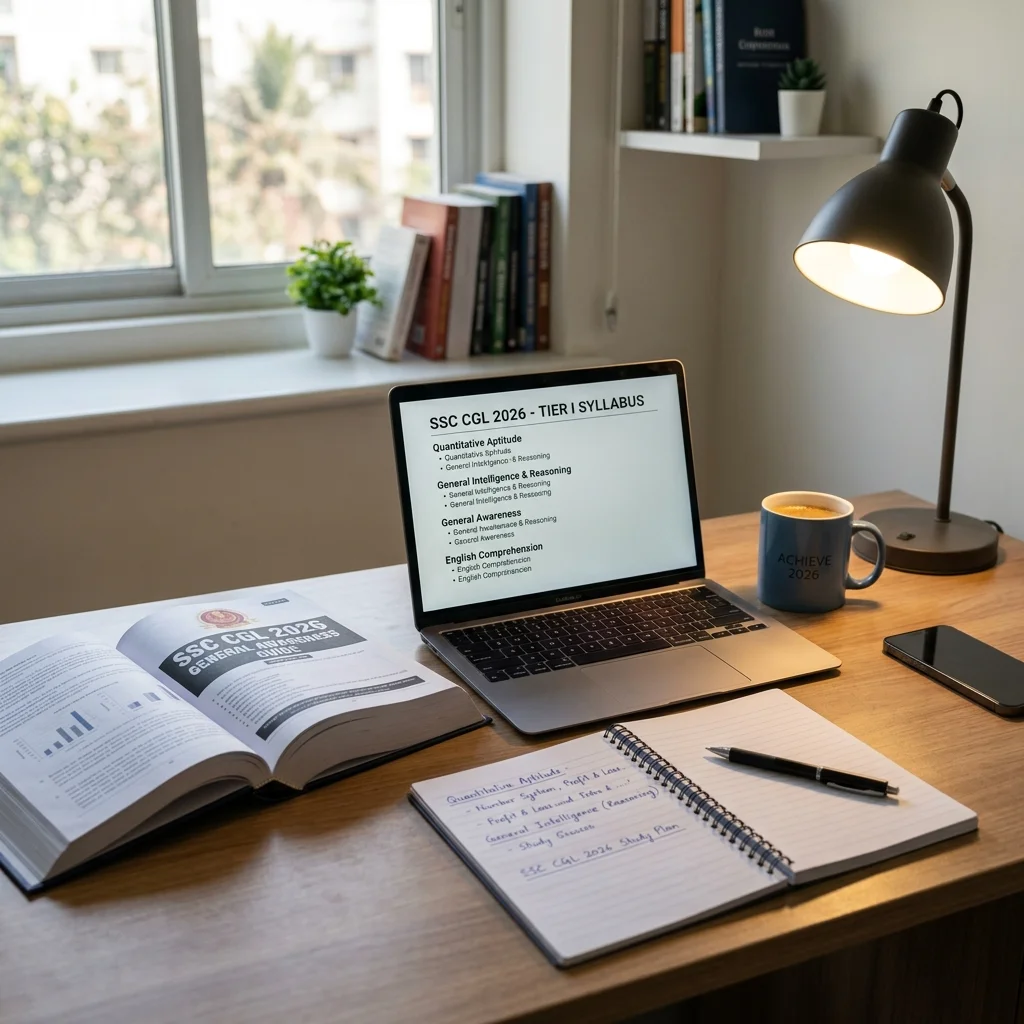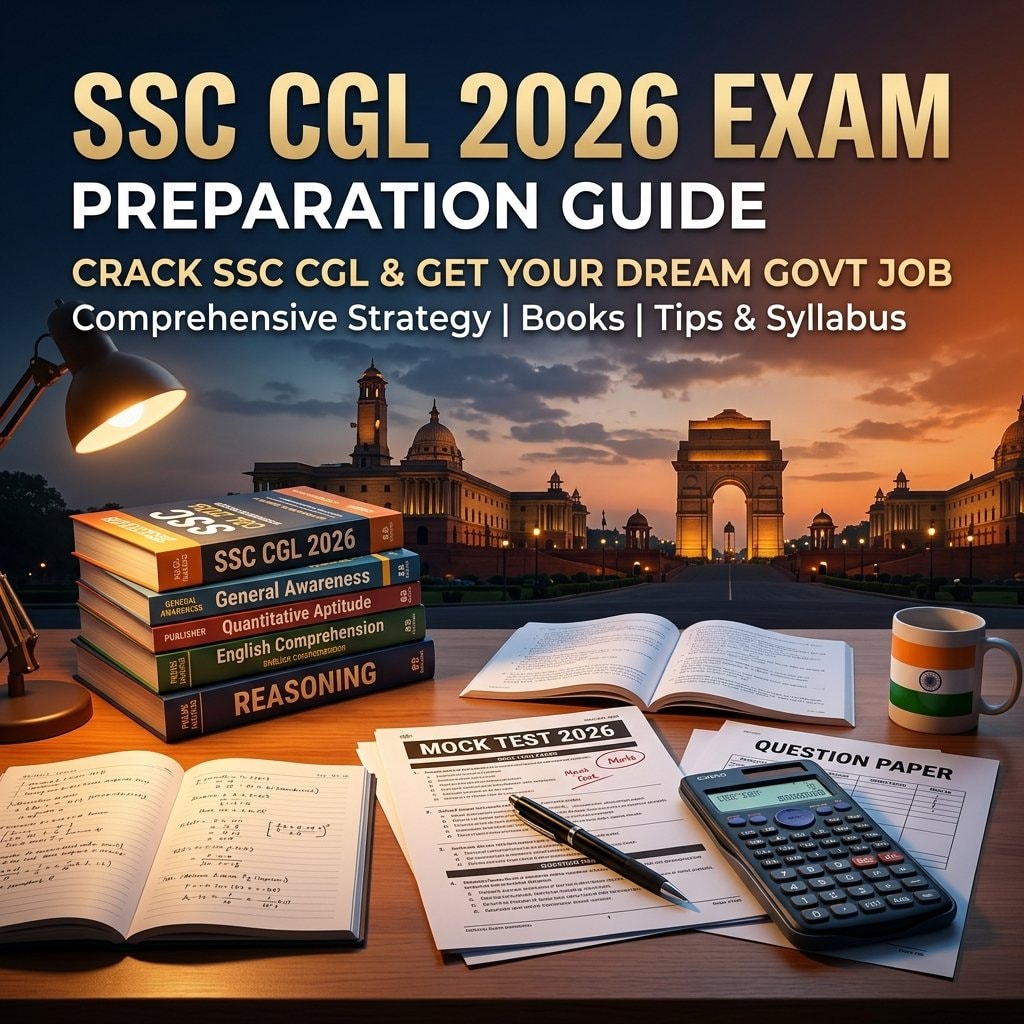
Introduction: Why SSC CGL 2026 is Your Gateway to a Prestigious Government Career
The SSC CGL 2026 (Staff Selection Commission Combined Graduate Level) examination is India's most sought-after competitive exam, offering a golden opportunity to secure prestigious Group B and Group C posts in central government ministries and departments. With over 17 lakh candidates competing for approximately 15,000+ vacancies in SSC CGL 2026, proper preparation strategy is not just important�it's essential for success.
Quick Navigation: Exam Pattern | Syllabus | Preparation Strategy | Best Books | Salary Details | FAQs
In this comprehensive SSC CGL 2026 preparation guide, we'll cover everything you need to know about the SSC CGL exam, from basic eligibility criteria to advanced preparation strategies that have helped thousands of aspirants crack this exam in their first attempt. Whether you're looking for SSC CGL syllabus, exam pattern, best books, or preparation tips, this guide has it all.
Related Articles:
- Complete Career Guide for Government Jobs
- Master Government Job Interviews with Expert Tips
- Latest SSC and Government Job Notifications
- SSC CHSL 2026 Complete Preparation Strategy
What Makes SSC CGL Special?
- Attractive Salary: ?25,500 to ?1,42,400 per month (7th Pay Commission)
- Job Security: Permanent government position with pension benefits
- Career Growth: Regular promotions and increments
- Work-Life Balance: Fixed working hours and holidays
- Prestige: Respected position in society
- Additional Benefits: DA, HRA, TA, Medical, LTC, and more
Table of Contents
Quick Links to Navigate This Guide:
Exam Overview
Syllabus & Preparation
- Complete Syllabus (Tier-I & II)
- 6-Month Preparation Plan
- Subject-wise Strategy
- Best Books & Resources
Strategy & Tips
Career & Salary
FAQs & Resources
Estimated Reading Time: 45 minutes | Last Updated: January 28, 2026
Share This Guide: Help your friends succeed! Share on WhatsApp | Telegram | Facebook | Twitter
SSC CGL 2026 Important Dates (Tentative Schedule)
SSC CGL 2026 Notification: The Staff Selection Commission will release the official SSC CGL 2026 notification in April 2026. Keep checking the official website for SSC CGL admit card, SSC CGL result, and SSC CGL answer key updates.
| Event | Expected Date | Status |
|---|---|---|
| Official Notification Release | April 2026 | Awaited |
| Online Application Start | April 2026 | Awaited |
| Last Date to Apply | May 2026 | Awaited |
| Application Correction Window | May 2026 | Awaited |
| Admit Card Release (Tier-I) | July 2026 | Awaited |
| Tier-I Exam Date | July-August 2026 | Awaited |
| Tier-I Result | September 2026 | Awaited |
| Tier-II Exam Date | October-November 2026 | Awaited |
| Tier-II Result | December 2026 | Awaited |
| Tier-III Exam Date | January 2027 | Awaited |
| Tier-IV Skill Test | February 2027 | Awaited |
| Final Result Declaration | March 2027 | Awaited |
Note: Official SSC CGL 2026 dates will be announced on SSC's official website. Bookmark this page for latest SSC CGL updates.
Stay Updated:
- SSC Official Website - Latest notifications
- SSC Northern Region - NR updates
- SSC Central Region - CR updates
- Subscribe to our notifications - Get instant alerts
Watch: SSC CGL 2026 Preparation Strategy Video
Recommended Video Resources:
- SSC CGL Complete Strategy by Adda247
- SSC CGL Syllabus Breakdown by Study IQ
- SSC CGL Time Management Tips
Video tutorials help in understanding complex topics better. Subscribe to these channels for regular updates.
SSC CGL 2026 Complete Eligibility Criteria
Educational Qualification Requirements
The educational qualification varies based on the post you're applying for:
For Most Posts (Assistant, Inspector, Tax Assistant, etc.)
- Bachelor's Degree from a recognized university or equivalent
- Final year students can also apply (degree must be completed before document verification)
- Any stream accepted (Arts, Science, Commerce)
For Statistical Posts
Statistical Investigator Grade-II:
- Bachelor's degree with Statistics or Mathematics as main subject, OR
- Master's degree in Statistics/Mathematical Statistics/Applied Statistics
Junior Statistical Officer (JSO):
- Bachelor's degree with Statistics as one subject, OR
- Bachelor's degree in Statistics, OR
- Master's degree in Statistics/Mathematical Statistics/Applied Statistics
For Assistant Audit Officer (AAO)
- Bachelor's degree with Commerce as main subject, OR
- Bachelor's degree with Economics or Mathematics as main subject, OR
- Master's degree in Commerce/Economics/Business Administration/Business Management
Age Limit (As on 01-01-2026)
| Post Category | Minimum Age | Maximum Age |
|---|---|---|
| General Posts | 18 years | 27 years |
| Assistant Audit Officer (AAO) | 18 years | 30 years |
| Junior Statistical Officer (JSO) | 18 years | 32 years |
| Statistical Investigator Grade-II | 18 years | 32 years |
Age Relaxation (As per Government Rules)
| Category | Age Relaxation |
|---|---|
| OBC (Other Backward Classes) | 3 years |
| SC/ST (Scheduled Castes/Tribes) | 5 years |
| PwD (Persons with Disabilities) - General | 10 years |
| PwD - OBC | 13 years |
| PwD - SC/ST | 15 years |
| Ex-Servicemen | 3 years after deduction of military service |
| Defence Personnel (Disabled in Operation) | 3 years |
| Central Government Civilian Employees | 5 years (40 years for General, 45 for OBC, 50 for SC/ST) |
Nationality Requirements
Candidates must be:
- A citizen of India, OR
- A subject of Nepal, OR
- A subject of Bhutan, OR
- A Tibetan refugee who came to India before 01-01-1962, OR
- A person of Indian origin migrated from Pakistan, Burma, Sri Lanka, East African countries
Number of Attempts
No limit on the number of attempts. You can apply as many times as you want until you reach the maximum age limit.
SSC CGL 2026 Complete Exam Pattern (All Tiers)
SSC CGL exam is conducted in 4 Tiers (Tier-I to Tier-IV). Let's understand each tier in detail:
Tier-I: Computer Based Examination (Screening Test)
Exam Mode: Computer Based Test (CBT)
Duration: 60 minutes (80 minutes for PwD candidates with scribe)
Total Questions: 100 Multiple Choice Questions (MCQs)
Total Marks: 200 marks
Negative Marking: 0.50 marks deducted for each wrong answer
Qualifying Nature: Yes (only qualified candidates move to Tier-II)
Subject-wise Distribution
| Subject | Questions | Marks | Time Allocated |
|---|---|---|---|
| General Intelligence & Reasoning | 25 | 50 | 15 minutes |
| General Awareness | 25 | 50 | 15 minutes |
| Quantitative Aptitude | 25 | 50 | 15 minutes |
| English Comprehension | 25 | 50 | 15 minutes |
| Total | 100 | 200 | 60 minutes |
Important Points:
- Each question carries 2 marks
- 0.50 marks deducted for wrong answer
- No marks deducted for unattempted questions
- Questions asked in English and Hindi (except English Comprehension)
- Normalization applied if exam conducted in multiple shifts
Tier-II: Computer Based Examination (Mains)
Exam Mode: Computer Based Test (CBT)
Negative Marking: 0.25 marks for Paper-I & II, 0.50 marks for Paper-III & IV
Qualifying Nature: Yes (marks counted for final merit)
Paper-wise Details
| Paper | Subject | Questions | Marks | Duration | Eligibility |
|---|---|---|---|---|---|
| Paper-I | Quantitative Abilities | 100 | 200 | 2 hours | All candidates |
| Paper-II | English Language & Comprehension | 200 | 200 | 2 hours | All candidates |
| Paper-III | Statistics | 100 | 200 | 2 hours | Only for Statistical posts |
| Paper-IV | General Studies (Finance & Economics) | 100 | 200 | 2 hours | Only for AAO posts |
Important Points:
- Paper-I & II are compulsory for all candidates
- Paper-III only for candidates applying for Statistical Investigator Grade-II & JSO
- Paper-IV only for candidates applying for Assistant Audit Officer (AAO)
- Each question in Paper-I, III, IV carries 2 marks
- Each question in Paper-II carries 1 mark
- 0.25 marks negative marking for Paper-I & II
- 0.50 marks negative marking for Paper-III & IV
- PwD candidates get 40 minutes extra per paper (2 hours 40 minutes)
Tier-III: Descriptive Paper (Pen & Paper Mode)
Exam Mode: Offline (Pen & Paper)
Duration: 60 minutes (80 minutes for PwD candidates with scribe)
Total Marks: 100 marks
Qualifying Nature: Yes (minimum 33% marks required)
Language: English or Hindi (candidate's choice)
Paper Structure
| Component | Marks | Word Limit |
|---|---|---|
| Essay Writing | 60 marks | 200-250 words |
| Letter/Application Writing | 40 marks | 150-200 words |
| Total | 100 marks | - |
Evaluation Criteria:
- Content quality and relevance
- Grammar and vocabulary
- Sentence structure and coherence
- Presentation and handwriting
- Adherence to word limit
Important Points:
- Must score minimum 33 marks out of 100 to qualify
- Marks NOT counted for final merit (only qualifying in nature)
- Can write in English or Hindi (your choice)
- Use of unfair means leads to disqualification
Tier-IV: Skill Test / Computer Proficiency Test
Qualifying Nature: Yes (only qualifying, no marks)
Conducted for specific posts only
Data Entry Speed Test (DEST)
For: Tax Assistant (Central Excise & Income Tax)
Speed Required: 8,000 key depressions per hour
Duration: 15 minutes
Test Type: English typing on computer
Computer Proficiency Test (CPT)
For: Assistant (CSS), Assistant (MEA), Inspector (Central Excise), Inspector (Preventive Officer), Inspector (Examiner)
Components:
- Word Processing (10 minutes)
- Spreadsheets (15 minutes)
- Generation of Slides (15 minutes)
Total Duration: 40 minutes (55 minutes for PwD)
Important Points:
- Only qualifying in nature (Pass/Fail)
- Must qualify to be considered for final selection
- Conducted after Tier-III result
- Candidates can bring their own keyboard (subject to approval)
Stay Updated with SSC CGL 2026 Notifications
Don't miss any important update about SSC CGL 2026! Subscribe to our instant notifications to get alerts about:
-
- Official notification release
-
- Application start/end dates
-
- Admit card availability
-
- Exam date announcements
-
- Result declarations
-
- Answer key releases
Subscribe Now for Free Updates | Download Previous Year Papers
SSC CGL 2026 Complete Syllabus (Tier-I & Tier-II)
Tier-I Syllabus (Detailed Topic-wise)
1. General Intelligence & Reasoning (50 Marks)
This section tests your logical and analytical abilities. Topics include:
Verbal Reasoning:
- Analogies (Word, Letter, Number)
- Classification (Semantic, Symbolic, Figural)
- Series Completion (Number, Letter, Figural)
- Coding-Decoding (Letter, Number, Substitution)
- Blood Relations
- Direction Sense Test
- Ranking and Arrangement
- Syllogism
- Statement and Conclusions
- Statement and Assumptions
- Statement and Arguments
- Cause and Effect
- Decision Making
- Assertion and Reason
Non-Verbal Reasoning:
- Figure Classification
- Figure Series
- Figure Analogy
- Paper Folding and Cutting
- Mirror Images
- Water Images
- Embedded Figures
- Completion of Incomplete Pattern
- Counting of Figures
- Cube and Dice
- Construction of Squares and Triangles
Analytical Reasoning:
- Seating Arrangement (Linear, Circular)
- Puzzle Test
- Input-Output
- Data Sufficiency
- Critical Reasoning
- Problem Solving
Important Tips:
- Practice 50+ questions daily
- Focus on speed and accuracy
- Learn shortcut techniques
- Solve previous year papers
- Time yourself while practicing
2. General Awareness (50 Marks)
This section tests your knowledge of current affairs and static GK.
Current Affairs (Last 6 Months):
- National and International Events
- Government Schemes and Policies
- Important Days and Dates
- Awards and Honors
- Sports Events and Winners
- Books and Authors
- Appointments and Resignations
- Summit and Conferences
- Science and Technology News
- Economic Developments
Static General Knowledge:
Indian History:
- Ancient India (Indus Valley, Vedic Period, Mauryan Empire)
- Medieval India (Delhi Sultanate, Mughal Empire)
- Modern India (British Rule, Freedom Struggle, Post-Independence)
- Important Movements and Leaders
Indian Geography:
- Physical Geography (Mountains, Rivers, Climate)
- Economic Geography (Agriculture, Industries, Resources)
- Indian States and Capitals
- Important Places and Landmarks
- National Parks and Wildlife Sanctuaries
Indian Polity:
- Indian Constitution (Features, Amendments)
- Fundamental Rights and Duties
- Directive Principles of State Policy
- Union and State Government
- Parliament and State Legislatures
- Judiciary System
- Local Government (Panchayati Raj)
- Important Constitutional Bodies
Indian Economy:
- Basic Economic Concepts
- Five Year Plans
- Budget and Taxation
- Banking System
- RBI and Monetary Policy
- Inflation and Deflation
- GDP, GNP, National Income
- Economic Reforms
- Important Economic Terms
General Science:
- Physics (Motion, Force, Energy, Light, Sound, Electricity)
- Chemistry (Elements, Compounds, Acids, Bases, Metals)
- Biology (Cell, Human Body, Diseases, Nutrition, Genetics)
- Environmental Science
- Scientific Inventions and Discoveries
Computer Basics:
- Computer Fundamentals
- Hardware and Software
- Internet and Email
- MS Office (Word, Excel, PowerPoint)
- Computer Abbreviations
Miscellaneous:
- Indian Culture and Heritage
- Art and Literature
- Music and Dance Forms
- Famous Personalities
- Countries and Capitals
- International Organizations (UN, WHO, IMF, World Bank)
Preparation Strategy:
- Read newspaper daily (The Hindu, Indian Express)
- Follow current affairs apps/websites
- Make monthly current affairs notes
- Revise static GK regularly
- Solve daily GK quizzes
Recommended Resources:
- PIB (Press Information Bureau) - Official government news
- Jagran Josh Current Affairs - Daily updates
- Affairs Cloud - Monthly compilations
- Our Current Affairs Section - Curated updates
3. Quantitative Aptitude (50 Marks)
This section tests your mathematical and numerical abilities.
Number System:
- Types of Numbers (Natural, Whole, Integer, Rational, Irrational)
- HCF and LCM
- Divisibility Rules
- Factors and Multiples
- Prime and Composite Numbers
- Unit Digit and Last Two Digits
- Remainder Theorem
Simplification:
- BODMAS Rule
- Fractions and Decimals
- Square Roots and Cube Roots
- Surds and Indices
- Approximation
Percentage:
- Basic Concepts
- Percentage Increase/Decrease
- Successive Percentage Changes
- Percentage to Fraction Conversion
Ratio and Proportion:
- Simple Ratio
- Compound Ratio
- Direct and Inverse Proportion
- Fourth Proportional
- Mean Proportional
- Partnership (Simple and Compound)
Average:
- Simple Average
- Weighted Average
- Average Speed
- Average Age Problems
Interest:
- Simple Interest (SI)
- Compound Interest (CI)
- Difference between SI and CI
- Installment Problems
Profit and Loss:
- Cost Price and Selling Price
- Profit and Loss Percentage
- Discount and Marked Price
- Successive Discounts
- Dishonest Dealer Problems
Time and Work:
- Work Efficiency
- Work Done by Multiple Persons
- Pipes and Cisterns
- Wages Distribution
Time, Speed and Distance:
- Basic Concepts
- Relative Speed
- Average Speed
- Train Problems
- Boat and Stream
- Races
Algebra:
- Linear Equations (One and Two Variables)
- Quadratic Equations
- Algebraic Identities
- Polynomials
- Factorization
Geometry:
- Lines and Angles
- Triangles (Types, Properties, Theorems)
- Congruence and Similarity
- Pythagoras Theorem
- Circles (Chord, Tangent, Secant)
- Quadrilaterals (Properties)
- Polygons
Mensuration:
- Area and Perimeter (2D Shapes)
- Volume and Surface Area (3D Shapes)
- Rectangle, Square, Triangle, Circle
- Cube, Cuboid, Cylinder, Cone, Sphere
Trigonometry:
- Trigonometric Ratios
- Trigonometric Identities
- Heights and Distances
- Complementary Angles
Data Interpretation:
- Tables
- Bar Graphs
- Line Graphs
- Pie Charts
- Mixed Graphs
- Data Comparison
Preparation Strategy:
- Learn all formulas and shortcuts
- Practice mental calculations
- Solve 50+ questions daily
- Focus on accuracy first, then speed
- Learn Vedic Math tricks
- Practice previous year papers
4. English Comprehension (50 Marks)
This section tests your English language proficiency.
Vocabulary:
- Synonyms (Same meaning words)
- Antonyms (Opposite meaning words)
- One Word Substitution
- Idioms and Phrases
- Phrasal Verbs
- Homophones and Homonyms
Grammar:
- Parts of Speech (Noun, Pronoun, Verb, Adjective, Adverb)
- Tenses (Present, Past, Future)
- Articles (A, An, The)
- Prepositions
- Conjunctions
- Subject-Verb Agreement
- Active and Passive Voice
- Direct and Indirect Speech
- Modals
- Conditionals
Sentence Structure:
- Sentence Correction
- Error Spotting (Grammatical Errors)
- Sentence Improvement
- Sentence Rearrangement (Para Jumbles)
- Fill in the Blanks (Single and Double)
- Phrase Replacement
Reading Comprehension:
- Passage Reading (200-300 words)
- Main Idea and Theme
- Inference Questions
- Vocabulary in Context
- Author's Tone and Purpose
- Fact vs Opinion
Cloze Test:
- Fill in the blanks in a passage
- Context-based word selection
- Grammar and vocabulary application
Preparation Strategy:
- Read English newspapers daily
- Learn 20 new words daily
- Practice grammar rules
- Solve comprehension passages
- Watch English news channels
- Read novels and magazines
Proven Preparation Strategy to Crack SSC CGL 2026 in First Attempt
Success Statistics:
- Average Success Rate: 0.5-1% (1 out of 100-200 candidates)
- First Attempt Success Rate: 15-20% (with proper preparation)
- Average Preparation Time: 6-12 months
- Mock Tests Required: Minimum 50-80 full-length tests
- Improvement Rate: 30-40% score increase with structured preparation
Key Success Factors (Based on Topper Analysis):
-
- 85% toppers followed a structured 6-month plan
-
- 92% attempted 50+ mock tests before exam
-
- 78% read newspaper daily for current affairs
-
- 95% solved last 10 years' previous papers
-
- 88% focused equally on all four sections
6-Month Preparation Plan (Month-wise Breakdown)
Visual Preparation Timeline:
Month 1-2: Foundation Building (40% Syllabus)

Month 3-4: Advanced Preparation (80% Syllabus)

Month 5: Intensive Practice (100% Syllabus + Mock Tests)

Month 6: Final Revision + Daily Mock Tests

SSC CGL 2026 Exam -> SUCCESS!
Preparation Phases Breakdown:
| Phase | Duration | Focus Area | Target | Success Rate |
|---|---|---|---|---|
| Foundation | Month 1-2 | Basic concepts | 40% syllabus | Build base |
| Advanced | Month 3-4 | Complete syllabus | 80% syllabus | Strengthen |
| Practice | Month 5 | Mock tests | 50+ tests | Perfect |
| Revision | Month 6 | Quick revision | 100+ tests | Master |
Month 1-2: Foundation Building Phase
Goals:
- Complete basic concepts of all subjects
- Build strong fundamentals
- Understand exam pattern thoroughly
Daily Schedule (8 hours):
- Quantitative Aptitude: 2.5 hours (Learn concepts + solve 30 questions)
- English: 1.5 hours (Grammar rules + vocabulary)
- Reasoning: 2 hours (Learn patterns + solve 30 questions)
- General Awareness: 1.5 hours (Read newspaper + static GK)
- Revision: 0.5 hours (Quick revision of day's topics)
Weekly Tasks:
- Complete 2-3 chapters per subject
- Solve 1 previous year paper (subject-wise)
- Make notes of important formulas and concepts
- Take 1 sectional test on Sunday
Books to Focus:
- NCERT Math (Class 6-10)
- NCERT Science (Class 6-10)
- NCERT History, Geography, Polity (Class 6-12)
- Basic grammar book (Wren & Martin)
Month 3-4: Advanced Preparation Phase
Goals:
- Complete entire syllabus
- Improve speed and accuracy
- Start solving full-length tests
Daily Schedule (8-9 hours):
- Quantitative Aptitude: 2.5 hours (Advanced topics + 50 questions)
- English: 2 hours (Comprehension + error spotting)
- Reasoning: 2 hours (Advanced puzzles + 50 questions)
- General Awareness: 2 hours (Current affairs + revision)
- Mock Test Analysis: 0.5 hours
Weekly Tasks:
- Solve 2 previous year papers (full-length)
- Take 2 sectional tests
- Take 1 full-length mock test
- Analyze mistakes thoroughly
- Update current affairs notes
Focus Areas:
- Data Interpretation
- Advanced reasoning puzzles
- Reading comprehension
- Last 3 months current affairs
Month 5: Intensive Practice Phase
Goals:
- Master time management
- Achieve 90%+ accuracy
- Attempt maximum mock tests
Daily Schedule (9-10 hours):
- Morning: 1 full-length mock test (2 hours)
- Mock Test Analysis: 2 hours (Analyze every question)
- Weak Areas Practice: 3 hours (Focus on mistakes)
- Current Affairs: 1.5 hours (Daily + revision)
- Formula Revision: 0.5 hours
Weekly Tasks:
- Attempt 5-6 full-length mock tests
- Solve 3-4 previous year papers
- Revise all formulas daily
- Update current affairs notes
- Take sectional tests for weak areas
Important:
- Simulate exam environment
- Maintain error log
- Track your progress
- Work on weak subjects
Month 6: Final Revision & Mock Tests
Goals:
- Quick revision of entire syllabus
- Attempt maximum mock tests
- Build exam temperament
- Stay confident and healthy
Daily Schedule (10-12 hours):
- Morning: 1 full-length mock test (2 hours)
- Analysis: 2 hours
- Quick Revision: 3 hours (All subjects)
- Current Affairs: 2 hours (Last 6 months)
- Formula Practice: 1 hour
- Previous Year Papers: 2 hours
Weekly Tasks:
- Attempt 7-10 mock tests
- Revise all formulas daily
- Read current affairs thoroughly
- Solve last 10 years papers
- Stay positive and healthy
Last Week Strategy:
- Reduce study hours (6-7 hours)
- Focus on revision only
- No new topics
- Maintain health
- Stay confident
Subject-wise Preparation Strategy
Quantitative Aptitude: Master Strategy
Phase 1: Concept Building (Month 1-2)
-
Start with NCERT Math (Class 6-10)
- Build strong basics
- Understand concepts clearly
- Solve all examples and exercises
-
Learn Formulas Systematically
- Create a formula notebook
- Write formulas with examples
- Revise daily
-
Practice Basic Questions
- Start with easy questions
- Focus on accuracy, not speed
- Understand solution methods
Phase 2: Advanced Practice (Month 3-4)
-
Learn Shortcut Techniques
- Vedic Math tricks
- Percentage to fraction conversion
- Square and cube shortcuts
- Multiplication tricks
-
Topic-wise Practice
- Solve 100+ questions per topic
- Time yourself
- Maintain accuracy above 85%
-
Data Interpretation Focus
- Practice different chart types
- Learn quick calculation methods
- Improve speed
Phase 3: Speed Building (Month 5-6)
-
Timed Practice
- Solve 25 questions in 15 minutes
- Gradually increase speed
- Maintain 90%+ accuracy
-
Mock Test Practice
- Attempt sectional tests
- Analyze mistakes
- Identify weak areas
Important Tips:
- Learn tables up to 30
- Learn squares up to 50
- Learn cubes up to 30
- Practice mental calculations daily
- Use elimination method in MCQs
- Skip difficult questions initially
Common Mistakes to Avoid:
-
- Not learning formulas properly
-
- Focusing only on speed, ignoring accuracy
-
- Not practicing enough
-
- Skipping basic concepts
-
- Not revising regularly
English Comprehension: Master Strategy
Phase 1: Foundation (Month 1-2)
-
Grammar Basics
- Study Wren & Martin
- Learn all tenses
- Understand parts of speech
- Practice active-passive voice
- Master direct-indirect speech
-
Vocabulary Building
- Learn 20 new words daily
- Use flashcards
- Read Word Power Made Easy
- Practice synonyms-antonyms
-
Reading Practice
- Read English newspapers daily
- Start with simple articles
- Understand sentence structure
Phase 2: Advanced Practice (Month 3-4)
-
Comprehension Practice
- Solve 2 passages daily
- Time yourself (7-8 minutes per passage)
- Understand main idea
- Practice inference questions
-
Error Spotting
- Learn common error types
- Practice 20 questions daily
- Understand grammar rules
-
Cloze Test
- Practice context-based questions
- Improve vocabulary
- Understand passage flow
Phase 3: Perfection (Month 5-6)
-
Speed Reading
- Increase reading speed
- Maintain comprehension
- Practice skimming and scanning
-
Mock Test Practice
- Attempt English sectional tests
- Aim for 90%+ accuracy
- Reduce time to 12-13 minutes
Daily Routine:
- Read newspaper (30 minutes)
- Learn 20 new words
- Practice 50 questions
- Solve 1 comprehension passage
- Watch English news (15 minutes)
Best Resources:
- The Hindu newspaper
- BBC News - International coverage
- Word Power Made Easy (Norman Lewis)
- Objective General English (S.P. Bakshi)
- Wren & Martin Grammar book
- Our English Preparation Tips - Free resources
General Intelligence & Reasoning: Master Strategy
Phase 1: Pattern Recognition (Month 1-2)
-
Understand Question Types
- Study all reasoning topics
- Learn basic patterns
- Practice classification
-
Verbal Reasoning
- Coding-decoding
- Blood relations
- Direction sense
- Syllogism basics
-
Non-Verbal Reasoning
- Figure series
- Mirror images
- Paper folding
- Embedded figures
Phase 2: Advanced Practice (Month 3-4)
-
Puzzle Solving
- Seating arrangement
- Floor-based puzzles
- Scheduling puzzles
- Comparison puzzles
-
Analytical Reasoning
- Input-output
- Data sufficiency
- Critical reasoning
-
Speed Building
- Practice 50+ questions daily
- Time yourself
- Learn shortcuts
Phase 3: Mastery (Month 5-6)
-
Mock Test Practice
- Attempt reasoning sectional tests
- Aim for 23-24 correct out of 25
- Reduce time to 12-13 minutes
-
Previous Year Analysis
- Solve last 10 years papers
- Identify repeated patterns
- Focus on high-weightage topics
Important Tips:
- Practice makes perfect
- Don't spend more than 30 seconds per question
- Use elimination method
- Skip difficult questions
- Come back to them later
General Awareness: Master Strategy
Current Affairs Strategy:
Daily Routine (1.5 hours):
-
Morning (30 minutes):
- Read newspaper thoroughly
- Focus on national and international news
- Note important events
-
Evening (30 minutes):
- Watch news channels (DD News, Rajya Sabha TV)
- Follow PIB (Press Information Bureau) website
- Read government press releases
-
Night (30 minutes):
- Make notes of important events
- Revise previous day's current affairs
- Take daily current affairs quiz
Monthly Routine:
- Compile monthly current affairs notes
- Categorize by topics (National, International, Sports, Awards, etc.)
- Revise previous months regularly
- Solve monthly current affairs tests
Static GK Strategy:
NCERT Approach:
-
History (Class 6-12):
- Ancient India
- Medieval India
- Modern India
- Freedom Struggle
-
Geography (Class 6-12):
- Physical Geography
- Indian Geography
- World Geography
- Economic Geography
-
Polity (Class 11-12):
- Indian Constitution
- Political System
- Governance
-
Economy (Class 11-12):
- Basic Economics
- Indian Economy
- Economic Development
-
Science (Class 6-10):
- Physics
- Chemistry
- Biology
Topic-wise Preparation:
- Make separate notebooks
- Use mnemonics for remembering
- Create mind maps
- Revise weekly
Best Resources:
- Lucent's General Knowledge
- Manorama Yearbook 2026
- NCERT Books (Class 6-12)
- Current Affairs Monthly Magazines
- PIB Website
- The Hindu Newspaper
Best Books for SSC CGL 2026 Preparation
Quantitative Aptitude Books
| Book Name | Author | Best For | Rating |
|---|---|---|---|
| Quantitative Aptitude for Competitive Examinations | R.S. Aggarwal | Complete preparation, all topics | 5/5 |
| Fast Track Objective Arithmetic | Rajesh Verma (Arihant) | Shortcuts and tricks | 5/5 |
| Quantum CAT | Sarvesh Kumar Verma | Advanced level practice | 4/5 |
| Advanced Maths for General Competitions | Rakesh Yadav | Tier-II preparation | 5/5 |
| SSC CGL Tier-II Maths | Abhinay Sharma (Paramount) | Tier-II specific | 4/5 |
English Comprehension Books
| Book Name | Author | Best For | Rating |
|---|---|---|---|
| Objective General English | S.P. Bakshi (Arihant) | Complete grammar and vocabulary | 5/5 |
| Word Power Made Easy | Norman Lewis | Vocabulary building | 5/5 |
| High School English Grammar & Composition | Wren & Martin | Grammar fundamentals | 5/5 |
| English for General Competitions | Neetu Singh (Arihant) | All topics covered | 4/5 |
| SSC English Topic-wise Solved Papers | Kiran Prakashan | Previous year practice | 4/5 |
General Intelligence & Reasoning Books
| Book Name | Author | Best For | Rating |
|---|---|---|---|
| A Modern Approach to Verbal & Non-Verbal Reasoning | R.S. Aggarwal | Complete reasoning preparation | 5/5 |
| Analytical Reasoning | M.K. Pandey (BSC Publications) | Advanced reasoning | 5/5 |
| Logical and Analytical Reasoning | A.K. Gupta (Ramesh Publishing) | Puzzle and seating arrangement | 4/5 |
| Reasoning | Arihant Publications | Topic-wise practice | 4/5 |
General Awareness Books
| Book Name | Author | Best For | Rating |
|---|---|---|---|
| Lucent's General Knowledge | Dr. Binay Karna | Static GK foundation | 5/5 |
| Manorama Yearbook 2026 | Manorama | Current affairs and facts | 5/5 |
| General Knowledge 2026 | Arihant Publications | Complete GK coverage | 4/5 |
| NCERT Books (Class 6-12) | NCERT | History, Geography, Polity, Science | 5/5 |
| Pratiyogita Darpan | Upkar Prakashan | Monthly current affairs | 4/5 |
Previous Year Papers & Mock Tests
| Book Name | Publisher | Best For | Rating |
|---|---|---|---|
| SSC CGL Previous Year Papers (Tier-I & II) | Kiran Prakashan | Last 10 years papers | 5/5 |
| SSC CGL 20 Practice Sets | Arihant Publications | Mock test practice | 4/5 |
| SSC CGL Tier-I & II Solved Papers | Disha Publications | Topic-wise solved papers | 4/5 |
Download Free Study Material
Get access to our exclusive SSC CGL 2026 preparation resources:
-
- Free Mock Tests - 10 full-length tests
-
- Previous Year Papers - Last 15 years with solutions
-
- Formula Sheets - All subjects in PDF
-
- Current Affairs - Monthly compilations
-
- Shortcut Tricks - Quantitative aptitude shortcuts
Download Free Resources | Join Our Telegram Group
Mock Test Strategy: The Game Changer
Why Mock Tests are Crucial?
- Simulates Real Exam Environment
- Improves Time Management
- Identifies Weak Areas
- Builds Exam Temperament
- Increases Speed and Accuracy
- Boosts Confidence
- Helps in Strategy Building
Mock Test Schedule (Phase-wise)
Phase 1: Initial Practice (Month 3)
- Frequency: 2 mock tests per week
- Focus: Understanding exam pattern
- Target: Complete all questions
- Analysis Time: 2 hours per test
Phase 2: Regular Practice (Month 4)
- Frequency: 3 mock tests per week
- Focus: Improving accuracy
- Target: 70-75% accuracy
- Analysis Time: 1.5 hours per test
Phase 3: Intensive Practice (Month 5)
- Frequency: 1 mock test daily
- Focus: Speed and accuracy balance
- Target: 85-90% accuracy
- Analysis Time: 1 hour per test
Phase 4: Final Preparation (Month 6)
- Frequency: 2 mock tests daily
- Focus: Exam simulation
- Target: 90%+ accuracy
- Analysis Time: 30 minutes per test
How to Analyze Mock Tests Effectively?
Step 1: Immediate Review (30 minutes)
- Check correct and incorrect answers
- Calculate section-wise scores
- Identify silly mistakes
- Note time taken per section
Step 2: Deep Analysis (1 hour)
- Understand why you got questions wrong
- Categorize mistakes:
- Conceptual errors
- Calculation mistakes
- Time management issues
- Silly mistakes
- Guesswork gone wrong
Step 3: Topic-wise Analysis
- Identify weak topics
- Note topics with low accuracy
- Plan focused practice for weak areas
Step 4: Strategy Refinement
- Adjust section-wise time allocation
- Decide question selection strategy
- Plan which questions to attempt first
Step 5: Action Plan
- Revise weak topics immediately
- Practice similar questions
- Take sectional test on weak topics
- Implement new strategy in next mock
Best Mock Test Platforms (Online)
| Platform | Features | Price | Rating |
|---|---|---|---|
| Adda247 | Quality questions, detailed analysis | ?299-999 | 5/5 |
| Testbook | Large test series, video solutions | ?199-799 | 5/5 |
| Oliveboard | Adaptive tests, performance tracking | ?399-1299 | 4/5 |
| Gradeup | Live classes + tests | ?499-1499 | 4/5 |
| SSC Adda (YouTube) | Free mock tests | Free | 4/5 |
| Unacademy | Comprehensive test series | ?299-999 | 4/5 |
Mock Test Do's and Don'ts
Do's:
- Attempt in exam-like environment
- Use timer strictly
- Analyze every test thoroughly
- Maintain error log
- Track your progress
- Revise mistakes immediately
- Take tests at same time as actual exam
- Stay calm during test
Don'ts:
- Don't skip analysis
- Don't take tests back-to-back
- Don't get demotivated by low scores
- Don't ignore weak areas
- Don't take tests without preparation
- Don't compare with others
- Don't take breaks during test
Time Management Strategy During Exam
Tier-I Time Distribution (60 minutes for 100 questions)
Recommended Strategy:
| Section | Questions | Time Allocated | Strategy |
|---|---|---|---|
| General Awareness | 25 | 8-10 minutes | Attempt first (either you know or you don't) |
| General Intelligence | 25 | 12-15 minutes | Attempt second (quick solving possible) |
| English Comprehension | 25 | 12-15 minutes | Attempt third (moderate difficulty) |
| Quantitative Aptitude | 25 | 18-20 minutes | Attempt last (time-consuming) |
| Review & Marking | - | 5 minutes | Final check and guessing |
Section-wise Approach
General Awareness (8-10 minutes)
Strategy:
- Attempt all known questions first (5 minutes)
- Skip unknown questions immediately
- Come back if time permits
- Don't waste time thinking
- Either you know or you don't
Target: 18-20 correct out of 25
General Intelligence & Reasoning (12-15 minutes)
Strategy:
- Start with easy questions (analogies, classification)
- Attempt puzzles if confident
- Skip lengthy seating arrangements initially
- Use elimination method
- Come back to difficult questions
Target: 22-23 correct out of 25
English Comprehension (12-15 minutes)
Strategy:
- Start with vocabulary questions (2 minutes)
- Attempt grammar questions (5 minutes)
- Read comprehension passage carefully (6-8 minutes)
- Don't re-read entire passage
- Use elimination method
Target: 20-22 correct out of 25
Quantitative Aptitude (18-20 minutes)
Strategy:
- Attempt easy questions first (simplification, percentage)
- Skip lengthy DI questions initially
- Use approximation method
- Don't spend more than 1 minute per question
- Come back to difficult questions
Target: 20-22 correct out of 25
Golden Rules for Time Management
-
Don't Stick to One Question
- Maximum 30-45 seconds per question
- If not solved, move on
- Mark for review
-
Use Elimination Method
- Remove obviously wrong options
- Increases chances of correct guess
- Saves time
-
Attempt Known Questions First
- Build confidence
- Secure marks
- Reduce pressure
-
Keep 5 Minutes for Review
- Check marked questions
- Attempt skipped easy questions
- Make educated guesses
-
Don't Change Answers Frequently
- First instinct is usually correct
- Change only if 100% sure
-
Manage Negative Marking
- Don't attempt if 50-50 doubt
- Attempt if you can eliminate 2 options
- Leave if completely unknown
Practice Time Management
Week 1-2:
- Practice without timer
- Focus on accuracy
- Understand concepts
Week 3-4:
- Start using timer
- Section-wise time limits
- Gradually increase speed
Week 5-6:
- Strict time limits
- Full mock tests
- Simulate exam environment
Last Month:
- Daily timed practice
- 2 mock tests daily
- Perfect time management
SSC CGL 2026 Salary Structure & Pay Scale
SSC CGL Salary 2026: One of the most attractive features of SSC CGL posts is the excellent salary package as per 7th Pay Commission. The SSC CGL in-hand salary ranges from ?35,000 to ?75,000 per month depending on the post and location. Let's understand the complete SSC CGL pay scale and allowances.
Pay Matrix as per 7th Pay Commission
| Post | Pay Level | Basic Pay Range (?) | In-Hand Salary (?) | Grade |
|---|---|---|---|---|
| Assistant | Level 4 | 25,500 - 81,100 | 35,000 - 45,000 | Group C |
| Tax Assistant | Level 4 | 25,500 - 81,100 | 35,000 - 45,000 | Group C |
| Junior Statistical Officer | Level 6 | 35,400 - 1,12,400 | 45,000 - 60,000 | Group B |
| Inspector (Central Excise) | Level 6 | 35,400 - 1,12,400 | 45,000 - 60,000 | Group B |
| Inspector (Income Tax) | Level 6 | 35,400 - 1,12,400 | 45,000 - 60,000 | Group B |
| Auditor | Level 7 | 44,900 - 1,42,400 | 55,000 - 75,000 | Group B |
| Assistant Audit Officer (AAO) | Level 7 | 44,900 - 1,42,400 | 55,000 - 75,000 | Group B |
| Assistant Section Officer (ASO) | Level 6 | 35,400 - 1,12,400 | 45,000 - 60,000 | Group B |
Additional Allowances & Benefits
Monthly Allowances
1. Dearness Allowance (DA)
- Current Rate: 50% of Basic Pay (as of January 2026)
- Revised every 6 months (January & July)
- Increases with inflation
2. House Rent Allowance (HRA)
- X-Class Cities (Mumbai, Delhi, etc.): 24% of Basic Pay
- Y-Class Cities: 16% of Basic Pay
- Z-Class Cities: 8% of Basic Pay
3. Transport Allowance (TA)
- ?3,600 per month (for cities with population > 10 lakh)
- ?1,800 per month (for other cities)
- Fully exempted from income tax
4. Other Allowances
- Medical Allowance: Free medical facilities for self and family
- Children Education Allowance: ?2,250 per child (max 2 children)
- Hostel Subsidy: ?6,750 per child (if applicable)
Annual Benefits
1. Leave Travel Allowance (LTA)
- Once in 2 years
- Travel expenses for self and family
- Tax exemption available
2. Annual Increment
- 3% of Basic Pay every year
- On 1st July every year
3. Performance Bonus
- Based on annual performance review
- Additional incentives for good performance
Long-term Benefits
1. Pension Benefits
- National Pension System (NPS)
- 10% employee contribution
- 14% employer contribution
- Tax benefits under Section 80C
2. Gratuity
- Paid after completion of service
- Formula: (Last drawn salary Years of service 15) / 26
- Maximum limit: ?20 lakhs
3. Leave Encashment
- Accumulated leave can be encashed
- Paid at the time of retirement
4. General Provident Fund (GPF)
- Monthly contribution
- Interest rate: 7.1% per annum (current)
- Tax-free returns
Sample Salary Calculation
Example: Assistant (Pay Level 4) in Delhi
| Component | Amount (?) |
|---|---|
| Basic Pay | 25,500 |
| DA (50%) | 12,750 |
| HRA (24%) | 6,120 |
| Transport Allowance | 3,600 |
| Gross Salary | 47,970 |
| Deductions (PF, Tax, etc.) | -8,000 |
| Net In-Hand Salary | ?39,970 |
After 5 Years (with increments):
- Basic Pay: ?29,500 (approx.)
- In-Hand Salary: ?48,000 - ?52,000
Top 15 Posts in SSC CGL 2026
Group B Posts (Higher Pay & Prestige)
1. Assistant Audit Officer (AAO)
- Pay Level: 7 (?44,900 - ?1,42,400)
- Department: Comptroller and Auditor General (CAG)
- Job Profile: Audit of government accounts, financial management
- Qualification: Commerce/Economics/Business Administration graduate
- Tier-II Papers: Paper-I, II, IV (Finance & Economics)
- Career Growth: AAO Senior AAO Audit Officer Deputy Accountant General
2. Assistant Section Officer (ASO)
- Pay Level: 6 (?35,400 - ?1,12,400)
- Department: Central Secretariat Service (CSS)
- Job Profile: Administrative work, file management, policy implementation
- Career Growth: ASO Section Officer Under Secretary Deputy Secretary
3. Inspector (Central Excise)
- Pay Level: 6 (?35,400 - ?1,12,400)
- Department: Central Board of Indirect Taxes and Customs (CBIC)
- Job Profile: Tax collection, anti-smuggling operations, investigation
- Career Growth: Inspector Superintendent Assistant Commissioner
4. Inspector (Income Tax)
- Pay Level: 6 (?35,400 - ?1,12,400)
- Department: Income Tax Department
- Job Profile: Tax assessment, investigation, raid operations
- Career Growth: Inspector Income Tax Officer Assistant Commissioner
5. Inspector (Preventive Officer)
- Pay Level: 6 (?35,400 - ?1,12,400)
- Department: Customs Department
- Job Profile: Prevent smuggling, customs clearance, investigation
- Career Growth: Inspector Superintendent Assistant Commissioner
6. Auditor
- Pay Level: 7 (?44,900 - ?1,42,400)
- Department: CAG, CGDA, and other audit departments
- Job Profile: Financial auditing, account verification
- Career Growth: Auditor Senior Auditor Audit Officer
7. Junior Statistical Officer (JSO)
- Pay Level: 6 (?35,400 - ?1,12,400)
- Department: Ministry of Statistics
- Job Profile: Data collection, statistical analysis, report preparation
- Qualification: Statistics graduate
- Career Growth: JSO Statistical Officer Senior Statistical Officer
8. Statistical Investigator Grade-II
- Pay Level: 6 (?35,400 - ?1,12,400)
- Department: Ministry of Statistics
- Job Profile: Field surveys, data collection, statistical research
- Qualification: Statistics/Mathematics graduate
Group C Posts (Entry Level)
9. Tax Assistant (Central Excise & Income Tax)
- Pay Level: 4 (?25,500 - ?81,100)
- Department: CBIC and Income Tax Department
- Job Profile: Tax assessment, data entry, file management
- Skill Test: Data Entry Speed Test (DEST) required
10. Assistant (CSS)
- Pay Level: 4 (?25,500 - ?81,100)
- Department: Central Secretariat Service
- Job Profile: Clerical work, file management, data entry
- Skill Test: Computer Proficiency Test (CPT) required
11. Assistant (MEA)
- Pay Level: 4 (?25,500 - ?81,100)
- Department: Ministry of External Affairs
- Job Profile: Administrative support in embassies and consulates
- Perks: Foreign posting opportunities
12. Inspector (Examiner)
- Pay Level: 6 (?35,400 - ?1,12,400)
- Department: CBIC
- Job Profile: Examination of goods, customs clearance
13. Inspector (Posts)
- Pay Level: 6 (?35,400 - ?1,12,400)
- Department: Department of Posts
- Job Profile: Postal operations, investigation, administration
14. Compiler
- Pay Level: 5 (?29,200 - ?92,300)
- Department: Registrar General of India
- Job Profile: Data compilation, statistical work
15. Sub-Inspector (CBI)
- Pay Level: 6 (?35,400 - ?1,12,400)
- Department: Central Bureau of Investigation
- Job Profile: Investigation, crime detection
- Note: Limited vacancies, high competition
Common Mistakes to Avoid
During Preparation Phase
1. Starting Late
- Mistake: Starting preparation 2-3 months before exam
- Solution: Start at least 6 months in advance
2. No Study Plan
- Mistake: Studying randomly without a plan
- Solution: Create a detailed month-wise study plan
3. Ignoring Previous Year Papers
- Mistake: Not solving last 10 years papers
- Solution: Solve and analyze all previous year papers
4. Skipping Mock Tests
- Mistake: Taking only 5-10 mock tests
- Solution: Attempt minimum 50 full-length mock tests
5. Neglecting Current Affairs
- Mistake: Reading current affairs only in last month
- Solution: Read newspaper daily from day one
6. Not Revising Regularly
- Mistake: Learning new topics without revision
- Solution: Revise daily, weekly, and monthly
7. Studying Without Strategy
- Mistake: Just reading books without practice
- Solution: Practice questions after every topic
8. Ignoring Weak Areas
- Mistake: Focusing only on strong subjects
- Solution: Give extra time to weak subjects
9. Not Making Notes
- Mistake: Reading without making notes
- Solution: Make concise notes for quick revision
10. Comparing with Others
- Mistake: Getting demotivated by others' progress
- Solution: Focus on your own preparation
During Exam Day
1. Not Reading Instructions
- Mistake: Directly starting without reading instructions
- Solution: Read all instructions carefully (2 minutes)
2. Spending Too Much Time on One Question
- Mistake: Spending 3-4 minutes on difficult questions
- Solution: Maximum 30-45 seconds per question
3. Attempting All Questions Blindly
- Mistake: Attempting all 100 questions without thinking
- Solution: Attempt only questions you're confident about
4. Poor Time Management
- Mistake: Spending 25 minutes on one section
- Solution: Stick to planned time allocation
5. Getting Nervous
- Mistake: Panicking if questions are tough
- Solution: Stay calm, skip difficult questions
6. Not Reviewing Answers
- Mistake: Not keeping time for final review
- Solution: Keep 5 minutes for review
7. Changing Answers Frequently
- Mistake: Changing 10-15 answers in review
- Solution: Change only if 100% sure
8. Not Carrying Required Documents
- Mistake: Forgetting admit card or ID proof
- Solution: Check document list night before
9. Reaching Late
- Mistake: Reaching exam center 15 minutes before
- Solution: Reach 1 hour early
10. Discussing After Exam
- Mistake: Discussing answers with friends
- Solution: Avoid discussion, focus on next tier
Exam Day Preparation & Tips
One Day Before Exam
Morning (8 AM - 12 PM):
- Light revision of formulas only
- Don't study new topics
- Quick revision of current affairs
- Solve one easy mock test (optional)
Afternoon (12 PM - 4 PM):
- Take complete rest
- Watch light entertainment
- Avoid heavy meals
- Stay hydrated
Evening (4 PM - 8 PM):
- Quick formula revision (30 minutes)
- Check exam center location on Google Maps
- Keep all documents ready:
- Admit Card (2 copies)
- Valid Photo ID (Aadhar/PAN/Driving License)
- Passport size photos (2)
- Pen for rough work
- Check exam timing again
Night (8 PM onwards):
- Have light dinner
- No studying after 8 PM
- Sleep early (by 10 PM)
- Set 2-3 alarms
- Keep positive mindset
Exam Day Morning Routine
Wake Up Early (2-3 hours before exam):
- Fresh up properly
- Light exercise or yoga (10 minutes)
- Have healthy breakfast (not too heavy)
- Avoid tea/coffee if it makes you nervous
- Reach exam center 1 hour early
Things to Carry:
- Admit Card (2 printed copies)
- Valid Photo ID (original)
- Passport size photos (2)
- Pen (for rough work)
- Water bottle
- Light snacks (for after exam)
- Hand sanitizer
- Mask (if required)
Things NOT to Carry:
- Mobile phone
- Calculator
- Smart watch
- Books or notes
- Bluetooth devices
- Any electronic gadgets
During Exam (60 Minutes Strategy)
First 2 Minutes (11:00 - 11:02):
- Read all instructions carefully
- Check total questions
- Verify sections
- Stay calm and confident
Next 58 Minutes (11:02 - 12:00):
Phase 1: General Awareness (8-10 minutes)
- Attempt all known questions
- Don't think too much
- Skip unknown immediately
- Mark for review if time permits
Phase 2: Reasoning (12-15 minutes)
- Start with easy questions
- Attempt puzzles if confident
- Use elimination method
- Skip lengthy questions
Phase 3: English (12-15 minutes)
- Vocabulary first
- Grammar questions
- Comprehension last
- Don't re-read entire passage
Phase 4: Quantitative Aptitude (18-20 minutes)
- Easy questions first
- Skip lengthy DI
- Use approximation
- Don't waste time
Last 5 Minutes (11:55 - 12:00):
- Review marked questions
- Attempt easy skipped questions
- Make educated guesses
- Final check
Post-Exam Strategy
Immediately After Exam:
- Don't discuss answers with anyone
- Don't check answer key immediately
- Relax and unwind
- Have proper meal
Same Evening:
- Analyze your performance mentally
- Identify mistakes (if you remember)
- Start planning for Tier-II
- Stay positive
Next Day Onwards:
- Check official answer key (when released)
- Calculate expected score
- If qualified, start Tier-II preparation immediately
- If not qualified, analyze mistakes and prepare for next attempt
Frequently Asked Questions (FAQs)
Quick Answers to Your SSC CGL 2026 Questions
<details> <summary><strong>Q1: Can I crack SSC CGL in 6 months with self-study?</strong></summary>General Questions
Q1: Can I crack SSC CGL in 6 months with self-study?
Answer: Yes, absolutely! With dedicated preparation of 6-8 hours daily, proper strategy, and consistent practice, you can definitely crack SSC CGL in 6 months through self-study. Many toppers have cracked it without coaching.
Key Requirements:
- Disciplined study routine
- Quality study materials
- Regular mock tests
- Proper guidance (online resources)
- Strong determination
Q2: Is SSC CGL exam very tough to crack?
Answer: SSC CGL is moderately difficult. The difficulty level varies:
- Tier-I: Moderate (with proper preparation, 70-80% can qualify)
- Tier-II: Difficult (requires advanced preparation)
- Tier-III: Easy (if you have good writing skills)
- Tier-IV: Easy (qualifying nature)
Success Rate: Approximately 0.5-1% (1 out of 100-200 candidates)
However, with proper preparation, strategy, and practice, anyone can crack it. The key is consistency and smart work.
Q3: How many hours should I study daily for SSC CGL?
Answer:
- Minimum: 6 hours daily (for working professionals)
- Recommended: 8-10 hours daily (for full-time aspirants)
- Last 2 months: 10-12 hours daily
Quality matters more than quantity. Focus on:
- Focused study (no distractions)
- Regular breaks (every 90 minutes)
- Proper sleep (7-8 hours)
- Healthy lifestyle
Q4: Is coaching necessary for SSC CGL preparation?
Answer: No, coaching is NOT mandatory. Many candidates crack SSC CGL through self-study.
Coaching Benefits:
- Structured guidance
- Doubt clearing
- Peer learning
- Regular tests
Self-Study Benefits:
- Flexible schedule
- Cost-effective
- Self-paced learning
- Online resources available
Recommendation: If you're disciplined and have access to good study materials, self-study is sufficient. Use online platforms for mock tests and doubt clearing.
Q5: Which section is the toughest in SSC CGL?
Answer: It varies from person to person:
For Most Candidates:
- Quantitative Aptitude (time-consuming, calculation-heavy)
- English Comprehension (for Hindi medium students)
- General Intelligence (puzzles can be tricky)
- General Awareness (vast syllabus)
Strategy: Focus more on your weak areas. Don't ignore any section.
Q6: What is the minimum qualifying marks for SSC CGL Tier-I?
Answer: There's no fixed qualifying marks. It depends on:
- Difficulty level of exam
- Number of candidates
- Number of vacancies
- Category (General/OBC/SC/ST)
Safe Score (General Category):
- 2024: 130-140 marks (out of 200)
- 2023: 125-135 marks
- 2022: 140-150 marks
Recommendation: Target 150+ marks to be on the safer side.
Q7: Can I use calculator in SSC CGL exam?
Answer: No, calculators are NOT allowed in SSC CGL exam. You need to do all calculations:
- Mentally
- On rough paper provided
- Using pen
Preparation Tips:
- Practice mental calculations daily
- Learn tables up to 30
- Learn squares up to 50
- Learn cubes up to 30
- Practice Vedic Math tricks
Q8: Can final year students apply for SSC CGL?
Answer: Yes, final year students can apply for SSC CGL. However:
- You must complete your degree before document verification
- If you fail to complete degree, your candidature will be cancelled
- Keep your final year marksheet ready
Important: Apply only if you're confident of completing your degree on time.
Q9: How many times can I attempt SSC CGL?
Answer: No limit on number of attempts. You can apply as many times as you want until you reach the maximum age limit.
Example:
- If you're 22 years old (General category)
- Maximum age: 27 years
- You can attempt: 5-6 times (depending on exam frequency)
Q10: What is the selection process for SSC CGL?
Answer:
- Tier-I (CBT): Screening test (qualifying + marks counted)
- Tier-II (CBT): Mains exam (marks counted for final merit)
- Tier-III (Descriptive): Essay + Letter writing (qualifying)
- Tier-IV (Skill Test): DEST/CPT (qualifying)
- Document Verification: Final verification
- Medical Examination: Fitness test
- Final Merit List: Based on Tier-I + Tier-II marks
Q11: Which posts are best in SSC CGL?
Answer: Top 5 posts based on salary, prestige, and career growth:
- Assistant Audit Officer (AAO) - Pay Level 7, CAG
- Inspector (Income Tax) - Pay Level 6, Investigation work
- Inspector (Central Excise) - Pay Level 6, Field work
- Assistant Section Officer (ASO) - Pay Level 6, CSS
- Auditor - Pay Level 7, Audit work
Factors to Consider:
- Salary and allowances
- Job profile and work culture
- Career growth opportunities
- Work-life balance
- Posting locations
Q12: Is there negative marking in SSC CGL?
Answer: Yes, there is negative marking:
- Tier-I: 0.50 marks deducted per wrong answer
- Tier-II Paper-I & II: 0.25 marks deducted
- Tier-II Paper-III & IV: 0.50 marks deducted
- Tier-III: No negative marking
- Tier-IV: No negative marking
Strategy: Don't attempt questions if you're 50-50 doubtful. Attempt only if you can eliminate at least 2 options.
Q13: Can I change my exam center after applying?
Answer: No, you cannot change exam center after submitting the application. However:
- SSC may change your center due to administrative reasons
- You'll be notified via email/SMS
- Check admit card for final exam center
Tip: Choose exam center carefully while filling application form.
Q14: What is normalization in SSC CGL?
Answer: Normalization is applied when exam is conducted in multiple shifts to ensure fairness.
Formula Used: Normalization based on difficulty level of each shift.
Impact:
- If your shift was easier, your score may decrease slightly
- If your shift was tougher, your score may increase slightly
- Usually, difference is 2-5 marks
Note: Normalization is applied only in Tier-I (if conducted in multiple shifts).
Q15: How to prepare for SSC CGL while doing a job?
Answer: Yes, it's possible! Many working professionals crack SSC CGL.
Time Management Strategy:
- Morning (5-7 AM): 2 hours before office
- Evening (7-10 PM): 3 hours after office
- Weekends: 8-10 hours daily
- Total: 25-30 hours per week
Tips:
- Wake up early
- Utilize travel time (audio lectures)
- Take study leave before exam
- Focus on quality, not quantity
- Stay consistent
Q16: Best time to start SSC CGL preparation?
Answer:
- Ideal: 8-12 months before exam
- Minimum: 6 months before exam
- For working professionals: 10-12 months
Timeline:
- January-March: Foundation building
- April-June: Advanced preparation
- July: Intensive practice
- August: Final revision + mock tests
Note: Earlier you start, better your chances!
Q17: Can I prepare for multiple exams along with SSC CGL?
Answer: Yes, but with caution.
Compatible Exams:
- SSC CHSL (70% syllabus overlap)
- Railway NTPC (60% overlap)
- State PSC (50% overlap)
- Banking PO (40% overlap)
Strategy:
- Focus primarily on SSC CGL
- Prepare common topics thoroughly
- Attempt other exams for practice
- Don't compromise SSC CGL preparation
Warning: Don't prepare for too many exams simultaneously. Focus on 2-3 exams maximum.
Q18: What to do if I fail in SSC CGL?
Answer: Don't lose hope! Many toppers failed multiple times before success.
Action Plan:
-
Analyze Mistakes:
- Identify weak areas
- Understand where you went wrong
- Check answer key thoroughly
-
Improve Strategy:
- Revise weak topics
- Practice more mock tests
- Improve time management
-
Stay Motivated:
- Learn from mistakes
- Stay positive
- Prepare for next attempt
-
Attempt Other Exams:
- SSC CHSL
- Railway NTPC
- State PSC
Remember: "Failure is not the opposite of success, it's a part of success."
Ready to Start Your SSC CGL 2026 Journey?
Take Action Now:
-
- Download Free Study Material - Get started today
-
- Subscribe to Notifications - Never miss updates
-
- Join Our Community - Connect with fellow aspirants
-
- Take Free Mock Test - Assess your preparation
-
- Read Success Stories - Get motivated
Don't wait! Start your preparation today and achieve your dream government job!
Q19: Is SSC CGL job transferable?
Answer: Yes, most SSC CGL posts are transferable.
Transfer Policy:
- Frequency: Every 3-5 years (varies by department)
- Location: Anywhere in India
- Type: Mutual transfer possible
- Exemption: Available for women, disabled persons (in some cases)
Posts with Less Transfer:
- Assistant (CSS) - mostly in Delhi
- Assistant (MEA) - foreign postings possible
Tip: Check transfer policy of specific post before applying.
Q20: What is the career growth in SSC CGL posts?
Answer:
Example: Inspector (Income Tax)
- Entry: Inspector (Pay Level 6)
- After 4-5 years: Income Tax Officer (Pay Level 7)
- After 10-12 years: Assistant Commissioner (Pay Level 10)
- After 20+ years: Joint Commissioner (Pay Level 12)
Promotion Criteria:
- Time-bound promotions
- Departmental exams
- Performance appraisal
- Seniority
Additional Growth:
- UPSC promotion quota
- Departmental promotions
- Lateral entry opportunities
Success Stories: Real Toppers' Strategies
Topper 1: Rahul Sharma (AIR 23, 2023)
Background: B.Com graduate, prepared while doing job
Preparation Time: 10 months
Study Hours: 4-5 hours daily (weekdays), 8-10 hours (weekends)
Strategy:
- Started with NCERT books for basics
- Focused heavily on mock tests (attempted 80+ mocks)
- Made concise notes for quick revision
- Read newspaper daily without fail
- Solved last 15 years papers multiple times
Key Advice: "Consistency is more important than intensity. Study daily, even if it's just 2 hours."
Topper 2: Priya Singh (AIR 47, 2023)
Background: B.A. graduate, first attempt
Preparation Time: 8 months
Study Hours: 8-10 hours daily
Strategy:
- Joined online test series (Testbook)
- Focused on weak areas (Quantitative Aptitude)
- Practiced 100+ questions daily in Quant
- Made monthly current affairs notes
- Attempted 2 mock tests daily in last month
Key Advice: "Don't ignore your weak subjects. Give them extra time and attention."
Topper 3: Amit Kumar (AIR 89, 2022)
Background: B.Tech graduate, second attempt
Preparation Time: 6 months (second attempt)
Study Hours: 10-12 hours daily
Strategy:
- Analyzed first attempt mistakes thoroughly
- Changed preparation strategy completely
- Focused on time management
- Attempted 100+ mock tests
- Revised formulas daily
Key Advice: "Learn from your failures. Every failure teaches you something valuable."
Motivational Tips for Aspirants
Stay Motivated Throughout Your Journey
1. Set Clear Goals
- Write down your goal
- Visualize your success
- Keep reminders everywhere
- Stay focused on the end result
2. Create a Support System
- Join study groups
- Connect with fellow aspirants
- Share your journey
- Help others
3. Celebrate Small Wins
- Completed a chapter? Celebrate!
- Scored well in mock test? Reward yourself!
- Improved accuracy? Acknowledge it!
- Every small step counts
4. Handle Stress Effectively
- Take regular breaks
- Exercise daily (30 minutes)
- Practice meditation/yoga
- Maintain work-life balance
- Sleep 7-8 hours daily
5. Stay Positive
- Avoid negative people
- Don't compare with others
- Focus on your progress
- Believe in yourself
- Stay away from social media distractions
Powerful Quotes to Keep You Going
"Success is not final, failure is not fatal: it is the courage to continue that counts." - Winston Churchill
"The only way to do great work is to love what you do." - Steve Jobs
"Believe you can and you're halfway there." - Theodore Roosevelt
"Don't watch the clock; do what it does. Keep going." - Sam Levenson
"Success is the sum of small efforts repeated day in and day out." - Robert Collier
Remember These Points
- Every topper was once a beginner
- Failure is a stepping stone to success
- Consistency beats intensity
- Your only competition is yourself
- Hard work always pays off
- Believe in the process
- Stay patient and persistent
- Your time will come
Important Resources & Links
Official Websites
| Resource | URL | Purpose |
|---|---|---|
| SSC Official Website | ssc.nic.in | Notifications, admit cards, results |
| SSC NR Region | sscnr.net.in | Northern region updates |
| SSC CR Region | ssc-cr.org | Central region updates |
| SSC WR Region | sscwr.net | Western region updates |
| SSC ER Region | sscer.org | Eastern region updates |
Best YouTube Channels (Free Resources)
| Channel | Focus Area | Subscribers |
|---|---|---|
| Adda247 | All subjects, mock tests | 10M+ |
| Study IQ Education | Current affairs, GK | 8M+ |
| SSC Adda | SSC specific preparation | 5M+ |
| Exampur | All subjects, strategy | 4M+ |
| Gradeup | Mock tests, strategy | 3M+ |
Best Mobile Apps
| App Name | Features | Rating |
|---|---|---|
| Adda247 | Mock tests, live classes | 5/5 |
| Testbook | Test series, video courses | 5/5 |
| Gradeup | Daily quizzes, mock tests | 4/5 |
| Oliveboard | Mock tests, analysis | 4/5 |
| Current Affairs by Jagran Josh | Daily current affairs | 4/5 |
Best Telegram Channels
- SSC CGL Preparation - Daily updates and study material
- Current Affairs Daily - Daily current affairs in Hindi & English
- SSC Exam Updates - Official notifications and updates
- Free Study Material - Free PDFs and notes
Best Websites for Current Affairs
| Website | Focus | Update Frequency |
|---|---|---|
| PIB (pib.gov.in) | Government press releases | Daily |
| The Hindu | National & international news | Daily |
| Indian Express | Detailed analysis | Daily |
| Jagran Josh | Current affairs compilation | Daily |
| Affairs Cloud | Monthly current affairs PDF | Monthly |
Conclusion: Your Journey Starts Now
Congratulations on taking the first step towards your dream government job! SSC CGL 2026 is not just an exam�it's an opportunity to transform your life and secure a prestigious career with excellent salary, job security, and growth prospects.
Key Takeaways from This Guide
- Start Early: Begin preparation at least 6 months before exam
- Follow Strategy: Stick to a well-planned preparation strategy
- Practice Daily: Solve questions and take mock tests regularly
- Stay Updated: Read current affairs daily without fail
- Revise Regularly: Revision is more important than studying new topics
- Manage Time: Master time management during exam
- Stay Positive: Believe in yourself and stay motivated
- Never Give Up: Persistence is the key to success
Your Action Plan (Starting Today)
Today:
-
- Bookmark this guide for future reference
-
- Create a study plan for next 6 months
-
- Buy/download essential study materials
-
- Join online test series platform
-
- Start reading newspaper from today
This Week:
-
- Complete NCERT Math (Class 6-8)
-
- Start learning basic grammar
-
- Practice 50 reasoning questions
-
- Make current affairs notes
-
- Take one diagnostic test
This Month:
-
- Complete 30% of syllabus
-
- Solve 2 previous year papers
-
- Take 4 sectional tests
-
- Revise completed topics
-
- Build strong foundation
Final Words of Motivation
Remember, every successful person was once a beginner. The toppers you admire today were once in your position, starting their preparation with dreams in their eyes and determination in their hearts.
SSC CGL is not about being the smartest�it's about being the most consistent, dedicated, and persistent.
You have everything you need to succeed:
-
- This comprehensive guide
-
- Access to study materials
-
- Online resources and mock tests
-
- Time to prepare
-
- Most importantly�the WILL to succeed
The only thing standing between you and your goal is the action you take today.
Don't wait for the "perfect time" to start. The perfect time is NOW. Start your preparation today, stay consistent, work hard, and success will be yours.
Your dream government job is waiting for you. Go and grab it!
Stay Connected for Latest Updates
Subscribe to our notifications to get instant alerts about:
- SSC CGL 2026 notification release
- Exam date announcements
- Admit card availability
- Result declarations
- Answer key releases
- Important updates and tips
Click the notification bell at the top of this page to never miss any update!
Share This Guide
If you found this guide helpful, please share it with your friends and fellow aspirants. Let's help each other succeed!
Share on:
- WhatsApp Groups
- Telegram Channels
- Facebook Groups
About Government Job Result
We are a dedicated team of government job experts with 10+ years of experience helping lakhs of aspirants crack SSC, UPSC, Banking, and Railway exams. Our mission is to provide accurate, timely, and actionable information to help you achieve your dream government job.
Our Services:
-
- Latest job notifications
-
- Exam preparation guides
-
- Study materials and notes
-
- Mock tests and quizzes
-
- Result updates
-
- Admit card downloads
-
- Career guidance
Follow us for daily updates:
- Website: governmentjobresult.com
- Email: governmentjobresultinfo@gmail.com
- Telegram: @governmentjobresult
- Facebook: /governmentjobresult
- Twitter: @govtjobresult
Disclaimer: This guide is prepared based on previous year exam patterns and official SSC notifications. While we strive for accuracy, please verify all information from official SSC website (ssc.nic.in) before taking any action. Exam patterns and syllabus may change as per SSC's discretion.
Last Updated: January 28, 2026
Next Update: When SSC CGL 2026 official notification is released
**All the best for your SSC CGL 2026 journey! May you achieve your dreams and secure your dream government job! **
Remember: "The future belongs to those who believe in the beauty of their dreams." - Eleanor Roosevelt
**Start your preparation today. Success is waiting for you! **
Related Articles & Resources
Must-Read Articles for SSC Aspirants
Exam Preparation Guides:
- SSC CHSL 2026: Complete Preparation Strategy
- Railway RRB NTPC 2026: Complete Guide
- Banking PO IBPS SBI 2026: Preparation Tips
- UPSC Civil Services 2026: Complete Roadmap
Career Guidance:
- How to Choose the Right Government Job
- Government Job Interview Tips & Tricks
- State PSC Exam Complete Guide 2026
- Teaching Jobs CTET TET Guide 2026
Study Materials:
- Free Study Material Downloads
- Previous Year Question Papers
- Current Affairs Monthly Updates
- Mock Test Series
Official Government Websites
SSC Regional Websites:
- SSC Official Portal - Main website
- SSC Northern Region - Delhi, Rajasthan, UP, Uttarakhand
- SSC Central Region - Bihar, Jharkhand, Odisha
- SSC Eastern Region - West Bengal, Sikkim, Assam
- SSC Western Region - Maharashtra, Gujarat, Goa
- SSC Southern Region - Karnataka, Kerala, Tamil Nadu
- SSC Karnataka Kerala Region - KKR region
- SSC North Eastern Region - NE states
- SSC Madhya Pradesh Region - MP, Chhattisgarh
Other Important Government Portals:
- UPSC Official Website - Civil Services
- IBPS Official Website - Banking exams
- RRB Official Portal - Railway jobs
- India.gov.in - National portal
- Employment News - Weekly job updates
Educational Resources
Free Learning Platforms:
- NCERT Official Website - Free textbooks
- NIOS Study Material - Open schooling
- SWAYAM - Free online courses
- e-PG Pathshala - PG level content
- National Digital Library - Digital books
YouTube Channels for SSC Preparation:
- Adda247 - Complete preparation
- Study IQ Education - Current affairs
- SSC Adda - SSC specific
- Exampur - All subjects
- Gradeup - Mock tests
Mobile Apps for Preparation:
- Adda247 App - Mock tests
- Testbook App - Test series
- Gradeup App - Daily quizzes
- Current Affairs App - Daily updates
Books & Study Material (Buy Online)
Amazon Links for Best Books:
- R.S. Aggarwal Quantitative Aptitude
- Fast Track Objective Arithmetic
- Word Power Made Easy
- Lucent's General Knowledge
- Manorama Yearbook 2026
- A Modern Approach to Reasoning
Flipkart Links:
Community & Discussion Forums
Join Online Communities:
- SSC Reddit Community - Discussions
- Quora SSC Space - Q&A
- Telegram Groups - Join our community
- Facebook SSC Groups - Study groups
News & Updates
Stay Updated with Latest News:
- The Hindu - National newspaper
- Indian Express - Daily news
- PIB (Press Information Bureau) - Government news
- DD News - Official news channel
- Jagran Josh - Education portal
- Affairs Cloud - Current affairs
Contact & Support
Need Help? Reach Out:
- Contact Us - Send your queries
- About Us - Know more about us
- Subscribe to Notifications - Get instant alerts
- Email: governmentjobresultinfo@gmail.com
- Follow us on social media for daily updates
Disclaimer & Important Notes
Please Note:
- All information is compiled from official sources and previous year patterns
- Exam pattern and syllabus may change as per SSC's discretion
- Always verify information from SSC official website
- We are not affiliated with SSC or any government organization
- This is an educational guide for preparation purposes only
External Links Disclaimer:
- External links are provided for reference and convenience
- We are not responsible for content on external websites
- Links may change or become unavailable over time
- Always verify information from official sources
Last Updated: January 28, 2026
Next Update: When SSC CGL 2026 official notification is released
Source: SSC Official Website, Previous Year Analysis, Expert Inputs