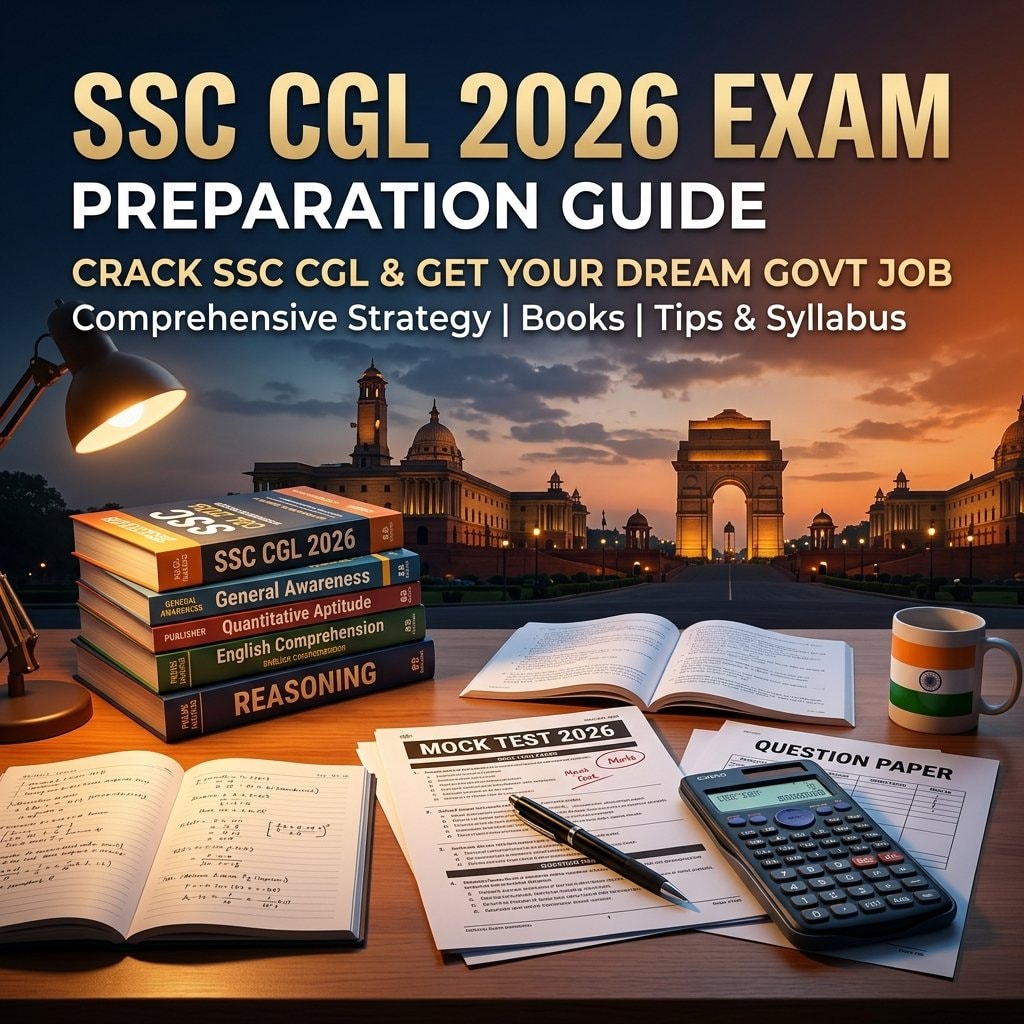
Introduction: Why SSC GD Constable 2026 is a Golden Opportunity
The SSC GD (General Duty) Constable 2026 exam is one of the most highly anticipated recruitments for 10th-pass candidates in India. Organized by the Staff Selection Commission, this exam recruits thousands of dedicated individuals into the Central Armed Police Forces (CAPFs), including BSF, CISF, CRPF, ITBP, SSB, SSF, and the Assam Rifles.
With huge vacancy numbers typically announced every year, SSC GD offers a prestigious uniform job, excellent job security, a respectable salary under the 7th Pay Commission, and the pride of serving the nation. If you have the passion to join the armed police forces, this complete guide will be your roadmap to success.
Quick Navigation: Important Dates | Eligibility & Physical Standards | Exam Pattern | Syllabus | Salary & Forces
Table of Contents
- SSC GD 2026 Important Dates (Tentative)
- Eligibility Criteria & Physical Standards
- Complete Exam Pattern (CBE, PET, PST, Medical)
- Detailed Syllabus for Computer Based Exam
- Force Preference & Salary Structure
- Best Preparation Strategy to Crack SSC GD
- Frequently Asked Questions (FAQs)
1. SSC GD 2026 Important Dates (Tentative)
Staying updated with the timeline is the first step in your preparation. The official notification for SSC GD 2026 is expected to be released in the coming months.
| Event | Expected Timeline | Status |
|---|---|---|
| SSC GD 2026 Official Notification | September - October 2026 | Awaited |
| Start Date for Online Application | October 2026 | Awaited |
| Last Date to Apply Online | November 2026 | Awaited |
| Admit Card Release (CBE) | January 2027 | Awaited |
| Computer Based Examination (CBE) | Feb - March 2027 | Awaited |
| Result of CBE | May 2027 | Awaited |
| PET / PST Dates | July 2027 | Awaited |
| Detailed Medical Examination (DME) | September 2027 | Awaited |
| Final Merit List | December 2027 | Awaited |
Note: The dates above are tentative and based on the standard SSC calendar. Bookmark this page as we will update the exact dates once the official notification is out.
2. Eligibility Criteria & Physical Standards
Before applying for the SSC GD 2026 exam, candidates must ensure they meet the rigorous eligibility criteria set by the Commission. The eligibility depends on three main pillars: educational qualification, age limit, and strict physical parameters.
Educational Qualification
The educational requirement is incredibly accessible, which is why lakhs of students apply every year. You must have passed your 10th Class (Matriculation) Examination from a recognized Board or University before the cut-off date mentioned in the official notification. Candidates awaiting their final 10th results are generally not eligible to apply.
Age Limit Details
- Minimum Age: 18 Years
- Maximum Age: 23 Years Note: Age relaxations are provided as per government norms to ensure fair representation. OBC candidates receive a relaxation of 3 years (up to 26 years), while SC/ST candidates receive a relaxation of 5 years (up to 28 years).
Physical Standard Test (PST) Requirements
Because this is a uniformed defence service under the Ministry of Home Affairs, meeting the exact physical measurements is completely non-negotiable.
For Male Candidates:
- Height: 170 cm (General/OBC/SC) | 162.5 cm for ST candidates.
- Chest: Unexpanded: 80 cm, Minimum expansion: 5 cm | For ST: 76 cm with 5 cm minimum expansion.
For Female Candidates:
- Height: 157 cm (General/OBC/SC) | 150 cm for ST candidates.
- Chest: Chest measurement is not applicable for female candidates.
(Special height relaxations are also applicable for candidates hailing from North-Eastern states, Left Wing Extremism affected districts, and specific hilly regions.)
3. Complete Exam Pattern (CBE, PET, PST, Medical)
The SSC GD Constable selection process is meticulously designed to test both your mental sharpness and physical endurance. It consists of four major stages. You must qualify each stage consecutively to secure your selection.
Stage 1: Computer Based Examination (CBE)
The first and most critical hurdle is the online written exam. According to the recently revised pattern by SSC, the exam now consists of 80 questions carrying a total of 160 marks (2 marks per question). Candidates are given exactly 60 minutes (1 hour) to complete the entire test.
| Subject / Section | Total Questions | Maximum Marks | Time Duration |
|---|---|---|---|
| Part A: General Intelligence & Reasoning | 20 | 40 | Combined |
| Part B: General Knowledge & Awareness | 20 | 40 | 60 Minutes |
| Part C: Elementary Mathematics | 20 | 40 | (1 Hour) |
| Part D: English / Hindi (Optional) | 20 | 40 | |
| Total | 80 Questions | 160 Marks | 60 Mins |
Crucial SEO Note for Aspirants: There is a strict negative marking of 0.50 marks for every incorrect answer. This means blind guessing will severely damage your final score. Accuracy is just as important as speed!
Stage 2: Physical Efficiency Test (PET) - The Running Test
Candidates who successfully clear the CBE cut-off are called for the PET. This stage purely tests your physical stamina, breath control, and running capability.
- For Male Candidates: You must complete a strenuous run of 5 Kilometers within 24 minutes.
- For Female Candidates: You must complete a run of 1.6 Kilometers within 8.5 minutes.
(Note: For candidates belonging to the high-altitude Ladakh Region, the criteria is slightly different: Males need to run 1.6 km in 7 minutes, and females must run 800 meters in 5 minutes.)
Stage 3 & 4: PST and Detailed Medical Examination (DME)
Immediately following the running test, candidates undergo the Physical Standard Test (PST) for exact height and chest measurements. Finally, the shortlisted candidates face the Detailed Medical Examination (DME). In the DME, your eyesight (ideally 6/6 without glasses), hearing, color blindness, and overall physical health are strictly assessed by an official medical board to ensure you are fully fit for demanding armed forces duties.
4. Detailed Syllabus for Computer Based Exam
To score high marks and secure your top-priority force (like SSF or CISF), understanding the exact syllabus is vital. The questions are primarily set at the matriculation (10th Class) level. Here is the highly detailed, topic-wise breakdown:
General Intelligence & Reasoning
This section evaluates your logical thinking, analytical aptitude, and problem-solving skills.
- Analogies (Semantic, Figural, Number)
- Similarities and Differences
- Spatial Visualization & Spatial Orientation
- Visual Memory and Discrimination Observation
- Blood Relations and Relationship Concepts
- Arithmetical Reasoning and Figural Classification
- Arithmetic Number Series & Non-Verbal Series
- Coding and Decoding
General Knowledge and General Awareness
This section requires you to stay updated with recent current events and foundational static GK. Questions are designed to test knowledge of current events without requiring specialized study.
- Current Affairs (National & International, Sports, Awards, Summits)
- History of India and neighboring countries
- Indian Geography and Culture
- Economic Scene and Five Year Plans
- General Polity and Indian Constitution
- Scientific Research and General Science (Physics, Chemistry, Biology up to 10th standard)
Elementary Mathematics
Accuracy and quick calculation speed are key here. Consistent practice is required to master these topics.
- Number Systems (Computation of Whole Numbers, Decimals, Fractions)
- Fundamental Arithmetical Operations (BODMAS)
- Percentages, Ratio and Proportion
- Averages, Interest (Simple & Compound)
- Profit and Loss, Discount
- Mensuration (Basic 2D and 3D shapes area and volume)
- Time and Distance, Ratio and Time, Time and Work
English / Hindi Language
Candidates can choose to attempt EITHER the English OR the Hindi section. This part tests basic comprehension, grammar, and vocabulary skills.
- English: Spot the Error, Fill in the Blanks, Synonyms/Homonyms, Antonyms, Spellings, Idioms & Phrases, One Word Substitution, Improvement of Sentences, Comprehension Passage.
- Hindi: Sandhi (Word Joining Rules), Samas (Compound Words), Paryayvachi Shabd (Synonyms), Muhavare aur Lokoktiyan (Idioms & Proverbs), Sentence Correction, Gadyansh (Reading Comprehension).
5. SSC GD Salary Structure & Force Preference
SSC GD Constable is a highly respected and well-paying central government job with excellent perks, medical facilities, and allowances under the 7th Pay Commission.
In-Hand Salary & Pay Scale
- Pay Level: Pay Level-3 (except for Sepoy in NCB, which is Level-1).
- Basic Pay: ₹21,700 to ₹69,100.
- In-Hand Salary: Approximately ₹28,000 to ₹32,000 per month (depending on the posting location and allowances like HRA, DA, Travel Allowance, and Risk Allowance). (Note: Forces deployed in high-risk or high-altitude areas like CRPF or ITBP receive additional Risk/Hardship allowances, which significantly increases the monthly salary.)
Force Preference List (Which Force is Best?)
While filling out the SSC GD 2026 application form, candidates must carefully select their force preference. Once chosen, it cannot be changed. Here is a highly recommended preference order based on duty profile, location, and risk level:
- SSF (Secretariat Security Force): Best for a peaceful family life, posting is mostly in Delhi.
- CISF (Central Industrial Security Force): Excellent postings at airports, metros, and major industrial sites.
- SSB (Sashastra Seema Bal): Indo-Nepal and Indo-Bhutan border (relatively peaceful).
- ITBP (Indo-Tibetan Border Police): Mountainous terrain (great allowances and adventurous duty).
- Assam Rifles (AR): Excellent for those wanting an army-like lifestyle and perks in the North-East.
- BSF (Border Security Force): Tough but proud duty on the Indo-Pak and Indo-Bangladesh borders.
- CRPF (Central Reserve Police Force): Highly active duty, including anti-Naxal and riot control operations.
6. Proven Preparation Strategy for SSC GD
If you want to clear the SSC GD 2026 exam on your first attempt, you need a highly disciplined approach combining mental and physical preparation.
- Master the Basics: Start by clearing your core concepts in Mathematics and Reasoning from 10th-level NCERT books or standard competition books like R.S. Aggarwal.
- Daily Mock Tests: Attempt at least 2 full-length mock tests per week. Analyze your mistakes to improve accuracy and avoid the trap of negative marking.
- Current Affairs: Read a daily newspaper or follow monthly current affairs magazines specifically tailored for SSC and defense exams.
- Physical Fitness (Start Early): Do not wait for the written exam results to start running. Practice running 5 KM (males) or 1.6 KM (females) at least 3-4 days a week to build stamina gradually.
- Previous Year Papers: SSC is known to repeat question patterns. Solve at least the last 5 years' SSC GD question papers to understand the trend.
7. Best Books for SSC GD 2026 Preparation
Choosing the right study material is half the battle won. To rank high in the merit list, relying on standard books is crucial. Here is a carefully curated list of highly recommended books by previous toppers:
For Mathematics (Quantitative Aptitude)
- Quantitative Aptitude for Competitive Examinations by R.S. Aggarwal (Excellent for clearing basic concepts).
- Fast Track Objective Arithmetic by Rajesh Verma (Arihant Publications - Best for short tricks).
- SSC Mathematics Chapter-wise Solved Papers by Kiran Publications (For extensive previous year practice).
For General Intelligence & Reasoning
- A Modern Approach to Verbal & Non-Verbal Reasoning by R.S. Aggarwal.
- Lucent’s Reasoning by Bhupendra Kumar Singh.
- Kiran’s SSC Reasoning Chapter-wise Solved Papers (To understand the exact exam pattern).
For General Knowledge & General Awareness
- Lucent’s General Knowledge (The ultimate guide for static GK like History, Geography, and Science).
- Manorama Yearbook (For a comprehensive overview of the year's events).
- Pratiyogita Darpan monthly magazine (For current affairs).
For English/Hindi Language
- Objective General English by S.P. Bakshi (Arihant - Highly recommended for Grammar and Vocabulary).
- Lucent’s Sampurna Hindi Vyakaran (For candidates opting for the Hindi section).
8. Detailed Medical Examination (DME) Crucial Points
The medical test for SSC GD is extremely stringent as it is a defense job. Candidates must keep the following points in mind to avoid rejection at the final stage:
- Tattoos: Tattoos depicting religious symbols or names (as followed in the Indian Army) are permitted only on the inner aspect of the forearm (usually the left arm, which is non-saluting) and must be less than 1/4th of the particular body part.
- Vision Standards: Visual acuity unaided (Near Vision) should be N6/N9 and (Distant Vision) should be 6/6 and 6/9 for both eyes. Color blindness is a strict ground for permanent rejection.
- Physical Deformities: Issues like flat foot, knock knees, bow legs, squint in eyes, or swollen veins (varicose veins) will lead to immediate disqualification.
(Expert Tip: Get a pre-medical checkup done by a certified doctor 2-3 months before the actual DME. This will help you fix minor, curable issues like ear wax, dental cavities, or slight overweight/underweight problems.)
9. Document Verification (DV) Checklist
Candidates who clear the PST/PET must produce original documents during the DV stage. Without proper documents, even toppers are rejected. Ensure you have the following ready well in advance:
- Matriculation (10th) Certificate & Marksheet: Essential for proof of age and educational qualification.
- Domicile/Permanent Resident Certificate (PRC): Issued by the competent authority of your state. State-wise vacancies depend heavily on this.
- Caste Certificate: SC/ST/OBC/EWS certificate must be strictly in the prescribed central government format.
- NCC Certificate: If applicable. (NCC 'C' certificate holders get 5% bonus marks, 'B' gets 3%, and 'A' gets 2% of the maximum marks).
- Valid Photo ID Proof: Aadhaar Card, Voter ID, PAN Card, or Driving License.
10. State-Wise Vacancy & Cut-Off Trends
The SSC GD Constable exam is highly unique because its vacancies are distributed state-wise and category-wise. Additionally, there are special reservations for candidates belonging to Naxal-affected districts and Border districts.
- High Cut-Off States (Red Zone): Uttar Pradesh, Bihar, Haryana, Rajasthan, and Madhya Pradesh generally witness the most fierce competition. General category candidates from these states usually need to score well above 120-130+ (out of 160) to secure a top-priority force like SSF or CISF.
- Moderate Cut-Off States: Delhi, Uttarakhand, Jharkhand, Himachal Pradesh, and Maharashtra typically fall in the mid-range.
- Lower Cut-Off States (Green Zone): North-Eastern states, Gujarat, Jammu & Kashmir, and Southern Indian states usually have a comparatively lower cut-off due to either fewer applicants or a higher number of border/naxal reserved seats.
(Pro Tip for Aspirants: Never fill out a fake address or domicile just to take advantage of a lower cut-off state. Very strict verification happens during the Document Verification (DV) stage, and any mismatch will lead to a lifetime ban from all future SSC exams.)
11. Career Growth and Promotions in SSC GD
Joining as a General Duty Constable is just the beginning of a highly promising and secure career in the paramilitary forces. With dedication, physical fitness, and by clearing departmental exams, candidates can rise to high-ranking officer levels. The standard promotion hierarchy is:
- Constable to Senior Constable: Usually takes about 8 to 10 years of regular, unblemished service.
- Head Constable: Achieved either through seniority or much faster by passing internal Limited Departmental Competitive Examinations (LDCE).
- Assistant Sub Inspector (ASI): Promoted after successfully serving as a Head Constable.
- Sub Inspector (SI): A highly respected gazetted/non-gazetted officer rank.
- Inspector: Often the highest rank reachable for those who join at the Constable level, usually achieved in the later stages of their career.
12. Step-by-Step Guide: How to Apply Online for SSC GD 2026
The application process is conducted strictly online through the newly updated official SSC portal (ssc.gov.in).
- One-Time Registration (OTR): If you are a new user, complete your OTR on the SSC website using your Aadhaar Card, active mobile number, and email ID.
- Login: Log in using your generated Registration Number and Password.
- Locate the Exam: Click on the "Apply" link under the "Constable (GD) in CAPFs" recruitment section.
- Fill Application Details: Carefully select your preferred exam centers. Most Importantly, fill in your Force Preference using the alphabetical codes (e.g., A for BSF, B for CISF, etc.).
- Upload Documents: Upload your photograph (following SSC's strict new rules) and a clear scanned signature.
- Fee Payment: Pay the nominal application fee of ₹100/- via UPI, Net Banking, or Challan. (Note: Women, SC, ST, and Ex-Servicemen are completely exempted from fee payment).
- Final Printout: Submit the form and securely save/print the final application PDF for future reference (especially for the Document Verification stage).
13. Top Mistakes to Avoid During Application Filling
Every year, lakhs of forms face outright rejection by SSC due to silly, avoidable mistakes. Please be extremely careful regarding:
- Photograph Issues (Most Common Reason for Rejection): SSC requires a clear, recent photograph. Do NOT wear spectacles/glasses, caps, or masks while taking the photo. Both ears must be visible, and the background should ideally be plain white or light-colored.
- Blurry Signature: Ensure your signature is clearly legible and strictly within the specified dimensions (10-20 KB, JPEG format).
- Careless Force Preference: Once the form is submitted, SSC does not allow any changes to your force preference. Research well before filling out the alphabetical codes.
- Name & DOB Mismatch: Your Name, Father's Name, Mother's Name, and Date of Birth must exactly match the spellings written on your 10th-grade (Matriculation) certificate.
14. SSC GD Normalization Process Explained
Since the SSC GD Computer Based Exam is conducted over multiple days and in various shifts, the difficulty level of question papers naturally varies. To ensure absolute fairness among all candidates, SSC uses a scientific Normalization Formula.
- If your shift was extremely difficult compared to the average, your raw score will be increased (normalized score) significantly.
- If your shift was relatively easy, your score might increase marginally or remain roughly the same. (Expert Tip: Focus purely on accuracy. Candidates with higher accuracy in tough shifts tend to gain the maximum benefit during the normalization process. Avoid wild guessing!)
15. NCC Certificate Bonus Marks Structure
To encourage youth participation in the defense sectors, the Ministry of Home Affairs provides special bonus marks to National Cadet Corps (NCC) certificate holders in the SSC GD exam. These marks are added directly to the normalized scores:
- NCC 'C' Certificate: 5% of the maximum marks of the examination (i.e., 8 Marks bonus).
- NCC 'B' Certificate: 3% of the maximum marks of the examination (i.e., 4.8 Marks bonus).
- NCC 'A' Certificate: 2% of the maximum marks of the examination (i.e., 3.2 Marks bonus). (Note: You must possess the valid original certificate on the crucial date and present it during the Document Verification stage to claim these bonus marks.)
16. Naxal/Border District Special Reservations
A huge strategic advantage of the SSC GD exam is the targeted allocation of vacancies to specific regions to promote local employment, security, and peace.
- Border Guarding Districts: Candidates holding a valid domicile of districts sharing international borders get exclusive reservations for forces like BSF, SSB, and ITBP that are deployed on those respective borders.
- Naxal/Militancy Affected Districts: Similar to border districts, a specific quota of vacancies in forces like CRPF is reserved exclusively for candidates belonging to these Left Wing Extremism (LWE) affected regions. (Ensure your domicile certificate exactly mentions your district as per the official SSC Annexure list to claim this massive benefit. Producing a fake domicile is a criminal offense.)
Frequently Asked Questions (FAQs)
Q1. Is there any negative marking in SSC GD 2026? Yes, there is a strict negative marking of 0.50 marks for every wrong answer. Guessing blindly should be completely avoided.
Q2. Can final-year 10th students apply for SSC GD? No, you must possess your final 10th passing certificate and mark sheet before the crucial cut-off date mentioned in the official notification.
Q3. Which force gives the highest salary in SSC GD? While the basic pay (Pay Level 3) is exactly the same for all forces, personnel posted in high-risk or extreme-weather areas like ITBP (High Altitude) or CRPF (Naxal areas) receive substantial risk and hardship allowances, making their gross in-hand salary significantly higher.
Q4. Can I choose to take the exam in Hindi? Yes, the Computer Based Exam is completely bilingual. You can attempt the entire paper (except the language section) in Hindi or English. Additionally, regional languages are also being introduced for the CBE to help local candidates.
Bookmark this page for the latest updates, admit cards, and official notifications regarding SSC GD Constable 2026!