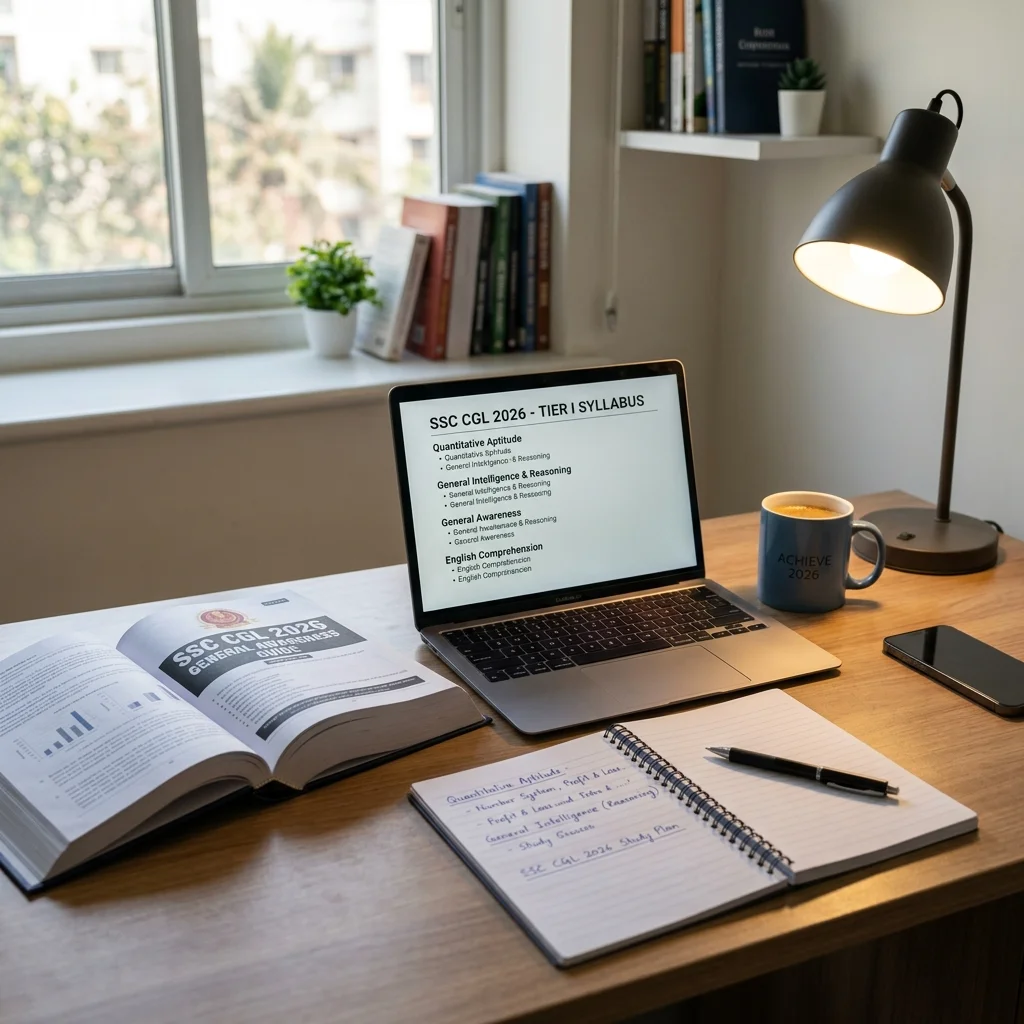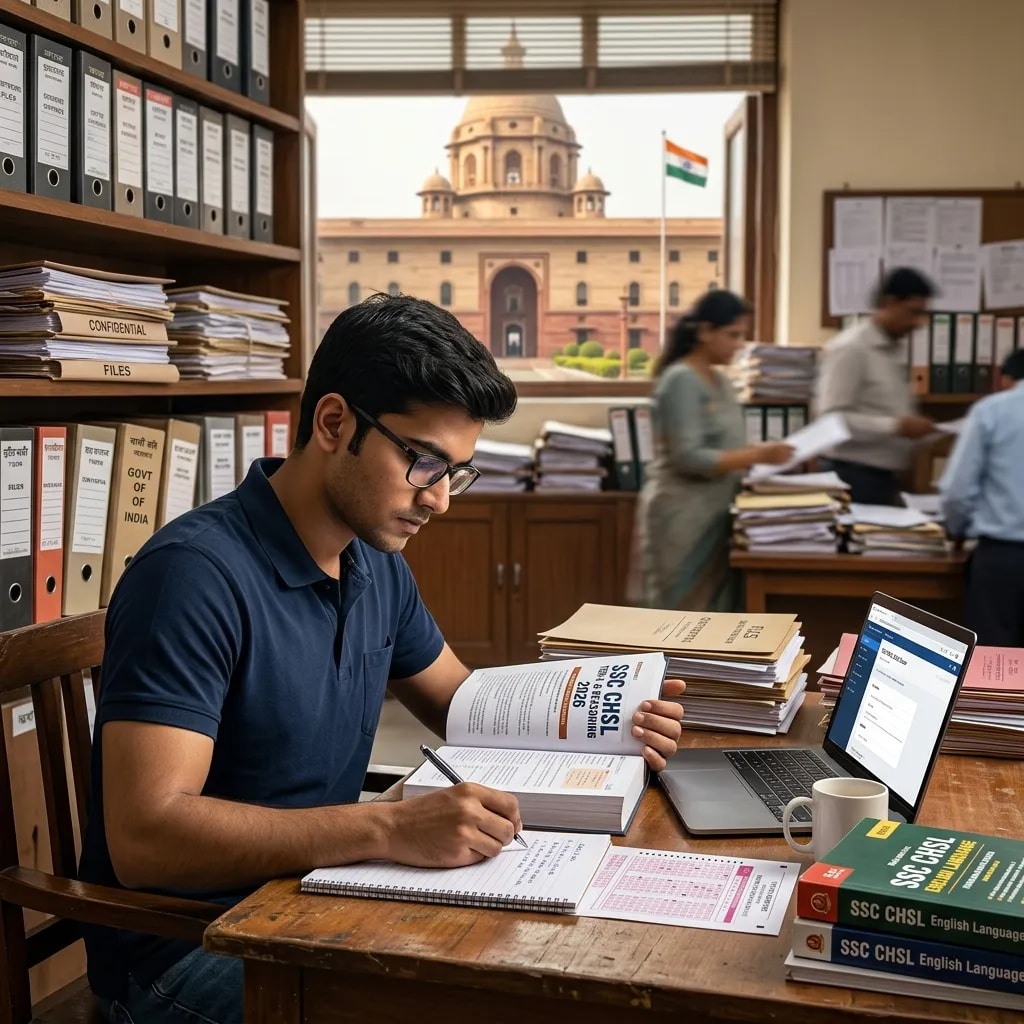
Introduction: Your Gateway to Central Government Jobs After 12th
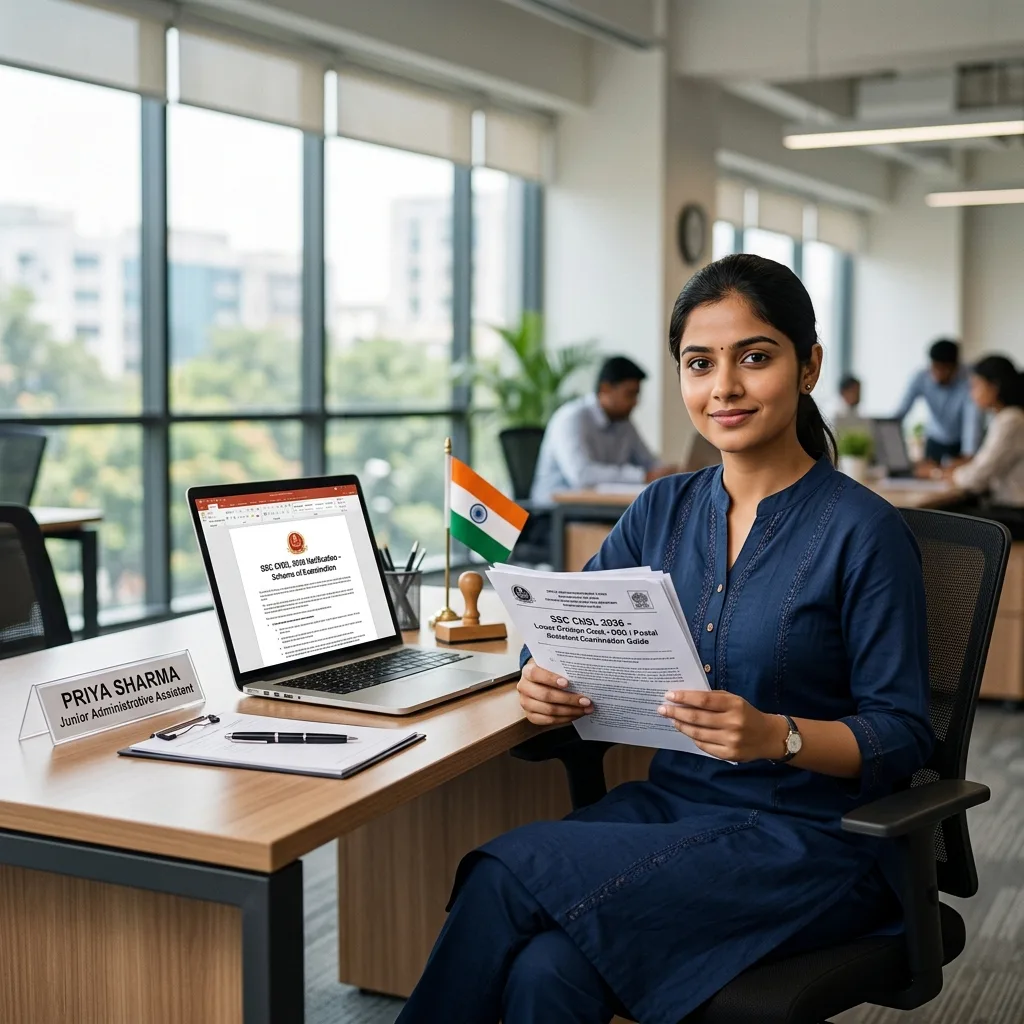
SSC CHSL (Combined Higher Secondary Level) 2026 is the perfect opportunity for 12th pass candidates to secure prestigious Central Government jobs in various ministries and departments. With approximately 4,500-5,000 vacancies and over 40 lakh applicants, strategic preparation is your key to success.
Quick Navigation: Exam Pattern | Syllabus | Preparation Strategy | Typing Test | Salary | Job Profiles | FAQs
Why Choose SSC CHSL?
Career Benefits:
- Job Security: Permanent Central Government position
- Attractive Salary: ₹19,900 to ₹63,200 (Pay Level 2-4)
- Career Growth: Regular promotions and increments
- Work-Life Balance: Fixed office hours (9 AM - 5:30 PM)
- Prestige: Respected government position
- Benefits: DA, HRA, TA, Medical, Pension, LTC
- Job Locations: Pan-India posting opportunities
Popular Posts:
- LDC (Lower Division Clerk) - Pay Level 2
- DEO (Data Entry Operator) - Pay Level 4
- PA (Postal Assistant) - Pay Level 4
- SA (Sorting Assistant) - Pay Level 4
SSC CHSL 2026 Statistics
- Total Vacancies: 4,500-5,000 (expected)
- Total Applications: 40+ lakh candidates
- Selection Rate: 0.1-0.12%
- Average Attempts: 2-3 attempts for success
- Preparation Time: 4-6 months recommended
SSC CHSL 2026 Important Dates
| Event | Expected Date 2026 | Status |
|---|---|---|
| Official Notification | May 2026 | Awaited |
| Online Application Start | May 2026 | Awaited |
| Last Date to Apply | June 2026 | Awaited |
| Tier-I Admit Card | July 2026 | Awaited |
| Tier-I Exam Date | August 2026 | Awaited |
| Tier-I Result | September 2026 | Awaited |
| Tier-II Exam Date | October 2026 | Awaited |
| Tier-II Result | November 2026 | Awaited |
| Tier-III Typing Test | December 2026 | Awaited |
| Final Result | January 2027 | Awaited |
Official Website: https://ssc.nic.in/
Eligibility Criteria
Educational Qualification
Minimum Requirement:
- 12th Pass (10+2) from recognized board
- Any stream accepted (Science, Commerce, Arts)
- Percentage: No minimum percentage required
- Distance/Open Board: Recognized boards accepted
Age Limit (As on August 1, 2026)
| Category | Minimum Age | Maximum Age |
|---|---|---|
| General/EWS | 18 years | 27 years |
| OBC | 18 years | 30 years |
| SC/ST | 18 years | 32 years |
| PwD (General) | 18 years | 37 years |
| PwD (OBC) | 18 years | 40 years |
| PwD (SC/ST) | 18 years | 42 years |
| Ex-Servicemen | 18 years | 32 years |
Nationality
- Indian citizen, OR
- Subject of Nepal/Bhutan, OR
- Tibetan refugee (came before Jan 1, 1962), OR
- Person of Indian origin from specified countries
SSC CHSL 2026 Exam Pattern
Tier-I: Computer Based Examination (Objective)
Exam Mode: Online (Computer-based)
Duration: 60 minutes (80 minutes for PwD with scribe)
Total Questions: 100 MCQs
Total Marks: 200 marks
Negative Marking: 0.50 marks for each wrong answer
Qualifying Nature: Yes (marks counted for final merit)
Section-wise Distribution
| Section | Questions | Marks | Topics |
|---|---|---|---|
| English Language | 25 | 50 | Grammar, Vocabulary, Comprehension |
| General Intelligence | 25 | 50 | Reasoning, Logical Ability |
| Quantitative Aptitude | 25 | 50 | Mathematics (Class 10 level) |
| General Awareness | 25 | 50 | Current Affairs, Static GK |
| Total | 100 | 200 | - |
Important Points:
- Each question carries 2 marks
- 0.50 marks deducted for wrong answer
- Questions in English and Hindi (except English section)
- Normalization applied if multiple shifts
- Marks counted for final merit
Tier-I Cutoff Trends (General Category):
- LDC: 140-150 marks out of 200
- DEO/PA/SA: 150-160 marks out of 200
Tier-II: Descriptive Paper (Pen & Paper Mode)
Exam Mode: Offline (Pen & Paper)
Duration: 60 minutes (80 minutes for PwD with scribe)
Total Marks: 100 marks
Qualifying Nature: Yes (minimum 33% required)
Language: English or Hindi (candidate's choice)
Paper Structure
| Component | Marks | Word Limit | Purpose |
|---|---|---|---|
| Essay Writing | 60 marks | 200-250 words | Test writing skills |
| Letter/Application | 40 marks | 150-200 words | Test formal writing |
| Total | 100 marks | - | Qualifying only |
Evaluation Criteria:
- Content quality and relevance
- Grammar and vocabulary
- Sentence structure
- Presentation and handwriting
- Adherence to word limit
Important Points:
- Must score minimum 33 marks to qualify
- Marks NOT counted for final merit
- Can write in English or Hindi
- Good handwriting matters
- Practice is essential
Tier-III: Skill Test/Typing Test (Qualifying)
Nature: Qualifying only (Pass/Fail)
Conducted for specific posts
Typing Test (For LDC, PA, SA)
English Typing:
- Speed Required: 35 words per minute
- Duration: 10 minutes
- Test Type: English typing on computer
Hindi Typing:
- Speed Required: 30 words per minute
- Duration: 10 minutes
- Test Type: Hindi typing on computer
Calculation Method:
Net Speed = (Total words typed - Errors) / Time in minutes
Data Entry Speed Test (For DEO)
Speed Required: 8,000 key depressions per hour
Duration: 15 minutes
Test Type: Data entry on computer
Passage: English typing
Important Points:
- Only qualifying in nature
- Must qualify to be considered for final selection
- Can practice on SSC website
- Accuracy is important
- Speed comes with practice
Complete Syllabus
English Language (25 Questions, 50 Marks)
Vocabulary (8-10 questions):
- Synonyms and Antonyms
- One Word Substitution
- Idioms and Phrases
- Phrasal Verbs
- Spelling Correction
Grammar (10-12 questions):
- Error Spotting
- Sentence Improvement
- Fill in the Blanks
- Active-Passive Voice
- Direct-Indirect Speech
- Parts of Speech
- Tenses
Reading Comprehension (5-7 questions):
- Passage-based questions
- Main idea and theme
- Inference questions
- Vocabulary in context
Preparation Strategy:
- Read English newspapers daily
- Learn 20 new words daily
- Practice grammar rules
- Solve previous year questions
- Focus on accuracy
General Intelligence & Reasoning (25 Questions, 50 Marks)
Verbal Reasoning (12-15 questions):
- Analogies
- Classification
- Series Completion
- Coding-Decoding
- Blood Relations
- Direction Sense
- Ranking and Arrangement
- Syllogism
- Statement and Conclusions
Non-Verbal Reasoning (5-7 questions):
- Figure Classification
- Figure Series
- Figure Analogy
- Paper Folding
- Mirror Images
- Embedded Figures
Analytical Reasoning (5-8 questions):
- Seating Arrangement
- Puzzle Test
- Input-Output
- Data Sufficiency
Preparation Strategy:
- Practice 50+ questions daily
- Learn shortcut techniques
- Focus on speed and accuracy
- Solve previous year papers
- Time yourself
Quantitative Aptitude (25 Questions, 50 Marks)
Number System (3-4 questions):
- HCF and LCM
- Divisibility Rules
- Factors and Multiples
- Prime Numbers
Simplification (4-5 questions):
- BODMAS Rule
- Fractions and Decimals
- Square Roots
- Surds and Indices
Arithmetic (12-15 questions):
- Percentage
- Ratio and Proportion
- Average
- Profit and Loss
- Simple and Compound Interest
- Time and Work
- Time, Speed and Distance
- Mixture and Alligation
Algebra (2-3 questions):
- Linear Equations
- Quadratic Equations
Geometry (2-3 questions):
- Triangles
- Circles
- Lines and Angles
Mensuration (2-3 questions):
- Area and Perimeter
- Volume and Surface Area
Preparation Strategy:
- Learn all formulas
- Practice mental calculations
- Solve 50+ questions daily
- Focus on accuracy first
- Learn Vedic Math tricks
General Awareness (25 Questions, 50 Marks)
Current Affairs (10-12 questions):
- National and international events (last 6 months)
- Government schemes
- Important days
- Awards and honors
- Sports events
- Books and authors
- Appointments
Static General Knowledge (13-15 questions):
Indian History:
- Ancient, Medieval, Modern India
- Freedom Struggle
- Important movements
Indian Geography:
- Physical features
- States and capitals
- Rivers and mountains
- Climate
Indian Polity:
- Constitution basics
- Fundamental Rights
- Government structure
Indian Economy:
- Economic terms
- Budget basics
- Banking system
General Science:
- Physics, Chemistry, Biology basics
- Scientific discoveries
- Environmental science
Miscellaneous:
- Indian culture
- Famous personalities
- Countries and capitals
Preparation Strategy:
- Read newspaper daily
- Make monthly current affairs notes
- Revise static GK regularly
- Solve daily GK quizzes
- Focus on last 6 months
Preparation Strategy
5-Month Preparation Plan
Month 1: Foundation Building
Goals:
- Complete basic concepts
- Understand exam pattern
- Start newspaper reading
- Build foundation
Daily Schedule (6-8 hours):
- Morning (2 hours): Quantitative Aptitude
- Afternoon (1.5 hours): Newspaper + Current Affairs
- Evening (2 hours): Reasoning
- Night (1.5 hours): English + General Awareness
Weekly Tasks:
- Complete 2-3 chapters per subject
- Solve 1 previous year paper (sectional)
- Make formula notes
- Take 1 sectional test
Month 2-3: Advanced Preparation
Goals:
- Complete entire syllabus
- Improve speed and accuracy
- Start mock tests
- Focus on weak areas
Daily Schedule (8-10 hours):
- Morning (2.5 hours): Quant (50 questions)
- Afternoon (2 hours): General Awareness + Current Affairs
- Evening (2.5 hours): Reasoning (50 questions)
- Night (2 hours): English + Revision
Weekly Tasks:
- Solve 2 previous year papers
- Take 2 sectional tests
- Take 1 full-length mock test
- Update current affairs notes
Month 4: Intensive Practice
Goals:
- Master time management
- Achieve 90%+ accuracy
- Attempt maximum mock tests
- Perfect exam strategy
Daily Schedule (10-12 hours):
- Morning: Mock test (1 hour)
- Analysis: 2 hours
- Practice: 4 hours (weak areas)
- Current Affairs: 2 hours
- Revision: 2 hours
Weekly Tasks:
- Attempt 5-6 mock tests
- Solve 3-4 previous year papers
- Revise all formulas daily
- Update current affairs
Month 5: Final Revision + Tier-II Preparation
Goals:
- Quick revision
- Essay and letter writing practice
- Typing test practice
- Stay confident
Daily Schedule (8-10 hours):
- Morning: Mock test + Analysis (3 hours)
- Afternoon: Essay writing practice (2 hours)
- Evening: Revision (3 hours)
- Night: Typing practice (1 hour)
Last Week:
- Light revision only
- 1 mock test daily
- Current affairs focus
- Typing practice
- Stay calm
Typing Test Preparation
English Typing Preparation
Target Speed: 35 words per minute
Practice Duration: 30-45 days
Week 1-2: Finger Placement
- Learn home row keys (ASDF JKL;)
- Practice finger positioning
- Type without looking at keyboard
- Speed: 10-15 WPM
Week 3-4: Speed Building
- Practice common words
- Type sentences
- Increase speed gradually
- Speed: 20-25 WPM
Week 5-6: Accuracy & Speed
- Practice paragraphs
- Focus on accuracy
- Time yourself
- Speed: 30-35 WPM
Week 7+: Final Practice
- Practice SSC passages
- Maintain 35+ WPM
- Reduce errors
- Build confidence
Best Typing Software:
- Typing Master
- Rapid Typing
- KeyBlaze
- Online typing tests
Tips:
- Practice daily (1 hour minimum)
- Don't look at keyboard
- Maintain proper posture
- Focus on accuracy first
- Speed will come automatically
Hindi Typing Preparation
Target Speed: 30 words per minute
Practice Duration: 30-45 days
Similar approach as English:
- Learn Mangal/Kruti Dev font
- Practice finger positioning
- Build speed gradually
- Focus on accuracy
Salary and Benefits
Pay Level Structure
| Post | Pay Level | Basic Pay | Gross Salary | In-Hand |
|---|---|---|---|---|
| LDC (Lower Division Clerk) | Level 2 | ₹19,900 | ₹35,000 | ₹28,000 |
| JSA (Junior Secretariat Assistant) | Level 3 | ₹21,700 | ₹38,000 | ₹30,000 |
| PA (Postal Assistant) | Level 4 | ₹25,500 | ₹44,000 | ₹35,000 |
| SA (Sorting Assistant) | Level 4 | ₹25,500 | ₹44,000 | ₹35,000 |
| DEO (Data Entry Operator) | Level 4 | ₹25,500 | ₹44,000 | ₹35,000 |
Additional Benefits
Allowances:
- Dearness Allowance (DA): 40%+ of basic
- House Rent Allowance (HRA): 8-24% of basic
- Transport Allowance (TA): As per rules
- City Compensatory Allowance (CCA)
Perquisites:
- Medical facilities for self and family
- Leave Travel Concession (LTC)
- Pension scheme
- Provident Fund
- Gratuity
- Leave encashment
Annual CTC: ₹4-5 lakh (including all benefits)
Job Profiles
1. Lower Division Clerk (LDC)
Responsibilities:
- File management
- Data entry
- Record maintenance
- Office correspondence
- Assisting senior officers
Work Environment: Central Government offices
Pay Level: 2
Career Growth: Promotion to UDC (Upper Division Clerk)
2. Data Entry Operator (DEO)
Responsibilities:
- Data entry in computer systems
- Database maintenance
- Report generation
- Data verification
- Computer operations
Work Environment: Various ministries
Pay Level: 4
Career Growth: Promotion to Senior DEO
3. Postal Assistant (PA)
Responsibilities:
- Mail sorting and delivery
- Counter operations
- Customer service
- Money order processing
- Savings account operations
Work Environment: Post offices
Pay Level: 4
Career Growth: Promotion to Postmaster
4. Sorting Assistant (SA)
Responsibilities:
- Mail sorting
- Parcel handling
- Address verification
- Mail dispatch
- Record keeping
Work Environment: Sorting offices
Pay Level: 4
Career Growth: Promotion to Senior SA
Recommended Books
English Language
- SP Bakshi: Objective English
- Wren & Martin: English Grammar
- Norman Lewis: Word Power Made Easy
- Arihant: English for SSC
Reasoning
- R.S. Aggarwal: Reasoning
- Kiran: SSC Reasoning
- Rakesh Yadav: Reasoning Class Notes
Quantitative Aptitude
- R.S. Aggarwal: Quantitative Aptitude
- Rakesh Yadav: Mathematics Class Notes
- Kiran: SSC Mathematics
General Awareness
- Lucent's General Knowledge
- Arihant: General Awareness
- Pratiyogita Darpan (Monthly)
- SSC Adda Current Affairs
Previous Year Papers
- Kiran: SSC CHSL Previous Papers (Last 10 Years)
- Arihant: SSC CHSL Solved Papers
Mock Test Strategy
Timeline:
- Month 2: 1 mock test per week
- Month 3: 2 mock tests per week
- Month 4: 4-5 mock tests per week
- Month 5: 5-6 mock tests per week
After Each Mock:
- Analyze all questions
- Identify weak areas
- Note silly mistakes
- Revise concepts
- Improve strategy
Best Mock Test Series:
- Adda247 SSC Test Series
- Testbook SSC CHSL
- Oliveboard SSC
- Gradeup SSC
- Previous year papers
Success Tips
- Consistency: Study daily without long breaks
- Practice: Solve 100+ questions daily
- Mock Tests: Attempt regularly from Month 2
- Current Affairs: Read newspaper daily
- Revision: Multiple revisions crucial
- Typing Practice: Start early (1 hour daily)
- Time Management: Practice sectional timing
- Stay Healthy: Exercise and proper sleep
- Stay Motivated: Keep your goal in sight
- Learn from Mistakes: Analyze every error
Frequently Asked Questions
Q1: Can I crack SSC CHSL in first attempt?
Answer: Yes! With 5-6 months of dedicated preparation, proper strategy, and regular practice, first attempt success is definitely possible. Many candidates clear in their first attempt.
Q2: Is coaching necessary for SSC CHSL?
Answer: Not mandatory. Self-study with good books and online resources is sufficient. However, joining a test series for mock tests and answer evaluation is recommended.
Q3: How many hours should I study daily?
Answer:
- Beginners: 6-8 hours
- Serious Preparation: 8-10 hours
- Last Month: 10-12 hours
Quality matters more than quantity. Focus on effective study.
Q4: Which section is most scoring?
Answer: All sections are equally important. However:
- Reasoning: Can be mastered with practice
- Quant: Scoring if you know formulas
- English: Improves with daily reading
- GK: Easy if you follow current affairs
Focus equally on all sections.
Q5: How important is typing test?
Answer: Very important! It's qualifying in nature. If you don't qualify typing test, you won't get the job even if you clear Tier-I and Tier-II. Start practicing early.
Q6: Can I prepare while studying/working?
Answer: Yes, but challenging. You need:
- Strong time management
- 4-5 hours daily study
- Weekend intensive study
- May take 6-8 months
- Dedication and consistency
Q7: What is the success rate?
Answer:
- Total applicants: 40+ lakh
- Tier-I qualified: ~2-3 lakh (5-7%)
- Tier-II qualified: ~50,000 (0.12%)
- Final selection: ~4,500-5,000 (0.1%)
Success rate is low, but achievable with proper preparation!
Q8: Which post is best - LDC, DEO, PA, or SA?
Answer:
- LDC: Good work-life balance, office work
- DEO: Computer-based work, good salary (Level 4)
- PA: Post office work, customer interaction, good salary
- SA: Sorting work, less customer interaction
Choose based on your interest and preference.
Q9: Is there negative marking in Tier-II?
Answer: No! Tier-II (Descriptive Paper) has no negative marking. However, you must score minimum 33% to qualify.
Q10: What after selection?
Answer: After final selection:
- Document verification
- Medical examination
- Joining formalities
- Training period (if applicable)
- Posting to respective department
- Probation period (usually 2 years)
- Confirmation as permanent employee
Conclusion
SSC CHSL 2026 is your golden opportunity to secure a prestigious Central Government job right after 12th. With proper strategy, consistent effort, and dedicated preparation, you can achieve your dream!
Key Success Mantras:
- Start early, stay consistent
- Practice daily without fail
- Mock tests are crucial
- Master typing test
- Current affairs is important
- Revision is the key
- Stay healthy and motivated
- Learn from mistakes
- Time management matters
- Believe in yourself!
Final Words:
The journey to becoming an LDC, DEO, PA, or SA is challenging but rewarding. You'll have job security, good salary, career growth, and the pride of serving the nation. Start your preparation today with determination!
All the best for SSC CHSL 2026! 🇮🇳
Stay Updated:
Share This Guide: Help your friends preparing for SSC CHSL 2026!
Disclaimer: This guide is based on previous years' patterns and expert analysis. Always refer to the official SSC notification for accurate and updated information.